
Request Free Sample ×

Kindly complete the form below to receive a free sample of this Report

* Please use a valid business email

Leading companies partner with us for data-driven Insights

clients tt-cursor
Hero Background
English
Chinese
French
Japanese
Korean
German
Spanish

Travel Tourism Market Share

ID: MRFR/CG/10906-HCR
128 Pages
Pradeep Nandi
March 2026

Travel and Tourism Market Size, Share, Industry Trend & Analysis Research Report Information By Type (Leisure, Educational, Business, Sports, Medical Tourism, and Others (Event Travel, Volunteer Travel, etc.)), By Application (Domestic, and International), By Traveler Type (Solo Traveler, Couple Traveler, and Group Traveler), By Travel Days (Less than 7 Days, 8- 15 Days, 16-30 Days, and More than 30 Days), By Travel Mode (Travel Packages, and Self-catered), By Booking (Online, and Offline), And By Region (North America, Europe, Asia-Pacific, And Rest Of The World) – Forecast Till 2035

Share:
Download PDF ×

We do not share your information with anyone. However, we may send you emails based on your report interest from time to time. You may contact us at any time to opt-out.

Travel Tourism Market Infographic
Purchase Options

Market Share

Travel Tourism Market Share Analysis

In the United States, market share positioning strategies are essential for businesses aiming to differentiate themselves and capture a significant portion of the market. Several key strategies have emerged as crucial for success in this dynamic sector. One primary market share positioning strategy focuses on sustainability and responsible tourism. With the increasing awareness of environmental issues, travelers prefer destinations and businesses that prioritize sustainable practices. Companies in the travel and tourism sector that implement eco-friendly initiatives, such as reducing carbon footprints, supporting local conservation efforts, and promoting responsible tourism practices, position themselves favorably in the eyes of environmentally conscious consumers. By aligning with the values of sustainability, businesses not only attract a growing segment of eco-conscious travelers and contribute to the long-term health of the industry and the destinations they serve. Digitalization is a transformative force in the travel and tourism market, and businesses that leverage technology effectively can enhance their market share positioning. Collaborations and partnerships play a strategic role in market share positioning within the travel and tourism industry. Collaborating with other businesses, local communities, or even influencers can create unique and attractive travel offerings. Strategic alliances can lead to exclusive packages, joint marketing efforts, and expanded reach. Diversification of offerings is another effective market share positioning strategy. Businesses that provide a wide array of travel services, such as accommodation, transportation, and tour packages, can cater to travelers' diverse needs and preferences. Offering a comprehensive range of services under one brand umbrella creates a one-stop-shop experience, making it convenient for travelers to plan and book their entire trip with a single provider. This strategy enhances customer loyalty and positions a brand as a versatile and reliable choice in the competitive market. Customer experience and personalized services are critical in market share positioning within the travel and tourism industry. Businesses prioritizing exceptional customer service, creating memorable experiences, and offering personalized travel options stand out in a crowded market.


Author
Author Profile
Pradeep Nandi
Senior Research Analyst

I have a bachelor's degree in mechanical engineering and an MBA. I have more than two years of expertise in the retail, food, and beverage, chemical, and material industries, and hence have developed a sound cross-domain expertise. A firm believer in lifelong learning and sharing of knowledge. Having a proclivity for hatching ideas and trying to absorb as much information as possible in a short amount of time. Introducing corporates to the data and insight, which enables them to move from probability to possibility, has been my key areas of interest. 

Leave a Comment

FAQs

What is the projected market valuation for the travel and tourism market in 2035?

<p>The projected market valuation for the travel and tourism market in 2035 is 1.7 USD Billion.</p>

What was the overall market valuation for the travel and tourism market in 2024?

<p>The overall market valuation for the travel and tourism market in 2024 was 1.1 USD Billion.</p>

What is the expected CAGR for the travel and tourism market from 2025 to 2035?

<p>The expected CAGR for the travel and tourism market during the forecast period 2025 - 2035 is 4.04%.</p>

Which companies are considered key players in the travel and tourism market?

<p>Key players in the travel and tourism market include Expedia Group, Booking Holdings, Airbnb, Tripadvisor, TUI Group, Ctrip, Travel Leaders Group, American Express Global Business Travel, Marriott International, and Hilton Worldwide.</p>

How does the leisure travel segment perform in terms of market valuation?

<p>The leisure travel segment is projected to grow from 0.55 USD Billion to 0.85 USD Billion during the forecast period.</p>

What is the market valuation for the adventure travel segment?

<p>The adventure travel segment is expected to increase from 0.1 USD Billion to 0.15 USD Billion by 2035.</p>

What are the projected valuations for different types of accommodations in 2035?

<p>By 2035, hotels are projected to reach 0.85 USD Billion, vacation rentals 0.35 USD Billion, and resorts 0.45 USD Billion.</p>

What is the expected growth for air travel in the coming years?

<p>Air travel is anticipated to grow from 0.5 USD Billion to 0.8 USD Billion during the forecast period.</p>

How do customer demographics influence the travel and tourism market?

<p>In 2035, families are projected to contribute 0.55 USD Billion, while solo travelers may account for 0.4 USD Billion.</p>

What are the anticipated trends in tourism purposes by 2035?

<p>By 2035, sightseeing is expected to generate 0.66 USD Billion, while relaxation may reach 0.5 USD Billion.</p>

Market Summary

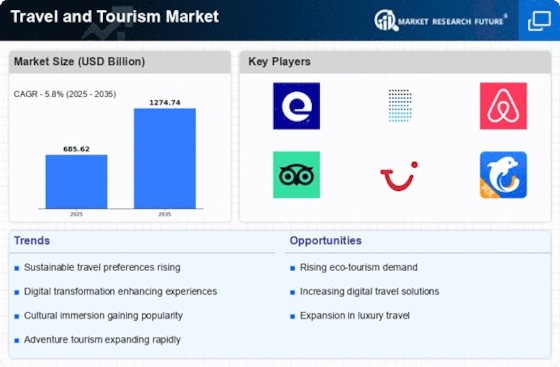
As per Market Research Future analysis, the Travel and Tourism Market was estimated at 685.62 USD Billion in 2024. The Travel and Tourism industry is projected to grow from 725.38 USD Billion in 2025 to 1274.74 USD Billion by 2035, exhibiting a compound annual growth rate (CAGR) of 5.8% during the forecast period 2025 - 2035

Key Market Trends & Highlights

The Travel and Tourism Market is experiencing a dynamic shift towards personalized and sustainable travel experiences.

  • Personalization of travel experiences is becoming increasingly prevalent, particularly in North America, where consumers seek tailored itineraries. Sustainability initiatives are gaining traction, especially in the Asia-Pacific region, as travelers prioritize eco-friendly options. Technological integration is reshaping the leisure segment, enhancing customer engagement through innovative platforms and services. Rising disposable incomes and a growing focus on cultural and experiential travel are driving demand in both domestic and international markets.

Market Size & Forecast

2024 Market Size 685.62 (USD Billion)
2035 Market Size 1274.74 (USD Billion)
CAGR (2025 - 2035) 5.8%
Largest Regional Market Share in 2024 North America

Major Players

<p>Expedia Group (US), <a href="https://www.bookingholdings.com/">Booking Holdings (US)</a>, Airbnb (US), Tripadvisor (US), <a href="https://www.tuigroup.com/de">TUI Group (DE)</a>, Ctrip (CN), Travel Leaders Group (US), American Express Global Business Travel (US), Marriott International (US)</p>

Market Trends

The Travel and Tourism Market is currently experiencing a dynamic transformation, driven by evolving consumer preferences and technological advancements. Travelers are increasingly seeking personalized experiences that cater to their individual interests and desires. This shift towards customization is prompting businesses within the sector to adapt their offerings, ensuring they meet the diverse needs of modern tourists. Additionally, sustainability has emerged as a pivotal concern, with many travelers prioritizing eco-friendly options and responsible tourism practices. This growing awareness is influencing travel choices, compelling companies to adopt greener practices and promote sustainable destinations. Moreover, the integration of technology into the Travel and Tourism Market is reshaping how consumers plan and experience their journeys. Digital platforms are facilitating seamless booking processes, while innovations such as virtual reality are enhancing pre-travel experiences. Social media continues to play a crucial role in shaping perceptions and influencing decisions, as travelers increasingly rely on online reviews and recommendations. As the market evolves, it appears that adaptability and responsiveness to consumer trends will be essential for businesses aiming to thrive in this competitive landscape.

Personalization of Travel Experiences

The trend towards personalized travel experiences is gaining momentum, as consumers seek unique and tailored adventures. This shift encourages businesses to offer customized itineraries and services that align with individual preferences, enhancing customer satisfaction and loyalty.

Sustainability in Travel

Sustainability is becoming a central theme in the Travel and Tourism Market, with travelers increasingly favoring eco-friendly options. Companies are responding by implementing sustainable practices, promoting responsible tourism, and highlighting environmentally conscious destinations.

Technological Integration

The integration of technology is transforming the Travel and Tourism Market, streamlining booking processes and enhancing customer engagement. Innovations such as mobile applications and virtual reality are reshaping how travelers plan and experience their journeys.

Travel Tourism Market Market Drivers

Rising Disposable Incomes

The Travel and Tourism Market is experiencing a notable increase in disposable incomes across various demographics. As individuals and families find themselves with more financial flexibility, they are more inclined to allocate a portion of their budgets towards travel experiences. This trend is particularly evident in emerging economies, where a growing middle class is eager to explore new destinations. According to recent data, the average household expenditure on travel has risen by approximately 15% over the past few years. This increase in disposable income not only fuels domestic travel but also encourages international trips, thereby expanding the overall market. The Travel and Tourism Market is likely to benefit from this trend, as more consumers seek unique and enriching travel experiences.

Sustainability Initiatives

Sustainability initiatives are becoming increasingly vital in the Travel and Tourism Market as consumers demonstrate a growing preference for eco-friendly travel options. Travelers are more inclined to choose destinations and service providers that prioritize sustainable practices, such as reducing carbon footprints and supporting local communities. Recent studies indicate that approximately 70% of travelers consider sustainability when making travel decisions. This shift is prompting many companies within the industry to adopt greener practices, such as promoting eco-tourism and implementing sustainable resource management. As awareness of environmental issues continues to rise, the Travel and Tourism Market is likely to evolve, with sustainability becoming a key differentiator for attracting environmentally conscious travelers.

Technological Advancements

Technological advancements are reshaping the Travel and Tourism Market in profound ways. Innovations such as mobile applications, artificial intelligence, and virtual reality are enhancing the travel experience for consumers. For instance, mobile apps facilitate seamless booking processes, while AI-driven recommendations personalize travel itineraries. Furthermore, the integration of virtual reality allows potential travelers to preview destinations before making decisions. Data indicates that nearly 70% of travelers utilize technology to plan their trips, highlighting its significance in the industry. As technology continues to evolve, it is expected to further streamline operations and improve customer satisfaction, thereby driving growth in the Travel and Tourism Market.

Cultural and Experiential Travel

Cultural and experiential travel is emerging as a prominent driver within the Travel and Tourism Market. Travelers are increasingly seeking authentic experiences that allow them to immerse themselves in local cultures and traditions. This shift towards experiential travel is reflected in the growing popularity of activities such as culinary tours, cultural festivals, and community-based tourism. Data suggests that nearly 50% of travelers are willing to pay a premium for unique experiences that offer deeper cultural insights. As a result, destinations that promote their cultural heritage and provide immersive experiences are likely to see a surge in visitor numbers. This trend not only enriches the travel experience but also supports local economies, thereby enhancing the overall appeal of the Travel and Tourism Market.

Increased Focus on Health and Safety

The Travel and Tourism Market is witnessing an increased focus on health and safety measures, which has become a pivotal driver of consumer confidence. Travelers are now more discerning about hygiene standards and safety protocols when selecting destinations and accommodations. This heightened awareness has prompted many service providers to implement rigorous health measures, such as enhanced cleaning protocols and contactless services. Recent surveys indicate that over 60% of travelers prioritize health and safety when planning their trips. Consequently, destinations that effectively communicate their commitment to safety are likely to attract more visitors. This trend not only influences consumer behavior but also shapes the competitive landscape within the Travel and Tourism Market.

Market Segment Insights

By Travel Type: Leisure (Largest) vs. Adventure (Fastest-Growing)

<p>In the travel and tourism market, the distribution of travelers by type reveals that leisure travel holds a substantial share, catering to the vast demand for relaxation and recreation. It is favored for family vacations, beach holidays, and getaways, making it the largest segment. On the other hand, adventure travel, marked by its thrilling activities and unique experiences, is gaining significant traction, particularly among millennials and younger travelers seeking novel experiences. The growth trends indicate that leisure travel continues to benefit from a stable and loyal consumer base, while adventure travel is on the rise, driven by changing consumer preferences and a growing desire for experiential travel. As outdoor activities and eco-tourism gain popularity, the adventure segment attracts those looking for activities that combine physical exertion with exploration. This growing demand for adventure compellingly shifts the market dynamics, signaling a vibrant future for both segments.</p>

<p>Leisure (Dominant) vs. Adventure (Emerging)</p>

<p>Leisure travel stands out as the dominant force within the travel and tourism market, appealing to a broad demographic seeking relaxation and enjoyment. This segment encompasses various activities including beach vacations, family trips, and spa retreats, creating a stable and enduring market presence. Consumers are increasingly opting for leisure options that offer value, comfort, and memorable experiences, contributing to its longevity and popularity. Kids' travel packages and family-oriented resorts are excellent examples of leisure travel shaping consumer preferences. On the other hand, adventure travel is rapidly emerging, characterized by a younger demographic eager to engage in experiences like hiking, scuba diving, or cultural immersions. This segment's growth is underscored by a shift towards authentic and transformative travel experiences that push physical and mental boundaries. As social media showcases thrilling escapades, more travelers are inspired to seek out adventure, making this segment increasingly relevant in contemporary travel trends.</p>

By Accommodation Type: Hotels (Largest) vs. Vacation Rentals (Fastest-Growing)

<p>In the travel and tourism market, hotels dominate the accommodation type segment, capturing a significant share due to their extensive range of services and global presence. They offer various amenities tailored to diverse traveler needs, from luxury options to budget-friendly choices. Meanwhile, vacation rentals are emerging rapidly, appealing to travelers seeking unique, home-like experiences that provide more space and local immersion compared to traditional hotels. The growing preference for personalized travel experiences is fueling this trend. Additionally, hostels, bed and breakfasts, and resorts present unique value propositions catering to niche markets. Hostels attract budget-conscious travelers and backpackers looking for social interactions, while bed and breakfasts offer a more intimate, home-like environment. Resorts, with their all-inclusive experiences, continue to attract families and leisure seekers, contributing significantly to overall market growth alongside vacation rentals.</p>

<p>Hotels (Dominant) vs. Vacation Rentals (Emerging)</p>

<p>The hotel sector is characterized by established chains that provide consistency in guest experiences across locations, attracting both leisure and business travelers. Their ability to offer loyalty programs and varied services such as dining, fitness, and meeting spaces enhances their appeal. In contrast, vacation rentals are redefining hospitality by offering personalized stays in local neighborhoods, appealing to younger travelers and families wanting a home base for exploring. The growing trend towards remote work is also fueling demand for vacation rentals, which provide the flexibility for longer stays. These two accommodation types illustrate the shift in traveler preferences, where traditional norms are being challenged by newer, experience-driven options.</p>

By Transportation Mode: Air Travel (Largest) vs. Rail Travel (Fastest-Growing)

<p>In the travel and tourism market, Air Travel holds the largest share among the various transportation modes, appealing to international and long-distance travelers due to its speed and efficiency. Rail Travel, historically significant, is rapidly evolving, capturing a growing segment of eco-conscious travelers seeking alternative transportation options. Road Travel remains important for domestic tourism, while Water Travel and Public Transport cater to niche markets and specific travel preferences.</p>

<p>Air Travel (Dominant) vs. Rail Travel (Emerging)</p>

<p>Air Travel remains the dominant force in the travel and tourism market, driven by its scalability and the increasing number of routes connecting global destinations. Airlines are continually innovating, focusing on customer experience and sustainable practices to appeal to environmentally conscious travelers. Rail Travel, once overshadowed, has become an emerging segment with investments in high-speed rail and improved infrastructure, offering an eco-friendly alternative that attracts tourists interested in scenic routes and convenience. As urbanization grows, Rail Travel is also supported by rising public interest in sustainable transportation, making it a key competitor to traditional modes.</p>

By Tourism Purpose: Sightseeing (Largest) vs. Wellness (Fastest-Growing)

<p>The travel and tourism market for the 'Tourism Purpose' segment showcases a diverse mix of motivations among travelers. Sightseeing holds the largest market share, as many tourists prioritize experiencing cultural landmarks, natural wonders, and urban attractions. Following closely are relaxation and wellness, each drawing significant attention from travelers seeking rejuvenation and mental relief during their trips. Education and sports round out the segment but with comparatively smaller shares in overall market distribution.</p>

<p>Sightseeing: Dominant vs. Wellness: Emerging</p>

<p>Sightseeing emerges as the dominant force in the tourism purpose segment due to its universal appeal across demographics. Travelers are increasingly seeking immersive experiences that allow them to explore historical sites, local cultures, and natural beauty. In contrast, wellness tourism, increasingly recognized as an emerging trend, is gaining momentum as consumers prioritize mental and physical health. This segment caters to those looking for retreats, spa experiences, and holistic health programs, reflecting a shift in traveler priorities towards well-being and self-care. With the rise of wellness-focused offerings, this segment is positioned for substantial growth.</p>

By Customer Demographics: Families (Largest) vs. Millennials (Fastest-Growing)

<p>In the travel and tourism market, the distribution of customer demographics showcases Families as the largest segment, significantly influencing the industry due to their need for family-friendly options. Following closely are Millennials, who are transforming the landscape with their adventurous spirit and inclination towards unique experiences. Solo Travelers, Couples, and Senior Citizens also play vital roles in shaping travel preferences, each contributing uniquely to the market dynamics. The growth trends reveal that while Families remain a dominant force, Millennials are emerging as the fastest-growing demographic segment. Their preferences lean towards experiential travel, technology integration, and sustainable tourism practices. Additionally, Solo Travelers are gaining momentum as more individuals seek personal journeys, while Senior Citizens are increasingly exploring new destinations, supported by enhanced accessibility. This evolving landscape is largely driven by changing social norms and enhanced digital connectivity.</p>

<p>Families (Dominant) vs. Millennials (Emerging)</p>

<p>Families represent a dominant segment in the travel and tourism market, characterized by multi-generational trips and a strong emphasis on activities catering to all age groups. Their travel decisions often prioritize safety, convenience, and family-friendly amenities such as accommodations with kitchens or proximity to children’s activities. This segment has a significant influence on seasonal trends, often planning vacations during school holidays or long weekends. On the other hand, Millennials are emerging as a pivotal demographic, showcasing a penchant for adventure, technology-driven travel planning, and a thirst for immersive experiences over traditional sightseeing. They tend to prioritize unique local interactions, social media-worthy moments, and sustainability in their travel choices, thereby reshaping tourism offerings.</p>

By Booking: Online (Largest) vs. Offline (Fastest-Growing)

<p>The booking segment of the Travel and Tourism market is currently dominated by online platforms, reflecting a significant shift in consumer behavior towards digital solutions. Online bookings account for the majority of transactions, driven by the convenience and accessibility they offer. In contrast, offline bookings, while less prevalent, have begun to gain traction as consumers seek personalized services and local expertise. This distribution highlights the varying consumer preferences in how travel services are procured.</p>

<p>Booking: Online (Dominant) vs. Offline (Emerging)</p>

<p>Online booking platforms leverage technology to provide travelers with comprehensive options, user-friendly interfaces, and instant confirmations. The convenience of booking from anywhere at any time has solidified its position as the dominant choice for consumers, particularly among younger demographics. Conversely, offline bookings are seen as emerging, driven by a resurgence in demand for personalized travel experiences and the expertise of travel agents. While online continues to lead, the offline segment is rapidly evolving, catering to niche markets and offering tailored experiences that are gaining popularity.</p>

Get more detailed insights about Travel and Tourism Market Research Report – Forecast till 2035

Regional Insights

North America : Tourism Powerhouse

North America is poised for significant growth in the travel and tourism market, driven by a resurgence in domestic travel and international tourism. The United States holds the largest market share at approximately 70%, followed by Canada at around 15%. Regulatory support, including eased travel restrictions and promotional campaigns, is catalyzing this recovery. The region's diverse attractions and robust infrastructure further enhance its appeal. Leading countries in this region include the United States and Canada, with major players like Expedia Group, Booking Holdings, and Airbnb dominating the landscape. The competitive environment is characterized by innovation in service delivery and technology integration. As travel demand rebounds, these companies are adapting to changing consumer preferences, focusing on sustainability and personalized experiences to capture market share.

Europe : Cultural and Historical Hub

Europe's travel and tourism market is experiencing a robust recovery, fueled by a strong demand for cultural and historical experiences. The region is characterized by its diverse offerings, with France and Spain being the largest markets, holding approximately 30% and 20% market shares, respectively. Regulatory frameworks promoting sustainable tourism and cross-border travel are key growth drivers, enhancing the region's attractiveness to international visitors. Countries like France, Spain, and Italy lead the market, supported by key players such as TUI Group and Airbnb. The competitive landscape is vibrant, with a mix of traditional travel agencies and online platforms vying for market share. The focus on eco-friendly travel options and unique local experiences is reshaping consumer preferences, pushing companies to innovate and adapt to the evolving market dynamics.

Asia-Pacific : Emerging Travel Market

The Asia-Pacific region is witnessing rapid growth in the travel and tourism market, driven by increasing disposable incomes and a burgeoning middle class. China and India are the largest markets, accounting for approximately 40% and 15% of the region's market share, respectively. Regulatory initiatives aimed at promoting tourism and easing visa restrictions are further stimulating demand, making the region a focal point for global travelers. China, India, and Japan are leading countries in this sector, with key players like Ctrip and Airbnb making significant inroads. The competitive landscape is marked by a blend of traditional travel agencies and innovative online platforms. As the region continues to develop its tourism infrastructure, the focus on unique cultural experiences and adventure tourism is becoming increasingly prominent, attracting a diverse range of travelers.

Middle East and Africa : Emerging Tourism Frontier

The Middle East and Africa region is emerging as a significant player in the travel and tourism market, driven by unique cultural experiences and luxury offerings. The United Arab Emirates and South Africa are the largest markets, holding approximately 25% and 15% market shares, respectively. Regulatory support for tourism development and investment in infrastructure are key factors driving growth in this region, attracting both leisure and business travelers. Leading countries include the UAE, South Africa, and Morocco, with key players like Travel Leaders Group and Marriott International establishing a strong presence. The competitive landscape is evolving, with a focus on luxury travel and unique experiences. As the region invests in tourism infrastructure and marketing, it is poised to capture a larger share of The Travel and Tourism, appealing to a diverse range of travelers.

Key Players and Competitive Insights

Leading market players are putting a lot of money on R&D to broaden their product ranges, which will aid in the continued growth of the tourism and travel sector. Additionally, market participants are engaging in a range of strategic initiatives to increase their worldwide reach, with important market developments such as the introduction of new products, contracts, mergers and acquisitions, increased investments, and cooperation with other businesses. To grow and endure in an increasingly competitive and challenging market environment, Travel and Tourism industry must provide reasonably priced goods.One of the main business strategies employed by manufacturers is to produce locally to reduce operational expenses in the Travel and Tourism industry to develop market sector and provide benefits to customers. In recent years, the Travel and Tourism industry has provided some of the tourism industry's most significant benefits. Major players in the Travel and Tourism market, including United Airlines, Emirates, Southwest Airlines, Uber, Mariott, Hyatt, Hilton, Carnival Cruise Line, Royal Caribbean, Central Japan Railway, East Japan Railway, Norfolk Southern and others, invest in operations for research and development in an effort to improve market demand.United Airlines, Inc. is based in Chicago, Illinois, at the Willis Tower. Across the United States and on all six inhabited continents, United operates a sizable domestic and international route network. After combining with Continental Airlines in 2010, it grew to be the third-largest airline in the world when measured by fleet size and the number of routes. Chicago-O'Hare is United's largest hub in terms of the number of departures and passengers it carries out of its eight hubs.

In June United said that it has reached an agreement with Boom Supersonic to buy at least 15 of its Overture supersonic aircraft, with a possible maximum order of 50. All sustainable fuels will be used to power these aircraft.The Emirates Group, which is held by the Dubai government's Investment Corporation of Dubai, is the parent company of the airline, which has its headquarters in Garhoud, Dubai. With nearly 3,600 weekly flights from its hub at Terminal 3 of the Dubai International Airport, it was also the biggest airline in the Middle East as of 2019. Through its fleet of almost 300 aircraft, it offers service to more than 150 cities in 80 countries on all continents (excluding Antarctica). Emirates SkyCargo handles all cargo-related activities. By scheduled income passenger-kilometers flown, Emirates is the fourth-largest airline in the world.In terms of freight tonne-kilometers flown, it is also the second-largest. In 2022, Emirates debuted two commercials with a "flight attendant" perched on the Burj Khalifa's pinnacle. The first advertisement discussed the UAE's inclusion on the UK's Amber List following the implementation of COVID-19 travel restrictions.

Key Companies in the Travel Tourism Market include

Industry Developments

August 2023: Two brand-new Tanzania and Italy National Geographic Family Journeys have been added by G Adventures. Throughout the eight-day Tanzania Family Journey, families are anticipated to go on Serengeti game drives and visit a community tourism initiative.

July 2023: TUI Group launched a ChatGPT-powered chatbot on its U.K. app. This was the first of what is anticipated to be a series of rollouts that combine generative AI into the company's technology.

February 2023: Adris announced intentions to invest US$ 511 million in its tourist business Maistra through 2025 in an effort to expand its luxury category.

Future Outlook

Travel Tourism Market Future Outlook

<p>The Travel and Tourism Market is projected to grow at a 5.8% CAGR from 2025 to 2035, driven by technological advancements, sustainable practices, and evolving consumer preferences.</p>

New opportunities lie in:

  • <p>Development of personalized travel planning platforms Expansion of eco-friendly accommodation options Integration of AI-driven customer service solutions</p>

<p>By 2035, the market is expected to be robust, reflecting dynamic growth and innovation.</p>

Market Segmentation

Travel Tourism Market Type Outlook

  • Leisure
  • Educational
  • Business
  • Sports
  • Medical Tourism
  • Others

Travel Tourism Market Booking Outlook

  • Online
  • Offline

Travel Tourism Market Application Outlook

  • Domestic
  • International

Travel Tourism Market Travel Days Outlook

  • Less than 7 Days
  • 8-15 Days
  • 16-30 Days
  • More than 30 Days

Travel Tourism Market Travel Mode Outlook

  • Travel Packages
  • Self-catered

Travel Tourism Market Traveler Type Outlook

  • Solo Traveler
  • Couple Traveler
  • Group Traveler

Report Scope

MARKET SIZE 2024 685.62(USD Billion)
MARKET SIZE 2025 725.38(USD Billion)
MARKET SIZE 2035 1274.74(USD Billion)
COMPOUND ANNUAL GROWTH RATE (CAGR) 5.8% (2025 - 2035)
REPORT COVERAGE Revenue Forecast, Competitive Landscape, Growth Factors, and Trends
BASE YEAR 2024
Market Forecast Period 2025 - 2035
Historical Data 2019 - 2024
Market Forecast Units USD Billion
Key Companies Profiled Expedia Group (US), Booking Holdings (US), Airbnb (US), Tripadvisor (US), TUI Group (DE), Ctrip (CN), Travel Leaders Group (US), American Express Global Business Travel (US), Marriott International (US)
Segments Covered Type, Application, Traveler Type, Travel Days, Travel Mode, Booking, Region
Key Market Opportunities Integration of artificial intelligence in personalized travel planning enhances customer experience in the Travel and Tourism Market.
Key Market Dynamics Evolving consumer preferences drive technological innovations and competitive strategies in the Travel and Tourism Market.
Countries Covered North America, Europe, APAC, South America, MEA

FAQs

What is the projected market valuation for the travel and tourism market in 2035?

<p>The projected market valuation for the travel and tourism market in 2035 is 1.7 USD Billion.</p>

What was the overall market valuation for the travel and tourism market in 2024?

<p>The overall market valuation for the travel and tourism market in 2024 was 1.1 USD Billion.</p>

What is the expected CAGR for the travel and tourism market from 2025 to 2035?

<p>The expected CAGR for the travel and tourism market during the forecast period 2025 - 2035 is 4.04%.</p>

Which companies are considered key players in the travel and tourism market?

<p>Key players in the travel and tourism market include Expedia Group, Booking Holdings, Airbnb, Tripadvisor, TUI Group, Ctrip, Travel Leaders Group, American Express Global Business Travel, Marriott International, and Hilton Worldwide.</p>

How does the leisure travel segment perform in terms of market valuation?

<p>The leisure travel segment is projected to grow from 0.55 USD Billion to 0.85 USD Billion during the forecast period.</p>

What is the market valuation for the adventure travel segment?

<p>The adventure travel segment is expected to increase from 0.1 USD Billion to 0.15 USD Billion by 2035.</p>

What are the projected valuations for different types of accommodations in 2035?

<p>By 2035, hotels are projected to reach 0.85 USD Billion, vacation rentals 0.35 USD Billion, and resorts 0.45 USD Billion.</p>

What is the expected growth for air travel in the coming years?

<p>Air travel is anticipated to grow from 0.5 USD Billion to 0.8 USD Billion during the forecast period.</p>

How do customer demographics influence the travel and tourism market?

<p>In 2035, families are projected to contribute 0.55 USD Billion, while solo travelers may account for 0.4 USD Billion.</p>

What are the anticipated trends in tourism purposes by 2035?

<p>By 2035, sightseeing is expected to generate 0.66 USD Billion, while relaxation may reach 0.5 USD Billion.</p>

  1. SECTION I: EXECUTIVE SUMMARY AND KEY HIGHLIGHTS
    1. | 1.1 EXECUTIVE SUMMARY
    2. | | 1.1.1 Market Overview
    3. | | 1.1.2 Key Findings
    4. | | 1.1.3 Market Segmentation
    5. | | 1.1.4 Competitive Landscape
    6. | | 1.1.5 Challenges and Opportunities
    7. | | 1.1.6 Future Outlook
  2. SECTION II: SCOPING, METHODOLOGY AND MARKET STRUCTURE
    1. | 2.1 MARKET INTRODUCTION
    2. | | 2.1.1 Definition
    3. | | 2.1.2 Scope of the study
    4. | | | 2.1.2.1 Research Objective
    5. | | | 2.1.2.2 Assumption
    6. | | | 2.1.2.3 Limitations
    7. | 2.2 RESEARCH METHODOLOGY
    8. | | 2.2.1 Overview
    9. | | 2.2.2 Data Mining
    10. | | 2.2.3 Secondary Research
    11. | | 2.2.4 Primary Research
    12. | | | 2.2.4.1 Primary Interviews and Information Gathering Process
    13. | | | 2.2.4.2 Breakdown of Primary Respondents
    14. | | 2.2.5 Forecasting Model
    15. | | 2.2.6 Market Size Estimation
    16. | | | 2.2.6.1 Bottom-Up Approach
    17. | | | 2.2.6.2 Top-Down Approach
    18. | | 2.2.7 Data Triangulation
    19. | | 2.2.8 Validation
  3. SECTION III: QUALITATIVE ANALYSIS
    1. | 3.1 MARKET DYNAMICS
    2. | | 3.1.1 Overview
    3. | | 3.1.2 Drivers
    4. | | 3.1.3 Restraints
    5. | | 3.1.4 Opportunities
    6. | 3.2 MARKET FACTOR ANALYSIS
    7. | | 3.2.1 Value chain Analysis
    8. | | 3.2.2 Porter's Five Forces Analysis
    9. | | | 3.2.2.1 Bargaining Power of Suppliers
    10. | | | 3.2.2.2 Bargaining Power of Buyers
    11. | | | 3.2.2.3 Threat of New Entrants
    12. | | | 3.2.2.4 Threat of Substitutes
    13. | | | 3.2.2.5 Intensity of Rivalry
    14. | | 3.2.3 COVID-19 Impact Analysis
    15. | | | 3.2.3.1 Market Impact Analysis
    16. | | | 3.2.3.2 Regional Impact
    17. | | | 3.2.3.3 Opportunity and Threat Analysis
  4. SECTION IV: QUANTITATIVE ANALYSIS
    1. | 4.1 Consumer and Retail, BY Travel Type (USD Billion)
    2. | | 4.1.1 Leisure
    3. | | 4.1.2 Business
    4. | | 4.1.3 Adventure
    5. | | 4.1.4 Cultural
    6. | | 4.1.5 Medical
    7. | 4.2 Consumer and Retail, BY Accommodation Type (USD Billion)
    8. | | 4.2.1 Hotels
    9. | | 4.2.2 Hostels
    10. | | 4.2.3 Vacation Rentals
    11. | | 4.2.4 Bed and Breakfast
    12. | | 4.2.5 Resorts
    13. | 4.3 Consumer and Retail, BY Transportation Mode (USD Billion)
    14. | | 4.3.1 Air Travel
    15. | | 4.3.2 Rail Travel
    16. | | 4.3.3 Road Travel
    17. | | 4.3.4 Water Travel
    18. | | 4.3.5 Public Transport
    19. | 4.4 Consumer and Retail, BY Tourism Purpose (USD Billion)
    20. | | 4.4.1 Sightseeing
    21. | | 4.4.2 Relaxation
    22. | | 4.4.3 Education
    23. | | 4.4.4 Wellness
    24. | | 4.4.5 Sports
    25. | 4.5 Consumer and Retail, BY Customer Demographics (USD Billion)
    26. | | 4.5.1 Families
    27. | | 4.5.2 Solo Travelers
    28. | | 4.5.3 Couples
    29. | | 4.5.4 Senior Citizens
    30. | | 4.5.5 Millennials
    31. | 4.6 Consumer and Retail, BY Region (USD Billion)
    32. | | 4.6.1 North America
    33. | | | 4.6.1.1 US
    34. | | | 4.6.1.2 Canada
    35. | | 4.6.2 Europe
    36. | | | 4.6.2.1 Germany
    37. | | | 4.6.2.2 UK
    38. | | | 4.6.2.3 France
    39. | | | 4.6.2.4 Russia
    40. | | | 4.6.2.5 Italy
    41. | | | 4.6.2.6 Spain
    42. | | | 4.6.2.7 Rest of Europe
    43. | | 4.6.3 APAC
    44. | | | 4.6.3.1 China
    45. | | | 4.6.3.2 India
    46. | | | 4.6.3.3 Japan
    47. | | | 4.6.3.4 South Korea
    48. | | | 4.6.3.5 Malaysia
    49. | | | 4.6.3.6 Thailand
    50. | | | 4.6.3.7 Indonesia
    51. | | | 4.6.3.8 Rest of APAC
    52. | | 4.6.4 South America
    53. | | | 4.6.4.1 Brazil
    54. | | | 4.6.4.2 Mexico
    55. | | | 4.6.4.3 Argentina
    56. | | | 4.6.4.4 Rest of South America
    57. | | 4.6.5 MEA
    58. | | | 4.6.5.1 GCC Countries
    59. | | | 4.6.5.2 South Africa
    60. | | | 4.6.5.3 Rest of MEA
  5. SECTION V: COMPETITIVE ANALYSIS
    1. | 5.1 Competitive Landscape
    2. | | 5.1.1 Overview
    3. | | 5.1.2 Competitive Analysis
    4. | | 5.1.3 Market share Analysis
    5. | | 5.1.4 Major Growth Strategy in the Consumer and Retail
    6. | | 5.1.5 Competitive Benchmarking
    7. | | 5.1.6 Leading Players in Terms of Number of Developments in the Consumer and Retail
    8. | | 5.1.7 Key developments and growth strategies
    9. | | | 5.1.7.1 New Product Launch/Service Deployment
    10. | | | 5.1.7.2 Merger & Acquisitions
    11. | | | 5.1.7.3 Joint Ventures
    12. | | 5.1.8 Major Players Financial Matrix
    13. | | | 5.1.8.1 Sales and Operating Income
    14. | | | 5.1.8.2 Major Players R&D Expenditure. 2023
    15. | 5.2 Company Profiles
    16. | | 5.2.1 Expedia Group (US)
    17. | | | 5.2.1.1 Financial Overview
    18. | | | 5.2.1.2 Products Offered
    19. | | | 5.2.1.3 Key Developments
    20. | | | 5.2.1.4 SWOT Analysis
    21. | | | 5.2.1.5 Key Strategies
    22. | | 5.2.2 Booking Holdings (US)
    23. | | | 5.2.2.1 Financial Overview
    24. | | | 5.2.2.2 Products Offered
    25. | | | 5.2.2.3 Key Developments
    26. | | | 5.2.2.4 SWOT Analysis
    27. | | | 5.2.2.5 Key Strategies
    28. | | 5.2.3 Airbnb (US)
    29. | | | 5.2.3.1 Financial Overview
    30. | | | 5.2.3.2 Products Offered
    31. | | | 5.2.3.3 Key Developments
    32. | | | 5.2.3.4 SWOT Analysis
    33. | | | 5.2.3.5 Key Strategies
    34. | | 5.2.4 Tripadvisor (US)
    35. | | | 5.2.4.1 Financial Overview
    36. | | | 5.2.4.2 Products Offered
    37. | | | 5.2.4.3 Key Developments
    38. | | | 5.2.4.4 SWOT Analysis
    39. | | | 5.2.4.5 Key Strategies
    40. | | 5.2.5 TUI Group (DE)
    41. | | | 5.2.5.1 Financial Overview
    42. | | | 5.2.5.2 Products Offered
    43. | | | 5.2.5.3 Key Developments
    44. | | | 5.2.5.4 SWOT Analysis
    45. | | | 5.2.5.5 Key Strategies
    46. | | 5.2.6 Ctrip (CN)
    47. | | | 5.2.6.1 Financial Overview
    48. | | | 5.2.6.2 Products Offered
    49. | | | 5.2.6.3 Key Developments
    50. | | | 5.2.6.4 SWOT Analysis
    51. | | | 5.2.6.5 Key Strategies
    52. | | 5.2.7 Travel Leaders Group (US)
    53. | | | 5.2.7.1 Financial Overview
    54. | | | 5.2.7.2 Products Offered
    55. | | | 5.2.7.3 Key Developments
    56. | | | 5.2.7.4 SWOT Analysis
    57. | | | 5.2.7.5 Key Strategies
    58. | | 5.2.8 American Express Global Business Travel (US)
    59. | | | 5.2.8.1 Financial Overview
    60. | | | 5.2.8.2 Products Offered
    61. | | | 5.2.8.3 Key Developments
    62. | | | 5.2.8.4 SWOT Analysis
    63. | | | 5.2.8.5 Key Strategies
    64. | | 5.2.9 Marriott International (US)
    65. | | | 5.2.9.1 Financial Overview
    66. | | | 5.2.9.2 Products Offered
    67. | | | 5.2.9.3 Key Developments
    68. | | | 5.2.9.4 SWOT Analysis
    69. | | | 5.2.9.5 Key Strategies
    70. | | 5.2.10 Hilton Worldwide (US)
    71. | | | 5.2.10.1 Financial Overview
    72. | | | 5.2.10.2 Products Offered
    73. | | | 5.2.10.3 Key Developments
    74. | | | 5.2.10.4 SWOT Analysis
    75. | | | 5.2.10.5 Key Strategies
    76. | 5.3 Appendix
    77. | | 5.3.1 References
    78. | | 5.3.2 Related Reports
  6. LIST OF FIGURES
    1. | 6.1 MARKET SYNOPSIS
    2. | 6.2 NORTH AMERICA MARKET ANALYSIS
    3. | 6.3 US MARKET ANALYSIS BY TRAVEL TYPE
    4. | 6.4 US MARKET ANALYSIS BY ACCOMMODATION TYPE
    5. | 6.5 US MARKET ANALYSIS BY TRANSPORTATION MODE
    6. | 6.6 US MARKET ANALYSIS BY TOURISM PURPOSE
    7. | 6.7 US MARKET ANALYSIS BY CUSTOMER DEMOGRAPHICS
    8. | 6.8 CANADA MARKET ANALYSIS BY TRAVEL TYPE
    9. | 6.9 CANADA MARKET ANALYSIS BY ACCOMMODATION TYPE
    10. | 6.10 CANADA MARKET ANALYSIS BY TRANSPORTATION MODE
    11. | 6.11 CANADA MARKET ANALYSIS BY TOURISM PURPOSE
    12. | 6.12 CANADA MARKET ANALYSIS BY CUSTOMER DEMOGRAPHICS
    13. | 6.13 EUROPE MARKET ANALYSIS
    14. | 6.14 GERMANY MARKET ANALYSIS BY TRAVEL TYPE
    15. | 6.15 GERMANY MARKET ANALYSIS BY ACCOMMODATION TYPE
    16. | 6.16 GERMANY MARKET ANALYSIS BY TRANSPORTATION MODE
    17. | 6.17 GERMANY MARKET ANALYSIS BY TOURISM PURPOSE
    18. | 6.18 GERMANY MARKET ANALYSIS BY CUSTOMER DEMOGRAPHICS
    19. | 6.19 UK MARKET ANALYSIS BY TRAVEL TYPE
    20. | 6.20 UK MARKET ANALYSIS BY ACCOMMODATION TYPE
    21. | 6.21 UK MARKET ANALYSIS BY TRANSPORTATION MODE
    22. | 6.22 UK MARKET ANALYSIS BY TOURISM PURPOSE
    23. | 6.23 UK MARKET ANALYSIS BY CUSTOMER DEMOGRAPHICS
    24. | 6.24 FRANCE MARKET ANALYSIS BY TRAVEL TYPE
    25. | 6.25 FRANCE MARKET ANALYSIS BY ACCOMMODATION TYPE
    26. | 6.26 FRANCE MARKET ANALYSIS BY TRANSPORTATION MODE
    27. | 6.27 FRANCE MARKET ANALYSIS BY TOURISM PURPOSE
    28. | 6.28 FRANCE MARKET ANALYSIS BY CUSTOMER DEMOGRAPHICS
    29. | 6.29 RUSSIA MARKET ANALYSIS BY TRAVEL TYPE
    30. | 6.30 RUSSIA MARKET ANALYSIS BY ACCOMMODATION TYPE
    31. | 6.31 RUSSIA MARKET ANALYSIS BY TRANSPORTATION MODE
    32. | 6.32 RUSSIA MARKET ANALYSIS BY TOURISM PURPOSE
    33. | 6.33 RUSSIA MARKET ANALYSIS BY CUSTOMER DEMOGRAPHICS
    34. | 6.34 ITALY MARKET ANALYSIS BY TRAVEL TYPE
    35. | 6.35 ITALY MARKET ANALYSIS BY ACCOMMODATION TYPE
    36. | 6.36 ITALY MARKET ANALYSIS BY TRANSPORTATION MODE
    37. | 6.37 ITALY MARKET ANALYSIS BY TOURISM PURPOSE
    38. | 6.38 ITALY MARKET ANALYSIS BY CUSTOMER DEMOGRAPHICS
    39. | 6.39 SPAIN MARKET ANALYSIS BY TRAVEL TYPE
    40. | 6.40 SPAIN MARKET ANALYSIS BY ACCOMMODATION TYPE
    41. | 6.41 SPAIN MARKET ANALYSIS BY TRANSPORTATION MODE
    42. | 6.42 SPAIN MARKET ANALYSIS BY TOURISM PURPOSE
    43. | 6.43 SPAIN MARKET ANALYSIS BY CUSTOMER DEMOGRAPHICS
    44. | 6.44 REST OF EUROPE MARKET ANALYSIS BY TRAVEL TYPE
    45. | 6.45 REST OF EUROPE MARKET ANALYSIS BY ACCOMMODATION TYPE
    46. | 6.46 REST OF EUROPE MARKET ANALYSIS BY TRANSPORTATION MODE
    47. | 6.47 REST OF EUROPE MARKET ANALYSIS BY TOURISM PURPOSE
    48. | 6.48 REST OF EUROPE MARKET ANALYSIS BY CUSTOMER DEMOGRAPHICS
    49. | 6.49 APAC MARKET ANALYSIS
    50. | 6.50 CHINA MARKET ANALYSIS BY TRAVEL TYPE
    51. | 6.51 CHINA MARKET ANALYSIS BY ACCOMMODATION TYPE
    52. | 6.52 CHINA MARKET ANALYSIS BY TRANSPORTATION MODE
    53. | 6.53 CHINA MARKET ANALYSIS BY TOURISM PURPOSE
    54. | 6.54 CHINA MARKET ANALYSIS BY CUSTOMER DEMOGRAPHICS
    55. | 6.55 INDIA MARKET ANALYSIS BY TRAVEL TYPE
    56. | 6.56 INDIA MARKET ANALYSIS BY ACCOMMODATION TYPE
    57. | 6.57 INDIA MARKET ANALYSIS BY TRANSPORTATION MODE
    58. | 6.58 INDIA MARKET ANALYSIS BY TOURISM PURPOSE
    59. | 6.59 INDIA MARKET ANALYSIS BY CUSTOMER DEMOGRAPHICS
    60. | 6.60 JAPAN MARKET ANALYSIS BY TRAVEL TYPE
    61. | 6.61 JAPAN MARKET ANALYSIS BY ACCOMMODATION TYPE
    62. | 6.62 JAPAN MARKET ANALYSIS BY TRANSPORTATION MODE
    63. | 6.63 JAPAN MARKET ANALYSIS BY TOURISM PURPOSE
    64. | 6.64 JAPAN MARKET ANALYSIS BY CUSTOMER DEMOGRAPHICS
    65. | 6.65 SOUTH KOREA MARKET ANALYSIS BY TRAVEL TYPE
    66. | 6.66 SOUTH KOREA MARKET ANALYSIS BY ACCOMMODATION TYPE
    67. | 6.67 SOUTH KOREA MARKET ANALYSIS BY TRANSPORTATION MODE
    68. | 6.68 SOUTH KOREA MARKET ANALYSIS BY TOURISM PURPOSE
    69. | 6.69 SOUTH KOREA MARKET ANALYSIS BY CUSTOMER DEMOGRAPHICS
    70. | 6.70 MALAYSIA MARKET ANALYSIS BY TRAVEL TYPE
    71. | 6.71 MALAYSIA MARKET ANALYSIS BY ACCOMMODATION TYPE
    72. | 6.72 MALAYSIA MARKET ANALYSIS BY TRANSPORTATION MODE
    73. | 6.73 MALAYSIA MARKET ANALYSIS BY TOURISM PURPOSE
    74. | 6.74 MALAYSIA MARKET ANALYSIS BY CUSTOMER DEMOGRAPHICS
    75. | 6.75 THAILAND MARKET ANALYSIS BY TRAVEL TYPE
    76. | 6.76 THAILAND MARKET ANALYSIS BY ACCOMMODATION TYPE
    77. | 6.77 THAILAND MARKET ANALYSIS BY TRANSPORTATION MODE
    78. | 6.78 THAILAND MARKET ANALYSIS BY TOURISM PURPOSE
    79. | 6.79 THAILAND MARKET ANALYSIS BY CUSTOMER DEMOGRAPHICS
    80. | 6.80 INDONESIA MARKET ANALYSIS BY TRAVEL TYPE
    81. | 6.81 INDONESIA MARKET ANALYSIS BY ACCOMMODATION TYPE
    82. | 6.82 INDONESIA MARKET ANALYSIS BY TRANSPORTATION MODE
    83. | 6.83 INDONESIA MARKET ANALYSIS BY TOURISM PURPOSE
    84. | 6.84 INDONESIA MARKET ANALYSIS BY CUSTOMER DEMOGRAPHICS
    85. | 6.85 REST OF APAC MARKET ANALYSIS BY TRAVEL TYPE
    86. | 6.86 REST OF APAC MARKET ANALYSIS BY ACCOMMODATION TYPE
    87. | 6.87 REST OF APAC MARKET ANALYSIS BY TRANSPORTATION MODE
    88. | 6.88 REST OF APAC MARKET ANALYSIS BY TOURISM PURPOSE
    89. | 6.89 REST OF APAC MARKET ANALYSIS BY CUSTOMER DEMOGRAPHICS
    90. | 6.90 SOUTH AMERICA MARKET ANALYSIS
    91. | 6.91 BRAZIL MARKET ANALYSIS BY TRAVEL TYPE
    92. | 6.92 BRAZIL MARKET ANALYSIS BY ACCOMMODATION TYPE
    93. | 6.93 BRAZIL MARKET ANALYSIS BY TRANSPORTATION MODE
    94. | 6.94 BRAZIL MARKET ANALYSIS BY TOURISM PURPOSE
    95. | 6.95 BRAZIL MARKET ANALYSIS BY CUSTOMER DEMOGRAPHICS
    96. | 6.96 MEXICO MARKET ANALYSIS BY TRAVEL TYPE
    97. | 6.97 MEXICO MARKET ANALYSIS BY ACCOMMODATION TYPE
    98. | 6.98 MEXICO MARKET ANALYSIS BY TRANSPORTATION MODE
    99. | 6.99 MEXICO MARKET ANALYSIS BY TOURISM PURPOSE
    100. | 6.100 MEXICO MARKET ANALYSIS BY CUSTOMER DEMOGRAPHICS
    101. | 6.101 ARGENTINA MARKET ANALYSIS BY TRAVEL TYPE
    102. | 6.102 ARGENTINA MARKET ANALYSIS BY ACCOMMODATION TYPE
    103. | 6.103 ARGENTINA MARKET ANALYSIS BY TRANSPORTATION MODE
    104. | 6.104 ARGENTINA MARKET ANALYSIS BY TOURISM PURPOSE
    105. | 6.105 ARGENTINA MARKET ANALYSIS BY CUSTOMER DEMOGRAPHICS
    106. | 6.106 REST OF SOUTH AMERICA MARKET ANALYSIS BY TRAVEL TYPE
    107. | 6.107 REST OF SOUTH AMERICA MARKET ANALYSIS BY ACCOMMODATION TYPE
    108. | 6.108 REST OF SOUTH AMERICA MARKET ANALYSIS BY TRANSPORTATION MODE
    109. | 6.109 REST OF SOUTH AMERICA MARKET ANALYSIS BY TOURISM PURPOSE
    110. | 6.110 REST OF SOUTH AMERICA MARKET ANALYSIS BY CUSTOMER DEMOGRAPHICS
    111. | 6.111 MEA MARKET ANALYSIS
    112. | 6.112 GCC COUNTRIES MARKET ANALYSIS BY TRAVEL TYPE
    113. | 6.113 GCC COUNTRIES MARKET ANALYSIS BY ACCOMMODATION TYPE
    114. | 6.114 GCC COUNTRIES MARKET ANALYSIS BY TRANSPORTATION MODE
    115. | 6.115 GCC COUNTRIES MARKET ANALYSIS BY TOURISM PURPOSE
    116. | 6.116 GCC COUNTRIES MARKET ANALYSIS BY CUSTOMER DEMOGRAPHICS
    117. | 6.117 SOUTH AFRICA MARKET ANALYSIS BY TRAVEL TYPE
    118. | 6.118 SOUTH AFRICA MARKET ANALYSIS BY ACCOMMODATION TYPE
    119. | 6.119 SOUTH AFRICA MARKET ANALYSIS BY TRANSPORTATION MODE
    120. | 6.120 SOUTH AFRICA MARKET ANALYSIS BY TOURISM PURPOSE
    121. | 6.121 SOUTH AFRICA MARKET ANALYSIS BY CUSTOMER DEMOGRAPHICS
    122. | 6.122 REST OF MEA MARKET ANALYSIS BY TRAVEL TYPE
    123. | 6.123 REST OF MEA MARKET ANALYSIS BY ACCOMMODATION TYPE
    124. | 6.124 REST OF MEA MARKET ANALYSIS BY TRANSPORTATION MODE
    125. | 6.125 REST OF MEA MARKET ANALYSIS BY TOURISM PURPOSE
    126. | 6.126 REST OF MEA MARKET ANALYSIS BY CUSTOMER DEMOGRAPHICS
    127. | 6.127 KEY BUYING CRITERIA OF CONSUMER AND RETAIL
    128. | 6.128 RESEARCH PROCESS OF MRFR
    129. | 6.129 DRO ANALYSIS OF CONSUMER AND RETAIL
    130. | 6.130 DRIVERS IMPACT ANALYSIS: CONSUMER AND RETAIL
    131. | 6.131 RESTRAINTS IMPACT ANALYSIS: CONSUMER AND RETAIL
    132. | 6.132 SUPPLY / VALUE CHAIN: CONSUMER AND RETAIL
    133. | 6.133 CONSUMER AND RETAIL, BY TRAVEL TYPE, 2024 (% SHARE)
    134. | 6.134 CONSUMER AND RETAIL, BY TRAVEL TYPE, 2024 TO 2035 (USD Billion)
    135. | 6.135 CONSUMER AND RETAIL, BY ACCOMMODATION TYPE, 2024 (% SHARE)
    136. | 6.136 CONSUMER AND RETAIL, BY ACCOMMODATION TYPE, 2024 TO 2035 (USD Billion)
    137. | 6.137 CONSUMER AND RETAIL, BY TRANSPORTATION MODE, 2024 (% SHARE)
    138. | 6.138 CONSUMER AND RETAIL, BY TRANSPORTATION MODE, 2024 TO 2035 (USD Billion)
    139. | 6.139 CONSUMER AND RETAIL, BY TOURISM PURPOSE, 2024 (% SHARE)
    140. | 6.140 CONSUMER AND RETAIL, BY TOURISM PURPOSE, 2024 TO 2035 (USD Billion)
    141. | 6.141 CONSUMER AND RETAIL, BY CUSTOMER DEMOGRAPHICS, 2024 (% SHARE)
    142. | 6.142 CONSUMER AND RETAIL, BY CUSTOMER DEMOGRAPHICS, 2024 TO 2035 (USD Billion)
    143. | 6.143 BENCHMARKING OF MAJOR COMPETITORS
  7. LIST OF TABLES
    1. | 7.1 LIST OF ASSUMPTIONS
    2. | | 7.1.1
    3. | 7.2 North America MARKET SIZE ESTIMATES; FORECAST
    4. | | 7.2.1 BY TRAVEL TYPE, 2025-2035 (USD Billion)
    5. | | 7.2.2 BY ACCOMMODATION TYPE, 2025-2035 (USD Billion)
    6. | | 7.2.3 BY TRANSPORTATION MODE, 2025-2035 (USD Billion)
    7. | | 7.2.4 BY TOURISM PURPOSE, 2025-2035 (USD Billion)
    8. | | 7.2.5 BY CUSTOMER DEMOGRAPHICS, 2025-2035 (USD Billion)
    9. | 7.3 US MARKET SIZE ESTIMATES; FORECAST
    10. | | 7.3.1 BY TRAVEL TYPE, 2025-2035 (USD Billion)
    11. | | 7.3.2 BY ACCOMMODATION TYPE, 2025-2035 (USD Billion)
    12. | | 7.3.3 BY TRANSPORTATION MODE, 2025-2035 (USD Billion)
    13. | | 7.3.4 BY TOURISM PURPOSE, 2025-2035 (USD Billion)
    14. | | 7.3.5 BY CUSTOMER DEMOGRAPHICS, 2025-2035 (USD Billion)
    15. | 7.4 Canada MARKET SIZE ESTIMATES; FORECAST
    16. | | 7.4.1 BY TRAVEL TYPE, 2025-2035 (USD Billion)
    17. | | 7.4.2 BY ACCOMMODATION TYPE, 2025-2035 (USD Billion)
    18. | | 7.4.3 BY TRANSPORTATION MODE, 2025-2035 (USD Billion)
    19. | | 7.4.4 BY TOURISM PURPOSE, 2025-2035 (USD Billion)
    20. | | 7.4.5 BY CUSTOMER DEMOGRAPHICS, 2025-2035 (USD Billion)
    21. | 7.5 Europe MARKET SIZE ESTIMATES; FORECAST
    22. | | 7.5.1 BY TRAVEL TYPE, 2025-2035 (USD Billion)
    23. | | 7.5.2 BY ACCOMMODATION TYPE, 2025-2035 (USD Billion)
    24. | | 7.5.3 BY TRANSPORTATION MODE, 2025-2035 (USD Billion)
    25. | | 7.5.4 BY TOURISM PURPOSE, 2025-2035 (USD Billion)
    26. | | 7.5.5 BY CUSTOMER DEMOGRAPHICS, 2025-2035 (USD Billion)
    27. | 7.6 Germany MARKET SIZE ESTIMATES; FORECAST
    28. | | 7.6.1 BY TRAVEL TYPE, 2025-2035 (USD Billion)
    29. | | 7.6.2 BY ACCOMMODATION TYPE, 2025-2035 (USD Billion)
    30. | | 7.6.3 BY TRANSPORTATION MODE, 2025-2035 (USD Billion)
    31. | | 7.6.4 BY TOURISM PURPOSE, 2025-2035 (USD Billion)
    32. | | 7.6.5 BY CUSTOMER DEMOGRAPHICS, 2025-2035 (USD Billion)
    33. | 7.7 UK MARKET SIZE ESTIMATES; FORECAST
    34. | | 7.7.1 BY TRAVEL TYPE, 2025-2035 (USD Billion)
    35. | | 7.7.2 BY ACCOMMODATION TYPE, 2025-2035 (USD Billion)
    36. | | 7.7.3 BY TRANSPORTATION MODE, 2025-2035 (USD Billion)
    37. | | 7.7.4 BY TOURISM PURPOSE, 2025-2035 (USD Billion)
    38. | | 7.7.5 BY CUSTOMER DEMOGRAPHICS, 2025-2035 (USD Billion)
    39. | 7.8 France MARKET SIZE ESTIMATES; FORECAST
    40. | | 7.8.1 BY TRAVEL TYPE, 2025-2035 (USD Billion)
    41. | | 7.8.2 BY ACCOMMODATION TYPE, 2025-2035 (USD Billion)
    42. | | 7.8.3 BY TRANSPORTATION MODE, 2025-2035 (USD Billion)
    43. | | 7.8.4 BY TOURISM PURPOSE, 2025-2035 (USD Billion)
    44. | | 7.8.5 BY CUSTOMER DEMOGRAPHICS, 2025-2035 (USD Billion)
    45. | 7.9 Russia MARKET SIZE ESTIMATES; FORECAST
    46. | | 7.9.1 BY TRAVEL TYPE, 2025-2035 (USD Billion)
    47. | | 7.9.2 BY ACCOMMODATION TYPE, 2025-2035 (USD Billion)
    48. | | 7.9.3 BY TRANSPORTATION MODE, 2025-2035 (USD Billion)
    49. | | 7.9.4 BY TOURISM PURPOSE, 2025-2035 (USD Billion)
    50. | | 7.9.5 BY CUSTOMER DEMOGRAPHICS, 2025-2035 (USD Billion)
    51. | 7.10 Italy MARKET SIZE ESTIMATES; FORECAST
    52. | | 7.10.1 BY TRAVEL TYPE, 2025-2035 (USD Billion)
    53. | | 7.10.2 BY ACCOMMODATION TYPE, 2025-2035 (USD Billion)
    54. | | 7.10.3 BY TRANSPORTATION MODE, 2025-2035 (USD Billion)
    55. | | 7.10.4 BY TOURISM PURPOSE, 2025-2035 (USD Billion)
    56. | | 7.10.5 BY CUSTOMER DEMOGRAPHICS, 2025-2035 (USD Billion)
    57. | 7.11 Spain MARKET SIZE ESTIMATES; FORECAST
    58. | | 7.11.1 BY TRAVEL TYPE, 2025-2035 (USD Billion)
    59. | | 7.11.2 BY ACCOMMODATION TYPE, 2025-2035 (USD Billion)
    60. | | 7.11.3 BY TRANSPORTATION MODE, 2025-2035 (USD Billion)
    61. | | 7.11.4 BY TOURISM PURPOSE, 2025-2035 (USD Billion)
    62. | | 7.11.5 BY CUSTOMER DEMOGRAPHICS, 2025-2035 (USD Billion)
    63. | 7.12 Rest of Europe MARKET SIZE ESTIMATES; FORECAST
    64. | | 7.12.1 BY TRAVEL TYPE, 2025-2035 (USD Billion)
    65. | | 7.12.2 BY ACCOMMODATION TYPE, 2025-2035 (USD Billion)
    66. | | 7.12.3 BY TRANSPORTATION MODE, 2025-2035 (USD Billion)
    67. | | 7.12.4 BY TOURISM PURPOSE, 2025-2035 (USD Billion)
    68. | | 7.12.5 BY CUSTOMER DEMOGRAPHICS, 2025-2035 (USD Billion)
    69. | 7.13 APAC MARKET SIZE ESTIMATES; FORECAST
    70. | | 7.13.1 BY TRAVEL TYPE, 2025-2035 (USD Billion)
    71. | | 7.13.2 BY ACCOMMODATION TYPE, 2025-2035 (USD Billion)
    72. | | 7.13.3 BY TRANSPORTATION MODE, 2025-2035 (USD Billion)
    73. | | 7.13.4 BY TOURISM PURPOSE, 2025-2035 (USD Billion)
    74. | | 7.13.5 BY CUSTOMER DEMOGRAPHICS, 2025-2035 (USD Billion)
    75. | 7.14 China MARKET SIZE ESTIMATES; FORECAST
    76. | | 7.14.1 BY TRAVEL TYPE, 2025-2035 (USD Billion)
    77. | | 7.14.2 BY ACCOMMODATION TYPE, 2025-2035 (USD Billion)
    78. | | 7.14.3 BY TRANSPORTATION MODE, 2025-2035 (USD Billion)
    79. | | 7.14.4 BY TOURISM PURPOSE, 2025-2035 (USD Billion)
    80. | | 7.14.5 BY CUSTOMER DEMOGRAPHICS, 2025-2035 (USD Billion)
    81. | 7.15 India MARKET SIZE ESTIMATES; FORECAST
    82. | | 7.15.1 BY TRAVEL TYPE, 2025-2035 (USD Billion)
    83. | | 7.15.2 BY ACCOMMODATION TYPE, 2025-2035 (USD Billion)
    84. | | 7.15.3 BY TRANSPORTATION MODE, 2025-2035 (USD Billion)
    85. | | 7.15.4 BY TOURISM PURPOSE, 2025-2035 (USD Billion)
    86. | | 7.15.5 BY CUSTOMER DEMOGRAPHICS, 2025-2035 (USD Billion)
    87. | 7.16 Japan MARKET SIZE ESTIMATES; FORECAST
    88. | | 7.16.1 BY TRAVEL TYPE, 2025-2035 (USD Billion)
    89. | | 7.16.2 BY ACCOMMODATION TYPE, 2025-2035 (USD Billion)
    90. | | 7.16.3 BY TRANSPORTATION MODE, 2025-2035 (USD Billion)
    91. | | 7.16.4 BY TOURISM PURPOSE, 2025-2035 (USD Billion)
    92. | | 7.16.5 BY CUSTOMER DEMOGRAPHICS, 2025-2035 (USD Billion)
    93. | 7.17 South Korea MARKET SIZE ESTIMATES; FORECAST
    94. | | 7.17.1 BY TRAVEL TYPE, 2025-2035 (USD Billion)
    95. | | 7.17.2 BY ACCOMMODATION TYPE, 2025-2035 (USD Billion)
    96. | | 7.17.3 BY TRANSPORTATION MODE, 2025-2035 (USD Billion)
    97. | | 7.17.4 BY TOURISM PURPOSE, 2025-2035 (USD Billion)
    98. | | 7.17.5 BY CUSTOMER DEMOGRAPHICS, 2025-2035 (USD Billion)
    99. | 7.18 Malaysia MARKET SIZE ESTIMATES; FORECAST
    100. | | 7.18.1 BY TRAVEL TYPE, 2025-2035 (USD Billion)
    101. | | 7.18.2 BY ACCOMMODATION TYPE, 2025-2035 (USD Billion)
    102. | | 7.18.3 BY TRANSPORTATION MODE, 2025-2035 (USD Billion)
    103. | | 7.18.4 BY TOURISM PURPOSE, 2025-2035 (USD Billion)
    104. | | 7.18.5 BY CUSTOMER DEMOGRAPHICS, 2025-2035 (USD Billion)
    105. | 7.19 Thailand MARKET SIZE ESTIMATES; FORECAST
    106. | | 7.19.1 BY TRAVEL TYPE, 2025-2035 (USD Billion)
    107. | | 7.19.2 BY ACCOMMODATION TYPE, 2025-2035 (USD Billion)
    108. | | 7.19.3 BY TRANSPORTATION MODE, 2025-2035 (USD Billion)
    109. | | 7.19.4 BY TOURISM PURPOSE, 2025-2035 (USD Billion)
    110. | | 7.19.5 BY CUSTOMER DEMOGRAPHICS, 2025-2035 (USD Billion)
    111. | 7.20 Indonesia MARKET SIZE ESTIMATES; FORECAST
    112. | | 7.20.1 BY TRAVEL TYPE, 2025-2035 (USD Billion)
    113. | | 7.20.2 BY ACCOMMODATION TYPE, 2025-2035 (USD Billion)
    114. | | 7.20.3 BY TRANSPORTATION MODE, 2025-2035 (USD Billion)
    115. | | 7.20.4 BY TOURISM PURPOSE, 2025-2035 (USD Billion)
    116. | | 7.20.5 BY CUSTOMER DEMOGRAPHICS, 2025-2035 (USD Billion)
    117. | 7.21 Rest of APAC MARKET SIZE ESTIMATES; FORECAST
    118. | | 7.21.1 BY TRAVEL TYPE, 2025-2035 (USD Billion)
    119. | | 7.21.2 BY ACCOMMODATION TYPE, 2025-2035 (USD Billion)
    120. | | 7.21.3 BY TRANSPORTATION MODE, 2025-2035 (USD Billion)
    121. | | 7.21.4 BY TOURISM PURPOSE, 2025-2035 (USD Billion)
    122. | | 7.21.5 BY CUSTOMER DEMOGRAPHICS, 2025-2035 (USD Billion)
    123. | 7.22 South America MARKET SIZE ESTIMATES; FORECAST
    124. | | 7.22.1 BY TRAVEL TYPE, 2025-2035 (USD Billion)
    125. | | 7.22.2 BY ACCOMMODATION TYPE, 2025-2035 (USD Billion)
    126. | | 7.22.3 BY TRANSPORTATION MODE, 2025-2035 (USD Billion)
    127. | | 7.22.4 BY TOURISM PURPOSE, 2025-2035 (USD Billion)
    128. | | 7.22.5 BY CUSTOMER DEMOGRAPHICS, 2025-2035 (USD Billion)
    129. | 7.23 Brazil MARKET SIZE ESTIMATES; FORECAST
    130. | | 7.23.1 BY TRAVEL TYPE, 2025-2035 (USD Billion)
    131. | | 7.23.2 BY ACCOMMODATION TYPE, 2025-2035 (USD Billion)
    132. | | 7.23.3 BY TRANSPORTATION MODE, 2025-2035 (USD Billion)
    133. | | 7.23.4 BY TOURISM PURPOSE, 2025-2035 (USD Billion)
    134. | | 7.23.5 BY CUSTOMER DEMOGRAPHICS, 2025-2035 (USD Billion)
    135. | 7.24 Mexico MARKET SIZE ESTIMATES; FORECAST
    136. | | 7.24.1 BY TRAVEL TYPE, 2025-2035 (USD Billion)
    137. | | 7.24.2 BY ACCOMMODATION TYPE, 2025-2035 (USD Billion)
    138. | | 7.24.3 BY TRANSPORTATION MODE, 2025-2035 (USD Billion)
    139. | | 7.24.4 BY TOURISM PURPOSE, 2025-2035 (USD Billion)
    140. | | 7.24.5 BY CUSTOMER DEMOGRAPHICS, 2025-2035 (USD Billion)
    141. | 7.25 Argentina MARKET SIZE ESTIMATES; FORECAST
    142. | | 7.25.1 BY TRAVEL TYPE, 2025-2035 (USD Billion)
    143. | | 7.25.2 BY ACCOMMODATION TYPE, 2025-2035 (USD Billion)
    144. | | 7.25.3 BY TRANSPORTATION MODE, 2025-2035 (USD Billion)
    145. | | 7.25.4 BY TOURISM PURPOSE, 2025-2035 (USD Billion)
    146. | | 7.25.5 BY CUSTOMER DEMOGRAPHICS, 2025-2035 (USD Billion)
    147. | 7.26 Rest of South America MARKET SIZE ESTIMATES; FORECAST
    148. | | 7.26.1 BY TRAVEL TYPE, 2025-2035 (USD Billion)
    149. | | 7.26.2 BY ACCOMMODATION TYPE, 2025-2035 (USD Billion)
    150. | | 7.26.3 BY TRANSPORTATION MODE, 2025-2035 (USD Billion)
    151. | | 7.26.4 BY TOURISM PURPOSE, 2025-2035 (USD Billion)
    152. | | 7.26.5 BY CUSTOMER DEMOGRAPHICS, 2025-2035 (USD Billion)
    153. | 7.27 MEA MARKET SIZE ESTIMATES; FORECAST
    154. | | 7.27.1 BY TRAVEL TYPE, 2025-2035 (USD Billion)
    155. | | 7.27.2 BY ACCOMMODATION TYPE, 2025-2035 (USD Billion)
    156. | | 7.27.3 BY TRANSPORTATION MODE, 2025-2035 (USD Billion)
    157. | | 7.27.4 BY TOURISM PURPOSE, 2025-2035 (USD Billion)
    158. | | 7.27.5 BY CUSTOMER DEMOGRAPHICS, 2025-2035 (USD Billion)
    159. | 7.28 GCC Countries MARKET SIZE ESTIMATES; FORECAST
    160. | | 7.28.1 BY TRAVEL TYPE, 2025-2035 (USD Billion)
    161. | | 7.28.2 BY ACCOMMODATION TYPE, 2025-2035 (USD Billion)
    162. | | 7.28.3 BY TRANSPORTATION MODE, 2025-2035 (USD Billion)
    163. | | 7.28.4 BY TOURISM PURPOSE, 2025-2035 (USD Billion)
    164. | | 7.28.5 BY CUSTOMER DEMOGRAPHICS, 2025-2035 (USD Billion)
    165. | 7.29 South Africa MARKET SIZE ESTIMATES; FORECAST
    166. | | 7.29.1 BY TRAVEL TYPE, 2025-2035 (USD Billion)
    167. | | 7.29.2 BY ACCOMMODATION TYPE, 2025-2035 (USD Billion)
    168. | | 7.29.3 BY TRANSPORTATION MODE, 2025-2035 (USD Billion)
    169. | | 7.29.4 BY TOURISM PURPOSE, 2025-2035 (USD Billion)
    170. | | 7.29.5 BY CUSTOMER DEMOGRAPHICS, 2025-2035 (USD Billion)
    171. | 7.30 Rest of MEA MARKET SIZE ESTIMATES; FORECAST
    172. | | 7.30.1 BY TRAVEL TYPE, 2025-2035 (USD Billion)
    173. | | 7.30.2 BY ACCOMMODATION TYPE, 2025-2035 (USD Billion)
    174. | | 7.30.3 BY TRANSPORTATION MODE, 2025-2035 (USD Billion)
    175. | | 7.30.4 BY TOURISM PURPOSE, 2025-2035 (USD Billion)
    176. | | 7.30.5 BY CUSTOMER DEMOGRAPHICS, 2025-2035 (USD Billion)
    177. | 7.31 PRODUCT LAUNCH/PRODUCT DEVELOPMENT/APPROVAL
    178. | | 7.31.1
    179. | 7.32 ACQUISITION/PARTNERSHIP
    180. | | 7.32.1

Consumer and Retail Market Segmentation

Consumer and Retail By Travel Type (USD Billion, 2025-2035)

  • Leisure
  • Business
  • Adventure
  • Cultural
  • Medical

Consumer and Retail By Accommodation Type (USD Billion, 2025-2035)

  • Hotels
  • Hostels
  • Vacation Rentals
  • Bed and Breakfast
  • Resorts

Consumer and Retail By Transportation Mode (USD Billion, 2025-2035)

  • Air Travel
  • Rail Travel
  • Road Travel
  • Water Travel
  • Public Transport

Consumer and Retail By Tourism Purpose (USD Billion, 2025-2035)

  • Sightseeing
  • Relaxation
  • Education
  • Wellness
  • Sports

Consumer and Retail By Customer Demographics (USD Billion, 2025-2035)

  • Families
  • Solo Travelers
  • Couples
  • Senior Citizens
  • Millennials
Infographic

Free Sample Request

Kindly complete the form below to receive a free sample of this Report

Get Free Sample

Customer Strories

Compare Licence

×
Features License Type
Single User Multiuser License Enterprise User
Price $4,950 $5,950 $7,250
Maximum User Access Limit 1 User Upto 10 Users Unrestricted Access Throughout the Organization
Free Customization
Direct Access to Analyst
Deliverable Format
Platform Access
Discount on Next Purchase 10% 15% 15%
Printable Versions