Traumatic Brain Injuries Treatment Market (2026 - 2035)

ID: MRFR/Pharma/5374-HCR 90 Pages Rahul Gotadki Last Updated: October 16, 2026
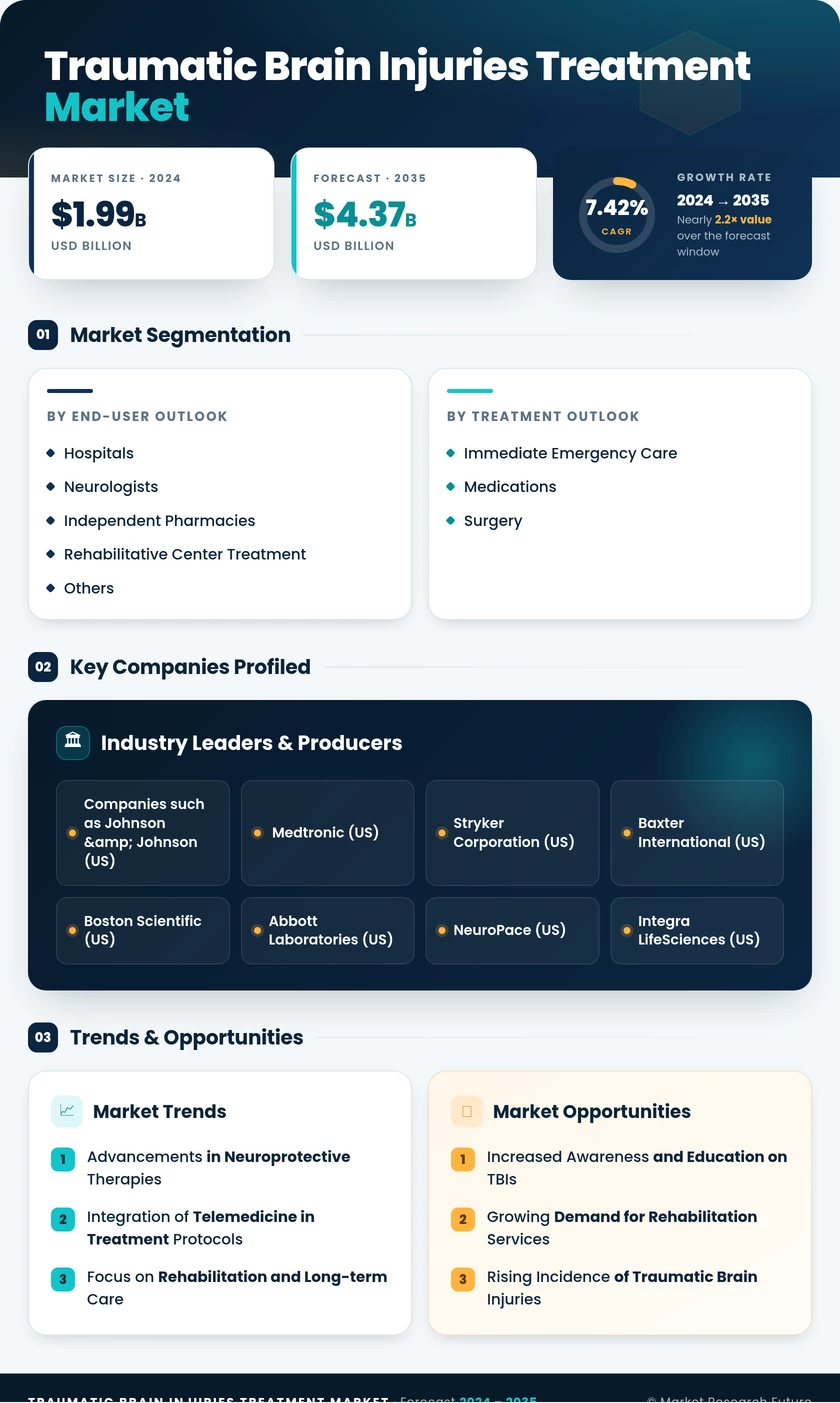
Traumatic Brain Injuries Treatment Market Research Report Information By Treatment (Immediate Emergency Care, Medications {Diuretics, Anti-Seizure Drugs, Coma-Inducing Drugs, Anti-Anxiety Agents, Anti-Depressant, Anti-Psychotics, Analgesic, Anti-Convulsants, Anti-Coagulants}, and Surgery {Removing Clotted Blood, Repairing Skull Fracture, Bleeding in the Brain, Opening a Window in the Skull, and Rehabilitation}), By End-User (Hospitals, Neurologist, Independent Pharmacies, Rehabilitative Center Treatment, and Others) And By Region (North America, Europe, Asia-Pacific, And Rest Of The World) –Market Forecast Till 2035
Traumatic Brain Injuries Treatment Market
Market Size
Forecast Period2026-2035
CAGR (2026-2035)6.5%
2025 Market SizeUSD 2.32 Billion
2035 Market SizeUSD 4.35 Billion
Key Players
Medtronic
Integra LifeSciences
Stryker
Johnson & Johnson
Pfizer
UCB
Opportunities
  • Trauma System Build-Out in Emerging Markets
  • Outcome Data and Subscription Rehabilitation Models
  • Dedicated Geriatric TBI Pathways
  1. 1 Market Summary | |
  2. 2 Key Report Takeaways | |
    1. 2.1 By Treatment Type | |
    2. 2.2 By Care Phase | |
    3. 2.3 By Patient Age | |
    4. 2.4 By Cause Of Injury | |
    5. 2.5 By End User | |
    6. 2.6 By Distribution Channel | |
    7. 2.7 By Region | |
  3. 3 Market Size and Forecast (2021–2035) | |
    1. 3.1 Historical Market Size (2021–2024) | |
    2. 3.2 Base Year Market Size (2025) | |
    3. 3.3 Forecast Market Size (2026–2035) | |
    4. 3.4 Year-over-Year Growth Analysis | |
  4. 4 Driver Impact Analysis | |
    1. 4.1 Rising Geriatric Fall-Related Injuries | |
    2. 4.2 Road-Traffic Injury Burden in Emerging Economies | |
    3. 4.3 Expanded Rehabilitation Reimbursement | |
    4. 4.4 Blood-Biomarker Triage Adoption | |
    5. 4.5 Minimally Invasive and Image-Guided Neurosurgery | |
    6. 4.6 Sports Concussion Protocols and Surveillance | |
    7. 4.7 Military and Veteran TBI Programs | |
  5. 5 Restraints Impact Analysis | |
    1. 5.1 High Cost of Acute and Rehabilitation Care | |
    2. 5.2 Absence of Approved Neuroprotective Drugs | |
    3. 5.3 Neurosurgical Workforce Shortages | |
    4. 5.4 Under-Diagnosis and Poor Follow-Up of Mild TBI | |
    5. 5.5 Fragmented Reimbursement for Chronic Care | |
  6. 6 Opportunities | |
    1. 6.1 Trauma System Build-Out in Emerging Markets | |
    2. 6.2 Outcome Data and Subscription Rehabilitation Models | |
    3. 6.3 Dedicated Geriatric TBI Pathways | |
    4. 6.4 Biomarker-Stratified Drug Development | |
  7. 7 Regional Market Share and Country-Level Analysis | |
    1. 7.1 North America | | |
      1. 7.1.1 US | | |
      2. 7.1.2 Canada | | |
      3. 7.1.3 Mexico | |
    2. 7.2 Europe | | |
      1. 7.2.1 Germany | | |
      2. 7.2.2 UK | | |
      3. 7.2.3 France | | |
      4. 7.2.4 Italy | | |
      5. 7.2.5 Spain | | |
      6. 7.2.6 Nordic Countries | | |
      7. 7.2.7 Russia | | |
      8. 7.2.8 Rest of Europe | |
    3. 7.3 Asia-Pacific | | |
      1. 7.3.1 China | | |
      2. 7.3.2 India | | |
      3. 7.3.3 Japan | | |
      4. 7.3.4 South Korea | | |
      5. 7.3.5 ASEAN | | |
      6. 7.3.6 Rest of Asia-Pacific | |
    4. 7.4 South America | | |
      1. 7.4.1 Brazil | | |
      2. 7.4.2 Argentina | | |
      3. 7.4.3 Rest of South America | |
    5. 7.5 Middle East & Africa | | |
      1. 7.5.1 Saudi Arabia | | |
      2. 7.5.2 UAE | | |
      3. 7.5.3 South Africa | | |
      4. 7.5.4 Egypt | | |
      5. 7.5.5 Rest of MEA | |
  8. 8 Future Outlook (2026–2035) | |
    1. 8.1 AI-Assisted Imaging and Neurocritical Analytics | |
    2. 8.2 Migration of Care to Outpatient and Home Settings | |
    3. 8.3 Precision Medicine and Biomarker-Led Care | |
    4. 8.4 Value-Based Reimbursement and Outcome Reporting | |
  9. 9 Segmentation Analysis | |
    1. 9.1 By Treatment Type | | |
      1. 9.1.1 Immediate Emergency Care | | |
      2. 9.1.2 Medications | | |
      3. 9.1.3 Surgery | | |
      4. 9.1.4 Rehabilitation Therapies | |
    2. 9.2 By Care Phase | | |
      1. 9.2.1 Prehospital and Emergency Stabilization | | |
      2. 9.2.2 Acute Hospital and Neurocritical Care | | |
      3. 9.2.3 Post-Acute Inpatient Rehabilitation | | |
      4. 9.2.4 Chronic Outpatient and Community Care | |
    3. 9.3 By Patient Age | | |
      1. 9.3.1 Pediatric Patients | | |
      2. 9.3.2 Adolescent Patients | | |
      3. 9.3.3 Adult Patients | | |
      4. 9.3.4 Geriatric Patients | |
    4. 9.4 By Cause Of Injury | | |
      1. 9.4.1 Falls | | |
      2. 9.4.2 Motor Vehicle Traffic Injuries | | |
      3. 9.4.3 Sports and Recreational Injuries | | |
      4. 9.4.4 Occupational and Industrial Injuries | | |
      5. 9.4.5 Military and Blast-Related Injuries | | |
      6. 9.4.6 Assault and Violence-Related Injuries | | |
      7. 9.4.7 Other Traumatic Causes | |
    5. 9.5 By End User | | |
      1. 9.5.1 Hospitals and Trauma Centers | | |
      2. 9.5.2 Neurology and Neurosurgery Clinics | | |
      3. 9.5.3 Ambulatory Care Centers | | |
      4. 9.5.4 Home Care and Community Care | | |
      5. 9.5.5 Other End Users | |
    6. 9.6 By Distribution Channel | | |
      1. 9.6.1 Hospital Pharmacies | | |
      2. 9.6.2 Retail and Independent Pharmacies | | |
      3. 9.6.3 Specialty Pharmacies | | |
      4. 9.6.4 Direct Institutional Procurement | | |
      5. 9.6.5 Online and Digital Channels | |
  10. 10 Competitive Landscape | |
    1. 10.1 Market Concentration Analysis | |
    2. 10.2 Competitive Benchmarking Matrix | |
    3. 10.3 Company Profiles | | |
      1. 10.3.1 Medtronic | | |
      2. 10.3.2 Integra LifeSciences | | |
      3. 10.3.3 Stryker | | |
      4. 10.3.4 Johnson & Johnson (DePuy Synthes) | | |
      5. 10.3.5 Pfizer | | |
      6. 10.3.6 UCB | | |
      7. 10.3.7 B. Braun (Aesculap) | | |
      8. 10.3.8 Teva Pharmaceutical | | |
      9. 10.3.9 Abbott Laboratories | | |
      10. 10.3.10 Natus Medical | | |
      11. 10.3.11 DIH (Hocoma) | |
  11. 11 Recent News & Developments | |
  12. 12 Report Scope and Methodology | |
  13. 13 Detailed Sources and Citations | |
  14. 14 Frequently Asked Questions (FAQs) | | LIST OF TABLES | |
  15. TABLE 1 Market Snapshot – Key Metrics, 2025–2035 | |
  16. TABLE 2 Global Market Size & Forecast, by Revenue (USD Billion), 2021–2035 | |
  17. TABLE 3 Driver Impact Analysis | |
  18. TABLE 4 Restraints Impact Analysis | |
  19. TABLE 5 Regional Summary, 2025 | |
  20. TABLE 6 North America Market, by Country, 2025 | |
  21. TABLE 7 Europe Market, by Country, 2025 | |
  22. TABLE 8 Asia-Pacific Market, by Country, 2025 | |
  23. TABLE 9 South America Market, by Country, 2025 | |
  24. TABLE 10 Middle East & Africa Market, by Country, 2025 | |
  25. TABLE 11 Market, by Treatment Type, 2025 | |
  26. TABLE 12 Market, by Care Phase, 2025 | |
  27. TABLE 13 Market, by Patient Age, 2025 | |
  28. TABLE 14 Market, by Cause of Injury, 2025 | |
  29. TABLE 15 Market, by End User, 2025 | |
  30. TABLE 16 Market, by Distribution Channel, 2025 | |
  31. TABLE 17 Competitive Benchmarking Matrix, 2025 | |
  32. TABLE 18 Report Scope and Methodology | |
  33. TABLE 19 Detailed Sources and Citations | | LIST OF FIGURES | |
  34. FIGURE 1 Market Dynamics Overview – Drivers, Restraints, Opportunities | |
  35. FIGURE 2 Industry Value Chain Analysis | |
  36. FIGURE 3 Porter's Five Forces Analysis | |
  37. FIGURE 4 Global Market Size Trend, 2021–2035 (USD Billion) | |
  38. FIGURE 5 Market Share, by Treatment Type, 2025 | |
  39. FIGURE 6 Market Share, by Care Phase, 2025 | |
  40. FIGURE 7 Market Share, by Patient Age, 2025 | |
  41. FIGURE 8 Market Share, by Cause of Injury, 2025 | |
  42. FIGURE 9 Market Share, by End User, 2025 | |
  43. FIGURE 10 Market Share, by Distribution Channel, 2025 | |
  44. FIGURE 11 Regional Market Share, 2025 | |
  45. FIGURE 12 Competitive Landscape – Estimated Revenue Share Positioning, 2025

Segmentation Quick Reference

DimensionSub-SegmentsDominant SegmentFastest Growing Segment
By Treatment TypeImmediate Emergency Care; Medications; Surgery; Rehabilitation TherapiesMedications (44.1% share)Rehabilitation Therapies (8.1% CAGR)
By Care PhasePrehospital and Emergency Stabilization; Acute Hospital and Neurocritical Care; Post-Acute Inpatient Rehabilitation; Chronic Outpatient and Community CareAcute Hospital and Neurocritical Care (47.0% share)Chronic Outpatient and Community Care (8.6% CAGR)
By Patient AgePediatric Patients; Adolescent Patients; Adult Patients; Geriatric PatientsAdult Patients (53.6% share)Geriatric Patients (8.8% CAGR)
By Cause Of InjuryFalls; Motor Vehicle Traffic Injuries; Sports and Recreational Injuries; Occupational and Industrial Injuries; Military and Blast-Related Injuries; Assault and Violence-Related Injuries; Other Traumatic CausesFalls (36.2% share)Sports and Recreational Injuries (8.7% CAGR)
By End UserHospitals and Trauma Centers; Neurology and Neurosurgery Clinics; Ambulatory Care Centers; Home Care and Community Care; Other End UsersHospitals and Trauma Centers (58.3% share)Home Care and Community Care (8.3% CAGR)
By Distribution ChannelHospital Pharmacies; Retail and Independent Pharmacies; Specialty Pharmacies; Direct Institutional Procurement; Online and Digital ChannelsHospital Pharmacies (49.5% share)Online and Digital Channels (9.0% CAGR)
By RegionNorth America; Europe; Asia-Pacific; South America; Middle East & AfricaNorth America (38.4% share)Asia-Pacific (8.1% CAGR)

Market Segmentation Overview

By Treatment Type

Sub-SegmentKey Trend
Immediate Emergency CareBiomarker-supported triage and early hemorrhage control
MedicationsHyperosmolar, anti-seizure, and neuropsychiatric drugs across acute and chronic care
SurgeryShift toward image-guided and minimally invasive evacuation.
Rehabilitation TherapiesRobotics, virtual reality, and telerehabilitation adoption

Medications lead with a 44.1% share because nearly every treated patient receives drugs for brain swelling, seizures, sedation, or mood. Rehabilitation Therapies grow fastest at an 8.1% CAGR, since more patients survive the acute phase and need years of therapy. Surgery stays concentrated in severe cases, where image-guided techniques are making intervention possible for more frail patients.

By Care Phase

Sub-SegmentKey Trend
Prehospital and Emergency StabilizationPoint-of-care biomarker testing in emergency departments and ambulances
Acute Hospital and Neurocritical CareMultimodal monitoring platforms
Post-Acute Inpatient RehabilitationSupported by Medicare payment updates
Chronic Outpatient and Community CareLong-term veteran and survivor services

Acute Hospital and Neurocritical Care holds 47.0% because intensive monitoring and neurosurgical staffing are costly per day. Chronic Outpatient and Community Care grows fastest at an 8.6% CAGR as better survival creates a growing group of patients with lasting deficits. Post-Acute Inpatient Rehabilitation connects these two phases for moderate and severe cases.

By Patient Age

Sub-SegmentKey Trend
Pediatric PatientsAge-adjusted dosing and developmental therapy
Adolescent PatientsReturn-to-learn and return-to-play protocols
Adult PatientsBroad mix of injury causes and long-term symptom care
Geriatric PatientsAnticoagulant-related bleeding and fall pathways

Adult Patients account for 53.6% of demand because they are exposed to crashes, workplace incidents, sports, and assaults. Geriatric Patients grow fastest at an 8.8% CAGR, as anticoagulant use and delayed diagnosis make each case more complex. Pediatric Patients need developmentally adapted care, which keeps that segment specialized.

By Cause Of Injury

Sub-SegmentKey Trend
FallsAging populations increase injury volume
Motor Vehicle Traffic InjuriesTwo-wheeler exposure in emerging markets
Sports and Recreational InjuriesConcussion surveillance formalizes care.
Occupational and Industrial InjuriesConstruction-site safety enforcement
Military and Blast-Related InjuriesLong-duration veteran care
Assault and Violence-Related InjuriesUrban trauma center caseloads
Other Traumatic CausesStruck-by-object injuries

Falls lead with a 36.2% share, driven by frailty and balance problems in older adults. Sports and Recreational Injuries grow fastest at an 8.7% CAGR because concussion laws now require formal assessment and medical clearance. Motor Vehicle Traffic Injuries remain the main source of severe cases in emerging economies.

By End User

Sub-SegmentKey Trend
Hospitals and Trauma CentersNeurosurgical and ICU capacity investment
Neurology and Neurosurgery ClinicsLong-term medication management
Ambulatory Care CentersLower-cost outpatient therapy
Home Care and Community CareTelerehabilitation and caregiver training
Other End UsersMilitary and long-term care facilities

Hospitals and Trauma Centers hold 58.3% because surgery, ICU care, and emergency imaging need specialized teams and equipment. Home Care and Community Care grows fastest at an 8.3% CAGR as telerehabilitation lets patients keep improving after discharge at lower cost. Ambulatory Care Centers also gain share as payers move routine therapy out of hospitals.

By Distribution Channel

Sub-SegmentKey Trend
Hospital PharmaciesInpatient acute-care dispensing
Retail and Independent PharmaciesChronic anti-seizure and psychiatric refills
Specialty PharmaciesComplex neuropsychiatric regimens
Direct Institutional ProcurementTendered implants and monitoring systems
Online and Digital ChannelsE-pharmacy and prescription digital therapies

Hospital Pharmacies lead with 49.5% because most TBI drug spending occurs during inpatient stays. Online and Digital Channels grow fastest at a 9.0% CAGR as survivors refill long-term prescriptions online and digital therapies gain prescriptions. Retail and Independent Pharmacies remain the main outpatient channel for anti-seizure and psychiatric drugs.


Download PDF ×

We do not share your information with anyone. However, we may send you emails based on your report interest from time to time. You may contact us at any time to opt-out.