Request Free Sample ×

Kindly complete the form below to receive a free sample of this Report

* Please use a valid business email

Leading companies partner with us for data-driven Insights

clients tt-cursor
Hero Background
English
Chinese
French
Japanese
Korean
German
Spanish

Transformer Oil Market Analysis

ID: MRFR/CnM/1237-CR
111 Pages
Chitranshi Jaiswal
March 2023

Transformer Oils Market Research Report Information By Type (Naphthenic Oil, Paraffinic Oil, Bio-Based Oil, Silicone Oil), By Application (Large Transformers, Small Transformers, Utility & Others), And By Region (North America, Europe, Asia-Pacific, And Rest Of The World) – Market Forecast Till 2035

Share:
Download PDF ×

We do not share your information with anyone. However, we may send you emails based on your report interest from time to time. You may contact us at any time to opt-out.

Transformer Oil Market Infographic
Purchase Options

Market Analysis

In-depth Analysis of Transformer Oil Market Industry Landscape

The transformer oil market witnesses a unique situation and atmosphere which consists of several factors that work together to define the momentum and this market scenario. Transformer oil or insulating oil is a critical element in power transformers as it provides both insulation as well as cooling which ensure the smooth and clean running of the machine. Transformers being key components of the distribution and transmission lines, change in the demand patterns of the energy and power market certainly have a resultant effect in the dynamics of the market. Transformer oil is a raw material used for power transformers which, in turn, are needed to cater for the increasing worldwide electricity demand arising from the population growth and high-tech manufacturing. Thereby, this need is the motor that keeps on the coil going, which consequently fuels the need for replacement of transformer oil. As the world's aging electricity infrastructure has proven to be a serious factor causing changes in the electricity market, it is essential to highlight this issue and find solutions. Insulators can get damaged as a transformer age, hence need maintenance repair or replacement. Transformational oil is presently in high demand due to the continuous handling of transformer, which is the key equipment ensuring stability and thermal insulation as well as integrity of this technology. In addition, requirement of emergence high-performance converter oils with enhanced performance attributes is another reason which leads to the need for modernization of the contemporary power infrastructure for adhering to present efficiency and environmental standards. To round it up, other certain key factors that impact the dynamic condition of sellers in the transformer oil markets are the sustainability and environmental regulation concerns. Be it the governments, international operations or agencies they all have the agendas of alleviating environmental impacts of electricity generation. Low toxic and low bio-persistent transformer oils are indeed thus becoming the most critical factor for the power industry. Consequently, the switch to environmentally friendly rather than only legally compliant transformer oils is gaining momentum within the market, as they are associated with the more general ambitions of sustainability and environmental awareness.


Author
Author Profile
Chitranshi Jaiswal
Team Lead - Research

Chitranshi is a Team Leader in the Chemicals & Materials (CnM) and Energy & Power (EnP) domains, with 6+ years of experience in market research. She leads and mentors teams to deliver cross-domain projects that equip clients with actionable insights and growth strategies. She is skilled in market estimation, forecasting, competitive benchmarking, and both primary & secondary research, enabling her to turn complex data into decision-ready insights. An engineer and MBA professional, she combines technical expertise with strategic acumen to solve dynamic market challenges. Chitranshi has successfully managed projects that support market entry, investment planning, and competitive positioning, while building strong client relationships. Certified in Advanced Excel & Power BI she leverages data-driven approaches to ensure accuracy, clarity, and impactful outcomes.

Leave a Comment

FAQs

What is the current valuation of the Transformer Oils Market as of 2024?

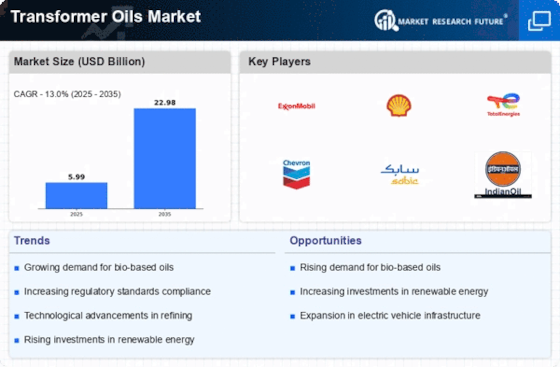
<p>The Transformer Oils Market was valued at 5.99 USD Billion in 2024.</p>

What is the projected market valuation for the Transformer Oils Market in 2035?

<p>The market is projected to reach 22.98 USD Billion by 2035.</p>

What is the expected CAGR for the Transformer Oils Market during the forecast period 2025 - 2035?

<p>The expected CAGR for the Transformer Oils Market during 2025 - 2035 is 13.0%.</p>

Which type of transformer oil segment had the highest valuation in 2024?

<p>In 2024, the Paraffinic Oil segment had the highest valuation at 2.39 USD Billion.</p>

What is the projected valuation for the Naphthenic Oil segment by 2035?

<p>The Naphthenic Oil segment is projected to reach 6.92 USD Billion by 2035.</p>

Which application segment is expected to grow the most by 2035?

<p>The Large Transformers application segment is expected to grow significantly, reaching 11.49 USD Billion by 2035.</p>

Who are the key players in the Transformer Oils Market?

Key players in the market include ExxonMobil, Shell, TotalEnergies, Chevron, and SABIC.

What is the valuation of the Bio-Based Oil segment in 2024?

The Bio-Based Oil segment was valued at 0.59 USD Billion in 2024.

How does the valuation of Small Transformers compare to Large Transformers in 2024?

In 2024, the valuation for Small Transformers was 1.2 USD Billion, compared to 2.99 USD Billion for Large Transformers.

What is the expected growth trend for the Transformer Oils Market in the coming years?

The Transformer Oils Market is expected to experience robust growth, driven by a CAGR of 13.0% from 2025 to 2035.

Market Summary

As per Market Research Future analysis, the Transformer Oils Market Size was estimated at 3.01 USD Billion in 2024. The Transformer Oils industry is projected to grow from 3.2 USD Billion in 2025 to 5.3 USD Billion by 2035, exhibiting a compound annual growth rate (CAGR) of 5.21% during the forecast period 2025 - 2035.

Key Market Trends & Highlights

The Transformer Oils Market is experiencing a dynamic shift towards sustainable and innovative solutions.

  • The market is witnessing a notable shift towards bio-based oils, reflecting a growing preference for environmentally friendly alternatives. North America is the fastest-growing region, projected to expand at a CAGR of around 10.6% through 2034, supported by technological advancements and increasing adoption of high-performance and sustainable lubricant solutions. Asia-Pacific is the dominant region, accounting for a 47.7% share in 2025, driven by rapid industrialization, expanding manufacturing activities, and strong demand across automotive and industrial sectors. Bio-based ester oils are the fastest-growing product segment, expected to grow at a CAGR of approximately 10.2% through 2033, driven by rising environmental concerns and increasing demand for sustainable and biodegradable lubricant alternatives.

Market Size & Forecast

Largest Regional Market Share in 2024 Asia Pacific

Major Players

Nynas AB, Shell plc, Valvoline Inc., PetroChina Lubricant, Savita Oil Technologies, Engen Petroleum Ltd., Hydro-Québec, PetroChina Lubricant

Market Trends

The Transformer Oils Market is currently experiencing a dynamic phase characterized by evolving consumer preferences and technological advancements. The demand for high-performance insulating oils is on the rise, driven by the increasing need for efficient energy transmission and distribution systems. This trend is further fueled by the global shift towards renewable energy sources, which necessitates the use of reliable and effective transformer oils to ensure optimal performance and longevity of electrical equipment. Additionally, the growing emphasis on sustainability and environmental protection is prompting manufacturers to innovate and develop eco-friendly alternatives, thereby reshaping the competitive landscape of the market and influencing overall transformer oil market share. , regulatory frameworks are becoming more stringent, compelling industry players to adhere to higher standards of quality and safety. This regulatory pressure is likely to drive investments in research and development, leading to the introduction of advanced formulations that enhance the performance characteristics of transformer oils and contribute to expanding the transformer oil market size. As the market continues to evolve, stakeholders must remain vigilant and adaptable to these changes, ensuring they meet the demands of a rapidly transforming energy sector, as highlighted in recent transformer oil market analysis. The future of the Transformer Oils Market appears promising, with opportunities for growth and innovation on the horizon across the broader transformer oil market.

Shift Towards Bio-Based Oils

There is a noticeable trend towards the adoption of bio-based transformer oils, which are derived from renewable resources. This shift is largely influenced by the increasing awareness of environmental sustainability and the need for reducing carbon footprints. Bio-based oils offer comparable performance to traditional mineral oils while presenting a lower environmental impact, making them an attractive alternative for many utilities.

Technological Advancements in Oil Formulations

Innovations in oil formulations are emerging as a key trend within the Transformer Oils Market. Manufacturers are investing in research to develop oils with enhanced thermal stability and improved dielectric properties. These advancements not only improve the efficiency of transformers but also extend their operational lifespan, thereby providing long-term cost benefits to users.

Growing Demand in Emerging Markets

Emerging markets are witnessing a surge in demand for transformer oils, driven by rapid industrialization and urbanization. As these regions expand their electrical infrastructure, the need for reliable insulating oils becomes increasingly critical. This trend presents significant opportunities for manufacturers to penetrate new markets and establish a strong presence in regions with high growth potential.

Transformer Oil Market Market Drivers

Expansion of Power Generation Capacity

The Transformer Oils Market Industry is closely linked to the expansion of power generation capacity across various regions. As nations invest in new power plants and upgrade existing facilities, the demand for transformers and, consequently, transformer oils is expected to rise. This expansion is driven by the need to meet increasing energy consumption and to support economic growth. Data suggests that the global power generation capacity is projected to increase by over 3% annually, which will likely lead to a corresponding increase in the demand for transformer oils. This trend underscores the critical role of transformer oils in supporting the energy infrastructure.

Increasing Demand for Renewable Energy Sources

The Transformer Oils Market Industry is experiencing a notable shift towards renewable energy sources, which is driving the demand for transformer oils. As countries strive to meet their renewable energy targets, the need for efficient energy transmission becomes paramount. This has led to an increase in the installation of transformers, which in turn boosts the demand for transformer oils. According to recent data, the market for transformer oils is projected to grow at a compound annual growth rate of approximately 5.2% over the next few years. This trend indicates a robust market environment, as utilities and energy companies invest in infrastructure to support renewable energy initiatives.

Technological Innovations in Transformer Design

The Transformer Oils Market Industry is benefiting from technological innovations in transformer design, which enhance the efficiency and performance of transformers. Advanced materials and designs are being developed to improve heat dissipation and reduce losses, thereby increasing the demand for high-quality transformer oils. These innovations are crucial as they allow for the operation of transformers at higher capacities and temperatures, necessitating the use of specialized oils that can withstand these conditions. The integration of smart technologies in transformers is also contributing to the growth of the transformer oils market, as these systems require reliable and efficient cooling solutions.

Regulatory Compliance and Environmental Standards

The Transformer Oil Industry is significantly influenced by stringent regulatory compliance and environmental standards. Governments are increasingly implementing regulations that mandate the use of environmentally friendly transformer oils, which has led to a rise in the adoption of bio-based and less harmful oil formulations. This shift not only aligns with The Transformer Oils for transformer oils that meet these standards. The market is expected to witness a surge in demand for eco-friendly transformer oils, as companies seek to comply with regulations while minimizing their environmental footprint. This regulatory landscape is likely to shape the future of the transformer oils market.

Rising Urbanization and Infrastructure Development

The Transformer Oils Market Industry is significantly impacted by rising urbanization and infrastructure development. As urban areas expand, the demand for reliable electricity supply increases, necessitating the installation of new transformers. This urban growth is accompanied by a surge in construction projects, which further drives the need for transformers and transformer oils. The market is likely to see a steady increase in demand as urbanization trends continue, with projections indicating that urban populations will grow by approximately 2 billion by 2050. This demographic shift will create substantial opportunities for the transformer oils market, as utilities and developers seek to enhance their energy distribution networks.

Market Segment Insights

By Type: Paraffinic Oil (Largest) vs. Bio-Based Oil (Fastest-Growing)

In the Transformer Oils Market, the share distribution among different types of oils reveals that Paraffinic Oil has established itself as the leading segment, primarily due to its widely recognized efficiency and compatibility with various transformer designs. Naphthenic Oil follows closely, appealing to users seeking oils with specific performance attributes under varying temperature ranges. Bio-Based Oil is emerging with significant interest from eco-conscious sectors, while Silicone Oil, though niche, holds promise for specialized applications requiring extreme environmental resistance. <br>Bio-based ester oil is the fastest-growing product segment, projected to expand at a CAGR of around 10.2% through 2033, supported by its biodegradable nature, high fire resistance, and increasing adoption across environmentally sensitive applications in developed regions.Application

Paraffinic Oil (Dominant) vs. Bio-Based Oil (Emerging)

<a href="https://www.marketresearchfuture.com/reports/paraffin-oil-market-39915">Paraffinic Oil</a> is recognized for its excellent dielectric strength and thermal stability, making it the preferred choice among manufacturers and utilities for transformer insulation. This oil type is known for its high compatibility with conventional transformers and its ability to operate efficiently under diverse climatic conditions. In contrast, <a href="https://www.marketresearchfuture.com/reports/bio-lubricants-market-2010">Bio-Based Oil</a> is gaining traction as sustainability becomes a priority for many industries. It is derived from renewable resources and offers a lower environmental impact, appealing especially to organizations seeking to enhance their green credentials. While still growing in market share, Bio-Based Oil represents a forward-looking alternative with potential for extensive adaptation in future transformer designs.

By Application: Large Transformers (Largest) vs. Small Transformers (Fastest-Growing)

In the Transformer Oils Market, the application segment is primarily composed of Large power transformers dominate the application segment, accounting for a 68.5% share, driven by their critical role in high-voltage transmission networks, while small transformers are the fastest-growing due to rising demand in distributed and renewable energy systems.<br>These transformers are integral to electricity distribution systems, requiring high-performance oils for efficiency. Small transformers, although they occupy a smaller share, are emerging rapidly due to the increasing demand for compact and efficient electrical devices, especially in renewable energy applications.

Large Transformers (Dominant) vs. Small Transformers (Emerging)

Large transformers are essential for high-voltage applications, playing a critical role in transmission networks and industrial usage. They require specially formulated transformer oils with excellent thermal properties and dielectric strength to ensure efficient operation and longevity. Meanwhile, small transformers, typically used in commercial and residential applications, are gaining momentum as industries seek more energy-efficient solutions. Their design caters to spaces where traditional large transformers are impractical, positioning them as an innovative alternative amidst growing environmental concerns and shifts towards sustainable energy.

Get more detailed insights about Transformer Oil Market Research Report – Forecast to 2035

Regional Insights

By region, the study provides market insights into North America, Europe, Asia-Pacific, and the Rest of the World. The Asia-Pacific region has emerged as the largest market for transformer oils, driven by rapid industrialization and urbanization in countries such as China and India. The growing demand for electricity and the increasing investments in infrastructure development, particularly in the power sector, has contributed to the growth of the transformer oils market in the region. 

Asia-Pacific is the largest regional market, valued at USD 1.47 billion in 2025 and projected to reach USD 1.61 billion in 2026, holding a 47.7% share, driven by investments from China State Grid, India’s RDSS and HVDC programs, and rapid industrialization across Southeast Asia.

In addition, the increasing adoption of renewable energy sources, such as solar and wind power, is also expected to drive the demand for transformer oils in the region. This is because renewable energy sources require a significant amount of transformers and other electrical equipment to transmit and distribute power.

Further, the major countries studied in the market report are The U.S., Canada, Germany, France, the UK, Italy, Spain, China, Japan, India, Australia, South Korea, and Brazil

Europe holds a 16.9% share, increasing from USD 0.52 billion in 2025 to USD 0.56 billion in 2026, driven by the EU Green Deal, Ecodesign transformer regulations, and growing adoption of bio-based transformer oils. driven by the mature power infrastructure in the region and the increasing investments in renewable energy sources. The region is also focusing on sustainability and environmental friendliness, which is driving the adoption of bio-based transformer oils in the region. Further, the Germany Transformer Oils market held the largest market share, and the UK Transformer Oils market was the fastest-growing market in the European region.

North America accounts for a 22.1% share, with the market growing from USD 0.68 billion in 2025 to USD 0.74 billion in 2026, supported by U.S. IRA-driven grid investments, expansion of data centers, and replacement of aging power infrastructure. This is driven by the well-established power infrastructure and the increasing demand for energy-efficient technologies. The region is also investing heavily in grid modernization and renewable energy sources, which is expected to drive the growth of the transformer oils market in the region. Moreover, the U.S. Transformer Oils market held the largest market share, and the Canada Transformer Oils market was the fastest-growing market in the North American region.

The Middle East & Africa region represents 7.8% of the market, expanding from USD 0.24 billion in 2025 to USD 0.26 billion in 2026, supported by large-scale power infrastructure development and new refinery-linked transmission networks.

Key Players and Competitive Insights

Major market players are spending a lot of money on R&D to increase their product lines, which will help the Transformer Oil market grow even more. Market participants are also taking a range of strategic initiatives to grow their worldwide footprint, with key market developments such as new product launches, contractual agreements, mergers and acquisitions, increased investments, and collaboration with other organizations. Competitors in the Transformer Oils industry must offer cost-effective items to expand and survive in an increasingly competitive and rising market environment. The major market players are investing a lot of money in R&D to expand their product lines, which will spur further market growth for Transformer Oils. With significant market development like new product releases, contractual agreements, mergers and acquisitions, increased investments, and collaboration with other organizations, market participants are also undertaking various strategic activities to expand their presence. To grow and thrive in a market climate that is becoming more competitive and growing, competitors in the Transformer Oils industry must offer affordable products. Manufacturing locally to cut operating costs is one of the main business tactics manufacturers use in the Transformer Oils industry to benefit customers and expand the market sector. Major Transformer Oils market players, including Nynas AB, Calumet Specialty Products, PetroChina Company, Hydrodec Group Plc., Engen Petroleum Limited, San Joaquin Refining, Ergon Inc., APAR Industries Limited, Sinopec Group, Cargill Inc., Valvoline Inc., Gandhar Oil Refining, and others, are attempting to increase market demand by funding R&D initiatives. Nynas AB is a Swedish company that produces and supplies specialty naphthenic oils and bitumen products. Nynas AB products are used in various industries, including the transformer oil industry, the chemical industry, and the asphalt industry. The company offers a range of transformer oils, including naphthenic and paraffinic oils, that are used in power transformers and other electrical equipment. Nynas AB is committed to sustainability and operates its business in an environmentally responsible manner. Calumet Specialty Products Partners, L.P. is a US-based company that produces and markets specialty hydrocarbon products. Calumet operates a network of manufacturing facilities across the United States and produces a wide range of products, including lubricating oils, solvents, waxes, and asphalt. The company offers transformer oils that are used in power transformers and other electrical equipment. Calumet is committed to sustainability and operates its business in a safe, environmentally responsible manner. The company also offers a range of bio-based transformer oils that are made from renewable sources.

Key Companies in the Transformer Oil Market include

Industry Developments

In May 2022, Nynas has announced a partnership with KONCAR to conduct a test of its NYTRO BIO 300X KONCAR instrument transformer.

In June 2023, the price of transformer oil increased by 5%. This was due to a combination of factors, including rising crude oil prices and increased demand for transformer oil from China.

In July 2023, the International Electrotechnical Commission (IEC) released a new standard for transformer oil. The new standard, IEC 60296-10, provides more stringent requirements for the performance of transformer oil.

In August 2023, the U.S. Department of Energy announced a new program to support the development of sustainable transformer oil. The program, called the Sustainable Transformer Oil Market Initiative, will provide funding for research and development of new transformer oil technologies.

In July 2025, Shell plc completed the acquisition of Raj Petro Specialities India, strengthening its local transformer oil production and specialty blending capabilities, enabling deeper market penetration across India and the broader Asia-Pacific region.

In February 2025, the European Union approved new transformer energy performance regulations, setting stricter efficiency and greenhouse gas reduction targets, thereby accelerating demand for advanced and low-loss transformer oil formulations across the region. 


Future Outlook

Transformer Oil Market Future Outlook

The Transformer Oil Market is projected to grow at a 5.21% CAGR from 2025 to 2035, driven by increasing demand for renewable energy and advancements in electrical infrastructure.

New opportunities lie in:

  • <p>Development of biodegradable transformer oils for eco-friendly applications. Expansion into emerging markets with tailored product offerings. Investment in advanced refining technologies to enhance oil performance.</p>

By 2035, the Transformer Oils Market is expected to achieve robust growth, reflecting evolving industry needs.

Market Segmentation

Transformer Oil Market Type Outlook

  • Naphthenic Oil
  • Paraffinic Oil
  • Bio-Based Oil
  • Silicone Oil

Transformer Oil Market Application Outlook

  • Large Transformers
  • Small Transformers
  • Utility
  • Others

Report Scope

MARKET SIZE 2024 3.01(USD Billion)
MARKET SIZE 2025 3.2(USD Billion)
MARKET SIZE 2035 5.3(USD Billion)
COMPOUND ANNUAL GROWTH RATE (CAGR) 5.21% (2025 - 2035)
REPORT COVERAGE Revenue Forecast, Competitive Landscape, Growth Factors, and Trends
BASE YEAR 2024
Market Forecast Period 2025 - 2035
Historical Data 2019 - 2024
Market Forecast Units USD Billion
Key Companies Profiled Nynas AB, Shell plc, Valvoline Inc., PetroChina Lubricant, Savita Oil Technologies, Engen Petroleum Ltd., Hydro-Québec, PetroChina Lubricant
Segments Covered Type, Application, Region
Key Market Opportunities Adoption of bio-based transformer oils driven by sustainability regulations and consumer demand for eco-friendly solutions.
Key Market Dynamics Rising demand for environmentally friendly transformer oils drives innovation and regulatory changes in the energy sector.
Countries Covered North America, Europe, APAC, South America, MEA

FAQs

What is the current valuation of the Transformer Oils Market as of 2024?

<p>The Transformer Oils Market was valued at 5.99 USD Billion in 2024.</p>

What is the projected market valuation for the Transformer Oils Market in 2035?

<p>The market is projected to reach 22.98 USD Billion by 2035.</p>

What is the expected CAGR for the Transformer Oils Market during the forecast period 2025 - 2035?

<p>The expected CAGR for the Transformer Oils Market during 2025 - 2035 is 13.0%.</p>

Which type of transformer oil segment had the highest valuation in 2024?

<p>In 2024, the Paraffinic Oil segment had the highest valuation at 2.39 USD Billion.</p>

What is the projected valuation for the Naphthenic Oil segment by 2035?

<p>The Naphthenic Oil segment is projected to reach 6.92 USD Billion by 2035.</p>

Which application segment is expected to grow the most by 2035?

<p>The Large Transformers application segment is expected to grow significantly, reaching 11.49 USD Billion by 2035.</p>

Who are the key players in the Transformer Oils Market?

Key players in the market include ExxonMobil, Shell, TotalEnergies, Chevron, and SABIC.

What is the valuation of the Bio-Based Oil segment in 2024?

The Bio-Based Oil segment was valued at 0.59 USD Billion in 2024.

How does the valuation of Small Transformers compare to Large Transformers in 2024?

In 2024, the valuation for Small Transformers was 1.2 USD Billion, compared to 2.99 USD Billion for Large Transformers.

What is the expected growth trend for the Transformer Oils Market in the coming years?

The Transformer Oils Market is expected to experience robust growth, driven by a CAGR of 13.0% from 2025 to 2035.

  1. SECTION I: EXECUTIVE SUMMARY AND KEY HIGHLIGHTS |
    1. EXECUTIVE SUMMARY | |
      1. Market Overview | |
      2. Key Findings | |
      3. Market Segmentation | |
      4. Competitive Landscape | |
      5. Challenges and Opportunities | |
      6. Future Outlook 2
  2. SECTION II: SCOPING, METHODOLOGY AND MARKET STRUCTURE |
    1. MARKET INTRODUCTION | |
      1. Definition | |
      2. Scope of the study | | |
    2. RESEARCH METHODOLOGY | |
      1. Overview | |
      2. Data Mining | |
      3. Secondary Research | |
      4. Primary Research | | |
      5. Forecasting Model | |
      6. Market Size Estimation | | |
      7. Data Triangulation | |
      8. Validation 3
  3. SECTION III: QUALITATIVE ANALYSIS |
    1. MARKET DYNAMICS | |
      1. Overview | |
      2. Drivers | |
      3. Restraints | |
      4. Opportunities |
    2. MARKET FACTOR ANALYSIS | |
      1. Value chain Analysis | |
      2. Porter's Five Forces Analysis | | |
      3. COVID-19 Impact Analysis | | |
  4. SECTION IV: QUANTITATIVE ANALYSIS |
    1. Chemicals and Materials, BY Type (USD Billion) | |
      1. Naphthenic Oil | |
      2. Paraffinic Oil | |
      3. Bio-Based Oil | |
      4. Silicone Oil |
    2. Chemicals and Materials, BY Application (USD Billion) | |
      1. Large Transformers | |
      2. Small Transformers | |
      3. Utility | |
      4. Others |
    3. Chemicals and Materials, BY Region (USD Billion) | |
      1. North America | | |
      2. Europe | | |
      3. APAC | | |
      4. South America | | |
      5. MEA | | |
  5. SECTION V: COMPETITIVE ANALYSIS |
    1. Competitive Landscape | |
      1. Overview | |
      2. Competitive Analysis | |
      3. Market share Analysis | |
      4. Major Growth Strategy in the Chemicals and Materials | |
      5. Competitive Benchmarking | |
      6. Leading Players in Terms of Number of Developments in the Chemicals and Materials | |
      7. Key developments and growth strategies | | |
      8. Major Players Financial Matrix | | |
    2. Company Profiles | |
      1. ExxonMobil (US) | | |
      2. Shell (GB) | | |
      3. TotalEnergies (FR) | | |
      4. Chevron (US) | | |
      5. SABIC (SA) | | |
      6. Indian Oil Corporation (IN) | | |
      7. Petrobras (BR) | | |
      8. Nynas (SE) | | |
      9. Castrol (GB) | | |
    3. Appendix | |
      1. References | |
      2. Related Reports 6 LIST OF FIGURES |
    4. MARKET SYNOPSIS |
    5. NORTH AMERICA MARKET ANALYSIS |
    6. US MARKET ANALYSIS BY TYPE |
    7. US MARKET ANALYSIS BY APPLICATION |
    8. CANADA MARKET ANALYSIS BY TYPE |
    9. CANADA MARKET ANALYSIS BY APPLICATION |
    10. EUROPE MARKET ANALYSIS |
    11. GERMANY MARKET ANALYSIS BY TYPE |
    12. GERMANY MARKET ANALYSIS BY APPLICATION |
    13. UK MARKET ANALYSIS BY TYPE |
    14. UK MARKET ANALYSIS BY APPLICATION |
    15. FRANCE MARKET ANALYSIS BY TYPE |
    16. FRANCE MARKET ANALYSIS BY APPLICATION |
    17. RUSSIA MARKET ANALYSIS BY TYPE |
    18. RUSSIA MARKET ANALYSIS BY APPLICATION |
    19. ITALY MARKET ANALYSIS BY TYPE |
    20. ITALY MARKET ANALYSIS BY APPLICATION |
    21. SPAIN MARKET ANALYSIS BY TYPE |
    22. SPAIN MARKET ANALYSIS BY APPLICATION |
    23. REST OF EUROPE MARKET ANALYSIS BY TYPE |
    24. REST OF EUROPE MARKET ANALYSIS BY APPLICATION |
    25. APAC MARKET ANALYSIS |
    26. CHINA MARKET ANALYSIS BY TYPE |
    27. CHINA MARKET ANALYSIS BY APPLICATION |
    28. INDIA MARKET ANALYSIS BY TYPE |
    29. INDIA MARKET ANALYSIS BY APPLICATION |
    30. JAPAN MARKET ANALYSIS BY TYPE |
    31. JAPAN MARKET ANALYSIS BY APPLICATION |
    32. SOUTH KOREA MARKET ANALYSIS BY TYPE |
    33. SOUTH KOREA MARKET ANALYSIS BY APPLICATION |
    34. MALAYSIA MARKET ANALYSIS BY TYPE |
    35. MALAYSIA MARKET ANALYSIS BY APPLICATION |
    36. THAILAND MARKET ANALYSIS BY TYPE |
    37. THAILAND MARKET ANALYSIS BY APPLICATION |
    38. INDONESIA MARKET ANALYSIS BY TYPE |
    39. INDONESIA MARKET ANALYSIS BY APPLICATION |
    40. REST OF APAC MARKET ANALYSIS BY TYPE |
    41. REST OF APAC MARKET ANALYSIS BY APPLICATION |
    42. SOUTH AMERICA MARKET ANALYSIS |
    43. BRAZIL MARKET ANALYSIS BY TYPE |
    44. BRAZIL MARKET ANALYSIS BY APPLICATION |
    45. MEXICO MARKET ANALYSIS BY TYPE |
    46. MEXICO MARKET ANALYSIS BY APPLICATION |
    47. ARGENTINA MARKET ANALYSIS BY TYPE |
    48. ARGENTINA MARKET ANALYSIS BY APPLICATION |
    49. REST OF SOUTH AMERICA MARKET ANALYSIS BY TYPE |
    50. REST OF SOUTH AMERICA MARKET ANALYSIS BY APPLICATION |
    51. MEA MARKET ANALYSIS |
    52. GCC COUNTRIES MARKET ANALYSIS BY TYPE |
    53. GCC COUNTRIES MARKET ANALYSIS BY APPLICATION |
    54. SOUTH AFRICA MARKET ANALYSIS BY TYPE |
    55. SOUTH AFRICA MARKET ANALYSIS BY APPLICATION |
    56. REST OF MEA MARKET ANALYSIS BY TYPE |
    57. REST OF MEA MARKET ANALYSIS BY APPLICATION |
    58. KEY BUYING CRITERIA OF CHEMICALS AND MATERIALS |
    59. RESEARCH PROCESS OF MRFR |
    60. DRO ANALYSIS OF CHEMICALS AND MATERIALS |
    61. DRIVERS IMPACT ANALYSIS: CHEMICALS AND MATERIALS |
    62. RESTRAINTS IMPACT ANALYSIS: CHEMICALS AND MATERIALS |
    63. SUPPLY / VALUE CHAIN: CHEMICALS AND MATERIALS |
    64. CHEMICALS AND MATERIALS, BY TYPE, 2024 (% SHARE) |
    65. CHEMICALS AND MATERIALS, BY TYPE, 2024 TO 2035 (USD Billion) |
    66. CHEMICALS AND MATERIALS, BY APPLICATION, 2024 (% SHARE) |
    67. CHEMICALS AND MATERIALS, BY APPLICATION, 2024 TO 2035 (USD Billion) |
    68. BENCHMARKING OF MAJOR COMPETITORS 7 LIST OF TABLES |
    69. LIST OF ASSUMPTIONS | |
      1. |
    70. North America MARKET SIZE ESTIMATES; FORECAST | |
      1. BY TYPE, 2025-2035 (USD Billion) | |
      2. BY APPLICATION, 2025-2035 (USD Billion) |
    71. US MARKET SIZE ESTIMATES; FORECAST | |
      1. BY TYPE, 2025-2035 (USD Billion) | |
      2. BY APPLICATION, 2025-2035 (USD Billion) |
    72. Canada MARKET SIZE ESTIMATES; FORECAST | |
      1. BY TYPE, 2025-2035 (USD Billion) | |
      2. BY APPLICATION, 2025-2035 (USD Billion) |
    73. Europe MARKET SIZE ESTIMATES; FORECAST | |
      1. BY TYPE, 2025-2035 (USD Billion) | |
      2. BY APPLICATION, 2025-2035 (USD Billion) |
    74. Germany MARKET SIZE ESTIMATES; FORECAST | |
      1. BY TYPE, 2025-2035 (USD Billion) | |
      2. BY APPLICATION, 2025-2035 (USD Billion) |
    75. UK MARKET SIZE ESTIMATES; FORECAST | |
      1. BY TYPE, 2025-2035 (USD Billion) | |
      2. BY APPLICATION, 2025-2035 (USD Billion) |
    76. France MARKET SIZE ESTIMATES; FORECAST | |
      1. BY TYPE, 2025-2035 (USD Billion) | |
      2. BY APPLICATION, 2025-2035 (USD Billion) |
    77. Russia MARKET SIZE ESTIMATES; FORECAST | |
      1. BY TYPE, 2025-2035 (USD Billion) | |
      2. BY APPLICATION, 2025-2035 (USD Billion) |
    78. Italy MARKET SIZE ESTIMATES; FORECAST | |
      1. BY TYPE, 2025-2035 (USD Billion) | |
      2. BY APPLICATION, 2025-2035 (USD Billion) |
    79. Spain MARKET SIZE ESTIMATES; FORECAST | |
      1. BY TYPE, 2025-2035 (USD Billion) | |
      2. BY APPLICATION, 2025-2035 (USD Billion) |
    80. Rest of Europe MARKET SIZE ESTIMATES; FORECAST | |
      1. BY TYPE, 2025-2035 (USD Billion) | |
      2. BY APPLICATION, 2025-2035 (USD Billion) |
    81. APAC MARKET SIZE ESTIMATES; FORECAST | |
      1. BY TYPE, 2025-2035 (USD Billion) | |
      2. BY APPLICATION, 2025-2035 (USD Billion) |
    82. China MARKET SIZE ESTIMATES; FORECAST | |
      1. BY TYPE, 2025-2035 (USD Billion) | |
      2. BY APPLICATION, 2025-2035 (USD Billion) |
    83. India MARKET SIZE ESTIMATES; FORECAST | |
      1. BY TYPE, 2025-2035 (USD Billion) | |
      2. BY APPLICATION, 2025-2035 (USD Billion) |
    84. Japan MARKET SIZE ESTIMATES; FORECAST | |
      1. BY TYPE, 2025-2035 (USD Billion) | |
      2. BY APPLICATION, 2025-2035 (USD Billion) |
    85. South Korea MARKET SIZE ESTIMATES; FORECAST | |
      1. BY TYPE, 2025-2035 (USD Billion) | |
      2. BY APPLICATION, 2025-2035 (USD Billion) |
    86. Malaysia MARKET SIZE ESTIMATES; FORECAST | |
      1. BY TYPE, 2025-2035 (USD Billion) | |
      2. BY APPLICATION, 2025-2035 (USD Billion) |
    87. Thailand MARKET SIZE ESTIMATES; FORECAST | |
      1. BY TYPE, 2025-2035 (USD Billion) | |
      2. BY APPLICATION, 2025-2035 (USD Billion) |
    88. Indonesia MARKET SIZE ESTIMATES; FORECAST | |
      1. BY TYPE, 2025-2035 (USD Billion) | |
      2. BY APPLICATION, 2025-2035 (USD Billion) |
    89. Rest of APAC MARKET SIZE ESTIMATES; FORECAST | |
      1. BY TYPE, 2025-2035 (USD Billion) | |
      2. BY APPLICATION, 2025-2035 (USD Billion) |
    90. South America MARKET SIZE ESTIMATES; FORECAST | |
      1. BY TYPE, 2025-2035 (USD Billion) | |
      2. BY APPLICATION, 2025-2035 (USD Billion) |
    91. Brazil MARKET SIZE ESTIMATES; FORECAST | |
      1. BY TYPE, 2025-2035 (USD Billion) | |
      2. BY APPLICATION, 2025-2035 (USD Billion) |
    92. Mexico MARKET SIZE ESTIMATES; FORECAST | |
      1. BY TYPE, 2025-2035 (USD Billion) | |
      2. BY APPLICATION, 2025-2035 (USD Billion) |
    93. Argentina MARKET SIZE ESTIMATES; FORECAST | |
      1. BY TYPE, 2025-2035 (USD Billion) | |
      2. BY APPLICATION, 2025-2035 (USD Billion) |
    94. Rest of South America MARKET SIZE ESTIMATES; FORECAST | |
      1. BY TYPE, 2025-2035 (USD Billion) | |
      2. BY APPLICATION, 2025-2035 (USD Billion) |
    95. MEA MARKET SIZE ESTIMATES; FORECAST | |
      1. BY TYPE, 2025-2035 (USD Billion) | |
      2. BY APPLICATION, 2025-2035 (USD Billion) |
    96. GCC Countries MARKET SIZE ESTIMATES; FORECAST | |
      1. BY TYPE, 2025-2035 (USD Billion) | |
      2. BY APPLICATION, 2025-2035 (USD Billion) |
    97. South Africa MARKET SIZE ESTIMATES; FORECAST | |
      1. BY TYPE, 2025-2035 (USD Billion) | |
      2. BY APPLICATION, 2025-2035 (USD Billion) |
    98. Rest of MEA MARKET SIZE ESTIMATES; FORECAST | |
      1. BY TYPE, 2025-2035 (USD Billion) | |
      2. BY APPLICATION, 2025-2035 (USD Billion) |
    99. PRODUCT LAUNCH/PRODUCT DEVELOPMENT/APPROVAL | |
      1. |
    100. ACQUISITION/PARTNERSHIP | |

Chemicals and Materials Market Segmentation

Chemicals and Materials By Type (USD Billion, 2025-2035)

  • Naphthenic Oil
  • Paraffinic Oil
  • Bio-Based Oil
  • Silicone Oil

Chemicals and Materials By Application (USD Billion, 2025-2035)

  • Large Transformers
  • Small Transformers
  • Utility
  • Others
Infographic

Free Sample Request

Kindly complete the form below to receive a free sample of this Report

Get Free Sample

Customer Strories

Compare Licence

×
Features License Type
Single User Multiuser License Enterprise User
Price $4,950 $5,950 $7,250
Maximum User Access Limit 1 User Upto 10 Users Unrestricted Access Throughout the Organization
Free Customization
Direct Access to Analyst
Deliverable Format
Platform Access
Discount on Next Purchase 10% 15% 15%
Printable Versions