Request Free Sample ×

Kindly complete the form below to receive a free sample of this Report

* Please use a valid business email

Leading companies partner with us for data-driven Insights

clients tt-cursor
Hero Background
English
Chinese
French
Japanese
Korean
German
Spanish

Thyristor Protectors Market Share

ID: MRFR/SEM/15661-HCR
128 Pages
Ankit Gupta
Last Updated: April 06, 2026

Thyristor Protectors Market Size, Share and Research Report By Type (Direction Type, Mounting Type, and Others), By Application (Consumer Electronics, Medical Equipment, Telecommunication, Utility, and Power Distribution and Others), And By Region (North America, Europe, Asia-Pacific, And Rest Of The World) –Industry Forecast Till 2035

Share:
Download PDF ×

We do not share your information with anyone. However, we may send you emails based on your report interest from time to time. You may contact us at any time to opt-out.

Thyristor Protectors Market Infographic
Purchase Options

Market Share

Thyristor Protectors Market Share Analysis

In the competitive landscape of the Thyristor Protectors market, market share positioning strategies play a pivotal role in determining the success and sustainability of companies within the industry. One key strategy employed by market players is product differentiation. Companies seek to distinguish their thyristor protectors by integrating innovative features, enhancing performance, and addressing specific customer needs. This approach not only allows for a competitive edge but also fosters brand loyalty as customers recognize the unique value proposition offered by a particular brand.

Pricing strategies are equally instrumental in market share positioning. Some companies adopt a cost leadership approach, aiming to offer thyristor protectors at competitive prices to capture a larger market share. On the other hand, premium pricing strategies are also prevalent, with certain manufacturers positioning their products as high-end solutions with advanced features, targeting niche markets willing to pay a premium for superior performance and reliability. Striking the right balance between pricing and product features is critical for companies to effectively position themselves in the market and attract a diverse customer base.

Distribution channels are another integral aspect of market share positioning. Efficient and widespread distribution networks ensure that thyristor protectors reach end-users promptly and reliably. Companies often collaborate with distributors and establish partnerships to expand their reach into different geographical regions. Moreover, online platforms have become increasingly popular for product distribution, allowing companies to reach a global audience and streamline the purchasing process. An effective distribution strategy contributes significantly to a company's market share by ensuring accessibility and availability to a wide range of customers.

Strategic collaborations and partnerships are common tactics employed by market players to enhance their market share positioning. Teaming up with other companies, whether in the same industry or complementary sectors, can lead to synergies that benefit both parties. Joint ventures, research and development partnerships, and strategic alliances enable companies to pool resources, share expertise, and collectively address market challenges. By leveraging the strengths of multiple entities, companies can enhance their competitive position and gain a larger market share.

Brand building and marketing efforts are crucial components of market share positioning strategies. Establishing a strong brand identity not only enhances a company's reputation but also influences customer perceptions. Effective marketing campaigns, both online and offline, create awareness and communicate the unique value proposition of thyristor protectors. Brand recognition and positive associations contribute to customer trust and loyalty, driving market share growth over time.

Adaptability and responsiveness to market trends and customer preferences are paramount for maintaining and expanding market share. Companies that stay attuned to emerging technologies, industry developments, and changing customer needs can proactively adjust their strategies and offerings. Flexibility in adapting to market dynamics allows companies to seize opportunities and mitigate potential challenges, ensuring a resilient market share position.

Lastly, customer support and after-sales services play a vital role in market share positioning. Providing excellent customer service, including technical support, warranty programs, and product training, fosters customer satisfaction and loyalty. Satisfied customers are more likely to become repeat buyers and advocates for a particular brand, positively influencing market share.


Author
Author Profile
Ankit Gupta
Team Lead - Research

Ankit Gupta is a seasoned market intelligence and strategic research professional with over six plus years of experience in the ICT and Semiconductor industries. With academic roots in Telecom, Marketing, and Electronics, he blends technical insight with business strategy. Ankit has led 200+ projects, including work for Fortune 500 clients like Microsoft and Rio Tinto, covering market sizing, tech forecasting, and go-to-market strategies. Known for bridging engineering and enterprise decision-making, his insights support growth, innovation, and investment planning across diverse technology markets.

Leave a Comment

FAQs

What is the projected market valuation of the Thyristor Protectors Market by 2035?

<p>The Thyristor Protectors Market is projected to reach a valuation of 0.9795 USD Billion by 2035.</p>

What was the market valuation of the Thyristor Protectors Market in 2024?

<p>In 2024, the Thyristor Protectors Market had a valuation of 0.5775 USD Billion.</p>

What is the expected CAGR for the Thyristor Protectors Market during the forecast period 2025 - 2035?

<p>The expected CAGR for the Thyristor Protectors Market during the forecast period 2025 - 2035 is 4.92%.</p>

Which companies are considered key players in the Thyristor Protectors Market?

<p>Key players in the Thyristor Protectors Market include ABB, Schneider Electric, Siemens, Mitsubishi Electric, General Electric, Eaton, Rockwell Automation, Infineon Technologies, and ON Semiconductor.</p>

What are the main application segments of the Thyristor Protectors Market?

<p>The main application segments include Consumer Electronics, Medical Equipment, Telecommunication, Utility and Power Distribution, and Others.</p>

What was the valuation of the Thyristor Protectors Market segment for Consumer Electronics in 2024?

<p>In 2024, the valuation for the Consumer Electronics segment of the Thyristor Protectors Market was between 0.1155 and 0.1955 USD Billion.</p>

How does the Thyristor Protectors Market segment for Utility and Power Distribution perform?

The Utility and Power Distribution segment is valued between 0.1155 and 0.1955 USD Billion in 2024.

What is the projected growth trend for the Thyristor Protectors Market from 2025 to 2035?

The Thyristor Protectors Market is expected to experience steady growth, with a projected CAGR of 4.92% from 2025 to 2035.

What was the valuation of the Thyristor Protectors Market segment for Medical Equipment in 2024?

The Medical Equipment segment of the Thyristor Protectors Market was valued between 0.0865 and 0.1455 USD Billion in 2024.

What are the projected valuations for the Thyristor Protectors Market segment categorized as 'Others'?

The 'Others' segment is projected to have valuations ranging from 0.231 to 0.4098 USD Billion in 2024.

Market Summary

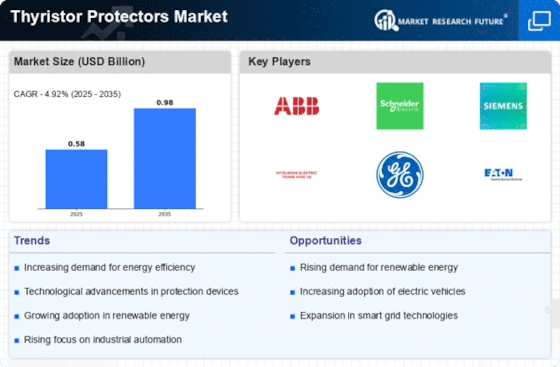
As per Market Research Future analysis, the Thyristor Protectors Market Size was estimated at 0.5775 USD Billion in 2024. The Thyristor Protectors industry is projected to grow from USD 0.6059 Billion in 2025 to USD 0.9795 Billion by 2035, exhibiting a compound annual growth rate (CAGR) of 4.92% during the forecast period 2025 - 2035

Key Market Trends & Highlights

The Thyristor Protectors Market is poised for substantial growth driven by technological advancements and increasing demand across various sectors.

  • North America remains the largest market for thyristor protectors, driven by robust industrial applications and technological innovations. The Asia-Pacific region is emerging as the fastest-growing market, fueled by rapid industrialization and increasing investments in renewable energy. In terms of segments, consumer electronics represent the largest share, while the medical equipment segment is experiencing the fastest growth due to rising healthcare demands. Key market drivers include the increasing adoption of electric vehicles and the expansion of renewable energy infrastructure, which are significantly influencing market dynamics.

Market Size & Forecast

2024 Market Size 0.5775 (USD Billion)
2035 Market Size 0.9795 (USD Billion)
CAGR (2025 - 2035) 4.92%
Largest Regional Market Share in 2024 North America

Major Players

ABB (CH), Schneider Electric (FR), Siemens (DE), Mitsubishi Electric (JP), General Electric (US), Eaton (IE), Rockwell Automation (US), Infineon Technologies (DE), ON Semiconductor (US)

Market Trends

The Thyristor Protectors Market is currently experiencing a notable evolution, driven by the increasing demand for reliable and efficient power management solutions across various industries. This market encompasses devices designed to safeguard thyristors from overvoltage and overcurrent conditions, thereby enhancing the longevity and performance of electronic systems. As industries continue to adopt advanced technologies, the need for robust protection mechanisms becomes paramount. The integration of thyristor protectors in applications such as renewable energy systems, electric vehicles, and industrial automation is indicative of a broader trend towards sustainable and efficient energy solutions. Moreover, the Thyristor Protectors Market is likely to witness significant advancements in product innovation and technological enhancements. Manufacturers are focusing on developing more compact, efficient, and cost-effective solutions to meet the evolving needs of end-users. The growing emphasis on energy efficiency and environmental sustainability is expected to further propel the adoption of these protective devices. As the market continues to mature, collaboration between stakeholders, including manufacturers, suppliers, and end-users, will play a crucial role in shaping the future landscape of the Thyristor Protectors Market. This collaborative approach may lead to the emergence of new applications and enhanced product offerings, ultimately benefiting a wide range of sectors.

Rising Demand for Renewable Energy Solutions

The Thyristor Protectors Market is witnessing an upsurge in demand due to the increasing integration of renewable energy sources. As solar and wind energy systems proliferate, the need for effective protection mechanisms to ensure system reliability becomes critical. Thyristor protectors play a vital role in safeguarding these systems from potential electrical faults, thereby enhancing their operational efficiency.

Technological Advancements in Protection Devices

Innovations in technology are driving the development of more sophisticated thyristor protectors. Manufacturers are focusing on creating devices that offer enhanced performance, compact designs, and improved energy efficiency. These advancements are likely to attract a broader range of applications, further expanding the Thyristor Protectors Market.

Growing Focus on Industrial Automation

The ongoing trend towards industrial automation is contributing to the expansion of the Thyristor Protectors Market. As industries increasingly adopt automated systems, the need for reliable protection against electrical disturbances becomes essential. Thyristor protectors are integral to ensuring the smooth operation of automated processes, thereby supporting the overall efficiency of industrial operations.

Thyristor Protectors Market Market Drivers

Increasing Adoption of Electric Vehicles

The Thyristor Protectors Market is experiencing a notable surge due to the increasing adoption of electric vehicles (EVs). As the automotive sector shifts towards electrification, the demand for efficient power management systems rises. Thyristor protectors play a crucial role in safeguarding the electrical components of EVs, ensuring reliability and longevity. The market for EVs is projected to grow at a compound annual growth rate (CAGR) of over 20% in the coming years, which could significantly bolster the Thyristor Protectors Market. This trend indicates a shift in consumer preferences towards sustainable transportation solutions, thereby driving the need for advanced protective devices in electric vehicles.

Rising Demand for Smart Grid Technologies

The Thyristor Protectors Market is poised for growth due to the rising demand for smart grid technologies. As utilities and energy providers seek to modernize their infrastructure, the integration of advanced protective devices becomes essential. Thyristor protectors are integral in ensuring the stability and reliability of smart grids, which are designed to optimize energy distribution and consumption. The Thyristor Protectors Market is anticipated to grow significantly, with investments in smart grid technologies expected to exceed hundreds of billions of dollars by 2025. This trend indicates a robust opportunity for the Thyristor Protectors Market to cater to the evolving needs of modern energy systems.

Expansion of Renewable Energy Infrastructure

The Thyristor Protectors Market is likely to benefit from the ongoing expansion of renewable energy infrastructure. As countries invest in solar, wind, and other renewable energy sources, the need for robust protection systems becomes paramount. Thyristor protectors are essential in managing the power flow and protecting against surges in renewable energy systems. The renewable energy sector is expected to witness substantial growth, with investments projected to reach trillions of dollars by 2030. This expansion not only enhances energy security but also drives the demand for reliable protective devices, positioning the Thyristor Protectors Market favorably in the evolving energy landscape.

Increased Focus on Industrial Safety Standards

The Thyristor Protectors Market is influenced by the increased focus on industrial safety standards across various sectors. As industries strive to enhance operational safety and minimize risks, the implementation of protective devices becomes critical. Thyristor protectors are essential in safeguarding equipment from electrical faults, thereby reducing downtime and maintenance costs. Regulatory bodies are continuously updating safety standards, which could lead to a heightened demand for reliable protective solutions. The industrial sector is projected to invest significantly in safety technologies, creating a favorable environment for the Thyristor Protectors Market to thrive in the coming years.

Technological Innovations in Power Electronics

The Thyristor Protectors Market is likely to experience growth driven by technological innovations in power electronics. Advances in semiconductor technology and materials are enhancing the performance and efficiency of thyristor protectors. These innovations enable the development of more compact and reliable protective devices, which are essential for modern applications. The power electronics market is expected to grow at a substantial rate, with projections indicating a market size reaching hundreds of billions of dollars by 2026. This growth presents a significant opportunity for the Thyristor Protectors Market to leverage new technologies and meet the evolving demands of various sectors.

Market Segment Insights

By Type: Direction Type (Largest) vs. Mounting Type (Fastest-Growing)

<p>In the Thyristor Protectors Market, the distribution of market share reflects a competitive landscape where Direction Type is the leading segment. This segment is preferred due to its versatility in various applications, capturing the majority of market interest. Mounting Type follows closely, with its own significant share as it caters to specific installation needs in diverse environments, influencing its uptake in recent years.</p>

<p>Direction Type (Dominant) vs. Mounting Type (Emerging)</p>

<p>Direction Type maintains a dominant position in the Thyristor Protectors Market, favored for its efficacy in controlling current flow in both AC and DC applications. Its well-established reputation, coupled with high-performance capabilities, makes it a preferred choice among manufacturers and users alike. On the other hand, Mounting Type, while emerging, is witnessing rapid growth as it adapts to the increasing demand for modular installations and ease of access for maintenance. This segment's adaptability to new technologies and compliance with evolving industry standards enhance its appeal, positioning it as a competitive player.</p>

By Application: Consumer Electronics (Largest) vs. Medical Equipment (Fastest-Growing)

<p>The Thyristor Protectors Market is significantly driven by its applications across various sectors. Consumer Electronics holds the largest share, largely due to the widespread adoption of electronic devices that require robust protection mechanisms. In contrast, the Medical Equipment segment is rapidly expanding as healthcare technologies evolve, necessitating high reliability and enhanced protective solutions to ensure the safe operation of sensitive medical devices. Growth trends within the Thyristor Protectors Market indicate that while Consumer Electronics remains a stronghold, the surging demand for advanced medical apparatus is propelling the Medical Equipment segment as the fastest-growing area. Factors contributing to this growth include increased investments in healthcare innovation, a rising focus on patient safety, and stringent regulatory requirements that pave the way for superior protective technologies.</p>

<p>Consumer Electronics (Dominant) vs. Medical Equipment (Emerging)</p>

<p>In the Thyristor Protectors Market, the Consumer Electronics segment stands out as the dominant application, reflecting the high volume of electronic devices deployed globally. This segment thrives on the necessity of safeguarding products such as smartphones, laptops, and home appliances from voltage spikes and electrical faults. On the other hand, the Medical Equipment sector represents an emerging market with significant growth potential. Advanced medical devices, driven by the latest innovations in telemedicine and diagnostic tools, are increasingly demanding reliable protection to ensure functional integrity and patient safety. As healthcare providers prioritize technological advancements, the integration of thyristor protectors becomes critical in minimizing risks associated with electrical failures.</p>

Get more detailed insights about Thyristor Protectors Market Research Report — Global Forecast till 2035

Regional Insights

North America : Technological Innovation Leader

North America is witnessing robust growth in the Thyristor Protectors Market, driven by increasing demand for energy-efficient solutions and advancements in semiconductor technology. The region holds approximately 40% of the global market share, making it the largest market. Regulatory support for renewable energy initiatives and smart grid technologies further catalyzes this growth, enhancing the adoption of thyristor protectors in various applications. The United States and Canada are the leading countries in this region, with significant investments from key players like General Electric and Rockwell Automation. The competitive landscape is characterized by a mix of established companies and innovative startups, all striving to enhance product offerings. The presence of major firms such as ABB and Siemens also contributes to a dynamic market environment, fostering continuous technological advancements.

Europe : Regulatory-Driven Market Growth

Europe is emerging as a significant player in the Thyristor Protectors Market, driven by stringent regulations aimed at enhancing energy efficiency and reducing carbon emissions. The region accounts for approximately 30% of the global market share, making it the second largest market. The European Union's Green Deal and various national policies are pivotal in promoting the adoption of advanced electrical components, including thyristor protectors, across multiple sectors. Germany, France, and the UK are the leading countries in this market, with a strong presence of key players like Siemens and Schneider Electric. The competitive landscape is marked by innovation and collaboration among industry leaders, focusing on developing cutting-edge technologies. The region's commitment to sustainability and energy transition is fostering a favorable environment for the growth of thyristor protectors, ensuring a steady demand in the coming years.

Asia-Pacific : Emerging Market Potential

The Asia-Pacific region is rapidly emerging as a key market for Thyristor Protectors Market, driven by industrialization, urbanization, and increasing energy demands. This region holds approximately 25% of the global market share, with countries like China and India leading the charge. Government initiatives promoting renewable energy and smart grid technologies are significant growth drivers, creating a favorable regulatory environment for thyristor protectors. China is the largest market in the region, supported by major investments in infrastructure and energy projects. India follows closely, with a growing focus on energy efficiency and sustainability. The competitive landscape features a mix of local and international players, including Mitsubishi Electric and Infineon Technologies, all vying for market share. The increasing adoption of electric vehicles and renewable energy sources further enhances the demand for thyristor protectors in this dynamic market.

Middle East and Africa : Resource-Rich Market Dynamics

The Middle East and Africa region is gradually developing its Thyristor Protectors Market, driven by increasing investments in infrastructure and energy projects. This region currently holds about 5% of the global market share, with potential for significant growth as countries focus on diversifying their energy sources and enhancing grid reliability. Regulatory frameworks are evolving to support renewable energy initiatives, which will likely boost the demand for thyristor protectors in the coming years. Leading countries in this region include South Africa and the UAE, where government initiatives are fostering a conducive environment for market growth. The competitive landscape is still emerging, with a few key players establishing their presence. Companies like Eaton and ON Semiconductor are beginning to tap into this market, focusing on innovative solutions tailored to local needs, which could drive future growth in the sector.

Key Players and Competitive Insights

Leading market players are investing heavily in the research and development in order to expand their product lines, which will help the Thyristor Protectors Market grow even more. Market players are also undertaking a variety of strategic activities to spread their global footprint, with important market developments including mergers and acquisitions, new product launches, contractual agreements, higher investments, and collaboration with other organizations. To spread and survive in a more competitive and rising market climate, the Thyristor Protectors industry must offer cost-effective items.
Manufacturing locally to minimize the operational costs is one of the key business tactics used by the manufacturers in the global Thyristor Protectors industry to benefit the clients and increase the market sector. In recent years, the Thyristor Protectors industry has offered some of the most significant advantages to several industries. Major players in the Thyristor Protectors Market, including Unictron Technologies Corporation, Diodes Incorporated, STMicroelectronics, Microchip Technology, ON Semiconductor, ProTek Devices, TE Connectivity, CYG Wayon, Shenzhen Ruilongyuan Electronics Co., Ltd, SSG Semiconductor, and others, are trying to increase market demand by investing in the research and development operations.
Eaton Corporation is the multinational power management company headquartered in Dublin, Ireland, with its operational headquarters in Beachwood, Ohio, USA. The company is a leader in electrical solutions, providing products and services for power distribution and control, circuit protection, lighting, and energy management. Eaton's electrical business serves a wide range of industries, including industrial, commercial, residential, and utility markets. Eaton Corporation is recognized for its commitment to innovation, sustainability, and corporate responsibility. The company has a strong reputation for developing technologies that enhance energy efficiency, reliability, and safety across various industries.
Eaton Corporation plc announced on October 4, 2023, that it had acquired Cooper Bussmann for US$5.9 billion. Cooper Bussmann is a leading provider of electrical protection and power distribution products, including thyristor protectors. The acquisition is expected to expand Eaton's product portfolio and geographic reach.
Schneider Electric SE is the multinational corporation that specializes in energy management, industrial automation, and electrical equipment. Schneider Electric is a leading developing technologies that facilitate energy efficiency and sustainability in various sectors. The company's EcoStruxure platform, an open and interoperable system architecture, integrates IoT (Internet of Things) and cloud technologies to deliver enhanced efficiency, reliability, and sustainability across different applications. The company's initiatives and products align with the growing demand for smart, energy-efficient solutions in a rapidly evolving technological landscape.
Schneider Electric SE announced on September 27, 2023, that it has formed a partnership with ABB Ltd. to develop and manufacture thyristor protectors. The partnership is expected to bring together the two companies' expertise in thyristor protection technology to develop innovative and reliable products for the market.

Key Companies in the Thyristor Protectors Market include

Industry Developments

September 2023: Siemens AG announced that it had acquired C&H Technology Inc. for US$1.7 billion. C&H Technology is a leading provider of electrical protection and power distribution products, including thyristor protectors. The acquisition is expected to expand Siemens' product portfolio and geographic reach.

September 2023: Mitsubishi Electric Corporation announced that it has formed a partnership with Fuji Electric Co., Ltd. to develop and manufacture thyristor protectors. The partnership is expected to bring together the two companies' expertise in thyristor protection technology to develop innovative and reliable products for the market.

September 2023: Hitachi, Ltd. announced that it had acquired ABB Power Grids AB for US$7 billion. ABB Power Grids is a leading provider of electrical protection and power distribution products, including thyristor protectors. The acquisition is expected to expand Hitachi's product portfolio and geographic reach.

Future Outlook

Thyristor Protectors Market Future Outlook

The Thyristor Protectors Market is projected to grow at a 4.92% CAGR from 2025 to 2035, driven by increasing demand for energy efficiency and advancements in semiconductor technology.

New opportunities lie in:

  • Development of smart grid integration solutions
  • Expansion into renewable energy sectors
  • Innovative thermal management systems for high-power applications

By 2035, the Thyristor Protectors Market is expected to achieve robust growth and enhanced technological integration.

Market Segmentation

Thyristor Protectors Market Type Outlook

  • Direction Type
  • Mounting Type
  • Others

Thyristor Protectors Market Application Outlook

  • Consumer Electronics
  • Medical Equipment
  • Telecommunication
  • Utility and Power Distribution
  • Others

Report Scope

MARKET SIZE 2024 0.5775(USD Billion)
MARKET SIZE 2025 0.6059(USD Billion)
MARKET SIZE 2035 0.9795(USD Billion)
COMPOUND ANNUAL GROWTH RATE (CAGR) 4.92% (2025 - 2035)
REPORT COVERAGE Revenue Forecast, Competitive Landscape, Growth Factors, and Trends
BASE YEAR 2024
Market Forecast Period 2025 - 2035
Historical Data 2019 - 2024
Market Forecast Units USD Billion
Key Companies Profiled ABB (CH), Schneider Electric (FR), Siemens (DE), Mitsubishi Electric (JP), General Electric (US), Eaton (IE), Rockwell Automation (US), Infineon Technologies (DE), ON Semiconductor (US)
Segments Covered Type, Application, Region
Key Market Opportunities Integration of advanced semiconductor technologies enhances performance in the Thyristor Protectors Market.
Key Market Dynamics Rising demand for energy efficiency drives innovation and competition in the Thyristor Protectors Market.
Countries Covered North America, Europe, APAC, South America, MEA

FAQs

What is the projected market valuation of the Thyristor Protectors Market by 2035?

<p>The Thyristor Protectors Market is projected to reach a valuation of 0.9795 USD Billion by 2035.</p>

What was the market valuation of the Thyristor Protectors Market in 2024?

<p>In 2024, the Thyristor Protectors Market had a valuation of 0.5775 USD Billion.</p>

What is the expected CAGR for the Thyristor Protectors Market during the forecast period 2025 - 2035?

<p>The expected CAGR for the Thyristor Protectors Market during the forecast period 2025 - 2035 is 4.92%.</p>

Which companies are considered key players in the Thyristor Protectors Market?

<p>Key players in the Thyristor Protectors Market include ABB, Schneider Electric, Siemens, Mitsubishi Electric, General Electric, Eaton, Rockwell Automation, Infineon Technologies, and ON Semiconductor.</p>

What are the main application segments of the Thyristor Protectors Market?

<p>The main application segments include Consumer Electronics, Medical Equipment, Telecommunication, Utility and Power Distribution, and Others.</p>

What was the valuation of the Thyristor Protectors Market segment for Consumer Electronics in 2024?

<p>In 2024, the valuation for the Consumer Electronics segment of the Thyristor Protectors Market was between 0.1155 and 0.1955 USD Billion.</p>

How does the Thyristor Protectors Market segment for Utility and Power Distribution perform?

The Utility and Power Distribution segment is valued between 0.1155 and 0.1955 USD Billion in 2024.

What is the projected growth trend for the Thyristor Protectors Market from 2025 to 2035?

The Thyristor Protectors Market is expected to experience steady growth, with a projected CAGR of 4.92% from 2025 to 2035.

What was the valuation of the Thyristor Protectors Market segment for Medical Equipment in 2024?

The Medical Equipment segment of the Thyristor Protectors Market was valued between 0.0865 and 0.1455 USD Billion in 2024.

What are the projected valuations for the Thyristor Protectors Market segment categorized as 'Others'?

The 'Others' segment is projected to have valuations ranging from 0.231 to 0.4098 USD Billion in 2024.

  1. SECTION I: EXECUTIVE SUMMARY AND KEY HIGHLIGHTS
    1. | 1.1 EXECUTIVE SUMMARY
    2. | | 1.1.1 Market Overview
    3. | | 1.1.2 Key Findings
    4. | | 1.1.3 Market Segmentation
    5. | | 1.1.4 Competitive Landscape
    6. | | 1.1.5 Challenges and Opportunities
    7. | | 1.1.6 Future Outlook
  2. SECTION II: SCOPING, METHODOLOGY AND MARKET STRUCTURE
    1. | 2.1 MARKET INTRODUCTION
    2. | | 2.1.1 Definition
    3. | | 2.1.2 Scope of the study
    4. | | | 2.1.2.1 Research Objective
    5. | | | 2.1.2.2 Assumption
    6. | | | 2.1.2.3 Limitations
    7. | 2.2 RESEARCH METHODOLOGY
    8. | | 2.2.1 Overview
    9. | | 2.2.2 Data Mining
    10. | | 2.2.3 Secondary Research
    11. | | 2.2.4 Primary Research
    12. | | | 2.2.4.1 Primary Interviews and Information Gathering Process
    13. | | | 2.2.4.2 Breakdown of Primary Respondents
    14. | | 2.2.5 Forecasting Model
    15. | | 2.2.6 Market Size Estimation
    16. | | | 2.2.6.1 Bottom-Up Approach
    17. | | | 2.2.6.2 Top-Down Approach
    18. | | 2.2.7 Data Triangulation
    19. | | 2.2.8 Validation
  3. SECTION III: QUALITATIVE ANALYSIS
    1. | 3.1 MARKET DYNAMICS
    2. | | 3.1.1 Overview
    3. | | 3.1.2 Drivers
    4. | | 3.1.3 Restraints
    5. | | 3.1.4 Opportunities
    6. | 3.2 MARKET FACTOR ANALYSIS
    7. | | 3.2.1 Value chain Analysis
    8. | | 3.2.2 Porter's Five Forces Analysis
    9. | | | 3.2.2.1 Bargaining Power of Suppliers
    10. | | | 3.2.2.2 Bargaining Power of Buyers
    11. | | | 3.2.2.3 Threat of New Entrants
    12. | | | 3.2.2.4 Threat of Substitutes
    13. | | | 3.2.2.5 Intensity of Rivalry
    14. | | 3.2.3 COVID-19 Impact Analysis
    15. | | | 3.2.3.1 Market Impact Analysis
    16. | | | 3.2.3.2 Regional Impact
    17. | | | 3.2.3.3 Opportunity and Threat Analysis
  4. SECTION IV: QUANTITATIVE ANALYSIS
    1. | 4.1 Semiconductor & Electronics, BY Type (USD Billion)
    2. | | 4.1.1 Direction Type
    3. | | 4.1.2 Mounting Type
    4. | | 4.1.3 Others
    5. | 4.2 Semiconductor & Electronics, BY Application (USD Billion)
    6. | | 4.2.1 Consumer Electronics
    7. | | 4.2.2 Medical Equipment
    8. | | 4.2.3 Telecommunication
    9. | | 4.2.4 Utility and Power Distribution
    10. | | 4.2.5 Others
    11. | 4.3 Semiconductor & Electronics, BY Region (USD Billion)
    12. | | 4.3.1 North America
    13. | | | 4.3.1.1 US
    14. | | | 4.3.1.2 Canada
    15. | | 4.3.2 Europe
    16. | | | 4.3.2.1 Germany
    17. | | | 4.3.2.2 UK
    18. | | | 4.3.2.3 France
    19. | | | 4.3.2.4 Russia
    20. | | | 4.3.2.5 Italy
    21. | | | 4.3.2.6 Spain
    22. | | | 4.3.2.7 Rest of Europe
    23. | | 4.3.3 APAC
    24. | | | 4.3.3.1 China
    25. | | | 4.3.3.2 India
    26. | | | 4.3.3.3 Japan
    27. | | | 4.3.3.4 South Korea
    28. | | | 4.3.3.5 Malaysia
    29. | | | 4.3.3.6 Thailand
    30. | | | 4.3.3.7 Indonesia
    31. | | | 4.3.3.8 Rest of APAC
    32. | | 4.3.4 South America
    33. | | | 4.3.4.1 Brazil
    34. | | | 4.3.4.2 Mexico
    35. | | | 4.3.4.3 Argentina
    36. | | | 4.3.4.4 Rest of South America
    37. | | 4.3.5 MEA
    38. | | | 4.3.5.1 GCC Countries
    39. | | | 4.3.5.2 South Africa
    40. | | | 4.3.5.3 Rest of MEA
  5. SECTION V: COMPETITIVE ANALYSIS
    1. | 5.1 Competitive Landscape
    2. | | 5.1.1 Overview
    3. | | 5.1.2 Competitive Analysis
    4. | | 5.1.3 Market share Analysis
    5. | | 5.1.4 Major Growth Strategy in the Semiconductor & Electronics
    6. | | 5.1.5 Competitive Benchmarking
    7. | | 5.1.6 Leading Players in Terms of Number of Developments in the Semiconductor & Electronics
    8. | | 5.1.7 Key developments and growth strategies
    9. | | | 5.1.7.1 New Product Launch/Service Deployment
    10. | | | 5.1.7.2 Merger & Acquisitions
    11. | | | 5.1.7.3 Joint Ventures
    12. | | 5.1.8 Major Players Financial Matrix
    13. | | | 5.1.8.1 Sales and Operating Income
    14. | | | 5.1.8.2 Major Players R&D Expenditure. 2023
    15. | 5.2 Company Profiles
    16. | | 5.2.1 ABB (CH)
    17. | | | 5.2.1.1 Financial Overview
    18. | | | 5.2.1.2 Products Offered
    19. | | | 5.2.1.3 Key Developments
    20. | | | 5.2.1.4 SWOT Analysis
    21. | | | 5.2.1.5 Key Strategies
    22. | | 5.2.2 Schneider Electric (FR)
    23. | | | 5.2.2.1 Financial Overview
    24. | | | 5.2.2.2 Products Offered
    25. | | | 5.2.2.3 Key Developments
    26. | | | 5.2.2.4 SWOT Analysis
    27. | | | 5.2.2.5 Key Strategies
    28. | | 5.2.3 Siemens (DE)
    29. | | | 5.2.3.1 Financial Overview
    30. | | | 5.2.3.2 Products Offered
    31. | | | 5.2.3.3 Key Developments
    32. | | | 5.2.3.4 SWOT Analysis
    33. | | | 5.2.3.5 Key Strategies
    34. | | 5.2.4 Mitsubishi Electric (JP)
    35. | | | 5.2.4.1 Financial Overview
    36. | | | 5.2.4.2 Products Offered
    37. | | | 5.2.4.3 Key Developments
    38. | | | 5.2.4.4 SWOT Analysis
    39. | | | 5.2.4.5 Key Strategies
    40. | | 5.2.5 General Electric (US)
    41. | | | 5.2.5.1 Financial Overview
    42. | | | 5.2.5.2 Products Offered
    43. | | | 5.2.5.3 Key Developments
    44. | | | 5.2.5.4 SWOT Analysis
    45. | | | 5.2.5.5 Key Strategies
    46. | | 5.2.6 Eaton (IE)
    47. | | | 5.2.6.1 Financial Overview
    48. | | | 5.2.6.2 Products Offered
    49. | | | 5.2.6.3 Key Developments
    50. | | | 5.2.6.4 SWOT Analysis
    51. | | | 5.2.6.5 Key Strategies
    52. | | 5.2.7 Rockwell Automation (US)
    53. | | | 5.2.7.1 Financial Overview
    54. | | | 5.2.7.2 Products Offered
    55. | | | 5.2.7.3 Key Developments
    56. | | | 5.2.7.4 SWOT Analysis
    57. | | | 5.2.7.5 Key Strategies
    58. | | 5.2.8 Infineon Technologies (DE)
    59. | | | 5.2.8.1 Financial Overview
    60. | | | 5.2.8.2 Products Offered
    61. | | | 5.2.8.3 Key Developments
    62. | | | 5.2.8.4 SWOT Analysis
    63. | | | 5.2.8.5 Key Strategies
    64. | | 5.2.9 ON Semiconductor (US)
    65. | | | 5.2.9.1 Financial Overview
    66. | | | 5.2.9.2 Products Offered
    67. | | | 5.2.9.3 Key Developments
    68. | | | 5.2.9.4 SWOT Analysis
    69. | | | 5.2.9.5 Key Strategies
    70. | 5.3 Appendix
    71. | | 5.3.1 References
    72. | | 5.3.2 Related Reports
  6. LIST OF FIGURES
    1. | 6.1 MARKET SYNOPSIS
    2. | 6.2 NORTH AMERICA MARKET ANALYSIS
    3. | 6.3 US MARKET ANALYSIS BY TYPE
    4. | 6.4 US MARKET ANALYSIS BY APPLICATION
    5. | 6.5 CANADA MARKET ANALYSIS BY TYPE
    6. | 6.6 CANADA MARKET ANALYSIS BY APPLICATION
    7. | 6.7 EUROPE MARKET ANALYSIS
    8. | 6.8 GERMANY MARKET ANALYSIS BY TYPE
    9. | 6.9 GERMANY MARKET ANALYSIS BY APPLICATION
    10. | 6.10 UK MARKET ANALYSIS BY TYPE
    11. | 6.11 UK MARKET ANALYSIS BY APPLICATION
    12. | 6.12 FRANCE MARKET ANALYSIS BY TYPE
    13. | 6.13 FRANCE MARKET ANALYSIS BY APPLICATION
    14. | 6.14 RUSSIA MARKET ANALYSIS BY TYPE
    15. | 6.15 RUSSIA MARKET ANALYSIS BY APPLICATION
    16. | 6.16 ITALY MARKET ANALYSIS BY TYPE
    17. | 6.17 ITALY MARKET ANALYSIS BY APPLICATION
    18. | 6.18 SPAIN MARKET ANALYSIS BY TYPE
    19. | 6.19 SPAIN MARKET ANALYSIS BY APPLICATION
    20. | 6.20 REST OF EUROPE MARKET ANALYSIS BY TYPE
    21. | 6.21 REST OF EUROPE MARKET ANALYSIS BY APPLICATION
    22. | 6.22 APAC MARKET ANALYSIS
    23. | 6.23 CHINA MARKET ANALYSIS BY TYPE
    24. | 6.24 CHINA MARKET ANALYSIS BY APPLICATION
    25. | 6.25 INDIA MARKET ANALYSIS BY TYPE
    26. | 6.26 INDIA MARKET ANALYSIS BY APPLICATION
    27. | 6.27 JAPAN MARKET ANALYSIS BY TYPE
    28. | 6.28 JAPAN MARKET ANALYSIS BY APPLICATION
    29. | 6.29 SOUTH KOREA MARKET ANALYSIS BY TYPE
    30. | 6.30 SOUTH KOREA MARKET ANALYSIS BY APPLICATION
    31. | 6.31 MALAYSIA MARKET ANALYSIS BY TYPE
    32. | 6.32 MALAYSIA MARKET ANALYSIS BY APPLICATION
    33. | 6.33 THAILAND MARKET ANALYSIS BY TYPE
    34. | 6.34 THAILAND MARKET ANALYSIS BY APPLICATION
    35. | 6.35 INDONESIA MARKET ANALYSIS BY TYPE
    36. | 6.36 INDONESIA MARKET ANALYSIS BY APPLICATION
    37. | 6.37 REST OF APAC MARKET ANALYSIS BY TYPE
    38. | 6.38 REST OF APAC MARKET ANALYSIS BY APPLICATION
    39. | 6.39 SOUTH AMERICA MARKET ANALYSIS
    40. | 6.40 BRAZIL MARKET ANALYSIS BY TYPE
    41. | 6.41 BRAZIL MARKET ANALYSIS BY APPLICATION
    42. | 6.42 MEXICO MARKET ANALYSIS BY TYPE
    43. | 6.43 MEXICO MARKET ANALYSIS BY APPLICATION
    44. | 6.44 ARGENTINA MARKET ANALYSIS BY TYPE
    45. | 6.45 ARGENTINA MARKET ANALYSIS BY APPLICATION
    46. | 6.46 REST OF SOUTH AMERICA MARKET ANALYSIS BY TYPE
    47. | 6.47 REST OF SOUTH AMERICA MARKET ANALYSIS BY APPLICATION
    48. | 6.48 MEA MARKET ANALYSIS
    49. | 6.49 GCC COUNTRIES MARKET ANALYSIS BY TYPE
    50. | 6.50 GCC COUNTRIES MARKET ANALYSIS BY APPLICATION
    51. | 6.51 SOUTH AFRICA MARKET ANALYSIS BY TYPE
    52. | 6.52 SOUTH AFRICA MARKET ANALYSIS BY APPLICATION
    53. | 6.53 REST OF MEA MARKET ANALYSIS BY TYPE
    54. | 6.54 REST OF MEA MARKET ANALYSIS BY APPLICATION
    55. | 6.55 KEY BUYING CRITERIA OF SEMICONDUCTOR & ELECTRONICS
    56. | 6.56 RESEARCH PROCESS OF MRFR
    57. | 6.57 DRO ANALYSIS OF SEMICONDUCTOR & ELECTRONICS
    58. | 6.58 DRIVERS IMPACT ANALYSIS: SEMICONDUCTOR & ELECTRONICS
    59. | 6.59 RESTRAINTS IMPACT ANALYSIS: SEMICONDUCTOR & ELECTRONICS
    60. | 6.60 SUPPLY / VALUE CHAIN: SEMICONDUCTOR & ELECTRONICS
    61. | 6.61 SEMICONDUCTOR & ELECTRONICS, BY TYPE, 2024 (% SHARE)
    62. | 6.62 SEMICONDUCTOR & ELECTRONICS, BY TYPE, 2024 TO 2035 (USD Billion)
    63. | 6.63 SEMICONDUCTOR & ELECTRONICS, BY APPLICATION, 2024 (% SHARE)
    64. | 6.64 SEMICONDUCTOR & ELECTRONICS, BY APPLICATION, 2024 TO 2035 (USD Billion)
    65. | 6.65 BENCHMARKING OF MAJOR COMPETITORS
  7. LIST OF TABLES
    1. | 7.1 LIST OF ASSUMPTIONS
    2. | | 7.1.1
    3. | 7.2 North America MARKET SIZE ESTIMATES; FORECAST
    4. | | 7.2.1 BY TYPE, 2025-2035 (USD Billion)
    5. | | 7.2.2 BY APPLICATION, 2025-2035 (USD Billion)
    6. | 7.3 US MARKET SIZE ESTIMATES; FORECAST
    7. | | 7.3.1 BY TYPE, 2025-2035 (USD Billion)
    8. | | 7.3.2 BY APPLICATION, 2025-2035 (USD Billion)
    9. | 7.4 Canada MARKET SIZE ESTIMATES; FORECAST
    10. | | 7.4.1 BY TYPE, 2025-2035 (USD Billion)
    11. | | 7.4.2 BY APPLICATION, 2025-2035 (USD Billion)
    12. | 7.5 Europe MARKET SIZE ESTIMATES; FORECAST
    13. | | 7.5.1 BY TYPE, 2025-2035 (USD Billion)
    14. | | 7.5.2 BY APPLICATION, 2025-2035 (USD Billion)
    15. | 7.6 Germany MARKET SIZE ESTIMATES; FORECAST
    16. | | 7.6.1 BY TYPE, 2025-2035 (USD Billion)
    17. | | 7.6.2 BY APPLICATION, 2025-2035 (USD Billion)
    18. | 7.7 UK MARKET SIZE ESTIMATES; FORECAST
    19. | | 7.7.1 BY TYPE, 2025-2035 (USD Billion)
    20. | | 7.7.2 BY APPLICATION, 2025-2035 (USD Billion)
    21. | 7.8 France MARKET SIZE ESTIMATES; FORECAST
    22. | | 7.8.1 BY TYPE, 2025-2035 (USD Billion)
    23. | | 7.8.2 BY APPLICATION, 2025-2035 (USD Billion)
    24. | 7.9 Russia MARKET SIZE ESTIMATES; FORECAST
    25. | | 7.9.1 BY TYPE, 2025-2035 (USD Billion)
    26. | | 7.9.2 BY APPLICATION, 2025-2035 (USD Billion)
    27. | 7.10 Italy MARKET SIZE ESTIMATES; FORECAST
    28. | | 7.10.1 BY TYPE, 2025-2035 (USD Billion)
    29. | | 7.10.2 BY APPLICATION, 2025-2035 (USD Billion)
    30. | 7.11 Spain MARKET SIZE ESTIMATES; FORECAST
    31. | | 7.11.1 BY TYPE, 2025-2035 (USD Billion)
    32. | | 7.11.2 BY APPLICATION, 2025-2035 (USD Billion)
    33. | 7.12 Rest of Europe MARKET SIZE ESTIMATES; FORECAST
    34. | | 7.12.1 BY TYPE, 2025-2035 (USD Billion)
    35. | | 7.12.2 BY APPLICATION, 2025-2035 (USD Billion)
    36. | 7.13 APAC MARKET SIZE ESTIMATES; FORECAST
    37. | | 7.13.1 BY TYPE, 2025-2035 (USD Billion)
    38. | | 7.13.2 BY APPLICATION, 2025-2035 (USD Billion)
    39. | 7.14 China MARKET SIZE ESTIMATES; FORECAST
    40. | | 7.14.1 BY TYPE, 2025-2035 (USD Billion)
    41. | | 7.14.2 BY APPLICATION, 2025-2035 (USD Billion)
    42. | 7.15 India MARKET SIZE ESTIMATES; FORECAST
    43. | | 7.15.1 BY TYPE, 2025-2035 (USD Billion)
    44. | | 7.15.2 BY APPLICATION, 2025-2035 (USD Billion)
    45. | 7.16 Japan MARKET SIZE ESTIMATES; FORECAST
    46. | | 7.16.1 BY TYPE, 2025-2035 (USD Billion)
    47. | | 7.16.2 BY APPLICATION, 2025-2035 (USD Billion)
    48. | 7.17 South Korea MARKET SIZE ESTIMATES; FORECAST
    49. | | 7.17.1 BY TYPE, 2025-2035 (USD Billion)
    50. | | 7.17.2 BY APPLICATION, 2025-2035 (USD Billion)
    51. | 7.18 Malaysia MARKET SIZE ESTIMATES; FORECAST
    52. | | 7.18.1 BY TYPE, 2025-2035 (USD Billion)
    53. | | 7.18.2 BY APPLICATION, 2025-2035 (USD Billion)
    54. | 7.19 Thailand MARKET SIZE ESTIMATES; FORECAST
    55. | | 7.19.1 BY TYPE, 2025-2035 (USD Billion)
    56. | | 7.19.2 BY APPLICATION, 2025-2035 (USD Billion)
    57. | 7.20 Indonesia MARKET SIZE ESTIMATES; FORECAST
    58. | | 7.20.1 BY TYPE, 2025-2035 (USD Billion)
    59. | | 7.20.2 BY APPLICATION, 2025-2035 (USD Billion)
    60. | 7.21 Rest of APAC MARKET SIZE ESTIMATES; FORECAST
    61. | | 7.21.1 BY TYPE, 2025-2035 (USD Billion)
    62. | | 7.21.2 BY APPLICATION, 2025-2035 (USD Billion)
    63. | 7.22 South America MARKET SIZE ESTIMATES; FORECAST
    64. | | 7.22.1 BY TYPE, 2025-2035 (USD Billion)
    65. | | 7.22.2 BY APPLICATION, 2025-2035 (USD Billion)
    66. | 7.23 Brazil MARKET SIZE ESTIMATES; FORECAST
    67. | | 7.23.1 BY TYPE, 2025-2035 (USD Billion)
    68. | | 7.23.2 BY APPLICATION, 2025-2035 (USD Billion)
    69. | 7.24 Mexico MARKET SIZE ESTIMATES; FORECAST
    70. | | 7.24.1 BY TYPE, 2025-2035 (USD Billion)
    71. | | 7.24.2 BY APPLICATION, 2025-2035 (USD Billion)
    72. | 7.25 Argentina MARKET SIZE ESTIMATES; FORECAST
    73. | | 7.25.1 BY TYPE, 2025-2035 (USD Billion)
    74. | | 7.25.2 BY APPLICATION, 2025-2035 (USD Billion)
    75. | 7.26 Rest of South America MARKET SIZE ESTIMATES; FORECAST
    76. | | 7.26.1 BY TYPE, 2025-2035 (USD Billion)
    77. | | 7.26.2 BY APPLICATION, 2025-2035 (USD Billion)
    78. | 7.27 MEA MARKET SIZE ESTIMATES; FORECAST
    79. | | 7.27.1 BY TYPE, 2025-2035 (USD Billion)
    80. | | 7.27.2 BY APPLICATION, 2025-2035 (USD Billion)
    81. | 7.28 GCC Countries MARKET SIZE ESTIMATES; FORECAST
    82. | | 7.28.1 BY TYPE, 2025-2035 (USD Billion)
    83. | | 7.28.2 BY APPLICATION, 2025-2035 (USD Billion)
    84. | 7.29 South Africa MARKET SIZE ESTIMATES; FORECAST
    85. | | 7.29.1 BY TYPE, 2025-2035 (USD Billion)
    86. | | 7.29.2 BY APPLICATION, 2025-2035 (USD Billion)
    87. | 7.30 Rest of MEA MARKET SIZE ESTIMATES; FORECAST
    88. | | 7.30.1 BY TYPE, 2025-2035 (USD Billion)
    89. | | 7.30.2 BY APPLICATION, 2025-2035 (USD Billion)
    90. | 7.31 PRODUCT LAUNCH/PRODUCT DEVELOPMENT/APPROVAL
    91. | | 7.31.1
    92. | 7.32 ACQUISITION/PARTNERSHIP
    93. | | 7.32.1

Semiconductor & Electronics Market Segmentation

Semiconductor & Electronics By Type (USD Billion, 2025-2035)

  • Direction Type
  • Mounting Type
  • Others

Semiconductor & Electronics By Application (USD Billion, 2025-2035)

  • Consumer Electronics
  • Medical Equipment
  • Telecommunication
  • Utility and Power Distribution
  • Others
Infographic

Free Sample Request

Kindly complete the form below to receive a free sample of this Report

Get Free Sample

Customer Strories

Compare Licence

×
Features License Type
Single User Multiuser License Enterprise User
Price $4,950 $5,950 $7,250
Maximum User Access Limit 1 User Upto 10 Users Unrestricted Access Throughout the Organization
Free Customization
Direct Access to Analyst
Deliverable Format
Platform Access
Discount on Next Purchase 10% 15% 15%
Printable Versions