×
Request Free Sample ×

Kindly complete the form below to receive a free sample of this Report

* Please use a valid business email

Leading companies partner with us for data-driven Insights

clients tt-cursor
Hero Background
English
Chinese
French
Japanese
Korean
German
Spanish

Theranostics Market Trends

ID: MRFR/HC/6585-HCR
90 Pages
Kinjoll Dey
October 2025

Theranostics Market Research Report By Application (Oncology, Neurology, Cardiology, Infectious Diseases), By Technology (Genomics, Proteomics, Metabolomics, Biomarkers), By End User (Hospitals, Diagnostic Laboratories, Research Institutes), By Product Type (Instruments, Reagents, Software) and By Regional (North America, Europe, South America, Asia Pacific, Middle East and Africa) - Growth & Industry Forecast 2025 To 2035

Share:
Download PDF ×

We do not share your information with anyone. However, we may send you emails based on your report interest from time to time. You may contact us at any time to opt-out.

Theranostics Market Infographic
×
Theranostics Market Infographic Full View
Purchase Options

Market Trends

Key Emerging Trends in the Theranostics Market

Therapy-diagnosis convergence is a major theranostics advancement. Theranostics uses therapeutic and diagnostic techniques on one platform to build personalized treatment programs based on each patient's condition profile. Leading theranostics market trends involve molecular imaging. With advanced imaging technologies like SPECT and PET, disease traits may be precisely observed at the molecular level, enabling more targeted treatment. Theranostics follows tailored treatment by tailoring care to each patient. Theranostic approaches allow cancer patients to choose targeted drugs based on their molecular composition, making this tailored approach increasingly popular. Radiopharmaceuticals provide focussed treatment and diagnostic imaging in theranostics. Innovative radiopharmaceuticals, such as radionuclide-tagged medicines, make accurate diagnosis and therapy simpler, especially in nuclear medicine. Nanotechnology changes theranostics industry since it offers new diagnosis and treatment methods. Nanoparticles and nanocarriers for medication transport and imaging increase theranostic agent specificity and efficacy, enabling personalized treatment and monitoring. Cancer therapy with theranostics is driving the market growth. Targeted radionuclide therapy may treat various malignancies with fewer side effects and greater outcomes. Diagnostic imaging often guides this therapy. Theranostics is expanding into neurological illnesses. Targeted drugs and neuroimaging are being studied for Parkinson's and Alzheimer's diseases, promising tailored treatment. AI is improving data processing, interpretation, and decision-making in theranostics. AI algorithms enhance patient outcomes by identifying diagnostic imaging patterns, predicting therapy responses, and optimizing treatments. Theranostics targets cardiovascular applications. Theranostic cardiology uses imaging to assess cardiovascular function and guide focused treatment for atherosclerosis, myocardial infarction, and heart failure. Increased regulatory support for theranostic procedures is growing the market. Because theranostics can enhance patient outcomes, regulatory agencies are aggressively pushing their development and approval. Clinical trials are validating theranostics' safety and efficacy in several medical fields. Theranostics market innovation is driven by pharmaceutical, diagnostic imaging, and research institute alliances. These collaborations use shared knowledge, resources, and technology to accelerate theranostic therapy research and commercialization. As more healthcare systems realize the benefits of personalized, focused therapy, theranostics is growing rapidly. Theranostics is getting more popular worldwide, expanding its usage in several medical disciplines.


Author
Kinjoll Dey
Research Analyst Level I

He is an extremely curious individual currently working in Healthcare and Medical Devices Domain. Kinjoll is comfortably versed in data centric research backed by healthcare educational background. He leverages extensive data mining and analytics tools such as Primary and Secondary Research, Statistical Analysis, Machine Learning, Data Modelling. His key role also involves Technical Sales Support, Client Interaction and Project management within the Healthcare team. Lastly, he showcases extensive affinity towards learning new skills and remain fascinated in implementing them.

Leave a Comment

FAQs

What is the expected market size of the Global Theranostics Market in 2035?

The Global Theranostics Market is expected to be valued at 31.2 USD Billion in 2035

What is the projected CAGR for the Global Theranostics Market from 2025 to 2035?

The expected CAGR for the Global Theranostics Market from 2025 to 2035 is 11.77%.

Which application segment is projected to dominate the Global Theranostics Market in terms of value by 2032?

The Oncology segment is projected to dominate, with a value of 10.78 USD Billion in 2032.

What will be the value of the North American Theranostics Market in 2032?

The North American Theranostics Market is expected to be valued at 11.78 USD Billion by 2032.

Which major players are involved in the Global Theranostics Market?

Key players in the market include Bristol-Myers Squibb, Siemens Healthineers, and Roche Holding, among others.

What is the expected market size for the Neurology application in 2032?

The Neurology application segment is expected to be valued at 4.86 USD Billion in 2032.

How much is the Global Theranostics Market valued in 2023?

The Global Theranostics Market is valued at 8.21 USD Billion in 2023.

What is the projected market size for the Cardiology application by 2032?

The Cardiology application is projected to reach a value of 3.93 USD Billion by 2032.

What will be the value of the Theranostics Market in South America by 2032?

The Theranostics Market in South America is expected to be valued at 1.34 USD Billion by 2032.

What is the expected value of the Infectious Diseases application by 2032?

The Infectious Diseases application is projected to be valued at 3.77 USD Billion in 2032.

Market Summary

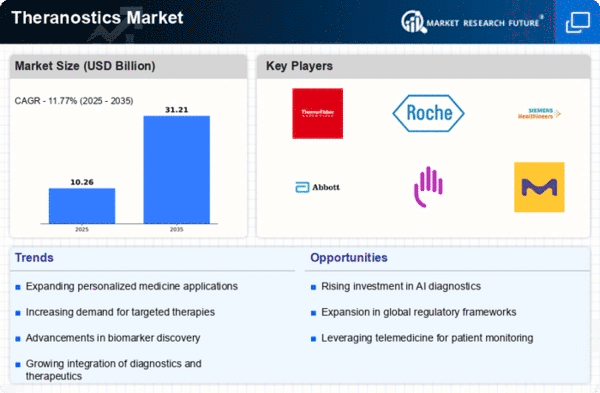
As per MRFR analysis, the Theranostics Market Size was estimated at 9.18 USD Billion in 2024. The Theranostics industry is projected to grow from 10.26 USD Billion in 2025 to 31.21 USD Billion by 2035, exhibiting a compound annual growth rate (CAGR) of 11.77 during the forecast period 2025 - 2035.

Key Market Trends & Highlights

The Theranostics Market is poised for substantial growth driven by personalized medicine and technological advancements.

  • The adoption of personalized medicine continues to reshape treatment paradigms, particularly in oncology, which remains the largest segment. Collaborative development efforts are increasingly prevalent, especially in North America, the largest market for theranostics. Regulatory support for innovation is fostering a conducive environment for advancements in molecular imaging, the largest segment. Rising prevalence of chronic diseases and advancements in biomarker discovery are key drivers propelling market expansion, particularly in the Asia-Pacific region.

Market Size & Forecast

2024 Market Size 9.18 (USD Billion)
2035 Market Size 31.21 (USD Billion)
CAGR (2025 - 2035) 11.77%
Largest Regional Market Share in 2024 North America

Major Players

<p><a href="thermofisher.com/es/en/home/life-science/stem-cell-research/stem-cell-differentiation/culture-systems-reagents-cardiomyocyte-differentiation.html">Thermo Fisher Scientific</a> (US), Roche Diagnostics (CH), <a href="https://www.siemens-healthineers.com/molecular-imaging/theranostics-journey">Siemens Healthineers</a> (DE), Abbott Laboratories (US), Bristol-Myers Squibb (US), Merck KGaA (DE), Illumina (US), Genomic Health (US), AstraZeneca (GB), Novartis (CH)</p>

Market Trends

The Theranostics Market is currently experiencing a transformative phase, characterized by the integration of therapeutic and diagnostic approaches. This convergence allows for personalized medicine, where treatments are tailored to individual patient profiles based on specific biomarkers As healthcare systems increasingly prioritize precision medicine, the demand for theranostic solutions appears to be on the rise. This trend is likely driven by advancements in molecular biology and genomics, which facilitate the identification of unique patient characteristics that can inform treatment decisions. Furthermore, the growing emphasis on patient-centric care suggests that stakeholders are focusing on improving outcomes through targeted therapies. In addition, the Theranostics Market is witnessing a surge in collaborations between pharmaceutical companies and diagnostic firms. Such partnerships aim to streamline the development of companion diagnostics that accompany targeted therapies. This collaborative approach not only enhances the efficiency of drug development but also ensures that patients receive the most effective treatments based on their specific conditions. Moreover, regulatory bodies are increasingly recognizing the importance of theranostics, which may lead to more favorable approval processes for innovative products. Overall, the Theranostics Market is poised for substantial growth as it adapts to the evolving landscape of healthcare, emphasizing the need for personalized and effective treatment options.

Personalized Medicine Adoption

The shift towards personalized medicine is reshaping the Theranostics Market. By utilizing genetic and molecular profiling, healthcare providers can tailor treatments to individual patients, enhancing therapeutic efficacy and minimizing adverse effects. This trend reflects a broader movement within healthcare to prioritize patient-specific approaches.

Collaborative Development Efforts

There is a notable increase in collaborations between pharmaceutical companies and diagnostic developers within the Theranostics Market. These partnerships aim to create companion diagnostics that align with targeted therapies, thereby improving treatment outcomes and streamlining the drug development process.

Regulatory Support for Innovation

Regulatory agencies are increasingly supportive of theranostic innovations, which may facilitate faster approval processes for new products. This trend indicates a growing recognition of the value of theranostics in enhancing patient care and optimizing treatment strategies.

Theranostics Market Market Drivers

Market Growth Projections

The Global Theranostics Market Industry is poised for substantial growth, with projections indicating a rise from 9.57 USD Billion in 2024 to 31.2 USD Billion by 2035. This growth trajectory suggests a compound annual growth rate of 11.34% from 2025 to 2035, highlighting the increasing adoption of theranostic approaches in clinical practice. Factors contributing to this growth include advancements in technology, rising demand for personalized medicine, and an increasing prevalence of chronic diseases. The market's expansion reflects a broader trend towards integrated healthcare solutions that combine diagnostics and therapeutics, ultimately aiming to improve patient outcomes and optimize treatment efficacy.

Supportive Regulatory Framework

A supportive regulatory framework is fostering growth within the Global Theranostics Market Industry. Regulatory bodies are increasingly recognizing the importance of theranostic approaches, leading to streamlined approval processes for new diagnostic and therapeutic agents. This regulatory support encourages innovation and investment in the development of novel theranostic products. For example, the FDA has established guidelines that facilitate the co-development of diagnostics and therapeutics, which is essential for the success of theranostic strategies. As a result, the market is likely to benefit from an influx of new products and technologies, further driving its expansion in the coming years.

Rising Demand for Personalized Medicine

The Global Theranostics Market Industry is experiencing a notable surge in demand for personalized medicine, which tailors treatment based on individual patient profiles. This shift is largely driven by advancements in genomic and molecular profiling technologies, enabling healthcare providers to identify specific biomarkers associated with diseases. As a result, therapies can be customized, enhancing efficacy and minimizing adverse effects. The market is projected to reach 9.57 USD Billion in 2024, reflecting the growing inclination towards precision medicine. This trend not only improves patient outcomes but also aligns with the broader healthcare paradigm shift towards individualized treatment strategies.

Increasing Incidence of Chronic Diseases

The Global Theranostics Market Industry is significantly impacted by the rising incidence of chronic diseases, including cancer, cardiovascular disorders, and diabetes. As these conditions become more prevalent globally, there is an urgent need for effective diagnostic and therapeutic solutions. Theranostics Market offers a dual approach by providing precise diagnostics alongside targeted therapies, which is particularly beneficial in managing chronic diseases. The market's projected compound annual growth rate of 11.34% from 2025 to 2035 reflects the increasing demand for integrated treatment solutions. This trend indicates a shift towards more comprehensive healthcare strategies that address both diagnosis and treatment in a cohesive manner.

Growing Investment in Research and Development

Investment in research and development is a critical driver of the Global Theranostics Market Industry. Pharmaceutical and biotechnology companies are increasingly allocating resources towards the discovery of new theranostic agents, recognizing the potential for improved patient outcomes and market growth. Collaborative efforts between academia and industry are also on the rise, leading to innovative solutions that bridge the gap between diagnostics and therapeutics. This trend is expected to contribute to the market's growth trajectory, with projections indicating a rise to 31.2 USD Billion by 2035. The emphasis on R&D not only enhances the therapeutic landscape but also positions companies competitively in a rapidly evolving market.

Technological Advancements in Diagnostic Tools

Technological innovations in diagnostic tools are significantly influencing the Global Theranostics Market Industry. The integration of artificial intelligence and machine learning in diagnostic processes enhances the accuracy and speed of disease detection. For instance, advanced imaging techniques and molecular diagnostics are now capable of identifying diseases at earlier stages, which is crucial for effective treatment. The anticipated growth of the market to 31.2 USD Billion by 2035 underscores the impact of these technological advancements. Furthermore, the continuous evolution of diagnostic technologies is likely to facilitate the development of new theranostic agents, thereby expanding treatment options for patients.

Market Segment Insights

By Application: Oncology (Largest) vs. Neurology (Fastest-Growing)

<p>In the Theranostics Market, Oncology stands out as the largest segment, capturing a substantial share due to the increasing prevalence of cancer and advancements in <a href="https://www.marketresearchfuture.com/reports/precision-medicine-market-925">precision medicine</a>. Neurology, while smaller, is emerging with rapid growth as novel therapeutics and diagnostics for neurological disorders gain traction. Infectious Diseases, Autoimmune Diseases, and Cardiology follow, contributing to a diverse landscape of applications that highlight the medical community's focus on personalized treatment pathways. The market's segmentation underscores the critical areas where theranostics can provide significant clinical benefits, ultimately enhancing patient outcomes through tailored therapies.</p>

<p>Oncology: Dominant vs. Neurology: Emerging</p>

<p>Oncology remains the dominant application in the Theranostics Market, driven by significant investments in cancer research and the development of targeted therapies that optimize patient responses. The integration of molecular imaging and biomarker identification enhances personalized treatment strategies, making it a critical focus for healthcare providers. Conversely, Neurology is an emerging segment characterized by innovative approaches to treat complex disorders such as Alzheimer's and Multiple Sclerosis. Advances in neuroimaging and the introduction of biomarker-guided therapy are propelling growth, positioning Neurology as a vital area for future development in theranostics. Innovations in both fields reflect a broader trend toward personalized medicine that addresses unique patient profiles.</p>

By Technology: Molecular Imaging (Largest) vs. Biomarkers (Fastest-Growing)

<p>In the Theranostics Market, molecular imaging holds the largest market share, representing a significant component of the technology segment. This area involves advanced imaging techniques that enable the visualization of biological processes at the molecular and cellular levels, playing a critical role in diagnosing and monitoring therapeutic responses. Biomarkers, while holding a smaller current share, are the fastest-growing segment, driven by the increasing need for precision medicine and personalized healthcare solutions.</p>

<p>Technology: Molecular Imaging (Dominant) vs. Biomarkers (Emerging)</p>

<p>Molecular imaging is currently the dominant force in the Theranostics Market, offering highly detailed insights into patient conditions and therapeutic effectiveness. Its techniques, such as PET and MRI, are integral in guiding treatment decisions. Conversely, biomarkers represent an emerging segment, critical for their role in predicting disease progression and treatment efficacy. As the shift towards personalized medicine accelerates, biomarkers are witnessing rapid adoption due to their ability to enhance clinical trial outcomes and facilitate targeted therapies, positioning them for significant growth alongside existing technologies.</p>

By End Use: Hospitals (Largest) vs. Diagnostic Laboratories (Fastest-Growing)

<p>In the Theranostics Market, the end use segment is notably diverse, comprising hospitals, diagnostic laboratories, research institutions, pharmaceutical companies, and academic institutions. Hospitals hold the largest market share, driven by the increasing demand for personalized medicine and targeted therapies that enable more effective treatment protocols. Diagnostic laboratories are increasingly important in this landscape, providing crucial testing services and technologies that support theranostic applications, thus securing a significant portion of the market earnings.</p>

<p>Hospitals (Dominant) vs. Diagnostic Laboratories (Emerging)</p>

<p>Hospitals play a pivotal role in the Theranostics Market, serving as both treatment centers and facilitators of personalized healthcare strategies. Their dominant position is underscored by significant investments in advanced diagnostic and treatment technologies, ensuring tailored therapeutic approaches. Conversely, diagnostic laboratories are emerging as essential players in this market, driven by innovations in testing methodologies and an increase in precision medicine initiatives. Their agility in adopting new technologies and efficiently processing patient data enhances their competitiveness, which is vital as healthcare systems demand rapid, reliable diagnostic capabilities that align with theranostic advancements.</p>

Get more detailed insights about Theranostics Market Research Report - Global Forecast till 2035

Regional Insights

North America : Market Leader in Theranostics

North America continues to lead the Theranostics market, holding a significant share of 4.5 billion in 2024. The region's growth is driven by advanced healthcare infrastructure, increasing prevalence of chronic diseases, and a strong focus on personalized medicine. Regulatory support from agencies like the FDA has catalyzed innovation, enabling rapid development and approval of new theranostic solutions. The demand for precision medicine is further fueled by rising healthcare expenditures and a growing emphasis on patient-centric approaches. The competitive landscape in North America is robust, featuring key players such as Thermo Fisher Scientific, Abbott Laboratories, and Illumina. The U.S. is the primary market, benefiting from substantial investments in research and development. Collaborations between biotech firms and academic institutions are fostering innovation, while the presence of major pharmaceutical companies enhances the availability of theranostic products. This dynamic environment positions North America as a hub for advancements in theranostics.

Europe : Emerging Market with Growth Potential

Europe's Theranostics market is valued at 2.5 billion, reflecting a growing interest in personalized medicine and targeted therapies. The region benefits from strong regulatory frameworks and initiatives aimed at enhancing healthcare quality. Countries like Germany and the UK are leading the charge, supported by government investments in healthcare innovation and research. The increasing incidence of cancer and genetic disorders is driving demand for theranostic solutions, with a focus on improving patient outcomes through tailored treatments. The competitive landscape in Europe is characterized by a mix of established players and emerging startups. Key companies such as Roche Diagnostics and Siemens Healthineers are at the forefront, leveraging advanced technologies to develop innovative theranostic products. The European market is also witnessing collaborations between public and private sectors, fostering a conducive environment for research and development. As the region continues to prioritize personalized healthcare, the theranostics market is poised for significant growth.

Asia-Pacific : Rapidly Growing Market Segment

The Asia-Pacific Theranostics market, valued at 1.8 billion, is experiencing rapid growth driven by increasing healthcare investments and rising awareness of personalized medicine. Countries like China and Japan are leading the market, supported by government initiatives aimed at enhancing healthcare infrastructure. The growing prevalence of chronic diseases and a shift towards precision medicine are key factors propelling market demand. Regulatory bodies are also becoming more supportive of innovative therapies, facilitating faster approvals for theranostic products. The competitive landscape in Asia-Pacific is evolving, with both local and international players vying for market share. Companies such as Illumina and Genomic Health are expanding their presence in the region, capitalizing on the growing demand for advanced diagnostic solutions. Collaborations between healthcare providers and technology firms are fostering innovation, while increasing investments in research and development are expected to drive future growth. The region's diverse population presents unique opportunities for tailored theranostic solutions.

Middle East and Africa : Emerging Market with Challenges

The Theranostics market in the Middle East and Africa is valued at 0.38 billion, reflecting a nascent but promising sector. The growth is primarily driven by increasing healthcare investments and a rising prevalence of chronic diseases. However, challenges such as limited access to advanced healthcare technologies and regulatory hurdles persist. Governments are beginning to recognize the importance of personalized medicine, leading to initiatives aimed at improving healthcare infrastructure and access to innovative therapies. Countries like South Africa and the UAE are emerging as key players in the theranostics landscape, with growing investments in healthcare innovation. The competitive environment is characterized by a mix of local and international companies, striving to establish a foothold in this developing market. As awareness of theranostics increases, the region is expected to see gradual growth, supported by collaborations between public and private sectors to enhance healthcare delivery.

Key Players and Competitive Insights

The Theranostics Market is currently characterized by a dynamic competitive landscape, driven by advancements in personalized medicine and the increasing demand for targeted therapies. Key players such as Thermo Fisher Scientific (US), Roche Diagnostics (CH), and Siemens Healthineers (DE) are at the forefront, leveraging innovation and strategic partnerships to enhance their market positions. For instance, Thermo Fisher Scientific (US) has focused on expanding its portfolio through acquisitions and collaborations, which appears to strengthen its capabilities in precision medicine. Similarly, Roche Diagnostics (CH) emphasizes its commitment to research and development, aiming to integrate cutting-edge technologies into its diagnostic solutions, thereby enhancing its competitive edge. The business tactics employed by these companies include localizing manufacturing and optimizing supply chains to improve efficiency and responsiveness to market demands. The competitive structure of the Theranostics Market is moderately fragmented, with several players vying for market share. However, the collective influence of major companies shapes the market dynamics, as they engage in strategic collaborations and innovations that set industry standards. In November 2025, Roche Diagnostics (CH) announced a partnership with a leading biotechnology firm to develop a novel theranostic platform aimed at improving patient outcomes in oncology. This collaboration is strategically significant as it not only enhances Roche's product offerings but also positions the company to capitalize on the growing trend of personalized cancer therapies. Furthermore, in October 2025, Siemens Healthineers (DE) launched a new imaging solution that integrates AI capabilities to enhance diagnostic accuracy. This move reflects Siemens' commitment to digital transformation and its potential to redefine diagnostic workflows in theranostics. In September 2025, Illumina (US) unveiled a new genomic sequencing technology that promises to accelerate the development of personalized therapies. This innovation is crucial as it aligns with the increasing demand for precision medicine, potentially allowing for more tailored treatment options for patients. Additionally, in August 2025, Bristol-Myers Squibb (US) expanded its collaboration with a prominent research institution to explore novel biomarkers for therapeutic response, indicating a strategic focus on enhancing its drug development pipeline through innovative research. As of December 2025, current competitive trends in the Theranostics Market include a pronounced shift towards digitalization, sustainability, and the integration of AI technologies. Strategic alliances are increasingly shaping the landscape, as companies recognize the value of collaboration in driving innovation. Looking ahead, competitive differentiation is likely to evolve, with a greater emphasis on technological advancements and supply chain reliability, rather than solely on price. This shift suggests that companies that prioritize innovation and adaptability will be better positioned to thrive in the evolving market.

Key Companies in the Theranostics Market include

Industry Developments

Recent developments in the Global Theranostics Market have indicated significant progress, particularly with companies such as Bristol-Myers Squibb and Merck & Co. engaging in advanced therapeutic approaches. Siemens Healthineers has recently showcased innovations in diagnostic imaging that enhance theranostic capabilities, aligning with the growing demand for personalized medicine. Qiagen and Illumina continue to evolve their genomic testing technologies, paving the way for tailored treatment solutions. Moreover, Genomic Health's enhancing collaboration with Hoffmann-La Roche aims to bolster cancer diagnosis and treatment strategies.

The market has witnessed notable growth, with Abbott Laboratories and Myriad Genetics expanding their product portfolios, thereby driving the valuation of the sector upward. AstraZeneca and Pfizer are actively involved in mergers and acquisitions to strengthen their therapeutic offerings, with recent acquisitions adding to a robust pipeline of novel therapies. Roche Holding's efforts to integrate precision medicine into clinical settings are contributing to a more comprehensive market landscape. The overall momentum in the theranostics sector reflects a shift towards targeted therapeutics and improved patient outcomes, underscoring a dynamic phase of growth and innovation.

Future Outlook

Theranostics Market Future Outlook

<p>The Theranostics Market is projected to grow at an 11.77% CAGR from 2025 to 2035, driven by advancements in personalized medicine, increased R&amp;D investments, and rising demand for targeted therapies.</p>

New opportunities lie in:

  • <p>Development of integrated diagnostic-therapeutic platforms Expansion of companion diagnostics for oncology Partnerships with biotech firms for innovative biomarker discovery</p>

<p>By 2035, the Theranostics Market is expected to achieve substantial growth, solidifying its role in precision medicine.</p>

Market Segmentation

Theranostics Market End Use Outlook

  • Hospitals
  • Diagnostic Laboratories
  • Research Institutions
  • Pharmaceutical Companies
  • Academic Institutions

Theranostics Market Technology Outlook

  • Molecular Imaging
  • Biomarkers
  • Genomics
  • Proteomics
  • Metabolomics

Theranostics Market Application Outlook

  • Oncology
  • Neurology
  • Cardiology
  • Infectious Diseases
  • Autoimmune Diseases

Report Scope

MARKET SIZE 2024 9.18(USD Billion)
MARKET SIZE 2025 10.26(USD Billion)
MARKET SIZE 2035 31.21(USD Billion)
COMPOUND ANNUAL GROWTH RATE (CAGR) 11.77% (2025 - 2035)
REPORT COVERAGE Revenue Forecast, Competitive Landscape, Growth Factors, and Trends
BASE YEAR 2024
Market Forecast Period 2025 - 2035
Historical Data 2019 - 2024
Market Forecast Units USD Billion
Key Companies Profiled Thermo Fisher Scientific (US), Roche Diagnostics (CH), Siemens Healthineers (DE), Abbott Laboratories (US), Bristol-Myers Squibb (US), Merck KGaA (DE), Illumina (US), Genomic Health (US), AstraZeneca (GB), Novartis (CH)
Segments Covered Application, Technology, End Use
Key Market Opportunities Integration of artificial intelligence in diagnostics enhances personalized treatment strategies in the Theranostics Market.
Key Market Dynamics Rising demand for personalized medicine drives innovation and competition in the Theranostics Market.
Countries Covered North America, Europe, APAC, South America, MEA

FAQs

What is the expected market size of the Global Theranostics Market in 2035?

The Global Theranostics Market is expected to be valued at 31.2 USD Billion in 2035

What is the projected CAGR for the Global Theranostics Market from 2025 to 2035?

The expected CAGR for the Global Theranostics Market from 2025 to 2035 is 11.77%.

Which application segment is projected to dominate the Global Theranostics Market in terms of value by 2032?

The Oncology segment is projected to dominate, with a value of 10.78 USD Billion in 2032.

What will be the value of the North American Theranostics Market in 2032?

The North American Theranostics Market is expected to be valued at 11.78 USD Billion by 2032.

Which major players are involved in the Global Theranostics Market?

Key players in the market include Bristol-Myers Squibb, Siemens Healthineers, and Roche Holding, among others.

What is the expected market size for the Neurology application in 2032?

The Neurology application segment is expected to be valued at 4.86 USD Billion in 2032.

How much is the Global Theranostics Market valued in 2023?

The Global Theranostics Market is valued at 8.21 USD Billion in 2023.

What is the projected market size for the Cardiology application by 2032?

The Cardiology application is projected to reach a value of 3.93 USD Billion by 2032.

What will be the value of the Theranostics Market in South America by 2032?

The Theranostics Market in South America is expected to be valued at 1.34 USD Billion by 2032.

What is the expected value of the Infectious Diseases application by 2032?

The Infectious Diseases application is projected to be valued at 3.77 USD Billion in 2032.

  1. SECTION I: EXECUTIVE SUMMARY AND KEY HIGHLIGHTS
    1. | 1.1 EXECUTIVE SUMMARY
    2. | 1.1.1 Market Overview
    3. | 1.1.2 Key Findings
    4. | 1.1.3 Market Segmentation
    5. | 1.1.4 Competitive Landscape
    6. | 1.1.5 Challenges and Opportunities
    7. | 1.1.6 Future Outlook
  2. SECTION II: SCOPING, METHODOLOGY AND MARKET STRUCTURE
    1. | 2.1 MARKET INTRODUCTION
    2. | 2.1.1 Definition
    3. | 2.1.2 Scope of the study
    4. |-- 2.1.2.1 Research Objective
    5. |-- 2.1.2.2 Assumption
    6. |-- 2.1.2.3 Limitations
    7. | 2.2 RESEARCH METHODOLOGY
    8. | 2.2.1 Overview
    9. | 2.2.2 Data Mining
    10. | 2.2.3 Secondary Research
    11. | 2.2.4 Primary Research
    12. |-- 2.2.4.1 Primary Interviews and Information Gathering Process
    13. |-- 2.2.4.2 Breakdown of Primary Respondents
    14. | 2.2.5 Forecasting Model
    15. | 2.2.6 Market Size Estimation
    16. |-- 2.2.6.1 Bottom-Up Approach
    17. |-- 2.2.6.2 Top-Down Approach
    18. | 2.2.7 Data Triangulation
    19. | 2.2.8 Validation
  3. SECTION III: QUALITATIVE ANALYSIS
    1. | 3.1 MARKET DYNAMICS
    2. | 3.1.1 Overview
    3. | 3.1.2 Drivers
    4. | 3.1.3 Restraints
    5. | 3.1.4 Opportunities
    6. | 3.2 MARKET FACTOR ANALYSIS
    7. | 3.2.1 Value chain Analysis
    8. | 3.2.2 Porter's Five Forces Analysis
    9. |-- 3.2.2.1 Bargaining Power of Suppliers
    10. |-- 3.2.2.2 Bargaining Power of Buyers
    11. |-- 3.2.2.3 Threat of New Entrants
    12. |-- 3.2.2.4 Threat of Substitutes
    13. |-- 3.2.2.5 Intensity of Rivalry
    14. | 3.2.3 COVID-19 Impact Analysis
    15. |-- 3.2.3.1 Market Impact Analysis
    16. |-- 3.2.3.2 Regional Impact
    17. |-- 3.2.3.3 Opportunity and Threat Analysis
  4. SECTION IV: QUANTITATIVE ANALYSIS
    1. | 4.1 Healthcare, BY Application (USD Billion)
    2. | 4.1.1 Oncology
    3. | 4.1.2 Neurology
    4. | 4.1.3 Cardiology
    5. | 4.1.4 Infectious Diseases
    6. | 4.1.5 Autoimmune Diseases
    7. | 4.2 Healthcare, BY Technology (USD Billion)
    8. | 4.2.1 Molecular Imaging
    9. | 4.2.2 Biomarkers
    10. | 4.2.3 Genomics
    11. | 4.2.4 Proteomics
    12. | 4.2.5 Metabolomics
    13. | 4.3 Healthcare, BY End Use (USD Billion)
    14. | 4.3.1 Hospitals
    15. | 4.3.2 Diagnostic Laboratories
    16. | 4.3.3 Research Institutions
    17. | 4.3.4 Pharmaceutical Companies
    18. | 4.3.5 Academic Institutions
    19. | 4.4 Healthcare, BY Region (USD Billion)
    20. | 4.4.1 North America
    21. |-- 4.4.1.1 US
    22. |-- 4.4.1.2 Canada
    23. | 4.4.2 Europe
    24. |-- 4.4.2.1 Germany
    25. |-- 4.4.2.2 UK
    26. |-- 4.4.2.3 France
    27. |-- 4.4.2.4 Russia
    28. |-- 4.4.2.5 Italy
    29. |-- 4.4.2.6 Spain
    30. |-- 4.4.2.7 Rest of Europe
    31. | 4.4.3 APAC
    32. |-- 4.4.3.1 China
    33. |-- 4.4.3.2 India
    34. |-- 4.4.3.3 Japan
    35. |-- 4.4.3.4 South Korea
    36. |-- 4.4.3.5 Malaysia
    37. |-- 4.4.3.6 Thailand
    38. |-- 4.4.3.7 Indonesia
    39. |-- 4.4.3.8 Rest of APAC
    40. | 4.4.4 South America
    41. |-- 4.4.4.1 Brazil
    42. |-- 4.4.4.2 Mexico
    43. |-- 4.4.4.3 Argentina
    44. |-- 4.4.4.4 Rest of South America
    45. | 4.4.5 MEA
    46. |-- 4.4.5.1 GCC Countries
    47. |-- 4.4.5.2 South Africa
    48. |-- 4.4.5.3 Rest of MEA
  5. SECTION V: COMPETITIVE ANALYSIS
    1. | 5.1 Competitive Landscape
    2. | 5.1.1 Overview
    3. | 5.1.2 Competitive Analysis
    4. | 5.1.3 Market share Analysis
    5. | 5.1.4 Major Growth Strategy in the Healthcare
    6. | 5.1.5 Competitive Benchmarking
    7. | 5.1.6 Leading Players in Terms of Number of Developments in the Healthcare
    8. | 5.1.7 Key developments and growth strategies
    9. |-- 5.1.7.1 New Product Launch/Service Deployment
    10. |-- 5.1.7.2 Merger & Acquisitions
    11. |-- 5.1.7.3 Joint Ventures
    12. | 5.1.8 Major Players Financial Matrix
    13. |-- 5.1.8.1 Sales and Operating Income
    14. |-- 5.1.8.2 Major Players R&D Expenditure. 2023
    15. | 5.2 Company Profiles
    16. | 5.2.1 Thermo Fisher Scientific (US)
    17. |-- 5.2.1.1 Financial Overview
    18. |-- 5.2.1.2 Products Offered
    19. |-- 5.2.1.3 Key Developments
    20. |-- 5.2.1.4 SWOT Analysis
    21. |-- 5.2.1.5 Key Strategies
    22. | 5.2.2 Roche Diagnostics (CH)
    23. |-- 5.2.2.1 Financial Overview
    24. |-- 5.2.2.2 Products Offered
    25. |-- 5.2.2.3 Key Developments
    26. |-- 5.2.2.4 SWOT Analysis
    27. |-- 5.2.2.5 Key Strategies
    28. | 5.2.3 Siemens Healthineers (DE)
    29. |-- 5.2.3.1 Financial Overview
    30. |-- 5.2.3.2 Products Offered
    31. |-- 5.2.3.3 Key Developments
    32. |-- 5.2.3.4 SWOT Analysis
    33. |-- 5.2.3.5 Key Strategies
    34. | 5.2.4 Abbott Laboratories (US)
    35. |-- 5.2.4.1 Financial Overview
    36. |-- 5.2.4.2 Products Offered
    37. |-- 5.2.4.3 Key Developments
    38. |-- 5.2.4.4 SWOT Analysis
    39. |-- 5.2.4.5 Key Strategies
    40. | 5.2.5 Bristol-Myers Squibb (US)
    41. |-- 5.2.5.1 Financial Overview
    42. |-- 5.2.5.2 Products Offered
    43. |-- 5.2.5.3 Key Developments
    44. |-- 5.2.5.4 SWOT Analysis
    45. |-- 5.2.5.5 Key Strategies
    46. | 5.2.6 Merck KGaA (DE)
    47. |-- 5.2.6.1 Financial Overview
    48. |-- 5.2.6.2 Products Offered
    49. |-- 5.2.6.3 Key Developments
    50. |-- 5.2.6.4 SWOT Analysis
    51. |-- 5.2.6.5 Key Strategies
    52. | 5.2.7 Illumina (US)
    53. |-- 5.2.7.1 Financial Overview
    54. |-- 5.2.7.2 Products Offered
    55. |-- 5.2.7.3 Key Developments
    56. |-- 5.2.7.4 SWOT Analysis
    57. |-- 5.2.7.5 Key Strategies
    58. | 5.2.8 Genomic Health (US)
    59. |-- 5.2.8.1 Financial Overview
    60. |-- 5.2.8.2 Products Offered
    61. |-- 5.2.8.3 Key Developments
    62. |-- 5.2.8.4 SWOT Analysis
    63. |-- 5.2.8.5 Key Strategies
    64. | 5.2.9 AstraZeneca (GB)
    65. |-- 5.2.9.1 Financial Overview
    66. |-- 5.2.9.2 Products Offered
    67. |-- 5.2.9.3 Key Developments
    68. |-- 5.2.9.4 SWOT Analysis
    69. |-- 5.2.9.5 Key Strategies
    70. | 5.2.10 Novartis (CH)
    71. |-- 5.2.10.1 Financial Overview
    72. |-- 5.2.10.2 Products Offered
    73. |-- 5.2.10.3 Key Developments
    74. |-- 5.2.10.4 SWOT Analysis
    75. |-- 5.2.10.5 Key Strategies
    76. | 5.3 Appendix
    77. | 5.3.1 References
    78. | 5.3.2 Related Reports

Healthcare Market Segmentation

Healthcare By Application (USD Billion, 2025-2035)

  • Oncology
  • Neurology
  • Cardiology
  • Infectious Diseases
  • Autoimmune Diseases

Healthcare By Technology (USD Billion, 2025-2035)

  • Molecular Imaging
  • Biomarkers
  • Genomics
  • Proteomics
  • Metabolomics

Healthcare By End Use (USD Billion, 2025-2035)

  • Hospitals
  • Diagnostic Laboratories
  • Research Institutions
  • Pharmaceutical Companies
  • Academic Institutions
Infographic

Free Sample Request

Kindly complete the form below to receive a free sample of this Report

Get Free Sample

Customer Strories

Compare Licence

×
Features License Type
Single User Multiuser License Enterprise User
Price $4,950 $5,950 $7,250
Maximum User Access Limit 1 User Upto 10 Users Unrestricted Access Throughout the Organization
Free Customization
Direct Access to Analyst
Deliverable Format
Platform Access
Discount on Next Purchase 10% 15% 15%
Printable Versions