Request Free Sample ×

Kindly complete the form below to receive a free sample of this Report

* Please use a valid business email

Leading companies partner with us for data-driven Insights

clients tt-cursor
Hero Background
English
Chinese
French
Japanese
Korean
German
Spanish

Textile Recycling Market Share

ID: MRFR/Equip/10342-HCR
128 Pages
Aarti Dhapte
April 2026

Textile Recycling Market Research Report Information By Material (Cotton, Polyester & Polyester Fiber, Wool, Nylon & Nylon Fiber, and Others), By Textile Waste (Pre-consumer and Post-consumer), By Distribution Channel (Online and Retail & Departmental Stores), By Process (Mechanical and Chemical), By End Use Industry (Apparel, Home Furnishings, Industrial & Institutional, and Others), and By Region (North America, Europe, Asia-Pacific, and Rest Of The World) – Market Forecast Till 2035

Share:
Download PDF ×

We do not share your information with anyone. However, we may send you emails based on your report interest from time to time. You may contact us at any time to opt-out.

Textile Recycling Market Infographic
Purchase Options

Market Share

Textile Recycling Market Share Analysis

Market share positioning strategies are crucial for companies operating in the textile recycling market to gain a competitive edge and capture a larger portion of the market. One of the key strategies is product differentiation, where companies focus on offering unique and innovative textile recycling solutions that set them apart from their competitors. This could involve developing new technologies or processes to recycle textiles more efficiently, or creating value-added products from recycled materials, such as eco-friendly clothing or accessories.

Another important strategy is targeting specific market segments. Instead of trying to appeal to the entire market, companies can focus their efforts on niche segments where there is high demand for textile recycling services. For example, they may target fashion brands that are looking to incorporate sustainable practices into their supply chain, or municipalities that are seeking to reduce landfill waste.

Companies can also differentiate themselves based on their sustainability credentials. This involves not only providing eco-friendly recycling solutions but also adopting sustainable practices throughout their operations, such as using renewable energy sources, minimizing water usage, and reducing carbon emissions. By positioning themselves as leaders in sustainability, companies can attract environmentally-conscious consumers and businesses who prioritize ethical and responsible practices.

In addition to product differentiation and targeting specific market segments, pricing strategy plays a crucial role in market share positioning. Companies can choose to compete on price by offering competitive rates for their recycling services, or they can position themselves as premium providers and charge higher prices for their superior quality or added value. The choice of pricing strategy will depend on factors such as the company's cost structure, the perceived value of its offerings, and the competitive landscape.

Furthermore, building strong partnerships and alliances can help companies expand their market share and reach new customers. This could involve forming strategic partnerships with textile manufacturers, retailers, or waste management companies to gain access to their supply chains or distribution networks. By collaborating with other players in the industry, companies can leverage their combined strengths and resources to achieve mutual growth and success.

Moreover, effective marketing and branding are essential for market share positioning. Companies need to communicate their unique value proposition and differentiate themselves from competitors through branding initiatives, advertising campaigns, and promotional activities. This could involve highlighting their sustainability efforts, showcasing their innovative recycling technologies, or emphasizing the quality and reliability of their services.

Lastly, continuous innovation and investment in research and development are critical for maintaining a competitive advantage in the textile recycling market. Companies need to stay abreast of emerging trends and technologies in recycling and sustainability, and adapt their strategies accordingly to stay ahead of the curve. By investing in innovation, companies can develop new products and services that meet the evolving needs of customers and differentiate themselves from competitors.


Author
Author Profile
Aarti Dhapte
AVP - Research

A consulting professional focused on helping businesses navigate complex markets through structured research and strategic insights. I partner with clients to solve high-impact business problems across market entry strategy, competitive intelligence, and opportunity assessment. Over the course of my experience, I have led and contributed to 100+ market research and consulting engagements, delivering insights across multiple industries and geographies, and supporting strategic decisions linked to $500M+ market opportunities. My core expertise lies in building robust market sizing, forecasting, and commercial models (top-down and bottom-up), alongside deep-dive competitive and industry analysis. I have played a key role in shaping go-to-market strategies, investment cases, and growth roadmaps, enabling clients to make confident, data-backed decisions in dynamic markets.

Leave a Comment

FAQs

What is the projected market valuation of the Textile Recycling Market by 2035?

<p>The Textile Recycling Market is projected to reach a valuation of 16.58 USD Billion by 2035.</p>

What was the market valuation of the Textile Recycling Market in 2024?

<p>In 2024, the Textile Recycling Market was valued at 8.208 USD Billion.</p>

What is the expected CAGR for the Textile Recycling Market during the forecast period 2025 - 2035?

<p>The expected CAGR for the Textile Recycling Market during the forecast period 2025 - 2035 is 6.6%.</p>

Which materials are leading in the Textile Recycling Market segments?

<p>In the Textile Recycling Market, Polyester & Polyester Fiber leads with a projected valuation of 6.5 USD Billion by 2035.</p>

What are the key distribution channels in the Textile Recycling Market?

<p>The key distribution channels include Retail & Departmental Stores, projected to reach 11.38 USD Billion by 2035.</p>

How does the market for post-consumer textile waste compare to pre-consumer waste?

<p>Post-consumer textile waste is projected to reach 11.38 USD Billion by 2035, significantly higher than the 5.2 USD Billion for pre-consumer waste.</p>

What are the primary end-use industries for recycled textiles?

The primary end-use industries include Apparel, expected to reach 7.1 USD Billion by 2035.

Who are the key players in the Textile Recycling Market?

Key players in the Textile Recycling Market include I:CO, Texaid, Worn Again Technologies, and Patagonia.

What processes are utilized in the Textile Recycling Market?

The Textile Recycling Market utilizes both Mechanical and Chemical processes, with projected valuations of 8.2 USD Billion and 8.38 USD Billion respectively by 2035.

What is the projected growth for the wool segment in the Textile Recycling Market?

The wool segment is projected to grow to 1.6 USD Billion by 2035.

Market Summary

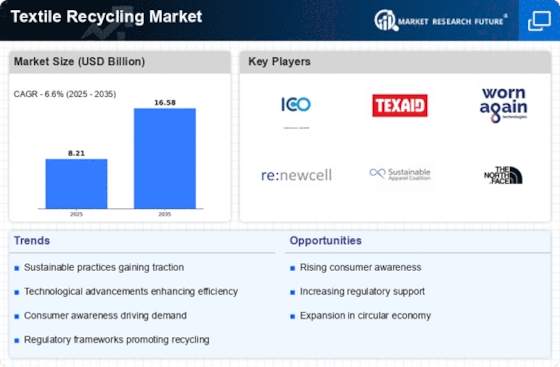
As per Market Research Future analysis, the Textile Recycling Market Size was estimated at 8.208 USD Billion in 2024. The Textile Recycling industry is projected to grow from 8.75 USD Billion in 2025 to 16.58 USD Billion by 2035, exhibiting a compound annual growth rate (CAGR) of 6.6% during the forecast period 2025 - 2035

Key Market Trends & Highlights

The Textile Recycling Market is poised for substantial growth driven by technological advancements and increasing consumer demand for sustainability.

  • Technological advancements in recycling processes are enhancing efficiency and output in the Textile Recycling Market. North America remains the largest market, while the Asia-Pacific region is emerging as the fastest-growing area for textile recycling initiatives. Cotton continues to dominate as the largest segment, whereas polyester and polyester fiber are witnessing rapid growth in recycling applications. Key market drivers include technological innovations in textile recycling and increasing environmental awareness among consumers.

Market Size & Forecast

2024 Market Size 8.208 (USD Billion)
2035 Market Size 16.58 (USD Billion)
CAGR (2025 - 2035) 6.6%
Largest Regional Market Share in 2024 North America

Major Players

I:CO (DE), <a href="https://www.texaid.ch/en/products-and-services/recycling.html">Texaid </a>(CH), Worn Again Technologies (GB), Re:newcell (SE), Sustainable Apparel Coalition (US), The North Face (US), <a href="https://www.patagonia.com/our-footprint/chemical-recycling.html">Patagonia </a>(US), Evrnu (US)

Market Trends

The Textile Recycling Market is currently experiencing a notable transformation driven by increasing environmental awareness and the need for sustainable practices. As consumers become more conscious of their ecological footprint, the demand for recycled textiles is on the rise. This shift is prompting manufacturers to explore innovative recycling technologies and processes that can efficiently convert waste materials into usable fibers. Furthermore, the integration of circular economy principles is gaining traction, encouraging brands to adopt practices that minimize waste and extend the lifecycle of textiles. In addition, regulatory frameworks are evolving to support sustainable textile management, which may further bolster the Textile Recycling Market. Governments are implementing policies aimed at reducing landfill waste and promoting recycling equipment initiatives. This regulatory push, combined with consumer demand, is likely to create a favorable environment for growth in the sector. As the market continues to evolve, collaboration among stakeholders, including manufacturers, retailers, and consumers, appears essential for fostering a robust recycling ecosystem that benefits both the environment and the economy.

Technological Advancements in Recycling Processes

Recent innovations in recycling technologies are enhancing the efficiency and effectiveness of textile recycling. New methods are being developed to separate and process various fabric types, which could lead to higher quality recycled materials. This trend suggests a potential for increased adoption of recycling practices within the industry.

Growing Consumer Demand for Sustainable Products

There is a noticeable shift in consumer preferences towards sustainable and eco-friendly products. This trend indicates that brands focusing on recycled textiles may gain a competitive edge, as consumers are increasingly seeking transparency in sourcing and production practices.

Regulatory Support for Sustainable Practices

Governments worldwide are implementing stricter regulations aimed at promoting recycling and reducing textile waste. This regulatory environment may encourage businesses to invest in sustainable practices, thereby driving growth in the Textile Recycling Market.

Textile Recycling Market Market Drivers

Economic Benefits of Recycling

The economic benefits associated with textile recycling are becoming increasingly apparent, driving growth in the Textile Recycling Market. Recycling textiles can lead to significant cost savings for manufacturers by reducing the need for virgin materials. Additionally, the recycling process can create new job opportunities in collection, sorting, and processing. Reports indicate that the textile recycling sector has the potential to generate thousands of jobs, contributing to local economies. Moreover, as the demand for recycled materials rises, businesses may find new revenue streams through the sale of recycled fibers and products. This economic incentive is likely to encourage more companies to engage in recycling practices, further bolstering the Textile Recycling Market and promoting a circular economy.

Increasing Environmental Awareness

There is a notable rise in environmental awareness among consumers, which is driving the Textile Recycling Market. As individuals become more conscious of the environmental impact of textile waste, they are increasingly seeking sustainable alternatives. This shift in consumer behavior is prompting brands to adopt recycling initiatives and promote eco-friendly practices. According to recent surveys, a significant percentage of consumers express a willingness to pay more for products made from recycled materials. This trend is likely to encourage manufacturers to invest in recycling technologies and processes, thereby expanding the market. Furthermore, the emphasis on reducing landfill waste management and carbon footprints aligns with the goals of the Textile Recycling Market, fostering a more sustainable future for the textile sector.

Government Regulations and Policies

Government regulations and policies play a crucial role in shaping the Textile Recycling Market. Many countries are implementing stricter waste management laws and promoting recycling initiatives to combat textile waste. For instance, extended producer responsibility (EPR) policies are being introduced, requiring manufacturers to take responsibility for the entire lifecycle of their products, including end-of-life disposal. These regulations are likely to incentivize companies to invest in recycling technologies and infrastructure. Additionally, financial incentives, such as grants and subsidies for recycling initiatives, are becoming more common. This regulatory support is expected to drive growth in the Textile Recycling Market, as businesses adapt to comply with new standards and capitalize on emerging opportunities.

Collaboration Across the Supply Chain

Collaboration across the supply chain is emerging as a key driver in the Textile Recycling Market. Stakeholders, including manufacturers, retailers, and recycling companies, are increasingly recognizing the importance of working together to enhance recycling efforts. Partnerships are being formed to streamline the collection and processing of textile waste, ensuring that materials are efficiently recycled. This collaborative approach not only improves the overall efficiency of recycling operations but also fosters innovation in recycling technologies. Furthermore, joint initiatives aimed at educating consumers about recycling practices are gaining traction. As these collaborations strengthen, they are likely to create a more integrated and effective Textile Recycling Market, ultimately leading to higher recycling rates and reduced environmental impact.

Technological Innovations in Textile Recycling

The Textile Recycling Market is experiencing a surge in technological innovations that enhance recycling processes. Advanced sorting technologies, such as artificial intelligence and machine learning, are being integrated to improve the efficiency of material recovery. These innovations allow for the separation of different fabric types, which is crucial for effective recycling. Moreover, new chemical recycling methods are emerging, enabling the breakdown of textiles into their original fibers. This not only increases the quality of recycled materials but also expands the range of textiles that can be recycled. As a result, the market is projected to grow significantly, with estimates suggesting a compound annual growth rate of over 10% in the coming years. Such advancements are likely to reshape the Textile Recycling Market, making it more viable and attractive for investors.

Market Segment Insights

By Material: Cotton (Largest) vs. Polyester & Polyester Fiber (Fastest-Growing)

In the Textile Recycling Market, cotton remains the largest segment, capturing a significant share due to its widespread usage and favorable properties for recycling. Polyester and its fiber counterpart are emerging rapidly, driven by the increasing demand for sustainable textiles and the recyclability of synthetic fibers. Wool, nylon, and 'others' are smaller segments, together contributing to the diversification of recycling inputs but not at the scale seen for cotton and polyester. The growth trends in the textile recycling market indicate a significant shift towards sustainability. The rapid adoption of innovative recycling technologies enhances the recovery rates of polyester, making it the fastest-growing segment. Increased consumer awareness about environmental impacts and stringent governmental regulations further stimulate the growth of recycled materials, impacting purchasing decisions across the industry.

Cotton (Dominant) vs. Nylon &amp; Nylon Fiber (Emerging)

Cotton is the dominant material in the textile recycling market due to its biodegradability and versatility in various applications. Its strong presence is bolstered by established recycling processes that ensure quality and performance. Conversely, nylon and nylon fibers are emerging as innovative materials that are gaining traction in recycling due to advancements in technology. Although historically seen as more challenging to recycle, new methods, including chemical recycling, are improving recovery rates. As sustainability becomes a central theme in the textile industry, both materials demonstrate a commitment to reducing waste and promoting circular economy principles.

By Textile Waste: Post-consumer (Largest) vs. Pre-consumer (Fastest-Growing)

The textile recycling market displays a significant distribution of textile waste segmentation, primarily dominated by post-consumer textiles. This segment accounts for a substantial portion of the overall market due to the increasing demand for sustainable practices and circular economy initiatives. Meanwhile, pre-consumer textile waste is the fastest-growing segment as manufacturers strive to minimize waste in their production processes, thus enhancing sustainability metrics.

Post-consumer (Dominant) vs. Pre-consumer (Emerging)

Post-consumer textile waste refers to discarded textiles after consumer use, making it a dominant force in the textile recycling market. Its growth is fueled by heightened awareness among consumers towards environmental issues related to textile disposal. On the other hand, pre-consumer textile waste involves unused fabric waste generated during the manufacturing process. This segment is emerging swiftly, driven by innovative recycling solutions and companies' commitment to reducing production-related waste. Both segments play crucial roles in driving market trends, with post-consumer waste offering abundant resources for recycling and pre-consumer waste appealing to manufacturers focused on sustainability.

By Distribution Channel: Online (Largest) vs. Retail & Departmental Stores (Fastest-Growing)

In the Textile Recycling Market, the distribution channel segment presents a notable divide between online platforms and traditional retail and departmental stores. Online distribution channels, leveraging e-commerce platforms, have emerged as the dominant player in this market, capturing a significant share of consumer engagement. Retail and departmental stores, while well-established, have been slower to adapt to the rising trend of digital shopping, resulting in a smaller market share when compared to online operations.

Distribution Channel: Online (Dominant) vs. Retail &amp; Departmental Stores (Emerging)

The online distribution channel in the Textile Recycling Market is characterized by its ability to reach a broader audience through digital marketing strategies and convenience. It allows for easy access to recycled textile products, catering to environmentally conscious consumers more effectively. Conversely, retail and departmental stores represent an emerging segment that is seeking to capture a growing demographic interested in sustainable fashion. These stores are increasingly incorporating recycled textiles into their offerings, yet they face challenges in competing with the ease and efficiency of online shopping. The market dynamics suggest that while online channels currently lead, retail and departmental stores are strategically evolving to enhance their market presence.

By Process: Mechanical (Largest) vs. Chemical (Fastest-Growing)

In the Textile Recycling Market, the Mechanical process holds a significant share, being the largest segment due to its established methodologies and efficiency in recycling post-consumer textiles. This technique is widely used for its cost-effectiveness and reliability, with many companies adopting it as their primary approach for textile waste processing. Conversely, the Chemical process is rapidly gaining traction, emerging as a vital player in the market. This growth is driven by advancements in chemical recycling technologies, which offer new possibilities for reclaiming fibers from textiles that cannot be processed mechanically.

Mechanical (Dominant) vs. Chemical (Emerging)

Mechanical recycling stands as the dominant process in the Textile Recycling Market, characterized by its ability to handle a wide range of textile types, including cotton, polyester, and blended fabrics. This method primarily involves shredding and separating fibers, allowing for the recovery of usable material efficiently. On the other hand, Chemical recycling is considered an emerging technology, focusing on breaking down textiles at a molecular level to restore raw materials. This process is particularly favorable for complex blends that mechanical methods struggle to recycle. As sustainability becomes paramount in the industry, both processes are expected to play crucial roles, with chemical recycling gradually opening new opportunities for recycling otherwise non-recyclable textiles.

By End Use Industry: Apparel (Largest) vs. Home Furnishings (Fastest-Growing)

The Textile Recycling Market is primarily divided into four key end-use industries: Apparel, Home Furnishings, Industrial &amp; Institutional, and Others. Among these, Apparel holds the largest market share, reflecting the significant volume of textile waste generated from worn clothing. This segment's dominance can be attributed to the increasing consumer awareness regarding sustainable fashion and recycling initiatives, prompting brands to invest more in recycling processes. The Home Furnishings segment is witnessing rapid growth, driven by rising demand for eco-friendly home decor products and an increasing focus on sustainability in interior design.

Apparel (Dominant) vs. Home Furnishings (Emerging)

The Apparel segment is characterized by its vast scale, leveraging established collection and recycling systems. Major brands are increasingly integrating recycled materials into their offerings, positioning them as leaders in sustainability. Conversely, the Home Furnishings segment, while currently smaller, is emerging rapidly due to shifting consumer preferences towards sustainable home products. Textiles such as curtains, upholstery, and bedding are now being sourced from recycled materials, appealing to eco-conscious consumers. This growth is further fueled by increased awareness about textile waste and the environmental impact of the fashion industry, making home furnishings a vibrant area of opportunity within textile recycling.

Get more detailed insights about Textile Recycling Market Research Report—Global Forecast till 2035

Regional Insights

North America : Sustainability Leader

North America is witnessing a significant surge in the textile recycling market, driven by increasing consumer awareness and stringent regulations aimed at reducing waste. The region holds the largest market share at approximately 40%, with the United States being the primary contributor. The demand for sustainable practices is further fueled by initiatives from organizations like the Sustainable Apparel Coalition, which advocate for eco-friendly production methods. Key players such as Patagonia and The North Face are leading the charge in promoting recycled textiles, enhancing their brand image while meeting consumer expectations. The competitive landscape is characterized by innovation and collaboration among companies, with a focus on developing advanced recycling technologies. As the market evolves, partnerships between brands and recycling firms are expected to strengthen, driving further growth in this sector.

Europe : Innovative Recycling Hub

Europe is emerging as a pivotal player in the textile recycling market, with a market share of around 30%. The region's growth is propelled by robust regulatory frameworks, such as the European Union's Circular Economy Action Plan, which emphasizes sustainable practices and waste reduction. Countries like Germany and Sweden are at the forefront, implementing policies that encourage recycling and the use of recycled materials in production. The competitive landscape in Europe is marked by a diverse array of companies, including Texaid and Worn Again Technologies, which are innovating in textile recycling processes. The presence of strong governmental support and funding for research in sustainable textiles further enhances the region's position. As consumer demand for eco-friendly products rises, European companies are increasingly focusing on transparency and sustainability in their supply chains.

Asia-Pacific : Emerging Market Potential

Asia-Pacific is rapidly becoming a significant player in the textile recycling market, holding a market share of approximately 20%. The region's growth is driven by increasing urbanization, rising disposable incomes, and a growing awareness of environmental issues. Countries like China and India are leading the charge, implementing policies to promote recycling and reduce textile waste, supported by government initiatives and public awareness campaigns. The competitive landscape is evolving, with local players and international companies entering the market. Key players such as Re:newcell are establishing operations in the region, focusing on innovative recycling technologies. As the demand for sustainable textiles grows, collaborations between brands and recycling firms are expected to increase, fostering a more circular economy in the textile industry.

Middle East and Africa : Resource-Rich Frontier

The Middle East and Africa are gradually emerging in the textile recycling market, with a market share of about 10%. The growth is primarily driven by increasing awareness of sustainability and the need for waste management solutions. Countries like South Africa are taking steps to enhance recycling initiatives, supported by local governments aiming to reduce landfill waste and promote sustainable practices. The competitive landscape is still developing, with a mix of local and international players entering the market. Companies are beginning to recognize the potential of recycled textiles, leading to innovative solutions tailored to regional needs. As consumer demand for sustainable products rises, the region is expected to see a gradual increase in textile recycling initiatives, paving the way for a more sustainable future.

Key Players and Competitive Insights

The Textile Recycling Market is currently characterized by a dynamic competitive landscape, driven by increasing consumer awareness regarding sustainability and the environmental impact of textile waste. Key players such as I:CO (DE), Texaid (CH), and Worn Again Technologies (GB) are at the forefront, each adopting distinct strategies to enhance their market positioning. I:CO (DE) focuses on expanding its global collection network, leveraging partnerships with retailers to facilitate the recycling process. Texaid (CH) emphasizes innovation in sorting technologies, which allows for more efficient processing of textile waste. Meanwhile, Worn Again Technologies (GB) is pioneering chemical recycling methods, aiming to convert discarded textiles into new raw materials, thus promoting a circular economy. Collectively, these strategies not only enhance operational efficiencies but also contribute to a more sustainable textile ecosystem. In terms of business tactics, companies are increasingly localizing manufacturing and optimizing supply chains to reduce carbon footprints and improve responsiveness to market demands. The competitive structure of the Textile Recycling Market appears moderately fragmented, with numerous players vying for market share. However, the influence of major companies is significant, as they set industry standards and drive innovation, thereby shaping the overall market dynamics. In August 2025, Worn Again Technologies (GB) announced a partnership with a leading fashion retailer to pilot a new recycling program aimed at collecting and processing post-consumer textiles. This initiative is strategically important as it not only enhances Worn Again's visibility in the retail sector but also aligns with the growing trend of brands seeking sustainable solutions to meet consumer expectations. The collaboration is expected to provide valuable insights into consumer behavior and recycling efficacy, potentially influencing future product development. In September 2025, Texaid (CH) launched an advanced sorting facility equipped with AI-driven technology to improve the efficiency of textile sorting processes. This move is indicative of Texaid's commitment to innovation and operational excellence. By integrating AI, Texaid aims to enhance the quality of recycled materials, thereby increasing their market value and appeal to manufacturers seeking sustainable inputs. This strategic investment could position Texaid as a leader in the technological advancement of textile recycling. In October 2025, I:CO (DE) expanded its collaboration with various global brands to enhance its textile collection initiatives. This expansion is crucial as it not only broadens I:CO's operational footprint but also reinforces its commitment to sustainability. By partnering with well-known brands, I:CO is likely to increase consumer engagement and participation in recycling programs, thereby driving higher collection rates and contributing to a circular economy. As of October 2025, the Textile Recycling Market is witnessing a pronounced shift towards digitalization, sustainability, and the integration of advanced technologies such as AI. Strategic alliances among key players are becoming increasingly prevalent, fostering innovation and enhancing competitive advantages. The current landscape suggests a transition from traditional price-based competition to a focus on technological differentiation, sustainability, and supply chain reliability. This evolution indicates that companies that prioritize innovation and sustainable practices are likely to thrive in the future.

Key Companies in the Textile Recycling Market include

Industry Developments

March 2022 A contract was inked by HYOSUNG TNC and TOPTEN to collaborate on the creation of high-quality environmentally friendly products.

May 2023 The European Union adopted a new regulation on waste textiles. The regulation aims to reduce the amount of textile waste going to landfill and incineration by increasing the amount of textile waste that is recycled.

In November 2024, the Salvation Army Trading Company and Plan B's combined effort was nominated for the Plastics Industry Awards 2024 in the "Recycler of the Year" category in Australia. The first polyester textile recycling system in Europe used PURE LOOP's ISEC evo technology.

In October 2024, Birla Cellulose, part of the Aditya Birla Group, worked with Circ to increase recycled fiber production by purchasing over 5,000 tons of Circ's pulp per year for five years. The goal was to increase textile recycling and develop innovative technologies for sustainable fashion.

In October 2023, Birla Cellulose introduced the eco-friendly circular yarn mix for freshly created textile items such as T-shirts, paints, and other garments.

In May 2023, LENZING AG and its business partners, Aritas and Södra, signed an agreement to establish Austria's biggest textile recycling project. The initiative would address waste creation across many end-use sectors and minimize garbage output in Asia over the next several years.

In April 2023, Zara collaborated with Circ to produce a womenswear line made from recycled polyester and lyocell derived from mixed textile waste.  

In November 2022, Renewcell teamed with Eastman to create Naia Renew ES yarns made from cellulose, Renewcell's recycled textile raw material.

In October 2022, Lenzing AG teamed with CISUTAC (Circular and Sustainable Textile and Clothing), an initiative co-founded by the EU. Lenzing AG's agreement focuses on increasing the output of recycled textile waste.

In May 2022, the TRI Group purchased Soex UK, a textile collector located in Gatwick, with operations throughout the UK. This purchase has increased the company's geographic presence throughout Europe.

Future Outlook

Textile Recycling Market Future Outlook

The Textile Recycling Market is projected to grow at a 6.6% CAGR from 2025 to 2035, driven by increasing sustainability initiatives, regulatory support, and consumer demand for eco-friendly products.

New opportunities lie in:

  • <p>Investment in advanced sorting technologies for improved material recovery. Development of partnerships with fashion brands for circular economy initiatives. Expansion of collection infrastructure in urban areas to enhance recycling rates.</p>

By 2035, the Textile Recycling Market is expected to be robust, driven by innovation and strategic collaborations.

Market Segmentation

Textile Recycling Market Process Outlook

  • Mechanical
  • Chemical

Textile Recycling Market Material Outlook

  • Cotton
  • Polyester & Polyester Fiber
  • Wool
  • Nylon & Nylon Fiber
  • Others

Textile Recycling Market Textile Waste Outlook

  • Pre-consumer
  • Post-consumer

Textile Recycling Market End Use Industry Outlook

  • Apparel
  • Home Furnishings
  • Industrial & Institutional
  • Others

Textile Recycling Market Distribution Channel Outlook

  • Online
  • Retail & Departmental Stores

Report Scope

MARKET SIZE 2024 8.208(USD Billion)
MARKET SIZE 2025 8.75(USD Billion)
MARKET SIZE 2035 16.58(USD Billion)
COMPOUND ANNUAL GROWTH RATE (CAGR) 6.6% (2025 - 2035)
REPORT COVERAGE Revenue Forecast, Competitive Landscape, Growth Factors, and Trends
BASE YEAR 2024
Market Forecast Period 2025 - 2035
Historical Data 2019 - 2024
Market Forecast Units USD Billion
Key Companies Profiled I:CO (DE), Texaid (CH), Worn Again Technologies (GB), Re:newcell (SE), Sustainable Apparel Coalition (US), The North Face (US), Patagonia (US), Evrnu (US)
Segments Covered Material, Textile Waste, Distribution Channel, Process, End Use Industry, Region
Key Market Opportunities Integration of advanced sorting technologies enhances efficiency in the Textile Recycling Market.
Key Market Dynamics Rising consumer awareness drives demand for sustainable textile recycling solutions amid evolving regulatory frameworks.
Countries Covered North America, Europe, APAC, South America, MEA

FAQs

What is the projected market valuation of the Textile Recycling Market by 2035?

<p>The Textile Recycling Market is projected to reach a valuation of 16.58 USD Billion by 2035.</p>

What was the market valuation of the Textile Recycling Market in 2024?

<p>In 2024, the Textile Recycling Market was valued at 8.208 USD Billion.</p>

What is the expected CAGR for the Textile Recycling Market during the forecast period 2025 - 2035?

<p>The expected CAGR for the Textile Recycling Market during the forecast period 2025 - 2035 is 6.6%.</p>

Which materials are leading in the Textile Recycling Market segments?

<p>In the Textile Recycling Market, Polyester & Polyester Fiber leads with a projected valuation of 6.5 USD Billion by 2035.</p>

What are the key distribution channels in the Textile Recycling Market?

<p>The key distribution channels include Retail & Departmental Stores, projected to reach 11.38 USD Billion by 2035.</p>

How does the market for post-consumer textile waste compare to pre-consumer waste?

<p>Post-consumer textile waste is projected to reach 11.38 USD Billion by 2035, significantly higher than the 5.2 USD Billion for pre-consumer waste.</p>

What are the primary end-use industries for recycled textiles?

The primary end-use industries include Apparel, expected to reach 7.1 USD Billion by 2035.

Who are the key players in the Textile Recycling Market?

Key players in the Textile Recycling Market include I:CO, Texaid, Worn Again Technologies, and Patagonia.

What processes are utilized in the Textile Recycling Market?

The Textile Recycling Market utilizes both Mechanical and Chemical processes, with projected valuations of 8.2 USD Billion and 8.38 USD Billion respectively by 2035.

What is the projected growth for the wool segment in the Textile Recycling Market?

The wool segment is projected to grow to 1.6 USD Billion by 2035.

  1. SECTION I: EXECUTIVE SUMMARY AND KEY HIGHLIGHTS
    1. | 1.1 EXECUTIVE SUMMARY
    2. | | 1.1.1 Market Overview
    3. | | 1.1.2 Key Findings
    4. | | 1.1.3 Market Segmentation
    5. | | 1.1.4 Competitive Landscape
    6. | | 1.1.5 Challenges and Opportunities
    7. | | 1.1.6 Future Outlook
  2. SECTION II: SCOPING, METHODOLOGY AND MARKET STRUCTURE
    1. | 2.1 MARKET INTRODUCTION
    2. | | 2.1.1 Definition
    3. | | 2.1.2 Scope of the study
    4. | | | 2.1.2.1 Research Objective
    5. | | | 2.1.2.2 Assumption
    6. | | | 2.1.2.3 Limitations
    7. | 2.2 RESEARCH METHODOLOGY
    8. | | 2.2.1 Overview
    9. | | 2.2.2 Data Mining
    10. | | 2.2.3 Secondary Research
    11. | | 2.2.4 Primary Research
    12. | | | 2.2.4.1 Primary Interviews and Information Gathering Process
    13. | | | 2.2.4.2 Breakdown of Primary Respondents
    14. | | 2.2.5 Forecasting Model
    15. | | 2.2.6 Market Size Estimation
    16. | | | 2.2.6.1 Bottom-Up Approach
    17. | | | 2.2.6.2 Top-Down Approach
    18. | | 2.2.7 Data Triangulation
    19. | | 2.2.8 Validation
  3. SECTION III: QUALITATIVE ANALYSIS
    1. | 3.1 MARKET DYNAMICS
    2. | | 3.1.1 Overview
    3. | | 3.1.2 Drivers
    4. | | 3.1.3 Restraints
    5. | | 3.1.4 Opportunities
    6. | 3.2 MARKET FACTOR ANALYSIS
    7. | | 3.2.1 Value chain Analysis
    8. | | 3.2.2 Porter's Five Forces Analysis
    9. | | | 3.2.2.1 Bargaining Power of Suppliers
    10. | | | 3.2.2.2 Bargaining Power of Buyers
    11. | | | 3.2.2.3 Threat of New Entrants
    12. | | | 3.2.2.4 Threat of Substitutes
    13. | | | 3.2.2.5 Intensity of Rivalry
    14. | | 3.2.3 COVID-19 Impact Analysis
    15. | | | 3.2.3.1 Market Impact Analysis
    16. | | | 3.2.3.2 Regional Impact
    17. | | | 3.2.3.3 Opportunity and Threat Analysis
  4. SECTION IV: QUANTITATIVE ANALYSIS
    1. | 4.1 Construction, BY Material (USD Billion)
    2. | | 4.1.1 Cotton
    3. | | 4.1.2 Polyester & Polyester Fiber
    4. | | 4.1.3 Wool
    5. | | 4.1.4 Nylon & Nylon Fiber
    6. | | 4.1.5 Others
    7. | 4.2 Construction, BY Textile Waste (USD Billion)
    8. | | 4.2.1 Pre-consumer
    9. | | 4.2.2 Post-consumer
    10. | 4.3 Construction, BY Distribution Channel (USD Billion)
    11. | | 4.3.1 Online
    12. | | 4.3.2 Retail & Departmental Stores
    13. | 4.4 Construction, BY Process (USD Billion)
    14. | | 4.4.1 Mechanical
    15. | | 4.4.2 Chemical
    16. | 4.5 Construction, BY End Use Industry (USD Billion)
    17. | | 4.5.1 Apparel
    18. | | 4.5.2 Home Furnishings
    19. | | 4.5.3 Industrial & Institutional
    20. | | 4.5.4 Others
    21. | 4.6 Construction, BY Region (USD Billion)
    22. | | 4.6.1 North America
    23. | | | 4.6.1.1 US
    24. | | | 4.6.1.2 Canada
    25. | | 4.6.2 Europe
    26. | | | 4.6.2.1 Germany
    27. | | | 4.6.2.2 UK
    28. | | | 4.6.2.3 France
    29. | | | 4.6.2.4 Russia
    30. | | | 4.6.2.5 Italy
    31. | | | 4.6.2.6 Spain
    32. | | | 4.6.2.7 Rest of Europe
    33. | | 4.6.3 APAC
    34. | | | 4.6.3.1 China
    35. | | | 4.6.3.2 India
    36. | | | 4.6.3.3 Japan
    37. | | | 4.6.3.4 South Korea
    38. | | | 4.6.3.5 Malaysia
    39. | | | 4.6.3.6 Thailand
    40. | | | 4.6.3.7 Indonesia
    41. | | | 4.6.3.8 Rest of APAC
    42. | | 4.6.4 South America
    43. | | | 4.6.4.1 Brazil
    44. | | | 4.6.4.2 Mexico
    45. | | | 4.6.4.3 Argentina
    46. | | | 4.6.4.4 Rest of South America
    47. | | 4.6.5 MEA
    48. | | | 4.6.5.1 GCC Countries
    49. | | | 4.6.5.2 South Africa
    50. | | | 4.6.5.3 Rest of MEA
  5. SECTION V: COMPETITIVE ANALYSIS
    1. | 5.1 Competitive Landscape
    2. | | 5.1.1 Overview
    3. | | 5.1.2 Competitive Analysis
    4. | | 5.1.3 Market share Analysis
    5. | | 5.1.4 Major Growth Strategy in the Construction
    6. | | 5.1.5 Competitive Benchmarking
    7. | | 5.1.6 Leading Players in Terms of Number of Developments in the Construction
    8. | | 5.1.7 Key developments and growth strategies
    9. | | | 5.1.7.1 New Product Launch/Service Deployment
    10. | | | 5.1.7.2 Merger & Acquisitions
    11. | | | 5.1.7.3 Joint Ventures
    12. | | 5.1.8 Major Players Financial Matrix
    13. | | | 5.1.8.1 Sales and Operating Income
    14. | | | 5.1.8.2 Major Players R&D Expenditure. 2023
    15. | 5.2 Company Profiles
    16. | | 5.2.1 I:CO (DE)
    17. | | | 5.2.1.1 Financial Overview
    18. | | | 5.2.1.2 Products Offered
    19. | | | 5.2.1.3 Key Developments
    20. | | | 5.2.1.4 SWOT Analysis
    21. | | | 5.2.1.5 Key Strategies
    22. | | 5.2.2 Texaid (CH)
    23. | | | 5.2.2.1 Financial Overview
    24. | | | 5.2.2.2 Products Offered
    25. | | | 5.2.2.3 Key Developments
    26. | | | 5.2.2.4 SWOT Analysis
    27. | | | 5.2.2.5 Key Strategies
    28. | | 5.2.3 Worn Again Technologies (GB)
    29. | | | 5.2.3.1 Financial Overview
    30. | | | 5.2.3.2 Products Offered
    31. | | | 5.2.3.3 Key Developments
    32. | | | 5.2.3.4 SWOT Analysis
    33. | | | 5.2.3.5 Key Strategies
    34. | | 5.2.4 Re:newcell (SE)
    35. | | | 5.2.4.1 Financial Overview
    36. | | | 5.2.4.2 Products Offered
    37. | | | 5.2.4.3 Key Developments
    38. | | | 5.2.4.4 SWOT Analysis
    39. | | | 5.2.4.5 Key Strategies
    40. | | 5.2.5 Sustainable Apparel Coalition (US)
    41. | | | 5.2.5.1 Financial Overview
    42. | | | 5.2.5.2 Products Offered
    43. | | | 5.2.5.3 Key Developments
    44. | | | 5.2.5.4 SWOT Analysis
    45. | | | 5.2.5.5 Key Strategies
    46. | | 5.2.6 The North Face (US)
    47. | | | 5.2.6.1 Financial Overview
    48. | | | 5.2.6.2 Products Offered
    49. | | | 5.2.6.3 Key Developments
    50. | | | 5.2.6.4 SWOT Analysis
    51. | | | 5.2.6.5 Key Strategies
    52. | | 5.2.7 Patagonia (US)
    53. | | | 5.2.7.1 Financial Overview
    54. | | | 5.2.7.2 Products Offered
    55. | | | 5.2.7.3 Key Developments
    56. | | | 5.2.7.4 SWOT Analysis
    57. | | | 5.2.7.5 Key Strategies
    58. | | 5.2.8 Evrnu (US)
    59. | | | 5.2.8.1 Financial Overview
    60. | | | 5.2.8.2 Products Offered
    61. | | | 5.2.8.3 Key Developments
    62. | | | 5.2.8.4 SWOT Analysis
    63. | | | 5.2.8.5 Key Strategies
    64. | 5.3 Appendix
    65. | | 5.3.1 References
    66. | | 5.3.2 Related Reports
  6. LIST OF FIGURES
    1. | 6.1 MARKET SYNOPSIS
    2. | 6.2 NORTH AMERICA MARKET ANALYSIS
    3. | 6.3 US MARKET ANALYSIS BY MATERIAL
    4. | 6.4 US MARKET ANALYSIS BY TEXTILE WASTE
    5. | 6.5 US MARKET ANALYSIS BY DISTRIBUTION CHANNEL
    6. | 6.6 US MARKET ANALYSIS BY PROCESS
    7. | 6.7 US MARKET ANALYSIS BY END USE INDUSTRY
    8. | 6.8 CANADA MARKET ANALYSIS BY MATERIAL
    9. | 6.9 CANADA MARKET ANALYSIS BY TEXTILE WASTE
    10. | 6.10 CANADA MARKET ANALYSIS BY DISTRIBUTION CHANNEL
    11. | 6.11 CANADA MARKET ANALYSIS BY PROCESS
    12. | 6.12 CANADA MARKET ANALYSIS BY END USE INDUSTRY
    13. | 6.13 EUROPE MARKET ANALYSIS
    14. | 6.14 GERMANY MARKET ANALYSIS BY MATERIAL
    15. | 6.15 GERMANY MARKET ANALYSIS BY TEXTILE WASTE
    16. | 6.16 GERMANY MARKET ANALYSIS BY DISTRIBUTION CHANNEL
    17. | 6.17 GERMANY MARKET ANALYSIS BY PROCESS
    18. | 6.18 GERMANY MARKET ANALYSIS BY END USE INDUSTRY
    19. | 6.19 UK MARKET ANALYSIS BY MATERIAL
    20. | 6.20 UK MARKET ANALYSIS BY TEXTILE WASTE
    21. | 6.21 UK MARKET ANALYSIS BY DISTRIBUTION CHANNEL
    22. | 6.22 UK MARKET ANALYSIS BY PROCESS
    23. | 6.23 UK MARKET ANALYSIS BY END USE INDUSTRY
    24. | 6.24 FRANCE MARKET ANALYSIS BY MATERIAL
    25. | 6.25 FRANCE MARKET ANALYSIS BY TEXTILE WASTE
    26. | 6.26 FRANCE MARKET ANALYSIS BY DISTRIBUTION CHANNEL
    27. | 6.27 FRANCE MARKET ANALYSIS BY PROCESS
    28. | 6.28 FRANCE MARKET ANALYSIS BY END USE INDUSTRY
    29. | 6.29 RUSSIA MARKET ANALYSIS BY MATERIAL
    30. | 6.30 RUSSIA MARKET ANALYSIS BY TEXTILE WASTE
    31. | 6.31 RUSSIA MARKET ANALYSIS BY DISTRIBUTION CHANNEL
    32. | 6.32 RUSSIA MARKET ANALYSIS BY PROCESS
    33. | 6.33 RUSSIA MARKET ANALYSIS BY END USE INDUSTRY
    34. | 6.34 ITALY MARKET ANALYSIS BY MATERIAL
    35. | 6.35 ITALY MARKET ANALYSIS BY TEXTILE WASTE
    36. | 6.36 ITALY MARKET ANALYSIS BY DISTRIBUTION CHANNEL
    37. | 6.37 ITALY MARKET ANALYSIS BY PROCESS
    38. | 6.38 ITALY MARKET ANALYSIS BY END USE INDUSTRY
    39. | 6.39 SPAIN MARKET ANALYSIS BY MATERIAL
    40. | 6.40 SPAIN MARKET ANALYSIS BY TEXTILE WASTE
    41. | 6.41 SPAIN MARKET ANALYSIS BY DISTRIBUTION CHANNEL
    42. | 6.42 SPAIN MARKET ANALYSIS BY PROCESS
    43. | 6.43 SPAIN MARKET ANALYSIS BY END USE INDUSTRY
    44. | 6.44 REST OF EUROPE MARKET ANALYSIS BY MATERIAL
    45. | 6.45 REST OF EUROPE MARKET ANALYSIS BY TEXTILE WASTE
    46. | 6.46 REST OF EUROPE MARKET ANALYSIS BY DISTRIBUTION CHANNEL
    47. | 6.47 REST OF EUROPE MARKET ANALYSIS BY PROCESS
    48. | 6.48 REST OF EUROPE MARKET ANALYSIS BY END USE INDUSTRY
    49. | 6.49 APAC MARKET ANALYSIS
    50. | 6.50 CHINA MARKET ANALYSIS BY MATERIAL
    51. | 6.51 CHINA MARKET ANALYSIS BY TEXTILE WASTE
    52. | 6.52 CHINA MARKET ANALYSIS BY DISTRIBUTION CHANNEL
    53. | 6.53 CHINA MARKET ANALYSIS BY PROCESS
    54. | 6.54 CHINA MARKET ANALYSIS BY END USE INDUSTRY
    55. | 6.55 INDIA MARKET ANALYSIS BY MATERIAL
    56. | 6.56 INDIA MARKET ANALYSIS BY TEXTILE WASTE
    57. | 6.57 INDIA MARKET ANALYSIS BY DISTRIBUTION CHANNEL
    58. | 6.58 INDIA MARKET ANALYSIS BY PROCESS
    59. | 6.59 INDIA MARKET ANALYSIS BY END USE INDUSTRY
    60. | 6.60 JAPAN MARKET ANALYSIS BY MATERIAL
    61. | 6.61 JAPAN MARKET ANALYSIS BY TEXTILE WASTE
    62. | 6.62 JAPAN MARKET ANALYSIS BY DISTRIBUTION CHANNEL
    63. | 6.63 JAPAN MARKET ANALYSIS BY PROCESS
    64. | 6.64 JAPAN MARKET ANALYSIS BY END USE INDUSTRY
    65. | 6.65 SOUTH KOREA MARKET ANALYSIS BY MATERIAL
    66. | 6.66 SOUTH KOREA MARKET ANALYSIS BY TEXTILE WASTE
    67. | 6.67 SOUTH KOREA MARKET ANALYSIS BY DISTRIBUTION CHANNEL
    68. | 6.68 SOUTH KOREA MARKET ANALYSIS BY PROCESS
    69. | 6.69 SOUTH KOREA MARKET ANALYSIS BY END USE INDUSTRY
    70. | 6.70 MALAYSIA MARKET ANALYSIS BY MATERIAL
    71. | 6.71 MALAYSIA MARKET ANALYSIS BY TEXTILE WASTE
    72. | 6.72 MALAYSIA MARKET ANALYSIS BY DISTRIBUTION CHANNEL
    73. | 6.73 MALAYSIA MARKET ANALYSIS BY PROCESS
    74. | 6.74 MALAYSIA MARKET ANALYSIS BY END USE INDUSTRY
    75. | 6.75 THAILAND MARKET ANALYSIS BY MATERIAL
    76. | 6.76 THAILAND MARKET ANALYSIS BY TEXTILE WASTE
    77. | 6.77 THAILAND MARKET ANALYSIS BY DISTRIBUTION CHANNEL
    78. | 6.78 THAILAND MARKET ANALYSIS BY PROCESS
    79. | 6.79 THAILAND MARKET ANALYSIS BY END USE INDUSTRY
    80. | 6.80 INDONESIA MARKET ANALYSIS BY MATERIAL
    81. | 6.81 INDONESIA MARKET ANALYSIS BY TEXTILE WASTE
    82. | 6.82 INDONESIA MARKET ANALYSIS BY DISTRIBUTION CHANNEL
    83. | 6.83 INDONESIA MARKET ANALYSIS BY PROCESS
    84. | 6.84 INDONESIA MARKET ANALYSIS BY END USE INDUSTRY
    85. | 6.85 REST OF APAC MARKET ANALYSIS BY MATERIAL
    86. | 6.86 REST OF APAC MARKET ANALYSIS BY TEXTILE WASTE
    87. | 6.87 REST OF APAC MARKET ANALYSIS BY DISTRIBUTION CHANNEL
    88. | 6.88 REST OF APAC MARKET ANALYSIS BY PROCESS
    89. | 6.89 REST OF APAC MARKET ANALYSIS BY END USE INDUSTRY
    90. | 6.90 SOUTH AMERICA MARKET ANALYSIS
    91. | 6.91 BRAZIL MARKET ANALYSIS BY MATERIAL
    92. | 6.92 BRAZIL MARKET ANALYSIS BY TEXTILE WASTE
    93. | 6.93 BRAZIL MARKET ANALYSIS BY DISTRIBUTION CHANNEL
    94. | 6.94 BRAZIL MARKET ANALYSIS BY PROCESS
    95. | 6.95 BRAZIL MARKET ANALYSIS BY END USE INDUSTRY
    96. | 6.96 MEXICO MARKET ANALYSIS BY MATERIAL
    97. | 6.97 MEXICO MARKET ANALYSIS BY TEXTILE WASTE
    98. | 6.98 MEXICO MARKET ANALYSIS BY DISTRIBUTION CHANNEL
    99. | 6.99 MEXICO MARKET ANALYSIS BY PROCESS
    100. | 6.100 MEXICO MARKET ANALYSIS BY END USE INDUSTRY
    101. | 6.101 ARGENTINA MARKET ANALYSIS BY MATERIAL
    102. | 6.102 ARGENTINA MARKET ANALYSIS BY TEXTILE WASTE
    103. | 6.103 ARGENTINA MARKET ANALYSIS BY DISTRIBUTION CHANNEL
    104. | 6.104 ARGENTINA MARKET ANALYSIS BY PROCESS
    105. | 6.105 ARGENTINA MARKET ANALYSIS BY END USE INDUSTRY
    106. | 6.106 REST OF SOUTH AMERICA MARKET ANALYSIS BY MATERIAL
    107. | 6.107 REST OF SOUTH AMERICA MARKET ANALYSIS BY TEXTILE WASTE
    108. | 6.108 REST OF SOUTH AMERICA MARKET ANALYSIS BY DISTRIBUTION CHANNEL
    109. | 6.109 REST OF SOUTH AMERICA MARKET ANALYSIS BY PROCESS
    110. | 6.110 REST OF SOUTH AMERICA MARKET ANALYSIS BY END USE INDUSTRY
    111. | 6.111 MEA MARKET ANALYSIS
    112. | 6.112 GCC COUNTRIES MARKET ANALYSIS BY MATERIAL
    113. | 6.113 GCC COUNTRIES MARKET ANALYSIS BY TEXTILE WASTE
    114. | 6.114 GCC COUNTRIES MARKET ANALYSIS BY DISTRIBUTION CHANNEL
    115. | 6.115 GCC COUNTRIES MARKET ANALYSIS BY PROCESS
    116. | 6.116 GCC COUNTRIES MARKET ANALYSIS BY END USE INDUSTRY
    117. | 6.117 SOUTH AFRICA MARKET ANALYSIS BY MATERIAL
    118. | 6.118 SOUTH AFRICA MARKET ANALYSIS BY TEXTILE WASTE
    119. | 6.119 SOUTH AFRICA MARKET ANALYSIS BY DISTRIBUTION CHANNEL
    120. | 6.120 SOUTH AFRICA MARKET ANALYSIS BY PROCESS
    121. | 6.121 SOUTH AFRICA MARKET ANALYSIS BY END USE INDUSTRY
    122. | 6.122 REST OF MEA MARKET ANALYSIS BY MATERIAL
    123. | 6.123 REST OF MEA MARKET ANALYSIS BY TEXTILE WASTE
    124. | 6.124 REST OF MEA MARKET ANALYSIS BY DISTRIBUTION CHANNEL
    125. | 6.125 REST OF MEA MARKET ANALYSIS BY PROCESS
    126. | 6.126 REST OF MEA MARKET ANALYSIS BY END USE INDUSTRY
    127. | 6.127 KEY BUYING CRITERIA OF CONSTRUCTION
    128. | 6.128 RESEARCH PROCESS OF MRFR
    129. | 6.129 DRO ANALYSIS OF CONSTRUCTION
    130. | 6.130 DRIVERS IMPACT ANALYSIS: CONSTRUCTION
    131. | 6.131 RESTRAINTS IMPACT ANALYSIS: CONSTRUCTION
    132. | 6.132 SUPPLY / VALUE CHAIN: CONSTRUCTION
    133. | 6.133 CONSTRUCTION, BY MATERIAL, 2024 (% SHARE)
    134. | 6.134 CONSTRUCTION, BY MATERIAL, 2024 TO 2035 (USD Billion)
    135. | 6.135 CONSTRUCTION, BY TEXTILE WASTE, 2024 (% SHARE)
    136. | 6.136 CONSTRUCTION, BY TEXTILE WASTE, 2024 TO 2035 (USD Billion)
    137. | 6.137 CONSTRUCTION, BY DISTRIBUTION CHANNEL, 2024 (% SHARE)
    138. | 6.138 CONSTRUCTION, BY DISTRIBUTION CHANNEL, 2024 TO 2035 (USD Billion)
    139. | 6.139 CONSTRUCTION, BY PROCESS, 2024 (% SHARE)
    140. | 6.140 CONSTRUCTION, BY PROCESS, 2024 TO 2035 (USD Billion)
    141. | 6.141 CONSTRUCTION, BY END USE INDUSTRY, 2024 (% SHARE)
    142. | 6.142 CONSTRUCTION, BY END USE INDUSTRY, 2024 TO 2035 (USD Billion)
    143. | 6.143 BENCHMARKING OF MAJOR COMPETITORS
  7. LIST OF TABLES
    1. | 7.1 LIST OF ASSUMPTIONS
    2. | | 7.1.1
    3. | 7.2 North America MARKET SIZE ESTIMATES; FORECAST
    4. | | 7.2.1 BY MATERIAL, 2025-2035 (USD Billion)
    5. | | 7.2.2 BY TEXTILE WASTE, 2025-2035 (USD Billion)
    6. | | 7.2.3 BY DISTRIBUTION CHANNEL, 2025-2035 (USD Billion)
    7. | | 7.2.4 BY PROCESS, 2025-2035 (USD Billion)
    8. | | 7.2.5 BY END USE INDUSTRY, 2025-2035 (USD Billion)
    9. | 7.3 US MARKET SIZE ESTIMATES; FORECAST
    10. | | 7.3.1 BY MATERIAL, 2025-2035 (USD Billion)
    11. | | 7.3.2 BY TEXTILE WASTE, 2025-2035 (USD Billion)
    12. | | 7.3.3 BY DISTRIBUTION CHANNEL, 2025-2035 (USD Billion)
    13. | | 7.3.4 BY PROCESS, 2025-2035 (USD Billion)
    14. | | 7.3.5 BY END USE INDUSTRY, 2025-2035 (USD Billion)
    15. | 7.4 Canada MARKET SIZE ESTIMATES; FORECAST
    16. | | 7.4.1 BY MATERIAL, 2025-2035 (USD Billion)
    17. | | 7.4.2 BY TEXTILE WASTE, 2025-2035 (USD Billion)
    18. | | 7.4.3 BY DISTRIBUTION CHANNEL, 2025-2035 (USD Billion)
    19. | | 7.4.4 BY PROCESS, 2025-2035 (USD Billion)
    20. | | 7.4.5 BY END USE INDUSTRY, 2025-2035 (USD Billion)
    21. | 7.5 Europe MARKET SIZE ESTIMATES; FORECAST
    22. | | 7.5.1 BY MATERIAL, 2025-2035 (USD Billion)
    23. | | 7.5.2 BY TEXTILE WASTE, 2025-2035 (USD Billion)
    24. | | 7.5.3 BY DISTRIBUTION CHANNEL, 2025-2035 (USD Billion)
    25. | | 7.5.4 BY PROCESS, 2025-2035 (USD Billion)
    26. | | 7.5.5 BY END USE INDUSTRY, 2025-2035 (USD Billion)
    27. | 7.6 Germany MARKET SIZE ESTIMATES; FORECAST
    28. | | 7.6.1 BY MATERIAL, 2025-2035 (USD Billion)
    29. | | 7.6.2 BY TEXTILE WASTE, 2025-2035 (USD Billion)
    30. | | 7.6.3 BY DISTRIBUTION CHANNEL, 2025-2035 (USD Billion)
    31. | | 7.6.4 BY PROCESS, 2025-2035 (USD Billion)
    32. | | 7.6.5 BY END USE INDUSTRY, 2025-2035 (USD Billion)
    33. | 7.7 UK MARKET SIZE ESTIMATES; FORECAST
    34. | | 7.7.1 BY MATERIAL, 2025-2035 (USD Billion)
    35. | | 7.7.2 BY TEXTILE WASTE, 2025-2035 (USD Billion)
    36. | | 7.7.3 BY DISTRIBUTION CHANNEL, 2025-2035 (USD Billion)
    37. | | 7.7.4 BY PROCESS, 2025-2035 (USD Billion)
    38. | | 7.7.5 BY END USE INDUSTRY, 2025-2035 (USD Billion)
    39. | 7.8 France MARKET SIZE ESTIMATES; FORECAST
    40. | | 7.8.1 BY MATERIAL, 2025-2035 (USD Billion)
    41. | | 7.8.2 BY TEXTILE WASTE, 2025-2035 (USD Billion)
    42. | | 7.8.3 BY DISTRIBUTION CHANNEL, 2025-2035 (USD Billion)
    43. | | 7.8.4 BY PROCESS, 2025-2035 (USD Billion)
    44. | | 7.8.5 BY END USE INDUSTRY, 2025-2035 (USD Billion)
    45. | 7.9 Russia MARKET SIZE ESTIMATES; FORECAST
    46. | | 7.9.1 BY MATERIAL, 2025-2035 (USD Billion)
    47. | | 7.9.2 BY TEXTILE WASTE, 2025-2035 (USD Billion)
    48. | | 7.9.3 BY DISTRIBUTION CHANNEL, 2025-2035 (USD Billion)
    49. | | 7.9.4 BY PROCESS, 2025-2035 (USD Billion)
    50. | | 7.9.5 BY END USE INDUSTRY, 2025-2035 (USD Billion)
    51. | 7.10 Italy MARKET SIZE ESTIMATES; FORECAST
    52. | | 7.10.1 BY MATERIAL, 2025-2035 (USD Billion)
    53. | | 7.10.2 BY TEXTILE WASTE, 2025-2035 (USD Billion)
    54. | | 7.10.3 BY DISTRIBUTION CHANNEL, 2025-2035 (USD Billion)
    55. | | 7.10.4 BY PROCESS, 2025-2035 (USD Billion)
    56. | | 7.10.5 BY END USE INDUSTRY, 2025-2035 (USD Billion)
    57. | 7.11 Spain MARKET SIZE ESTIMATES; FORECAST
    58. | | 7.11.1 BY MATERIAL, 2025-2035 (USD Billion)
    59. | | 7.11.2 BY TEXTILE WASTE, 2025-2035 (USD Billion)
    60. | | 7.11.3 BY DISTRIBUTION CHANNEL, 2025-2035 (USD Billion)
    61. | | 7.11.4 BY PROCESS, 2025-2035 (USD Billion)
    62. | | 7.11.5 BY END USE INDUSTRY, 2025-2035 (USD Billion)
    63. | 7.12 Rest of Europe MARKET SIZE ESTIMATES; FORECAST
    64. | | 7.12.1 BY MATERIAL, 2025-2035 (USD Billion)
    65. | | 7.12.2 BY TEXTILE WASTE, 2025-2035 (USD Billion)
    66. | | 7.12.3 BY DISTRIBUTION CHANNEL, 2025-2035 (USD Billion)
    67. | | 7.12.4 BY PROCESS, 2025-2035 (USD Billion)
    68. | | 7.12.5 BY END USE INDUSTRY, 2025-2035 (USD Billion)
    69. | 7.13 APAC MARKET SIZE ESTIMATES; FORECAST
    70. | | 7.13.1 BY MATERIAL, 2025-2035 (USD Billion)
    71. | | 7.13.2 BY TEXTILE WASTE, 2025-2035 (USD Billion)
    72. | | 7.13.3 BY DISTRIBUTION CHANNEL, 2025-2035 (USD Billion)
    73. | | 7.13.4 BY PROCESS, 2025-2035 (USD Billion)
    74. | | 7.13.5 BY END USE INDUSTRY, 2025-2035 (USD Billion)
    75. | 7.14 China MARKET SIZE ESTIMATES; FORECAST
    76. | | 7.14.1 BY MATERIAL, 2025-2035 (USD Billion)
    77. | | 7.14.2 BY TEXTILE WASTE, 2025-2035 (USD Billion)
    78. | | 7.14.3 BY DISTRIBUTION CHANNEL, 2025-2035 (USD Billion)
    79. | | 7.14.4 BY PROCESS, 2025-2035 (USD Billion)
    80. | | 7.14.5 BY END USE INDUSTRY, 2025-2035 (USD Billion)
    81. | 7.15 India MARKET SIZE ESTIMATES; FORECAST
    82. | | 7.15.1 BY MATERIAL, 2025-2035 (USD Billion)
    83. | | 7.15.2 BY TEXTILE WASTE, 2025-2035 (USD Billion)
    84. | | 7.15.3 BY DISTRIBUTION CHANNEL, 2025-2035 (USD Billion)
    85. | | 7.15.4 BY PROCESS, 2025-2035 (USD Billion)
    86. | | 7.15.5 BY END USE INDUSTRY, 2025-2035 (USD Billion)
    87. | 7.16 Japan MARKET SIZE ESTIMATES; FORECAST
    88. | | 7.16.1 BY MATERIAL, 2025-2035 (USD Billion)
    89. | | 7.16.2 BY TEXTILE WASTE, 2025-2035 (USD Billion)
    90. | | 7.16.3 BY DISTRIBUTION CHANNEL, 2025-2035 (USD Billion)
    91. | | 7.16.4 BY PROCESS, 2025-2035 (USD Billion)
    92. | | 7.16.5 BY END USE INDUSTRY, 2025-2035 (USD Billion)
    93. | 7.17 South Korea MARKET SIZE ESTIMATES; FORECAST
    94. | | 7.17.1 BY MATERIAL, 2025-2035 (USD Billion)
    95. | | 7.17.2 BY TEXTILE WASTE, 2025-2035 (USD Billion)
    96. | | 7.17.3 BY DISTRIBUTION CHANNEL, 2025-2035 (USD Billion)
    97. | | 7.17.4 BY PROCESS, 2025-2035 (USD Billion)
    98. | | 7.17.5 BY END USE INDUSTRY, 2025-2035 (USD Billion)
    99. | 7.18 Malaysia MARKET SIZE ESTIMATES; FORECAST
    100. | | 7.18.1 BY MATERIAL, 2025-2035 (USD Billion)
    101. | | 7.18.2 BY TEXTILE WASTE, 2025-2035 (USD Billion)
    102. | | 7.18.3 BY DISTRIBUTION CHANNEL, 2025-2035 (USD Billion)
    103. | | 7.18.4 BY PROCESS, 2025-2035 (USD Billion)
    104. | | 7.18.5 BY END USE INDUSTRY, 2025-2035 (USD Billion)
    105. | 7.19 Thailand MARKET SIZE ESTIMATES; FORECAST
    106. | | 7.19.1 BY MATERIAL, 2025-2035 (USD Billion)
    107. | | 7.19.2 BY TEXTILE WASTE, 2025-2035 (USD Billion)
    108. | | 7.19.3 BY DISTRIBUTION CHANNEL, 2025-2035 (USD Billion)
    109. | | 7.19.4 BY PROCESS, 2025-2035 (USD Billion)
    110. | | 7.19.5 BY END USE INDUSTRY, 2025-2035 (USD Billion)
    111. | 7.20 Indonesia MARKET SIZE ESTIMATES; FORECAST
    112. | | 7.20.1 BY MATERIAL, 2025-2035 (USD Billion)
    113. | | 7.20.2 BY TEXTILE WASTE, 2025-2035 (USD Billion)
    114. | | 7.20.3 BY DISTRIBUTION CHANNEL, 2025-2035 (USD Billion)
    115. | | 7.20.4 BY PROCESS, 2025-2035 (USD Billion)
    116. | | 7.20.5 BY END USE INDUSTRY, 2025-2035 (USD Billion)
    117. | 7.21 Rest of APAC MARKET SIZE ESTIMATES; FORECAST
    118. | | 7.21.1 BY MATERIAL, 2025-2035 (USD Billion)
    119. | | 7.21.2 BY TEXTILE WASTE, 2025-2035 (USD Billion)
    120. | | 7.21.3 BY DISTRIBUTION CHANNEL, 2025-2035 (USD Billion)
    121. | | 7.21.4 BY PROCESS, 2025-2035 (USD Billion)
    122. | | 7.21.5 BY END USE INDUSTRY, 2025-2035 (USD Billion)
    123. | 7.22 South America MARKET SIZE ESTIMATES; FORECAST
    124. | | 7.22.1 BY MATERIAL, 2025-2035 (USD Billion)
    125. | | 7.22.2 BY TEXTILE WASTE, 2025-2035 (USD Billion)
    126. | | 7.22.3 BY DISTRIBUTION CHANNEL, 2025-2035 (USD Billion)
    127. | | 7.22.4 BY PROCESS, 2025-2035 (USD Billion)
    128. | | 7.22.5 BY END USE INDUSTRY, 2025-2035 (USD Billion)
    129. | 7.23 Brazil MARKET SIZE ESTIMATES; FORECAST
    130. | | 7.23.1 BY MATERIAL, 2025-2035 (USD Billion)
    131. | | 7.23.2 BY TEXTILE WASTE, 2025-2035 (USD Billion)
    132. | | 7.23.3 BY DISTRIBUTION CHANNEL, 2025-2035 (USD Billion)
    133. | | 7.23.4 BY PROCESS, 2025-2035 (USD Billion)
    134. | | 7.23.5 BY END USE INDUSTRY, 2025-2035 (USD Billion)
    135. | 7.24 Mexico MARKET SIZE ESTIMATES; FORECAST
    136. | | 7.24.1 BY MATERIAL, 2025-2035 (USD Billion)
    137. | | 7.24.2 BY TEXTILE WASTE, 2025-2035 (USD Billion)
    138. | | 7.24.3 BY DISTRIBUTION CHANNEL, 2025-2035 (USD Billion)
    139. | | 7.24.4 BY PROCESS, 2025-2035 (USD Billion)
    140. | | 7.24.5 BY END USE INDUSTRY, 2025-2035 (USD Billion)
    141. | 7.25 Argentina MARKET SIZE ESTIMATES; FORECAST
    142. | | 7.25.1 BY MATERIAL, 2025-2035 (USD Billion)
    143. | | 7.25.2 BY TEXTILE WASTE, 2025-2035 (USD Billion)
    144. | | 7.25.3 BY DISTRIBUTION CHANNEL, 2025-2035 (USD Billion)
    145. | | 7.25.4 BY PROCESS, 2025-2035 (USD Billion)
    146. | | 7.25.5 BY END USE INDUSTRY, 2025-2035 (USD Billion)
    147. | 7.26 Rest of South America MARKET SIZE ESTIMATES; FORECAST
    148. | | 7.26.1 BY MATERIAL, 2025-2035 (USD Billion)
    149. | | 7.26.2 BY TEXTILE WASTE, 2025-2035 (USD Billion)
    150. | | 7.26.3 BY DISTRIBUTION CHANNEL, 2025-2035 (USD Billion)
    151. | | 7.26.4 BY PROCESS, 2025-2035 (USD Billion)
    152. | | 7.26.5 BY END USE INDUSTRY, 2025-2035 (USD Billion)
    153. | 7.27 MEA MARKET SIZE ESTIMATES; FORECAST
    154. | | 7.27.1 BY MATERIAL, 2025-2035 (USD Billion)
    155. | | 7.27.2 BY TEXTILE WASTE, 2025-2035 (USD Billion)
    156. | | 7.27.3 BY DISTRIBUTION CHANNEL, 2025-2035 (USD Billion)
    157. | | 7.27.4 BY PROCESS, 2025-2035 (USD Billion)
    158. | | 7.27.5 BY END USE INDUSTRY, 2025-2035 (USD Billion)
    159. | 7.28 GCC Countries MARKET SIZE ESTIMATES; FORECAST
    160. | | 7.28.1 BY MATERIAL, 2025-2035 (USD Billion)
    161. | | 7.28.2 BY TEXTILE WASTE, 2025-2035 (USD Billion)
    162. | | 7.28.3 BY DISTRIBUTION CHANNEL, 2025-2035 (USD Billion)
    163. | | 7.28.4 BY PROCESS, 2025-2035 (USD Billion)
    164. | | 7.28.5 BY END USE INDUSTRY, 2025-2035 (USD Billion)
    165. | 7.29 South Africa MARKET SIZE ESTIMATES; FORECAST
    166. | | 7.29.1 BY MATERIAL, 2025-2035 (USD Billion)
    167. | | 7.29.2 BY TEXTILE WASTE, 2025-2035 (USD Billion)
    168. | | 7.29.3 BY DISTRIBUTION CHANNEL, 2025-2035 (USD Billion)
    169. | | 7.29.4 BY PROCESS, 2025-2035 (USD Billion)
    170. | | 7.29.5 BY END USE INDUSTRY, 2025-2035 (USD Billion)
    171. | 7.30 Rest of MEA MARKET SIZE ESTIMATES; FORECAST
    172. | | 7.30.1 BY MATERIAL, 2025-2035 (USD Billion)
    173. | | 7.30.2 BY TEXTILE WASTE, 2025-2035 (USD Billion)
    174. | | 7.30.3 BY DISTRIBUTION CHANNEL, 2025-2035 (USD Billion)
    175. | | 7.30.4 BY PROCESS, 2025-2035 (USD Billion)
    176. | | 7.30.5 BY END USE INDUSTRY, 2025-2035 (USD Billion)
    177. | 7.31 PRODUCT LAUNCH/PRODUCT DEVELOPMENT/APPROVAL
    178. | | 7.31.1
    179. | 7.32 ACQUISITION/PARTNERSHIP
    180. | | 7.32.1

Construction Market Segmentation

Construction By Material (USD Billion, 2025-2035)

  • Cotton
  • Polyester & Polyester Fiber
  • Wool
  • Nylon & Nylon Fiber
  • Others

Construction By Textile Waste (USD Billion, 2025-2035)

  • Pre-consumer
  • Post-consumer

Construction By Distribution Channel (USD Billion, 2025-2035)

  • Online
  • Retail & Departmental Stores

Construction By Process (USD Billion, 2025-2035)

  • Mechanical
  • Chemical

Construction By End Use Industry (USD Billion, 2025-2035)

  • Apparel
  • Home Furnishings
  • Industrial & Institutional
  • Others
Infographic

Free Sample Request

Kindly complete the form below to receive a free sample of this Report

Get Free Sample

Customer Strories

Compare Licence

×
Features License Type
Single User Multiuser License Enterprise User
Price $4,950 $5,950 $7,250
Maximum User Access Limit 1 User Upto 10 Users Unrestricted Access Throughout the Organization
Free Customization
Direct Access to Analyst
Deliverable Format
Platform Access
Discount on Next Purchase 10% 15% 15%
Printable Versions
%>