Request Free Sample ×

Kindly complete the form below to receive a free sample of this Report

* Please use a valid business email

Leading companies partner with us for data-driven Insights

clients tt-cursor
Hero Background
English
Chinese
French
Japanese
Korean
German
Spanish

Synthetic Bio-Based Aniline Market Share

ID: MRFR/CnM/4523-HCR
100 Pages
Anshula Mandaokar
April 2026

Synthetic and Bio-based Aniline Market Research Report Information By Type (Synthetic and Bio-Based), By Process (Nitrobenzene and Chlorobenzene), By Application (MDI and Rubber Processing Chemical), By End-Use Industry (Construction, Automotive and Home Furnishing), And By Region (North America, Europe, Asia-Pacific, And Rest Of The World) –Market Forecast Till 2035

Share:
Download PDF ×

We do not share your information with anyone. However, we may send you emails based on your report interest from time to time. You may contact us at any time to opt-out.

Synthetic Bio-Based Aniline Market Infographic
Purchase Options

Market Share

Synthetic Bio-Based Aniline Market Share Analysis

In the dynamic landscape of the chemical industry, the market share positioning strategies of the Synthetic and Bio-Based Aniline Market play a pivotal role in shaping the competitive scenario. Synthetic aniline, derived from petrochemical sources, and bio-based aniline, produced from renewable feedstocks, represent two distinct pathways within this sector. To gain a competitive edge, companies operating in this space deploy various strategic approaches aimed at enhancing their market share.

Synthetic aniline manufacturers often focus on economies of scale and cost leadership strategies. By optimizing production processes, improving efficiency, and leveraging bulk production advantages, they aim to reduce per-unit costs and offer competitive pricing to customers. This approach allows these companies to capture a larger market share by attracting cost-conscious customers and gaining a competitive edge in price-sensitive segments.

On the other hand, bio-based aniline producers differentiate themselves through sustainability and environmental consciousness. With an increasing emphasis on eco-friendly alternatives, companies in this segment position their products as greener and more sustainable options. By aligning with the growing demand for environmentally friendly solutions, bio-based aniline manufacturers can carve out a niche market share among consumers and businesses prioritizing sustainability in their operations.

In addition to cost and sustainability factors, innovation plays a crucial role in shaping market share positioning strategies. Both synthetic and bio-based aniline producers invest in research and development to create novel formulations, enhance product performance, and introduce unique features. The ability to offer differentiated products allows companies to attract customers seeking specialized solutions, thereby expanding their market share in specific application areas.

Market segmentation is another key strategy employed by aniline manufacturers. By identifying and targeting distinct market segments based on factors such as industry, application, or geography, companies can tailor their offerings to meet the specific needs of different customer groups. This targeted approach enables them to penetrate niche markets effectively and secure a substantial market share in specialized sectors.

Strategic partnerships and collaborations also contribute significantly to market share positioning in the Synthetic and Bio-Based Aniline Market. Companies often form alliances with raw material suppliers, distributors, or research institutions to strengthen their value chains, expand their market reach, and access new technologies. Such collaborations enhance their overall competitiveness and aid in securing a larger share of the market.

Furthermore, branding and marketing efforts play a crucial role in influencing customer perceptions and preferences. Effective branding strategies help companies establish a strong market presence, build trust among consumers, and differentiate their products from competitors. Whether emphasizing the reliability of synthetic aniline or the sustainability of bio-based alternatives, a well-crafted brand narrative contributes to market share growth by resonating with target audiences.

Author
Author Profile
Anshula Mandaokar
Team Lead - Research

Anshula Mandaokar holds an academic degree in Chemical Engineering and has been contributing to the field for more than 5 years. She has expertise in Market Research and Business Consulting and serves as a Team Lead for a reputed Market Research firm under the Chemicals and Materials domain spectrum. She has worked on multiple projects, generating explicit results in a quick turnaround time. Her understanding of data interpretation justifies her role as a leader.

Leave a Comment

FAQs

What is the projected market valuation for the Global Synthetic and Bio-based Aniline Market in 2035?

<p>The projected market valuation for the Global Synthetic and Bio-based Aniline Market in 2035 is 22.51 USD Billion.</p>

What was the market valuation for the Global Synthetic and Bio-based Aniline Market in 2024?

<p>The overall market valuation for the Global Synthetic and Bio-based Aniline Market was 10.43 USD Billion in 2024.</p>

What is the expected CAGR for the Global Synthetic and Bio-based Aniline Market during the forecast period 2025 - 2035?

<p>The expected CAGR for the Global Synthetic and Bio-based Aniline Market during the forecast period 2025 - 2035 is 7.24%.</p>

Which companies are considered key players in the Global Synthetic and Bio-based Aniline Market?

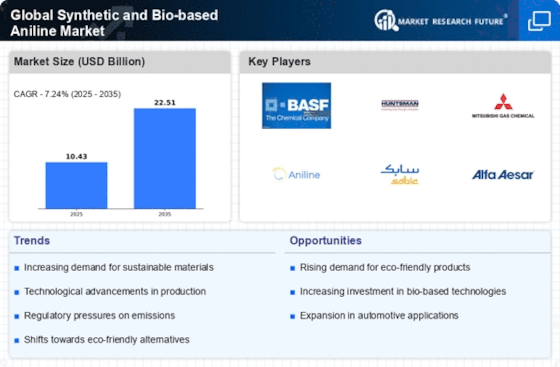
<p>Key players in the Global Synthetic and Bio-based Aniline Market include BASF SE, Huntsman Corporation, Mitsubishi Gas Chemical Company, and SABIC.</p>

What are the projected valuations for Synthetic and Bio-Based Aniline by 2035?

<p>By 2035, the projected valuation for Synthetic Aniline is 15.0 USD Billion, while Bio-Based Aniline is expected to reach 7.51 USD Billion.</p>

How does the valuation of Nitrobenzene and Chlorobenzene compare in the Global Synthetic and Bio-based Aniline Market?

<p>In 2035, Nitrobenzene is projected to reach 8.83 USD Billion, whereas Chlorobenzene is expected to attain 13.68 USD Billion.</p>

What applications are driving growth in the Global Synthetic and Bio-based Aniline Market?

The applications driving growth include MDI, projected to reach 11.25 USD Billion, and Rubber Processing Chemicals, expected to reach 11.26 USD Billion by 2035.

What end-use industries are contributing to the Global Synthetic and Bio-based Aniline Market?

The end-use industries contributing to the market include Construction, Automotive, and Home Furnishing, with Home Furnishing projected to reach 11.51 USD Billion by 2035.

What was the valuation of Synthetic Aniline in 2024?

The valuation of Synthetic Aniline in 2024 was 7.0 USD Billion.

What is the future outlook for the Global Synthetic and Bio-based Aniline Market?

The future outlook for the Global Synthetic and Bio-based Aniline Market appears positive, with substantial growth anticipated across various segments by 2035.

Market Summary

As per Market Research Future analysis, the Global Synthetic and Bio-based Aniline Market Size was estimated at 10.43 USD Billion in 2024. The aniline industry is projected to grow from 11.19 USD Billion in 2025 to 22.51 USD Billion by 2035, exhibiting a compound annual growth rate (CAGR) of 7.24% during the forecast period 2025 - 2035

Key Market Trends & Highlights

The Global Synthetic and Bio-based Aniline Market is poised for substantial growth driven by sustainability and technological advancements.

  • North America remains the largest market for synthetic and bio-based aniline, reflecting a strong industrial base and demand.
  • Asia-Pacific is emerging as the fastest-growing region, propelled by increasing industrialization and urbanization.
  • The synthetic segment dominates the market, while the bio-based segment is rapidly gaining traction due to rising sustainability concerns.
  • Key market drivers include sustainability initiatives and technological innovations, which are fostering diverse applications across various industries.

Market Size & Forecast

2024 Market Size 10.43 (USD Billion)
2035 Market Size 22.51 (USD Billion)
CAGR (2025 - 2035) 7.24%
Largest Regional Market Share in 2024 North America

Major Players

BASF SE (DE), Huntsman Corporation (US), Mitsubishi Gas Chemical Company, Inc. (JP), Aniline Chemical Company (US), SABIC (SA), Alfa Aesar (US), Eastman Chemical Company (US), Yancheng Hongtai Chemical Co., Ltd. (CN)

Market Trends

The Global Synthetic and Bio-based Aniline Market is currently experiencing a notable transformation, driven by increasing environmental awareness and the demand for sustainable products. As industries seek to reduce their carbon footprint, bio-based aniline is gaining traction as a viable alternative to traditional synthetic methods. This shift appears to be influenced by regulatory frameworks that encourage the use of renewable resources, thereby fostering innovation in production techniques. Furthermore, the market is witnessing a growing interest from various sectors, including textiles, pharmaceuticals, and agrochemicals, which are exploring the benefits of bio-based aniline in their applications. In addition to sustainability, advancements in technology are playing a crucial role in shaping the Global Synthetic and Bio-based Aniline Market. Enhanced production processes and improved efficiency are likely to drive down costs, making bio-based options more competitive against synthetic counterparts. Moreover, the increasing collaboration between manufacturers and research institutions suggests a commitment to developing new applications and improving product quality. As the market evolves, it seems poised for growth, with a focus on balancing economic viability and environmental responsibility, which could redefine industry standards in the coming years.

Sustainability Focus

The emphasis on sustainability is reshaping the Global Synthetic and Bio-based Aniline Market. Companies are increasingly prioritizing eco-friendly practices, leading to a rise in the adoption of bio-based aniline. This trend reflects a broader commitment to reducing environmental impact and aligning with consumer preferences for greener products.

Technological Advancements

Innovations in production technology are significantly influencing the Global Synthetic and Bio-based Aniline Market. Enhanced methods are improving efficiency and reducing costs, making bio-based aniline more appealing. This trend indicates a potential shift in market dynamics as companies seek to leverage these advancements.

Diverse Applications

The versatility of aniline derivatives is driving demand across various sectors within the Global Synthetic and Bio-based Aniline Market. Industries such as textiles, pharmaceuticals, and agrochemicals are exploring new applications, suggesting a broadening scope for both synthetic and bio-based aniline products.

Synthetic Bio-Based Aniline Market Market Drivers

Regulatory Support

Regulatory frameworks promoting the use of bio-based chemicals are likely to enhance the Global Synthetic and Bio-based Aniline Market. Governments worldwide are implementing policies that encourage the adoption of sustainable practices, including the use of bio-based aniline. These regulations often provide incentives for companies to transition from synthetic to bio-based materials, thereby fostering innovation and investment in the sector. For example, initiatives aimed at reducing greenhouse gas emissions are pushing manufacturers to explore alternative sources of aniline. As a result, the market for bio-based aniline is expected to gain traction, potentially capturing a larger share of the overall aniline market. This regulatory support could be pivotal in shaping future market dynamics.

Technological Innovations

Technological advancements in production processes are reshaping the Global Synthetic and Bio-based Aniline Market. Innovations such as improved catalytic processes and more efficient extraction methods are enhancing the yield and purity of aniline. These advancements not only reduce production costs but also minimize waste, aligning with the industry's sustainability goals. For instance, the introduction of green chemistry principles in aniline production has the potential to significantly lower hazardous by-products. Market data suggests that companies investing in these technologies may experience a competitive edge, as they can offer higher quality products at lower prices. This trend indicates a promising future for both synthetic and bio-based aniline, as technology continues to evolve.

Sustainability Initiatives

The increasing emphasis on sustainability within the chemical industry appears to drive the demand for bio-based aniline. As consumers and manufacturers alike prioritize eco-friendly products, the Global Synthetic and Bio-based Aniline Market is witnessing a shift towards renewable resources. This transition is not merely a trend but a fundamental change in production practices, with bio-based aniline offering a lower carbon footprint compared to its synthetic counterpart. Reports indicate that the bio-based segment is projected to grow at a compound annual growth rate (CAGR) of approximately 8% over the next five years. This growth is likely fueled by regulatory frameworks and consumer preferences that favor sustainable materials, thereby enhancing the market's overall appeal.

Diverse Industrial Applications

The versatility of aniline in various industrial applications is a key driver for the Global Synthetic and Bio-based Aniline Market. Aniline is utilized in the production of dyes, pharmaceuticals, and rubber processing chemicals, among others. The demand for high-performance materials in sectors such as automotive and construction is likely to bolster the market. For instance, the automotive industry increasingly relies on aniline-based products for manufacturing durable and efficient components. Market analysis reveals that the demand for aniline in the dye industry alone is expected to reach USD 5 billion by 2026, highlighting the material's critical role across multiple sectors. This diverse applicability suggests a robust and expanding market landscape.

Growing Demand from Emerging Economies

Emerging economies are increasingly contributing to the growth of the Global Synthetic and Bio-based Aniline Market. As these regions industrialize, the demand for aniline-based products is on the rise, driven by expanding manufacturing sectors. Countries in Asia-Pacific, particularly, are witnessing a surge in demand for aniline in various applications, including textiles and automotive components. Market forecasts indicate that the Asia-Pacific region could account for over 40% of the global aniline consumption by 2027. This trend suggests that manufacturers may need to adapt their strategies to cater to the unique needs of these markets, potentially leading to increased production capacities and localized supply chains.

Market Segment Insights

By Type: Synthetic (Largest) vs. Bio-Based (Fastest-Growing)

<p>In the Global Synthetic and Bio-based Aniline Market, the synthetic segment remains the dominant force, capturing a significant portion of the market share. This segment benefits from established production processes and extensive industrial applications, which reinforce its prominent position. In contrast, while the bio-based segment currently holds a smaller share, it is rapidly gaining traction as sustainability concerns drive innovation and demand within the industry. The growth trends in this segment are heavily influenced by the increasing focus on eco-friendly materials and regulatory pressure for greener solutions. While the synthetic segment is expected to maintain its lead, bio-based aniline is poised for substantial growth due to mounting consumer preference for sustainable products and advancements in bio-manufacturing technologies, positioning it as a key player in the future market landscape.</p>

<p>Synthetic (Dominant) vs. Bio-Based (Emerging)</p>

<p>The synthetic aniline segment stands as the cornerstone of the Global Synthetic and Bio-based Aniline Market, characterized by its well-established production techniques and broad utilization across various industries such as dyes, pharmaceuticals, and agrochemicals. This dominance is attributed to consistent demand and a robust supply chain. Meanwhile, the bio-based aniline segment emerges as a noteworthy contender, driven by increasing environmental awareness and regulatory shifts towards renewable resources. Despite being in its growth phase, bio-based aniline is rapidly gaining acceptance in the market, fueled by innovations in production processes that enhance efficiency and reduce ecological impact. This trend highlights a significant shift toward sustainable practices, with both segments vying for growth as they adapt to changing market dynamics.</p>

By Process: Nitrobenzene (Largest) vs. Chlorobenzene (Fastest-Growing)

<p>In the Global Synthetic and Bio-based Aniline Market, Nitrobenzene holds the largest share among process segments, largely due to its established applications in the production of aniline. This segment has consistently dominated the market, thanks to its wide usage in the manufacturing of dyes, agrochemicals, and polymers. On the other hand, Chlorobenzene is emerging rapidly, capitalizing on its versatility and application in producing various aniline derivatives, which is attracting increasing attention from manufacturers.</p>

<p>Process: Nitrobenzene (Dominant) vs. Chlorobenzene (Emerging)</p>

<p>Nitrobenzene is considered the dominant process in the Global Synthetic and Bio-based Aniline Market due to its extensive use in a plethora of industrial applications. Its established presence allows for economies of scale, thus making it indispensable in aniline production. Contrastingly, Chlorobenzene, identified as an emerging process, is witnessing swift growth due to its adaptability in producing high-value aniline derivatives. Innovations and technological advancements in the chlorobenzene process are enhancing its efficiency and environmental sustainability, which is expected to further its market presence and competitiveness.</p>

By Application: MDI (Largest) vs. Rubber Processing Chemical (Fastest-Growing)

<p>In the Global Synthetic and Bio-based Aniline Market, the application segment is marked by MDI (Methylene Diphenyl Diisocyanate) holding a significant share, establishing itself as the central element in various industrial applications, particularly in the production of polyurethane foams, coatings, and adhesives. Rubber Processing Chemicals segment, while comparatively smaller in share, is gaining momentum due to its integral role in enhancing the performance and durability of rubber products used across automotive, industrial, and consumer sectors. The growth trends indicate a robust expansion for both applications, with MDI enjoying stability from its widespread utility in high-demand sectors. However, Rubber Processing Chemicals emerge as the fastest-growing, driven by increasing industrial production and the rising influence of the automotive industry, showcasing sustainable practices and advanced material use, appealing to manufacturers striving for quality and performance enhancement.</p>

<p>MDI (Dominant) vs. Rubber Processing Chemical (Emerging)</p>

<p>MDI, being the dominant player in the Global Synthetic and Bio-based Aniline Market, showcases its versatility and reliability across a multitude of applications, most notably in producing high-performance polyurethane products. The robust demand for insulation and cushioning materials in construction and automotive industries fuels MDI's strong market position. On the other hand, Rubber Processing Chemicals are emerging rapidly due to the burgeoning need for quality enhancements in rubber formulations. This segment addresses essential properties like heat resistance and aging stability, catering to a wide range of applications in tires and industrial rubber goods. With the increased focus on sustainability, bio-based alternatives within this segment are becoming increasingly appealing to environmentally-conscious manufacturers.</p>

By End-Use Industry: Construction (Largest) vs. Automotive (Fastest-Growing)

<p>In the Global Synthetic and Bio-based Aniline Market, the end-use industry segment showcases a diverse distribution of market share among three primary categories: Construction, Automotive, and Home Furnishing. Currently, the Construction sector is the largest market contributor, leveraging the properties of synthetic and bio-based aniline for applications in paints, coatings, and adhesives, which are essential for modern infrastructure development. Meanwhile, the Automotive sector is emerging rapidly, gaining traction due to the increasing demand for lightweight materials and innovative coatings that enhance vehicle performance and aesthetics.</p>

<p>Construction (Dominant) vs. Automotive (Emerging)</p>

<p>The Construction sector remains dominant in the Global Synthetic and Bio-based Aniline Market, attributed to its extensive applications in infrastructure projects and development. Synthetic aniline plays a critical role in manufacturing high-performance coatings, sealants, and adhesives that meet industry standards. On the other hand, the Automotive sector is identified as an emerging field, driven by the rise in electric and hybrid vehicle production. Manufacturers are increasingly incorporating bio-based aniline in interior components and coatings to align with sustainability goals and regulatory frameworks. This shift not only addresses environmental concerns but also enhances product performance, making the automotive segment a key area of growth in the coming years.</p>

Get more detailed insights about Synthetic and Bio-Based Aniline Market Research Report – Forecast to 2035

Regional Insights

North America : Innovation and Demand Surge

North America is the largest market for synthetic and bio-based aniline, holding approximately 40% of the global market share. The region's growth is driven by increasing demand from the automotive and textile industries, alongside stringent environmental regulations promoting bio-based alternatives. The U.S. and Canada are the primary contributors, with a focus on sustainable production methods and innovations in chemical processes. The competitive landscape is characterized by major players such as BASF SE, Huntsman Corporation, and Eastman Chemical Company. These companies are investing in R&D to enhance product offerings and meet regulatory standards. The presence of advanced manufacturing facilities and a robust supply chain further strengthens North America's position in The Global Synthetic and Bio-based Aniline.

Europe : Sustainability and Innovation Focus

Europe is the second-largest market for synthetic and bio-based aniline, accounting for around 30% of the global market share. The region's growth is propelled by a strong emphasis on sustainability and innovation, driven by EU regulations aimed at reducing carbon emissions and promoting green chemistry. Countries like Germany and France are at the forefront, with increasing investments in bio-based technologies and sustainable practices. The competitive landscape features key players such as BASF SE and Mitsubishi Gas Chemical Company, which are actively developing eco-friendly aniline products. The presence of stringent regulations encourages companies to innovate, leading to a dynamic market environment. The European market is also characterized by collaborations between industry and academia to advance research in sustainable chemical processes.

Asia-Pacific : Rapid Growth and Expansion

Asia-Pacific is witnessing rapid growth in the synthetic and bio-based aniline market, holding approximately 25% of the global market share. The region's expansion is driven by increasing industrialization, urbanization, and rising demand from the automotive and textile sectors. Countries like China and India are leading this growth, supported by favorable government policies and investments in manufacturing capabilities. The competitive landscape is marked by the presence of local players such as Yancheng Hongtai Chemical Co., Ltd. and international firms like SABIC. The region is becoming a hub for production due to lower labor costs and increasing investments in technology. As environmental concerns rise, there is a growing shift towards bio-based aniline, further enhancing market dynamics in Asia-Pacific.

Middle East and Africa : Resource-Rich and Emerging Market

The Middle East and Africa region is emerging as a potential market for synthetic and bio-based aniline, currently holding about 5% of the global market share. The growth is driven by the region's rich natural resources and increasing investments in chemical manufacturing. Countries like Saudi Arabia and South Africa are focusing on diversifying their economies, which includes expanding their chemical industries to meet local and international demand. The competitive landscape is still developing, with local players beginning to establish their presence. Companies are exploring partnerships and collaborations to enhance production capabilities and market reach. As the region continues to invest in infrastructure and technology, the aniline market is expected to grow, driven by both domestic and export opportunities.

Key Players and Competitive Insights

Leading market players are investing heavily in research and development in order to expand their product lines, which will help the synthetic and bio-based aniline market, grow even more. Market participants are also undertaking a variety of strategic activities to expand their footprint, with important market developments including new product launches, contractual agreements, mergers and acquisitions, higher investments, and collaboration with other organizations. To expand and survive in a more competitive and rising market climate, synthetic and bio-based aniline industry must offer cost-effective items.
Manufacturing locally to minimize operational costs is one of the key business tactics used by manufacturers in the synthetic and bio-based aniline industry to benefit clients and increase the market sector. In recent years, the synthetic and bio-based aniline industry has offered some of the most significant advantages to market.
Major players in the synthetic and bio-based aniline market attempting to increase market demand by investing in research and development operations include BASF SE (Germany), Huntsman International LLC. (U.S.), GNFC. (India), China Petroleum & Chemical Corporation (China), Sumitomo Chemical Co., Ltd. (Japan), Tosoh Corporation (Japan), Covestro AG (Germany), Borsodchem Mchz S.R.O. (Czech Republic), SP Chemicals Holdings Ltd. (Singapore), Arrow Chemical Group Corp. (China), and DowDuPont Inc. (U.S.).
Tosoh Corp. is a manufacturer and distributor of petrochemicals, fine chemicals, specialized products, and basic chemicals for industry. It also produces and sells materials for high-tech and specialized industries. Olefins, functional polymers, polyethylene, cement, caustic soda, measuring and diagnostic tools, inorganic and organic fine chemicals, functional materials, and urethane materials are among the company's product offerings. Additionally, it provides services including product delivery and logistics, insurance brokerage, equipment maintenance, and product sale and purchase.
Product manufacturers Covestro Deutschland AG produce polymers. The business manufactures and sells sealants, polycarbonates, polyurethanes, adhesives, coatings, and adhesives. The automotive, building, health, electronics, and medical engineering sectors are all served by Covestro Deutschland. Products range from thermoplastic polyurethane and polycarbonate pellets through isocyanates and polyols for cellular foams, as well as polyurethane-based additives used in the creation of coatings and adhesives. Formerly known as Bayer MaterialScience, it is a Bayer spin-off company that was established in the autumn of 2015.

Key Companies in the Synthetic Bio-Based Aniline Market include

Industry Developments

February 2022: Launched recently, the Aston Martin DBX707 is the most significant luxury SUV in the world and offers a wide range of gearbox, engine, brake and suspension improvements. Alcantara, Inspires - Comfort, and Inspire Sport come with fully and semi-aniline leather seats that also have embroidered Aston Martin wings on the headrest, a contrast stripe down the middle of the seat, a perforation pattern in the back seat, and a base cushion.

Future Outlook

Synthetic Bio-Based Aniline Market Future Outlook

The Global Synthetic and Bio-based Aniline Market is projected to grow at a 7.24% CAGR from 2025 to 2035, driven by increasing demand in various applications and sustainability initiatives.

New opportunities lie in:

  • Expansion into emerging markets with tailored product offerings.
  • Investment in R&D for bio-based aniline production technologies.
  • Partnerships with automotive manufacturers for specialized aniline applications.

By 2035, the market is expected to solidify its position as a leader in sustainable chemical solutions.

Market Segmentation

Synthetic Bio-Based Aniline Market Type Outlook

  • Synthetic
  • Bio-Based

Synthetic Bio-Based Aniline Market Process Outlook

  • Nitrobenzene
  • Chlorobenzene

Synthetic Bio-Based Aniline Market Application Outlook

  • MDI
  • Rubber Processing Chemical

Synthetic Bio-Based Aniline Market End-Use Industry Outlook

  • Construction
  • Automotive
  • Home Furnishing

Report Scope

MARKET SIZE 2024 10.43(USD Billion)
MARKET SIZE 2025 11.19(USD Billion)
MARKET SIZE 2035 22.51(USD Billion)
COMPOUND ANNUAL GROWTH RATE (CAGR) 7.24% (2025 - 2035)
REPORT COVERAGE Revenue Forecast, Competitive Landscape, Growth Factors, and Trends
BASE YEAR 2024
Market Forecast Period 2025 - 2035
Historical Data 2019 - 2024
Market Forecast Units USD Billion
Key Companies Profiled BASF SE (DE), Huntsman Corporation (US), Mitsubishi Gas Chemical Company, Inc. (JP), Aniline Chemical Company (US), SABIC (SA), Alfa Aesar (US), Eastman Chemical Company (US), Yancheng Hongtai Chemical Co., Ltd. (CN)
Segments Covered Type, Process, Application, End-Use Industry, Region
Key Market Opportunities Growing demand for sustainable materials drives innovation in the Global Synthetic and Bio-based Aniline Market.
Key Market Dynamics Rising demand for sustainable materials drives innovation in bio-based aniline production and regulatory compliance.
Countries Covered North America, Europe, APAC, South America, MEA

FAQs

What is the projected market valuation for the Global Synthetic and Bio-based Aniline Market in 2035?

<p>The projected market valuation for the Global Synthetic and Bio-based Aniline Market in 2035 is 22.51 USD Billion.</p>

What was the market valuation for the Global Synthetic and Bio-based Aniline Market in 2024?

<p>The overall market valuation for the Global Synthetic and Bio-based Aniline Market was 10.43 USD Billion in 2024.</p>

What is the expected CAGR for the Global Synthetic and Bio-based Aniline Market during the forecast period 2025 - 2035?

<p>The expected CAGR for the Global Synthetic and Bio-based Aniline Market during the forecast period 2025 - 2035 is 7.24%.</p>

Which companies are considered key players in the Global Synthetic and Bio-based Aniline Market?

<p>Key players in the Global Synthetic and Bio-based Aniline Market include BASF SE, Huntsman Corporation, Mitsubishi Gas Chemical Company, and SABIC.</p>

What are the projected valuations for Synthetic and Bio-Based Aniline by 2035?

<p>By 2035, the projected valuation for Synthetic Aniline is 15.0 USD Billion, while Bio-Based Aniline is expected to reach 7.51 USD Billion.</p>

How does the valuation of Nitrobenzene and Chlorobenzene compare in the Global Synthetic and Bio-based Aniline Market?

<p>In 2035, Nitrobenzene is projected to reach 8.83 USD Billion, whereas Chlorobenzene is expected to attain 13.68 USD Billion.</p>

What applications are driving growth in the Global Synthetic and Bio-based Aniline Market?

The applications driving growth include MDI, projected to reach 11.25 USD Billion, and Rubber Processing Chemicals, expected to reach 11.26 USD Billion by 2035.

What end-use industries are contributing to the Global Synthetic and Bio-based Aniline Market?

The end-use industries contributing to the market include Construction, Automotive, and Home Furnishing, with Home Furnishing projected to reach 11.51 USD Billion by 2035.

What was the valuation of Synthetic Aniline in 2024?

The valuation of Synthetic Aniline in 2024 was 7.0 USD Billion.

What is the future outlook for the Global Synthetic and Bio-based Aniline Market?

The future outlook for the Global Synthetic and Bio-based Aniline Market appears positive, with substantial growth anticipated across various segments by 2035.

  1. SECTION I: EXECUTIVE SUMMARY AND KEY HIGHLIGHTS
    1. | 1.1 EXECUTIVE SUMMARY
    2. | | 1.1.1 Market Overview
    3. | | 1.1.2 Key Findings
    4. | | 1.1.3 Market Segmentation
    5. | | 1.1.4 Competitive Landscape
    6. | | 1.1.5 Challenges and Opportunities
    7. | | 1.1.6 Future Outlook
  2. SECTION II: SCOPING, METHODOLOGY AND MARKET STRUCTURE
    1. | 2.1 MARKET INTRODUCTION
    2. | | 2.1.1 Definition
    3. | | 2.1.2 Scope of the study
    4. | | | 2.1.2.1 Research Objective
    5. | | | 2.1.2.2 Assumption
    6. | | | 2.1.2.3 Limitations
    7. | 2.2 RESEARCH METHODOLOGY
    8. | | 2.2.1 Overview
    9. | | 2.2.2 Data Mining
    10. | | 2.2.3 Secondary Research
    11. | | 2.2.4 Primary Research
    12. | | | 2.2.4.1 Primary Interviews and Information Gathering Process
    13. | | | 2.2.4.2 Breakdown of Primary Respondents
    14. | | 2.2.5 Forecasting Model
    15. | | 2.2.6 Market Size Estimation
    16. | | | 2.2.6.1 Bottom-Up Approach
    17. | | | 2.2.6.2 Top-Down Approach
    18. | | 2.2.7 Data Triangulation
    19. | | 2.2.8 Validation
  3. SECTION III: QUALITATIVE ANALYSIS
    1. | 3.1 MARKET DYNAMICS
    2. | | 3.1.1 Overview
    3. | | 3.1.2 Drivers
    4. | | 3.1.3 Restraints
    5. | | 3.1.4 Opportunities
    6. | 3.2 MARKET FACTOR ANALYSIS
    7. | | 3.2.1 Value chain Analysis
    8. | | 3.2.2 Porter's Five Forces Analysis
    9. | | | 3.2.2.1 Bargaining Power of Suppliers
    10. | | | 3.2.2.2 Bargaining Power of Buyers
    11. | | | 3.2.2.3 Threat of New Entrants
    12. | | | 3.2.2.4 Threat of Substitutes
    13. | | | 3.2.2.5 Intensity of Rivalry
    14. | | 3.2.3 COVID-19 Impact Analysis
    15. | | | 3.2.3.1 Market Impact Analysis
    16. | | | 3.2.3.2 Regional Impact
    17. | | | 3.2.3.3 Opportunity and Threat Analysis
  4. SECTION IV: QUANTITATIVE ANALYSIS
    1. | 4.1 Chemicals and Materials, BY Type (USD Billion)
    2. | | 4.1.1 Synthetic
    3. | | 4.1.2 Bio-Based
    4. | 4.2 Chemicals and Materials, BY Process (USD Billion)
    5. | | 4.2.1 Nitrobenzene
    6. | | 4.2.2 Chlorobenzene
    7. | 4.3 Chemicals and Materials, BY Application (USD Billion)
    8. | | 4.3.1 MDI
    9. | | 4.3.2 Rubber Processing Chemical
    10. | 4.4 Chemicals and Materials, BY End-Use Industry (USD Billion)
    11. | | 4.4.1 Construction
    12. | | 4.4.2 Automotive
    13. | | 4.4.3 Home Furnishing
    14. | 4.5 Chemicals and Materials, BY Region (USD Billion)
    15. | | 4.5.1 North America
    16. | | | 4.5.1.1 US
    17. | | | 4.5.1.2 Canada
    18. | | 4.5.2 Europe
    19. | | | 4.5.2.1 Germany
    20. | | | 4.5.2.2 UK
    21. | | | 4.5.2.3 France
    22. | | | 4.5.2.4 Russia
    23. | | | 4.5.2.5 Italy
    24. | | | 4.5.2.6 Spain
    25. | | | 4.5.2.7 Rest of Europe
    26. | | 4.5.3 APAC
    27. | | | 4.5.3.1 China
    28. | | | 4.5.3.2 India
    29. | | | 4.5.3.3 Japan
    30. | | | 4.5.3.4 South Korea
    31. | | | 4.5.3.5 Malaysia
    32. | | | 4.5.3.6 Thailand
    33. | | | 4.5.3.7 Indonesia
    34. | | | 4.5.3.8 Rest of APAC
    35. | | 4.5.4 South America
    36. | | | 4.5.4.1 Brazil
    37. | | | 4.5.4.2 Mexico
    38. | | | 4.5.4.3 Argentina
    39. | | | 4.5.4.4 Rest of South America
    40. | | 4.5.5 MEA
    41. | | | 4.5.5.1 GCC Countries
    42. | | | 4.5.5.2 South Africa
    43. | | | 4.5.5.3 Rest of MEA
  5. SECTION V: COMPETITIVE ANALYSIS
    1. | 5.1 Competitive Landscape
    2. | | 5.1.1 Overview
    3. | | 5.1.2 Competitive Analysis
    4. | | 5.1.3 Market share Analysis
    5. | | 5.1.4 Major Growth Strategy in the Chemicals and Materials
    6. | | 5.1.5 Competitive Benchmarking
    7. | | 5.1.6 Leading Players in Terms of Number of Developments in the Chemicals and Materials
    8. | | 5.1.7 Key developments and growth strategies
    9. | | | 5.1.7.1 New Product Launch/Service Deployment
    10. | | | 5.1.7.2 Merger & Acquisitions
    11. | | | 5.1.7.3 Joint Ventures
    12. | | 5.1.8 Major Players Financial Matrix
    13. | | | 5.1.8.1 Sales and Operating Income
    14. | | | 5.1.8.2 Major Players R&D Expenditure. 2023
    15. | 5.2 Company Profiles
    16. | | 5.2.1 BASF SE (DE)
    17. | | | 5.2.1.1 Financial Overview
    18. | | | 5.2.1.2 Products Offered
    19. | | | 5.2.1.3 Key Developments
    20. | | | 5.2.1.4 SWOT Analysis
    21. | | | 5.2.1.5 Key Strategies
    22. | | 5.2.2 Huntsman Corporation (US)
    23. | | | 5.2.2.1 Financial Overview
    24. | | | 5.2.2.2 Products Offered
    25. | | | 5.2.2.3 Key Developments
    26. | | | 5.2.2.4 SWOT Analysis
    27. | | | 5.2.2.5 Key Strategies
    28. | | 5.2.3 Mitsubishi Gas Chemical Company, Inc. (JP)
    29. | | | 5.2.3.1 Financial Overview
    30. | | | 5.2.3.2 Products Offered
    31. | | | 5.2.3.3 Key Developments
    32. | | | 5.2.3.4 SWOT Analysis
    33. | | | 5.2.3.5 Key Strategies
    34. | | 5.2.4 Aniline Chemical Company (US)
    35. | | | 5.2.4.1 Financial Overview
    36. | | | 5.2.4.2 Products Offered
    37. | | | 5.2.4.3 Key Developments
    38. | | | 5.2.4.4 SWOT Analysis
    39. | | | 5.2.4.5 Key Strategies
    40. | | 5.2.5 SABIC (SA)
    41. | | | 5.2.5.1 Financial Overview
    42. | | | 5.2.5.2 Products Offered
    43. | | | 5.2.5.3 Key Developments
    44. | | | 5.2.5.4 SWOT Analysis
    45. | | | 5.2.5.5 Key Strategies
    46. | | 5.2.6 Alfa Aesar (US)
    47. | | | 5.2.6.1 Financial Overview
    48. | | | 5.2.6.2 Products Offered
    49. | | | 5.2.6.3 Key Developments
    50. | | | 5.2.6.4 SWOT Analysis
    51. | | | 5.2.6.5 Key Strategies
    52. | | 5.2.7 Eastman Chemical Company (US)
    53. | | | 5.2.7.1 Financial Overview
    54. | | | 5.2.7.2 Products Offered
    55. | | | 5.2.7.3 Key Developments
    56. | | | 5.2.7.4 SWOT Analysis
    57. | | | 5.2.7.5 Key Strategies
    58. | | 5.2.8 Yancheng Hongtai Chemical Co., Ltd. (CN)
    59. | | | 5.2.8.1 Financial Overview
    60. | | | 5.2.8.2 Products Offered
    61. | | | 5.2.8.3 Key Developments
    62. | | | 5.2.8.4 SWOT Analysis
    63. | | | 5.2.8.5 Key Strategies
    64. | 5.3 Appendix
    65. | | 5.3.1 References
    66. | | 5.3.2 Related Reports
  6. LIST OF FIGURES
    1. | 6.1 MARKET SYNOPSIS
    2. | 6.2 NORTH AMERICA MARKET ANALYSIS
    3. | 6.3 US MARKET ANALYSIS BY TYPE
    4. | 6.4 US MARKET ANALYSIS BY PROCESS
    5. | 6.5 US MARKET ANALYSIS BY APPLICATION
    6. | 6.6 US MARKET ANALYSIS BY END-USE INDUSTRY
    7. | 6.7 CANADA MARKET ANALYSIS BY TYPE
    8. | 6.8 CANADA MARKET ANALYSIS BY PROCESS
    9. | 6.9 CANADA MARKET ANALYSIS BY APPLICATION
    10. | 6.10 CANADA MARKET ANALYSIS BY END-USE INDUSTRY
    11. | 6.11 EUROPE MARKET ANALYSIS
    12. | 6.12 GERMANY MARKET ANALYSIS BY TYPE
    13. | 6.13 GERMANY MARKET ANALYSIS BY PROCESS
    14. | 6.14 GERMANY MARKET ANALYSIS BY APPLICATION
    15. | 6.15 GERMANY MARKET ANALYSIS BY END-USE INDUSTRY
    16. | 6.16 UK MARKET ANALYSIS BY TYPE
    17. | 6.17 UK MARKET ANALYSIS BY PROCESS
    18. | 6.18 UK MARKET ANALYSIS BY APPLICATION
    19. | 6.19 UK MARKET ANALYSIS BY END-USE INDUSTRY
    20. | 6.20 FRANCE MARKET ANALYSIS BY TYPE
    21. | 6.21 FRANCE MARKET ANALYSIS BY PROCESS
    22. | 6.22 FRANCE MARKET ANALYSIS BY APPLICATION
    23. | 6.23 FRANCE MARKET ANALYSIS BY END-USE INDUSTRY
    24. | 6.24 RUSSIA MARKET ANALYSIS BY TYPE
    25. | 6.25 RUSSIA MARKET ANALYSIS BY PROCESS
    26. | 6.26 RUSSIA MARKET ANALYSIS BY APPLICATION
    27. | 6.27 RUSSIA MARKET ANALYSIS BY END-USE INDUSTRY
    28. | 6.28 ITALY MARKET ANALYSIS BY TYPE
    29. | 6.29 ITALY MARKET ANALYSIS BY PROCESS
    30. | 6.30 ITALY MARKET ANALYSIS BY APPLICATION
    31. | 6.31 ITALY MARKET ANALYSIS BY END-USE INDUSTRY
    32. | 6.32 SPAIN MARKET ANALYSIS BY TYPE
    33. | 6.33 SPAIN MARKET ANALYSIS BY PROCESS
    34. | 6.34 SPAIN MARKET ANALYSIS BY APPLICATION
    35. | 6.35 SPAIN MARKET ANALYSIS BY END-USE INDUSTRY
    36. | 6.36 REST OF EUROPE MARKET ANALYSIS BY TYPE
    37. | 6.37 REST OF EUROPE MARKET ANALYSIS BY PROCESS
    38. | 6.38 REST OF EUROPE MARKET ANALYSIS BY APPLICATION
    39. | 6.39 REST OF EUROPE MARKET ANALYSIS BY END-USE INDUSTRY
    40. | 6.40 APAC MARKET ANALYSIS
    41. | 6.41 CHINA MARKET ANALYSIS BY TYPE
    42. | 6.42 CHINA MARKET ANALYSIS BY PROCESS
    43. | 6.43 CHINA MARKET ANALYSIS BY APPLICATION
    44. | 6.44 CHINA MARKET ANALYSIS BY END-USE INDUSTRY
    45. | 6.45 INDIA MARKET ANALYSIS BY TYPE
    46. | 6.46 INDIA MARKET ANALYSIS BY PROCESS
    47. | 6.47 INDIA MARKET ANALYSIS BY APPLICATION
    48. | 6.48 INDIA MARKET ANALYSIS BY END-USE INDUSTRY
    49. | 6.49 JAPAN MARKET ANALYSIS BY TYPE
    50. | 6.50 JAPAN MARKET ANALYSIS BY PROCESS
    51. | 6.51 JAPAN MARKET ANALYSIS BY APPLICATION
    52. | 6.52 JAPAN MARKET ANALYSIS BY END-USE INDUSTRY
    53. | 6.53 SOUTH KOREA MARKET ANALYSIS BY TYPE
    54. | 6.54 SOUTH KOREA MARKET ANALYSIS BY PROCESS
    55. | 6.55 SOUTH KOREA MARKET ANALYSIS BY APPLICATION
    56. | 6.56 SOUTH KOREA MARKET ANALYSIS BY END-USE INDUSTRY
    57. | 6.57 MALAYSIA MARKET ANALYSIS BY TYPE
    58. | 6.58 MALAYSIA MARKET ANALYSIS BY PROCESS
    59. | 6.59 MALAYSIA MARKET ANALYSIS BY APPLICATION
    60. | 6.60 MALAYSIA MARKET ANALYSIS BY END-USE INDUSTRY
    61. | 6.61 THAILAND MARKET ANALYSIS BY TYPE
    62. | 6.62 THAILAND MARKET ANALYSIS BY PROCESS
    63. | 6.63 THAILAND MARKET ANALYSIS BY APPLICATION
    64. | 6.64 THAILAND MARKET ANALYSIS BY END-USE INDUSTRY
    65. | 6.65 INDONESIA MARKET ANALYSIS BY TYPE
    66. | 6.66 INDONESIA MARKET ANALYSIS BY PROCESS
    67. | 6.67 INDONESIA MARKET ANALYSIS BY APPLICATION
    68. | 6.68 INDONESIA MARKET ANALYSIS BY END-USE INDUSTRY
    69. | 6.69 REST OF APAC MARKET ANALYSIS BY TYPE
    70. | 6.70 REST OF APAC MARKET ANALYSIS BY PROCESS
    71. | 6.71 REST OF APAC MARKET ANALYSIS BY APPLICATION
    72. | 6.72 REST OF APAC MARKET ANALYSIS BY END-USE INDUSTRY
    73. | 6.73 SOUTH AMERICA MARKET ANALYSIS
    74. | 6.74 BRAZIL MARKET ANALYSIS BY TYPE
    75. | 6.75 BRAZIL MARKET ANALYSIS BY PROCESS
    76. | 6.76 BRAZIL MARKET ANALYSIS BY APPLICATION
    77. | 6.77 BRAZIL MARKET ANALYSIS BY END-USE INDUSTRY
    78. | 6.78 MEXICO MARKET ANALYSIS BY TYPE
    79. | 6.79 MEXICO MARKET ANALYSIS BY PROCESS
    80. | 6.80 MEXICO MARKET ANALYSIS BY APPLICATION
    81. | 6.81 MEXICO MARKET ANALYSIS BY END-USE INDUSTRY
    82. | 6.82 ARGENTINA MARKET ANALYSIS BY TYPE
    83. | 6.83 ARGENTINA MARKET ANALYSIS BY PROCESS
    84. | 6.84 ARGENTINA MARKET ANALYSIS BY APPLICATION
    85. | 6.85 ARGENTINA MARKET ANALYSIS BY END-USE INDUSTRY
    86. | 6.86 REST OF SOUTH AMERICA MARKET ANALYSIS BY TYPE
    87. | 6.87 REST OF SOUTH AMERICA MARKET ANALYSIS BY PROCESS
    88. | 6.88 REST OF SOUTH AMERICA MARKET ANALYSIS BY APPLICATION
    89. | 6.89 REST OF SOUTH AMERICA MARKET ANALYSIS BY END-USE INDUSTRY
    90. | 6.90 MEA MARKET ANALYSIS
    91. | 6.91 GCC COUNTRIES MARKET ANALYSIS BY TYPE
    92. | 6.92 GCC COUNTRIES MARKET ANALYSIS BY PROCESS
    93. | 6.93 GCC COUNTRIES MARKET ANALYSIS BY APPLICATION
    94. | 6.94 GCC COUNTRIES MARKET ANALYSIS BY END-USE INDUSTRY
    95. | 6.95 SOUTH AFRICA MARKET ANALYSIS BY TYPE
    96. | 6.96 SOUTH AFRICA MARKET ANALYSIS BY PROCESS
    97. | 6.97 SOUTH AFRICA MARKET ANALYSIS BY APPLICATION
    98. | 6.98 SOUTH AFRICA MARKET ANALYSIS BY END-USE INDUSTRY
    99. | 6.99 REST OF MEA MARKET ANALYSIS BY TYPE
    100. | 6.100 REST OF MEA MARKET ANALYSIS BY PROCESS
    101. | 6.101 REST OF MEA MARKET ANALYSIS BY APPLICATION
    102. | 6.102 REST OF MEA MARKET ANALYSIS BY END-USE INDUSTRY
    103. | 6.103 KEY BUYING CRITERIA OF CHEMICALS AND MATERIALS
    104. | 6.104 RESEARCH PROCESS OF MRFR
    105. | 6.105 DRO ANALYSIS OF CHEMICALS AND MATERIALS
    106. | 6.106 DRIVERS IMPACT ANALYSIS: CHEMICALS AND MATERIALS
    107. | 6.107 RESTRAINTS IMPACT ANALYSIS: CHEMICALS AND MATERIALS
    108. | 6.108 SUPPLY / VALUE CHAIN: CHEMICALS AND MATERIALS
    109. | 6.109 CHEMICALS AND MATERIALS, BY TYPE, 2024 (% SHARE)
    110. | 6.110 CHEMICALS AND MATERIALS, BY TYPE, 2024 TO 2035 (USD Billion)
    111. | 6.111 CHEMICALS AND MATERIALS, BY PROCESS, 2024 (% SHARE)
    112. | 6.112 CHEMICALS AND MATERIALS, BY PROCESS, 2024 TO 2035 (USD Billion)
    113. | 6.113 CHEMICALS AND MATERIALS, BY APPLICATION, 2024 (% SHARE)
    114. | 6.114 CHEMICALS AND MATERIALS, BY APPLICATION, 2024 TO 2035 (USD Billion)
    115. | 6.115 CHEMICALS AND MATERIALS, BY END-USE INDUSTRY, 2024 (% SHARE)
    116. | 6.116 CHEMICALS AND MATERIALS, BY END-USE INDUSTRY, 2024 TO 2035 (USD Billion)
    117. | 6.117 BENCHMARKING OF MAJOR COMPETITORS
  7. LIST OF TABLES
    1. | 7.1 LIST OF ASSUMPTIONS
    2. | | 7.1.1
    3. | 7.2 North America MARKET SIZE ESTIMATES; FORECAST
    4. | | 7.2.1 BY TYPE, 2025-2035 (USD Billion)
    5. | | 7.2.2 BY PROCESS, 2025-2035 (USD Billion)
    6. | | 7.2.3 BY APPLICATION, 2025-2035 (USD Billion)
    7. | | 7.2.4 BY END-USE INDUSTRY, 2025-2035 (USD Billion)
    8. | 7.3 US MARKET SIZE ESTIMATES; FORECAST
    9. | | 7.3.1 BY TYPE, 2025-2035 (USD Billion)
    10. | | 7.3.2 BY PROCESS, 2025-2035 (USD Billion)
    11. | | 7.3.3 BY APPLICATION, 2025-2035 (USD Billion)
    12. | | 7.3.4 BY END-USE INDUSTRY, 2025-2035 (USD Billion)
    13. | 7.4 Canada MARKET SIZE ESTIMATES; FORECAST
    14. | | 7.4.1 BY TYPE, 2025-2035 (USD Billion)
    15. | | 7.4.2 BY PROCESS, 2025-2035 (USD Billion)
    16. | | 7.4.3 BY APPLICATION, 2025-2035 (USD Billion)
    17. | | 7.4.4 BY END-USE INDUSTRY, 2025-2035 (USD Billion)
    18. | 7.5 Europe MARKET SIZE ESTIMATES; FORECAST
    19. | | 7.5.1 BY TYPE, 2025-2035 (USD Billion)
    20. | | 7.5.2 BY PROCESS, 2025-2035 (USD Billion)
    21. | | 7.5.3 BY APPLICATION, 2025-2035 (USD Billion)
    22. | | 7.5.4 BY END-USE INDUSTRY, 2025-2035 (USD Billion)
    23. | 7.6 Germany MARKET SIZE ESTIMATES; FORECAST
    24. | | 7.6.1 BY TYPE, 2025-2035 (USD Billion)
    25. | | 7.6.2 BY PROCESS, 2025-2035 (USD Billion)
    26. | | 7.6.3 BY APPLICATION, 2025-2035 (USD Billion)
    27. | | 7.6.4 BY END-USE INDUSTRY, 2025-2035 (USD Billion)
    28. | 7.7 UK MARKET SIZE ESTIMATES; FORECAST
    29. | | 7.7.1 BY TYPE, 2025-2035 (USD Billion)
    30. | | 7.7.2 BY PROCESS, 2025-2035 (USD Billion)
    31. | | 7.7.3 BY APPLICATION, 2025-2035 (USD Billion)
    32. | | 7.7.4 BY END-USE INDUSTRY, 2025-2035 (USD Billion)
    33. | 7.8 France MARKET SIZE ESTIMATES; FORECAST
    34. | | 7.8.1 BY TYPE, 2025-2035 (USD Billion)
    35. | | 7.8.2 BY PROCESS, 2025-2035 (USD Billion)
    36. | | 7.8.3 BY APPLICATION, 2025-2035 (USD Billion)
    37. | | 7.8.4 BY END-USE INDUSTRY, 2025-2035 (USD Billion)
    38. | 7.9 Russia MARKET SIZE ESTIMATES; FORECAST
    39. | | 7.9.1 BY TYPE, 2025-2035 (USD Billion)
    40. | | 7.9.2 BY PROCESS, 2025-2035 (USD Billion)
    41. | | 7.9.3 BY APPLICATION, 2025-2035 (USD Billion)
    42. | | 7.9.4 BY END-USE INDUSTRY, 2025-2035 (USD Billion)
    43. | 7.10 Italy MARKET SIZE ESTIMATES; FORECAST
    44. | | 7.10.1 BY TYPE, 2025-2035 (USD Billion)
    45. | | 7.10.2 BY PROCESS, 2025-2035 (USD Billion)
    46. | | 7.10.3 BY APPLICATION, 2025-2035 (USD Billion)
    47. | | 7.10.4 BY END-USE INDUSTRY, 2025-2035 (USD Billion)
    48. | 7.11 Spain MARKET SIZE ESTIMATES; FORECAST
    49. | | 7.11.1 BY TYPE, 2025-2035 (USD Billion)
    50. | | 7.11.2 BY PROCESS, 2025-2035 (USD Billion)
    51. | | 7.11.3 BY APPLICATION, 2025-2035 (USD Billion)
    52. | | 7.11.4 BY END-USE INDUSTRY, 2025-2035 (USD Billion)
    53. | 7.12 Rest of Europe MARKET SIZE ESTIMATES; FORECAST
    54. | | 7.12.1 BY TYPE, 2025-2035 (USD Billion)
    55. | | 7.12.2 BY PROCESS, 2025-2035 (USD Billion)
    56. | | 7.12.3 BY APPLICATION, 2025-2035 (USD Billion)
    57. | | 7.12.4 BY END-USE INDUSTRY, 2025-2035 (USD Billion)
    58. | 7.13 APAC MARKET SIZE ESTIMATES; FORECAST
    59. | | 7.13.1 BY TYPE, 2025-2035 (USD Billion)
    60. | | 7.13.2 BY PROCESS, 2025-2035 (USD Billion)
    61. | | 7.13.3 BY APPLICATION, 2025-2035 (USD Billion)
    62. | | 7.13.4 BY END-USE INDUSTRY, 2025-2035 (USD Billion)
    63. | 7.14 China MARKET SIZE ESTIMATES; FORECAST
    64. | | 7.14.1 BY TYPE, 2025-2035 (USD Billion)
    65. | | 7.14.2 BY PROCESS, 2025-2035 (USD Billion)
    66. | | 7.14.3 BY APPLICATION, 2025-2035 (USD Billion)
    67. | | 7.14.4 BY END-USE INDUSTRY, 2025-2035 (USD Billion)
    68. | 7.15 India MARKET SIZE ESTIMATES; FORECAST
    69. | | 7.15.1 BY TYPE, 2025-2035 (USD Billion)
    70. | | 7.15.2 BY PROCESS, 2025-2035 (USD Billion)
    71. | | 7.15.3 BY APPLICATION, 2025-2035 (USD Billion)
    72. | | 7.15.4 BY END-USE INDUSTRY, 2025-2035 (USD Billion)
    73. | 7.16 Japan MARKET SIZE ESTIMATES; FORECAST
    74. | | 7.16.1 BY TYPE, 2025-2035 (USD Billion)
    75. | | 7.16.2 BY PROCESS, 2025-2035 (USD Billion)
    76. | | 7.16.3 BY APPLICATION, 2025-2035 (USD Billion)
    77. | | 7.16.4 BY END-USE INDUSTRY, 2025-2035 (USD Billion)
    78. | 7.17 South Korea MARKET SIZE ESTIMATES; FORECAST
    79. | | 7.17.1 BY TYPE, 2025-2035 (USD Billion)
    80. | | 7.17.2 BY PROCESS, 2025-2035 (USD Billion)
    81. | | 7.17.3 BY APPLICATION, 2025-2035 (USD Billion)
    82. | | 7.17.4 BY END-USE INDUSTRY, 2025-2035 (USD Billion)
    83. | 7.18 Malaysia MARKET SIZE ESTIMATES; FORECAST
    84. | | 7.18.1 BY TYPE, 2025-2035 (USD Billion)
    85. | | 7.18.2 BY PROCESS, 2025-2035 (USD Billion)
    86. | | 7.18.3 BY APPLICATION, 2025-2035 (USD Billion)
    87. | | 7.18.4 BY END-USE INDUSTRY, 2025-2035 (USD Billion)
    88. | 7.19 Thailand MARKET SIZE ESTIMATES; FORECAST
    89. | | 7.19.1 BY TYPE, 2025-2035 (USD Billion)
    90. | | 7.19.2 BY PROCESS, 2025-2035 (USD Billion)
    91. | | 7.19.3 BY APPLICATION, 2025-2035 (USD Billion)
    92. | | 7.19.4 BY END-USE INDUSTRY, 2025-2035 (USD Billion)
    93. | 7.20 Indonesia MARKET SIZE ESTIMATES; FORECAST
    94. | | 7.20.1 BY TYPE, 2025-2035 (USD Billion)
    95. | | 7.20.2 BY PROCESS, 2025-2035 (USD Billion)
    96. | | 7.20.3 BY APPLICATION, 2025-2035 (USD Billion)
    97. | | 7.20.4 BY END-USE INDUSTRY, 2025-2035 (USD Billion)
    98. | 7.21 Rest of APAC MARKET SIZE ESTIMATES; FORECAST
    99. | | 7.21.1 BY TYPE, 2025-2035 (USD Billion)
    100. | | 7.21.2 BY PROCESS, 2025-2035 (USD Billion)
    101. | | 7.21.3 BY APPLICATION, 2025-2035 (USD Billion)
    102. | | 7.21.4 BY END-USE INDUSTRY, 2025-2035 (USD Billion)
    103. | 7.22 South America MARKET SIZE ESTIMATES; FORECAST
    104. | | 7.22.1 BY TYPE, 2025-2035 (USD Billion)
    105. | | 7.22.2 BY PROCESS, 2025-2035 (USD Billion)
    106. | | 7.22.3 BY APPLICATION, 2025-2035 (USD Billion)
    107. | | 7.22.4 BY END-USE INDUSTRY, 2025-2035 (USD Billion)
    108. | 7.23 Brazil MARKET SIZE ESTIMATES; FORECAST
    109. | | 7.23.1 BY TYPE, 2025-2035 (USD Billion)
    110. | | 7.23.2 BY PROCESS, 2025-2035 (USD Billion)
    111. | | 7.23.3 BY APPLICATION, 2025-2035 (USD Billion)
    112. | | 7.23.4 BY END-USE INDUSTRY, 2025-2035 (USD Billion)
    113. | 7.24 Mexico MARKET SIZE ESTIMATES; FORECAST
    114. | | 7.24.1 BY TYPE, 2025-2035 (USD Billion)
    115. | | 7.24.2 BY PROCESS, 2025-2035 (USD Billion)
    116. | | 7.24.3 BY APPLICATION, 2025-2035 (USD Billion)
    117. | | 7.24.4 BY END-USE INDUSTRY, 2025-2035 (USD Billion)
    118. | 7.25 Argentina MARKET SIZE ESTIMATES; FORECAST
    119. | | 7.25.1 BY TYPE, 2025-2035 (USD Billion)
    120. | | 7.25.2 BY PROCESS, 2025-2035 (USD Billion)
    121. | | 7.25.3 BY APPLICATION, 2025-2035 (USD Billion)
    122. | | 7.25.4 BY END-USE INDUSTRY, 2025-2035 (USD Billion)
    123. | 7.26 Rest of South America MARKET SIZE ESTIMATES; FORECAST
    124. | | 7.26.1 BY TYPE, 2025-2035 (USD Billion)
    125. | | 7.26.2 BY PROCESS, 2025-2035 (USD Billion)
    126. | | 7.26.3 BY APPLICATION, 2025-2035 (USD Billion)
    127. | | 7.26.4 BY END-USE INDUSTRY, 2025-2035 (USD Billion)
    128. | 7.27 MEA MARKET SIZE ESTIMATES; FORECAST
    129. | | 7.27.1 BY TYPE, 2025-2035 (USD Billion)
    130. | | 7.27.2 BY PROCESS, 2025-2035 (USD Billion)
    131. | | 7.27.3 BY APPLICATION, 2025-2035 (USD Billion)
    132. | | 7.27.4 BY END-USE INDUSTRY, 2025-2035 (USD Billion)
    133. | 7.28 GCC Countries MARKET SIZE ESTIMATES; FORECAST
    134. | | 7.28.1 BY TYPE, 2025-2035 (USD Billion)
    135. | | 7.28.2 BY PROCESS, 2025-2035 (USD Billion)
    136. | | 7.28.3 BY APPLICATION, 2025-2035 (USD Billion)
    137. | | 7.28.4 BY END-USE INDUSTRY, 2025-2035 (USD Billion)
    138. | 7.29 South Africa MARKET SIZE ESTIMATES; FORECAST
    139. | | 7.29.1 BY TYPE, 2025-2035 (USD Billion)
    140. | | 7.29.2 BY PROCESS, 2025-2035 (USD Billion)
    141. | | 7.29.3 BY APPLICATION, 2025-2035 (USD Billion)
    142. | | 7.29.4 BY END-USE INDUSTRY, 2025-2035 (USD Billion)
    143. | 7.30 Rest of MEA MARKET SIZE ESTIMATES; FORECAST
    144. | | 7.30.1 BY TYPE, 2025-2035 (USD Billion)
    145. | | 7.30.2 BY PROCESS, 2025-2035 (USD Billion)
    146. | | 7.30.3 BY APPLICATION, 2025-2035 (USD Billion)
    147. | | 7.30.4 BY END-USE INDUSTRY, 2025-2035 (USD Billion)
    148. | 7.31 PRODUCT LAUNCH/PRODUCT DEVELOPMENT/APPROVAL
    149. | | 7.31.1
    150. | 7.32 ACQUISITION/PARTNERSHIP
    151. | | 7.32.1

Chemicals and Materials Market Segmentation

Chemicals and Materials By Type (USD Billion, 2025-2035)

  • Synthetic
  • Bio-Based

Chemicals and Materials By Process (USD Billion, 2025-2035)

  • Nitrobenzene
  • Chlorobenzene

Chemicals and Materials By Application (USD Billion, 2025-2035)

  • MDI
  • Rubber Processing Chemical

Chemicals and Materials By End-Use Industry (USD Billion, 2025-2035)

  • Construction
  • Automotive
  • Home Furnishing
Infographic

Free Sample Request

Kindly complete the form below to receive a free sample of this Report

Get Free Sample

Customer Strories

Compare Licence

×
Features License Type
Single User Multiuser License Enterprise User
Price $4,950 $5,950 $7,250
Maximum User Access Limit 1 User Upto 10 Users Unrestricted Access Throughout the Organization
Free Customization
Direct Access to Analyst
Deliverable Format
Platform Access
Discount on Next Purchase 10% 15% 15%
Printable Versions
%>