Surrogacy Market (2026 - 2035)

ID: MRFR/HC/21153-HCR 128 Pages Satyendra Maurya Last Updated: September 17, 2026
Surrogacy Market Research Report By Intended Parent Type (Infertile Couples, Single Individuals, LGBTQ+ Couples), By Surrogacy Type (Traditional Surrogacy, Gestational Surrogacy), By Compensation Type (Altruistic Surrogacy, Commercial Surrogacy), By Surrogacy Arrangement (Independent Surrogacy, Agency-Assisted Surrogacy), By Legal Framework (Permissive/Legalized Surrogacy, Restrictive/Prohibited Surrogacy) and By Regional (North America, Europe, South America, Asia Pacific, Middle East and Africa) - Growth & Industry Forecast 2025 To 2035
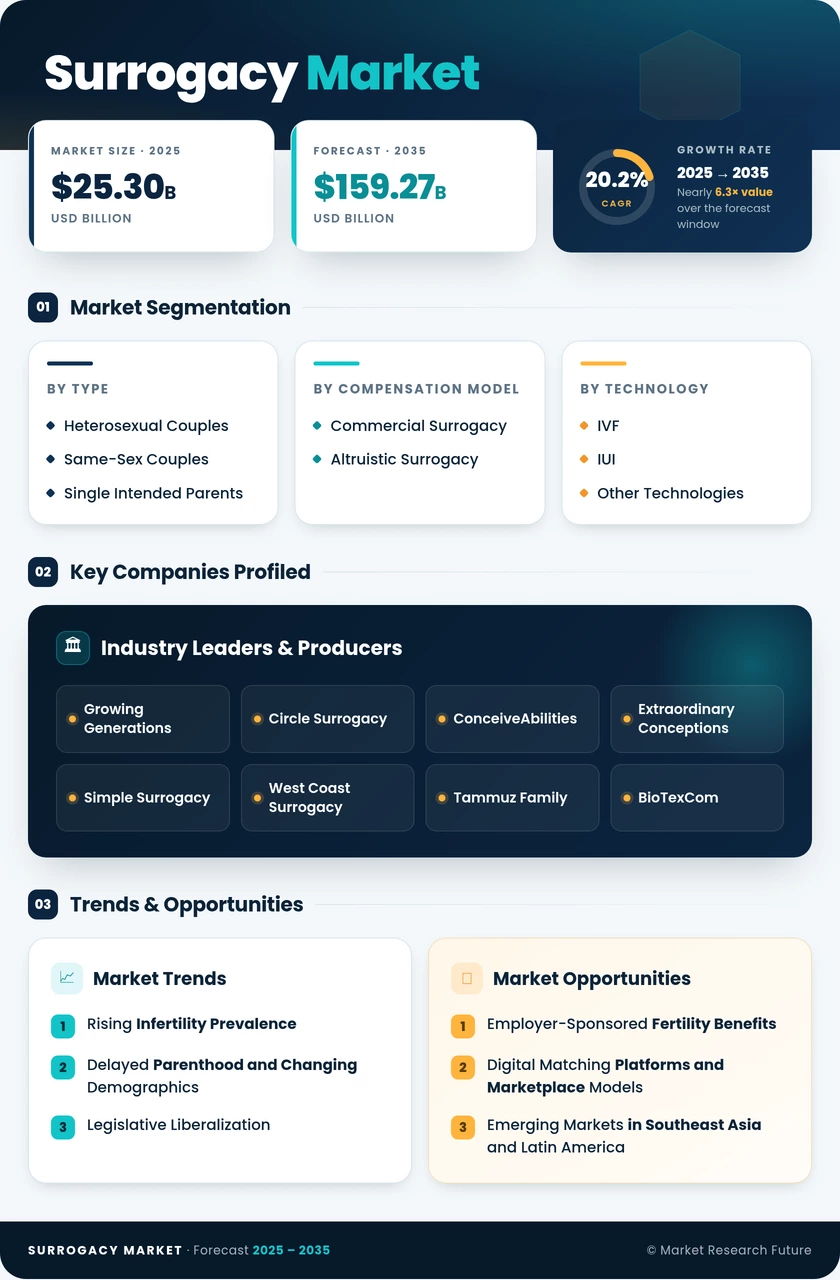
Surrogacy Market
Market Size
Forecast Period2026-2035
CAGR (2026-2035)20.2%
2025 Market SizeUSD 25.30 Billion
2035 Market SizeUSD 159.27 Billion
Key Players
Growing Generations
Circle Surrogacy
ConceiveAbilities
Extraordinary Conceptions
Simple Surrogacy
West Coast Surrogacy
Opportunities
  • Employer-Sponsored Fertility Benefits
  • Digital Matching Platforms and Marketplace Models
  • Emerging Markets in Southeast Asia and Latin America
  1. 1 Market Overview |
    1. 1.1 Study Assumptions & Market Definition |
    2. 1.2 Scope of the Study |
    3. 1.3 Research Methodology
  2. 2 Market Summary & Key Takeaways
  3. 3 Market Dynamics |
    1. 3.1 Market Drivers Analysis | |
      1. 3.1.1 Rising Infertility Prevalence | |
      2. 3.1.2 Delayed Parenthood and Changing Demographics | |
      3. 3.1.3 Legislative Liberalization | |
      4. 3.1.4 AI-Driven Reproductive Technology | |
      5. 3.1.5 LGBTQ+ Family-Building Acceptance | |
      6. 3.1.6 Cross-Border Medical Tourism Growth | |
      7. 3.1.7 Insurance Coverage Expansion |
    2. 3.2 Market Restraints Analysis | |
      1. 3.2.1 Regulatory Fragmentation and Bans | |
      2. 3.2.2 High All-In Program Costs | |
      3. 3.2.3 Ethical and Safeguarding Concerns | |
      4. 3.2.4 Legal Uncertainty on Parentage | |
      5. 3.2.5 Ethical and Religious Opposition |
    3. 3.3 Market Opportunity Analysis | |
      1. 3.3.1 Employer-Sponsored Fertility Benefits | |
      2. 3.3.2 Digital Matching Platforms and Marketplace Models | |
      3. 3.3.3 Emerging Markets in Southeast Asia and Latin America | |
      4. 3.3.4 Genetic Screening and Personalized Reproductive Medicine | |
      5. 3.3.5 Insurance Product Innovation |
    4. 3.4 Industry Value Chain Analysis |
    5. 3.5 Porter's Five Forces Analysis
  4. 4 Global Surrogacy Market Size & Forecast (2021–2035) |
    1. 4.1 Historical Market Size (2021–2025) |
    2. 4.2 Current & Forecast Market Size (2026–2035) |
    3. 4.3 Market Size by Revenue (USD Billion) |
    4. 4.4 Year-over-Year Growth Analysis
  5. 5 Segmentation Analysis |
    1. 5.1 By Type | |
      1. 5.1.1 Gestational Surrogacy | |
      2. 5.1.2 Traditional Surrogacy |
    2. 5.2 By Compensation Model | |
      1. 5.2.1 Commercial Surrogacy | |
      2. 5.2.2 Altruistic Surrogacy |
    3. 5.3 By Technology | |
      1. 5.3.1 IVF | |
      2. 5.3.2 IUI | |
      3. 5.3.3 Other Technologies |
    4. 5.4 By Intended Parent Type | |
      1. 5.4.1 Heterosexual Couples | |
      2. 5.4.2 Same-Sex Couples | |
      3. 5.4.3 Single Intended Parents |
    5. 5.5 By Service Provider | |
      1. 5.5.1 Fertility Centers | |
      2. 5.5.2 Surrogacy Agencies | |
      3. 5.5.3 Hospitals |
    6. 5.6 By Arrangement Geography | |
      1. 5.6.1 Domestic Surrogacy | |
      2. 5.6.2 Cross-Border Surrogacy
  6. 6 Regional Analysis |
    1. 6.1 North America | |
      1. 6.1.1 United States | |
      2. 6.1.2 Canada | |
      3. 6.1.3 Mexico |
    2. 6.2 Europe | |
      1. 6.2.1 Germany | |
      2. 6.2.2 United Kingdom | |
      3. 6.2.3 France | |
      4. 6.2.4 Italy | |
      5. 6.2.5 Spain | |
      6. 6.2.6 Nordic Countries | |
      7. 6.2.7 Russia | |
      8. 6.2.8 Rest of Europe |
    3. 6.3 Asia-Pacific | |
      1. 6.3.1 China | |
      2. 6.3.2 India | |
      3. 6.3.3 Japan | |
      4. 6.3.4 South Korea | |
      5. 6.3.5 ASEAN | |
      6. 6.3.6 Rest of Asia-Pacific |
    4. 6.4 South America | |
      1. 6.4.1 Brazil | |
      2. 6.4.2 Argentina | |
      3. 6.4.3 Rest of South America |
    5. 6.5 Middle East & Africa | |
      1. 6.5.1 Saudi Arabia | |
      2. 6.5.2 UAE | |
      3. 6.5.3 South Africa | |
      4. 6.5.4 Egypt | |
      5. 6.5.5 Rest of MEA
  7. 7 Competitive Landscape |
    1. 7.1 Market Share Analysis (2025) |
    2. 7.2 Competitive Benchmarking Matrix |
    3. 7.3 Company Profiles | |
      1. 7.3.1 Growing Generations | |
      2. 7.3.2 Circle Surrogacy | |
      3. 7.3.3 ConceiveAbilities | |
      4. 7.3.4 Extraordinary Conceptions | |
      5. 7.3.5 Simple Surrogacy | |
      6. 7.3.6 West Coast Surrogacy | |
      7. 7.3.7 Tammuz Family | |
      8. 7.3.8 BioTexCom | |
      9. 7.3.9 Creative Family Connections | |
      10. 7.3.10 Sensible Surrogacy
  8. 8 Future Outlook & Strategic Recommendations (2026–2035) |
    1. 8.1 AI and Precision Reproductive Medicine |
    2. 8.2 Platform Economics and Marketplace Consolidation |
    3. 8.3 Regulatory Convergence and International Frameworks |
    4. 8.4 ESG, Ethics, and Responsible Surrogacy Standards
  9. 9 Recent Developments & News
  10. 10 Frequently Asked Questions (FAQs)
  11. 11 Report Scope & Methodology |
    1. 11.1 Study Period & Base Year |
    2. 11.2 Data Sources & Citations |
    3. 11.3 Abbreviations
  12. 12 LIST OF TABLES |
  13. TABLE 1 Global Surrogacy Market Size & Forecast, by Revenue (USD Billion), 2021–2035 |
  14. TABLE 2 Global Surrogacy Market – Year-over-Year Growth Analysis, 2021–2035 |
  15. TABLE 3 Global Surrogacy Market – Driver Impact Analysis |
  16. TABLE 4 Global Surrogacy Market – Restraints Impact Analysis |
  17. TABLE 5 Global Surrogacy Market Size, by Type, 2021–2035 (USD Billion) |
  18. TABLE 6 Global Surrogacy Market Size, by Compensation Model, 2021–2035 (USD Billion) |
  19. TABLE 7 Global Surrogacy Market Size, by Technology, 2021–2035 (USD Billion) |
  20. TABLE 8 Global Surrogacy Market Size, by Intended Parent Type, 2021–2035 (USD Billion) |
  21. TABLE 9 Global Surrogacy Market Size, by Service Provider, 2021–2035 (USD Billion) |
  22. TABLE 10 Global Surrogacy Market Size, by Arrangement Geography, 2021–2035 (USD Billion) |
  23. TABLE 11 Global Surrogacy Market Size, by Region, 2021–2035 (USD Billion) |
  24. TABLE 12 North America Surrogacy Market Size, by Country, 2021–2035 (USD Billion) |
  25. TABLE 13 Europe Surrogacy Market Size, by Country, 2021–2035 (USD Billion) |
  26. TABLE 14 Asia-Pacific Surrogacy Market Size, by Country, 2021–2035 (USD Billion) |
  27. TABLE 15 South America Surrogacy Market Size, by Country, 2021–2035 (USD Billion) |
  28. TABLE 16 Middle East & Africa Surrogacy Market Size, by Country, 2021–2035 (USD Billion) |
  29. TABLE 17 Competitive Benchmarking Matrix – Global Surrogacy Market, 2025 |
  30. TABLE 18 Company Profiles – Key Players, Global Surrogacy Market |
  31. TABLE 19 Recent Developments & Strategic Announcements, 2023–2025 |
  32. TABLE 20 Report Scope & Methodology Summary |
  33. TABLE 21 Detailed Sources and Citations
  34. 13 LIST OF FIGURES |
  35. FIGURE 1 Global Surrogacy Market Dynamics — Drivers, Restraints, and Opportunities |
  36. FIGURE 2 Industry Value Chain Analysis — Surrogacy Market |
  37. FIGURE 3 Porter's Five Forces Analysis — Surrogacy Market |
  38. FIGURE 4 Global Surrogacy Market Size Trend (USD Billion), 2021–2035 |
  39. FIGURE 5 Global Surrogacy Market Share, by Type, 2025 (%) |
  40. FIGURE 6 Global Surrogacy Market Share, by Compensation Model, 2025 (%) |
  41. FIGURE 7 Global Surrogacy Market Share, by Technology, 2025 (%) |
  42. FIGURE 8 Global Surrogacy Market Share, by Intended Parent Type, 2025 (%) |
  43. FIGURE 9 Global Surrogacy Market Share, by Service Provider, 2025 (%) |
  44. FIGURE 10 Global Surrogacy Market Share, by Arrangement Geography, 2025 (%) |
  45. FIGURE 11 Global Surrogacy Market Share, by Region, 2025 (%) |
  46. FIGURE 12 North America Surrogacy Market Share, by Country, 2025 (%) |
  47. FIGURE 13 Europe Surrogacy Market Share, by Country, 2025 (%) |
  48. FIGURE 14 Asia-Pacific Surrogacy Market Share, by Country, 2025 (%) |
  49. FIGURE 15 South America Surrogacy Market Share, by Country, 2025 (%) |
  50. FIGURE 16 Middle East & Africa Surrogacy Market Share, by Country, 2025 (%) |
  51. FIGURE 17 Competitive Landscape — Market Share Analysis, 2025

Segmentation Quick Reference

DimensionSub-SegmentsDominant SegmentFastest Growing Segment
TypeGestational Surrogacy, Traditional SurrogacyGestational SurrogacyTraditional Surrogacy
Compensation ModelCommercial Surrogacy, Altruistic SurrogacyCommercial SurrogacyAltruistic Surrogacy
TechnologyIVF, IUI, Other TechnologiesIVFIVF
Intended Parent TypeHeterosexual Couples, Same-Sex Couples, Single Intended ParentsHeterosexual CouplesSame-Sex Couples
Service ProviderFertility Centers, Surrogacy Agencies, HospitalsFertility CentersSurrogacy Agencies
Arrangement GeographyDomestic Surrogacy, Cross-Border SurrogacyDomestic SurrogacyCross-Border Surrogacy
GeographyNorth America, Europe, Asia-Pacific, South America, Middle East & AfricaNorth AmericaAsia-Pacific


Market Segmentation Overview

By Type

Sub-SegmentKey Trend
Gestational SurrogacyDominant model driven by legal clarity and the absence of a genetic link between the surrogate and child
Traditional SurrogacyGrowing in cost-sensitive markets where IVF access remains limited


Gestational surrogacy continues to represent the overwhelming majority of surrogacy arrangements globally, supported by clear legal precedents and intended parent preferences. Traditional surrogacy retains relevance in emerging markets and for intended parents seeking lower-cost pathways.

By Compensation Model

Sub-SegmentKey Trend
Commercial SurrogacyPreferred in the U.S. and select international destinations where compensation attracts a wider surrogate pool
Altruistic SurrogacyMandated in the UK, Canada, India, and Australia; growing as regulatory frameworks formalize


Commercial surrogacy accounts for the majority of global arrangements, as financial compensation incentivizes participation and reduces wait times. Altruistic models are expanding where legislation restricts commercial activity but creates structured oversight.

By Technology

Sub-SegmentKey Trend
IVFGold-standard technology; AI-powered embryo selection improving success rates
IUICost-effective alternative used primarily in traditional surrogacy arrangements
Other TechnologiesNatural cycle and minimal stimulation protocols for select clinical profiles


IVF dominates surrogacy-related conception due to its compatibility with genetic testing and its high per-cycle success rates. IUI remains an accessible option in markets with limited clinical infrastructure.

By Intended Parent Type

Sub-SegmentKey Trend
Heterosexual CouplesThe largest segment, driven by infertility and delayed parenthood
Same-Sex CouplesFastest-growing segment, fueled by marriage equality and social acceptance
Single Intended ParentsEmerging segment reflecting the single-parent-by-choice movement


Heterosexual couples facing infertility challenges constitute the core demand base, while same-sex couples represent the fastest-expanding cohort as legal recognition of diverse family structures broadens worldwide.

By Service Provider

Sub-SegmentKey Trend
Fertility CentersIntegrated clinical and coordination services; dominant provider type
Surrogacy AgenciesSpecialized intermediaries handling matching, legal, and logistical support
HospitalsProvide prenatal, delivery, and postnatal care for surrogates


Fertility centers capture the largest share of surrogacy-related revenue by offering end-to-end medical services. Surrogacy agencies are the fastest-growing provider segment as demand for streamlined coordination services rises.

By Arrangement Geography

Sub-SegmentKey Trend
Domestic SurrogacyPreferred for legal simplicity and proximity; dominant in the U.S.
Cross-Border SurrogacyFastest growing, driven by cost arbitrage and regulatory access for restricted-market residents


Domestic arrangements remain the majority of surrogacy contracts, particularly in the United States. Cross-border surrogacy is accelerating as intended parents in ban or restriction countries seek accessible jurisdictions with favorable pricing.


Download PDF ×

We do not share your information with anyone. However, we may send you emails based on your report interest from time to time. You may contact us at any time to opt-out.