Request Free Sample ×

Kindly complete the form below to receive a free sample of this Report

* Please use a valid business email

Leading companies partner with us for data-driven Insights

clients tt-cursor
Hero Background
English
Chinese
French
Japanese
Korean
German
Spanish

Surgical Apparel Market Size

ID: MRFR/MED/10349-HCR
128 Pages
Rahul Gotadki
March 2026

Surgical Apparel Market Research Report Information By Type (Disposable and Reusable), By Product (Scrubs, Gowns, Caps, Gloves, Mask, and Others), By End User (Hospitals, Diagnostic Centers, Ambulatory Surgical Centers, Clinics, and Others), and By Region (North America, Europe, Asia-Pacific, and Rest Of The World) - Growth & Industry Forecast 2025 To 2035

Share:
Download PDF ×

We do not share your information with anyone. However, we may send you emails based on your report interest from time to time. You may contact us at any time to opt-out.

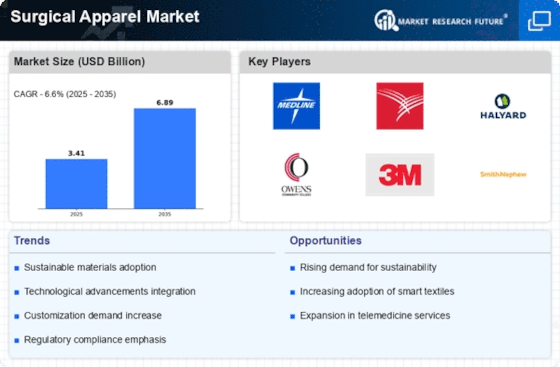
Surgical Apparel Market Infographic
Purchase Options

Surgical Apparel Size

Surgical Apparel Market Growth Projections and Opportunities

The Surgical Apparel Market is influenced by a multitude of market factors that collectively shape its dynamics and growth trajectory. One of the primary drivers is the rising global healthcare expenditure. As nations allocate substantial budgets towards healthcare infrastructure development, including hospitals and clinics, the demand for surgical apparel experiences a parallel surge. The increasing prevalence of chronic diseases and a growing aging population further amplify the need for surgical procedures, subsequently boosting the market for surgical apparel.

Technological advancements play a pivotal role in shaping the Surgical Apparel Market. The continuous evolution of materials and manufacturing processes results in the production of high-performance, comfortable, and cost-effective surgical attire. Innovations such as antimicrobial fabrics and disposable surgical gowns enhance infection control measures, contributing to the market's expansion. As healthcare providers prioritize patient safety and infection prevention, the adoption of advanced surgical apparel becomes imperative, driving market growth.

Government regulations and standards also significantly impact the Surgical Apparel Market. Stringent guidelines related to hygiene, safety, and quality control drive manufacturers to adhere to specific norms, ensuring the production of reliable and compliant surgical attire. Regulatory bodies play a crucial role in establishing and maintaining industry standards, creating a foundation of trust for both healthcare professionals and patients. Compliance with these regulations becomes a key factor in determining market success and longevity.

Globalization and trade patterns contribute to the complexity of the Surgical Apparel Market. International trade agreements, economic conditions, and geopolitical factors influence the procurement and distribution of surgical apparel across borders. Additionally, the interconnectedness of economies results in the transfer of technological know-how and best practices, fostering a global market where manufacturers and suppliers collaborate on a broader scale.

Consumer awareness and preferences also shape the dynamics of the Surgical Apparel Market. With an increasing focus on patient-centric care, there is a growing demand for comfortable, breathable, and aesthetically pleasing surgical attire. Healthcare professionals are becoming more discerning in their choices, leading manufacturers to invest in research and development to meet evolving preferences. As awareness about the importance of infection control rises, consumers are more likely to opt for high-quality surgical apparel, driving market growth.

Market competition is another crucial factor influencing the Surgical Apparel Market. The presence of numerous manufacturers and suppliers intensifies competition, prompting companies to differentiate themselves through product innovation, pricing strategies, and distribution networks. Market players continuously strive to gain a competitive edge by offering a diverse range of surgical apparel that meets the varying needs of healthcare facilities and professionals.

Lastly, the COVID-19 pandemic has brought unprecedented challenges and opportunities to the Surgical Apparel Market. The increased demand for personal protective equipment (PPE), including surgical apparel, in the wake of the pandemic has accelerated market growth. The pandemic has underscored the importance of robust supply chains, resilience, and adaptability within the industry.
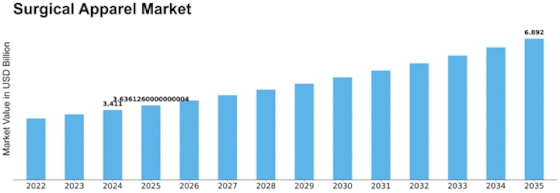
Surgical Apparel Market Size Graph
Author
Author Profile
Rahul Gotadki
Research Manager

He holds an experience of about 9+ years in Market Research and Business Consulting, working under the spectrum of Life Sciences and Healthcare domains. Rahul conceptualizes and implements a scalable business strategy and provides strategic leadership to the clients. His expertise lies in market estimation, competitive intelligence, pipeline analysis, customer assessment, etc.

Leave a Comment

FAQs

What is the current valuation of the Surgical Apparel Market as of 2024?

<p>The Surgical Apparel Market was valued at 3.411 USD Billion in 2024.</p>

What is the projected market size for the Surgical Apparel Market in 2035?

<p>The market is projected to reach 6.892 USD Billion by 2035.</p>

What is the expected CAGR for the Surgical Apparel Market during the forecast period 2025 - 2035?

<p>The expected CAGR for the Surgical Apparel Market during 2025 - 2035 is 6.6%.</p>

Which segment of the Surgical Apparel Market is expected to grow the most by 2035?

<p>The Disposable segment is anticipated to grow significantly, with a projected increase from 1.5 USD Billion to 3.0 USD Billion.</p>

How do the revenues of surgical gowns compare to surgical caps in 2025?

<p>In 2025, surgical gowns are expected to generate revenues of 1.8 USD Billion, while surgical caps are projected at 0.8 USD Billion.</p>

What are the key end-user segments driving the Surgical Apparel Market?

<p>Key end-user segments include Hospitals, Diagnostic Centers, and Ambulatory Surgical Centers, with Hospitals projected to grow from 1.5 USD Billion to 3.0 USD Billion.</p>

Which companies are considered leaders in the Surgical Apparel Market?

Key players in the market include Medline Industries, Cardinal Health, and Halyard Health, among others.

What is the expected revenue growth for surgical gloves from 2024 to 2035?

Surgical gloves are projected to grow from 0.7 USD Billion in 2024 to 1.4 USD Billion by 2035.

How does the revenue of reusable surgical apparel compare to disposable surgical apparel in 2025?

In 2025, reusable surgical apparel is expected to generate 3.892 USD Billion, while disposable surgical apparel is projected at 3.0 USD Billion.

What is the anticipated growth for the 'Others' product segment in the Surgical Apparel Market?

The 'Others' product segment is expected to grow from 0.061 USD Billion in 2024 to 0.192 USD Billion by 2035.

Market Summary

As per Market Research Future analysis, the Surgical Apparel Market Size was estimated at 3.411 USD Billion in 2024. The Surgical Apparel industry is projected to grow from 3.636 USD Billion in 2025 to 6.892 USD Billion by 2035, exhibiting a compound annual growth rate (CAGR) of 6.6% during the forecast period 2025 - 2035

Key Market Trends & Highlights

The Surgical Apparel Market is experiencing a dynamic shift towards innovation and sustainability.

  • Technological advancements in materials are enhancing the performance and safety of surgical apparel. Sustainability initiatives are increasingly influencing purchasing decisions in the North American market. Customization and personalization are becoming essential in the fastest-growing reusable segment. The rising demand for surgical procedures and increased focus on infection control are driving market growth.

Market Size & Forecast

2024 Market Size 3.411 (USD Billion)
2035 Market Size 6.892 (USD Billion)
CAGR (2025 - 2035) 6.6%
Largest Regional Market Share in 2024 North America

Major Players

Medline Industries (US), Cardinal Health (US), Halyard Health (US), Owens &amp; Minor (US), 3M (US), Smith &amp; Nephew (GB), Mölnlycke Health Care (SE), Ansell (AU), Kimberly-Clark (US)

Market Trends

The Surgical Apparel Market is currently experiencing a dynamic evolution, driven by various factors that influence both demand and supply. The increasing emphasis on safety and hygiene in healthcare settings has led to a heightened focus on the quality and functionality of surgical garments. As healthcare facilities strive to enhance patient outcomes, the adoption of advanced materials and innovative designs in surgical apparel is becoming more prevalent. This trend reflects a broader commitment to ensuring that medical professionals are equipped with reliable and effective protective clothing, which is essential in maintaining sterile environments during surgical procedures. Moreover, the Surgical Apparel Market is witnessing a shift towards sustainability, as manufacturers explore eco-friendly materials and production methods. This movement aligns with global efforts to reduce environmental impact and promote responsible consumption. As healthcare organizations become more aware of their ecological footprint, there is a growing demand for surgical apparel that not only meets safety standards but also adheres to sustainable practices. Consequently, the market is likely to see an increase in the availability of biodegradable and recyclable surgical garments, catering to the evolving preferences of healthcare providers and patients alike.

Technological Advancements in Materials

The Surgical Apparel Market is increasingly influenced by innovations in fabric technology. Manufacturers are developing materials that offer enhanced protection, breathability, and comfort. These advancements not only improve the functionality of surgical garments but also contribute to the overall well-being of healthcare professionals during procedures.

Sustainability Initiatives

There is a noticeable trend towards sustainability within the Surgical Apparel Market. Companies are prioritizing eco-friendly materials and practices, responding to the growing demand for environmentally responsible products. This shift reflects a broader commitment to reducing waste and promoting sustainable healthcare solutions.

Customization and Personalization

The Surgical Apparel Market is seeing a rise in demand for customized surgical garments. Healthcare providers are increasingly seeking apparel that meets specific needs, such as size, fit, and design. This trend indicates a move towards more personalized solutions that enhance both functionality and comfort for medical professionals.

Surgical Apparel Market Market Drivers

Increased Focus on Infection Control

The emphasis on infection control within healthcare settings is a critical driver for the Surgical Apparel Market. As healthcare facilities implement stricter protocols to prevent hospital-acquired infections, the demand for high-quality surgical apparel that offers effective barrier protection is likely to rise. This focus on infection control is supported by data indicating that surgical site infections can significantly impact patient outcomes and healthcare costs. Consequently, hospitals are investing in advanced surgical apparel that meets stringent infection control standards, thereby fostering growth within the Surgical Apparel Market.

Growth of Ambulatory Surgical Centers

The proliferation of ambulatory surgical centers (ASCs) is reshaping the Surgical Apparel Market. ASCs are increasingly favored for their efficiency and cost-effectiveness, leading to a rise in outpatient surgical procedures. This shift necessitates a steady supply of surgical apparel tailored to the unique needs of these facilities. As ASCs continue to expand, the demand for specialized surgical gowns, drapes, and other apparel is expected to grow. This trend not only reflects changing patient preferences but also indicates a broader transformation within the Surgical Apparel Market, as manufacturers adapt to the evolving landscape of surgical care.

Rising Demand for Surgical Procedures

The increasing prevalence of chronic diseases and the aging population contribute to a heightened demand for surgical procedures. This trend is likely to drive the Surgical Apparel Market as healthcare facilities require more surgical apparel to accommodate the growing number of surgeries performed annually. According to recent data, the number of surgical procedures is projected to rise significantly, necessitating a corresponding increase in surgical apparel usage. As hospitals and surgical centers expand their operations, the demand for high-quality surgical gowns, masks, and other apparel is expected to surge, thereby propelling the Surgical Apparel Market forward.

Regulatory Compliance and Safety Standards

Stringent regulatory frameworks and safety standards imposed by health authorities are pivotal in shaping the Surgical Apparel Market. Compliance with these regulations ensures that surgical apparel meets the necessary safety and quality benchmarks, which is crucial for protecting both healthcare professionals and patients. The enforcement of these standards often leads to increased demand for certified surgical apparel, as healthcare facilities prioritize the procurement of compliant products. This regulatory landscape not only influences purchasing decisions but also drives innovation within the Surgical Apparel Market, as manufacturers strive to meet evolving safety requirements.

Technological Innovations in Fabric Production

Advancements in fabric technology are transforming the Surgical Apparel Market by introducing materials that enhance performance and comfort. Innovations such as antimicrobial fabrics and breathable materials are becoming increasingly prevalent, catering to the needs of healthcare professionals who require durable and comfortable apparel during lengthy surgical procedures. The integration of smart textiles, which can monitor vital signs or provide temperature regulation, is also on the horizon. These technological innovations not only improve the functionality of surgical apparel but also contribute to the overall growth of the Surgical Apparel Market as healthcare providers seek to enhance the surgical experience.

Market Segment Insights

By Type: Disposable (Largest) vs. Reusable (Fastest-Growing)

<p>In the Surgical Apparel Market, disposable surgical apparel currently holds the largest market share. This segment’s appeal stems from its convenience and one-time use, which minimizes the risk of infection and contamination in medical settings. In contrast, the reusable category, although smaller in share, is rapidly gaining traction as healthcare providers strive for more sustainable practices that reduce waste. Both categories serve distinct functions within surgical environments, catering to varying institutional policies and preferences. The growth of the reusable surgical apparel segment is driven by increased awareness surrounding sustainability and eco-friendly practices in the healthcare sector. Hospitals and surgical centers are recognizing the cost benefits associated with reusables, such as reduced waste disposal costs and the potential for long-term use. This shift in focus towards sustainability is likely to propel reusable surgical apparel as the fastest-growing segment in this market, driven by changing consumer preferences and regulatory pushes towards greener operations.</p>

<p>Surgical Apparel: Disposable (Dominant) vs. Reusable (Emerging)</p>

<p>Disposable surgical apparel is characterized by its single-use convenience, allowing for rapid transitions between surgical procedures. This category includes gowns, masks, and gloves that are offer high levels of sterility, crucial for infection control in operating rooms. While disposable options dominate the current market due to their practicality and lower risk of contamination, the reusable surgical apparel segment is gaining ground as an emerging contender. Reusable surgical apparel provides healthcare facilities with an economically viable and eco-friendly alternative. By using fabrics designed for multiple washes without sacrificing sterility, these garments not only meet clinical standards but also align with increasing consumer demand for sustainability. As a result, reusable surgical apparel is set to emerge as a significant player, especially in institutions prioritizing environmental responsibility.</p>

By Product: Gloves (Largest) vs. Gowns (Fastest-Growing)

<p>The surgical apparel market showcases a diverse portfolio of products, with gloves accounting for the largest segment share. Scrubs, gowns, caps, and masks also contribute significantly, but gloves dominate due to their essential role in maintaining aseptic conditions. Gowns, while currently smaller in volume, are climbing quickly in demand, especially in surgical settings, as healthcare regulations tighten and patient safety concerns heighten. These trends reflect the shifting priorities of medical facilities towards comprehensive and reliable protective wear. In the context of growth trends, the surgical apparel market is witnessing increased investments driven by advancements in fabric technology and increasing surgical procedures globally. The ongoing emphasis on infection control practices, augmented by the COVID-19 pandemic, has accelerated the adoption of high-quality gowns, masks, and gloves. As healthcare systems evolve, innovations aimed at enhancing comfort, breathability, and safety features in surgical apparel will likely propel the market forward, particularly for gowns as they address emerging demands effectively.</p>

<p>Gowns: Dominant vs. Gloves: Emerging</p>

<p>Gowns have gained prominence in the surgical apparel market as a dominant force, especially in high-risk surgical environments, owing to their critical role in protecting healthcare workers and patients alike. Their design has evolved significantly with advancements in materials that offer greater durability and fluid resistance. Meanwhile, gloves, while traditionally viewed as a standard necessity, are emerging in new varieties designed for specialized surgical techniques. Innovations are leading to the introduction of latex-free gloves that cater to allergy concerns, along with enhanced tactile sensitivity options in surgical gloves. As these segments evolve, gowns continue to hold the largest share due to their essential use in protective wear, whereas gloves are rapidly developing new characteristics to meet the dynamic needs of healthcare professionals.</p>

By End User: Hospitals (Largest) vs. Ambulatory Surgical Centers (Fastest-Growing)

<p>The Surgical Apparel Market is largely influenced by the distribution of end users, with hospitals commanding the largest share. This is mainly due to their extensive surgical operations, requiring a consistent supply of surgical apparel. Diagnostic centers and clinics also contribute significantly, but they do not match the volume’s demand seen in hospitals. Ambulatory surgical centers, although smaller in share, are gaining traction as they cater to the rising trend of outpatient surgeries, leading to increased requirements for surgical apparel. Growth trends indicate a rapidly evolving landscape within the end-user segment, particularly as more patients opt for outpatient procedures in ambulatory surgical centers. This shift contributes to a growing demand for specialized surgical apparel suited for less invasive, quicker recovery surgeries. Additionally, increased focus on infection control and patient safety further drives the need for high-quality surgical apparel across all end users, with hospitals remaining steadfast in leading the market.”,</p>

<p>Hospitals (Dominant) vs. Ambulatory Surgical Centers (Emerging)</p>

<p>Hospitals remain the dominant end user in the Surgical Apparel Market due to their continuous need for surgical supplies driven by the high volume of surgical procedures conducted daily. They require a diverse range of surgical apparel, from gowns to caps, ensuring compliance with stringent safety standards. In contrast, Ambulatory Surgical Centers are emerging as a vital segment within this market, reflecting the growing preference for outpatient surgery. They typically demand lighter and more flexible surgical apparel, catering to shorter procedures and faster patient turnover. This duality between hospitals and ambulatory surgical centers illustrates ongoing shifts in the healthcare delivery model, emphasizing function, comfort, and compliance in surgical apparel.</p>

Get more detailed insights about Surgical Apparel Market Research Report—Global Forecast till 2035

Regional Insights

North America : Healthcare Innovation Leader

North America is the largest market for surgical apparel, accounting for approximately 45% of the global share. The region's growth is driven by advanced healthcare infrastructure, increasing surgical procedures, and stringent regulations ensuring product safety and efficacy. The demand for high-quality surgical apparel is further fueled by the rising awareness of infection control and the adoption of innovative materials. The United States leads the market, supported by key players such as Medline Industries, Cardinal Health, and 3M. The competitive landscape is characterized by continuous innovation and strategic partnerships among manufacturers. Canada also plays a significant role, contributing to the overall market growth with its focus on healthcare advancements and regulatory compliance.

Europe : Emerging Market Dynamics

Europe is the second-largest market for surgical apparel, holding around 30% of the global market share. The region's growth is propelled by increasing surgical procedures, heightened awareness of hygiene standards, and regulatory frameworks that promote the use of high-quality surgical garments. Countries like Germany and France are at the forefront, with a growing emphasis on healthcare quality and patient safety driving demand. Germany is a key player in the European market, with significant contributions from companies like Mölnlycke Health Care and Smith & Nephew. The competitive landscape is marked by innovation and a focus on sustainable practices. The European Union's regulations on medical devices and apparel further enhance market growth, ensuring compliance and safety in surgical environments.

Asia-Pacific : Rapidly Growing Market

Asia-Pacific is witnessing rapid growth in the surgical apparel market, accounting for approximately 20% of the global share. The region's expansion is driven by increasing healthcare expenditures, a rising number of surgical procedures, and growing awareness of infection control practices. Countries like China and India are leading this growth, supported by government initiatives to improve healthcare infrastructure and access to quality medical supplies. China is emerging as a significant player, with a surge in domestic manufacturing and investments from global companies. The competitive landscape is evolving, with local manufacturers gaining traction alongside established international brands. The region's diverse healthcare needs and regulatory frameworks are shaping the market dynamics, fostering innovation and quality improvements in surgical apparel.

Middle East and Africa : Untapped Market Potential

The Middle East and Africa region is gradually emerging in the surgical apparel market, holding about 5% of the global share. The growth is driven by increasing healthcare investments, rising surgical procedures, and a growing focus on infection prevention. Countries like South Africa and the UAE are leading the way, with government initiatives aimed at enhancing healthcare quality and accessibility. South Africa is a key player in the region, with a mix of local and international companies operating in the market. The competitive landscape is characterized by a growing demand for high-quality surgical apparel, driven by both public and private healthcare sectors. As regulations evolve, the market is expected to see increased investments and innovations in surgical apparel to meet the rising healthcare standards.

Key Players and Competitive Insights

Leading market players are investing heavily in research and development in order to expand their product lines, which will help the market of surgical apparel, grow even more. Market participants are also undertaking a variety of strategic activities to expand their global footprint, with important market developments including new product launches, contractual agreements, mergers and acquisitions, higher investments, and collaboration with other organizations. To expand and survive in a more competitive and rising market climate, Surgical Apparel industry must offer cost-effective items. Manufacturing locally to minimize operational costs is one of the key business tactics used by manufacturers in the global Surgical Apparel industry to benefit clients and increase the market sector. In recent years, the Surgical Apparel industry has offered some of the most significant advantages to medicine. Major players in the market of surgical apparel, including Johnson & Johnson, Baxter International Inc., Medtronic plc, Boston Scientific Corporation, GE Healthcare, Smith & Nephew plc, Stryker Corporation, B Braun, Thermo Fisher Scientific, Covidien, and The 3M Company, are attempting to increase market demand by investing in research and development Products. An engineering and technology corporation is Honeywell International Inc. The business develops and produces technology to address problems in a number of industries, including energy, security, safety, productivity, and global urbanization. Specialty chemicals, process technologies, electrical and sophisticated materials, productivity, sensing, safety and security technology, and spare parts are just a few of the things Honeywell has to offer.  Additionally, it offers management, technical, repair, and maintenance services. In North America, Europe, and other continents, Honeywell provides services to clients in the building, petrochemical, aircraft, and refining industries. Around the world, it has manufacturing and other operations. The U.S. city of Charlotte, North Carolina, is home to Honeywell's headquarters. Honeywell announced the release of two new NIOSH-certified respiratory products in May 2022. For many years, Honeywell has produced respiratory protection products. The company Toray Industries Inc. (Toray) sells cutting-edge materials. The company's product line consists of fibers, clothing, plastics, chemicals, composite materials, products for the life sciences, as well as medical equipment, drugs, and optical goods. Additionally, it offers polyester, polyethylene, polypropylene, water treatment membranes, carbon fibers, and carbon fiber composites. The clothing, industrial materials, automotive, construction, water treatment, and medical industries all employ its goods.  Additionally, it offers services for physical assessment, analysis, and research. Toray also offers full-service engineering, condominiums, commercial and industrial machinery, IT-related gear, water treatment membranes and gear associated to them, as well as materials for use in construction, housing, and civil engineering. The business has operations in a number of nations in North America, South America, Europe, and Asia Pacific. Tokyo, Japan serves as the home base for Toray. Toray Industries, Inc. declared in April 2022 that it has created LIVMOATM 4500AS disposable personal protective apparel.

Key Companies in the Surgical Apparel Market include

Industry Developments

June 2022 Government contracting and medical supply firm Health Supply US recently made known that it intended to start up new manufacturing facilities in Greenville County. Class I medical gadgets and items including nitrile gloves and medical isolation gowns are among the company's FDA-compliant offerings. The new factory will significantly improve domestic availability of this essential medical supply product by producing an estimated 4.3 billion nitrile gloves yearly.

Future Outlook

Surgical Apparel Market Future Outlook

The Surgical Apparel Market is projected to grow at a 6.6% CAGR from 2025 to 2035, driven by technological advancements, increasing surgical procedures, and heightened awareness of infection control.

New opportunities lie in:

  • <p>Development of eco-friendly surgical apparel materials Integration of smart textiles for real-time monitoring Expansion of customized surgical apparel solutions for diverse specialties</p>

By 2035, the market is expected to achieve robust growth, reflecting evolving healthcare demands.

Market Segmentation

Surgical Apparel Market Type Outlook

  • Disposable
  • Reusable

Surgical Apparel Market Product Outlook

  • Scrubs
  • Gowns
  • Caps
  • Gloves
  • Mask
  • Others

Surgical Apparel Market End User Outlook

  • Hospitals
  • Diagnostic Centers
  • Ambulatory Surgical Centers
  • Clinics
  • Others

Report Scope

MARKET SIZE 2024 3.411(USD Billion)
MARKET SIZE 2025 3.636(USD Billion)
MARKET SIZE 2035 6.892(USD Billion)
COMPOUND ANNUAL GROWTH RATE (CAGR) 6.6% (2025 - 2035)
REPORT COVERAGE Revenue Forecast, Competitive Landscape, Growth Factors, and Trends
BASE YEAR 2024
Market Forecast Period 2025 - 2035
Historical Data 2019 - 2024
Market Forecast Units USD Billion
Key Companies Profiled Medline Industries (US), Cardinal Health (US), Halyard Health (US), Owens & Minor (US), 3M (US), Smith & Nephew (GB), Mölnlycke Health Care (SE), Ansell (AU), Kimberly-Clark (US)
Segments Covered Type, Product, End User, Region
Key Market Opportunities Integration of advanced antimicrobial fabrics in the Surgical Apparel Market enhances infection control and safety.
Key Market Dynamics Rising demand for sustainable materials in surgical apparel drives innovation and reshapes competitive dynamics in the market.
Countries Covered North America, Europe, APAC, South America, MEA

FAQs

What is the current valuation of the Surgical Apparel Market as of 2024?

<p>The Surgical Apparel Market was valued at 3.411 USD Billion in 2024.</p>

What is the projected market size for the Surgical Apparel Market in 2035?

<p>The market is projected to reach 6.892 USD Billion by 2035.</p>

What is the expected CAGR for the Surgical Apparel Market during the forecast period 2025 - 2035?

<p>The expected CAGR for the Surgical Apparel Market during 2025 - 2035 is 6.6%.</p>

Which segment of the Surgical Apparel Market is expected to grow the most by 2035?

<p>The Disposable segment is anticipated to grow significantly, with a projected increase from 1.5 USD Billion to 3.0 USD Billion.</p>

How do the revenues of surgical gowns compare to surgical caps in 2025?

<p>In 2025, surgical gowns are expected to generate revenues of 1.8 USD Billion, while surgical caps are projected at 0.8 USD Billion.</p>

What are the key end-user segments driving the Surgical Apparel Market?

<p>Key end-user segments include Hospitals, Diagnostic Centers, and Ambulatory Surgical Centers, with Hospitals projected to grow from 1.5 USD Billion to 3.0 USD Billion.</p>

Which companies are considered leaders in the Surgical Apparel Market?

Key players in the market include Medline Industries, Cardinal Health, and Halyard Health, among others.

What is the expected revenue growth for surgical gloves from 2024 to 2035?

Surgical gloves are projected to grow from 0.7 USD Billion in 2024 to 1.4 USD Billion by 2035.

How does the revenue of reusable surgical apparel compare to disposable surgical apparel in 2025?

In 2025, reusable surgical apparel is expected to generate 3.892 USD Billion, while disposable surgical apparel is projected at 3.0 USD Billion.

What is the anticipated growth for the 'Others' product segment in the Surgical Apparel Market?

The 'Others' product segment is expected to grow from 0.061 USD Billion in 2024 to 0.192 USD Billion by 2035.

  1. SECTION I: EXECUTIVE SUMMARY AND KEY HIGHLIGHTS
    1. | 1.1 EXECUTIVE SUMMARY
    2. | | 1.1.1 Market Overview
    3. | | 1.1.2 Key Findings
    4. | | 1.1.3 Market Segmentation
    5. | | 1.1.4 Competitive Landscape
    6. | | 1.1.5 Challenges and Opportunities
    7. | | 1.1.6 Future Outlook
  2. SECTION II: SCOPING, METHODOLOGY AND MARKET STRUCTURE
    1. | 2.1 MARKET INTRODUCTION
    2. | | 2.1.1 Definition
    3. | | 2.1.2 Scope of the study
    4. | | | 2.1.2.1 Research Objective
    5. | | | 2.1.2.2 Assumption
    6. | | | 2.1.2.3 Limitations
    7. | 2.2 RESEARCH METHODOLOGY
    8. | | 2.2.1 Overview
    9. | | 2.2.2 Data Mining
    10. | | 2.2.3 Secondary Research
    11. | | 2.2.4 Primary Research
    12. | | | 2.2.4.1 Primary Interviews and Information Gathering Process
    13. | | | 2.2.4.2 Breakdown of Primary Respondents
    14. | | 2.2.5 Forecasting Model
    15. | | 2.2.6 Market Size Estimation
    16. | | | 2.2.6.1 Bottom-Up Approach
    17. | | | 2.2.6.2 Top-Down Approach
    18. | | 2.2.7 Data Triangulation
    19. | | 2.2.8 Validation
  3. SECTION III: QUALITATIVE ANALYSIS
    1. | 3.1 MARKET DYNAMICS
    2. | | 3.1.1 Overview
    3. | | 3.1.2 Drivers
    4. | | 3.1.3 Restraints
    5. | | 3.1.4 Opportunities
    6. | 3.2 MARKET FACTOR ANALYSIS
    7. | | 3.2.1 Value chain Analysis
    8. | | 3.2.2 Porter's Five Forces Analysis
    9. | | | 3.2.2.1 Bargaining Power of Suppliers
    10. | | | 3.2.2.2 Bargaining Power of Buyers
    11. | | | 3.2.2.3 Threat of New Entrants
    12. | | | 3.2.2.4 Threat of Substitutes
    13. | | | 3.2.2.5 Intensity of Rivalry
    14. | | 3.2.3 COVID-19 Impact Analysis
    15. | | | 3.2.3.1 Market Impact Analysis
    16. | | | 3.2.3.2 Regional Impact
    17. | | | 3.2.3.3 Opportunity and Threat Analysis
  4. SECTION IV: QUANTITATIVE ANALYSIS
    1. | 4.1 Healthcare, BY Type (USD Billion)
    2. | | 4.1.1 Disposable
    3. | | 4.1.2 Reusable
    4. | 4.2 Healthcare, BY Product (USD Billion)
    5. | | 4.2.1 Scrubs
    6. | | 4.2.2 Gowns
    7. | | 4.2.3 Caps
    8. | | 4.2.4 Gloves
    9. | | 4.2.5 Mask
    10. | | 4.2.6 Others
    11. | 4.3 Healthcare, BY End User (USD Billion)
    12. | | 4.3.1 Hospitals
    13. | | 4.3.2 Diagnostic Centers
    14. | | 4.3.3 Ambulatory Surgical Centers
    15. | | 4.3.4 Clinics
    16. | | 4.3.5 Others
    17. | 4.4 Healthcare, BY Region (USD Billion)
    18. | | 4.4.1 North America
    19. | | | 4.4.1.1 US
    20. | | | 4.4.1.2 Canada
    21. | | 4.4.2 Europe
    22. | | | 4.4.2.1 Germany
    23. | | | 4.4.2.2 UK
    24. | | | 4.4.2.3 France
    25. | | | 4.4.2.4 Russia
    26. | | | 4.4.2.5 Italy
    27. | | | 4.4.2.6 Spain
    28. | | | 4.4.2.7 Rest of Europe
    29. | | 4.4.3 APAC
    30. | | | 4.4.3.1 China
    31. | | | 4.4.3.2 India
    32. | | | 4.4.3.3 Japan
    33. | | | 4.4.3.4 South Korea
    34. | | | 4.4.3.5 Malaysia
    35. | | | 4.4.3.6 Thailand
    36. | | | 4.4.3.7 Indonesia
    37. | | | 4.4.3.8 Rest of APAC
    38. | | 4.4.4 South America
    39. | | | 4.4.4.1 Brazil
    40. | | | 4.4.4.2 Mexico
    41. | | | 4.4.4.3 Argentina
    42. | | | 4.4.4.4 Rest of South America
    43. | | 4.4.5 MEA
    44. | | | 4.4.5.1 GCC Countries
    45. | | | 4.4.5.2 South Africa
    46. | | | 4.4.5.3 Rest of MEA
  5. SECTION V: COMPETITIVE ANALYSIS
    1. | 5.1 Competitive Landscape
    2. | | 5.1.1 Overview
    3. | | 5.1.2 Competitive Analysis
    4. | | 5.1.3 Market share Analysis
    5. | | 5.1.4 Major Growth Strategy in the Healthcare
    6. | | 5.1.5 Competitive Benchmarking
    7. | | 5.1.6 Leading Players in Terms of Number of Developments in the Healthcare
    8. | | 5.1.7 Key developments and growth strategies
    9. | | | 5.1.7.1 New Product Launch/Service Deployment
    10. | | | 5.1.7.2 Merger & Acquisitions
    11. | | | 5.1.7.3 Joint Ventures
    12. | | 5.1.8 Major Players Financial Matrix
    13. | | | 5.1.8.1 Sales and Operating Income
    14. | | | 5.1.8.2 Major Players R&D Expenditure. 2023
    15. | 5.2 Company Profiles
    16. | | 5.2.1 Medline Industries (US)
    17. | | | 5.2.1.1 Financial Overview
    18. | | | 5.2.1.2 Products Offered
    19. | | | 5.2.1.3 Key Developments
    20. | | | 5.2.1.4 SWOT Analysis
    21. | | | 5.2.1.5 Key Strategies
    22. | | 5.2.2 Cardinal Health (US)
    23. | | | 5.2.2.1 Financial Overview
    24. | | | 5.2.2.2 Products Offered
    25. | | | 5.2.2.3 Key Developments
    26. | | | 5.2.2.4 SWOT Analysis
    27. | | | 5.2.2.5 Key Strategies
    28. | | 5.2.3 Halyard Health (US)
    29. | | | 5.2.3.1 Financial Overview
    30. | | | 5.2.3.2 Products Offered
    31. | | | 5.2.3.3 Key Developments
    32. | | | 5.2.3.4 SWOT Analysis
    33. | | | 5.2.3.5 Key Strategies
    34. | | 5.2.4 Owens & Minor (US)
    35. | | | 5.2.4.1 Financial Overview
    36. | | | 5.2.4.2 Products Offered
    37. | | | 5.2.4.3 Key Developments
    38. | | | 5.2.4.4 SWOT Analysis
    39. | | | 5.2.4.5 Key Strategies
    40. | | 5.2.5 3M (US)
    41. | | | 5.2.5.1 Financial Overview
    42. | | | 5.2.5.2 Products Offered
    43. | | | 5.2.5.3 Key Developments
    44. | | | 5.2.5.4 SWOT Analysis
    45. | | | 5.2.5.5 Key Strategies
    46. | | 5.2.6 Smith & Nephew (GB)
    47. | | | 5.2.6.1 Financial Overview
    48. | | | 5.2.6.2 Products Offered
    49. | | | 5.2.6.3 Key Developments
    50. | | | 5.2.6.4 SWOT Analysis
    51. | | | 5.2.6.5 Key Strategies
    52. | | 5.2.7 Mölnlycke Health Care (SE)
    53. | | | 5.2.7.1 Financial Overview
    54. | | | 5.2.7.2 Products Offered
    55. | | | 5.2.7.3 Key Developments
    56. | | | 5.2.7.4 SWOT Analysis
    57. | | | 5.2.7.5 Key Strategies
    58. | | 5.2.8 Ansell (AU)
    59. | | | 5.2.8.1 Financial Overview
    60. | | | 5.2.8.2 Products Offered
    61. | | | 5.2.8.3 Key Developments
    62. | | | 5.2.8.4 SWOT Analysis
    63. | | | 5.2.8.5 Key Strategies
    64. | | 5.2.9 Kimberly-Clark (US)
    65. | | | 5.2.9.1 Financial Overview
    66. | | | 5.2.9.2 Products Offered
    67. | | | 5.2.9.3 Key Developments
    68. | | | 5.2.9.4 SWOT Analysis
    69. | | | 5.2.9.5 Key Strategies
    70. | 5.3 Appendix
    71. | | 5.3.1 References
    72. | | 5.3.2 Related Reports
  6. LIST OF FIGURES
    1. | 6.1 MARKET SYNOPSIS
    2. | 6.2 NORTH AMERICA MARKET ANALYSIS
    3. | 6.3 US MARKET ANALYSIS BY TYPE
    4. | 6.4 US MARKET ANALYSIS BY PRODUCT
    5. | 6.5 US MARKET ANALYSIS BY END USER
    6. | 6.6 CANADA MARKET ANALYSIS BY TYPE
    7. | 6.7 CANADA MARKET ANALYSIS BY PRODUCT
    8. | 6.8 CANADA MARKET ANALYSIS BY END USER
    9. | 6.9 EUROPE MARKET ANALYSIS
    10. | 6.10 GERMANY MARKET ANALYSIS BY TYPE
    11. | 6.11 GERMANY MARKET ANALYSIS BY PRODUCT
    12. | 6.12 GERMANY MARKET ANALYSIS BY END USER
    13. | 6.13 UK MARKET ANALYSIS BY TYPE
    14. | 6.14 UK MARKET ANALYSIS BY PRODUCT
    15. | 6.15 UK MARKET ANALYSIS BY END USER
    16. | 6.16 FRANCE MARKET ANALYSIS BY TYPE
    17. | 6.17 FRANCE MARKET ANALYSIS BY PRODUCT
    18. | 6.18 FRANCE MARKET ANALYSIS BY END USER
    19. | 6.19 RUSSIA MARKET ANALYSIS BY TYPE
    20. | 6.20 RUSSIA MARKET ANALYSIS BY PRODUCT
    21. | 6.21 RUSSIA MARKET ANALYSIS BY END USER
    22. | 6.22 ITALY MARKET ANALYSIS BY TYPE
    23. | 6.23 ITALY MARKET ANALYSIS BY PRODUCT
    24. | 6.24 ITALY MARKET ANALYSIS BY END USER
    25. | 6.25 SPAIN MARKET ANALYSIS BY TYPE
    26. | 6.26 SPAIN MARKET ANALYSIS BY PRODUCT
    27. | 6.27 SPAIN MARKET ANALYSIS BY END USER
    28. | 6.28 REST OF EUROPE MARKET ANALYSIS BY TYPE
    29. | 6.29 REST OF EUROPE MARKET ANALYSIS BY PRODUCT
    30. | 6.30 REST OF EUROPE MARKET ANALYSIS BY END USER
    31. | 6.31 APAC MARKET ANALYSIS
    32. | 6.32 CHINA MARKET ANALYSIS BY TYPE
    33. | 6.33 CHINA MARKET ANALYSIS BY PRODUCT
    34. | 6.34 CHINA MARKET ANALYSIS BY END USER
    35. | 6.35 INDIA MARKET ANALYSIS BY TYPE
    36. | 6.36 INDIA MARKET ANALYSIS BY PRODUCT
    37. | 6.37 INDIA MARKET ANALYSIS BY END USER
    38. | 6.38 JAPAN MARKET ANALYSIS BY TYPE
    39. | 6.39 JAPAN MARKET ANALYSIS BY PRODUCT
    40. | 6.40 JAPAN MARKET ANALYSIS BY END USER
    41. | 6.41 SOUTH KOREA MARKET ANALYSIS BY TYPE
    42. | 6.42 SOUTH KOREA MARKET ANALYSIS BY PRODUCT
    43. | 6.43 SOUTH KOREA MARKET ANALYSIS BY END USER
    44. | 6.44 MALAYSIA MARKET ANALYSIS BY TYPE
    45. | 6.45 MALAYSIA MARKET ANALYSIS BY PRODUCT
    46. | 6.46 MALAYSIA MARKET ANALYSIS BY END USER
    47. | 6.47 THAILAND MARKET ANALYSIS BY TYPE
    48. | 6.48 THAILAND MARKET ANALYSIS BY PRODUCT
    49. | 6.49 THAILAND MARKET ANALYSIS BY END USER
    50. | 6.50 INDONESIA MARKET ANALYSIS BY TYPE
    51. | 6.51 INDONESIA MARKET ANALYSIS BY PRODUCT
    52. | 6.52 INDONESIA MARKET ANALYSIS BY END USER
    53. | 6.53 REST OF APAC MARKET ANALYSIS BY TYPE
    54. | 6.54 REST OF APAC MARKET ANALYSIS BY PRODUCT
    55. | 6.55 REST OF APAC MARKET ANALYSIS BY END USER
    56. | 6.56 SOUTH AMERICA MARKET ANALYSIS
    57. | 6.57 BRAZIL MARKET ANALYSIS BY TYPE
    58. | 6.58 BRAZIL MARKET ANALYSIS BY PRODUCT
    59. | 6.59 BRAZIL MARKET ANALYSIS BY END USER
    60. | 6.60 MEXICO MARKET ANALYSIS BY TYPE
    61. | 6.61 MEXICO MARKET ANALYSIS BY PRODUCT
    62. | 6.62 MEXICO MARKET ANALYSIS BY END USER
    63. | 6.63 ARGENTINA MARKET ANALYSIS BY TYPE
    64. | 6.64 ARGENTINA MARKET ANALYSIS BY PRODUCT
    65. | 6.65 ARGENTINA MARKET ANALYSIS BY END USER
    66. | 6.66 REST OF SOUTH AMERICA MARKET ANALYSIS BY TYPE
    67. | 6.67 REST OF SOUTH AMERICA MARKET ANALYSIS BY PRODUCT
    68. | 6.68 REST OF SOUTH AMERICA MARKET ANALYSIS BY END USER
    69. | 6.69 MEA MARKET ANALYSIS
    70. | 6.70 GCC COUNTRIES MARKET ANALYSIS BY TYPE
    71. | 6.71 GCC COUNTRIES MARKET ANALYSIS BY PRODUCT
    72. | 6.72 GCC COUNTRIES MARKET ANALYSIS BY END USER
    73. | 6.73 SOUTH AFRICA MARKET ANALYSIS BY TYPE
    74. | 6.74 SOUTH AFRICA MARKET ANALYSIS BY PRODUCT
    75. | 6.75 SOUTH AFRICA MARKET ANALYSIS BY END USER
    76. | 6.76 REST OF MEA MARKET ANALYSIS BY TYPE
    77. | 6.77 REST OF MEA MARKET ANALYSIS BY PRODUCT
    78. | 6.78 REST OF MEA MARKET ANALYSIS BY END USER
    79. | 6.79 KEY BUYING CRITERIA OF HEALTHCARE
    80. | 6.80 RESEARCH PROCESS OF MRFR
    81. | 6.81 DRO ANALYSIS OF HEALTHCARE
    82. | 6.82 DRIVERS IMPACT ANALYSIS: HEALTHCARE
    83. | 6.83 RESTRAINTS IMPACT ANALYSIS: HEALTHCARE
    84. | 6.84 SUPPLY / VALUE CHAIN: HEALTHCARE
    85. | 6.85 HEALTHCARE, BY TYPE, 2024 (% SHARE)
    86. | 6.86 HEALTHCARE, BY TYPE, 2024 TO 2035 (USD Billion)
    87. | 6.87 HEALTHCARE, BY PRODUCT, 2024 (% SHARE)
    88. | 6.88 HEALTHCARE, BY PRODUCT, 2024 TO 2035 (USD Billion)
    89. | 6.89 HEALTHCARE, BY END USER, 2024 (% SHARE)
    90. | 6.90 HEALTHCARE, BY END USER, 2024 TO 2035 (USD Billion)
    91. | 6.91 BENCHMARKING OF MAJOR COMPETITORS
  7. LIST OF TABLES
    1. | 7.1 LIST OF ASSUMPTIONS
    2. | | 7.1.1
    3. | 7.2 North America MARKET SIZE ESTIMATES; FORECAST
    4. | | 7.2.1 BY TYPE, 2025-2035 (USD Billion)
    5. | | 7.2.2 BY PRODUCT, 2025-2035 (USD Billion)
    6. | | 7.2.3 BY END USER, 2025-2035 (USD Billion)
    7. | 7.3 US MARKET SIZE ESTIMATES; FORECAST
    8. | | 7.3.1 BY TYPE, 2025-2035 (USD Billion)
    9. | | 7.3.2 BY PRODUCT, 2025-2035 (USD Billion)
    10. | | 7.3.3 BY END USER, 2025-2035 (USD Billion)
    11. | 7.4 Canada MARKET SIZE ESTIMATES; FORECAST
    12. | | 7.4.1 BY TYPE, 2025-2035 (USD Billion)
    13. | | 7.4.2 BY PRODUCT, 2025-2035 (USD Billion)
    14. | | 7.4.3 BY END USER, 2025-2035 (USD Billion)
    15. | 7.5 Europe MARKET SIZE ESTIMATES; FORECAST
    16. | | 7.5.1 BY TYPE, 2025-2035 (USD Billion)
    17. | | 7.5.2 BY PRODUCT, 2025-2035 (USD Billion)
    18. | | 7.5.3 BY END USER, 2025-2035 (USD Billion)
    19. | 7.6 Germany MARKET SIZE ESTIMATES; FORECAST
    20. | | 7.6.1 BY TYPE, 2025-2035 (USD Billion)
    21. | | 7.6.2 BY PRODUCT, 2025-2035 (USD Billion)
    22. | | 7.6.3 BY END USER, 2025-2035 (USD Billion)
    23. | 7.7 UK MARKET SIZE ESTIMATES; FORECAST
    24. | | 7.7.1 BY TYPE, 2025-2035 (USD Billion)
    25. | | 7.7.2 BY PRODUCT, 2025-2035 (USD Billion)
    26. | | 7.7.3 BY END USER, 2025-2035 (USD Billion)
    27. | 7.8 France MARKET SIZE ESTIMATES; FORECAST
    28. | | 7.8.1 BY TYPE, 2025-2035 (USD Billion)
    29. | | 7.8.2 BY PRODUCT, 2025-2035 (USD Billion)
    30. | | 7.8.3 BY END USER, 2025-2035 (USD Billion)
    31. | 7.9 Russia MARKET SIZE ESTIMATES; FORECAST
    32. | | 7.9.1 BY TYPE, 2025-2035 (USD Billion)
    33. | | 7.9.2 BY PRODUCT, 2025-2035 (USD Billion)
    34. | | 7.9.3 BY END USER, 2025-2035 (USD Billion)
    35. | 7.10 Italy MARKET SIZE ESTIMATES; FORECAST
    36. | | 7.10.1 BY TYPE, 2025-2035 (USD Billion)
    37. | | 7.10.2 BY PRODUCT, 2025-2035 (USD Billion)
    38. | | 7.10.3 BY END USER, 2025-2035 (USD Billion)
    39. | 7.11 Spain MARKET SIZE ESTIMATES; FORECAST
    40. | | 7.11.1 BY TYPE, 2025-2035 (USD Billion)
    41. | | 7.11.2 BY PRODUCT, 2025-2035 (USD Billion)
    42. | | 7.11.3 BY END USER, 2025-2035 (USD Billion)
    43. | 7.12 Rest of Europe MARKET SIZE ESTIMATES; FORECAST
    44. | | 7.12.1 BY TYPE, 2025-2035 (USD Billion)
    45. | | 7.12.2 BY PRODUCT, 2025-2035 (USD Billion)
    46. | | 7.12.3 BY END USER, 2025-2035 (USD Billion)
    47. | 7.13 APAC MARKET SIZE ESTIMATES; FORECAST
    48. | | 7.13.1 BY TYPE, 2025-2035 (USD Billion)
    49. | | 7.13.2 BY PRODUCT, 2025-2035 (USD Billion)
    50. | | 7.13.3 BY END USER, 2025-2035 (USD Billion)
    51. | 7.14 China MARKET SIZE ESTIMATES; FORECAST
    52. | | 7.14.1 BY TYPE, 2025-2035 (USD Billion)
    53. | | 7.14.2 BY PRODUCT, 2025-2035 (USD Billion)
    54. | | 7.14.3 BY END USER, 2025-2035 (USD Billion)
    55. | 7.15 India MARKET SIZE ESTIMATES; FORECAST
    56. | | 7.15.1 BY TYPE, 2025-2035 (USD Billion)
    57. | | 7.15.2 BY PRODUCT, 2025-2035 (USD Billion)
    58. | | 7.15.3 BY END USER, 2025-2035 (USD Billion)
    59. | 7.16 Japan MARKET SIZE ESTIMATES; FORECAST
    60. | | 7.16.1 BY TYPE, 2025-2035 (USD Billion)
    61. | | 7.16.2 BY PRODUCT, 2025-2035 (USD Billion)
    62. | | 7.16.3 BY END USER, 2025-2035 (USD Billion)
    63. | 7.17 South Korea MARKET SIZE ESTIMATES; FORECAST
    64. | | 7.17.1 BY TYPE, 2025-2035 (USD Billion)
    65. | | 7.17.2 BY PRODUCT, 2025-2035 (USD Billion)
    66. | | 7.17.3 BY END USER, 2025-2035 (USD Billion)
    67. | 7.18 Malaysia MARKET SIZE ESTIMATES; FORECAST
    68. | | 7.18.1 BY TYPE, 2025-2035 (USD Billion)
    69. | | 7.18.2 BY PRODUCT, 2025-2035 (USD Billion)
    70. | | 7.18.3 BY END USER, 2025-2035 (USD Billion)
    71. | 7.19 Thailand MARKET SIZE ESTIMATES; FORECAST
    72. | | 7.19.1 BY TYPE, 2025-2035 (USD Billion)
    73. | | 7.19.2 BY PRODUCT, 2025-2035 (USD Billion)
    74. | | 7.19.3 BY END USER, 2025-2035 (USD Billion)
    75. | 7.20 Indonesia MARKET SIZE ESTIMATES; FORECAST
    76. | | 7.20.1 BY TYPE, 2025-2035 (USD Billion)
    77. | | 7.20.2 BY PRODUCT, 2025-2035 (USD Billion)
    78. | | 7.20.3 BY END USER, 2025-2035 (USD Billion)
    79. | 7.21 Rest of APAC MARKET SIZE ESTIMATES; FORECAST
    80. | | 7.21.1 BY TYPE, 2025-2035 (USD Billion)
    81. | | 7.21.2 BY PRODUCT, 2025-2035 (USD Billion)
    82. | | 7.21.3 BY END USER, 2025-2035 (USD Billion)
    83. | 7.22 South America MARKET SIZE ESTIMATES; FORECAST
    84. | | 7.22.1 BY TYPE, 2025-2035 (USD Billion)
    85. | | 7.22.2 BY PRODUCT, 2025-2035 (USD Billion)
    86. | | 7.22.3 BY END USER, 2025-2035 (USD Billion)
    87. | 7.23 Brazil MARKET SIZE ESTIMATES; FORECAST
    88. | | 7.23.1 BY TYPE, 2025-2035 (USD Billion)
    89. | | 7.23.2 BY PRODUCT, 2025-2035 (USD Billion)
    90. | | 7.23.3 BY END USER, 2025-2035 (USD Billion)
    91. | 7.24 Mexico MARKET SIZE ESTIMATES; FORECAST
    92. | | 7.24.1 BY TYPE, 2025-2035 (USD Billion)
    93. | | 7.24.2 BY PRODUCT, 2025-2035 (USD Billion)
    94. | | 7.24.3 BY END USER, 2025-2035 (USD Billion)
    95. | 7.25 Argentina MARKET SIZE ESTIMATES; FORECAST
    96. | | 7.25.1 BY TYPE, 2025-2035 (USD Billion)
    97. | | 7.25.2 BY PRODUCT, 2025-2035 (USD Billion)
    98. | | 7.25.3 BY END USER, 2025-2035 (USD Billion)
    99. | 7.26 Rest of South America MARKET SIZE ESTIMATES; FORECAST
    100. | | 7.26.1 BY TYPE, 2025-2035 (USD Billion)
    101. | | 7.26.2 BY PRODUCT, 2025-2035 (USD Billion)
    102. | | 7.26.3 BY END USER, 2025-2035 (USD Billion)
    103. | 7.27 MEA MARKET SIZE ESTIMATES; FORECAST
    104. | | 7.27.1 BY TYPE, 2025-2035 (USD Billion)
    105. | | 7.27.2 BY PRODUCT, 2025-2035 (USD Billion)
    106. | | 7.27.3 BY END USER, 2025-2035 (USD Billion)
    107. | 7.28 GCC Countries MARKET SIZE ESTIMATES; FORECAST
    108. | | 7.28.1 BY TYPE, 2025-2035 (USD Billion)
    109. | | 7.28.2 BY PRODUCT, 2025-2035 (USD Billion)
    110. | | 7.28.3 BY END USER, 2025-2035 (USD Billion)
    111. | 7.29 South Africa MARKET SIZE ESTIMATES; FORECAST
    112. | | 7.29.1 BY TYPE, 2025-2035 (USD Billion)
    113. | | 7.29.2 BY PRODUCT, 2025-2035 (USD Billion)
    114. | | 7.29.3 BY END USER, 2025-2035 (USD Billion)
    115. | 7.30 Rest of MEA MARKET SIZE ESTIMATES; FORECAST
    116. | | 7.30.1 BY TYPE, 2025-2035 (USD Billion)
    117. | | 7.30.2 BY PRODUCT, 2025-2035 (USD Billion)
    118. | | 7.30.3 BY END USER, 2025-2035 (USD Billion)
    119. | 7.31 PRODUCT LAUNCH/PRODUCT DEVELOPMENT/APPROVAL
    120. | | 7.31.1
    121. | 7.32 ACQUISITION/PARTNERSHIP
    122. | | 7.32.1

Healthcare Market Segmentation

Healthcare By Type (USD Billion, 2025-2035)

  • Disposable
  • Reusable

Healthcare By Product (USD Billion, 2025-2035)

  • Scrubs
  • Gowns
  • Caps
  • Gloves
  • Mask
  • Others

Healthcare By End User (USD Billion, 2025-2035)

  • Hospitals
  • Diagnostic Centers
  • Ambulatory Surgical Centers
  • Clinics
  • Others
Infographic

Free Sample Request

Kindly complete the form below to receive a free sample of this Report

Get Free Sample

Customer Strories

Compare Licence

×
Features License Type
Single User Multiuser License Enterprise User
Price $4,950 $5,950 $7,250
Maximum User Access Limit 1 User Upto 10 Users Unrestricted Access Throughout the Organization
Free Customization
Direct Access to Analyst
Deliverable Format
Platform Access
Discount on Next Purchase 10% 15% 15%
Printable Versions