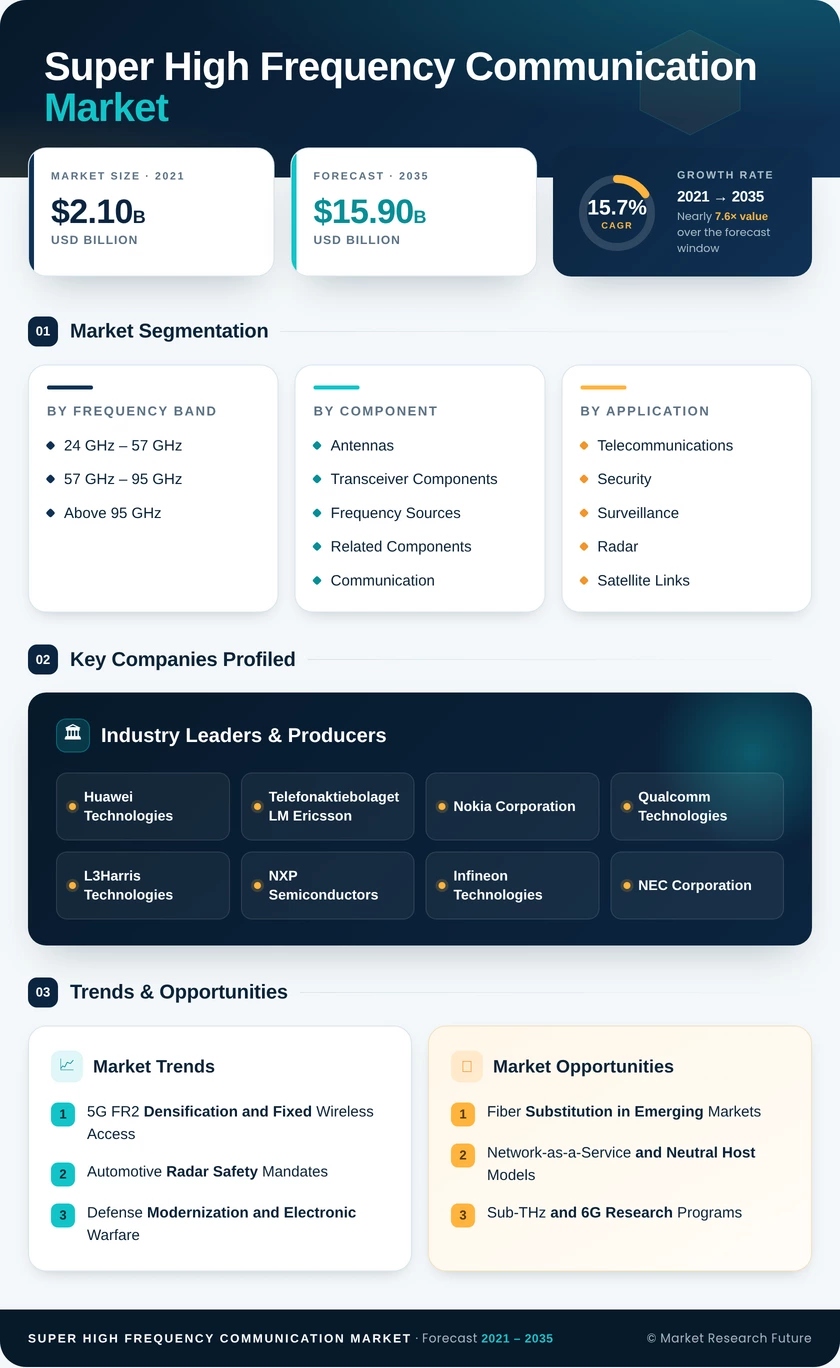
Segmentation Quick Reference
| Dimension | Sub-Segments | Dominant Segment | Fastest Growing Segment |
|---|
| By Frequency Band | 24 GHz – 57 GHz; 57 GHz – 95 GHz; Above 95 GHz | 24 GHz – 57 GHz (46.8% share) | 57 GHz – 95 GHz (16.1% CAGR) |
| By Component | Antennas and Transceiver Components; Frequency Sources and Related Components; Communication and Networking Components; Imaging Components; Other Components | Antennas and Transceiver Components (42.5% share) | Communication and Networking Components (16.3% CAGR) |
| By Application | Telecommunications; Security and Surveillance; Radar and Satellite Links; Imaging and Scanning; Other Applications | Telecommunications (56.1% share) | Security and Surveillance (16.5% CAGR) |
| By End-User Industry | Aerospace and Defence; Automotive and Transportation; Healthcare; Industrial; Other End-User Industries | Aerospace and Defence (53.3% share) | Automotive and Transportation (16.4% CAGR) |
| By Region | North America; Europe; Asia-Pacific; South America; Middle East & Africa | North America (37.0% share) | Asia-Pacific (17.9% CAGR) |
Market Segmentation Overview
| Sub-Segment | Key Trend |
|---|
| 24 GHz – 57 GHz | Mature licensed allocations for 5G FR2 small cells |
| 57 GHz – 95 GHz | Wide unlicensed and light-licensed channels for multi-gigabit links and 77 GHz radar |
| Above 95 GHz | Experimental licensing for terahertz imaging and D-band research |
The 24 GHz – 57 GHz band leads because operators hold licensed spectrum there and handsets already support it. The 57 GHz – 95 GHz band grows fastest, since 7 GHz-wide channels at 60 GHz and E-band deliver fiber-like capacity while 77 GHz radar rides automotive mandates. Above 95 GHz stays a research-driven niche until device physics and regulation mature.
| Sub-Segment | Key Trend |
|---|
| Antennas and Transceiver Components | Antenna-in-package designs shrink module size |
| Frequency Sources and Related Components | Low-phase-noise oscillators for high-order QAM |
| Communication and Networking Components | Software-defined radios spanning multiple bands |
| Imaging Components | Rising use in body scanners and industrial testing |
| Other Components | Integrated interfaces and control ICs |
Antennas and Transceiver Components hold the largest share because every SHF link and radar requires them. Communication and Networking Components expand fastest as operators demand single radios that switch across several millimeter-wave bands. Frequency Sources and Related Components gain relevance as tighter error budgets favor cleaner oscillators.
| Sub-Segment | Key Trend |
|---|
| Telecommunications | FR2 densification and fixed wireless access |
| Security and Surveillance | Non-ionizing screening at airports and venues |
| Radar and Satellite Links | Defense AESA programs and LEO terminals |
| Imaging and Scanning | Sub-millimeter defect detection on production lines |
| Other Applications | Scientific and medical instrumentation |
Telecommunications leads on the strength of small-cell rollouts and backhaul upgrades. Security and Surveillance grows fastest because millimeter-wave scanners screen travelers quickly without X-ray exposure, and base-station vendors now bundle perimeter sensing into cellular hardware. Radar and Satellite Links remain steady beneficiaries of defense and space budgets.
| Sub-Segment | Key Trend |
|---|
| Aerospace and Defence | GaN-based phased arrays and electronic warfare |
| Automotive and Transportation | Mandated AEB radar and 79 GHz imaging radar |
| Healthcare | Terahertz spectroscopy for diagnostics |
| Industrial | 60 GHz sensors for robotic guidance |
| Other End-User Industries | Research institutes and telecom operators |
Aerospace and Defence dominates thanks to sustained radar and secure-link procurement. Automotive and Transportation grows fastest as U.S. and EU safety rules make 77 GHz radar standard on new vehicles. Volume from automotive lowers chip prices that Industrial and Healthcare buyers then benefit from.


 Noah Malgeri
Co-Founder

 Peter Groot koerkamp
Account and Business Manager

 Younghwan Choi
Senior Retail Manager

 Mark Irwin
Management Consultant

 Akif Moroglu
Strategy & Business Development Director

 Guilherme Gomes Martins
Product Management Director

 Joseph Aguayo
Sales Operations & Pricing Manager

 La Terria Dodd
Program Support Specialist

 Rob Kooiker
Group Product Manager HVAC & Fire Protection GMA