Request Free Sample ×

Kindly complete the form below to receive a free sample of this Report

* Please use a valid business email

Leading companies partner with us for data-driven Insights

clients tt-cursor
Hero Background
English
Chinese
French
Japanese
Korean
German
Spanish

Sterilization Equipment Market Size

ID: MRFR/HC/4936-HCR
200 Pages
Rahul Gotadki
Last Updated: April 15, 2026

Sterilization Equipment Market Research Report: Size, Share, Trend Analysis By Applications (Medical Equipment Sterilization, Pharmaceutical Sterilization, Laboratory Sterilization, Food Sterilization), By Product Type (Steam Sterilizers, Ethylene Oxide Sterilizers, Radiation Sterilizers, Plasma Sterilizers), By End Use (Hospitals, Pharmaceutical Companies, Clinical Laboratories, Food Industry), By Technique (Thermal Sterilization, Chemical Sterilization, Radiation Sterilization) and By Regional (North America, Europe, South America, Asia Pacific, Middle East and Africa) - Growth Outlook & Industry Forecast 2026 To 2035

Share:
Download PDF ×

We do not share your information with anyone. However, we may send you emails based on your report interest from time to time. You may contact us at any time to opt-out.

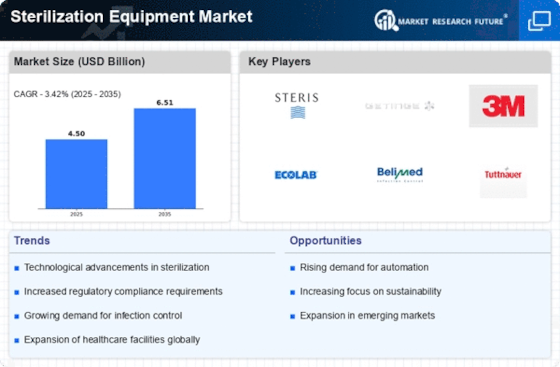
Sterilization Equipment Market Infographic
Purchase Options

Sterilization Equipment Size

Sterilization Equipment Market Growth Projections and Opportunities

There is significant growth in the sterilization equipment market due to increased attention on healthcare hygiene. Today, healthcare facilities are focusing on strict sterilization practices due to recent health concerns and outbursts of infectious diseases across the world; this makes patient safety an important factor affecting demand for advanced sterilization equipment. A significant market factor is the overall trend of increased health care spending across all countries. As healthcare structure develops and upgrades, so does the need for cutting-edge sterilization equipment to ensure top quality hygiene. This is particularly noticeable in the developed as well as emerging economies. Rapid advancement of technology in sterilization methods and equipment is driving the market growth. Innovations like low-temperature sterilization, plasma treatment and high end features in automation are increasing the effectiveness of procedures improving their appeal to healthcare providers also. The market for sterilization equipment in the healthcare industry is also being influenced by strict regulatory standards and guidelines. This is because healthcare facilities need to comply with these standards so as to ensure safety of patients and staff. Reliable and validated sterilization equipment is gaining acceptance because of the necessity to comply with regulations. Due to recent global health crises like the COVID -19 pandemic, there is need for more robust sterilization practices. Now, healthcare organizations are spending large amounts on state-of-the art sterilization equipment to be better prepared for future pandemics and provide a clean environment even during routine as well as emergency medical procedures. This is due to the change in demographic shift which now gravitates towards an aged population thus causing a higher demand for any sterilization equipment. Old people often need more intensive and individualized medical procedures, frequently involving extensive sterilisation to avoid infections or other complications during healthcare processes. The sterilization equipment market is positively impacted by the tremendous growth in pharmaceuticals and biotechnologies. Aseptic conditions are required to the production of drugs, vaccines and biopharmaceuticals leading into increased demand for sterilization equipment in manufacturing facilities. One of the main factors stimulating the market is an increasing number of surgeries around the world. At the center of healthcare is surgery and sterilization forms an important part in preventing surgical site infections. With the growth in surgical volumes, there is also a corresponding increase for efficient and reliable sterilization equipment. This market is driven by increased awareness of environmental sustainability. There is a broader trend toward eco-friendly practices and thus manufacturers are developing equipment of lower energy consumption or reduced use of harmful chemicals, to minimise the impact on the environment. The trend towards outsourcing sterilization services is impacting the market. Many healthcare facilities are opting for third-party sterilization services, leading to increased demand for specialized sterilization equipment. This shift allows healthcare providers to focus on core activities while ensuring sterilization is handled by experts.
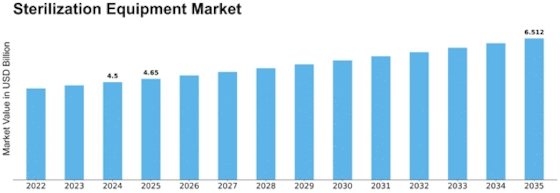
Sterilization Equipment Market Size Graph
Author
Author Profile
Rahul Gotadki
Research Manager

He holds an experience of about 9+ years in Market Research and Business Consulting, working under the spectrum of Life Sciences and Healthcare domains. Rahul conceptualizes and implements a scalable business strategy and provides strategic leadership to the clients. His expertise lies in market estimation, competitive intelligence, pipeline analysis, customer assessment, etc.

Leave a Comment

FAQs

What is the projected market valuation of the Sterilization Equipment Market by 2035?

<p>The Sterilization Equipment Market is projected to reach a valuation of 6.512 USD Billion by 2035.</p>

What was the market valuation of the Sterilization Equipment Market in 2024?

<p>In 2024, the Sterilization Equipment Market was valued at 4.499 USD Billion.</p>

What is the expected CAGR for the Sterilization Equipment Market during the forecast period 2025 - 2035?

<p>The expected CAGR for the Sterilization Equipment Market during the forecast period 2025 - 2035 is 3.42%.</p>

Which application segment is anticipated to have the highest valuation by 2035?

<p>The Medical Equipment Sterilization segment is anticipated to reach a valuation of 2.5 USD Billion by 2035.</p>

What are the projected values for the Steam Sterilizers product type by 2035?

<p>The Steam Sterilizers product type is projected to reach a value of 2.1 USD Billion by 2035.</p>

Which end-use segment is expected to grow significantly by 2035?

<p>The Hospitals end-use segment is expected to grow significantly, reaching 2.5 USD Billion by 2035.</p>

What is the projected value for Chemical Sterilization technique by 2035?

<p>The Chemical Sterilization technique is projected to reach a value of 1.8 USD Billion by 2035.</p>

Who are the key players in the Sterilization Equipment Market?

<p>Key players in the Sterilization Equipment Market include Steris, Getinge, 3M, Ecolab, and Belimed.</p>

What is the projected value for the Pharmaceutical Sterilization application by 2035?

<p>The Pharmaceutical Sterilization application is projected to reach a value of 1.8 USD Billion by 2035.</p>

What is the expected growth for the Radiation Sterilizers product type by 2035?

<p>The Radiation Sterilizers product type is expected to grow to a value of 1.3 USD Billion by 2035.</p>

Market Summary

As per Market Research Future analysis, the Sterilization Equipment Market was estimated at 16.7 USD Billion in 2025. The sterilization equipment industry is projected to grow from 18.1 USD Billion in 2026 to 18.1 USD Billion by 2035, exhibiting a compound annual growth rate (CAGR) of 8.2% during the forecast period 2026 - 2035

Key Market Trends & Highlights

The Sterilization Equipment Market is experiencing robust growth driven by technological advancements and increasing regulatory compliance.

  • North America remains the largest market for sterilization equipment, driven by high healthcare expenditure and stringent regulatory standards. The Asia-Pacific region is emerging as the fastest-growing market, fueled by rising awareness of infection control and healthcare infrastructure development. Medical equipment sterilization continues to dominate the market, while pharmaceutical sterilization is witnessing rapid growth due to increased demand for safe drug production. Key market drivers include rising healthcare expenditure and technological innovations in sterilization, which are enhancing efficiency and compliance.

Market Size & Forecast

2025 Market Size 16.7 (USD Billion)
2035 Market Size 18.1 (USD Billion)
CAGR (2026 - 2035) 8.2%
Largest Regional Market Share in 2025 North America

Major Players

Steris (US), Getinge (SE), <a href="https://www.3m.com/3M/en_US/p/c/i/consumer/">3M </a>(US), Ecolab (US), Belimed (CH), Tuttnauer (IL), Matachana (ES), Sakura (JP), Advanced Sterilization Products (US)

Market Trends

The Global Sterilization Equipment Market is currently experiencing a notable evolution, driven by advancements in technology and increasing awareness regarding infection control. The demand for effective sterilization solutions is rising across various sectors, including healthcare, pharmaceuticals, and food processing. This growth is largely attributed to the heightened focus on maintaining hygiene standards and ensuring patient safety. As a result, manufacturers are innovating and enhancing their product offerings to meet the diverse needs of end-users. Furthermore, regulatory bodies are imposing stringent guidelines, which compel organizations to adopt reliable sterilization practices. In addition to technological advancements, the Sterilization Equipment Market is witnessing a shift towards environmentally friendly solutions. Stakeholders are increasingly prioritizing sustainability, leading to the development of eco-conscious sterilization methods. This trend reflects a broader societal movement towards reducing environmental impact while maintaining effective sterilization processes. As the Global Sterilization Equipment Market continues to evolve, it appears poised for further growth, with emerging technologies and changing consumer preferences shaping its trajectory.

Technological Advancements

The Global Sterilization Equipment Market is seeing rapid technological innovations, particularly in automation and digitalization. These advancements enhance efficiency and accuracy in sterilization processes, allowing for better monitoring and control.

Sustainability Focus

There is a growing emphasis on sustainable practices within the Sterilization Equipment Market. Companies are increasingly developing eco-friendly sterilization methods that minimize environmental impact while ensuring effective sterilization.

Regulatory Compliance

The Sterilization Equipment Market is influenced by stringent regulatory requirements. Organizations are compelled to adhere to these guidelines, driving the demand for reliable and compliant sterilization solutions.

Sterilization Equipment Market Market Drivers

Rising Healthcare Expenditure

The Sterilization Equipment Market is experiencing growth due to increasing healthcare expenditure across various regions. As nations allocate more resources to healthcare, the demand for sterilization equipment rises correspondingly. In 2025, healthcare spending is projected to reach approximately 10 trillion USD, which is likely to enhance the procurement of sterilization technologies. Hospitals and clinics are investing in advanced sterilization solutions to ensure patient safety and compliance with stringent health regulations. This trend indicates a robust market for sterilization equipment, as healthcare facilities prioritize infection control and patient care. Furthermore, the expansion of healthcare infrastructure in emerging economies is expected to contribute to the demand for sterilization equipment, thereby driving the market forward.

Regulatory Standards and Compliance

The Sterilization Equipment Market is heavily influenced by stringent regulatory standards and compliance requirements. Regulatory bodies are continuously updating guidelines to ensure the safety and efficacy of sterilization processes in healthcare settings. Compliance with these regulations is paramount for healthcare facilities, as non-compliance can lead to severe penalties and reputational damage. The increasing focus on regulatory adherence is driving the demand for advanced sterilization equipment that meets these standards. Facilities are investing in equipment that not only complies with current regulations but also anticipates future requirements. This trend indicates a growing market for sterilization technologies that can adapt to evolving regulatory landscapes, thereby ensuring patient safety and operational efficiency.

Increased Awareness of Infection Control

The Sterilization Equipment Market is significantly influenced by the heightened awareness surrounding infection control. As healthcare-associated infections (HAIs) remain a critical concern, medical facilities are increasingly adopting sterilization technologies to mitigate risks. Reports suggest that HAIs affect millions of patients annually, leading to substantial healthcare costs and adverse outcomes. Consequently, hospitals are prioritizing sterilization processes to enhance patient safety and improve overall healthcare quality. This growing emphasis on infection prevention is likely to propel the demand for sterilization equipment, as facilities seek to implement effective sterilization protocols. The awareness campaigns and educational initiatives aimed at healthcare professionals further reinforce the importance of sterilization, thereby fostering market growth.

Technological Innovations in Sterilization

The Sterilization Equipment Market is witnessing a surge in technological innovations that enhance the efficiency and effectiveness of sterilization processes. Advancements such as automated sterilization systems, advanced monitoring technologies, and eco-friendly sterilization methods are transforming the landscape. For instance, the introduction of low-temperature sterilization techniques is gaining traction, particularly in sensitive medical environments. These innovations not only improve sterilization outcomes but also reduce operational costs for healthcare facilities. The market for sterilization equipment is projected to grow at a compound annual growth rate (CAGR) of around 7% over the next few years, driven by these technological advancements. As healthcare providers seek to adopt state-of-the-art sterilization solutions, the demand for innovative equipment is expected to rise.

Growth in the Pharmaceutical and Biotechnology Sectors

The Sterilization Equipment Market is benefiting from the expansion of the pharmaceutical and biotechnology sectors. As these industries grow, the need for sterilization processes to ensure product safety and efficacy becomes increasingly critical. The pharmaceutical market is projected to reach over 1.5 trillion USD by 2026, necessitating robust sterilization solutions to maintain product integrity. Biopharmaceutical companies are also investing heavily in sterilization technologies to comply with stringent quality standards. This growth is likely to drive demand for sterilization equipment, as manufacturers seek to implement effective sterilization protocols in their production processes. The intersection of these sectors with the sterilization equipment market presents a promising opportunity for growth and innovation.

Market Segment Insights

By Application: Medical Equipment Sterilization (Largest) vs. Pharmaceutical Sterilization (Fastest-Growing)

In the Sterilization Equipment Market, the distribution of market share among application segments reveals that medical sterilization machine holds the largest position. This segment is pivotal because of its necessity in hospitals and clinics, ensuring that surgical tools and devices remain free from contamination. On the other hand, Pharmaceutical Sterilization, while currently smaller in market share, is rapidly gaining traction due to increasing demands for sterile products amidst a global push for higher safety standards in pharmaceutical manufacturing. The growth trends within the Sterilization Equipment Market are influenced by various factors, especially in the Pharmaceutical Sterilization segment which is driven by innovations in sterilization technologies and rising regulatory requirements. Additionally, the surge in biopharmaceutical manufacturing and a heightened focus on patient safety are propelling this segment forward. As a result, advancements and increasing investments in sterilization methods across all applications are expected to reshape the market dynamics significantly.

Medical Equipment Sterilization (Dominant) vs. Laboratory Sterilization (Emerging)

Medical Equipment Sterilization stands as the dominant segment in the Sterilization Equipment Market due to its critical role in maintaining hygiene and safety in medical settings. The sterility equipment used in this sector typically includes steam sterilizers, ethylene oxide sterilizers, and <a href="https://www.marketresearchfuture.com/reports/hydrogen-peroxide-market-7396">hydrogen peroxide</a> sterilizers, each designed to ensure comprehensive sterilization of various medical instruments. Meanwhile, Laboratory Sterilization is emerging as a notable segment propelled by expanding research activities and rising laboratory standards. The laboratory sterilization processes, often utilizing autoclaves and dry heat sterilizers, cater to the needs of research institutions, biotech firms, and educational establishments. As the demand for high-quality research outcomes increases, the laboratory sterilization segment's relevance in supporting these efforts is expected to enhance its market presence.

By Product Type: Steam Sterilizers (Largest) vs. Ethylene Oxide Sterilizers (Fastest-Growing)

The Sterilization Equipment Market is characterized by a diverse array of product types, notably including Steam Sterilizers, Ethylene Oxide Sterilizers, Radiation Sterilizers, and <a href="https://www.marketresearchfuture.com/reports/plasma-sterilizers-market-27810">Plasma Sterilizers</a>. Among these, Steam Sterilizers maintain the largest market share due to their widespread application across healthcare facilities and laboratories. Meanwhile, Ethylene Oxide Sterilizers are quickly gaining traction, driven by their effectiveness in sterilizing heat-sensitive medical devices, thereby making them the fastest-growing segment within the market.

Steam Sterilizers (Dominant) vs. Ethylene Oxide Sterilizers (Emerging)

Steam hospital sterilizer equipment, often viewed as the backbone of sterilization methods within healthcare, are preferred for their reliability and effectiveness at eliminating microorganisms. Their ability to handle a variety of instruments has positioned them as the dominant technology in the market. On the other hand, Ethylene Oxide Sterilizers, recognized for their unique capabilities, are emerging as vital alternatives, especially for heat-sensitive products. Their gentle yet effective sterilization process caters to diverse applications, leading to a surge in adoption. The increasing focus on safety and compliance in sterilization practices further propels the growth of both segments, highlighting a significant shift towards adopting innovative sterilization technologies.

By End Use: Hospitals (Largest) vs. Pharmaceutical Companies (Fastest-Growing)

The sterilization equipment market reflects diverse application areas across different end-user segments, with the hospital sterilization equipment market commanding the largest share. They rely heavily on advanced sterilization techniques to ensure patient safety and infection control. Following the hospital <a href="https://www.marketresearchfuture.com/reports/sterilization-equipment-market-6397">sterilization equipment</a> market, are pharmaceutical companies, which utilize sterilization processes to maintain the quality and efficacy of drugs, thus ensuring compliance with regulatory standards. Together, these sectors form a substantial part of the market, driving demand for sophisticated sterilization technologies. Clinical laboratories and the food industry, while significantly contributing, represent smaller segments due to stricter regulations and niche applications.

Hospitals (Dominant) vs. Food Industry (Emerging)

The hospital sterilization equipment market continue to be the dominant force in the sterilization equipment market due to their constant need for sanitation and infection control. With increasing patient admissions and surgical procedures, the demand for reliable sterilization methods remains high. On the other hand, the food industry is emerging rapidly as a significant user of sterilization technologies. The focus on food safety and hygiene is driving the adoption of sterilization processes to eliminate pathogens. This segment is characterized by innovative solutions tailored to meet sterilization industry demands, resulting in an increasing trend toward automated and efficient sterilization methods.

By Technique: Thermal Sterilization (Largest) vs. Chemical Sterilization (Fastest-Growing)

In the Sterilization Equipment Market, Thermal Sterilization holds a substantial share, being the most widely used method due to its effectiveness and reliability across various applications. On the other hand, Chemical Sterilization is gaining momentum, particularly in regions where rapid processing and flexibility are paramount, making it an integral part of the market landscape. This distribution reflects the industry's diverse needs, where both methods play critical roles.

Sterilization Method: Thermal (Dominant) vs. Chemical (Emerging)

Thermal Sterilization is the dominant technique in the market, leveraging heat to eliminate pathogens. Its consistency and efficacy make it a preferred choice in healthcare and pharmaceuticals. Conversely, Chemical Sterilization is emerging rapidly, utilizing gaseous agents and liquids for sterilization, appealing in scenarios requiring minimal heat exposure. While Thermal Sterilization remains foundational, the chemical approach caters to sensitive sterility equipment, indicating a shift towards more versatile solutions in sterilization. This evolving dynamic showcases the adaptive nature of sterilization techniques to meet modern healthcare demands.

Get more detailed insights about Sterilization Equipment Market Research Report -Forecast till 2035

Regional Insights

North America : Leading Market Innovators

North America is the largest market for sterilization equipment, holding approximately 40% of the global share. The growth is driven by stringent regulatory standards, increasing healthcare expenditure, and a rising focus on infection control. The U.S. is the primary contributor, followed by Canada, as healthcare facilities adopt advanced sterilization technologies to enhance patient safety and operational efficiency. The competitive landscape is dominated by key players such as Steris, 3M, and Ecolab, which are continuously innovating to meet the evolving demands of healthcare providers. The presence of established companies fosters a robust supply chain, ensuring the availability of advanced sterilization solutions. Additionally, ongoing collaborations and partnerships among these players are expected to further enhance market growth.

Europe : Regulatory-Driven Market Expansion

Europe is the second-largest market for sterilization equipment, accounting for approximately 30% of the global market share. The growth is propelled by stringent regulations from health authorities, increasing awareness of infection control, and advancements in sterilization technologies. Countries like Germany and France lead the market, driven by their robust healthcare systems and high demand for sterilization solutions in hospitals and laboratories. The competitive landscape features key players such as Getinge, Belimed, and Tuttnauer, which are actively involved in product innovation and compliance with European regulations. The presence of a well-established healthcare infrastructure and a growing emphasis on patient safety further enhance the market dynamics. Collaborative efforts among manufacturers and healthcare providers are expected to drive future growth in this region.

Asia-Pacific : Emerging Market Potential

Asia-Pacific is witnessing significant growth in the sterilization equipment market, holding approximately 20% of the global share. The region's expansion is driven by increasing healthcare investments, rising awareness of infection control, and a growing number of healthcare facilities. Countries like China and India are at the forefront, with substantial investments in healthcare infrastructure and a rising demand for advanced sterilization technologies. The competitive landscape is characterized by the presence of both global and local players, including Sakura and Matachana. These companies are focusing on product development and strategic partnerships to enhance their market presence. The increasing adoption of sterilization equipment in various sectors, including pharmaceuticals and food processing, is expected to further boost market growth in the region.

Middle East and Africa : Untapped Market Opportunities

The Middle East and Africa region is gradually emerging in the sterilization equipment market, accounting for approximately 10% of the global share. The growth is driven by increasing healthcare investments, rising awareness of hygiene standards, and the need for effective infection control measures. Countries like South Africa and the UAE are leading the market, supported by government initiatives to improve healthcare infrastructure and services. The competitive landscape is evolving, with both international and regional players entering the market. Companies are focusing on expanding their product offerings and enhancing distribution networks to meet the growing demand. The increasing prevalence of healthcare-associated infections is further propelling the need for advanced sterilization solutions in this region.

Key Players and Competitive Insights

The Sterilization Equipment Market is characterized by a dynamic competitive landscape, driven by increasing demand for effective infection control across healthcare settings. Key players such as Steris (US), Getinge (SE), and 3M (US) are at the forefront, each adopting distinct strategies to enhance their market positioning. Steris (US) focuses on innovation in sterilization technologies, particularly in the development of advanced sterilization systems that cater to diverse healthcare environments. Getinge (SE) emphasizes regional expansion, particularly in emerging markets, to capitalize on the growing healthcare infrastructure. Meanwhile, 3M (US) leverages its strong brand reputation and extensive distribution network to maintain a competitive edge, particularly in the production of sterilization indicators and monitoring systems. Collectively, these strategies contribute to a moderately fragmented market structure, where competition is intensified by the presence of both established and emerging players.
In terms of business tactics, companies are increasingly localizing manufacturing to enhance supply chain efficiency and reduce lead times. This approach not only mitigates risks associated with The Sterilization Equipment Market demands. The competitive structure of the Sterilization Equipment Market appears to be moderately fragmented, with key players exerting considerable influence through strategic partnerships and technological advancements. This fragmentation fosters innovation, as companies strive to differentiate their offerings in a crowded marketplace.
In August 2025, Steris (US) announced the launch of a new line of automated sterilization systems designed to improve operational efficiency in hospitals. This strategic move is significant as it aligns with the growing trend towards automation in healthcare, potentially enhancing Steris's market share by addressing the increasing demand for efficient sterilization solutions. The introduction of these systems may also position Steris as a leader in the automation of sterilization processes, thereby reinforcing its competitive advantage.
In September 2025, Getinge (SE) entered into a strategic partnership with a leading healthcare technology firm to integrate AI-driven analytics into its sterilization equipment. This collaboration is noteworthy as it reflects the sterilization industry's shift towards digitalization, enabling Getinge to offer enhanced data-driven insights to its customers. By leveraging AI, Getinge aims to optimize sterilization processes, thereby improving patient safety and operational efficiency, which could significantly bolster its market presence.
In July 2025, 3M (US) expanded its product portfolio by acquiring a small but innovative company specializing in eco-friendly sterilization solutions. This acquisition underscores 3M's commitment to sustainability, a growing concern among healthcare providers. By integrating these eco-friendly solutions into its offerings, 3M not only enhances its product line but also positions itself favorably in a market increasingly focused on sustainable practices.
As of October 2025, the Sterilization Equipment Market is witnessing trends that emphasize digitalization, sustainability, and the integration of advanced technologies such as AI. Strategic alliances are becoming increasingly pivotal, as companies seek to enhance their technological capabilities and market reach. Looking ahead, competitive differentiation is likely to evolve from traditional price-based competition towards a focus on innovation, technological advancements, and supply chain reliability. This shift suggests that companies that prioritize these aspects will be better positioned to thrive in an increasingly competitive landscape.

Key Companies in the Sterilization Equipment Market include

Industry Developments

The Sterilization Equipment Market has recently seen significant developments, particularly in the areas of technological advancements and increased demand driven by the ongoing focus on infection control.

In July 2024, Getinge established a digital sterilization relationship with a Japan-based sterile-services provider, "Medical Bear," to integrate its T-DOC supply management system, achieving a 9% enhancement in efficiency and a 27% reduction in procedural steps.

Miele Professional announced a partnership in March 2023 with a prominent health-tech firm to integrate smart technology into benchtop hospital sterilizer equipment, facilitating contact with hospital management systems to enhance use insights and efficiency.

Future Outlook

Sterilization Equipment Market Future Outlook

The Global Sterilization Equipment Market is projected to grow at a 3.42% CAGR from 2024 to 2035, driven by technological advancements, increasing healthcare standards, and rising demand for sterilization in various industries.

New opportunities lie in:

  • <p>Expansion of automated sterilization systems in hospitals Development of portable sterilization units for remote areas Integration of IoT technology for real-time monitoring of sterilization processes</p>

By 2035, the Global Sterilization Equipment Market is expected to be robust, reflecting sustained growth and innovation.

Market Segmentation

Sterilization Equipment Market End Use Outlook

  • Hospitals
  • Pharmaceutical Companies
  • Clinical Laboratories
  • Food Industry

Sterilization Equipment Market Technique Outlook

  • Thermal Sterilization
  • Chemical Sterilization
  • Radiation Sterilization

Sterilization Equipment Market Application Outlook

  • Medical Equipment Sterilization
  • Pharmaceutical Sterilization
  • Laboratory Sterilization
  • Food Sterilization

Sterilization Equipment Market Product Type Outlook

  • Steam Sterilizers
  • Ethylene Oxide Sterilizers
  • Radiation Sterilizers
  • Plasma Sterilizers

Report Scope

MARKET SIZE 2025 16.7 (USD Billion)
MARKET SIZE 2026 18.1 (USD Billion)
MARKET SIZE 2035 37.0 (USD Billion)
COMPOUND ANNUAL GROWTH RATE (CAGR) 8.2% (2026 - 2035)
REPORT COVERAGE Revenue Forecast, Competitive Landscape, Growth Factors, and Trends
BASE YEAR 2025
Market Forecast Period 2026 - 2035
Historical Data 2019 - 2025
Market Forecast Units USD Billion
Key Companies Profiled Steris (US), Getinge (SE), 3M (US), Ecolab (US), Belimed (CH), Tuttnauer (IL), Matachana (ES), Sakura (JP), Advanced Sterilization Products (US)
Segments Covered Applications, Product Type, End Use, Technique, Regional
Key Market Opportunities Integration of advanced automation and artificial intelligence in Sterilization Equipment Market enhances efficiency and compliance.
Key Market Dynamics Technological advancements and stringent regulatory standards drive innovation and competition in the sterilization equipment market.
Countries Covered North America, Europe, APAC, South America, MEA

FAQs

What is the projected market valuation of the Sterilization Equipment Market by 2035?

<p>The Sterilization Equipment Market is projected to reach a valuation of 6.512 USD Billion by 2035.</p>

What was the market valuation of the Sterilization Equipment Market in 2024?

<p>In 2024, the Sterilization Equipment Market was valued at 4.499 USD Billion.</p>

What is the expected CAGR for the Sterilization Equipment Market during the forecast period 2025 - 2035?

<p>The expected CAGR for the Sterilization Equipment Market during the forecast period 2025 - 2035 is 3.42%.</p>

Which application segment is anticipated to have the highest valuation by 2035?

<p>The Medical Equipment Sterilization segment is anticipated to reach a valuation of 2.5 USD Billion by 2035.</p>

What are the projected values for the Steam Sterilizers product type by 2035?

<p>The Steam Sterilizers product type is projected to reach a value of 2.1 USD Billion by 2035.</p>

Which end-use segment is expected to grow significantly by 2035?

<p>The Hospitals end-use segment is expected to grow significantly, reaching 2.5 USD Billion by 2035.</p>

What is the projected value for Chemical Sterilization technique by 2035?

<p>The Chemical Sterilization technique is projected to reach a value of 1.8 USD Billion by 2035.</p>

Who are the key players in the Sterilization Equipment Market?

<p>Key players in the Sterilization Equipment Market include Steris, Getinge, 3M, Ecolab, and Belimed.</p>

What is the projected value for the Pharmaceutical Sterilization application by 2035?

<p>The Pharmaceutical Sterilization application is projected to reach a value of 1.8 USD Billion by 2035.</p>

What is the expected growth for the Radiation Sterilizers product type by 2035?

<p>The Radiation Sterilizers product type is expected to grow to a value of 1.3 USD Billion by 2035.</p>

  1. SECTION I: EXECUTIVE SUMMARY AND KEY HIGHLIGHTS |
    1. EXECUTIVE SUMMARY | |
      1. Market Overview | |
      2. Key Findings | |
      3. Market Segmentation | |
      4. Competitive Landscape | |
      5. Challenges and Opportunities | |
      6. Future Outlook 2
  2. SECTION II: SCOPING, METHODOLOGY AND MARKET STRUCTURE |
    1. MARKET INTRODUCTION | |
      1. Definition | |
      2. Scope of the study | | |
    2. RESEARCH METHODOLOGY | |
      1. Overview | |
      2. Data Mining | |
      3. Secondary Research | |
      4. Primary Research | | |
      5. Forecasting Model | |
      6. Market Size Estimation | | |
      7. Data Triangulation | |
      8. Validation 3
  3. SECTION III: QUALITATIVE ANALYSIS |
    1. MARKET DYNAMICS | |
      1. Overview | |
      2. Drivers | |
      3. Restraints | |
      4. Opportunities |
    2. MARKET FACTOR ANALYSIS | |
      1. Value chain Analysis | |
      2. Porter's Five Forces Analysis | | |
      3. COVID-19 Impact Analysis | | |
  4. SECTION IV: QUANTITATIVE ANALYSIS |
    1. Healthcare, BY Application (USD Billion) | |
      1. Medical Equipment Sterilization | |
      2. Pharmaceutical Sterilization | |
      3. Laboratory Sterilization | |
      4. Food Sterilization |
    2. Healthcare, BY Product Type (USD Billion) | |
      1. Steam Sterilizers | |
      2. Ethylene Oxide Sterilizers | |
      3. Radiation Sterilizers | |
      4. Plasma Sterilizers |
    3. Healthcare, BY End Use (USD Billion) | |
      1. Hospitals | |
      2. Pharmaceutical Companies | |
      3. Clinical Laboratories | |
      4. Food Industry |
    4. Healthcare, BY Technique (USD Billion) | |
      1. Thermal Sterilization | |
      2. Chemical Sterilization | |
      3. Radiation Sterilization |
    5. Healthcare, BY Region (USD Billion) | |
      1. North America | | |
      2. Europe | | |
      3. APAC | | |
      4. South America | | |
      5. MEA | | |
  5. SECTION V: COMPETITIVE ANALYSIS |
    1. Competitive Landscape | |
      1. Overview | |
      2. Competitive Analysis | |
      3. Market share Analysis | |
      4. Major Growth Strategy in the Healthcare | |
      5. Competitive Benchmarking | |
      6. Leading Players in Terms of Number of Developments in the Healthcare | |
      7. Key developments and growth strategies | | |
      8. Major Players Financial Matrix | | |
    2. Company Profiles | |
      1. Steris (US) | | |
      2. Getinge (SE) | | |
      3. 3M (US) | | |
      4. Ecolab (US) | | |
      5. Belimed (CH) | | |
      6. Tuttnauer (IL) | | |
      7. Matachana (ES) | | |
      8. Sakura (JP) | | |
      9. Advanced Sterilization Products (US) | | |
    3. Appendix | |
      1. References | |
      2. Related Reports 6 LIST OF FIGURES |
    4. MARKET SYNOPSIS |
    5. NORTH AMERICA MARKET ANALYSIS |
    6. US MARKET ANALYSIS BY APPLICATION |
    7. US MARKET ANALYSIS BY PRODUCT TYPE |
    8. US MARKET ANALYSIS BY END USE |
    9. US MARKET ANALYSIS BY TECHNIQUE |
    10. CANADA MARKET ANALYSIS BY APPLICATION |
    11. CANADA MARKET ANALYSIS BY PRODUCT TYPE |
    12. CANADA MARKET ANALYSIS BY END USE |
    13. CANADA MARKET ANALYSIS BY TECHNIQUE |
    14. EUROPE MARKET ANALYSIS |
    15. GERMANY MARKET ANALYSIS BY APPLICATION |
    16. GERMANY MARKET ANALYSIS BY PRODUCT TYPE |
    17. GERMANY MARKET ANALYSIS BY END USE |
    18. GERMANY MARKET ANALYSIS BY TECHNIQUE |
    19. UK MARKET ANALYSIS BY APPLICATION |
    20. UK MARKET ANALYSIS BY PRODUCT TYPE |
    21. UK MARKET ANALYSIS BY END USE |
    22. UK MARKET ANALYSIS BY TECHNIQUE |
    23. FRANCE MARKET ANALYSIS BY APPLICATION |
    24. FRANCE MARKET ANALYSIS BY PRODUCT TYPE |
    25. FRANCE MARKET ANALYSIS BY END USE |
    26. FRANCE MARKET ANALYSIS BY TECHNIQUE |
    27. RUSSIA MARKET ANALYSIS BY APPLICATION |
    28. RUSSIA MARKET ANALYSIS BY PRODUCT TYPE |
    29. RUSSIA MARKET ANALYSIS BY END USE |
    30. RUSSIA MARKET ANALYSIS BY TECHNIQUE |
    31. ITALY MARKET ANALYSIS BY APPLICATION |
    32. ITALY MARKET ANALYSIS BY PRODUCT TYPE |
    33. ITALY MARKET ANALYSIS BY END USE |
    34. ITALY MARKET ANALYSIS BY TECHNIQUE |
    35. SPAIN MARKET ANALYSIS BY APPLICATION |
    36. SPAIN MARKET ANALYSIS BY PRODUCT TYPE |
    37. SPAIN MARKET ANALYSIS BY END USE |
    38. SPAIN MARKET ANALYSIS BY TECHNIQUE |
    39. REST OF EUROPE MARKET ANALYSIS BY APPLICATION |
    40. REST OF EUROPE MARKET ANALYSIS BY PRODUCT TYPE |
    41. REST OF EUROPE MARKET ANALYSIS BY END USE |
    42. REST OF EUROPE MARKET ANALYSIS BY TECHNIQUE |
    43. APAC MARKET ANALYSIS |
    44. CHINA MARKET ANALYSIS BY APPLICATION |
    45. CHINA MARKET ANALYSIS BY PRODUCT TYPE |
    46. CHINA MARKET ANALYSIS BY END USE |
    47. CHINA MARKET ANALYSIS BY TECHNIQUE |
    48. INDIA MARKET ANALYSIS BY APPLICATION |
    49. INDIA MARKET ANALYSIS BY PRODUCT TYPE |
    50. INDIA MARKET ANALYSIS BY END USE |
    51. INDIA MARKET ANALYSIS BY TECHNIQUE |
    52. JAPAN MARKET ANALYSIS BY APPLICATION |
    53. JAPAN MARKET ANALYSIS BY PRODUCT TYPE |
    54. JAPAN MARKET ANALYSIS BY END USE |
    55. JAPAN MARKET ANALYSIS BY TECHNIQUE |
    56. SOUTH KOREA MARKET ANALYSIS BY APPLICATION |
    57. SOUTH KOREA MARKET ANALYSIS BY PRODUCT TYPE |
    58. SOUTH KOREA MARKET ANALYSIS BY END USE |
    59. SOUTH KOREA MARKET ANALYSIS BY TECHNIQUE |
    60. MALAYSIA MARKET ANALYSIS BY APPLICATION |
    61. MALAYSIA MARKET ANALYSIS BY PRODUCT TYPE |
    62. MALAYSIA MARKET ANALYSIS BY END USE |
    63. MALAYSIA MARKET ANALYSIS BY TECHNIQUE |
    64. THAILAND MARKET ANALYSIS BY APPLICATION |
    65. THAILAND MARKET ANALYSIS BY PRODUCT TYPE |
    66. THAILAND MARKET ANALYSIS BY END USE |
    67. THAILAND MARKET ANALYSIS BY TECHNIQUE |
    68. INDONESIA MARKET ANALYSIS BY APPLICATION |
    69. INDONESIA MARKET ANALYSIS BY PRODUCT TYPE |
    70. INDONESIA MARKET ANALYSIS BY END USE |
    71. INDONESIA MARKET ANALYSIS BY TECHNIQUE |
    72. REST OF APAC MARKET ANALYSIS BY APPLICATION |
    73. REST OF APAC MARKET ANALYSIS BY PRODUCT TYPE |
    74. REST OF APAC MARKET ANALYSIS BY END USE |
    75. REST OF APAC MARKET ANALYSIS BY TECHNIQUE |
    76. SOUTH AMERICA MARKET ANALYSIS |
    77. BRAZIL MARKET ANALYSIS BY APPLICATION |
    78. BRAZIL MARKET ANALYSIS BY PRODUCT TYPE |
    79. BRAZIL MARKET ANALYSIS BY END USE |
    80. BRAZIL MARKET ANALYSIS BY TECHNIQUE |
    81. MEXICO MARKET ANALYSIS BY APPLICATION |
    82. MEXICO MARKET ANALYSIS BY PRODUCT TYPE |
    83. MEXICO MARKET ANALYSIS BY END USE |
    84. MEXICO MARKET ANALYSIS BY TECHNIQUE |
    85. ARGENTINA MARKET ANALYSIS BY APPLICATION |
    86. ARGENTINA MARKET ANALYSIS BY PRODUCT TYPE |
    87. ARGENTINA MARKET ANALYSIS BY END USE |
    88. ARGENTINA MARKET ANALYSIS BY TECHNIQUE |
    89. REST OF SOUTH AMERICA MARKET ANALYSIS BY APPLICATION |
    90. REST OF SOUTH AMERICA MARKET ANALYSIS BY PRODUCT TYPE |
    91. REST OF SOUTH AMERICA MARKET ANALYSIS BY END USE |
    92. REST OF SOUTH AMERICA MARKET ANALYSIS BY TECHNIQUE |
    93. MEA MARKET ANALYSIS |
    94. GCC COUNTRIES MARKET ANALYSIS BY APPLICATION |
    95. GCC COUNTRIES MARKET ANALYSIS BY PRODUCT TYPE |
    96. GCC COUNTRIES MARKET ANALYSIS BY END USE |
    97. GCC COUNTRIES MARKET ANALYSIS BY TECHNIQUE |
    98. SOUTH AFRICA MARKET ANALYSIS BY APPLICATION |
    99. SOUTH AFRICA MARKET ANALYSIS BY PRODUCT TYPE |
    100. SOUTH AFRICA MARKET ANALYSIS BY END USE |
    101. SOUTH AFRICA MARKET ANALYSIS BY TECHNIQUE |
    102. REST OF MEA MARKET ANALYSIS BY APPLICATION |
    103. REST OF MEA MARKET ANALYSIS BY PRODUCT TYPE |
    104. REST OF MEA MARKET ANALYSIS BY END USE |
    105. REST OF MEA MARKET ANALYSIS BY TECHNIQUE |
    106. KEY BUYING CRITERIA OF HEALTHCARE |
    107. RESEARCH PROCESS OF MRFR |
    108. DRO ANALYSIS OF HEALTHCARE |
    109. DRIVERS IMPACT ANALYSIS: HEALTHCARE |
    110. RESTRAINTS IMPACT ANALYSIS: HEALTHCARE |
    111. SUPPLY / VALUE CHAIN: HEALTHCARE |
    112. HEALTHCARE, BY APPLICATION, 2024 (% SHARE) |
    113. HEALTHCARE, BY APPLICATION, 2024 TO 2035 (USD Billion) |
    114. HEALTHCARE, BY PRODUCT TYPE, 2024 (% SHARE) |
    115. HEALTHCARE, BY PRODUCT TYPE, 2024 TO 2035 (USD Billion) |
    116. HEALTHCARE, BY END USE, 2024 (% SHARE) |
    117. HEALTHCARE, BY END USE, 2024 TO 2035 (USD Billion) |
    118. HEALTHCARE, BY TECHNIQUE, 2024 (% SHARE) |
    119. HEALTHCARE, BY TECHNIQUE, 2024 TO 2035 (USD Billion) |
    120. BENCHMARKING OF MAJOR COMPETITORS 7 LIST OF TABLES |
    121. LIST OF ASSUMPTIONS | |
      1. |
    122. North America MARKET SIZE ESTIMATES; FORECAST | |
      1. BY APPLICATION, 2025-2035 (USD Billion) | |
      2. BY PRODUCT TYPE, 2025-2035 (USD Billion) | |
      3. BY END USE, 2025-2035 (USD Billion) | |
      4. BY TECHNIQUE, 2025-2035 (USD Billion) |
    123. US MARKET SIZE ESTIMATES; FORECAST | |
      1. BY APPLICATION, 2025-2035 (USD Billion) | |
      2. BY PRODUCT TYPE, 2025-2035 (USD Billion) | |
      3. BY END USE, 2025-2035 (USD Billion) | |
      4. BY TECHNIQUE, 2025-2035 (USD Billion) |
    124. Canada MARKET SIZE ESTIMATES; FORECAST | |
      1. BY APPLICATION, 2025-2035 (USD Billion) | |
      2. BY PRODUCT TYPE, 2025-2035 (USD Billion) | |
      3. BY END USE, 2025-2035 (USD Billion) | |
      4. BY TECHNIQUE, 2025-2035 (USD Billion) |
    125. Europe MARKET SIZE ESTIMATES; FORECAST | |
      1. BY APPLICATION, 2025-2035 (USD Billion) | |
      2. BY PRODUCT TYPE, 2025-2035 (USD Billion) | |
      3. BY END USE, 2025-2035 (USD Billion) | |
      4. BY TECHNIQUE, 2025-2035 (USD Billion) |
    126. Germany MARKET SIZE ESTIMATES; FORECAST | |
      1. BY APPLICATION, 2025-2035 (USD Billion) | |
      2. BY PRODUCT TYPE, 2025-2035 (USD Billion) | |
      3. BY END USE, 2025-2035 (USD Billion) | |
      4. BY TECHNIQUE, 2025-2035 (USD Billion) |
    127. UK MARKET SIZE ESTIMATES; FORECAST | |
      1. BY APPLICATION, 2025-2035 (USD Billion) | |
      2. BY PRODUCT TYPE, 2025-2035 (USD Billion) | |
      3. BY END USE, 2025-2035 (USD Billion) | |
      4. BY TECHNIQUE, 2025-2035 (USD Billion) |
    128. France MARKET SIZE ESTIMATES; FORECAST | |
      1. BY APPLICATION, 2025-2035 (USD Billion) | |
      2. BY PRODUCT TYPE, 2025-2035 (USD Billion) | |
      3. BY END USE, 2025-2035 (USD Billion) | |
      4. BY TECHNIQUE, 2025-2035 (USD Billion) |
    129. Russia MARKET SIZE ESTIMATES; FORECAST | |
      1. BY APPLICATION, 2025-2035 (USD Billion) | |
      2. BY PRODUCT TYPE, 2025-2035 (USD Billion) | |
      3. BY END USE, 2025-2035 (USD Billion) | |
      4. BY TECHNIQUE, 2025-2035 (USD Billion) |
    130. Italy MARKET SIZE ESTIMATES; FORECAST | |
      1. BY APPLICATION, 2025-2035 (USD Billion) | |
      2. BY PRODUCT TYPE, 2025-2035 (USD Billion) | |
      3. BY END USE, 2025-2035 (USD Billion) | |
      4. BY TECHNIQUE, 2025-2035 (USD Billion) |
    131. Spain MARKET SIZE ESTIMATES; FORECAST | |
      1. BY APPLICATION, 2025-2035 (USD Billion) | |
      2. BY PRODUCT TYPE, 2025-2035 (USD Billion) | |
      3. BY END USE, 2025-2035 (USD Billion) | |
      4. BY TECHNIQUE, 2025-2035 (USD Billion) |
    132. Rest of Europe MARKET SIZE ESTIMATES; FORECAST | |
      1. BY APPLICATION, 2025-2035 (USD Billion) | |
      2. BY PRODUCT TYPE, 2025-2035 (USD Billion) | |
      3. BY END USE, 2025-2035 (USD Billion) | |
      4. BY TECHNIQUE, 2025-2035 (USD Billion) |
    133. APAC MARKET SIZE ESTIMATES; FORECAST | |
      1. BY APPLICATION, 2025-2035 (USD Billion) | |
      2. BY PRODUCT TYPE, 2025-2035 (USD Billion) | |
      3. BY END USE, 2025-2035 (USD Billion) | |
      4. BY TECHNIQUE, 2025-2035 (USD Billion) |
    134. China MARKET SIZE ESTIMATES; FORECAST | |
      1. BY APPLICATION, 2025-2035 (USD Billion) | |
      2. BY PRODUCT TYPE, 2025-2035 (USD Billion) | |
      3. BY END USE, 2025-2035 (USD Billion) | |
      4. BY TECHNIQUE, 2025-2035 (USD Billion) |
    135. India MARKET SIZE ESTIMATES; FORECAST | |
      1. BY APPLICATION, 2025-2035 (USD Billion) | |
      2. BY PRODUCT TYPE, 2025-2035 (USD Billion) | |
      3. BY END USE, 2025-2035 (USD Billion) | |
      4. BY TECHNIQUE, 2025-2035 (USD Billion) |
    136. Japan MARKET SIZE ESTIMATES; FORECAST | |
      1. BY APPLICATION, 2025-2035 (USD Billion) | |
      2. BY PRODUCT TYPE, 2025-2035 (USD Billion) | |
      3. BY END USE, 2025-2035 (USD Billion) | |
      4. BY TECHNIQUE, 2025-2035 (USD Billion) |
    137. South Korea MARKET SIZE ESTIMATES; FORECAST | |
      1. BY APPLICATION, 2025-2035 (USD Billion) | |
      2. BY PRODUCT TYPE, 2025-2035 (USD Billion) | |
      3. BY END USE, 2025-2035 (USD Billion) | |
      4. BY TECHNIQUE, 2025-2035 (USD Billion) |
    138. Malaysia MARKET SIZE ESTIMATES; FORECAST | |
      1. BY APPLICATION, 2025-2035 (USD Billion) | |
      2. BY PRODUCT TYPE, 2025-2035 (USD Billion) | |
      3. BY END USE, 2025-2035 (USD Billion) | |
      4. BY TECHNIQUE, 2025-2035 (USD Billion) |
    139. Thailand MARKET SIZE ESTIMATES; FORECAST | |
      1. BY APPLICATION, 2025-2035 (USD Billion) | |
      2. BY PRODUCT TYPE, 2025-2035 (USD Billion) | |
      3. BY END USE, 2025-2035 (USD Billion) | |
      4. BY TECHNIQUE, 2025-2035 (USD Billion) |
    140. Indonesia MARKET SIZE ESTIMATES; FORECAST | |
      1. BY APPLICATION, 2025-2035 (USD Billion) | |
      2. BY PRODUCT TYPE, 2025-2035 (USD Billion) | |
      3. BY END USE, 2025-2035 (USD Billion) | |
      4. BY TECHNIQUE, 2025-2035 (USD Billion) |
    141. Rest of APAC MARKET SIZE ESTIMATES; FORECAST | |
      1. BY APPLICATION, 2025-2035 (USD Billion) | |
      2. BY PRODUCT TYPE, 2025-2035 (USD Billion) | |
      3. BY END USE, 2025-2035 (USD Billion) | |
      4. BY TECHNIQUE, 2025-2035 (USD Billion) |
    142. South America MARKET SIZE ESTIMATES; FORECAST | |
      1. BY APPLICATION, 2025-2035 (USD Billion) | |
      2. BY PRODUCT TYPE, 2025-2035 (USD Billion) | |
      3. BY END USE, 2025-2035 (USD Billion) | |
      4. BY TECHNIQUE, 2025-2035 (USD Billion) |
    143. Brazil MARKET SIZE ESTIMATES; FORECAST | |
      1. BY APPLICATION, 2025-2035 (USD Billion) | |
      2. BY PRODUCT TYPE, 2025-2035 (USD Billion) | |
      3. BY END USE, 2025-2035 (USD Billion) | |
      4. BY TECHNIQUE, 2025-2035 (USD Billion) |
    144. Mexico MARKET SIZE ESTIMATES; FORECAST | |
      1. BY APPLICATION, 2025-2035 (USD Billion) | |
      2. BY PRODUCT TYPE, 2025-2035 (USD Billion) | |
      3. BY END USE, 2025-2035 (USD Billion) | |
      4. BY TECHNIQUE, 2025-2035 (USD Billion) |
    145. Argentina MARKET SIZE ESTIMATES; FORECAST | |
      1. BY APPLICATION, 2025-2035 (USD Billion) | |
      2. BY PRODUCT TYPE, 2025-2035 (USD Billion) | |
      3. BY END USE, 2025-2035 (USD Billion) | |
      4. BY TECHNIQUE, 2025-2035 (USD Billion) |
    146. Rest of South America MARKET SIZE ESTIMATES; FORECAST | |
      1. BY APPLICATION, 2025-2035 (USD Billion) | |
      2. BY PRODUCT TYPE, 2025-2035 (USD Billion) | |
      3. BY END USE, 2025-2035 (USD Billion) | |
      4. BY TECHNIQUE, 2025-2035 (USD Billion) |
    147. MEA MARKET SIZE ESTIMATES; FORECAST | |
      1. BY APPLICATION, 2025-2035 (USD Billion) | |
      2. BY PRODUCT TYPE, 2025-2035 (USD Billion) | |
      3. BY END USE, 2025-2035 (USD Billion) | |
      4. BY TECHNIQUE, 2025-2035 (USD Billion) |
    148. GCC Countries MARKET SIZE ESTIMATES; FORECAST | |
      1. BY APPLICATION, 2025-2035 (USD Billion) | |
      2. BY PRODUCT TYPE, 2025-2035 (USD Billion) | |
      3. BY END USE, 2025-2035 (USD Billion) | |
      4. BY TECHNIQUE, 2025-2035 (USD Billion) |
    149. South Africa MARKET SIZE ESTIMATES; FORECAST | |
      1. BY APPLICATION, 2025-2035 (USD Billion) | |
      2. BY PRODUCT TYPE, 2025-2035 (USD Billion) | |
      3. BY END USE, 2025-2035 (USD Billion) | |
      4. BY TECHNIQUE, 2025-2035 (USD Billion) |
    150. Rest of MEA MARKET SIZE ESTIMATES; FORECAST | |
      1. BY APPLICATION, 2025-2035 (USD Billion) | |
      2. BY PRODUCT TYPE, 2025-2035 (USD Billion) | |
      3. BY END USE, 2025-2035 (USD Billion) | |
      4. BY TECHNIQUE, 2025-2035 (USD Billion) |
    151. PRODUCT LAUNCH/PRODUCT DEVELOPMENT/APPROVAL | |
      1. |
    152. ACQUISITION/PARTNERSHIP | |

Healthcare Market Segmentation

Healthcare By Application (USD Billion, 2025-2035)

  • Medical Equipment Sterilization
  • Pharmaceutical Sterilization
  • Laboratory Sterilization
  • Food Sterilization

Healthcare By Product Type (USD Billion, 2025-2035)

  • Steam Sterilizers
  • Ethylene Oxide Sterilizers
  • Radiation Sterilizers
  • Plasma Sterilizers

Healthcare By End Use (USD Billion, 2025-2035)

  • Hospitals
  • Pharmaceutical Companies
  • Clinical Laboratories
  • Food Industry

Healthcare By Technique (USD Billion, 2025-2035)

  • Thermal Sterilization
  • Chemical Sterilization
  • Radiation Sterilization
Infographic

Free Sample Request

Kindly complete the form below to receive a free sample of this Report

Get Free Sample

Customer Strories

Compare Licence

×
Features License Type
Single User Multiuser License Enterprise User
Price $4,950 $5,950 $7,250
Maximum User Access Limit 1 User Upto 10 Users Unrestricted Access Throughout the Organization
Free Customization
Direct Access to Analyst
Deliverable Format
Platform Access
Discount on Next Purchase 10% 15% 15%
Printable Versions