×
Request Free Sample ×

Kindly complete the form below to receive a free sample of this Report

* Please use a valid business email

Leading companies partner with us for data-driven Insights

clients tt-cursor
Hero Background
English
Chinese
French
Japanese
Korean
German
Spanish

Steam Autoclave Market Share

ID: MRFR/MED/5182-HCR
90 Pages
Kinjoll Dey
October 2025

Steam Autoclave Market Research Report By Application (Healthcare, Pharmaceuticals, Laboratory, Food and Beverage), By Type (Horizontal Autoclave, Vertical Autoclave, Portable Autoclave), By End Use (Hospitals, Research Institutions, Pharmaceutical Companies, Food Industry), By Functionality (Steam Sterilization, Vacuum Sterilization, Dry Heat Sterilization) and By Regional (North America, Europe, South America, Asia Pacific, Middle East and Africa) - Growth & Industry Forecast 2025 To 2035

Share:
Download PDF ×

We do not share your information with anyone. However, we may send you emails based on your report interest from time to time. You may contact us at any time to opt-out.

Steam Autoclave Market Infographic
×
Steam Autoclave Market Infographic Full View
Purchase Options

Market Share

Steam Autoclave Market Share Analysis

The market for steam autoclaves is a fundamental part of the clinical and research facility hardware area, giving disease control-basic cleansing arrangements. Market members try to achieve an upper hand by executing an effective portion of the overall industry situating techniques. A cognizance of piece of the pie situation involves the essential drives embraced by an association to lay out an extraordinary market presence in contrast with its opponents. Concerning autoclaves, this envelops the improvement of item credits, the development of market entrance, and the foundation of brand picture. Item Separation and Advancement: Organizations endeavor to separate themselves by consistently enhancing their steam autoclave items. Improving customer advance by incorporating state of the art innovations, for example, contact screen interfaces, quicker sanitization cycles, and energy-productive plans, is conceivable. Key Industry Concentration: By growing the usage of steam autoclaves into different areas like exploration, drugs, and medical care, associations can get to undiscovered market amazing open doors. By embracing this system, they extend their customers as well as decrease dependence on a solitary industry. With an end goal to increase their portion of the overall industry, organizations focus on the extension of their global presence. This involves wandering into already neglected showcases or improving their piece of the pie in regions with significant interest for cleansing gear. Dissemination arrangements and key associations are basic to this development. Cost initiative systems are executed by specific associations to achieve an upper hand. They can draw in cost-cognizant buyers by offering cutthroat estimating through the execution of financially savvy creation techniques, proficient obtaining of materials, and streamlining of assembling processes. Brand Improvement and Notoriety The board: For piece of the pie situating, laying out a strong brand picture is pivotal. A positive standing is laid out through the execution of key drives, for example, putting resources into showcasing efforts, underscoring item dependability, and ensuring excellent client care. These activities can affect purchaser inclinations. Administrative Consistence and Quality Confirmation: considering the basic idea of cleansing in the fields of medical services and exploration, it is critical to stick to administrative norms. Associations allot assets towards maintaining predominant quality benchmarks, gaining fundamental affirmations, and showing adherence to these principles to develop client certainty and mastery. The arrangement of comprehensive client schooling and preparing programs expands the apparent worth ascribed to steam autoclaves. By furnishing clients with assets on appropriate utilization, support, and investigating, organizations encourage dependable associations with their customers. Laying out essential unions with reciprocal endeavors or taking part in cooperative endeavors with research foundations can give amazing chances to showcase extension and passage. These sorts of unions enable organizations to gain by particular information, pool assets, and cooperatively tackle changing business sector needs. The dynamic pursuit and reconciliation of buyer criticism are crucial during the time spent improving and upgrading items and administrations. By speedily answering developing buyer requests, organizations can guarantee that their steam autoclaves will keep an upper hand and keep on satisfying client assumptions. Manageability drives are acquiring conspicuousness among organizations working in the steam autoclave market as a response to the raising natural fears. To draw in naturally cognizant clients, this involves the advancement of eco-accommodating items, the streamlining of energy utilization, and the execution of dependable assembling rehearses. The capacity to give an assortment of steam autoclave models with particular limits and characteristics empowers organizations to oblige a wide exhibit of client necessities. This flexibility ensures that they are equipped for fulfilling unmistakable needs in different market fragments, subsequently cultivating an extension of their general piece of the pie.


Author
Kinjoll Dey
Research Analyst Level I

He is an extremely curious individual currently working in Healthcare and Medical Devices Domain. Kinjoll is comfortably versed in data centric research backed by healthcare educational background. He leverages extensive data mining and analytics tools such as Primary and Secondary Research, Statistical Analysis, Machine Learning, Data Modelling. His key role also involves Technical Sales Support, Client Interaction and Project management within the Healthcare team. Lastly, he showcases extensive affinity towards learning new skills and remain fascinated in implementing them.

Leave a Comment

FAQs

What is the projected growth of the Steam Autoclave market?

The Steam Autoclave market is the expected increase in total market value of 3.77 USD billion over a defined forecast period 2025–2035. It is driven by factors such as demand trends, technological advances, regulatory changes, and geographic expansion.

What is the size of the Steam Autoclave market?

Steam Autoclave market size was valued at approximately 1.43 billion USD in 2024. This figure will reach 3.77 billion USD covering all regions (America, Europe, Asia, MEA and ROW), focusing its segments / services / distribution channels till 2035.

What is the CAGR of the Steam Autoclave market?

Steam Autoclave market is expected to grow at a CAGR of 9.2% between 2025 and 2035.

How much will the Steam Autoclave market be worth by 2035?

Steam Autoclave market is expected to be worth of 3.77 billion USD, reflecting growth driven by usage, technology and global demands by the end of 2035.

How will the Steam Autoclave market perform over the next 10 years?

Over the next 10 years the Steam Autoclave market is expected to shift from usd billion 1.43 to 3.77 billion USD, led by adoption of advanced tech, demographic trends, regulatory approvals, with potential headwinds from 2025 to 2035.

Which application segment is projected to dominate the Steam Autoclave Market by 2035?

The Healthcare application segment is projected to dominate with a market size of 3.45 USD Billion by 2035.

What is the market size for the Pharmaceuticals application in 2024?

The Pharmaceuticals application segment is valued at 1.0 USD Billion in 2024.

How much is the North America segment expected to be worth by 2035?

The North America segment is expected to be valued at 1.78 USD Billion by 2035.

What was the market size of the Europe region in 2024?

The Europe region was valued at 0.93 USD Billion in 2024.

Who are the key players in the Steam Autoclave Market?

Major players in the market include PMS, Hirayama, Systec, Eschmann Equipment, and Tuttnauer.

Market Summary

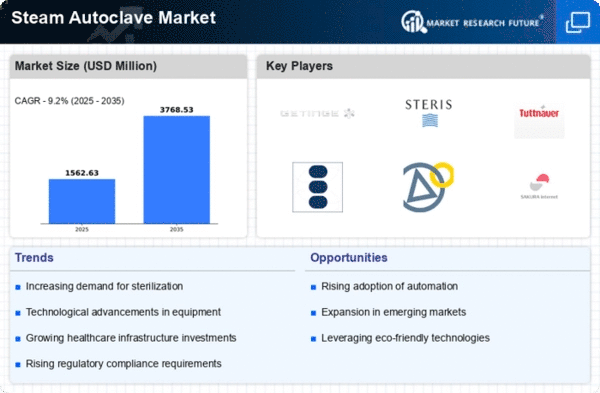
As per MRFR analysis, the Steam Autoclave Market Size was estimated at 1430.98 USD Million in 2024. The Steam Autoclave industry is projected to grow from 1562.66 USD Million in 2025 to 3768.53 USD Million by 2035, exhibiting a compound annual growth rate (CAGR) of 9.2 during the forecast period 2025 - 2035.

Key Market Trends & Highlights

The Steam Autoclave Market is poised for growth driven by technological advancements and increasing demand across various sectors.

  • Technological advancements are enhancing the efficiency and effectiveness of steam autoclaves, leading to broader adoption.
  • The medical segment remains the largest market, while the pharmaceutical segment is experiencing rapid growth due to increased sterilization needs.
  • North America continues to dominate the market, whereas the Asia-Pacific region is emerging as the fastest-growing area for steam autoclaves.
  • Rising demand in the healthcare sector and a growing focus on regulatory compliance are key drivers propelling market expansion.

Market Size & Forecast

2024 Market Size 1430.98 (USD Million)
2035 Market Size 3768.53 (USD Million)
CAGR (2025 - 2035) 9.2%
Largest Regional Market Share in 2024 North America

Major Players

Getinge (SE), Steris (US), Tuttnauer (IL), Matachana (ES), Astell Scientific (GB), Sakura (JP), Belimed (CH), Cisa (IT)

Market Trends

The Steam Autoclave Market is currently experiencing a notable evolution, driven by advancements in sterilization technology and increasing demand for effective infection control measures across various sectors. The healthcare industry, particularly hospitals and laboratories, is a primary consumer of steam autoclaves, as these devices are essential for ensuring the safety and sterility of medical instruments. Furthermore, the growing awareness regarding hygiene and safety standards in food processing and pharmaceutical industries is propelling the adoption of steam autoclaves. As a result, manufacturers are focusing on enhancing the efficiency and reliability of their products to meet the diverse needs of end-users. In addition to the healthcare sector, the Steam Autoclave Market is witnessing a rise in applications within research institutions and educational facilities. These environments require robust sterilization solutions to maintain sterile conditions for experiments and training. The trend towards automation and smart technology integration is also becoming increasingly prevalent, as stakeholders seek to optimize operational efficiency and reduce human error. Overall, the Steam Autoclave Market appears poised for growth, with innovations and heightened awareness of sterilization practices likely to shape its future trajectory.

Technological Advancements

The Steam Autoclave Market is witnessing a surge in technological innovations, particularly in automation and smart features. Manufacturers are increasingly integrating advanced monitoring systems and user-friendly interfaces, which enhance operational efficiency and ensure consistent sterilization outcomes. This trend suggests a shift towards more sophisticated devices that cater to the evolving needs of various industries.

Rising Demand in Food and Pharmaceutical Sectors

There is a growing recognition of the importance of sterilization in the food and pharmaceutical industries, leading to increased demand for steam autoclaves. These sectors require stringent hygiene standards to prevent contamination and ensure product safety. Consequently, the Steam Autoclave Market is likely to expand as more companies invest in reliable sterilization solutions.

Focus on Sustainability

Sustainability is becoming a critical consideration within the Steam Autoclave Market, as stakeholders seek environmentally friendly solutions. Manufacturers are exploring ways to reduce energy consumption and minimize waste during the sterilization process. This trend indicates a broader commitment to sustainable practices, which may influence purchasing decisions in the coming years.

Steam Autoclave Market Market Drivers

Market Growth Projections

The Global Steam Autoclave Market Industry is projected to experience substantial growth over the coming years. With an estimated market value of 1.43 USD Billion in 2024, the industry is on track to reach 3.77 USD Billion by 2035. This growth trajectory indicates a compound annual growth rate of 9.21% from 2025 to 2035, reflecting increasing investments in healthcare and advancements in sterilization technologies. The market's expansion is likely to be driven by rising demand across various sectors, including healthcare, pharmaceuticals, and research laboratories, as organizations prioritize effective sterilization solutions.

Technological Advancements

Technological innovations in steam autoclave design and functionality contribute significantly to the Global Steam Autoclave Market Industry. Enhanced features such as automated controls, improved energy efficiency, and advanced monitoring systems are becoming increasingly prevalent. These advancements not only optimize sterilization processes but also reduce operational costs for healthcare facilities and laboratories. As organizations seek to adopt more efficient and reliable sterilization solutions, the market is likely to experience a compound annual growth rate of 9.21% from 2025 to 2035. This growth is indicative of the industry's response to evolving needs and technological capabilities.

Rising Demand for Sterilization

The increasing demand for effective sterilization methods across various sectors drives the Global Steam Autoclave Market Industry. Hospitals, laboratories, and pharmaceutical companies require reliable sterilization processes to ensure safety and compliance with health regulations. As of 2024, the market is valued at approximately 1.43 USD Billion, reflecting a growing recognition of the importance of sterilization in preventing infections and maintaining product integrity. This trend is expected to continue, with the market projected to reach 3.77 USD Billion by 2035, indicating a robust growth trajectory fueled by heightened awareness of hygiene standards.

Growing Healthcare Infrastructure

The expansion of healthcare infrastructure, particularly in developing regions, significantly influences the Global Steam Autoclave Market Industry. As countries invest in healthcare facilities, the need for effective sterilization solutions becomes paramount. New hospitals and laboratories are increasingly incorporating steam autoclaves into their operations to ensure patient safety and meet regulatory requirements. This growth in infrastructure is expected to drive market expansion, with the industry poised for a compound annual growth rate of 9.21% from 2025 to 2035. The increasing focus on healthcare accessibility and quality further supports this trend.

Regulatory Compliance and Standards

The stringent regulatory environment surrounding sterilization practices is a key driver for the Global Steam Autoclave Market Industry. Regulatory bodies impose strict guidelines to ensure that sterilization equipment meets safety and efficacy standards. Compliance with these regulations is essential for healthcare providers and manufacturers, thereby increasing the demand for high-quality steam autoclaves. As organizations strive to adhere to these regulations, the market is expected to grow substantially, with projections indicating a rise from 1.43 USD Billion in 2024 to 3.77 USD Billion by 2035. This trend underscores the critical role of regulatory compliance in shaping market dynamics.

Increased Awareness of Infection Control

Heightened awareness of infection control measures among healthcare professionals and the general public is a vital driver for the Global Steam Autoclave Market Industry. As the importance of sterilization in preventing healthcare-associated infections becomes more recognized, the demand for steam autoclaves is likely to rise. Educational initiatives and training programs emphasize the significance of proper sterilization techniques, leading to increased adoption of steam autoclaves in various settings. This growing awareness is expected to contribute to the market's growth, aligning with projections of reaching 3.77 USD Billion by 2035.

Market Segment Insights

By Application: Medical (Largest) vs. Pharmaceutical (Fastest-Growing)

The Steam Autoclave Market is significantly segmented by its applications, with the Medical sector holding the largest share. This sector encompasses a variety of applications including surgical instruments sterilization, dental tools, and general hospital equipment, ensuring its dominance. Following this, the Pharmaceutical application emerges as a crucial area, essential for sterilizing equipment used in drug manufacturing and compounding. Each segment contributes uniquely to the overall market landscape, highlighting the importance of steam autoclaves in maintaining safety and compliance across industries. In recent years, the demand for steam autoclaves has surged, particularly in the Pharmaceutical sector, which is recognized as the fastest-growing segment. This growth is largely driven by the increasing need for stringent sterilization processes in drug development and manufacturing, as the industry faces heightened regulatory standards and safety protocols. Additionally, the Medical segment remains steady due to its established infrastructure and continued investments in healthcare facilities, while a rising emphasis on lab safety and compliance in various sectors fuels overall growth in the Steam Autoclave Market.

Medical (Dominant) vs. Laboratory (Emerging)

The Medical application of steam autoclaves is represented by rigorous sterilization processes critical for infection control in healthcare settings, making it a dominant force in the market. Facilities such as hospitals and clinics prioritize high efficiency and reliability in their sterilization methods, integrating advanced autoclave technologies to ensure safety and compliance. Conversely, the Laboratory application is emerging as a vital segment, with increasing demand for sterilization in research and academic labs. This sector focuses on the need for precise control and versatility in sterilization processes to handle various laboratory materials. Together, these segments illustrate the diverse applications of steam autoclaves, catering to the stringent requirements of safety and efficiency within medical and research environments.

By End Use: Hospitals (Largest) vs. Pharmaceutical Companies (Fastest-Growing)

The 'End Use' segment of the Steam Autoclave Market showcases a distinct distribution of market share among various sectors. Hospitals account for the largest share due to their critical need for sterilization processes to ensure patient safety and operational efficiency. Following hospitals, pharmaceutical companies are also significant players, relying on advanced sterilization methods to comply with stringent regulations and maintain product integrity. Research institutions and laboratories are equally essential, utilizing steam autoclaves for various testing and experimental purposes.

Hospital (Dominant) vs. Pharmaceutical Companies (Emerging)

Hospitals represent the dominant end-use segment in the Steam Autoclave Market as they require regular sterilization of surgical instruments and other medical equipment to prevent infections. Their substantial demand ensures that manufacturers continually innovate and improve autoclave technologies to enhance efficiency and reliability. On the other hand, pharmaceutical companies are emerging as a fast-growing segment driven by increasing production demands for sterile pharmaceutical products. The stringent regulatory landscape mandates robust sterilization processes, thus boosting the adoption of steam autoclaves. Pharmaceutical firms are investing in advanced sterilization technologies, making them a segment to watch, as they strive to ensure compliance while scaling up production.

By Product Type: Vertical Autoclave (Largest) vs. Portable Autoclave (Fastest-Growing)

In the Steam Autoclave Market, the product type segment is prominently led by Vertical Autoclaves, which comfortably hold the largest market share. Their design is favored in healthcare and laboratory settings, primarily due to their efficiency and effectiveness in sterilization processes. Both Horizontal and Tabletop Autoclaves also contribute significantly to the market, but they do not match the dominance seen by the Vertical configuration. The Portable Autoclave segment, while smaller in market share, is rapidly gaining traction owing to its convenience and increasing applications, especially in field operations and smaller medical facilities.

Vertical Autoclave: Dominant vs. Portable Autoclave: Emerging

Vertical Autoclaves are known for their large capacity and efficient steam penetration, making them particularly suitable for sterilizing larger instruments and supplies. They dominate the market due to their extensive use in hospitals and labs, where space optimization and operational efficiency are critical. On the other hand, Portable Autoclaves are becoming increasingly popular as they cater to the needs of on-the-go sterilization in remote locations. Their compact design allows for easy transportation, while advancements in technology are making them more efficient and reliable, thus solidifying their emerging status in the market.

By Technology: Steam Sterilization (Largest) vs. Dry Heat Sterilization (Fastest-Growing)

The Steam Autoclave Market is primarily dominated by steam sterilization, which holds the largest share due to its effectiveness and widespread acceptance in healthcare settings. This method is preferred for its efficiency in eliminating a wide range of microorganisms, making it a standard in many sterilization protocols. In contrast, dry heat sterilization, though less common, is witnessing a growing share as industries look for alternative methods that do not rely on moisture, appealing to specific applications where steam might not be suitable.

Technology: Steam Sterilization (Dominant) vs. Dry Heat Sterilization (Emerging)

Steam sterilization is the dominant technology in the Steam Autoclave Market, revered for its rapid cycle times and effectiveness in sterilizing surgical instruments and other medical tools. Its ability to penetrate materials quickly, coupled with optimal temperature and pressure, ensures thorough sterilization. Conversely, dry heat sterilization is gaining traction as an emerging technology. It is especially useful for heat-stable materials that cannot tolerate moisture, such as certain powders and oils. This method is slower but offers a reliable solution for industries seeking to maintain integrity while achieving sterilization, reflecting a trend toward diversified sterilization technologies.

By Capacity: Large Capacity (Largest) vs. Small Capacity (Fastest-Growing)

The Steam Autoclave Market demonstrates diverse capacity preferences, notably with the Large Capacity segment commanding a significant share due to its extensive usage in large-scale healthcare facilities and laboratories. Conversely, the Small Capacity segment is rapidly gaining traction, particularly among smaller clinics and laboratories that require efficient sterilization solutions for limited volumes. These dynamics indicate a market that is catering to both large organizations and smaller entities, shaping the overall landscape of the industry.

Size: Large Capacity (Dominant) vs. Small Capacity (Emerging)

The Large Capacity segment stands dominant in the Steam Autoclave Market, favored for its capability to handle larger loads, making it ideal for institutions with high sterilization demands. This segment is characterized by robust performance, reliability, and efficiency, catering primarily to hospitals and research facilities. In contrast, the Small Capacity segment is emerging as a vital player, especially with the increasing number of small and outpatient care centers. These units offer flexible and cost-effective sterilization options, addressing the needs of organizations with limited space or lower sterilization volume requirements, thus driving significant growth through tailored offerings.

Get more detailed insights about Steam Autoclave Market Research Report-Global Forecast till 2035

Regional Insights

North America : Market Leader in Innovation

North America continues to lead the steam autoclave market, holding a significant share of 715.49 million in 2024. The region's growth is driven by increasing healthcare expenditures, stringent sterilization regulations, and a rising demand for advanced medical technologies. The presence of established healthcare infrastructure and a focus on infection control further catalyze market expansion. Regulatory bodies are emphasizing compliance with safety standards, enhancing the demand for reliable sterilization solutions. The competitive landscape in North America is robust, featuring key players such as Steris, Getinge, and Tuttnauer. These companies are investing in R&D to innovate and improve their product offerings. The U.S. is the largest market, driven by a high volume of surgical procedures and a growing emphasis on patient safety. The region's focus on technological advancements and regulatory compliance positions it as a critical hub for steam autoclave solutions.

Europe : Emerging Market with Growth Potential

Europe's steam autoclave market is valued at 400.0 million, reflecting steady growth driven by increasing healthcare demands and regulatory frameworks promoting sterilization practices. The region is witnessing a rise in surgical procedures and a growing awareness of infection control, which are key factors propelling market expansion. Additionally, government initiatives aimed at improving healthcare infrastructure are expected to further boost demand for steam autoclaves across various healthcare settings. Leading countries in Europe include Germany, France, and the UK, where major players like Astell Scientific and Belimed are actively competing. The competitive landscape is characterized by innovation and strategic partnerships, enhancing product offerings. The European market is also influenced by stringent regulations that ensure high standards of sterilization, making it a vital region for steam autoclave manufacturers. "The European Union has set forth regulations to ensure the highest standards of medical device sterilization," European Commission, 2023.

Asia-Pacific : Rapidly Growing Market Segment

The Asia-Pacific steam autoclave market, valued at 250.0 million, is experiencing rapid growth due to increasing healthcare investments and a rising number of surgical procedures. Countries like China and India are at the forefront, driven by expanding healthcare infrastructure and a growing awareness of infection control. The region's demand for advanced sterilization solutions is further fueled by government initiatives aimed at improving healthcare quality and accessibility, making it a key area for market expansion. The competitive landscape in Asia-Pacific is evolving, with key players such as Sakura and Matachana making significant inroads. The presence of local manufacturers is also increasing, contributing to competitive pricing and innovation. As healthcare facilities modernize, the demand for reliable steam autoclaves is expected to rise, positioning the region as a critical player in the global market.

Middle East and Africa : Emerging Market with Challenges

The Middle East and Africa steam autoclave market is valued at 65.49 million, reflecting emerging growth driven by increasing healthcare investments and a focus on infection control. The region faces challenges such as limited healthcare infrastructure and varying regulatory standards, but the demand for sterilization solutions is on the rise. Governments are increasingly recognizing the importance of healthcare quality, leading to initiatives that promote the adoption of advanced sterilization technologies. Countries like South Africa and the UAE are leading the market, with key players such as Cisa and Belimed establishing a presence. The competitive landscape is characterized by a mix of local and international companies, focusing on affordability and reliability. As healthcare facilities expand and modernize, the demand for steam autoclaves is expected to grow, making this region a potential hotspot for market development.

Key Players and Competitive Insights

The Steam Autoclave Market is currently characterized by a competitive landscape that is both dynamic and multifaceted. Key growth drivers include the increasing demand for sterilization in healthcare settings, advancements in technology, and a heightened focus on infection control. Major players such as Getinge (SE), Steris (US), and Tuttnauer (IL) are strategically positioned to leverage these trends. Getinge (SE) emphasizes innovation in its product offerings, focusing on advanced sterilization technologies, while Steris (US) has adopted a strategy of regional expansion, enhancing its market presence in emerging economies. Tuttnauer (IL) appears to be concentrating on partnerships with healthcare facilities to optimize sterilization processes, thereby shaping a competitive environment that is increasingly collaborative and innovation-driven.In terms of business tactics, companies are localizing manufacturing to reduce costs and enhance supply chain efficiency. The market structure is moderately fragmented, with several key players exerting influence over their respective segments. This fragmentation allows for a diverse range of products and services, catering to various customer needs while fostering competition among established and emerging players.

In November Getinge (SE) announced the launch of a new line of eco-friendly steam autoclaves designed to reduce energy consumption by 30%. This strategic move not only aligns with global sustainability trends but also positions Getinge as a leader in environmentally conscious sterilization solutions. The introduction of these products is likely to attract environmentally aware customers and enhance the company's competitive edge.

In October Steris (US) expanded its operations in Asia by acquiring a local sterilization service provider. This acquisition is significant as it allows Steris to tap into the rapidly growing healthcare market in the region, thereby increasing its market share and operational capabilities. The strategic importance of this move lies in its potential to enhance Steris's service offerings and improve customer access to advanced sterilization technologies.

In September Tuttnauer (IL) entered into a partnership with a leading healthcare technology firm to integrate AI-driven monitoring systems into its autoclave products. This collaboration is indicative of a broader trend towards digitalization in the industry, enhancing the efficiency and reliability of sterilization processes. The integration of AI technology is expected to provide real-time data analytics, thereby improving operational efficiency and customer satisfaction.

As of December current competitive trends in the Steam Autoclave Market are heavily influenced by digitalization, sustainability, and the integration of advanced technologies such as AI. Strategic alliances are increasingly shaping the landscape, allowing companies to pool resources and expertise. Looking ahead, competitive differentiation is likely to evolve from traditional price-based competition to a focus on innovation, technological advancements, and supply chain reliability. This shift underscores the importance of adaptability and forward-thinking strategies in maintaining a competitive edge in the market.

Key Companies in the Steam Autoclave Market include

Industry Developments

Recent developments in the Steam Autoclave Market indicate a growing emphasis on technological advancements and sustainability practices. Companies such as Hirayama and Astell Scientific are integrating innovative features into their steam autoclaves to enhance efficiency and reduce environmental impact. Current affairs highlight the significant increase in demand for sterilization equipment within healthcare and laboratory settings, driven by heightened awareness of hygiene standards and regulatory compliance. 

Moreover, notable acquisitions have reshaped the competitive landscape as companies seek to expand their product portfolios and geographic reach. For instance, Priority Consulting has been recognized for its strategic partnerships with major manufacturers like Belimed and Tuttnauer, aimed at enhancing service offerings. 

Growth in market valuation is particularly evident among established players such as Getinge and Eschmann Equipment, which have recently reported increased revenues attributed to the rising demand for durable and reliable sterilization systems. In addition, the market is witnessing an expansion with new entrants capitalizing on emerging technologies, further intensifying competition and innovation within the steam autoclave sector. The overall outlook remains positive as stakeholders adapt to evolving market dynamics and customer needs.

Future Outlook

Steam Autoclave Market Future Outlook

The Steam Autoclave Market is projected to grow at a 9.2% CAGR from 2025 to 2035, driven by technological advancements, increasing healthcare demands, and stringent sterilization regulations.

New opportunities lie in:

  • Expansion into emerging markets with tailored solutions
  • Development of eco-friendly autoclave technologies
  • Integration of IoT for real-time monitoring and maintenance

By 2035, the Steam Autoclave Market is expected to achieve robust growth, solidifying its position as a critical industry.

Market Segmentation

Steam Autoclave Market End Use Outlook

  • Hospitals
  • Pharmaceutical Companies
  • Research Institutions
  • Laboratories
  • Food Industry

Steam Autoclave Market Capacity Outlook

  • Small Capacity
  • Medium Capacity
  • Large Capacity
  • Extra Large Capacity
  • Custom Capacity

Steam Autoclave Market Technology Outlook

  • Steam Sterilization
  • Dry Heat Sterilization
  • Chemical Sterilization
  • Radiation Sterilization
  • Plasma Sterilization

Steam Autoclave Market Application Outlook

  • Medical
  • Pharmaceutical
  • Laboratory
  • Food Processing
  • Research

Steam Autoclave Market Product Type Outlook

  • Vertical Autoclave
  • Horizontal Autoclave
  • Tabletop Autoclave
  • Portable Autoclave
  • Industrial Autoclave

Report Scope

MARKET SIZE 20241430.98(USD Million)
MARKET SIZE 20251562.66(USD Million)
MARKET SIZE 20353768.53(USD Million)
COMPOUND ANNUAL GROWTH RATE (CAGR)9.2% (2025 - 2035)
REPORT COVERAGERevenue Forecast, Competitive Landscape, Growth Factors, and Trends
BASE YEAR2024
Market Forecast Period2025 - 2035
Historical Data2019 - 2024
Market Forecast UnitsUSD Million
Key Companies ProfiledGetinge (SE), Steris (US), Tuttnauer (IL), Matachana (ES), Astell Scientific (GB), Sakura (JP), Belimed (CH), Cisa (IT)
Segments CoveredApplication, End Use, Product Type, Technology, Capacity
Key Market OpportunitiesIntegration of advanced automation and IoT technologies in the Steam Autoclave Market enhances efficiency and monitoring.
Key Market DynamicsRising demand for sterilization in healthcare drives innovation and competition in the steam autoclave market.
Countries CoveredNorth America, Europe, APAC, South America, MEA

FAQs

What is the projected growth of the Steam Autoclave market?

The Steam Autoclave market is the expected increase in total market value of 3.77 USD billion over a defined forecast period 2025–2035. It is driven by factors such as demand trends, technological advances, regulatory changes, and geographic expansion.

What is the size of the Steam Autoclave market?

Steam Autoclave market size was valued at approximately 1.43 billion USD in 2024. This figure will reach 3.77 billion USD covering all regions (America, Europe, Asia, MEA and ROW), focusing its segments / services / distribution channels till 2035.

What is the CAGR of the Steam Autoclave market?

Steam Autoclave market is expected to grow at a CAGR of 9.2% between 2025 and 2035.

How much will the Steam Autoclave market be worth by 2035?

Steam Autoclave market is expected to be worth of 3.77 billion USD, reflecting growth driven by usage, technology and global demands by the end of 2035.

How will the Steam Autoclave market perform over the next 10 years?

Over the next 10 years the Steam Autoclave market is expected to shift from usd billion 1.43 to 3.77 billion USD, led by adoption of advanced tech, demographic trends, regulatory approvals, with potential headwinds from 2025 to 2035.

Which application segment is projected to dominate the Steam Autoclave Market by 2035?

The Healthcare application segment is projected to dominate with a market size of 3.45 USD Billion by 2035.

What is the market size for the Pharmaceuticals application in 2024?

The Pharmaceuticals application segment is valued at 1.0 USD Billion in 2024.

How much is the North America segment expected to be worth by 2035?

The North America segment is expected to be valued at 1.78 USD Billion by 2035.

What was the market size of the Europe region in 2024?

The Europe region was valued at 0.93 USD Billion in 2024.

Who are the key players in the Steam Autoclave Market?

Major players in the market include PMS, Hirayama, Systec, Eschmann Equipment, and Tuttnauer.

  1. SECTION I: EXECUTIVE SUMMARY AND KEY HIGHLIGHTS
    1. | 1.1 EXECUTIVE SUMMARY
    2. | 1.1.1 Market Overview
    3. | 1.1.2 Key Findings
    4. | 1.1.3 Market Segmentation
    5. | 1.1.4 Competitive Landscape
    6. | 1.1.5 Challenges and Opportunities
    7. | 1.1.6 Future Outlook
  2. SECTION II: SCOPING, METHODOLOGY AND MARKET STRUCTURE
    1. | 2.1 MARKET INTRODUCTION
    2. | 2.1.1 Definition
    3. | 2.1.2 Scope of the study
    4. |-- 2.1.2.1 Research Objective
    5. |-- 2.1.2.2 Assumption
    6. |-- 2.1.2.3 Limitations
    7. | 2.2 RESEARCH METHODOLOGY
    8. | 2.2.1 Overview
    9. | 2.2.2 Data Mining
    10. | 2.2.3 Secondary Research
    11. | 2.2.4 Primary Research
    12. |-- 2.2.4.1 Primary Interviews and Information Gathering Process
    13. |-- 2.2.4.2 Breakdown of Primary Respondents
    14. | 2.2.5 Forecasting Model
    15. | 2.2.6 Market Size Estimation
    16. |-- 2.2.6.1 Bottom-Up Approach
    17. |-- 2.2.6.2 Top-Down Approach
    18. | 2.2.7 Data Triangulation
    19. | 2.2.8 Validation
  3. SECTION III: QUALITATIVE ANALYSIS
    1. | 3.1 MARKET DYNAMICS
    2. | 3.1.1 Overview
    3. | 3.1.2 Drivers
    4. | 3.1.3 Restraints
    5. | 3.1.4 Opportunities
    6. | 3.2 MARKET FACTOR ANALYSIS
    7. | 3.2.1 Value chain Analysis
    8. | 3.2.2 Porter's Five Forces Analysis
    9. |-- 3.2.2.1 Bargaining Power of Suppliers
    10. |-- 3.2.2.2 Bargaining Power of Buyers
    11. |-- 3.2.2.3 Threat of New Entrants
    12. |-- 3.2.2.4 Threat of Substitutes
    13. |-- 3.2.2.5 Intensity of Rivalry
    14. | 3.2.3 COVID-19 Impact Analysis
    15. |-- 3.2.3.1 Market Impact Analysis
    16. |-- 3.2.3.2 Regional Impact
    17. |-- 3.2.3.3 Opportunity and Threat Analysis
  4. SECTION IV: QUANTITATIVE ANALYSIS
    1. | 4.1 Healthcare, BY Application (USD Million)
    2. | 4.1.1 Medical
    3. | 4.1.2 Pharmaceutical
    4. | 4.1.3 Laboratory
    5. | 4.1.4 Food Processing
    6. | 4.1.5 Research
    7. | 4.2 Healthcare, BY End Use (USD Million)
    8. | 4.2.1 Hospitals
    9. | 4.2.2 Pharmaceutical Companies
    10. | 4.2.3 Research Institutions
    11. | 4.2.4 Laboratories
    12. | 4.2.5 Food Industry
    13. | 4.3 Healthcare, BY Product Type (USD Million)
    14. | 4.3.1 Vertical Autoclave
    15. | 4.3.2 Horizontal Autoclave
    16. | 4.3.3 Tabletop Autoclave
    17. | 4.3.4 Portable Autoclave
    18. | 4.3.5 Industrial Autoclave
    19. | 4.4 Healthcare, BY Technology (USD Million)
    20. | 4.4.1 Steam Sterilization
    21. | 4.4.2 Dry Heat Sterilization
    22. | 4.4.3 Chemical Sterilization
    23. | 4.4.4 Radiation Sterilization
    24. | 4.4.5 Plasma Sterilization
    25. | 4.5 Healthcare, BY Capacity (USD Million)
    26. | 4.5.1 Small Capacity
    27. | 4.5.2 Medium Capacity
    28. | 4.5.3 Large Capacity
    29. | 4.5.4 Extra Large Capacity
    30. | 4.5.5 Custom Capacity
    31. | 4.6 Healthcare, BY Region (USD Million)
    32. | 4.6.1 North America
    33. |-- 4.6.1.1 US
    34. |-- 4.6.1.2 Canada
    35. | 4.6.2 Europe
    36. |-- 4.6.2.1 Germany
    37. |-- 4.6.2.2 UK
    38. |-- 4.6.2.3 France
    39. |-- 4.6.2.4 Russia
    40. |-- 4.6.2.5 Italy
    41. |-- 4.6.2.6 Spain
    42. |-- 4.6.2.7 Rest of Europe
    43. | 4.6.3 APAC
    44. |-- 4.6.3.1 China
    45. |-- 4.6.3.2 India
    46. |-- 4.6.3.3 Japan
    47. |-- 4.6.3.4 South Korea
    48. |-- 4.6.3.5 Malaysia
    49. |-- 4.6.3.6 Thailand
    50. |-- 4.6.3.7 Indonesia
    51. |-- 4.6.3.8 Rest of APAC
    52. | 4.6.4 South America
    53. |-- 4.6.4.1 Brazil
    54. |-- 4.6.4.2 Mexico
    55. |-- 4.6.4.3 Argentina
    56. |-- 4.6.4.4 Rest of South America
    57. | 4.6.5 MEA
    58. |-- 4.6.5.1 GCC Countries
    59. |-- 4.6.5.2 South Africa
    60. |-- 4.6.5.3 Rest of MEA
  5. SECTION V: COMPETITIVE ANALYSIS
    1. | 5.1 Competitive Landscape
    2. | 5.1.1 Overview
    3. | 5.1.2 Competitive Analysis
    4. | 5.1.3 Market share Analysis
    5. | 5.1.4 Major Growth Strategy in the Healthcare
    6. | 5.1.5 Competitive Benchmarking
    7. | 5.1.6 Leading Players in Terms of Number of Developments in the Healthcare
    8. | 5.1.7 Key developments and growth strategies
    9. |-- 5.1.7.1 New Product Launch/Service Deployment
    10. |-- 5.1.7.2 Merger & Acquisitions
    11. |-- 5.1.7.3 Joint Ventures
    12. | 5.1.8 Major Players Financial Matrix
    13. |-- 5.1.8.1 Sales and Operating Income
    14. |-- 5.1.8.2 Major Players R&D Expenditure. 2023
    15. | 5.2 Company Profiles
    16. | 5.2.1 Getinge (SE)
    17. |-- 5.2.1.1 Financial Overview
    18. |-- 5.2.1.2 Products Offered
    19. |-- 5.2.1.3 Key Developments
    20. |-- 5.2.1.4 SWOT Analysis
    21. |-- 5.2.1.5 Key Strategies
    22. | 5.2.2 Steris (US)
    23. |-- 5.2.2.1 Financial Overview
    24. |-- 5.2.2.2 Products Offered
    25. |-- 5.2.2.3 Key Developments
    26. |-- 5.2.2.4 SWOT Analysis
    27. |-- 5.2.2.5 Key Strategies
    28. | 5.2.3 Tuttnauer (IL)
    29. |-- 5.2.3.1 Financial Overview
    30. |-- 5.2.3.2 Products Offered
    31. |-- 5.2.3.3 Key Developments
    32. |-- 5.2.3.4 SWOT Analysis
    33. |-- 5.2.3.5 Key Strategies
    34. | 5.2.4 Matachana (ES)
    35. |-- 5.2.4.1 Financial Overview
    36. |-- 5.2.4.2 Products Offered
    37. |-- 5.2.4.3 Key Developments
    38. |-- 5.2.4.4 SWOT Analysis
    39. |-- 5.2.4.5 Key Strategies
    40. | 5.2.5 Astell Scientific (GB)
    41. |-- 5.2.5.1 Financial Overview
    42. |-- 5.2.5.2 Products Offered
    43. |-- 5.2.5.3 Key Developments
    44. |-- 5.2.5.4 SWOT Analysis
    45. |-- 5.2.5.5 Key Strategies
    46. | 5.2.6 Sakura (JP)
    47. |-- 5.2.6.1 Financial Overview
    48. |-- 5.2.6.2 Products Offered
    49. |-- 5.2.6.3 Key Developments
    50. |-- 5.2.6.4 SWOT Analysis
    51. |-- 5.2.6.5 Key Strategies
    52. | 5.2.7 Belimed (CH)
    53. |-- 5.2.7.1 Financial Overview
    54. |-- 5.2.7.2 Products Offered
    55. |-- 5.2.7.3 Key Developments
    56. |-- 5.2.7.4 SWOT Analysis
    57. |-- 5.2.7.5 Key Strategies
    58. | 5.2.8 Cisa (IT)
    59. |-- 5.2.8.1 Financial Overview
    60. |-- 5.2.8.2 Products Offered
    61. |-- 5.2.8.3 Key Developments
    62. |-- 5.2.8.4 SWOT Analysis
    63. |-- 5.2.8.5 Key Strategies
    64. | 5.3 Appendix
    65. | 5.3.1 References
    66. | 5.3.2 Related Reports

Healthcare Market Segmentation

Healthcare By Application (USD Million, 2025-2035)

  • Medical
  • Pharmaceutical
  • Laboratory
  • Food Processing
  • Research

Healthcare By End Use (USD Million, 2025-2035)

  • Hospitals
  • Pharmaceutical Companies
  • Research Institutions
  • Laboratories
  • Food Industry

Healthcare By Product Type (USD Million, 2025-2035)

  • Vertical Autoclave
  • Horizontal Autoclave
  • Tabletop Autoclave
  • Portable Autoclave
  • Industrial Autoclave

Healthcare By Technology (USD Million, 2025-2035)

  • Steam Sterilization
  • Dry Heat Sterilization
  • Chemical Sterilization
  • Radiation Sterilization
  • Plasma Sterilization

Healthcare By Capacity (USD Million, 2025-2035)

  • Small Capacity
  • Medium Capacity
  • Large Capacity
  • Extra Large Capacity
  • Custom Capacity
Infographic

Free Sample Request

Kindly complete the form below to receive a free sample of this Report

Get Free Sample

Customer Strories

Compare Licence

×
Features License Type
Single User Multiuser License Enterprise User
Price $4,950 $5,950 $7,250
Maximum User Access Limit 1 User Upto 10 Users Unrestricted Access Throughout the Organization
Free Customization
Direct Access to Analyst
Deliverable Format
Platform Access
Discount on Next Purchase 10% 15% 15%
Printable Versions