
Request Free Sample ×

Kindly complete the form below to receive a free sample of this Report

* Please use a valid business email

Leading companies partner with us for data-driven Insights

clients tt-cursor
Hero Background
English
Chinese
French
Japanese
Korean
German
Spanish

Stand on Mini Skid Steer Loader Market Trends

ID: MRFR/PCM/9983-CR
128 Pages
Garvit Vyas
April 2023

Stand on Mini Skid Steer Loader Market Research Report Information by Type (Wheeled Skid Steer Loaders, Tracked Skid Steer Loaders), By Engine Power (Up To 30 HP, 30 To 40 HP, and 40 To 50 HP), By Application (Construction, Agriculture & Forestry, Ground Maintenance, and Others), And by Region (North America, South America, Western Europe, Eastern Europe, Asia Pacific, And Middle East & Africa) –Market Forecast Till 2035

Share:
Download PDF ×

We do not share your information with anyone. However, we may send you emails based on your report interest from time to time. You may contact us at any time to opt-out.

Stand on Mini Skid Steer Loader Market Infographic
Purchase Options

Market Trends

Key Emerging Trends in the Stand on Mini Skid Steer Loader Market

The global Stand on Mini Skid Steer Loader Market is poised for substantial growth in the foreseeable future, fueled by a surge in infrastructure projects worldwide. Increased investment in infrastructure is a key driver, contributing to enhanced growth, productivity, and improved trade connectivity. Stand-on mini skid steer loaders are gaining prominence in infrastructure projects due to their ability to operate in confined spaces and their compact design, making them invaluable in construction tasks where larger trucks and equipment face limitations. Notably, the rise in residential construction infrastructure projects in various countries, including the UK, Canada, Germany, China, and Russia, is anticipated to drive the demand for stand-on mini skid steer loaders. One notable example is the Krampnitz Housing Development Project in Germany, slated to commence in 2022. Covering 150 acres of land at Krampnitz Barracks in Potsdam, Brandenburg, Germany, this project aims to create a housing complex accommodating 10,000 people by 2038. Additionally, the Biden-Harris Administration's proposal to allocate USD 905.25 billion to 24 projects in 18 states under the INFRA (Infrastructure for Rebuilding America) discretionary grant program will further bolster the demand for stand-on mini skid steer loaders. Furthermore, the agricultural industry is witnessing a surge in the adoption of stand-on mini skid steer loaders, driving market growth. These loaders are preferred in agriculture due to their high productivity, lifting capacity, efficiency, fuel efficiency, speed, and low carbon emissions. With a small turn radius and compact design, stand-on mini skid steer loaders can navigate tight spaces, making them ideal for tasks like moving cattle debris, dirt, and loading bushes. In agricultural applications, they prove invaluable for transporting sick cattle to locations for easier treatment. Considering the high labor costs and limited disposable income of farmers in developing nations, there is a notable demand for skid steer loaders with lower horsepower. The trend toward advanced technological farming techniques is driving the adoption of various farming equipment, including loaders and harvesters, further supporting the growth of the stand-on mini skid steer loader market in the coming years.


Author
Author Profile
Garvit Vyas
Vice President - Operations

Garvit Vyas is a Research Analyst with experience in working across multiple industry domains in the market research sector. Over the past four years, he has been actively involved in analyzing diverse markets, gathering industry insights, and contributing to the development of comprehensive research reports. His work includes studying market trends, evaluating competitive landscapes, and supporting data-driven business insights. In the early phase of his career, Garvit worked on cross-domain research projects, which helped him build a strong foundation in market analysis, data interpretation, and industry intelligence across various sectors. Later, he transitioned into the Quality Control (QC) function, where he focuses on reviewing and refining research reports and marketing collaterals to ensure accuracy, consistency, and high editorial standards. His responsibilities include validating research data, improving report structure, and maintaining the overall quality of published content. Garvit is committed to maintaining strong research integrity and delivering reliable insights that support informed business decision-making.

Leave a Comment

FAQs

What is the projected market valuation for the Stand on Mini Skid Steer Loader Market in 2035?

<p>The projected market valuation for the Stand on Mini Skid Steer Loader Market in 2035 is 4.417 USD Billion.</p>

What was the market valuation for the Stand on Mini Skid Steer Loader Market in 2024?

<p>The market valuation for the Stand on Mini Skid Steer Loader Market in 2024 was 2.839 USD Billion.</p>

What is the expected CAGR for the Stand on Mini Skid Steer Loader Market during the forecast period 2025 - 2035?

<p>The expected CAGR for the Stand on Mini Skid Steer Loader Market during the forecast period 2025 - 2035 is 4.1%.</p>

Which companies are considered key players in the Stand on Mini Skid Steer Loader Market?

<p>Key players in the Stand on Mini Skid Steer Loader Market include Bobcat Company, CASE Construction Equipment, Caterpillar Inc., and John Deere.</p>

What are the projected revenues for Wheeled and Tracked Skid Steer Loaders by 2035?

<p>By 2035, the projected revenue for Wheeled Skid Steer Loaders is 2.1865 USD Billion, while Tracked Skid Steer Loaders is 2.2305 USD Billion.</p>

How does the engine power segment perform in the Stand on Mini Skid Steer Loader Market?

<p>The engine power segment shows projected revenues of 0.95 USD Billion for up to 30 HP, 1.2 USD Billion for 30 to 40 HP, and 1.267 USD Billion for 40 to 50 HP by 2035.</p>

What applications are driving growth in the Stand on Mini Skid Steer Loader Market?

<p>The applications driving growth include Construction, with projected revenues of 2.174 USD Billion, and Agriculture & Forestry, with 1.308 USD Billion by 2035.</p>

What was the revenue for the Ground Maintenance application in 2024?

<p>The revenue for the Ground Maintenance application in 2024 was 0.568 USD Billion.</p>

What is the potential for the Others segment in the Stand on Mini Skid Steer Loader Market?

<p>The Others segment shows potential growth, with projected revenues increasing from 0.001 USD Billion in 2024 to 0.052 USD Billion by 2035.</p>

How do the revenues of different engine power categories compare in the Stand on Mini Skid Steer Loader Market?

<p>In 2024, the revenues for engine power categories were 0.85 USD Billion for up to 30 HP, 0.95 USD Billion for 30 to 40 HP, and 1.039 USD Billion for 40 to 50 HP.</p>

Market Summary

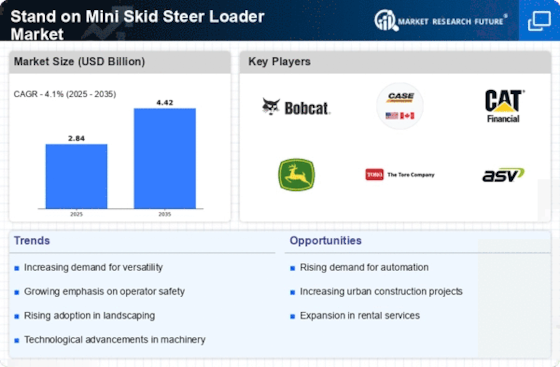
As per Market Research Future analysis, the Stand on Mini Skid Steer Loader Market Size was estimated at 2.839 USD Billion in 2024. The Stand on Mini Skid Steer Loader industry is projected to grow from 2.956 USD Billion in 2025 to 4.417 USD Billion by 2035, exhibiting a compound annual growth rate (CAGR) of 4.1% during the forecast period 2025 - 2035

Key Market Trends & Highlights

The Stand on Mini Skid Steer Loader Market is experiencing robust growth driven by technological advancements and increasing demand for versatile equipment.

  • North America remains the largest market for stand on mini skid steer loaders, driven by high construction activity and infrastructure projects. The Asia-Pacific region is emerging as the fastest-growing market, fueled by rapid urbanization and economic development. Wheeled skid steer loaders dominate the market, while tracked skid steer loaders are witnessing the fastest growth due to their enhanced stability and traction. Key market drivers include technological advancements and labor shortages, which are pushing the demand for more efficient and versatile machinery.

Market Size & Forecast

2024 Market Size 2.839 (USD Billion)
2035 Market Size 4.417 (USD Billion)
CAGR (2025 - 2035) 4.1%
Largest Regional Market Share in 2024 Asia Pacific

Major Players

Bobcat Company (US), CASE Construction Equipment (US), Caterpillar Inc. (US), John Deere (US), Toro Company (US), ASV Holdings, Inc. (US), Ditch Witch (US), Vermeer Corporation (US), Takeuchi Manufacturing (JP)

Market Trends

The Stand on Mini Skid Steer Loader Market is currently experiencing a notable transformation, driven by advancements in technology and evolving consumer preferences. These compact machines are increasingly favored for their versatility and efficiency in various applications, including landscaping, construction, and agriculture. As urbanization continues to rise, the demand for equipment that can navigate tight spaces and perform multiple tasks is becoming more pronounced. This trend suggests a shift towards more innovative designs that enhance maneuverability and operator comfort, potentially leading to a broader adoption across different sectors. Moreover, sustainability concerns are influencing purchasing decisions within the Stand on Mini Skid Steer Loader Market. Manufacturers are likely focusing on developing eco-friendly models that reduce emissions and improve fuel efficiency. This shift not only aligns with global environmental goals but also appeals to a growing segment of environmentally conscious consumers. As the market evolves, it appears that the integration of smart technologies, such as telematics and automation, may further enhance operational efficiency and safety, indicating a promising future for this segment of the equipment industry.

Technological Advancements

The Stand on Mini Skid Steer Loader Market is witnessing a surge in technological innovations. Enhanced features such as telematics, automation, and improved hydraulic systems are becoming increasingly prevalent. These advancements not only boost productivity but also enhance safety and operator comfort, making these machines more appealing to a wider audience.

Sustainability Focus

There is a growing emphasis on sustainability within the Stand on Mini Skid Steer Loader Market. Manufacturers are likely prioritizing the development of eco-friendly models that minimize environmental impact. This trend reflects a broader societal shift towards greener practices, appealing to consumers who value sustainability in their purchasing decisions.

Increased Versatility

The demand for multifunctional equipment is rising in the Stand on Mini Skid Steer Loader Market. These machines are being designed to perform a variety of tasks, from excavation to material handling. This versatility allows operators to maximize efficiency and productivity, particularly in urban environments where space is limited.

Stand on Mini Skid Steer Loader Market Market Drivers

Labor Shortages

The Stand on Mini Skid Steer Loader Market is significantly impacted by ongoing labor shortages across various sectors. As skilled labor becomes increasingly scarce, businesses are turning to machinery to fill the gap and maintain productivity. Mini skid steer loaders, particularly stand-on models, are favored for their ease of use and reduced training requirements. This trend is particularly evident in construction and landscaping, where companies are investing in equipment that can be operated with minimal supervision. Market data indicates that the demand for stand-on mini skid steer loaders has surged by 20% in the last year alone, as firms seek to mitigate the effects of labor shortages. This reliance on machinery is likely to continue, driving further growth in the Stand on Mini Skid Steer Loader Market.

Sustainability Focus

The Stand on Mini Skid Steer Loader Market is increasingly influenced by a growing emphasis on sustainability and environmental responsibility. As regulations tighten and consumer preferences shift towards eco-friendly solutions, manufacturers are compelled to develop loaders that minimize emissions and fuel consumption. Electric and hybrid models are gaining traction, as they offer reduced carbon footprints compared to traditional diesel-powered machines. Market data indicates that the share of electric mini skid steer loaders is expected to increase by approximately 15% by 2027. This shift not only aligns with global sustainability goals but also appeals to contractors and businesses seeking to enhance their green credentials. Consequently, the focus on sustainability is likely to drive innovation and investment in the Stand on Mini Skid Steer Loader Market.

Increased Versatility

The Stand on Mini Skid Steer Loader Market is witnessing a notable trend towards increased versatility in equipment design. Modern mini skid steer loaders are being engineered to accommodate a wide range of attachments, enabling them to perform various tasks across different sectors, including construction, landscaping, and agriculture. This adaptability allows operators to switch between tasks seamlessly, thereby maximizing productivity and reducing downtime. Market analysis suggests that the demand for versatile loaders is expected to grow by 10% annually, as businesses seek multifunctional equipment to optimize their operations. The ability to customize loaders with specialized attachments not only enhances their utility but also positions them as essential tools in diverse applications, further propelling growth in the Stand on Mini Skid Steer Loader Market.

Technological Advancements

The Stand on Mini Skid Steer Loader Market is experiencing a surge in technological advancements that enhance operational efficiency and safety. Innovations such as advanced telematics, automated controls, and improved hydraulic systems are becoming increasingly prevalent. These technologies not only streamline operations but also reduce the skill gap required for effective machine handling. For instance, the integration of GPS and remote monitoring systems allows operators to track performance metrics in real-time, leading to better decision-making. As a result, the demand for technologically advanced mini skid steer loaders is likely to rise, with projections indicating a potential market growth rate of 5% annually over the next five years. This trend suggests that manufacturers who invest in R&D may gain a competitive edge in the Stand on Mini Skid Steer Loader Market.

Urbanization and Infrastructure Development

The Stand on Mini Skid Steer Loader Market is benefiting from rapid urbanization and ongoing infrastructure development projects. As cities expand and new construction projects emerge, the demand for compact and efficient machinery is on the rise. Mini skid steer loaders are particularly well-suited for urban environments due to their size and maneuverability, allowing them to operate in tight spaces where larger equipment cannot. Recent market assessments indicate that infrastructure spending is projected to increase by 8% annually, creating a favorable environment for the adoption of mini skid steer loaders. This trend suggests that as urbanization continues to accelerate, the Stand on Mini Skid Steer Loader Market will likely experience sustained growth, driven by the need for efficient construction solutions.

Market Segment Insights

By Type: Wheeled Skid Steer Loaders (Largest) vs. Tracked Skid Steer Loaders (Fastest-Growing)

<p>In the Stand on Mini Skid Steer Loader Market, the distribution of market share between Wheeled and Tracked Skid Steer Loaders reflects distinct preferences among users. Wheeled Skid Steer Loaders dominate the market due to their versatility and ease of maneuverability, particularly in urban environments and tight job sites where space is constrained. In contrast, Tracked Skid Steer Loaders are gaining traction, appealing to customers needing enhanced stability and traction on uneven terrains, such as construction sites and agricultural applications. The growth trends in this segment indicate a positive trajectory for both types of skid steer loaders. The increasing adoption of Wheeled Skid Steer Loaders is driven by their lower maintenance costs and operational efficiency, making them a favored choice for rental companies and contractors. Meanwhile, the surging demand for Tracked Skid Steer Loaders is attributed to advancements in technology that improve performance and safety, leading to their rise as the fastest-growing segment within the market, especially in sectors requiring robust machinery that can withstand diverse operating conditions.</p>

<p>Wheeled Skid Steer Loaders (Dominant) vs. Tracked Skid Steer Loaders (Emerging)</p>

<p>Wheeled Skid Steer Loaders stand as the dominant choice in the market, recognized for their high maneuverability, making them ideal for light- to medium-duty applications across various industries, including construction, landscaping, and maintenance. Their lightweight design contributes to lower fuel consumption and ease of transport, appealing to operators who require a balance between capability and efficiency. On the other hand, Tracked Skid Steer Loaders are emerging rapidly into segments that demand superior traction and stability, particularly in challenging terrains. These loaders are favored for heavy-duty tasks where soil conditions may hinder performance. Their robust build and advanced features cater to end-users looking for reliability and performance in rough environments, marking them as a growing force in the skid steer market.</p>

By Engine Power: 30 to 40 HP (Largest) vs. 40 to 50 HP (Fastest-Growing)

<p>The Stand on Mini Skid Steer Loader Market displays a notable market share distribution across different engine power segments, with the 30 to 40 HP category leading as the largest segment. This segment is particularly favored for its versatility and practicality in various applications ranging from landscaping to construction sites. Following closely is the 40 to 50 HP range, which, while smaller in overall market share, is rapidly gaining traction owing to its enhanced power capabilities and efficiency for heavier tasks.</p>

<p>30 to 40 HP (Dominant) vs. 40 to 50 HP (Emerging)</p>

<p>The 30 to 40 HP segment stands out as the dominant force in the Stand on Mini Skid Steer Loader Market, appealing to a broad user base seeking a balance between power and maneuverability. This range offers intuitive controls and a reliable performance for diverse applications, making it an attractive choice for operators. In contrast, the 40 to 50 HP segment is emerging rapidly due to the growing demand for higher performance machines that can handle more intensive workloads. With robust designs and advanced technology, these models are becoming increasingly popular among contractors and businesses looking to improve productivity in more demanding environments.</p>

By Application: Construction (Largest) vs. Agriculture & Forestry (Fastest-Growing)

<p>In the Stand on Mini Skid Steer Loader Market, the application segment is diversified into Construction, Agriculture & Forestry, Ground Maintenance, and Others. The Construction sector dominates this market, accounting for a significant portion of the total application share due to the increasing demand for earthmoving and material handling. Agriculture & Forestry, while smaller currently, showcases a rising trend as more agricultural operations recognize the utility of mini skid steer loaders for tasks such as material transportation and land preparation.</p>

<p>Construction: Dominant vs. Agriculture & Forestry: Emerging</p>

<p>The Construction sector stands as the dominant force in the application segment of the Stand on Mini Skid Steer Loader Market, driven by continuous investments in infrastructure development and urbanization. With a focus on improving efficiency, construction projects increasingly utilize these compact machines for their versatility and maneuverability in tight spaces. Conversely, Agriculture & Forestry are emerging segments, leveraging mini skid steer loaders for tasks like hauling materials and managing landscapes. This growth is largely influenced by rising mechanization and labor shortages in agricultural operations, prompting farmers and forestry operators to adopt these machines for enhanced productivity.</p>

Stand on Mini Skid Steer Loader Market Application Insights

The Application segment of the Stand on Mini Skid Steer Loader Market size includes Construction, Agriculture &amp; Forestry, Ground Maintenance, and Others. The Construction segment dominated the market in 2021 and is projected to be the fastest-growing segment during the forecast period 2022-2030. Stand-on mini skid steer loaders are becoming increasingly popular in the construction industry due to their compact size, versatility, and ability to access tight spaces. These machines are small enough to fit through narrow doorways and tight hallways, making them ideal for indoor construction and renovation projects.

One of the major benefits of stand-on mini skid steer loaders is their ability to manage a wide range of tasks. They can be used for digging, grading, hauling, and even demolition work with the right attachments. Another advantage of stand-on mini skid steer loaders is their maneuverability. They have a zero-turn radius, allowing them to easily navigate around obstacles and tight corners. They are also equipped with tracks or tires that provide excellent traction on a variety of surfaces, including mud, gravel, and concrete.

Similarly, Sandvik Mining and Rock Solutions declared that it had introduced AutoMine AutoLoad 2.0 in June 2023 for loaders with fixed draw point and dump point mining applications for full automation production cycles. Hence, these technological advancements represent the key market opportunity for loaders.

Get more detailed insights about Stand on Mini Skid Steer Loader Market Research Report—Global Forecast till 2035

Regional Insights

North America : Market Leader in Innovation

North America is the largest market for stand on mini skid steer loaders, accounting for approximately 45% of the global market share. The region's growth is driven by increasing demand for compact construction equipment, particularly in urban areas where space is limited. Regulatory support for infrastructure development and construction projects further fuels this demand, making it a key player in the market. The United States is the leading country in this sector, with major players like Bobcat Company, CASE Construction Equipment, and Caterpillar Inc. dominating the landscape. The competitive environment is characterized by continuous innovation and technological advancements, ensuring that these companies maintain their market leadership. The presence of a robust distribution network also enhances market accessibility for consumers.

Europe : Emerging Market with Potential

Europe is witnessing a growing demand for stand on mini skid steer loaders, driven by an expanding construction sector and increasing urbanization. The region holds approximately 30% of the global market share, with countries like Germany and the UK leading the charge. Regulatory initiatives aimed at promoting sustainable construction practices are also contributing to market growth, as companies seek to comply with environmental standards. Germany stands out as a key player in the European market, with a strong presence of manufacturers and suppliers. The competitive landscape is marked by both established companies and new entrants, fostering innovation and diversity in product offerings. The presence of major players like Caterpillar and John Deere further solidifies the region's market position.

Asia-Pacific : Rapid Growth and Urbanization

Asia-Pacific is rapidly emerging as a significant market for stand on mini skid steer loaders, driven by urbanization and infrastructure development. The region holds about 20% of the global market share, with countries like China and India leading in demand. Government initiatives to enhance infrastructure and construction capabilities are key growth drivers, alongside increasing investments in urban development projects. China is the largest market in the region, with a growing number of local manufacturers entering the market. The competitive landscape is evolving, with both domestic and international players vying for market share. Companies like Takeuchi Manufacturing are expanding their presence, contributing to the region's dynamic market environment.

Middle East and Africa : Untapped Market Potential

The Middle East and Africa region is characterized by untapped potential in the stand on mini skid steer loader market, holding approximately 5% of the global market share. The growth is primarily driven by increasing investments in infrastructure and construction projects, particularly in countries like the UAE and South Africa. Regulatory frameworks supporting construction activities are also emerging, providing a conducive environment for market expansion. The competitive landscape is still developing, with a mix of local and international players. Companies are increasingly focusing on adapting their products to meet regional needs, which presents opportunities for growth. The presence of key players like Vermeer Corporation and Ditch Witch is expected to enhance market dynamics in the coming years.

Key Players and Competitive Insights

With a strong presence across different verticals and geographies, the Stand on Mini Skid Steer Loader Market is highly competitive and dominated by established, pure-play vendors. Over significant vendors cater to this market, and they continually innovate their solutions to meet the evolving needs of businesses by adopting innovative technologies. These vendors have a robust geographic footprint and partner ecosystem to cater to diverse customer segments. The Stand on Mini Skid Steer Loader Market is highly competitive, with many vendors offering related products and services. The major players in the market include Kubota Corporation, Bobcat Company, Wacker Neuson Se, The Toro Company, among others. The Stand on Mini Skid Steer Loader Market is a consolidated market due to increasing competition, acquisitions, mergers and other strategic market developments and decisions to improve operational effectiveness.

Key Companies in the Stand on Mini Skid Steer Loader Market include

Industry Developments

In January 2023, New Holland Agriculture, a brand of global capital goods company, collaborated with CNH Industrial, has reached beyond its core farming audience to show the wider world what the farm equipment manufacturer is doing in terms of innovation and technology.

In February 2023, Bobcat Partnership with Agtonomy to advance productivity in the agriculture industry through collaboration in the areas of electrification, autonomous operation, and digital technology.

In April 2019, The Toro Company acquired The Charles Machine Works, Inc., an Oklahoma corporation, and the parent company of Ditch Witch.

In February 2020, Kanga Loaders has expanded their business to the United States, with a product launch at the American Rental Association Show.

In March 2020, Vermeer corporation entered into an agreement with Vacuum X-Traction Products Inc. (VXP). Vacuum X-Traction Products Inc. (VXP) will supply vacuum excavators to Vermeer Corporation for distribution.

Future Outlook

Stand on Mini Skid Steer Loader Market Future Outlook

The Stand on Mini Skid Steer Loader Market is projected to grow at a 4.1% CAGR from 2025 to 2035, driven by urbanization, technological advancements, and increased demand for compact machinery.

New opportunities lie in:

  • <p>Expansion into emerging markets with tailored financing options. Development of electric mini skid steer loaders for sustainability. Integration of IoT technology for fleet management and efficiency.</p>

By 2035, the market is expected to solidify its position as a key player in construction and landscaping.

Market Segmentation

Stand on Mini Skid Steer Loader Market Type Outlook

  • Wheeled Skid Steer Loaders
  • Tracked Skid Steer Loaders

Stand on Mini Skid Steer Loader Market Application Outlook

  • Construction
  • Agriculture & Forestry
  • Ground Maintenance
  • Others

Stand on Mini Skid Steer Loader Market Engine Power Outlook

  • Up to 30 HP
  • 30 to 40 HP
  • 40 to 50 HP

Report Scope

MARKET SIZE 2024 2.839(USD Billion)
MARKET SIZE 2025 2.956(USD Billion)
MARKET SIZE 2035 4.417(USD Billion)
COMPOUND ANNUAL GROWTH RATE (CAGR) 4.1% (2025 - 2035)
REPORT COVERAGE Revenue Forecast, Competitive Landscape, Growth Factors, and Trends
BASE YEAR 2024
Market Forecast Period 2025 - 2035
Historical Data 2019 - 2024
Market Forecast Units USD Billion
Key Companies Profiled Bobcat Company (US), CASE Construction Equipment (US), Caterpillar Inc. (US), John Deere (US), Toro Company (US), ASV Holdings, Inc. (US), Ditch Witch (US), Vermeer Corporation (US), Takeuchi Manufacturing (JP)
Segments Covered Type, Engine Power, Application, Region
Key Market Opportunities Growing demand for compact equipment in urban construction drives innovation in the Stand on Mini Skid Steer Loader Market.
Key Market Dynamics Rising demand for compact equipment drives innovation and competition in the Stand on Mini Skid Steer Loader market.
Countries Covered North America, Europe, APAC, South America, MEA

FAQs

What is the projected market valuation for the Stand on Mini Skid Steer Loader Market in 2035?

<p>The projected market valuation for the Stand on Mini Skid Steer Loader Market in 2035 is 4.417 USD Billion.</p>

What was the market valuation for the Stand on Mini Skid Steer Loader Market in 2024?

<p>The market valuation for the Stand on Mini Skid Steer Loader Market in 2024 was 2.839 USD Billion.</p>

What is the expected CAGR for the Stand on Mini Skid Steer Loader Market during the forecast period 2025 - 2035?

<p>The expected CAGR for the Stand on Mini Skid Steer Loader Market during the forecast period 2025 - 2035 is 4.1%.</p>

Which companies are considered key players in the Stand on Mini Skid Steer Loader Market?

<p>Key players in the Stand on Mini Skid Steer Loader Market include Bobcat Company, CASE Construction Equipment, Caterpillar Inc., and John Deere.</p>

What are the projected revenues for Wheeled and Tracked Skid Steer Loaders by 2035?

<p>By 2035, the projected revenue for Wheeled Skid Steer Loaders is 2.1865 USD Billion, while Tracked Skid Steer Loaders is 2.2305 USD Billion.</p>

How does the engine power segment perform in the Stand on Mini Skid Steer Loader Market?

<p>The engine power segment shows projected revenues of 0.95 USD Billion for up to 30 HP, 1.2 USD Billion for 30 to 40 HP, and 1.267 USD Billion for 40 to 50 HP by 2035.</p>

What applications are driving growth in the Stand on Mini Skid Steer Loader Market?

<p>The applications driving growth include Construction, with projected revenues of 2.174 USD Billion, and Agriculture & Forestry, with 1.308 USD Billion by 2035.</p>

What was the revenue for the Ground Maintenance application in 2024?

<p>The revenue for the Ground Maintenance application in 2024 was 0.568 USD Billion.</p>

What is the potential for the Others segment in the Stand on Mini Skid Steer Loader Market?

<p>The Others segment shows potential growth, with projected revenues increasing from 0.001 USD Billion in 2024 to 0.052 USD Billion by 2035.</p>

How do the revenues of different engine power categories compare in the Stand on Mini Skid Steer Loader Market?

<p>In 2024, the revenues for engine power categories were 0.85 USD Billion for up to 30 HP, 0.95 USD Billion for 30 to 40 HP, and 1.039 USD Billion for 40 to 50 HP.</p>

  1. SECTION I: EXECUTIVE SUMMARY AND KEY HIGHLIGHTS
    1. | 1.1 EXECUTIVE SUMMARY
    2. | | 1.1.1 Market Overview
    3. | | 1.1.2 Key Findings
    4. | | 1.1.3 Market Segmentation
    5. | | 1.1.4 Competitive Landscape
    6. | | 1.1.5 Challenges and Opportunities
    7. | | 1.1.6 Future Outlook
  2. SECTION II: SCOPING, METHODOLOGY AND MARKET STRUCTURE
    1. | 2.1 MARKET INTRODUCTION
    2. | | 2.1.1 Definition
    3. | | 2.1.2 Scope of the study
    4. | | | 2.1.2.1 Research Objective
    5. | | | 2.1.2.2 Assumption
    6. | | | 2.1.2.3 Limitations
    7. | 2.2 RESEARCH METHODOLOGY
    8. | | 2.2.1 Overview
    9. | | 2.2.2 Data Mining
    10. | | 2.2.3 Secondary Research
    11. | | 2.2.4 Primary Research
    12. | | | 2.2.4.1 Primary Interviews and Information Gathering Process
    13. | | | 2.2.4.2 Breakdown of Primary Respondents
    14. | | 2.2.5 Forecasting Model
    15. | | 2.2.6 Market Size Estimation
    16. | | | 2.2.6.1 Bottom-Up Approach
    17. | | | 2.2.6.2 Top-Down Approach
    18. | | 2.2.7 Data Triangulation
    19. | | 2.2.8 Validation
  3. SECTION III: QUALITATIVE ANALYSIS
    1. | 3.1 MARKET DYNAMICS
    2. | | 3.1.1 Overview
    3. | | 3.1.2 Drivers
    4. | | 3.1.3 Restraints
    5. | | 3.1.4 Opportunities
    6. | 3.2 MARKET FACTOR ANALYSIS
    7. | | 3.2.1 Value chain Analysis
    8. | | 3.2.2 Porter's Five Forces Analysis
    9. | | | 3.2.2.1 Bargaining Power of Suppliers
    10. | | | 3.2.2.2 Bargaining Power of Buyers
    11. | | | 3.2.2.3 Threat of New Entrants
    12. | | | 3.2.2.4 Threat of Substitutes
    13. | | | 3.2.2.5 Intensity of Rivalry
    14. | | 3.2.3 COVID-19 Impact Analysis
    15. | | | 3.2.3.1 Market Impact Analysis
    16. | | | 3.2.3.2 Regional Impact
    17. | | | 3.2.3.3 Opportunity and Threat Analysis
  4. SECTION IV: QUANTITATIVE ANALYSIS
    1. | 4.1 Packaging & Transport, BY Type (USD Billion)
    2. | | 4.1.1 Wheeled Skid Steer Loaders
    3. | | 4.1.2 Tracked Skid Steer Loaders
    4. | 4.2 Packaging & Transport, BY Engine Power (USD Billion)
    5. | | 4.2.1 Up to 30 HP
    6. | | 4.2.2 30 to 40 HP
    7. | | 4.2.3 40 to 50 HP
    8. | 4.3 Packaging & Transport, BY Application (USD Billion)
    9. | | 4.3.1 Construction
    10. | | 4.3.2 Agriculture & Forestry
    11. | | 4.3.3 Ground Maintenance
    12. | | 4.3.4 Others
    13. | 4.4 Packaging & Transport, BY Region (USD Billion)
    14. | | 4.4.1 North America
    15. | | | 4.4.1.1 US
    16. | | | 4.4.1.2 Canada
    17. | | 4.4.2 Europe
    18. | | | 4.4.2.1 Germany
    19. | | | 4.4.2.2 UK
    20. | | | 4.4.2.3 France
    21. | | | 4.4.2.4 Russia
    22. | | | 4.4.2.5 Italy
    23. | | | 4.4.2.6 Spain
    24. | | | 4.4.2.7 Rest of Europe
    25. | | 4.4.3 APAC
    26. | | | 4.4.3.1 China
    27. | | | 4.4.3.2 India
    28. | | | 4.4.3.3 Japan
    29. | | | 4.4.3.4 South Korea
    30. | | | 4.4.3.5 Malaysia
    31. | | | 4.4.3.6 Thailand
    32. | | | 4.4.3.7 Indonesia
    33. | | | 4.4.3.8 Rest of APAC
    34. | | 4.4.4 South America
    35. | | | 4.4.4.1 Brazil
    36. | | | 4.4.4.2 Mexico
    37. | | | 4.4.4.3 Argentina
    38. | | | 4.4.4.4 Rest of South America
    39. | | 4.4.5 MEA
    40. | | | 4.4.5.1 GCC Countries
    41. | | | 4.4.5.2 South Africa
    42. | | | 4.4.5.3 Rest of MEA
  5. SECTION V: COMPETITIVE ANALYSIS
    1. | 5.1 Competitive Landscape
    2. | | 5.1.1 Overview
    3. | | 5.1.2 Competitive Analysis
    4. | | 5.1.3 Market share Analysis
    5. | | 5.1.4 Major Growth Strategy in the Packaging & Transport
    6. | | 5.1.5 Competitive Benchmarking
    7. | | 5.1.6 Leading Players in Terms of Number of Developments in the Packaging & Transport
    8. | | 5.1.7 Key developments and growth strategies
    9. | | | 5.1.7.1 New Product Launch/Service Deployment
    10. | | | 5.1.7.2 Merger & Acquisitions
    11. | | | 5.1.7.3 Joint Ventures
    12. | | 5.1.8 Major Players Financial Matrix
    13. | | | 5.1.8.1 Sales and Operating Income
    14. | | | 5.1.8.2 Major Players R&D Expenditure. 2023
    15. | 5.2 Company Profiles
    16. | | 5.2.1 Bobcat Company (US)
    17. | | | 5.2.1.1 Financial Overview
    18. | | | 5.2.1.2 Products Offered
    19. | | | 5.2.1.3 Key Developments
    20. | | | 5.2.1.4 SWOT Analysis
    21. | | | 5.2.1.5 Key Strategies
    22. | | 5.2.2 CASE Construction Equipment (US)
    23. | | | 5.2.2.1 Financial Overview
    24. | | | 5.2.2.2 Products Offered
    25. | | | 5.2.2.3 Key Developments
    26. | | | 5.2.2.4 SWOT Analysis
    27. | | | 5.2.2.5 Key Strategies
    28. | | 5.2.3 Caterpillar Inc. (US)
    29. | | | 5.2.3.1 Financial Overview
    30. | | | 5.2.3.2 Products Offered
    31. | | | 5.2.3.3 Key Developments
    32. | | | 5.2.3.4 SWOT Analysis
    33. | | | 5.2.3.5 Key Strategies
    34. | | 5.2.4 John Deere (US)
    35. | | | 5.2.4.1 Financial Overview
    36. | | | 5.2.4.2 Products Offered
    37. | | | 5.2.4.3 Key Developments
    38. | | | 5.2.4.4 SWOT Analysis
    39. | | | 5.2.4.5 Key Strategies
    40. | | 5.2.5 Toro Company (US)
    41. | | | 5.2.5.1 Financial Overview
    42. | | | 5.2.5.2 Products Offered
    43. | | | 5.2.5.3 Key Developments
    44. | | | 5.2.5.4 SWOT Analysis
    45. | | | 5.2.5.5 Key Strategies
    46. | | 5.2.6 ASV Holdings, Inc. (US)
    47. | | | 5.2.6.1 Financial Overview
    48. | | | 5.2.6.2 Products Offered
    49. | | | 5.2.6.3 Key Developments
    50. | | | 5.2.6.4 SWOT Analysis
    51. | | | 5.2.6.5 Key Strategies
    52. | | 5.2.7 Ditch Witch (US)
    53. | | | 5.2.7.1 Financial Overview
    54. | | | 5.2.7.2 Products Offered
    55. | | | 5.2.7.3 Key Developments
    56. | | | 5.2.7.4 SWOT Analysis
    57. | | | 5.2.7.5 Key Strategies
    58. | | 5.2.8 Vermeer Corporation (US)
    59. | | | 5.2.8.1 Financial Overview
    60. | | | 5.2.8.2 Products Offered
    61. | | | 5.2.8.3 Key Developments
    62. | | | 5.2.8.4 SWOT Analysis
    63. | | | 5.2.8.5 Key Strategies
    64. | | 5.2.9 Takeuchi Manufacturing (JP)
    65. | | | 5.2.9.1 Financial Overview
    66. | | | 5.2.9.2 Products Offered
    67. | | | 5.2.9.3 Key Developments
    68. | | | 5.2.9.4 SWOT Analysis
    69. | | | 5.2.9.5 Key Strategies
    70. | 5.3 Appendix
    71. | | 5.3.1 References
    72. | | 5.3.2 Related Reports
  6. LIST OF FIGURES
    1. | 6.1 MARKET SYNOPSIS
    2. | 6.2 NORTH AMERICA MARKET ANALYSIS
    3. | 6.3 US MARKET ANALYSIS BY TYPE
    4. | 6.4 US MARKET ANALYSIS BY ENGINE POWER
    5. | 6.5 US MARKET ANALYSIS BY APPLICATION
    6. | 6.6 CANADA MARKET ANALYSIS BY TYPE
    7. | 6.7 CANADA MARKET ANALYSIS BY ENGINE POWER
    8. | 6.8 CANADA MARKET ANALYSIS BY APPLICATION
    9. | 6.9 EUROPE MARKET ANALYSIS
    10. | 6.10 GERMANY MARKET ANALYSIS BY TYPE
    11. | 6.11 GERMANY MARKET ANALYSIS BY ENGINE POWER
    12. | 6.12 GERMANY MARKET ANALYSIS BY APPLICATION
    13. | 6.13 UK MARKET ANALYSIS BY TYPE
    14. | 6.14 UK MARKET ANALYSIS BY ENGINE POWER
    15. | 6.15 UK MARKET ANALYSIS BY APPLICATION
    16. | 6.16 FRANCE MARKET ANALYSIS BY TYPE
    17. | 6.17 FRANCE MARKET ANALYSIS BY ENGINE POWER
    18. | 6.18 FRANCE MARKET ANALYSIS BY APPLICATION
    19. | 6.19 RUSSIA MARKET ANALYSIS BY TYPE
    20. | 6.20 RUSSIA MARKET ANALYSIS BY ENGINE POWER
    21. | 6.21 RUSSIA MARKET ANALYSIS BY APPLICATION
    22. | 6.22 ITALY MARKET ANALYSIS BY TYPE
    23. | 6.23 ITALY MARKET ANALYSIS BY ENGINE POWER
    24. | 6.24 ITALY MARKET ANALYSIS BY APPLICATION
    25. | 6.25 SPAIN MARKET ANALYSIS BY TYPE
    26. | 6.26 SPAIN MARKET ANALYSIS BY ENGINE POWER
    27. | 6.27 SPAIN MARKET ANALYSIS BY APPLICATION
    28. | 6.28 REST OF EUROPE MARKET ANALYSIS BY TYPE
    29. | 6.29 REST OF EUROPE MARKET ANALYSIS BY ENGINE POWER
    30. | 6.30 REST OF EUROPE MARKET ANALYSIS BY APPLICATION
    31. | 6.31 APAC MARKET ANALYSIS
    32. | 6.32 CHINA MARKET ANALYSIS BY TYPE
    33. | 6.33 CHINA MARKET ANALYSIS BY ENGINE POWER
    34. | 6.34 CHINA MARKET ANALYSIS BY APPLICATION
    35. | 6.35 INDIA MARKET ANALYSIS BY TYPE
    36. | 6.36 INDIA MARKET ANALYSIS BY ENGINE POWER
    37. | 6.37 INDIA MARKET ANALYSIS BY APPLICATION
    38. | 6.38 JAPAN MARKET ANALYSIS BY TYPE
    39. | 6.39 JAPAN MARKET ANALYSIS BY ENGINE POWER
    40. | 6.40 JAPAN MARKET ANALYSIS BY APPLICATION
    41. | 6.41 SOUTH KOREA MARKET ANALYSIS BY TYPE
    42. | 6.42 SOUTH KOREA MARKET ANALYSIS BY ENGINE POWER
    43. | 6.43 SOUTH KOREA MARKET ANALYSIS BY APPLICATION
    44. | 6.44 MALAYSIA MARKET ANALYSIS BY TYPE
    45. | 6.45 MALAYSIA MARKET ANALYSIS BY ENGINE POWER
    46. | 6.46 MALAYSIA MARKET ANALYSIS BY APPLICATION
    47. | 6.47 THAILAND MARKET ANALYSIS BY TYPE
    48. | 6.48 THAILAND MARKET ANALYSIS BY ENGINE POWER
    49. | 6.49 THAILAND MARKET ANALYSIS BY APPLICATION
    50. | 6.50 INDONESIA MARKET ANALYSIS BY TYPE
    51. | 6.51 INDONESIA MARKET ANALYSIS BY ENGINE POWER
    52. | 6.52 INDONESIA MARKET ANALYSIS BY APPLICATION
    53. | 6.53 REST OF APAC MARKET ANALYSIS BY TYPE
    54. | 6.54 REST OF APAC MARKET ANALYSIS BY ENGINE POWER
    55. | 6.55 REST OF APAC MARKET ANALYSIS BY APPLICATION
    56. | 6.56 SOUTH AMERICA MARKET ANALYSIS
    57. | 6.57 BRAZIL MARKET ANALYSIS BY TYPE
    58. | 6.58 BRAZIL MARKET ANALYSIS BY ENGINE POWER
    59. | 6.59 BRAZIL MARKET ANALYSIS BY APPLICATION
    60. | 6.60 MEXICO MARKET ANALYSIS BY TYPE
    61. | 6.61 MEXICO MARKET ANALYSIS BY ENGINE POWER
    62. | 6.62 MEXICO MARKET ANALYSIS BY APPLICATION
    63. | 6.63 ARGENTINA MARKET ANALYSIS BY TYPE
    64. | 6.64 ARGENTINA MARKET ANALYSIS BY ENGINE POWER
    65. | 6.65 ARGENTINA MARKET ANALYSIS BY APPLICATION
    66. | 6.66 REST OF SOUTH AMERICA MARKET ANALYSIS BY TYPE
    67. | 6.67 REST OF SOUTH AMERICA MARKET ANALYSIS BY ENGINE POWER
    68. | 6.68 REST OF SOUTH AMERICA MARKET ANALYSIS BY APPLICATION
    69. | 6.69 MEA MARKET ANALYSIS
    70. | 6.70 GCC COUNTRIES MARKET ANALYSIS BY TYPE
    71. | 6.71 GCC COUNTRIES MARKET ANALYSIS BY ENGINE POWER
    72. | 6.72 GCC COUNTRIES MARKET ANALYSIS BY APPLICATION
    73. | 6.73 SOUTH AFRICA MARKET ANALYSIS BY TYPE
    74. | 6.74 SOUTH AFRICA MARKET ANALYSIS BY ENGINE POWER
    75. | 6.75 SOUTH AFRICA MARKET ANALYSIS BY APPLICATION
    76. | 6.76 REST OF MEA MARKET ANALYSIS BY TYPE
    77. | 6.77 REST OF MEA MARKET ANALYSIS BY ENGINE POWER
    78. | 6.78 REST OF MEA MARKET ANALYSIS BY APPLICATION
    79. | 6.79 KEY BUYING CRITERIA OF PACKAGING & TRANSPORT
    80. | 6.80 RESEARCH PROCESS OF MRFR
    81. | 6.81 DRO ANALYSIS OF PACKAGING & TRANSPORT
    82. | 6.82 DRIVERS IMPACT ANALYSIS: PACKAGING & TRANSPORT
    83. | 6.83 RESTRAINTS IMPACT ANALYSIS: PACKAGING & TRANSPORT
    84. | 6.84 SUPPLY / VALUE CHAIN: PACKAGING & TRANSPORT
    85. | 6.85 PACKAGING & TRANSPORT, BY TYPE, 2024 (% SHARE)
    86. | 6.86 PACKAGING & TRANSPORT, BY TYPE, 2024 TO 2035 (USD Billion)
    87. | 6.87 PACKAGING & TRANSPORT, BY ENGINE POWER, 2024 (% SHARE)
    88. | 6.88 PACKAGING & TRANSPORT, BY ENGINE POWER, 2024 TO 2035 (USD Billion)
    89. | 6.89 PACKAGING & TRANSPORT, BY APPLICATION, 2024 (% SHARE)
    90. | 6.90 PACKAGING & TRANSPORT, BY APPLICATION, 2024 TO 2035 (USD Billion)
    91. | 6.91 BENCHMARKING OF MAJOR COMPETITORS
  7. LIST OF TABLES
    1. | 7.1 LIST OF ASSUMPTIONS
    2. | | 7.1.1
    3. | 7.2 North America MARKET SIZE ESTIMATES; FORECAST
    4. | | 7.2.1 BY TYPE, 2025-2035 (USD Billion)
    5. | | 7.2.2 BY ENGINE POWER, 2025-2035 (USD Billion)
    6. | | 7.2.3 BY APPLICATION, 2025-2035 (USD Billion)
    7. | 7.3 US MARKET SIZE ESTIMATES; FORECAST
    8. | | 7.3.1 BY TYPE, 2025-2035 (USD Billion)
    9. | | 7.3.2 BY ENGINE POWER, 2025-2035 (USD Billion)
    10. | | 7.3.3 BY APPLICATION, 2025-2035 (USD Billion)
    11. | 7.4 Canada MARKET SIZE ESTIMATES; FORECAST
    12. | | 7.4.1 BY TYPE, 2025-2035 (USD Billion)
    13. | | 7.4.2 BY ENGINE POWER, 2025-2035 (USD Billion)
    14. | | 7.4.3 BY APPLICATION, 2025-2035 (USD Billion)
    15. | 7.5 Europe MARKET SIZE ESTIMATES; FORECAST
    16. | | 7.5.1 BY TYPE, 2025-2035 (USD Billion)
    17. | | 7.5.2 BY ENGINE POWER, 2025-2035 (USD Billion)
    18. | | 7.5.3 BY APPLICATION, 2025-2035 (USD Billion)
    19. | 7.6 Germany MARKET SIZE ESTIMATES; FORECAST
    20. | | 7.6.1 BY TYPE, 2025-2035 (USD Billion)
    21. | | 7.6.2 BY ENGINE POWER, 2025-2035 (USD Billion)
    22. | | 7.6.3 BY APPLICATION, 2025-2035 (USD Billion)
    23. | 7.7 UK MARKET SIZE ESTIMATES; FORECAST
    24. | | 7.7.1 BY TYPE, 2025-2035 (USD Billion)
    25. | | 7.7.2 BY ENGINE POWER, 2025-2035 (USD Billion)
    26. | | 7.7.3 BY APPLICATION, 2025-2035 (USD Billion)
    27. | 7.8 France MARKET SIZE ESTIMATES; FORECAST
    28. | | 7.8.1 BY TYPE, 2025-2035 (USD Billion)
    29. | | 7.8.2 BY ENGINE POWER, 2025-2035 (USD Billion)
    30. | | 7.8.3 BY APPLICATION, 2025-2035 (USD Billion)
    31. | 7.9 Russia MARKET SIZE ESTIMATES; FORECAST
    32. | | 7.9.1 BY TYPE, 2025-2035 (USD Billion)
    33. | | 7.9.2 BY ENGINE POWER, 2025-2035 (USD Billion)
    34. | | 7.9.3 BY APPLICATION, 2025-2035 (USD Billion)
    35. | 7.10 Italy MARKET SIZE ESTIMATES; FORECAST
    36. | | 7.10.1 BY TYPE, 2025-2035 (USD Billion)
    37. | | 7.10.2 BY ENGINE POWER, 2025-2035 (USD Billion)
    38. | | 7.10.3 BY APPLICATION, 2025-2035 (USD Billion)
    39. | 7.11 Spain MARKET SIZE ESTIMATES; FORECAST
    40. | | 7.11.1 BY TYPE, 2025-2035 (USD Billion)
    41. | | 7.11.2 BY ENGINE POWER, 2025-2035 (USD Billion)
    42. | | 7.11.3 BY APPLICATION, 2025-2035 (USD Billion)
    43. | 7.12 Rest of Europe MARKET SIZE ESTIMATES; FORECAST
    44. | | 7.12.1 BY TYPE, 2025-2035 (USD Billion)
    45. | | 7.12.2 BY ENGINE POWER, 2025-2035 (USD Billion)
    46. | | 7.12.3 BY APPLICATION, 2025-2035 (USD Billion)
    47. | 7.13 APAC MARKET SIZE ESTIMATES; FORECAST
    48. | | 7.13.1 BY TYPE, 2025-2035 (USD Billion)
    49. | | 7.13.2 BY ENGINE POWER, 2025-2035 (USD Billion)
    50. | | 7.13.3 BY APPLICATION, 2025-2035 (USD Billion)
    51. | 7.14 China MARKET SIZE ESTIMATES; FORECAST
    52. | | 7.14.1 BY TYPE, 2025-2035 (USD Billion)
    53. | | 7.14.2 BY ENGINE POWER, 2025-2035 (USD Billion)
    54. | | 7.14.3 BY APPLICATION, 2025-2035 (USD Billion)
    55. | 7.15 India MARKET SIZE ESTIMATES; FORECAST
    56. | | 7.15.1 BY TYPE, 2025-2035 (USD Billion)
    57. | | 7.15.2 BY ENGINE POWER, 2025-2035 (USD Billion)
    58. | | 7.15.3 BY APPLICATION, 2025-2035 (USD Billion)
    59. | 7.16 Japan MARKET SIZE ESTIMATES; FORECAST
    60. | | 7.16.1 BY TYPE, 2025-2035 (USD Billion)
    61. | | 7.16.2 BY ENGINE POWER, 2025-2035 (USD Billion)
    62. | | 7.16.3 BY APPLICATION, 2025-2035 (USD Billion)
    63. | 7.17 South Korea MARKET SIZE ESTIMATES; FORECAST
    64. | | 7.17.1 BY TYPE, 2025-2035 (USD Billion)
    65. | | 7.17.2 BY ENGINE POWER, 2025-2035 (USD Billion)
    66. | | 7.17.3 BY APPLICATION, 2025-2035 (USD Billion)
    67. | 7.18 Malaysia MARKET SIZE ESTIMATES; FORECAST
    68. | | 7.18.1 BY TYPE, 2025-2035 (USD Billion)
    69. | | 7.18.2 BY ENGINE POWER, 2025-2035 (USD Billion)
    70. | | 7.18.3 BY APPLICATION, 2025-2035 (USD Billion)
    71. | 7.19 Thailand MARKET SIZE ESTIMATES; FORECAST
    72. | | 7.19.1 BY TYPE, 2025-2035 (USD Billion)
    73. | | 7.19.2 BY ENGINE POWER, 2025-2035 (USD Billion)
    74. | | 7.19.3 BY APPLICATION, 2025-2035 (USD Billion)
    75. | 7.20 Indonesia MARKET SIZE ESTIMATES; FORECAST
    76. | | 7.20.1 BY TYPE, 2025-2035 (USD Billion)
    77. | | 7.20.2 BY ENGINE POWER, 2025-2035 (USD Billion)
    78. | | 7.20.3 BY APPLICATION, 2025-2035 (USD Billion)
    79. | 7.21 Rest of APAC MARKET SIZE ESTIMATES; FORECAST
    80. | | 7.21.1 BY TYPE, 2025-2035 (USD Billion)
    81. | | 7.21.2 BY ENGINE POWER, 2025-2035 (USD Billion)
    82. | | 7.21.3 BY APPLICATION, 2025-2035 (USD Billion)
    83. | 7.22 South America MARKET SIZE ESTIMATES; FORECAST
    84. | | 7.22.1 BY TYPE, 2025-2035 (USD Billion)
    85. | | 7.22.2 BY ENGINE POWER, 2025-2035 (USD Billion)
    86. | | 7.22.3 BY APPLICATION, 2025-2035 (USD Billion)
    87. | 7.23 Brazil MARKET SIZE ESTIMATES; FORECAST
    88. | | 7.23.1 BY TYPE, 2025-2035 (USD Billion)
    89. | | 7.23.2 BY ENGINE POWER, 2025-2035 (USD Billion)
    90. | | 7.23.3 BY APPLICATION, 2025-2035 (USD Billion)
    91. | 7.24 Mexico MARKET SIZE ESTIMATES; FORECAST
    92. | | 7.24.1 BY TYPE, 2025-2035 (USD Billion)
    93. | | 7.24.2 BY ENGINE POWER, 2025-2035 (USD Billion)
    94. | | 7.24.3 BY APPLICATION, 2025-2035 (USD Billion)
    95. | 7.25 Argentina MARKET SIZE ESTIMATES; FORECAST
    96. | | 7.25.1 BY TYPE, 2025-2035 (USD Billion)
    97. | | 7.25.2 BY ENGINE POWER, 2025-2035 (USD Billion)
    98. | | 7.25.3 BY APPLICATION, 2025-2035 (USD Billion)
    99. | 7.26 Rest of South America MARKET SIZE ESTIMATES; FORECAST
    100. | | 7.26.1 BY TYPE, 2025-2035 (USD Billion)
    101. | | 7.26.2 BY ENGINE POWER, 2025-2035 (USD Billion)
    102. | | 7.26.3 BY APPLICATION, 2025-2035 (USD Billion)
    103. | 7.27 MEA MARKET SIZE ESTIMATES; FORECAST
    104. | | 7.27.1 BY TYPE, 2025-2035 (USD Billion)
    105. | | 7.27.2 BY ENGINE POWER, 2025-2035 (USD Billion)
    106. | | 7.27.3 BY APPLICATION, 2025-2035 (USD Billion)
    107. | 7.28 GCC Countries MARKET SIZE ESTIMATES; FORECAST
    108. | | 7.28.1 BY TYPE, 2025-2035 (USD Billion)
    109. | | 7.28.2 BY ENGINE POWER, 2025-2035 (USD Billion)
    110. | | 7.28.3 BY APPLICATION, 2025-2035 (USD Billion)
    111. | 7.29 South Africa MARKET SIZE ESTIMATES; FORECAST
    112. | | 7.29.1 BY TYPE, 2025-2035 (USD Billion)
    113. | | 7.29.2 BY ENGINE POWER, 2025-2035 (USD Billion)
    114. | | 7.29.3 BY APPLICATION, 2025-2035 (USD Billion)
    115. | 7.30 Rest of MEA MARKET SIZE ESTIMATES; FORECAST
    116. | | 7.30.1 BY TYPE, 2025-2035 (USD Billion)
    117. | | 7.30.2 BY ENGINE POWER, 2025-2035 (USD Billion)
    118. | | 7.30.3 BY APPLICATION, 2025-2035 (USD Billion)
    119. | 7.31 PRODUCT LAUNCH/PRODUCT DEVELOPMENT/APPROVAL
    120. | | 7.31.1
    121. | 7.32 ACQUISITION/PARTNERSHIP
    122. | | 7.32.1

Packaging & Transport Market Segmentation

Packaging & Transport By Type (USD Billion, 2025-2035)

  • Wheeled Skid Steer Loaders
  • Tracked Skid Steer Loaders

Packaging & Transport By Engine Power (USD Billion, 2025-2035)

  • Up to 30 HP
  • 30 to 40 HP
  • 40 to 50 HP

Packaging & Transport By Application (USD Billion, 2025-2035)

  • Construction
  • Agriculture & Forestry
  • Ground Maintenance
  • Others
Infographic

Free Sample Request

Kindly complete the form below to receive a free sample of this Report

Get Free Sample

Customer Strories

Compare Licence

×
Features License Type
Single User Multiuser License Enterprise User
Price $4,950 $5,950 $7,250
Maximum User Access Limit 1 User Upto 10 Users Unrestricted Access Throughout the Organization
Free Customization
Direct Access to Analyst
Deliverable Format
Platform Access
Discount on Next Purchase 10% 15% 15%
Printable Versions
%>