Request Free Sample ×

Kindly complete the form below to receive a free sample of this Report

* Please use a valid business email

Leading companies partner with us for data-driven Insights

clients tt-cursor
Hero Background
English
Chinese
French
Japanese
Korean
German
Spanish

Spinal needles Market Analysis

ID: MRFR/MED/0709-HCR
80 Pages
Satyendra Maurya
March 2026

Spinal Needles Market Research Report Information By Type (Atraumatic Needles, Directional Spinal Needles, and Pencil-Point Needles), Application (Therapeutic and Diagnostic), End-User (Hospitals & Clinics, Diagnostic Centers, Research Laboratories, and Others), and Region (Americas, Europe, Asia-Pacific, and Middle East and Africa)—Forecast till 2035

Share:
Download PDF ×

We do not share your information with anyone. However, we may send you emails based on your report interest from time to time. You may contact us at any time to opt-out.

Spinal needles Market Infographic
Purchase Options

Market Analysis

In-depth Analysis of Spinal needles Market Industry Landscape

The spinal needles market is a basic part of the clinical devices area, assuming an imperative part in different operations connected with the spinal rope. Understanding the market elements of spinal needles is critical for associates, including makers, medical services suppliers, and financial backers. One of the key elements molding the spinal needles market is the developing demand for minimally invasive methods. As patients and medical services experts look for less invasive other options, spinal needles have become fundamental in strategies like lumbar punctures and spinal anesthesia. The maturing worldwide populace is a main thrust behind the rising demand for spinal needles. Elderly individuals frequently require spinal mediations for torment management and indicative purposes, adding to a predictable market development. The commonness of persistent illnesses, like spinal problems and neurological circumstances, has risen as of late. This pattern has prodded an expanded requirement for spinal strategies, further driving the demand for spinal needles. The spinal needles market is seeing solidification, with key part captivating in consolidations and acquisitions to fortify their market position. This union is driven by the requirement for a differentiated product portfolio and expanded geographical presence. The spinal needles market is expanding in arising economies because of the rising awareness of medical care, expanding discretionary cashflow, and further developing medical services framework. This presents new open doors for market players to investigate unexplored regions. Material development is a striking element in market elements, with makers investigating progressed materials to improve needle execution. The advancement of biocompatible and durable materials adds to the general improvement of spinal needle quality. Patient wellbeing stays an essential concern, impacting market elements through the demand for security designed gadgets. Producers are focusing in on coordinating security highlights into spinal needles to limit the risk of needlestick wounds and improve in general wellbeing.

Author
Author Profile
Satyendra Maurya
Research Analyst

An accomplished research analyst with high proficiency in market forecasting, data visualization, competitive benchmarking, and others. He holds a pronounced track record in research and consulting projects for sectors such as life sciences, medical devices, and healthcare IT. His capabilities in qualitative and quantitative analysis have resulted in positive client outcomes. Working on niche market trends, opportunities, sales, and forecasted value is part of his skill set.

Leave a Comment

FAQs

What is the projected market valuation of the Spinal Needles Market by 2035?

<p>The Spinal Needles Market is projected to reach approximately 0.6883 USD Billion by 2035.</p>

What was the market valuation of the Spinal Needles Market in 2024?

<p>In 2024, the Spinal Needles Market was valued at 0.33 USD Billion.</p>

What is the expected CAGR for the Spinal Needles Market during the forecast period 2025 - 2035?

<p>The expected CAGR for the Spinal Needles Market during the forecast period 2025 - 2035 is 6.91%.</p>

Which companies are considered key players in the Spinal Needles Market?

<p>Key players in the Spinal Needles Market include B. Braun Melsungen AG, Medtronic plc, Teleflex Incorporated, and Smiths Medical.</p>

What are the main types of spinal needles in the market?

<p>The main types of spinal needles include Pencil-Point Needles, Directional Spinal Needles, and Atraumatic Needles.</p>

What was the market size for Pencil-Point Needles in 2024?

<p>The market size for Pencil-Point Needles was approximately 0.12 USD Billion in 2024.</p>

How does the market for therapeutic applications compare to diagnostic applications in 2024?

<p>In 2024, the market for therapeutic applications was valued at 0.2 USD Billion, while diagnostic applications were valued at 0.13 USD Billion.</p>

What is the projected market size for hospitals and clinics by 2035?

<p>The market size for hospitals and clinics is projected to reach approximately 0.32 USD Billion by 2035.</p>

What segment of the Spinal Needles Market had the highest valuation in 2024?

In 2024, the therapeutic application segment had the highest valuation at 0.2 USD Billion.

What is the expected growth trend for research laboratories in the Spinal Needles Market?

The market for research laboratories is expected to grow from 0.05 USD Billion in 2024 to potentially 0.1 USD Billion by 2035.

Market Summary

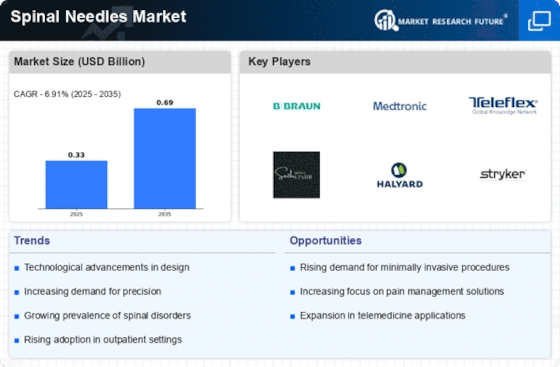
As per Market Research Future analysis, the Spinal Needles Market Size was estimated at 0.33 USD Billion in 2024. The Spinal Needles industry is projected to grow from USD 0.3528 Billion in 2025 to USD 0.6883 Billion by 2035, exhibiting a compound annual growth rate (CAGR) of 6.91% during the forecast period 2025 - 2035

Key Market Trends & Highlights

The Spinal Needles Market is experiencing robust growth driven by technological advancements and increasing demand for minimally invasive procedures.

  • Technological advancements are enhancing the efficacy and safety of spinal needle procedures. North America remains the largest market, while Asia-Pacific is recognized as the fastest-growing region. Pencil-point needles dominate the market, whereas directional spinal needles are emerging as the fastest-growing segment. The rising prevalence of chronic pain and advancements in medical technology are key drivers propelling market growth.

Market Size & Forecast

2024 Market Size 0.33 (USD Billion)
2035 Market Size 0.6883 (USD Billion)
CAGR (2025 - 2035) 6.91%
Largest Regional Market Share in 2024 Europe

Major Players

<a title="B. Braun Melsungen" href="https://catalogs.bbraun.com/en-01/c/PRODUCTS0000000626/spinal-needles-luer" target="_blank" rel="noopener">B. Braun Melsungen</a> AG (DE), Medtronic plc (IE), <a title="Teleflex Incorporated" href="https://www.teleflex.com/emea/en/product-areas/anaesthesia/pain-management/spinal-needles/index.html" target="_blank" rel="noopener">Teleflex Incorporated</a> (US), Smiths Medical (US), Halyard Health, Inc. (US), Stryker Corporation (US), Boston Scientific Corporation (US), Nipro Corporation (JP)

Market Trends

The Spinal Needles Market is currently experiencing a notable evolution, driven by advancements in medical technology and an increasing demand for minimally invasive procedures. Healthcare professionals are increasingly adopting spinal needles that offer enhanced precision and reduced patient discomfort. This shift is likely influenced by a growing awareness of the benefits associated with these devices, including improved patient outcomes and shorter recovery times. Furthermore, the rising prevalence of chronic pain conditions and the aging population are contributing to the heightened need for effective spinal interventions. As a result, manufacturers are focusing on innovation and product development to meet the changing needs of healthcare providers and patients alike. In addition, regulatory bodies are playing a crucial role in shaping the Spinal Needles Market landscape. Stringent regulations regarding product safety and efficacy are prompting companies to invest in research and development. This regulatory environment may foster a competitive atmosphere, encouraging firms to enhance their offerings. Moreover, the integration of digital technologies in healthcare is likely to influence the market dynamics, as telemedicine and remote monitoring become more prevalent. Overall, the Spinal Needles Market appears poised for growth, with various factors indicating a promising future for both manufacturers and healthcare providers.

Technological Advancements

The Spinal Needles Market is witnessing a surge in technological innovations, particularly in needle design and materials. Enhanced imaging techniques and smart needles are emerging, which may improve accuracy during procedures. These advancements could lead to better patient outcomes and increased adoption rates among healthcare professionals.

Rising Demand for Minimally Invasive Procedures

There is a growing trend towards minimally invasive surgical techniques within the Spinal Needles Market. Patients and healthcare providers alike are favoring procedures that reduce recovery time and minimize discomfort. This shift is likely to drive the demand for spinal needles that facilitate such interventions.

Regulatory Influence on Product Development

Regulatory bodies are increasingly impacting the Spinal Needles Market by enforcing stringent safety and efficacy standards. This regulatory landscape may compel manufacturers to prioritize quality and innovation in their product offerings, potentially leading to enhanced safety profiles and improved market competitiveness.

Spinal needles Market Market Drivers

Advancements in Medical Technology

Technological innovations in the medical field are significantly influencing the Spinal Needles Market. The introduction of advanced materials and designs, such as ultra-thin needles and safety-engineered devices, enhances the precision and safety of spinal procedures. These advancements not only improve patient outcomes but also reduce the risk of complications associated with spinal interventions. The market is witnessing a shift towards the adoption of smart spinal needles equipped with sensors that provide real-time feedback during procedures. This trend is expected to drive the growth of the Spinal Needles Market as healthcare providers increasingly prioritize patient safety and procedural accuracy. Moreover, the integration of imaging technologies with spinal needle procedures is likely to further enhance the effectiveness of these interventions.

Increasing Prevalence of Chronic Pain

The rising incidence of chronic pain conditions, such as lower back pain and neuropathic pain, is a primary driver for the Spinal Needles Market. According to recent estimates, chronic pain affects a significant portion of the population, leading to an increased demand for effective pain management solutions. Spinal needles Market are essential for procedures like epidurals and spinal anesthesia, which are commonly employed to alleviate pain. As healthcare providers seek to address this growing issue, the Spinal Needles Market is likely to experience substantial growth. Furthermore, the aging population, which is more susceptible to chronic pain, further amplifies this demand. The need for innovative and efficient spinal needle designs that enhance patient comfort and procedural efficacy is becoming increasingly apparent.

Regulatory Support for Innovative Products

Regulatory bodies are increasingly supporting the development of innovative products within the Spinal Needles Market. Streamlined approval processes for new spinal needle designs and technologies are encouraging manufacturers to invest in research and development. This regulatory environment fosters innovation, allowing for the introduction of safer and more effective spinal needles. Additionally, the emphasis on patient safety and quality assurance in regulatory frameworks is likely to enhance the credibility of products in the market. As a result, healthcare providers may be more inclined to adopt new spinal needle technologies that align with regulatory standards. This trend is expected to contribute positively to the growth trajectory of the Spinal Needles Market, as manufacturers respond to regulatory incentives by developing cutting-edge solutions.

Rising Demand for Pain Management Solutions

The increasing focus on effective pain management strategies is propelling the Spinal Needles Market forward. As healthcare systems worldwide prioritize patient-centered care, the demand for spinal interventions, including epidural injections and spinal anesthesia, is on the rise. The World Health Organization has highlighted the importance of addressing pain as a critical component of healthcare, which has led to a surge in the utilization of spinal needles for various therapeutic applications. This trend is further supported by the growing awareness among patients regarding available pain management options. Consequently, the Spinal Needles Market is likely to expand as healthcare providers seek to meet the rising expectations of patients for effective and minimally invasive pain relief solutions.

Growing Awareness of Minimally Invasive Techniques

The increasing awareness and acceptance of minimally invasive techniques among healthcare professionals and patients are driving the Spinal Needles Market. Minimally invasive procedures are associated with reduced recovery times, lower complication rates, and improved patient satisfaction. As a result, there is a growing preference for spinal interventions that utilize spinal needles, such as epidural injections and spinal anesthesia. This shift in preference is supported by educational initiatives and training programs aimed at enhancing the skills of healthcare providers in performing these procedures. The Spinal Needles Market is likely to benefit from this trend, as more practitioners adopt minimally invasive techniques to meet the evolving needs of patients seeking effective and less invasive treatment options.

Market Segment Insights

By Type: Pencil-Point Needles (Largest) vs. Directional Spinal Needles (Fastest-Growing)

<p>The spinal needles market is primarily dominated by pencil-point needles, which hold the largest share due to their effectiveness in facilitating accurate anesthesia administration. These needles are preferred for their precision and reduced risk of tissue trauma. Directional spinal needles are emerging rapidly, as they offer enhanced flexibility and ease of use during procedures, contributing to their growing market share. Atraumatic needles are also part of this segment but have a smaller market presence compared to the leading types. Growth trends in the spinal needles market are significantly influenced by technological advancements and increasing preferences for minimally invasive surgical procedures. The rise in patient safety standards has elevated the demand for high-quality spinal needles, particularly those designed to minimize complications. Additionally, the growing aging population and subsequently increasing incidences of orthopedic issues contribute to the demand for spinal needles, fostering market growth in both the long-established and emerging segments.</p>

<p>Pencil-Point Needles (Dominant) vs. Directional Spinal Needles (Emerging)</p>

<p>Pencil-point needles are regarded as the dominant type in the spinal needles market, favored for their design that minimizes patient discomfort during procedures. Their fine tip allows for precision entry, reducing the risk of nerve damage and improving overall patient outcomes, which solidifies their popularity among healthcare professionals. On the other hand, directional spinal needles are considered an emerging option, designed to deliver enhanced maneuverability and versatility during spinal injections. This innovation accommodates various anatomical considerations and provides physicians with better control, setting them apart as a preferred choice in complex cases. As healthcare practices evolve, these two segments reflect contrasting market positions, with pencil-point needles leading in reliability while directional needles gain traction.</p>

By Application: Therapeutic (Largest) vs. Diagnostic (Fastest-Growing)

<p>In the Spinal Needles Market, the application segment reveals a substantial market share distribution. The therapeutic category emerges as the largest segment, driven by its extensive utilization in pain management and other clinical therapeutic procedures. This category encompasses a wide range of procedures such as epidurals, spinal block injections, and nerve root blocks, making it essential for various pain treatment protocols. Meanwhile, the diagnostic segment, although smaller in comparison, is noted for its rapid growth. Its applications primarily include spinal anesthesia and diagnostic procedures that aid in the assessment of spinal conditions. As the healthcare industry evolves, the growth trends within the Spinal Needles Market reflect a distinct upward trajectory for both segments. The therapeutic segment benefits from a rising prevalence of chronic pain disorders and an increasing emphasis on minimally invasive techniques. At the same time, the diagnostic segment is increasingly characterized by technological advancements, which enhance the efficacy of spinal procedures. Improved imaging techniques and the increasing number of diagnostic tests contribute positively to this segment's rapid expansion, making it a locus of investment for manufacturers and healthcare providers alike.</p>

<p>Application: Therapeutic (Dominant) vs. Diagnostic (Emerging)</p>

<p>In the Spinal Needles Market, the therapeutic application stands out as the dominant segment, characterized by its integral role in chronic pain management and surgical procedures. This segment leverages a variety of spinal needle types designed for precision and minimal discomfort, underscoring its importance in the overall healthcare landscape. Conversely, the diagnostic application, while emerging, reflects a significant shift towards enhanced diagnostic capabilities for spinal conditions. Diagnostic procedures, such as myelograms and spinal block procedures, are witnessing heightened adoption due to advancements in technologies, which improve safety and accuracy. As healthcare providers seek out innovative solutions, both segments highlight the dynamic growth of the spinal needles market, with therapeutic applications leading the way and diagnostic applications poised for significant breakthroughs.</p>

By End User: Hospitals & Clinics (Largest) vs. Diagnostic Centers (Fastest-Growing)

<p>In the Spinal Needles Market, the distribution of market share among various end users shows that Hospitals & Clinics hold a significant portion, reflecting their critical role in providing comprehensive patient care. This segment benefits from established infrastructures and a steady influx of patients requiring medical interventions involving spinal procedures. In contrast, Diagnostic Centers are emerging swiftly due to the increasing demand for precise diagnostic imaging and procedures involving spinal needles, indicating a shift in service allocation towards specialized diagnostics.</p>

<p>Hospitals & Clinics (Dominant) vs. Diagnostic Centers (Emerging)</p>

<p>Hospitals & Clinics represent the dominant end-user category in the Spinal Needles Market, driven by their vast scope of surgical procedures, including anesthesia and pain management. This segment is characterized by well-equipped facilities and a steady influx of patients, leading to the consistent utilization of spinal needles. On the other hand, Diagnostic Centers are emerging as a vital segment due to the rise in demand for non-invasive diagnostic procedures. Their focus on specialized imaging and patient-centric approaches results in rapid growth, positioning them as key players in the expanding landscape of spinal interventions.</p>

Get more detailed insights about Spinal Needles Market Research Report-Forecast till 2035

Regional Insights

North America : Market Leader in Innovation

North America is the largest market for spinal needles, accounting for approximately 45% of the global share. The region's growth is driven by advanced healthcare infrastructure, increasing prevalence of spinal disorders, and a strong emphasis on research and development. Regulatory support from agencies like the FDA further catalyzes market expansion, ensuring safety and efficacy in medical devices. The United States leads the North American market, with significant contributions from Canada. Key players such as Medtronic, Teleflex, and Smiths Medical dominate the landscape, focusing on innovative product development and strategic partnerships. The competitive environment is characterized by continuous advancements in technology and a growing demand for minimally invasive procedures, enhancing patient outcomes.

Europe : Emerging Regulatory Frameworks

Europe is the second-largest market for spinal needles, holding around 30% of the global share. The region's growth is propelled by increasing surgical procedures, a rising geriatric population, and stringent regulatory frameworks that ensure product safety. The European Medicines Agency (EMA) plays a crucial role in overseeing medical device regulations, fostering innovation while maintaining high safety standards. Leading countries in Europe include Germany, France, and the UK, where key players like B. Braun Melsungen AG and Stryker Corporation are prominent. The competitive landscape is marked by a focus on technological advancements and collaborations among manufacturers to enhance product offerings. The presence of well-established healthcare systems further supports market growth, driving demand for advanced spinal needle solutions.

Asia-Pacific : Rapidly Growing Market Potential

Asia-Pacific is witnessing rapid growth in the spinal needles market, accounting for approximately 20% of the global share. The region's expansion is driven by increasing healthcare expenditure, a growing population, and rising awareness of spinal health. Countries like China and India are at the forefront, supported by government initiatives aimed at improving healthcare access and quality. China is the largest market in the region, followed by India and Japan. The competitive landscape features both local and international players, including Nipro Corporation and Medtronic. The market is characterized by a surge in demand for advanced medical technologies and a shift towards minimally invasive surgical techniques, which are expected to drive further growth in the coming years.

Middle East and Africa : Untapped Market Opportunities

The Middle East and Africa represent an emerging market for spinal needles, holding about 5% of the global share. The growth in this region is driven by increasing healthcare investments, a rising prevalence of spinal disorders, and a growing awareness of advanced medical technologies. Governments are focusing on improving healthcare infrastructure, which is expected to enhance market dynamics significantly. Leading countries in this region include South Africa and the UAE, where there is a growing presence of international players. The competitive landscape is evolving, with local manufacturers beginning to emerge alongside established companies. The market is characterized by a demand for innovative solutions and a gradual shift towards advanced healthcare practices, indicating significant growth potential in the coming years.

Key Players and Competitive Insights

The Spinal Needles Market is characterized by the presence of many global, regional, and local vendors. The market is highly competitive, with all the players competing to gain market share. Intense competition, rapid technological advances, frequent changes in government policies, and environmental regulations are key factors that confront market growth. The vendors compete based on cost, quality, and reliability. It is decisive for the vendors to provide cost-efficient and high-quality products to survive and succeed in an intensely competitive market environment.

The major players have adopted a strategy of obtaining regulatory approval from government agencies for their products and signing contracts and agreements to broaden their reach and reduce operational costs.

In August B. Braun (Germany) received the US FDA approval for its Onvision ultrasound guidance needle tip tracking solution, aiming to drastically improve success rates in regional anesthesia procedures.

In September B. Braun (Germany) collaborated with Philips (Netherlands) to launch the Onvision needle tip tracking guidance solution, which works in real-time for regional anesthesia processes.

The Spinal Needles Market is extremely competitive, with players investing heavily in R&D to create product differentiation and gain a significant market share.

Key Companies in the Spinal needles Market include

Industry Developments

December 2020 Smiths Medical (US) launched its Portex EchoGlo needle portfolio which work for echogenic brightness under ultrasound and are designed to make medication delivery more efficient and accurate. This further improves the companies pain management product portfolio.

September 2019 B. Braun (Germany) collaborated with Philips (Netherlands) to launch the Onvision needle tip tracking guidance solution which works in real-time for regional anaesthesia processes. This works in line with Philip’s ultrasound system, making anaesthesia processes safer and more accurate.

January 2021 Stryker Corporation (US) acquired OrthoSensor, Inc. (US), a market leader in providing digital care in musculoskeletal care and total joint replacement sensor technology. The move will help the company innovate novel treatments, in the spinal segment as well.

December 2020 Argon Medical (US) acquired Mana-Tech, Ltd. (UK) which was its exclusive product distributor in the UK and Ireland. This move helped the company to expand its reach throughout Europe.

November 2020 Medtronic plc (Ireland) acquired Medicrea (France) to become the first company to provide Artificial Intelligence (AI) driven spinal surgery planning, implant, and robotic surgery with the help of Medicrea Ai capabilities.

Future Outlook

Spinal needles Market Future Outlook

The Spinal Needles Market is projected to grow at a 6.91% CAGR from 2025 to 2035, driven by technological advancements, increasing surgical procedures, and rising demand for minimally invasive techniques.

New opportunities lie in:

  • Development of smart spinal needles with integrated sensors for real-time feedback.
  • Expansion into emerging markets with tailored product offerings.
  • Partnerships with hospitals for exclusive supply agreements and training programs.

By 2035, the Spinal Needles Market is expected to achieve substantial growth and innovation.

Market Segmentation

Spinal needles Market Type Outlook

  • Pencil-Point Needles
  • Directional Spinal Needles
  • Atraumatic Needles

Spinal needles Market End User Outlook

  • Hospitals & Clinics
  • Diagnostic Centers
  • Research Laboratories
  • Speciality Centres

Spinal needles Market Application Outlook

  • Therapeutic
  • Diagnostic

Report Scope

MARKET SIZE 2024 0.33(USD Billion)
MARKET SIZE 2025 0.3528(USD Billion)
MARKET SIZE 2035 0.6883(USD Billion)
COMPOUND ANNUAL GROWTH RATE (CAGR) 6.91% (2025 - 2035)
REPORT COVERAGE Revenue Forecast, Competitive Landscape, Growth Factors, and Trends
BASE YEAR 2024
Market Forecast Period 2025 - 2035
Historical Data 2019 - 2024
Market Forecast Units USD Billion
Key Companies Profiled B. Braun Melsungen AG (DE), Medtronic plc (IE), Teleflex Incorporated (US), Smiths Medical (US), Halyard Health, Inc. (US), Stryker Corporation (US), Boston Scientific Corporation (US), Nipro Corporation (JP)
Segments Covered Type
Key Market Opportunities Advancements in minimally invasive techniques enhance growth potential in the Spinal Needles Market.
Key Market Dynamics Technological advancements and regulatory changes are reshaping competitive dynamics in the spinal needles market.
Countries Covered North America, Europe, APAC, South America, MEA

FAQs

What is the projected market valuation of the Spinal Needles Market by 2035?

<p>The Spinal Needles Market is projected to reach approximately 0.6883 USD Billion by 2035.</p>

What was the market valuation of the Spinal Needles Market in 2024?

<p>In 2024, the Spinal Needles Market was valued at 0.33 USD Billion.</p>

What is the expected CAGR for the Spinal Needles Market during the forecast period 2025 - 2035?

<p>The expected CAGR for the Spinal Needles Market during the forecast period 2025 - 2035 is 6.91%.</p>

Which companies are considered key players in the Spinal Needles Market?

<p>Key players in the Spinal Needles Market include B. Braun Melsungen AG, Medtronic plc, Teleflex Incorporated, and Smiths Medical.</p>

What are the main types of spinal needles in the market?

<p>The main types of spinal needles include Pencil-Point Needles, Directional Spinal Needles, and Atraumatic Needles.</p>

What was the market size for Pencil-Point Needles in 2024?

<p>The market size for Pencil-Point Needles was approximately 0.12 USD Billion in 2024.</p>

How does the market for therapeutic applications compare to diagnostic applications in 2024?

<p>In 2024, the market for therapeutic applications was valued at 0.2 USD Billion, while diagnostic applications were valued at 0.13 USD Billion.</p>

What is the projected market size for hospitals and clinics by 2035?

<p>The market size for hospitals and clinics is projected to reach approximately 0.32 USD Billion by 2035.</p>

What segment of the Spinal Needles Market had the highest valuation in 2024?

In 2024, the therapeutic application segment had the highest valuation at 0.2 USD Billion.

What is the expected growth trend for research laboratories in the Spinal Needles Market?

The market for research laboratories is expected to grow from 0.05 USD Billion in 2024 to potentially 0.1 USD Billion by 2035.

  1. SECTION I: EXECUTIVE SUMMARY AND KEY HIGHLIGHTS
    1. | 1.1 EXECUTIVE SUMMARY
    2. | | 1.1.1 Market Overview
    3. | | 1.1.2 Key Findings
    4. | | 1.1.3 Market Segmentation
    5. | | 1.1.4 Competitive Landscape
    6. | | 1.1.5 Challenges and Opportunities
    7. | | 1.1.6 Future Outlook
  2. SECTION II: SCOPING, METHODOLOGY AND MARKET STRUCTURE
    1. | 2.1 MARKET INTRODUCTION
    2. | | 2.1.1 Definition
    3. | | 2.1.2 Scope of the study
    4. | | | 2.1.2.1 Research Objective
    5. | | | 2.1.2.2 Assumption
    6. | | | 2.1.2.3 Limitations
    7. | 2.2 RESEARCH METHODOLOGY
    8. | | 2.2.1 Overview
    9. | | 2.2.2 Data Mining
    10. | | 2.2.3 Secondary Research
    11. | | 2.2.4 Primary Research
    12. | | | 2.2.4.1 Primary Interviews and Information Gathering Process
    13. | | | 2.2.4.2 Breakdown of Primary Respondents
    14. | | 2.2.5 Forecasting Model
    15. | | 2.2.6 Market Size Estimation
    16. | | | 2.2.6.1 Bottom-Up Approach
    17. | | | 2.2.6.2 Top-Down Approach
    18. | | 2.2.7 Data Triangulation
    19. | | 2.2.8 Validation
  3. SECTION III: QUALITATIVE ANALYSIS
    1. | 3.1 MARKET DYNAMICS
    2. | | 3.1.1 Overview
    3. | | 3.1.2 Drivers
    4. | | 3.1.3 Restraints
    5. | | 3.1.4 Opportunities
    6. | 3.2 MARKET FACTOR ANALYSIS
    7. | | 3.2.1 Value chain Analysis
    8. | | 3.2.2 Porter's Five Forces Analysis
    9. | | | 3.2.2.1 Bargaining Power of Suppliers
    10. | | | 3.2.2.2 Bargaining Power of Buyers
    11. | | | 3.2.2.3 Threat of New Entrants
    12. | | | 3.2.2.4 Threat of Substitutes
    13. | | | 3.2.2.5 Intensity of Rivalry
    14. | | 3.2.3 COVID-19 Impact Analysis
    15. | | | 3.2.3.1 Market Impact Analysis
    16. | | | 3.2.3.2 Regional Impact
    17. | | | 3.2.3.3 Opportunity and Threat Analysis
  4. SECTION IV: QUANTITATIVE ANALYSIS
    1. | 4.1 Healthcare, BY Type (USD Billion)
    2. | | 4.1.1 Pencil-Point Needles
    3. | | 4.1.2 Directional Spinal Needles
    4. | | 4.1.3 Atraumatic Needles
    5. | 4.2 Healthcare, BY Application (USD Billion)
    6. | | 4.2.1 Therapeutic
    7. | | 4.2.2 Diagnostic
    8. | 4.3 Healthcare, BY End User (USD Billion)
    9. | | 4.3.1 Hospitals & Clinics
    10. | | 4.3.2 Diagnostic Centers
    11. | | 4.3.3 Research Laboratories
    12. | | 4.3.4 Speciality Centres
    13. | 4.4 Healthcare, BY Region (USD Billion)
    14. | | 4.4.1 North America
    15. | | | 4.4.1.1 US
    16. | | | 4.4.1.2 Canada
    17. | | 4.4.2 Europe
    18. | | | 4.4.2.1 Germany
    19. | | | 4.4.2.2 UK
    20. | | | 4.4.2.3 France
    21. | | | 4.4.2.4 Russia
    22. | | | 4.4.2.5 Italy
    23. | | | 4.4.2.6 Spain
    24. | | | 4.4.2.7 Rest of Europe
    25. | | 4.4.3 APAC
    26. | | | 4.4.3.1 China
    27. | | | 4.4.3.2 India
    28. | | | 4.4.3.3 Japan
    29. | | | 4.4.3.4 South Korea
    30. | | | 4.4.3.5 Malaysia
    31. | | | 4.4.3.6 Thailand
    32. | | | 4.4.3.7 Indonesia
    33. | | | 4.4.3.8 Rest of APAC
    34. | | 4.4.4 South America
    35. | | | 4.4.4.1 Brazil
    36. | | | 4.4.4.2 Mexico
    37. | | | 4.4.4.3 Argentina
    38. | | | 4.4.4.4 Rest of South America
    39. | | 4.4.5 MEA
    40. | | | 4.4.5.1 GCC Countries
    41. | | | 4.4.5.2 South Africa
    42. | | | 4.4.5.3 Rest of MEA
  5. SECTION V: COMPETITIVE ANALYSIS
    1. | 5.1 Competitive Landscape
    2. | | 5.1.1 Overview
    3. | | 5.1.2 Competitive Analysis
    4. | | 5.1.3 Market share Analysis
    5. | | 5.1.4 Major Growth Strategy in the Healthcare
    6. | | 5.1.5 Competitive Benchmarking
    7. | | 5.1.6 Leading Players in Terms of Number of Developments in the Healthcare
    8. | | 5.1.7 Key developments and growth strategies
    9. | | | 5.1.7.1 New Product Launch/Service Deployment
    10. | | | 5.1.7.2 Merger & Acquisitions
    11. | | | 5.1.7.3 Joint Ventures
    12. | | 5.1.8 Major Players Financial Matrix
    13. | | | 5.1.8.1 Sales and Operating Income
    14. | | | 5.1.8.2 Major Players R&D Expenditure. 2023
    15. | 5.2 Company Profiles
    16. | | 5.2.1 B. Braun Melsungen AG (DE)
    17. | | | 5.2.1.1 Financial Overview
    18. | | | 5.2.1.2 Products Offered
    19. | | | 5.2.1.3 Key Developments
    20. | | | 5.2.1.4 SWOT Analysis
    21. | | | 5.2.1.5 Key Strategies
    22. | | 5.2.2 Medtronic plc (IE)
    23. | | | 5.2.2.1 Financial Overview
    24. | | | 5.2.2.2 Products Offered
    25. | | | 5.2.2.3 Key Developments
    26. | | | 5.2.2.4 SWOT Analysis
    27. | | | 5.2.2.5 Key Strategies
    28. | | 5.2.3 Teleflex Incorporated (US)
    29. | | | 5.2.3.1 Financial Overview
    30. | | | 5.2.3.2 Products Offered
    31. | | | 5.2.3.3 Key Developments
    32. | | | 5.2.3.4 SWOT Analysis
    33. | | | 5.2.3.5 Key Strategies
    34. | | 5.2.4 Smiths Medical (US)
    35. | | | 5.2.4.1 Financial Overview
    36. | | | 5.2.4.2 Products Offered
    37. | | | 5.2.4.3 Key Developments
    38. | | | 5.2.4.4 SWOT Analysis
    39. | | | 5.2.4.5 Key Strategies
    40. | | 5.2.5 Halyard Health, Inc. (US)
    41. | | | 5.2.5.1 Financial Overview
    42. | | | 5.2.5.2 Products Offered
    43. | | | 5.2.5.3 Key Developments
    44. | | | 5.2.5.4 SWOT Analysis
    45. | | | 5.2.5.5 Key Strategies
    46. | | 5.2.6 Stryker Corporation (US)
    47. | | | 5.2.6.1 Financial Overview
    48. | | | 5.2.6.2 Products Offered
    49. | | | 5.2.6.3 Key Developments
    50. | | | 5.2.6.4 SWOT Analysis
    51. | | | 5.2.6.5 Key Strategies
    52. | | 5.2.7 Boston Scientific Corporation (US)
    53. | | | 5.2.7.1 Financial Overview
    54. | | | 5.2.7.2 Products Offered
    55. | | | 5.2.7.3 Key Developments
    56. | | | 5.2.7.4 SWOT Analysis
    57. | | | 5.2.7.5 Key Strategies
    58. | | 5.2.8 Nipro Corporation (JP)
    59. | | | 5.2.8.1 Financial Overview
    60. | | | 5.2.8.2 Products Offered
    61. | | | 5.2.8.3 Key Developments
    62. | | | 5.2.8.4 SWOT Analysis
    63. | | | 5.2.8.5 Key Strategies
    64. | 5.3 Appendix
    65. | | 5.3.1 References
    66. | | 5.3.2 Related Reports
  6. LIST OF FIGURES
    1. | 6.1 MARKET SYNOPSIS
    2. | 6.2 NORTH AMERICA MARKET ANALYSIS
    3. | 6.3 US MARKET ANALYSIS BY TYPE
    4. | 6.4 US MARKET ANALYSIS BY APPLICATION
    5. | 6.5 US MARKET ANALYSIS BY END USER
    6. | 6.6 CANADA MARKET ANALYSIS BY TYPE
    7. | 6.7 CANADA MARKET ANALYSIS BY APPLICATION
    8. | 6.8 CANADA MARKET ANALYSIS BY END USER
    9. | 6.9 EUROPE MARKET ANALYSIS
    10. | 6.10 GERMANY MARKET ANALYSIS BY TYPE
    11. | 6.11 GERMANY MARKET ANALYSIS BY APPLICATION
    12. | 6.12 GERMANY MARKET ANALYSIS BY END USER
    13. | 6.13 UK MARKET ANALYSIS BY TYPE
    14. | 6.14 UK MARKET ANALYSIS BY APPLICATION
    15. | 6.15 UK MARKET ANALYSIS BY END USER
    16. | 6.16 FRANCE MARKET ANALYSIS BY TYPE
    17. | 6.17 FRANCE MARKET ANALYSIS BY APPLICATION
    18. | 6.18 FRANCE MARKET ANALYSIS BY END USER
    19. | 6.19 RUSSIA MARKET ANALYSIS BY TYPE
    20. | 6.20 RUSSIA MARKET ANALYSIS BY APPLICATION
    21. | 6.21 RUSSIA MARKET ANALYSIS BY END USER
    22. | 6.22 ITALY MARKET ANALYSIS BY TYPE
    23. | 6.23 ITALY MARKET ANALYSIS BY APPLICATION
    24. | 6.24 ITALY MARKET ANALYSIS BY END USER
    25. | 6.25 SPAIN MARKET ANALYSIS BY TYPE
    26. | 6.26 SPAIN MARKET ANALYSIS BY APPLICATION
    27. | 6.27 SPAIN MARKET ANALYSIS BY END USER
    28. | 6.28 REST OF EUROPE MARKET ANALYSIS BY TYPE
    29. | 6.29 REST OF EUROPE MARKET ANALYSIS BY APPLICATION
    30. | 6.30 REST OF EUROPE MARKET ANALYSIS BY END USER
    31. | 6.31 APAC MARKET ANALYSIS
    32. | 6.32 CHINA MARKET ANALYSIS BY TYPE
    33. | 6.33 CHINA MARKET ANALYSIS BY APPLICATION
    34. | 6.34 CHINA MARKET ANALYSIS BY END USER
    35. | 6.35 INDIA MARKET ANALYSIS BY TYPE
    36. | 6.36 INDIA MARKET ANALYSIS BY APPLICATION
    37. | 6.37 INDIA MARKET ANALYSIS BY END USER
    38. | 6.38 JAPAN MARKET ANALYSIS BY TYPE
    39. | 6.39 JAPAN MARKET ANALYSIS BY APPLICATION
    40. | 6.40 JAPAN MARKET ANALYSIS BY END USER
    41. | 6.41 SOUTH KOREA MARKET ANALYSIS BY TYPE
    42. | 6.42 SOUTH KOREA MARKET ANALYSIS BY APPLICATION
    43. | 6.43 SOUTH KOREA MARKET ANALYSIS BY END USER
    44. | 6.44 MALAYSIA MARKET ANALYSIS BY TYPE
    45. | 6.45 MALAYSIA MARKET ANALYSIS BY APPLICATION
    46. | 6.46 MALAYSIA MARKET ANALYSIS BY END USER
    47. | 6.47 THAILAND MARKET ANALYSIS BY TYPE
    48. | 6.48 THAILAND MARKET ANALYSIS BY APPLICATION
    49. | 6.49 THAILAND MARKET ANALYSIS BY END USER
    50. | 6.50 INDONESIA MARKET ANALYSIS BY TYPE
    51. | 6.51 INDONESIA MARKET ANALYSIS BY APPLICATION
    52. | 6.52 INDONESIA MARKET ANALYSIS BY END USER
    53. | 6.53 REST OF APAC MARKET ANALYSIS BY TYPE
    54. | 6.54 REST OF APAC MARKET ANALYSIS BY APPLICATION
    55. | 6.55 REST OF APAC MARKET ANALYSIS BY END USER
    56. | 6.56 SOUTH AMERICA MARKET ANALYSIS
    57. | 6.57 BRAZIL MARKET ANALYSIS BY TYPE
    58. | 6.58 BRAZIL MARKET ANALYSIS BY APPLICATION
    59. | 6.59 BRAZIL MARKET ANALYSIS BY END USER
    60. | 6.60 MEXICO MARKET ANALYSIS BY TYPE
    61. | 6.61 MEXICO MARKET ANALYSIS BY APPLICATION
    62. | 6.62 MEXICO MARKET ANALYSIS BY END USER
    63. | 6.63 ARGENTINA MARKET ANALYSIS BY TYPE
    64. | 6.64 ARGENTINA MARKET ANALYSIS BY APPLICATION
    65. | 6.65 ARGENTINA MARKET ANALYSIS BY END USER
    66. | 6.66 REST OF SOUTH AMERICA MARKET ANALYSIS BY TYPE
    67. | 6.67 REST OF SOUTH AMERICA MARKET ANALYSIS BY APPLICATION
    68. | 6.68 REST OF SOUTH AMERICA MARKET ANALYSIS BY END USER
    69. | 6.69 MEA MARKET ANALYSIS
    70. | 6.70 GCC COUNTRIES MARKET ANALYSIS BY TYPE
    71. | 6.71 GCC COUNTRIES MARKET ANALYSIS BY APPLICATION
    72. | 6.72 GCC COUNTRIES MARKET ANALYSIS BY END USER
    73. | 6.73 SOUTH AFRICA MARKET ANALYSIS BY TYPE
    74. | 6.74 SOUTH AFRICA MARKET ANALYSIS BY APPLICATION
    75. | 6.75 SOUTH AFRICA MARKET ANALYSIS BY END USER
    76. | 6.76 REST OF MEA MARKET ANALYSIS BY TYPE
    77. | 6.77 REST OF MEA MARKET ANALYSIS BY APPLICATION
    78. | 6.78 REST OF MEA MARKET ANALYSIS BY END USER
    79. | 6.79 KEY BUYING CRITERIA OF HEALTHCARE
    80. | 6.80 RESEARCH PROCESS OF MRFR
    81. | 6.81 DRO ANALYSIS OF HEALTHCARE
    82. | 6.82 DRIVERS IMPACT ANALYSIS: HEALTHCARE
    83. | 6.83 RESTRAINTS IMPACT ANALYSIS: HEALTHCARE
    84. | 6.84 SUPPLY / VALUE CHAIN: HEALTHCARE
    85. | 6.85 HEALTHCARE, BY TYPE, 2024 (% SHARE)
    86. | 6.86 HEALTHCARE, BY TYPE, 2024 TO 2035 (USD Billion)
    87. | 6.87 HEALTHCARE, BY APPLICATION, 2024 (% SHARE)
    88. | 6.88 HEALTHCARE, BY APPLICATION, 2024 TO 2035 (USD Billion)
    89. | 6.89 HEALTHCARE, BY END USER, 2024 (% SHARE)
    90. | 6.90 HEALTHCARE, BY END USER, 2024 TO 2035 (USD Billion)
    91. | 6.91 BENCHMARKING OF MAJOR COMPETITORS
  7. LIST OF TABLES
    1. | 7.1 LIST OF ASSUMPTIONS
    2. | | 7.1.1
    3. | 7.2 North America MARKET SIZE ESTIMATES; FORECAST
    4. | | 7.2.1 BY TYPE, 2025-2035 (USD Billion)
    5. | | 7.2.2 BY APPLICATION, 2025-2035 (USD Billion)
    6. | | 7.2.3 BY END USER, 2025-2035 (USD Billion)
    7. | 7.3 US MARKET SIZE ESTIMATES; FORECAST
    8. | | 7.3.1 BY TYPE, 2025-2035 (USD Billion)
    9. | | 7.3.2 BY APPLICATION, 2025-2035 (USD Billion)
    10. | | 7.3.3 BY END USER, 2025-2035 (USD Billion)
    11. | 7.4 Canada MARKET SIZE ESTIMATES; FORECAST
    12. | | 7.4.1 BY TYPE, 2025-2035 (USD Billion)
    13. | | 7.4.2 BY APPLICATION, 2025-2035 (USD Billion)
    14. | | 7.4.3 BY END USER, 2025-2035 (USD Billion)
    15. | 7.5 Europe MARKET SIZE ESTIMATES; FORECAST
    16. | | 7.5.1 BY TYPE, 2025-2035 (USD Billion)
    17. | | 7.5.2 BY APPLICATION, 2025-2035 (USD Billion)
    18. | | 7.5.3 BY END USER, 2025-2035 (USD Billion)
    19. | 7.6 Germany MARKET SIZE ESTIMATES; FORECAST
    20. | | 7.6.1 BY TYPE, 2025-2035 (USD Billion)
    21. | | 7.6.2 BY APPLICATION, 2025-2035 (USD Billion)
    22. | | 7.6.3 BY END USER, 2025-2035 (USD Billion)
    23. | 7.7 UK MARKET SIZE ESTIMATES; FORECAST
    24. | | 7.7.1 BY TYPE, 2025-2035 (USD Billion)
    25. | | 7.7.2 BY APPLICATION, 2025-2035 (USD Billion)
    26. | | 7.7.3 BY END USER, 2025-2035 (USD Billion)
    27. | 7.8 France MARKET SIZE ESTIMATES; FORECAST
    28. | | 7.8.1 BY TYPE, 2025-2035 (USD Billion)
    29. | | 7.8.2 BY APPLICATION, 2025-2035 (USD Billion)
    30. | | 7.8.3 BY END USER, 2025-2035 (USD Billion)
    31. | 7.9 Russia MARKET SIZE ESTIMATES; FORECAST
    32. | | 7.9.1 BY TYPE, 2025-2035 (USD Billion)
    33. | | 7.9.2 BY APPLICATION, 2025-2035 (USD Billion)
    34. | | 7.9.3 BY END USER, 2025-2035 (USD Billion)
    35. | 7.10 Italy MARKET SIZE ESTIMATES; FORECAST
    36. | | 7.10.1 BY TYPE, 2025-2035 (USD Billion)
    37. | | 7.10.2 BY APPLICATION, 2025-2035 (USD Billion)
    38. | | 7.10.3 BY END USER, 2025-2035 (USD Billion)
    39. | 7.11 Spain MARKET SIZE ESTIMATES; FORECAST
    40. | | 7.11.1 BY TYPE, 2025-2035 (USD Billion)
    41. | | 7.11.2 BY APPLICATION, 2025-2035 (USD Billion)
    42. | | 7.11.3 BY END USER, 2025-2035 (USD Billion)
    43. | 7.12 Rest of Europe MARKET SIZE ESTIMATES; FORECAST
    44. | | 7.12.1 BY TYPE, 2025-2035 (USD Billion)
    45. | | 7.12.2 BY APPLICATION, 2025-2035 (USD Billion)
    46. | | 7.12.3 BY END USER, 2025-2035 (USD Billion)
    47. | 7.13 APAC MARKET SIZE ESTIMATES; FORECAST
    48. | | 7.13.1 BY TYPE, 2025-2035 (USD Billion)
    49. | | 7.13.2 BY APPLICATION, 2025-2035 (USD Billion)
    50. | | 7.13.3 BY END USER, 2025-2035 (USD Billion)
    51. | 7.14 China MARKET SIZE ESTIMATES; FORECAST
    52. | | 7.14.1 BY TYPE, 2025-2035 (USD Billion)
    53. | | 7.14.2 BY APPLICATION, 2025-2035 (USD Billion)
    54. | | 7.14.3 BY END USER, 2025-2035 (USD Billion)
    55. | 7.15 India MARKET SIZE ESTIMATES; FORECAST
    56. | | 7.15.1 BY TYPE, 2025-2035 (USD Billion)
    57. | | 7.15.2 BY APPLICATION, 2025-2035 (USD Billion)
    58. | | 7.15.3 BY END USER, 2025-2035 (USD Billion)
    59. | 7.16 Japan MARKET SIZE ESTIMATES; FORECAST
    60. | | 7.16.1 BY TYPE, 2025-2035 (USD Billion)
    61. | | 7.16.2 BY APPLICATION, 2025-2035 (USD Billion)
    62. | | 7.16.3 BY END USER, 2025-2035 (USD Billion)
    63. | 7.17 South Korea MARKET SIZE ESTIMATES; FORECAST
    64. | | 7.17.1 BY TYPE, 2025-2035 (USD Billion)
    65. | | 7.17.2 BY APPLICATION, 2025-2035 (USD Billion)
    66. | | 7.17.3 BY END USER, 2025-2035 (USD Billion)
    67. | 7.18 Malaysia MARKET SIZE ESTIMATES; FORECAST
    68. | | 7.18.1 BY TYPE, 2025-2035 (USD Billion)
    69. | | 7.18.2 BY APPLICATION, 2025-2035 (USD Billion)
    70. | | 7.18.3 BY END USER, 2025-2035 (USD Billion)
    71. | 7.19 Thailand MARKET SIZE ESTIMATES; FORECAST
    72. | | 7.19.1 BY TYPE, 2025-2035 (USD Billion)
    73. | | 7.19.2 BY APPLICATION, 2025-2035 (USD Billion)
    74. | | 7.19.3 BY END USER, 2025-2035 (USD Billion)
    75. | 7.20 Indonesia MARKET SIZE ESTIMATES; FORECAST
    76. | | 7.20.1 BY TYPE, 2025-2035 (USD Billion)
    77. | | 7.20.2 BY APPLICATION, 2025-2035 (USD Billion)
    78. | | 7.20.3 BY END USER, 2025-2035 (USD Billion)
    79. | 7.21 Rest of APAC MARKET SIZE ESTIMATES; FORECAST
    80. | | 7.21.1 BY TYPE, 2025-2035 (USD Billion)
    81. | | 7.21.2 BY APPLICATION, 2025-2035 (USD Billion)
    82. | | 7.21.3 BY END USER, 2025-2035 (USD Billion)
    83. | 7.22 South America MARKET SIZE ESTIMATES; FORECAST
    84. | | 7.22.1 BY TYPE, 2025-2035 (USD Billion)
    85. | | 7.22.2 BY APPLICATION, 2025-2035 (USD Billion)
    86. | | 7.22.3 BY END USER, 2025-2035 (USD Billion)
    87. | 7.23 Brazil MARKET SIZE ESTIMATES; FORECAST
    88. | | 7.23.1 BY TYPE, 2025-2035 (USD Billion)
    89. | | 7.23.2 BY APPLICATION, 2025-2035 (USD Billion)
    90. | | 7.23.3 BY END USER, 2025-2035 (USD Billion)
    91. | 7.24 Mexico MARKET SIZE ESTIMATES; FORECAST
    92. | | 7.24.1 BY TYPE, 2025-2035 (USD Billion)
    93. | | 7.24.2 BY APPLICATION, 2025-2035 (USD Billion)
    94. | | 7.24.3 BY END USER, 2025-2035 (USD Billion)
    95. | 7.25 Argentina MARKET SIZE ESTIMATES; FORECAST
    96. | | 7.25.1 BY TYPE, 2025-2035 (USD Billion)
    97. | | 7.25.2 BY APPLICATION, 2025-2035 (USD Billion)
    98. | | 7.25.3 BY END USER, 2025-2035 (USD Billion)
    99. | 7.26 Rest of South America MARKET SIZE ESTIMATES; FORECAST
    100. | | 7.26.1 BY TYPE, 2025-2035 (USD Billion)
    101. | | 7.26.2 BY APPLICATION, 2025-2035 (USD Billion)
    102. | | 7.26.3 BY END USER, 2025-2035 (USD Billion)
    103. | 7.27 MEA MARKET SIZE ESTIMATES; FORECAST
    104. | | 7.27.1 BY TYPE, 2025-2035 (USD Billion)
    105. | | 7.27.2 BY APPLICATION, 2025-2035 (USD Billion)
    106. | | 7.27.3 BY END USER, 2025-2035 (USD Billion)
    107. | 7.28 GCC Countries MARKET SIZE ESTIMATES; FORECAST
    108. | | 7.28.1 BY TYPE, 2025-2035 (USD Billion)
    109. | | 7.28.2 BY APPLICATION, 2025-2035 (USD Billion)
    110. | | 7.28.3 BY END USER, 2025-2035 (USD Billion)
    111. | 7.29 South Africa MARKET SIZE ESTIMATES; FORECAST
    112. | | 7.29.1 BY TYPE, 2025-2035 (USD Billion)
    113. | | 7.29.2 BY APPLICATION, 2025-2035 (USD Billion)
    114. | | 7.29.3 BY END USER, 2025-2035 (USD Billion)
    115. | 7.30 Rest of MEA MARKET SIZE ESTIMATES; FORECAST
    116. | | 7.30.1 BY TYPE, 2025-2035 (USD Billion)
    117. | | 7.30.2 BY APPLICATION, 2025-2035 (USD Billion)
    118. | | 7.30.3 BY END USER, 2025-2035 (USD Billion)
    119. | 7.31 PRODUCT LAUNCH/PRODUCT DEVELOPMENT/APPROVAL
    120. | | 7.31.1
    121. | 7.32 ACQUISITION/PARTNERSHIP
    122. | | 7.32.1

Healthcare Market Segmentation

Healthcare By Type (USD Billion, 2025-2035)

  • Pencil-Point Needles
  • Directional Spinal Needles
  • Atraumatic Needles

Healthcare By Application (USD Billion, 2025-2035)

  • Therapeutic
  • Diagnostic

Healthcare By End User (USD Billion, 2025-2035)

  • Hospitals & Clinics
  • Diagnostic Centers
  • Research Laboratories
  • Speciality Centres
Infographic

Free Sample Request

Kindly complete the form below to receive a free sample of this Report

Get Free Sample

Customer Strories

Compare Licence

×
Features License Type
Single User Multiuser License Enterprise User
Price $4,950 $5,950 $7,250
Maximum User Access Limit 1 User Upto 10 Users Unrestricted Access Throughout the Organization
Free Customization
Direct Access to Analyst
Deliverable Format
Platform Access
Discount on Next Purchase 10% 15% 15%
Printable Versions