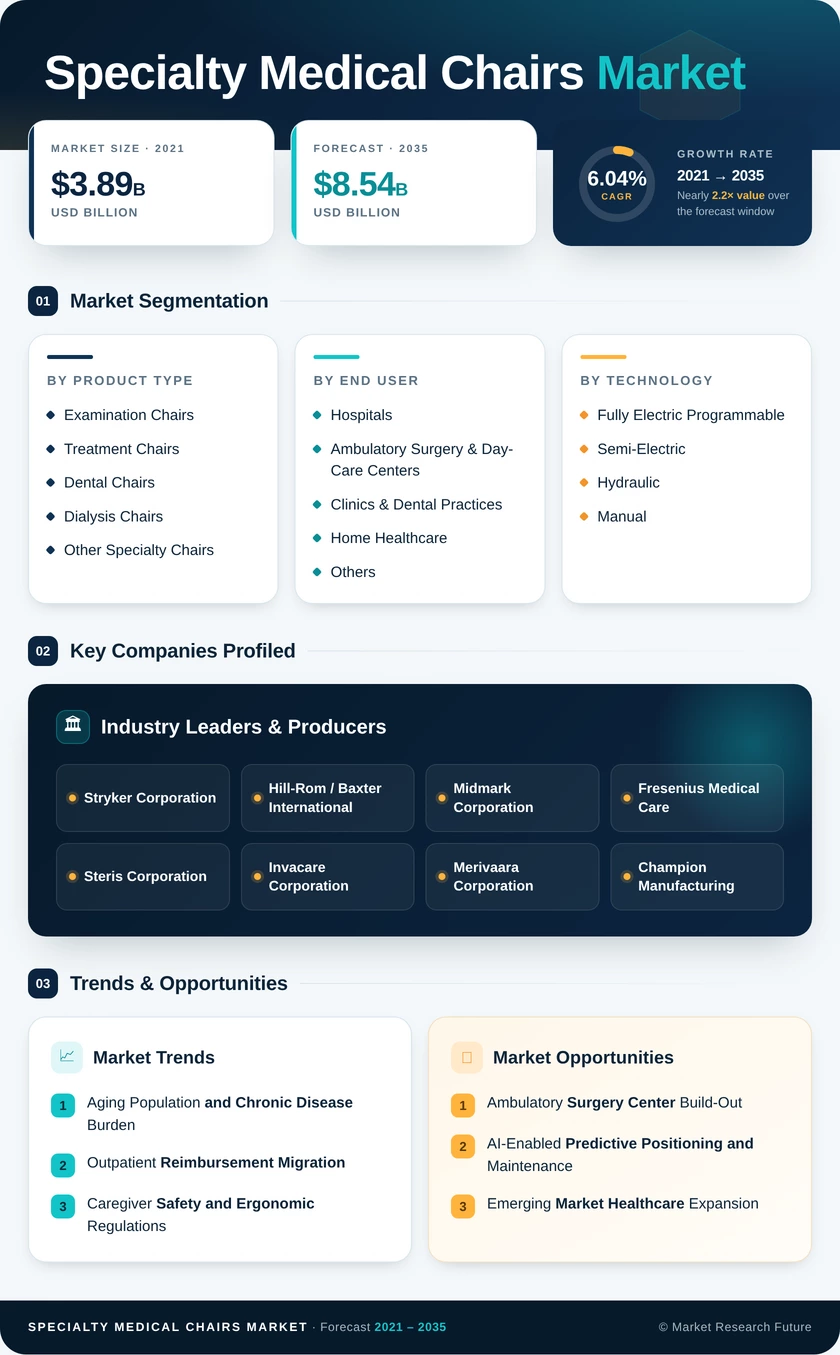
Specialty Medical Chairs Market

ID: MRFR/MED/6151-HCR
160 Pages
Vikita Thakur
Last Updated: June 22, 2026
Specialty Medical Chairs Market Research Report By Application (Orthopedic, Dental, Dialysis, Psychiatric, Physical Therapy), By Chair Type (Examination Chairs, Procedure Chairs, Reclining Chairs, Wheelchair Accessible Chairs), By Material (Plastic, Metal, Wood, Vinyl, Foam), By End User (Hospitals, Clinics, Home Care, Rehabilitation Centers) and By Regional (North America, Europe, South America, Asia Pacific, Middle East and Africa) - Growth & Industry Forecast 2025 To 2035
Download PDF ×

We do not share your information with anyone. However, we may send you emails based on your report interest from time to time. You may contact us at any time to opt-out.

  1. 1 Market Overview |
    1. 1.1 Study Assumptions & Market Definition |
    2. 1.2 Scope of the Study |
    3. 1.3 Research Methodology
  2. 2 Market Summary & Key Takeaways
  3. 3 Market Dynamics |
    1. 3.1 Market Drivers Analysis | |
      1. 3.1.1 Aging Population & Chronic Disease Burden | |
      2. 3.1.2 Outpatient Reimbursement Migration | |
      3. 3.1.3 Caregiver Safety & Ergonomic Regulations | |
      4. 3.1.4 Electric/Programmable Chair Adoption | |
      5. 3.1.5 IoT Integration & Cybersecurity Mandates | |
      6. 3.1.6 Healthcare Infrastructure Investment in Emerging Economies | |
      7. 3.1.7 Ambulatory Surgical Center Proliferation |
    2. 3.2 Market Restraints Analysis | |
      1. 3.2.1 High Upfront Capital Costs | |
      2. 3.2.2 Electronic Component Supply-Chain Constraints | |
      3. 3.2.3 Reimbursement Complexity & Coverage Gaps | |
      4. 3.2.4 Cybersecurity Compliance Burden | |
      5. 3.2.5 Extended Replacement Cycles in Budget-Constrained Facilities |
    3. 3.3 Market Opportunity Analysis | |
      1. 3.3.1 Ambulatory Surgery Center Build-Out | |
      2. 3.3.2 AI-Enabled Predictive Positioning & Maintenance | |
      3. 3.3.3 Emerging Market Healthcare Expansion | |
      4. 3.3.4 Chair-as-a-Service & Leasing Models | |
      5. 3.3.5 Bariatric & Specialty Population Configurations |
    4. 3.4 Industry Value Chain Analysis |
    5. 3.5 Porter's Five Forces Analysis
  4. 4 Global Specialty Medical Chairs Market Size & Forecast (2021–2035) |
    1. 4.1 Historical Market Size (2021–2025) |
    2. 4.2 Current & Forecast Market Size (2026–2035) |
    3. 4.3 Market Size by Revenue (USD billion) |
    4. 4.4 Year-over-Year Growth Analysis
  5. 5 Segmentation Analysis |
    1. 5.1 By Product Type | |
      1. 5.1.1 Examination Chairs | |
      2. 5.1.2 Treatment Chairs | |
      3. 5.1.3 Dental Chairs | |
      4. 5.1.4 Dialysis Chairs | |
      5. 5.1.5 Other Specialty Chairs |
    2. 5.2 By End User | |
      1. 5.2.1 Hospitals | |
      2. 5.2.2 Ambulatory Surgery & Day-Care Centers | |
      3. 5.2.3 Clinics & Dental Practices | |
      4. 5.2.4 Home Healthcare | |
      5. 5.2.5 Others |
    3. 5.3 By Technology | |
      1. 5.3.1 Fully Electric Programmable | |
      2. 5.3.2 Semi-Electric | |
      3. 5.3.3 Hydraulic | |
      4. 5.3.4 Manual
  6. 6 Regional Analysis |
    1. 6.1 North America | |
      1. 6.1.1 United States | |
      2. 6.1.2 Canada | |
      3. 6.1.3 Mexico |
    2. 6.2 Europe | |
      1. 6.2.1 Germany | |
      2. 6.2.2 United Kingdom | |
      3. 6.2.3 France | |
      4. 6.2.4 Italy | |
      5. 6.2.5 Spain | |
      6. 6.2.6 Nordic Countries | |
      7. 6.2.7 Russia | |
      8. 6.2.8 Rest of Europe |
    3. 6.3 Asia-Pacific | |
      1. 6.3.1 China | |
      2. 6.3.2 India | |
      3. 6.3.3 Japan | |
      4. 6.3.4 South Korea | |
      5. 6.3.5 ASEAN | |
      6. 6.3.6 Rest of Asia-Pacific |
    4. 6.4 South America | |
      1. 6.4.1 Brazil | |
      2. 6.4.2 Argentina | |
      3. 6.4.3 Rest of South America |
    5. 6.5 Middle East & Africa | |
      1. 6.5.1 Saudi Arabia | |
      2. 6.5.2 UAE | |
      3. 6.5.3 South Africa | |
      4. 6.5.4 Egypt | |
      5. 6.5.5 Rest of MEA
  7. 7 Competitive Landscape |
    1. 7.1 Market Share Analysis (2025) |
    2. 7.2 Competitive Benchmarking Matrix |
    3. 7.3 Company Profiles | |
      1. 7.3.1 Stryker Corporation | |
      2. 7.3.2 Hill-Rom / Baxter International | |
      3. 7.3.3 Midmark Corporation | |
      4. 7.3.4 Fresenius Medical Care | |
      5. 7.3.5 Steris Corporation | |
      6. 7.3.6 Invacare Corporation | |
      7. 7.3.7 Merivaara Corporation | |
      8. 7.3.8 Champion Manufacturing | |
      9. 7.3.9 Medical Technology Industries | |
      10. 7.3.10 Promotal (Groupe Médipréma)
  8. 8 Future Outlook & Strategic Recommendations (2026–2035) |
    1. 8.1 AI-Driven Autonomous Positioning |
    2. 8.2 Platform Economics & Recurring Revenue |
    3. 8.3 Sustainability & Circular-Economy Mandates |
    4. 8.4 Decentralized Care & Home-Health Expansion
  9. 9 Recent Developments & News
  10. 10 Frequently Asked Questions (FAQs)
  11. 11 Report Scope & Methodology |
    1. 11.1 Study Period & Base Year |
    2. 11.2 Data Sources & Citations |
    3. 11.3 Abbreviations
  12. 1 LIST OF TABLES
  13. 2 LIST OF FIGURES

Segmentation Quick Reference

DimensionSub-SegmentsDominant SegmentFastest Growing Segment
Product TypeExamination Chairs, Treatment Chairs, Dental Chairs, Dialysis Chairs, Other Specialty ChairsExamination Chairs (40.7% share, 2025)Treatment Chairs (7.84% CAGR)
End UserHospitals, Ambulatory Surgery & Day-Care Centers, Clinics & Dental Practices, Home Healthcare, OthersHospitals (39.8% share, 2025)Ambulatory Surgery & Day-Care Centers (9.95% CAGR)
TechnologyFully Electric Programmable, Semi-Electric, Hydraulic, ManualFully Electric Programmable (41.4% share, 2025)Fully Electric Programmable (leading CAGR)
GeographyNorth America, Europe, Asia-Pacific, South America, Middle East & AfricaNorth America (39.2% share, 2025)Asia-Pacific (8.14% CAGR)


Market Segmentation Overview

By Product Type

Sub-SegmentKey Trend
Examination ChairsTransition to barrier-free, height-adjustable electric models in primary care
Treatment ChairsMulti-hour session ergonomics for infusion and chemotherapy applications
Dental ChairsIntegration of LED operating lights and digital imaging mounts
Dialysis ChairsExtended-comfort designs for 3–4-hour renal therapy sessions
Other Specialty ChairsNiche growth in ophthalmic, podiatric, and ENT-specific configurations


Product type segmentation reflects the functional diversity of clinical environments where specialty seating is deployed. Examination chairs serve the broadest installed base across primary care, urgent care, and emergency departments, while treatment chairs are experiencing accelerated adoption driven by ambulatory infusion therapy volumes.

By End User

Sub-SegmentKey Trend
HospitalsFleet replacement aligned with Joint Commission and pressure-injury standards
Ambulatory Surgery & Day-Care CentersFastest-growing segment driven by reimbursement migration
Clinics & Dental PracticesPrivate-practice modernization and patient-experience competition
Home HealthcareCompact, patient-operated designs for hospital-at-home programs
OthersResearch institutions, military medical, and correctional healthcare


End-user segmentation captures the migration of procedural volumes from traditional inpatient settings to ambulatory and decentralized care environments. Hospitals remain the largest buyer, but growth momentum is shifting toward ambulatory surgery centers and home healthcare as payer policies incentivize lower-cost care delivery sites.

By Technology

Sub-SegmentKey Trend
Fully Electric ProgrammableIoT sensor integration, EHR connectivity, over-the-air updates
Semi-ElectricCost-effective mid-tier adoption in multi-provider clinics
HydraulicLegacy installed base in emerging markets with gradual replacement
ManualEntry-level positioning for basic examination settings


Technology segmentation reflects the ongoing electrification of specialty medical seating. Fully electric programmable platforms command the largest share and fastest growth, driven by caregiver safety mandates and healthcare IT integration requirements. Hydraulic and manual chairs continue to serve cost-sensitive and low-acuity environments but face declining share over the forecast period.