Request Free Sample ×

Kindly complete the form below to receive a free sample of this Report

* Please use a valid business email

Leading companies partner with us for data-driven Insights

clients tt-cursor
Hero Background

South America hERG Screening Market

ID: MRFR/HC/51280-HCR
200 Pages
Vikita Thakur
March 2026

South America hERG screening Market Research Report By Type (Gene KCNH2, Mutant KCNH2), By Ion Channel (Voltage Gated, Ligand Gated), By Application (Antiarrhythmic, Antipsychotic, Antibiotics, Others) and By Regional (Brazil, Mexico, Argentina, Rest of South America) - Growth & Industry Forecast 2025 To 2035

Share:
Download PDF ×

We do not share your information with anyone. However, we may send you emails based on your report interest from time to time. You may contact us at any time to opt-out.

South America hERG Screening Market Infographic
Purchase Options

South America hERG Screening Market Summary

As per Market Research Future analysis, the Herg Screening market Size was estimated at 56.0 USD Million in 2024. The herg screening market is projected to grow from 61.95 USD Million in 2025 to 170.2 USD Million by 2035, exhibiting a compound annual growth rate (CAGR) of 10.6% during the forecast period 2025 - 2035

Key Market Trends & Highlights

The South America Herg screening market is poised for growth driven by regulatory focus and technological advancements.

  • Brazil remains the largest market for Herg screening, reflecting a robust demand for cardiac safety assessments.
  • Mexico is emerging as the fastest-growing region, indicating a rising investment in biopharmaceutical research.
  • Technological advancements in screening methods are enhancing the accuracy and efficiency of Herg testing.
  • The increasing incidence of cardiovascular diseases and growing awareness of drug-induced arrhythmias are key drivers of market expansion.

Market Size & Forecast

2024 Market Size 56.0 (USD Million)
2035 Market Size 170.2 (USD Million)
CAGR (2025 - 2035) 10.63%

Major Players

Thermo Fisher Scientific (US), Charles River Laboratories (US), Eurofins Scientific (LU), Celerion (US), CROMSOURCE (IT), Inotiv (US), Celerion (US), Celerion (US)

Our Impact
Enabled $4.3B Revenue Impact for Fortune 500 and Leading Multinationals
Partnering with 2000+ Global Organizations Each Year
30K+ Citations by Top-Tier Firms in the Industry

South America hERG Screening Market Trends

The herg screening market is currently experiencing notable growth, driven by the increasing emphasis on drug safety and regulatory compliance in South America. Regulatory bodies in the region are placing heightened scrutiny on the cardiac safety profiles of new pharmaceuticals, which has led to a surge in demand for herg screening technologies. This trend is further supported by the rising incidence of cardiac-related adverse events associated with various medications, prompting pharmaceutical companies to prioritize herg testing in their development processes. As a result, the market is witnessing a shift towards more sophisticated and efficient screening methods, including high-throughput screening and in silico modeling, which are becoming essential tools for researchers and developers alike. Moreover, the herg screening market is also influenced by advancements in technology and increased collaboration between academic institutions and industry players. These partnerships are fostering innovation and enhancing the capabilities of herg screening methodologies. The growing awareness of the importance of herg testing in drug development is likely to drive further investments in this area, as stakeholders recognize the potential for improved patient safety and reduced liability. Overall, the herg screening market appears poised for continued expansion in South America, reflecting broader trends in the pharmaceutical industry that prioritize safety and efficacy in drug development.

Regulatory Focus on Cardiac Safety

Regulatory agencies in South America are increasingly emphasizing the importance of cardiac safety in drug development. This heightened focus is driving pharmaceutical companies to adopt herg screening as a critical component of their research and development processes, ensuring compliance with safety standards.

Technological Advancements in Screening Methods

Innovations in herg screening technologies are transforming the market landscape. The introduction of high-throughput screening and advanced computational models is enhancing the efficiency and accuracy of herg testing, enabling faster drug development timelines.

Collaborative Research Initiatives

There is a growing trend of collaboration between academic institutions and pharmaceutical companies in South America. These partnerships are fostering research and development in herg screening methodologies, leading to improved testing protocols and enhanced drug safety outcomes.

South America hERG Screening Market Drivers

Rising Cardiovascular Disease Incidence

The increasing prevalence of cardiovascular diseases in South America is a crucial driver for the herg screening market. As healthcare providers focus on improving patient outcomes, the demand for effective screening methods has surged. Reports indicate that cardiovascular diseases account for approximately 30% of all deaths in the region, prompting regulatory bodies to emphasize cardiac safety in drug development. This heightened awareness has led to a growing need for herg screening solutions, as pharmaceutical companies seek to mitigate risks associated with drug-induced arrhythmias. Consequently, the herg screening market is likely to experience significant growth as stakeholders prioritize patient safety and regulatory compliance.

Investment in Biopharmaceutical Research

The herg screening market is witnessing a surge in investment from biopharmaceutical companies in South America. With the region's growing focus on innovative drug development, there is an increasing need for robust screening methods to ensure cardiac safety. In 2025, biopharmaceutical investments in South America are projected to reach $5 billion, reflecting a commitment to enhancing research capabilities. This influx of funding is likely to drive the adoption of advanced herg screening technologies, as companies aim to streamline their drug development processes while adhering to stringent regulatory requirements. As a result, the herg screening market stands to benefit from this trend, fostering innovation and improving patient safety.

Growing Awareness of Drug-Induced Arrhythmias

The herg screening market is experiencing growth due to the increasing awareness of drug-induced arrhythmias among healthcare professionals and regulatory bodies in South America. As the understanding of the risks associated with certain medications expands, there is a heightened emphasis on cardiac safety during drug development. This awareness is reflected in the rising number of training programs and workshops focused on herg screening methodologies. In 2025, it is anticipated that educational initiatives will increase by 15%, further promoting the importance of herg screening in ensuring patient safety. Consequently, the herg screening market is likely to benefit from this trend, as stakeholders prioritize effective screening practices.

Technological Integration in Drug Development

The herg screening market is being propelled by the integration of advanced technologies in drug development processes across South America. The adoption of high-throughput screening methods and automated systems is enhancing the efficiency and accuracy of herg screening. In 2025, it is projected that the market for automated screening technologies will grow by 25%, reflecting the industry's shift towards more sophisticated methodologies. This technological advancement not only streamlines the screening process but also reduces the time and costs associated with drug development. As a result, the herg screening market is likely to see increased investment and innovation, ultimately benefiting patient safety and therapeutic efficacy.

Regulatory Changes and Compliance Requirements

Recent regulatory changes in South America have significantly impacted the herg screening market. Authorities are increasingly mandating comprehensive cardiac safety assessments for new drug applications, which has heightened the demand for herg screening solutions. In 2025, it is estimated that compliance costs for pharmaceutical companies could rise by 20% due to these new regulations. This shift necessitates the integration of herg screening into the drug development pipeline, compelling companies to invest in advanced technologies and methodologies. As a result, the herg screening market is poised for growth, driven by the need for compliance and the assurance of patient safety in drug therapies.
Market Segment Insights

By Application: Cardiovascular Research (Largest) vs. Drug Development (Fastest-Growing)

In the South America HERG screening market, Cardiovascular Research stands out as the largest segment, reflecting a significant focus on understanding heart-related conditions and the impact of drugs on cardiac cells. This sector accounts for a considerable portion of the market share due to the increasing incidence of cardiac diseases and the rising demand for tailored therapies. Conversely, Drug Development is emerging rapidly, driven by the need for innovative pharmaceutical solutions that ensure drug safety and efficacy, particularly concerning cardiac health.

Cardiovascular Research: Dominant vs. Drug Development: Emerging

Cardiovascular Research holds a dominant position in the South America HERG screening market, primarily due to the critical emphasis on understanding drug interactions at the cardiac level. This segment focuses on ensuring the safety of compounds being developed for cardiovascular indications, thereby significantly influencing pharmaceutical strategies. On the other hand, Drug Development is recognized as an emerging segment, fueled by technological advancements in screening methodologies and a heightened regulatory focus on drug safety. This segment's growth is propelled by an increasing collaboration between biotech firms and academic institutions, aiming to develop safer, more effective therapeutic options.

By End Use: Pharmaceutical Companies (Largest) vs. Contract Research Organizations (Fastest-Growing)

In the South America Herg Screening market, pharmaceutical companies hold the largest market share, driven by their extensive research and development activities. These companies are focused on developing novel therapies, leading to a consistent demand for Herg screening services. In contrast, contract research organizations (CROs) are rapidly gaining market share as they provide specialized outsourced services to the pharmaceutical industry, making them a crucial player in the landscape.

Pharmaceutical Companies (Dominant) vs. Contract Research Organizations (Emerging)

Pharmaceutical companies are dominant in the South America Herg screening market due to their robust investment in drug development and regulatory compliance. These companies leverage Herg screening to ensure the safety and efficacy of their products, thus establishing competitive advantages. On the other hand, contract research organizations are emerging as vital partners for pharmaceutical firms, offering flexible and scalable solutions for preclinical and clinical trials. As the demand for innovative therapies grows, CROs are expected to expand rapidly, driven by their ability to adapt to the evolving needs of the pharmaceutical sector.

By Technology: Automated Screening Systems (Largest) vs. High-Throughput Screening (Fastest-Growing)

In the South America HERG screening market, the Automated Screening Systems hold the largest market share, driven by their efficiency and ability to deliver rapid results. This segment is crucial for pharmaceutical companies focusing on drug safety and efficacy. In contrast, High-Throughput Screening, while currently smaller in market share, is recognized for its potential to speed up the drug discovery process significantly and is gaining traction among biotech firms due to the rising demand for faster testing methods.

Automated Screening Systems: Dominant vs. High-Throughput Screening: Emerging

Automated Screening Systems are the backbone of the HERG screening process in South America, favored for their precision and speed in evaluating drug effects on cardiac cells. These systems allow researchers to process millions of samples quickly, which is essential in the fast-paced pharmaceutical environment. High-Throughput Screening, emerging as a revolutionary approach, enables comprehensive testing with reduced resource expenditure. As research laboratories continuously seek more efficient methodologies, High-Throughput Screening is expected to capture a growing share of the market, appealing to organizations eager for innovation in drug screening.

By Test Type: Voltage Clamp Assays (Largest) vs. Patch Clamp Techniques (Fastest-Growing)

In the South America HERG screening market, Voltage Clamp Assays dominate with a significant market share due to their ability to provide accurate and reliable ion channel characterization. These assays are extensively utilized in drug development and safety pharmacology, leading them to maintain a strong foothold in the market. In contrast, Patch Clamp Techniques are emerging rapidly, gaining traction among researchers and pharmaceutical companies. Their advanced precision in recording ionic currents makes them increasingly preferred, driving their share to grow significantly in recent years. The acceleration in the growth of the Patch Clamp Techniques segment can be attributed to advancements in technology and increasing investments in drug research and development. Companies are recognizing the importance of understanding cardiac safety, contributing to a rising demand for robust screening methods that these techniques provide. As researchers continue to seek innovative solutions, the adoption of Patch Clamp Techniques is poised to flourish, complemented by training programs and workshops that enhance proficiency among scientists in South America.

Voltage Clamp Assays (Dominant) vs. Current Clamp Assays (Emerging)

Voltage Clamp Assays hold a dominant position in the South America HERG screening market due to their established efficacy in evaluating ion channel behavior under controlled voltage conditions. These assays allow for a detailed understanding of drug interactions with HERG channels, crucial for assessing cardiotoxicity risk. On the other hand, Current Clamp Assays represent an emerging alternative that is gaining attention for their ability to record the membrane potential and action potentials of cells. Though currently less prevalent than Voltage Clamp Assays, Current Clamp Assays are becoming popular among researchers who seek insights on cellular electrophysiology, particularly for their applications in the evaluation of neuronal networks and cardiac cell functionality. As scientific understanding evolves, these emerging technologies are likely to gain greater acceptance.

Get more detailed insights about South America hERG Screening Market

Regional Insights

Mexico : Regulatory Support Fuels Growth

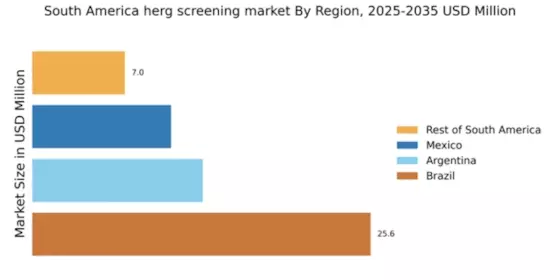
With a market share of 10.5%, Mexico's herg screening market is gaining traction, driven by government initiatives aimed at boosting healthcare innovation. The demand for herg screening is increasing due to the growing pharmaceutical industry and rising awareness of drug safety. Regulatory bodies are enhancing frameworks to support clinical trials, which is vital for market expansion. The country's investment in healthcare infrastructure further bolsters this growth.

Argentina : Pharmaceutical Growth Drives Market

Argentina accounts for 12.9% of the South American herg screening market, reflecting a growing demand for drug safety testing. The pharmaceutical sector is expanding, supported by government incentives for research and development. Regulatory frameworks are evolving to ensure compliance with international standards, enhancing market attractiveness. The increasing prevalence of chronic diseases is also driving the need for effective drug testing solutions.

Rest of South America : Potential for Herg Screening Growth

The Rest of South America holds a 7.0% market share in the herg screening sector, with varying demand across countries. Key growth drivers include increasing healthcare investments and a focus on improving drug safety regulations. Countries like Chile and Colombia are emerging as significant players, with supportive government policies fostering innovation. The competitive landscape features both local and international players, enhancing market dynamics.

South America hERG Screening Market Regional Image

Key Players and Competitive Insights

The herg screening market in South America is characterized by a competitive landscape that is increasingly shaped by innovation, strategic partnerships, and regional expansion. Key players such as Thermo Fisher Scientific (US), Charles River Laboratories (US), and Eurofins Scientific (LU) are at the forefront, each adopting distinct strategies to enhance their market presence. Thermo Fisher Scientific (US) focuses on technological advancements in screening methodologies, while Charles River Laboratories (US) emphasizes its comprehensive service offerings, including preclinical and clinical development. Eurofins Scientific (LU) appears to be leveraging its extensive laboratory network to optimize service delivery across the region, thereby enhancing its competitive edge. Collectively, these strategies contribute to a dynamic environment where innovation and service diversification are paramount.In terms of business tactics, companies are increasingly localizing manufacturing and optimizing supply chains to better serve the South American market. The competitive structure of the herg screening market is moderately fragmented, with several players vying for market share. This fragmentation allows for a variety of service offerings, yet the influence of major players remains significant, as they set benchmarks for quality and innovation that smaller firms often strive to meet.

In October Thermo Fisher Scientific (US) announced the launch of a new high-throughput herg screening platform designed to enhance drug safety assessments. This strategic move is likely to position the company as a leader in the market, as it addresses the growing demand for efficient and reliable screening solutions. The introduction of this platform not only reflects Thermo Fisher's commitment to innovation but also aligns with the industry's shift towards more automated and scalable solutions.

In September Charles River Laboratories (US) expanded its partnership with a leading pharmaceutical company to provide integrated herg screening services. This collaboration is indicative of Charles River's strategy to deepen its service offerings and enhance its value proposition to clients. By aligning with a major player in the pharmaceutical sector, Charles River is likely to strengthen its market position and drive revenue growth through increased service utilization.

In August Eurofins Scientific (LU) acquired a regional laboratory specializing in herg screening, thereby expanding its operational footprint in South America. This acquisition not only enhances Eurofins' capabilities but also allows for greater market penetration. The strategic importance of this move lies in Eurofins' ability to offer localized services, which can significantly improve turnaround times and customer satisfaction.

As of November the herg screening market is witnessing trends such as digitalization, sustainability, and the integration of artificial intelligence (AI) into screening processes. Strategic alliances are increasingly shaping the competitive landscape, enabling companies to pool resources and expertise. Looking ahead, it appears that competitive differentiation will evolve from traditional price-based competition to a focus on innovation, technological advancements, and supply chain reliability. This shift suggests that companies that prioritize these areas may gain a substantial advantage in the market.

Key Companies in the South America hERG Screening Market include

Industry Developments

Recent developments in the South America hERG screening Market indicate a growing emphasis on safety pharmacology as drug manufacturers in the region focus on compliance with international regulations. Notably, Abbott Laboratories and Pfizer are involved in enhancing their respective HERG screening processes to ensure cardiovascular safety for new drug candidates. In July 2023, Roche announced a partnership with a local biotechnology firm to improve drug testing capabilities. Thermo Fisher Scientific has expanded its service offerings in Brazil to cater to the rising demand for HERG screening services.

Financial growth is evident, with market valuations for companies like Celerion and Fujifilm experiencing a notable increase due to investments in innovative screening technologies. 

In terms of mergers and acquisitions, AstraZeneca's acquisition of a small biotech firm in June 2023 has strengthened its research capabilities in pharmacology within the South American market. Major happenings in recent years include Sanofi's establishment of a new research center in Argentina in August 2022, focusing on drug safety evaluations, underlining the importance placed on HERG screening within the regulatory framework of the region. The ongoing developments cater to an evolving landscape where drug safety is becoming increasingly prioritized in South America.

South America hERG Screening Market Segmentation Insights

hERG Screening Market Type Outlook

    • Gene KCNH2
    • Mutant KCNH2

hERG Screening Market Ion Channel Outlook

    • Voltage Gated
    • Ligand Gated

hERG Screening Market Application Outlook

    • Antiarrhythmic
    • Antipsychotic
    • Antibiotics
    • Others

hERG Screening Market Regional Outlook

    • Brazil
    • Mexico
    • Argentina
    • Rest of South America

Future Outlook

South America hERG Screening Market Future Outlook

The HERG Screening Market is projected to grow at a 10.63% CAGR from 2025 to 2035, driven by increasing regulatory demands and technological advancements.

New opportunities lie in:

  • Development of AI-driven screening technologies for enhanced accuracy.
  • Expansion of partnerships with pharmaceutical companies for integrated testing solutions.
  • Launch of mobile herg screening units for remote testing capabilities.

By 2035, the herg screening market is expected to achieve substantial growth and innovation.

Market Segmentation

South America hERG Screening Market Type Outlook

  • Gene KCNH2
  • Mutant KCNH2

South America hERG Screening Market Application Outlook

  • Antiarrhythmic
  • Antipsychotic
  • Antibiotics
  • Others

South America hERG Screening Market Ion Channel Outlook

  • Voltage Gated
  • Ligand Gated

Report Scope

MARKET SIZE 2024 56.0(USD Million)
MARKET SIZE 2025 61.95(USD Million)
MARKET SIZE 2035 170.2(USD Million)
COMPOUND ANNUAL GROWTH RATE (CAGR) 10.63% (2025 - 2035)
REPORT COVERAGE Revenue Forecast, Competitive Landscape, Growth Factors, and Trends
BASE YEAR 2024
Market Forecast Period 2025 - 2035
Historical Data 2019 - 2024
Market Forecast Units USD Million
Key Companies Profiled Thermo Fisher Scientific (US), Charles River Laboratories (US), Eurofins Scientific (LU), Celerion (US), CROMSOURCE (IT), Inotiv (US), Celerion (US), Celerion (US)
Segments Covered Type, Ion Channel, Application
Key Market Opportunities Emerging technologies enhance herg screening efficiency, addressing regulatory demands and safety concerns in drug development.
Key Market Dynamics Rising regulatory scrutiny drives demand for advanced human ether-a-go-go related gene screening technologies in South America.
Countries Covered Brazil, Mexico, Argentina, Rest of South America
Author
Author
Author Profile
Vikita Thakur LinkedIn
Senior Research Analyst
She holds an experience of about 5+ years in market research and business consulting projects for sectors such as life sciences, medical devices, and healthcare IT. She possesses a robust background in data analysis, market estimation, competitive intelligence, pipeline analysis market trend identification, and consumer behavior insights. Her expertise lies in technical Sales support, client interaction and project management, designing and implementing market research studies, conducting competitive analysis, and synthesizing complex data into actionable recommendations that drive business growth.
Co-Author
Co-Author Profile
Garvit Vyas LinkedIn
Vice President - Operations
Garvit Vyas is a Research Analyst with experience in working across multiple industry domains in the market research sector. Over the past four years, he has been actively involved in analyzing diverse markets, gathering industry insights, and contributing to the development of comprehensive research reports. His work includes studying market trends, evaluating competitive landscapes, and supporting data-driven business insights. In the early phase of his career, Garvit worked on cross-domain research projects, which helped him build a strong foundation in market analysis, data interpretation, and industry intelligence across various sectors. Later, he transitioned into the Quality Control (QC) function, where he focuses on reviewing and refining research reports and marketing collaterals to ensure accuracy, consistency, and high editorial standards. His responsibilities include validating research data, improving report structure, and maintaining the overall quality of published content. Garvit is committed to maintaining strong research integrity and delivering reliable insights that support informed business decision-making.
Leave a Comment

FAQs

What is the current valuation of the South America HERG screening market?

<p>As of 2024, the South America HERG screening market was valued at 56.0 USD Million.</p>

What is the projected market valuation for the South America HERG screening market by 2035?

<p>The market is projected to reach a valuation of 177.24 USD Million by 2035.</p>

What is the expected CAGR for the South America HERG screening market during the forecast period?

<p>The expected CAGR for the South America HERG screening market from 2025 to 2035 is 11.04%.</p>

Which companies are considered key players in the South America HERG screening market?

<p>Key players include Thermo Fisher Scientific, Agilent Technologies, PerkinElmer, and Bio-Rad Laboratories.</p>

What are the primary applications of HERG screening in South America?

<p>The primary applications include Drug Development, Toxicology Studies, Cardiovascular Research, and Safety Pharmacology.</p>

How do pharmaceutical companies contribute to the HERG screening market?

<p>Pharmaceutical companies are projected to account for 20.0 to 60.0 USD Million in market valuation.</p>

What technologies are utilized in HERG screening?

<p>Technologies include Automated Screening Systems, Manual Screening Methods, and High-Throughput Screening.</p>

What test types are commonly used in HERG screening?

<p>Common test types include Voltage Clamp Assays, Current Clamp Assays, and Patch Clamp Techniques.</p>

What role do Contract Research Organizations play in the HERG screening market?

<p>Contract Research Organizations are expected to contribute between 15.0 and 45.0 USD Million to the market.</p>

What is the significance of the projected growth in the HERG screening market?

<p>The projected growth indicates a rising demand for HERG screening, reflecting advancements in drug safety and efficacy testing.</p>

Download Free Sample

Kindly complete the form below to receive a free sample of this Report

Compare Licence

×
Features License Type
Single User Multiuser License Enterprise User
Price $4,950 $5,950 $7,250
Maximum User Access Limit 1 User Upto 10 Users Unrestricted Access Throughout the Organization
Free Customization
Direct Access to Analyst
Deliverable Format
Platform Access
Discount on Next Purchase 10% 15% 15%
Printable Versions