×
Request Free Sample ×

Kindly complete the form below to receive a free sample of this Report

* Please use a valid business email

Leading companies partner with us for data-driven Insights

clients tt-cursor
Hero Background
English
Chinese
French
Japanese
Korean
German
Spanish

Solar Hybrid Inverter Market Size

ID: MRFR/EnP/6980-HCR
111 Pages
Priya Nagrale
October 2025

Solar Hybrid Inverter Market Size, Share & Growth Analysis Report by Product (Single-Phase Hybrid, Three-Phase Hybrid), By Grid Type (On Grid, Off Grid), End-User (Commercial, Residential and Others), Sales Channel (Direct, Distributor), By Application (Energy Generation, Solar Energy Storage, Others) And By Region (North America, Europe, Asia-Pacific, And Rest Of The World) – Market Forecast Till 2035

Share:
Download PDF ×

We do not share your information with anyone. However, we may send you emails based on your report interest from time to time. You may contact us at any time to opt-out.

Solar Hybrid Inverter Market Infographic
×
Solar Hybrid Inverter Market Infographic Full View
Purchase Options

Solar Hybrid Inverter Size

Solar Hybrid Inverter Market Growth Projections and Opportunities

One of the drivers of the market is the worldwide accentuation on sustainable power reception. As the world looks for cleaner and more practical energy sources, solar power stands apart as a key supporter. Solar hybrid inverters assume an urgent part in this specific circumstance, empowering the reconciliation of solar-created power with other power sources, like the framework or batteries. The market is emphatically impacted by the developing attention to natural issues and the craving to lessen reliance on customary, non-sustainable power. These inverters assume a basic part in dealing with the progression of energy between solar boards and energy stockpiling frameworks, giving adaptability in energy utilization, and empowering more noteworthy lattice freedom. The rising spotlight on energy versatility and the capacity to store overabundance solar energy for use during times of low daylight add to the interest for solar hybrid inverters. Moreover, districts with high power rates and discontinuous framework dependability establish an ideal climate for the reception of solar hybrid inverters. The financial practicality of these frameworks, considering beginning speculation and long-haul reserve funds, assumes a significant part in driving market interest. Solar hybrid inverters add to natural manageability by outfitting clean solar energy, lessening dependence on inexhaustible sources, and supporting the change to a greener energy scene. The market is impacted by the developing interest for arrangements that line up with natural cognizance and corporate supportability objectives. The worldwide spotlight on relieving environmental change and progressing to cleaner energy sources establishes a promising climate for the development of the solar hybrid inverter market. Solar hybrid inverters, with their capacity to flawlessly switch between solar power, matrix power, and put away energy, address these inclinations. Manufacturers and suppliers should think about client prerequisites, simplicity of combination, and framework dependability to take special care of different client needs in the solar hybrid inverter market.
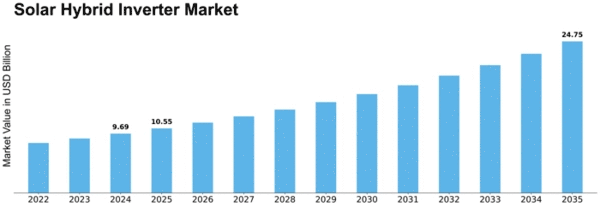
Solar Hybrid Inverter Market Size Graph
Author
Priya Nagrale
Senior Research Analyst

With an experience of over five years in market research industry (Chemicals & Materials domain), I gather and analyze market data from diverse sources to produce results, which are then presented back to a client. Also, provide recommendations based on the findings. As a Senior Research Analyst, I perform quality checks (QC) for market estimations, QC for reports, and handle queries and work extensively on client customizations. Also, handle the responsibilities of client proposals, report planning, report finalization, and execution

Leave a Comment

FAQs

How much is the Solar Hybrid Inverter market?

The Solar Hybrid Inverter market size was valued at USD 9.69 Billion in 2024.

What is the growth rate of the Solar Hybrid Inverter market?

The market is projected to grow at a CAGR of 8.90% during the forecast period, 2025-2034.

Which region held the largest market share in the Solar Hybrid Inverter market?

Asia-Pacific had the largest share in the market.

Who are the key players in the Solar Hybrid Inverter market?

The key players in the market are Flin Energy (India), Havells (India), Schneider Electric (France), Microtek Inverters (India), Delta Energy Systems (Germany), Pure Volt (India), Su-Kam power systems (India), Redback Technologies (Australia), Luminous (India), EAST Group (China), KACO new energy (Germany), Tabuchi Electric (US), SolarEdge Technologies (Israel), Voltronic Power Technology (Taiwan), and SolaX Power (China).

Which Product led the Solar Hybrid Inverter market?

The Three-Phase Hybrid category dominated the market in 2022.

Which End-User had the largest market share in the Solar Hybrid Inverter market?

The Commercial had the largest share in the market.

Market Summary

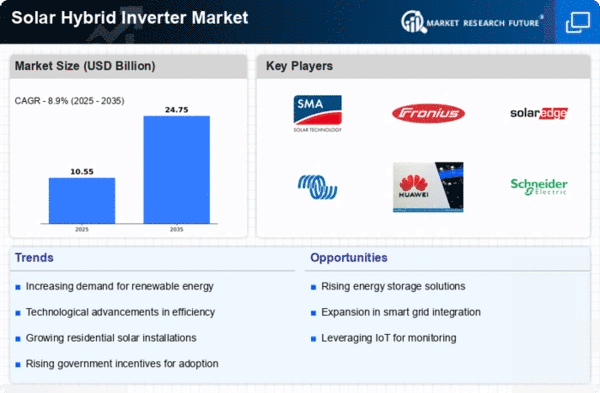
As per MRFR analysis, the Solar Hybrid Inverter Market Size was estimated at 9.69 USD Billion in 2024. The Solar Hybrid Inverter industry is projected to grow from 10.55 USD Billion in 2025 to 24.75 USD Billion by 2035, exhibiting a compound annual growth rate (CAGR) of 8.9 during the forecast period 2025 - 2035.

Key Market Trends & Highlights

The Solar Hybrid Inverter Market is experiencing robust growth driven by technological advancements and increasing consumer demand.

  • North America remains the largest market for solar hybrid inverters, reflecting a strong adoption of renewable energy solutions.
  • The Asia-Pacific region is identified as the fastest-growing market, propelled by rising energy needs and supportive government policies.
  • The residential segment continues to dominate the market, while the commercial segment is witnessing rapid growth due to increasing energy efficiency initiatives.
  • Rising energy costs and government incentives are key drivers fueling the expansion of the solar hybrid inverter market.
Market Size & Forecast

2024 Market Size 9.69 (USD Billion)
2035 Market Size 24.75 (USD Billion)
CAGR (2025 - 2035) 8.9%
Largest Regional Market Share in 2024 Asia-Pacific

Major Players

SMA Solar Technology AG (DE), Fronius International GmbH (AT), SolarEdge Technologies Inc (IL), Victron Energy (NL), Huawei Technologies Co., Ltd. (CN), Schneider Electric SE (FR), Tigo Energy, Inc. (US), Enphase Energy, Inc. (US), Goodwe Power Supply Technology Co., Ltd. (CN)

Market Trends

The Solar Hybrid Inverter Market is currently experiencing a notable transformation, driven by the increasing demand for renewable energy solutions and the growing emphasis on energy efficiency. This market encompasses inverters that combine solar energy with other power sources, such as grid electricity or diesel generators, thereby enhancing reliability and flexibility in energy supply. As consumers and businesses alike seek to reduce their carbon footprints, the adoption of solar hybrid inverters appears to be gaining momentum. Furthermore, advancements in technology are likely to play a pivotal role in shaping the future landscape of this market, as innovations lead to improved performance and cost-effectiveness. In addition, regulatory frameworks and government incentives are fostering a conducive environment for the growth of the Solar Hybrid Inverter Market. Various regions are implementing policies aimed at promoting clean energy technologies, which may further stimulate investment in solar hybrid systems. The integration of smart technologies, such as energy management systems and IoT capabilities, is also anticipated to enhance the functionality of these inverters, making them more appealing to end-users. Overall, the Solar Hybrid Inverter Market is poised for substantial growth, driven by a combination of technological advancements, regulatory support, and a shift towards sustainable energy practices.

Technological Advancements

The Solar Hybrid Inverter Market is witnessing rapid technological advancements that enhance efficiency and performance. Innovations in inverter design and energy management systems are likely to improve energy conversion rates and reduce operational costs. These developments may also facilitate better integration with smart home technologies, making solar hybrid systems more attractive to consumers.

Regulatory Support

Government policies and incentives are playing a crucial role in the expansion of the Solar Hybrid Inverter Market. Various regions are implementing supportive regulations that encourage the adoption of renewable energy solutions. This regulatory backing could lead to increased investments in solar hybrid technologies, fostering market growth.

Consumer Awareness and Demand

There is a growing awareness among consumers regarding the benefits of renewable energy, which is driving demand for solar hybrid inverters. As individuals and businesses seek sustainable energy solutions, the market is likely to see an increase in the adoption of these systems. This trend suggests a shift towards more environmentally friendly energy practices.

Solar Hybrid Inverter Market Market Drivers

Rising Electricity Costs

The increasing cost of electricity is a significant driver for the Global Solar Hybrid Inverter Market Industry. As traditional energy prices continue to rise, consumers are seeking alternative energy solutions to mitigate their electricity expenses. Solar hybrid inverters provide a viable option by enabling users to generate their own electricity, thus reducing dependence on grid power. This trend is particularly evident in regions where electricity prices are soaring, prompting homeowners and businesses to invest in solar energy systems. The potential for long-term savings on energy bills is likely to propel market growth in the coming years.

Market Growth Projections

The Global Solar Hybrid Inverter Market Industry is projected to grow significantly, with estimates indicating a rise from 9.69 USD Billion in 2024 to 24.8 USD Billion by 2035. This growth reflects a compound annual growth rate (CAGR) of 8.9% from 2025 to 2035, highlighting the increasing adoption of solar hybrid inverters across various sectors. The market dynamics suggest a robust expansion driven by technological advancements, government incentives, and rising consumer awareness regarding renewable energy solutions. Such projections indicate a promising future for the solar hybrid inverter market, positioning it as a key player in the global energy landscape.

Growing Environmental Awareness

Growing environmental awareness among consumers is a pivotal factor influencing the Global Solar Hybrid Inverter Market Industry. As individuals and organizations become more conscious of their carbon footprints, there is an increasing preference for sustainable energy solutions. Solar hybrid inverters, which facilitate the use of renewable energy, align with this shift towards eco-friendly practices. This heightened awareness is driving demand for solar energy systems, as consumers seek to contribute to environmental conservation. The market's growth trajectory appears promising, as more people recognize the benefits of adopting solar technology in their daily lives.

Government Incentives and Subsidies

Government incentives and subsidies play a crucial role in the expansion of the Global Solar Hybrid Inverter Market Industry. Many countries are offering financial support to encourage the installation of solar energy systems, including tax credits, grants, and rebates. These initiatives lower the initial investment barrier for consumers and businesses, making solar hybrid inverters more accessible. As a result, the market is expected to witness substantial growth, with a projected CAGR of 8.9% from 2025 to 2035. Such supportive policies not only stimulate demand but also contribute to the overall transition towards sustainable energy solutions.

Increasing Demand for Renewable Energy

The Global Solar Hybrid Inverter Market Industry is experiencing a surge in demand driven by the global shift towards renewable energy sources. Governments worldwide are implementing policies and incentives to promote solar energy adoption, which is reflected in the projected market growth from 9.69 USD Billion in 2024 to 24.8 USD Billion by 2035. This transition is not only environmentally motivated but also economically beneficial, as solar hybrid inverters enhance energy efficiency and reduce reliance on fossil fuels. The increasing awareness of climate change and the need for sustainable energy solutions further bolster this trend, indicating a robust future for the solar hybrid inverter market.
Technological Advancements in Inverter Design

Technological innovations are significantly shaping the Global Solar Hybrid Inverter Market Industry. The development of advanced inverter technologies, such as multi-mode operation and smart grid integration, enhances the efficiency and reliability of solar energy systems. These advancements allow for better energy management, optimizing the use of solar power and reducing energy costs for consumers. As inverter technology continues to evolve, it is likely to attract more investments and drive market growth. The integration of artificial intelligence and machine learning in inverter systems may further improve performance, suggesting a promising trajectory for the industry.

Market Segment Insights

By Application: Residential (Largest) vs. Commercial (Fastest-Growing)

The Solar Hybrid Inverter Market showcases a diverse application spectrum, with the Residential segment holding the largest share. Homeowners are increasingly adopting solar hybrid inverters due to rising energy costs and a growing emphasis on sustainability. This segment benefits from government incentives and the increasing installation of solar panels, making it a preferred choice for energy independence. Meanwhile, the Commercial segment, albeit smaller in share, is emerging as the fastest-growing area. Businesses are recognizing the financial and environmental benefits of integrating solar hybrid solutions to reduce operational costs and transition to greener practices. Growth trends indicate that the Residential application will continue to thrive, driven by technological advancements that enhance efficiency and performance. Additionally, the influx of smart home technologies promotes the integration of solar hybrid inverters, offering users better control over energy consumption. In contrast, the Commercial sector is expanding rapidly as organizations seek to meet sustainability goals and comply with stricter regulations. Fleet management and large-scale solar deployments are increasingly becoming common, propelling the demand for these versatile inverters in the commercial landscape.

Residential (Dominant) vs. Commercial (Emerging)

The Residential segment is characterized by its strong market position, driven by the increasing installation of solar energy systems in homes. As homeowners seek to reduce electricity bills and reliance on the grid, this segment effectively meets the demand for sustainable energy solutions. Enhanced features such as energy storage capabilities, manageability through mobile applications, and integration with home energy management systems bolster the attractiveness of these products. On the other hand, the Commercial segment, while classified as emerging, shows remarkable promise for growth. Commercial enterprises are investing in solar hybrid inverters as they become more environmentally conscious, looking to lower their carbon footprint. The need for reliable power solutions and the benefits of cost savings from energy efficiency make this segment a focal point for manufacturers and investors in the solar hybrid inverter industry.

By Technology: Hybrid (Largest) vs. Off-grid (Fastest-Growing)

In the Solar Hybrid Inverter Market, the technology segment showcases a diverse distribution of market shares among various inverter types. The hybrid inverter technology leads the pack, capitalizing on its versatility to operate seamlessly with grid systems while also providing backup power from battery storage. Off-grid inverters, driven by the increasing demand for renewable energy solutions in remote areas, have emerged as a significant player. Their growth reflects the rising trend towards energy independence and resilience in energy supply.

Technology: Hybrid (Dominant) vs. Off-grid (Emerging)

Hybrid inverters have established themselves as the dominant player in the Solar Hybrid Inverter Market, owing to their ability to integrate multiple energy sources, including solar panels and battery storage. This adaptability positions hybrid models favorably among residential and commercial applications, enhancing energy efficiency and reliability. On the other hand, off-grid inverters are emerging rapidly as a vital solution for areas lacking access to traditional power grids. Their ability to store and utilize renewable energy resources makes them a popular choice among eco-conscious consumers. Both segments are crucial, with hybrid inverters paving the way for mainstream adoption while off-grid options are expanding their market share through innovative technology.

By End Use: Energy Management (Largest) vs. Demand Response (Fastest-Growing)

The Solar Hybrid Inverter Market's end use segment demonstrates a diverse market share distribution, where Energy Management stands out as the largest segment due to its critical role in optimizing energy consumption and enhancing efficiency. Following closely are Backup Power and Renewable Integration, both essential for supplying reliable energy solutions. Load Shifting is gradually gaining traction, whereas Demand Response is emerging rapidly as consumers become more engaged with energy management practices, thereby facilitating a shift towards more sustainable energy utilization.

Energy Management (Dominant) vs. Demand Response (Emerging)

Energy Management is the dominant force in the Solar Hybrid Inverter Market, providing connectivity and control over energy systems to maximize efficiency and reduce waste. This approach is supported by increasing awareness and regulations encouraging sustainable energy practices. On the emerging side, Demand Response is gaining attention as technology evolves, enabling real-time energy consumption adjustments based on grid demand. This segment is becoming pivotal in integrating renewable sources, ensuring stability in energy flow, and maximizing renewable energy utilization. A shift towards advanced technologies in demand response will further drive its adoption, positioning it as a crucial player in the market.

Get more detailed insights about Solar Hybrid Inverter Market Research Report - Global Forecast till 2035

Regional Insights

North America : Growing Adoption of Renewables

The North American solar hybrid inverter market is poised for significant growth, driven by increasing demand for renewable energy solutions and supportive government policies. With a market size of $1.94 billion, the region is witnessing a surge in residential and commercial solar installations. Regulatory incentives, such as tax credits and rebates, are further catalyzing this growth, making solar energy more accessible to consumers. Leading countries like the USA and Canada are at the forefront of this transition, with major players such as Enphase Energy, Tigo Energy, and Schneider Electric actively contributing to market expansion. The competitive landscape is characterized by innovation and technological advancements, ensuring that North America remains a key player in The Solar Hybrid Inverter.

Europe : Innovative Energy Solutions Hub

Europe is emerging as a powerhouse in the solar hybrid inverter market, with a market size of €2.31 billion. The region's commitment to sustainability and stringent environmental regulations are driving the adoption of solar technologies. Countries like Germany, France, and the Netherlands are leading the charge, supported by government initiatives aimed at reducing carbon emissions and promoting renewable energy sources. The competitive landscape is robust, featuring key players such as SMA Solar Technology and Fronius International. These companies are leveraging innovative technologies to enhance efficiency and reliability in solar hybrid inverters. The European market is characterized by a strong emphasis on research and development, ensuring that it remains at the forefront of solar energy solutions.

Asia-Pacific : Emerging Powerhouse in Solar

The Asia-Pacific region is the largest market for solar hybrid inverters, boasting a market size of $5.0 billion. This growth is fueled by rapid urbanization, increasing energy demands, and government initiatives promoting renewable energy. Countries like China, India, and Japan are leading the way, with substantial investments in solar infrastructure and technology, making the region a global leader in solar energy production. The competitive landscape is vibrant, with major players such as Huawei Technologies and Goodwe Power Supply Technology driving innovation. The presence of these key players, along with favorable regulatory frameworks, positions Asia-Pacific as a critical player in The Solar Hybrid Inverter, ensuring continued growth and development in the sector.

Middle East and Africa : Resource-Rich Frontier for Solar

The Middle East and Africa region is emerging as a significant player in the solar hybrid inverter market, with a market size of $0.44 billion. The region's abundant solar resources and increasing energy needs are driving investments in renewable energy solutions. Governments are implementing policies to diversify energy sources and reduce reliance on fossil fuels, creating a favorable environment for solar energy adoption. Countries like South Africa and the UAE are leading the charge, with initiatives aimed at expanding solar capacity. The competitive landscape is evolving, with both local and international players entering the market. This growth is supported by strategic partnerships and investments in technology, positioning the region for future advancements in solar energy.

Key Players and Competitive Insights

The Solar Hybrid Inverter Market is currently characterized by a dynamic competitive landscape, driven by increasing demand for renewable energy solutions and advancements in inverter technology. Key players such as SMA Solar Technology AG (DE), SolarEdge Technologies Inc (IL), and Huawei Technologies Co., Ltd. (CN) are strategically positioned to leverage these trends. SMA Solar Technology AG (DE) focuses on innovation and product diversification, while SolarEdge Technologies Inc (IL) emphasizes digital transformation and smart energy management solutions. Huawei Technologies Co., Ltd. (CN) is expanding its footprint through strategic partnerships and technological advancements, collectively shaping a competitive environment that prioritizes efficiency and sustainability.In terms of business tactics, companies are increasingly localizing manufacturing to reduce costs and enhance supply chain resilience. The market appears moderately fragmented, with several key players exerting influence through innovative product offerings and strategic collaborations. This competitive structure allows for a diverse range of solutions, catering to various customer needs and preferences.

In November SMA Solar Technology AG (DE) announced a partnership with a leading energy provider to develop a new line of hybrid inverters tailored for residential applications. This strategic move is likely to enhance SMA's market presence and address the growing demand for efficient home energy solutions. The collaboration underscores the importance of partnerships in driving innovation and expanding product offerings in the sector.

In October SolarEdge Technologies Inc (IL) launched a new AI-driven monitoring platform designed to optimize energy consumption and enhance system performance. This initiative reflects the company's commitment to integrating advanced technologies into its product suite, potentially setting a new standard for energy management in the hybrid inverter market. The focus on AI integration may provide SolarEdge with a competitive edge in an increasingly tech-driven landscape.

In September Huawei Technologies Co., Ltd. (CN) unveiled its latest generation of hybrid inverters, featuring enhanced efficiency and smart grid capabilities. This product launch is indicative of Huawei's strategy to lead in technological innovation, positioning the company favorably against competitors. The emphasis on smart grid technology aligns with global trends towards more interconnected and efficient energy systems.

As of December the competitive trends in the Solar Hybrid Inverter Market are increasingly defined by digitalization, sustainability, and the integration of AI technologies. Strategic alliances are playing a crucial role in shaping the current landscape, enabling companies to pool resources and expertise. Looking ahead, competitive differentiation is likely to evolve from traditional price-based competition to a focus on innovation, technological advancements, and supply chain reliability, as companies strive to meet the growing expectations of environmentally conscious consumers.

Key Companies in the Solar Hybrid Inverter Market include

Industry Developments

The year 2023 will see Ningbo Deye Inverter Technology Co., Ltd. as a major manufacturer of intelligent hybrid inverters meant to seamlessly link into battery storage systems and smart grids. The advanced inverters assist in improved energy efficiency and flexibility in power management thus catering to the changing requirements of modern energy solutions.

Sungrow introduced its latest SH8.ORS and SHIORS single-phase hybrid inverters for homes at All Energy Australia 2023 in October 2023. The advantages of this system are capable of seamless transition within 10ms for uninterrupted power supply, improved performance and reliability through upgrading the design, as well as a digital energy management platform (iSolarCloud) on which smart energy management is made possible.

GoodWe launched a high-capacity ET Series three-phase hybrid for residential and small C&I applications in October 2022. Powerful energy backup, peak shaving, and intelligent load management provide other benefits with respect to this series of inverters for increased energy autonomy and reduced energy costs. The intention behind this is to provide reliable and flexible energy solutions for various rooftop installations by increasing the range of its products to serve larger residential and small commercial/industrial projects.

According to IEA forecast published in 2022, global renewable capacity is set to soar by nearly 2 400 GW (nearly three-quarters) between 2022 and 2027

In 2021, Tesla (TSLA) launched a solar power inverter that complemented its home solar lineup alongside Powerwall. It is what the Tesla Solar Inverter does converting DC electricity generated by sunlight into AC for use in households. The inverter has strong safety features and an easy installation process with compatibility on both Solar Roof and standard solar panels because it leverages Tesla’s expertise in power electronics.

Governments worldwide have been implementing policies and incentives aimed at promoting the adoption of solar power like the Solar Investment Tax Credit (ITC) being used within the United States, which provides a 26% tax credit for solar installations until 2022.

Ingeteam developer of electric power conversion equipment, released the INGECON SUN storage 1 play TLM hybrid inverter in the year 2020. This new product is highly adaptable, with one battery input and two other PV panel inputs. Each PV input has its own maximum power point tracking mechanism. The solar hybrid inverter has a flexible application allowing easy setup and firmware updates via PC, tablet or smartphone. Additionally, the lead-acid batteries and lithium-ion used by most of the major storage systems in the market are compatible with this type of storage system.

This will drive market growth during the forecast period.

In July 2018, Schneider Electric, an energy management specialist and automation leader, secured a patent for its new smart charge technology- the Conext SW inverter. It initiates automatic battery charging and monitors excess power flow.

Future Outlook

Solar Hybrid Inverter Market Future Outlook

The Solar Hybrid Inverter Market is projected to grow at an 8.9% CAGR from 2025 to 2035, driven by increasing renewable energy adoption, technological advancements, and supportive government policies.

New opportunities lie in:

  • Expansion into emerging markets with tailored financing solutions.
  • Development of smart grid integration technologies for enhanced efficiency.
  • Partnerships with electric vehicle manufacturers for dual-use applications.

By 2035, the market is expected to solidify its position as a leader in renewable energy solutions.

Market Segmentation

Solar Hybrid Inverter Market End Use Outlook

  • Energy Management
  • Backup Power
  • Renewable Integration
  • Load Shifting
  • Demand Response

Solar Hybrid Inverter Market Technology Outlook

  • Grid-tied
  • Off-grid
  • Hybrid
  • Battery Storage
  • Smart Inverter

Solar Hybrid Inverter Market Application Outlook

  • Residential
  • Commercial
  • Industrial
  • Utility
  • Off-grid

Report Scope

MARKET SIZE 20249.69(USD Billion)
MARKET SIZE 202510.55(USD Billion)
MARKET SIZE 203524.75(USD Billion)
COMPOUND ANNUAL GROWTH RATE (CAGR)8.9% (2025 - 2035)
REPORT COVERAGERevenue Forecast, Competitive Landscape, Growth Factors, and Trends
BASE YEAR2024
Market Forecast Period2025 - 2035
Historical Data2019 - 2024
Market Forecast UnitsUSD Billion
Key Companies ProfiledSMA Solar Technology AG (DE), Fronius International GmbH (AT), SolarEdge Technologies Inc (IL), Victron Energy (NL), Huawei Technologies Co., Ltd. (CN), Schneider Electric SE (FR), Tigo Energy, Inc. (US), Enphase Energy, Inc. (US), Goodwe Power Supply Technology Co., Ltd. (CN)
Segments CoveredApplication, Technology, End Use
Key Market OpportunitiesGrowing demand for renewable energy solutions drives innovation in the Solar Hybrid Inverter Market.
Key Market DynamicsRising demand for renewable energy drives innovation and competition in the Solar Hybrid Inverter Market.
Countries CoveredNorth America, Europe, APAC, South America, MEA

FAQs

How much is the Solar Hybrid Inverter market?

The Solar Hybrid Inverter market size was valued at USD 9.69 Billion in 2024.

What is the growth rate of the Solar Hybrid Inverter market?

The market is projected to grow at a CAGR of 8.90% during the forecast period, 2025-2034.

Which region held the largest market share in the Solar Hybrid Inverter market?

Asia-Pacific had the largest share in the market.

Who are the key players in the Solar Hybrid Inverter market?

The key players in the market are Flin Energy (India), Havells (India), Schneider Electric (France), Microtek Inverters (India), Delta Energy Systems (Germany), Pure Volt (India), Su-Kam power systems (India), Redback Technologies (Australia), Luminous (India), EAST Group (China), KACO new energy (Germany), Tabuchi Electric (US), SolarEdge Technologies (Israel), Voltronic Power Technology (Taiwan), and SolaX Power (China).

Which Product led the Solar Hybrid Inverter market?

The Three-Phase Hybrid category dominated the market in 2022.

Which End-User had the largest market share in the Solar Hybrid Inverter market?

The Commercial had the largest share in the market.

  1. SECTION I: EXECUTIVE SUMMARY AND KEY HIGHLIGHTS
    1. | 1.1 EXECUTIVE SUMMARY
    2. | 1.1.1 Market Overview
    3. | 1.1.2 Key Findings
    4. | 1.1.3 Market Segmentation
    5. | 1.1.4 Competitive Landscape
    6. | 1.1.5 Challenges and Opportunities
    7. | 1.1.6 Future Outlook
  2. SECTION II: SCOPING, METHODOLOGY AND MARKET STRUCTURE
    1. | 2.1 MARKET INTRODUCTION
    2. | 2.1.1 Definition
    3. | 2.1.2 Scope of the study
    4. |-- 2.1.2.1 Research Objective
    5. |-- 2.1.2.2 Assumption
    6. |-- 2.1.2.3 Limitations
    7. | 2.2 RESEARCH METHODOLOGY
    8. | 2.2.1 Overview
    9. | 2.2.2 Data Mining
    10. | 2.2.3 Secondary Research
    11. | 2.2.4 Primary Research
    12. |-- 2.2.4.1 Primary Interviews and Information Gathering Process
    13. |-- 2.2.4.2 Breakdown of Primary Respondents
    14. | 2.2.5 Forecasting Model
    15. | 2.2.6 Market Size Estimation
    16. |-- 2.2.6.1 Bottom-Up Approach
    17. |-- 2.2.6.2 Top-Down Approach
    18. | 2.2.7 Data Triangulation
    19. | 2.2.8 Validation
  3. SECTION III: QUALITATIVE ANALYSIS
    1. | 3.1 MARKET DYNAMICS
    2. | 3.1.1 Overview
    3. | 3.1.2 Drivers
    4. | 3.1.3 Restraints
    5. | 3.1.4 Opportunities
    6. | 3.2 MARKET FACTOR ANALYSIS
    7. | 3.2.1 Value chain Analysis
    8. | 3.2.2 Porter's Five Forces Analysis
    9. |-- 3.2.2.1 Bargaining Power of Suppliers
    10. |-- 3.2.2.2 Bargaining Power of Buyers
    11. |-- 3.2.2.3 Threat of New Entrants
    12. |-- 3.2.2.4 Threat of Substitutes
    13. |-- 3.2.2.5 Intensity of Rivalry
    14. | 3.2.3 COVID-19 Impact Analysis
    15. |-- 3.2.3.1 Market Impact Analysis
    16. |-- 3.2.3.2 Regional Impact
    17. |-- 3.2.3.3 Opportunity and Threat Analysis
  4. SECTION IV: QUANTITATIVE ANALYSIS
    1. | 4.1 Energy & Power, BY Application (USD Billion)
    2. | 4.1.1 Residential
    3. | 4.1.2 Commercial
    4. | 4.1.3 Industrial
    5. | 4.1.4 Utility
    6. | 4.1.5 Off-grid
    7. | 4.2 Energy & Power, BY Technology (USD Billion)
    8. | 4.2.1 Grid-tied
    9. | 4.2.2 Off-grid
    10. | 4.2.3 Hybrid
    11. | 4.2.4 Battery Storage
    12. | 4.2.5 Smart Inverter
    13. | 4.3 Energy & Power, BY End Use (USD Billion)
    14. | 4.3.1 Energy Management
    15. | 4.3.2 Backup Power
    16. | 4.3.3 Renewable Integration
    17. | 4.3.4 Load Shifting
    18. | 4.3.5 Demand Response
    19. | 4.4 Energy & Power, BY Region (USD Billion)
    20. | 4.4.1 North America
    21. |-- 4.4.1.1 US
    22. |-- 4.4.1.2 Canada
    23. | 4.4.2 Europe
    24. |-- 4.4.2.1 Germany
    25. |-- 4.4.2.2 UK
    26. |-- 4.4.2.3 France
    27. |-- 4.4.2.4 Russia
    28. |-- 4.4.2.5 Italy
    29. |-- 4.4.2.6 Spain
    30. |-- 4.4.2.7 Rest of Europe
    31. | 4.4.3 APAC
    32. |-- 4.4.3.1 China
    33. |-- 4.4.3.2 India
    34. |-- 4.4.3.3 Japan
    35. |-- 4.4.3.4 South Korea
    36. |-- 4.4.3.5 Malaysia
    37. |-- 4.4.3.6 Thailand
    38. |-- 4.4.3.7 Indonesia
    39. |-- 4.4.3.8 Rest of APAC
    40. | 4.4.4 South America
    41. |-- 4.4.4.1 Brazil
    42. |-- 4.4.4.2 Mexico
    43. |-- 4.4.4.3 Argentina
    44. |-- 4.4.4.4 Rest of South America
    45. | 4.4.5 MEA
    46. |-- 4.4.5.1 GCC Countries
    47. |-- 4.4.5.2 South Africa
    48. |-- 4.4.5.3 Rest of MEA
  5. SECTION V: COMPETITIVE ANALYSIS
    1. | 5.1 Competitive Landscape
    2. | 5.1.1 Overview
    3. | 5.1.2 Competitive Analysis
    4. | 5.1.3 Market share Analysis
    5. | 5.1.4 Major Growth Strategy in the Energy & Power
    6. | 5.1.5 Competitive Benchmarking
    7. | 5.1.6 Leading Players in Terms of Number of Developments in the Energy & Power
    8. | 5.1.7 Key developments and growth strategies
    9. |-- 5.1.7.1 New Product Launch/Service Deployment
    10. |-- 5.1.7.2 Merger & Acquisitions
    11. |-- 5.1.7.3 Joint Ventures
    12. | 5.1.8 Major Players Financial Matrix
    13. |-- 5.1.8.1 Sales and Operating Income
    14. |-- 5.1.8.2 Major Players R&D Expenditure. 2023
    15. | 5.2 Company Profiles
    16. | 5.2.1 SMA Solar Technology AG (DE)
    17. |-- 5.2.1.1 Financial Overview
    18. |-- 5.2.1.2 Products Offered
    19. |-- 5.2.1.3 Key Developments
    20. |-- 5.2.1.4 SWOT Analysis
    21. |-- 5.2.1.5 Key Strategies
    22. | 5.2.2 Fronius International GmbH (AT)
    23. |-- 5.2.2.1 Financial Overview
    24. |-- 5.2.2.2 Products Offered
    25. |-- 5.2.2.3 Key Developments
    26. |-- 5.2.2.4 SWOT Analysis
    27. |-- 5.2.2.5 Key Strategies
    28. | 5.2.3 SolarEdge Technologies Inc (IL)
    29. |-- 5.2.3.1 Financial Overview
    30. |-- 5.2.3.2 Products Offered
    31. |-- 5.2.3.3 Key Developments
    32. |-- 5.2.3.4 SWOT Analysis
    33. |-- 5.2.3.5 Key Strategies
    34. | 5.2.4 Victron Energy (NL)
    35. |-- 5.2.4.1 Financial Overview
    36. |-- 5.2.4.2 Products Offered
    37. |-- 5.2.4.3 Key Developments
    38. |-- 5.2.4.4 SWOT Analysis
    39. |-- 5.2.4.5 Key Strategies
    40. | 5.2.5 Huawei Technologies Co., Ltd. (CN)
    41. |-- 5.2.5.1 Financial Overview
    42. |-- 5.2.5.2 Products Offered
    43. |-- 5.2.5.3 Key Developments
    44. |-- 5.2.5.4 SWOT Analysis
    45. |-- 5.2.5.5 Key Strategies
    46. | 5.2.6 Schneider Electric SE (FR)
    47. |-- 5.2.6.1 Financial Overview
    48. |-- 5.2.6.2 Products Offered
    49. |-- 5.2.6.3 Key Developments
    50. |-- 5.2.6.4 SWOT Analysis
    51. |-- 5.2.6.5 Key Strategies
    52. | 5.2.7 Tigo Energy, Inc. (US)
    53. |-- 5.2.7.1 Financial Overview
    54. |-- 5.2.7.2 Products Offered
    55. |-- 5.2.7.3 Key Developments
    56. |-- 5.2.7.4 SWOT Analysis
    57. |-- 5.2.7.5 Key Strategies
    58. | 5.2.8 Enphase Energy, Inc. (US)
    59. |-- 5.2.8.1 Financial Overview
    60. |-- 5.2.8.2 Products Offered
    61. |-- 5.2.8.3 Key Developments
    62. |-- 5.2.8.4 SWOT Analysis
    63. |-- 5.2.8.5 Key Strategies
    64. | 5.2.9 Goodwe Power Supply Technology Co., Ltd. (CN)
    65. |-- 5.2.9.1 Financial Overview
    66. |-- 5.2.9.2 Products Offered
    67. |-- 5.2.9.3 Key Developments
    68. |-- 5.2.9.4 SWOT Analysis
    69. |-- 5.2.9.5 Key Strategies
    70. | 5.3 Appendix
    71. | 5.3.1 References
    72. | 5.3.2 Related Reports

Energy & Power Market Segmentation

Energy & Power By Application (USD Billion, 2025-2035)

  • Residential
  • Commercial
  • Industrial
  • Utility
  • Off-grid

Energy & Power By Technology (USD Billion, 2025-2035)

  • Grid-tied
  • Off-grid
  • Hybrid
  • Battery Storage
  • Smart Inverter

Energy & Power By End Use (USD Billion, 2025-2035)

  • Energy Management
  • Backup Power
  • Renewable Integration
  • Load Shifting
  • Demand Response
Infographic

Free Sample Request

Kindly complete the form below to receive a free sample of this Report

Get Free Sample

Customer Strories

Compare Licence

×
Features License Type
Single User Multiuser License Enterprise User
Price $4,950 $5,950 $7,250
Maximum User Access Limit 1 User Upto 10 Users Unrestricted Access Throughout the Organization
Free Customization
Direct Access to Analyst
Deliverable Format
Platform Access
Discount on Next Purchase 10% 15% 15%
Printable Versions