×
Request Free Sample ×

Kindly complete the form below to receive a free sample of this Report

* Please use a valid business email

Leading companies partner with us for data-driven Insights

clients tt-cursor
Hero Background
English
Chinese
French
Japanese
Korean
German
Spanish

Smartwatch Battery Market Trends

ID: MRFR/SEM/10981-HCR
128 Pages
Ankit Gupta
February 2026

Smartwatch Battery Market Size, Share and Research Report By Type (Up to 5 Days, Up to 7 Days, Up to 10 Days, Up to 21 Days and UP to 30 Days), By Application (Android System Smartwatch, iOS System Smartwatch and Windows System Smartwatch) And By Region (North America, Europe, Asia-Pacific, And Rest Of The World) – Industry Forecast Till 2035

Share:
Download PDF ×

We do not share your information with anyone. However, we may send you emails based on your report interest from time to time. You may contact us at any time to opt-out.

Smartwatch Battery Market Infographic
Purchase Options

Market Trends

Key Emerging Trends in the Smartwatch Battery Market

The Smartwatch Battery Market is witnessing several notable trends that are shaping the industry landscape and influencing consumer choices. One prominent trend is the continuous pursuit of enhanced battery life. Consumers increasingly demand smartwatches that can go the distance, providing extended usage without frequent recharging. This trend has led manufacturers to focus on developing batteries with higher capacities, improved energy efficiency, and optimized power management systems, addressing the critical need for prolonged battery performance in smartwatches.

Integration of advanced charging technologies is another significant trend in the Smartwatch Battery Market. As users seek convenience and faster charging times, manufacturers are incorporating technologies like fast charging and wireless charging into smartwatch batteries. These advancements aim to reduce downtime and enhance the overall user experience, catering to the modern consumer's preference for quick and hassle-free charging solutions.

Health and wellness features have become integral to smartwatches, driving a trend towards batteries that can support continuous health monitoring capabilities. With the increasing emphasis on fitness tracking, sleep monitoring, and other health-related functionalities, smartwatch batteries are evolving to meet the demands of users who rely on their devices for comprehensive health insights. This trend aligns with the broader shift towards proactive health management and contributes to the growth of the health-focused wearables market.

The exploration of sustainable and eco-friendly battery solutions is gaining momentum as a notable trend in the Smartwatch Battery Market. With environmental consciousness on the rise, consumers are showing a preference for products that align with sustainability goals. Manufacturers are responding by researching and implementing eco-friendly materials and production processes in smartwatch batteries, contributing to a greener and more sustainable tech industry.

Compatibility and interoperability are emerging as key considerations influencing smartwatch battery trends. As smartwatches become part of larger ecosystems, consumers are looking for batteries that seamlessly integrate with other devices and platforms. This trend is driving manufacturers to develop batteries that support cross-device connectivity, enhancing the overall user experience and contributing to the growth of interconnected wearables.

Customization is becoming increasingly important in the Smartwatch Battery Market. Consumers are seeking personalized features and designs in their smartwatches, and this trend extends to battery customization. Manufacturers are exploring options to offer batteries with customizable power profiles, allowing users to optimize battery performance based on their individual preferences and usage patterns.

Security features in smartwatches are also influencing battery trends. As smartwatches become more sophisticated and gain capabilities like mobile payments and secure access controls, the demand for batteries that support these features securely is rising. This trend emphasizes the importance of developing batteries that not only power the device efficiently but also contribute to ensuring the overall security of sensitive data and transactions.

The trend towards fashion-forward smartwatches is influencing the design and form factor of smartwatch batteries. As consumers increasingly view smartwatches as fashion accessories, manufacturers are exploring slim and compact battery designs that complement the sleek aesthetics of modern smartwatches. This trend underscores the importance of balancing performance with aesthetics to meet the evolving preferences of style-conscious consumers.


Author
Ankit Gupta
Team Lead - Research

Ankit Gupta is a seasoned market intelligence and strategic research professional with over six plus years of experience in the ICT and Semiconductor industries. With academic roots in Telecom, Marketing, and Electronics, he blends technical insight with business strategy. Ankit has led 200+ projects, including work for Fortune 500 clients like Microsoft and Rio Tinto, covering market sizing, tech forecasting, and go-to-market strategies. Known for bridging engineering and enterprise decision-making, his insights support growth, innovation, and investment planning across diverse technology markets.

Leave a Comment

FAQs

What is the current valuation of the Smartwatch Battery Market as of 2024?

<p>The Smartwatch Battery Market was valued at 0.7601 USD Billion in 2024.</p>

What is the projected market valuation for the Smartwatch Battery Market in 2035?

<p>The market is projected to reach a valuation of 7.151 USD Billion by 2035.</p>

What is the expected CAGR for the Smartwatch Battery Market during the forecast period 2025 - 2035?

<p>The expected CAGR for the Smartwatch Battery Market during 2025 - 2035 is 22.6%.</p>

Which companies are considered key players in the Smartwatch Battery Market?

<p>Key players in the market include Apple, Samsung, Garmin, Fitbit, Huawei, Fossil, Xiaomi, Suunto, and Withings.</p>

How does the market segment for smartwatch batteries perform based on battery life?

<p>The segment for battery life shows valuations such as 0.152 USD Billion for up to 5 days and 0.228 USD Billion for up to 7 days.</p>

What are the valuations for smartwatch batteries based on the operating system?

<p>For operating systems, the Android System Smartwatch and iOS System Smartwatch each had a valuation of 0.3041 USD Billion.</p>

What is the market performance for smartwatch batteries lasting up to 21 days?

The market performance for batteries lasting up to 21 days was valued at 0.076 USD Billion.

What is the valuation for smartwatch batteries that last up to 30 days?

The valuation for smartwatch batteries lasting up to 30 days was also 0.076 USD Billion.

How do the valuations for Windows System Smartwatches compare to others?

The valuation for Windows System Smartwatches was 0.1519 USD Billion, indicating a smaller segment compared to Android and iOS.

What trends are anticipated in the Smartwatch Battery Market as it approaches 2035?

Trends suggest substantial growth, with the market likely expanding significantly due to increasing demand and technological advancements.

Market Summary

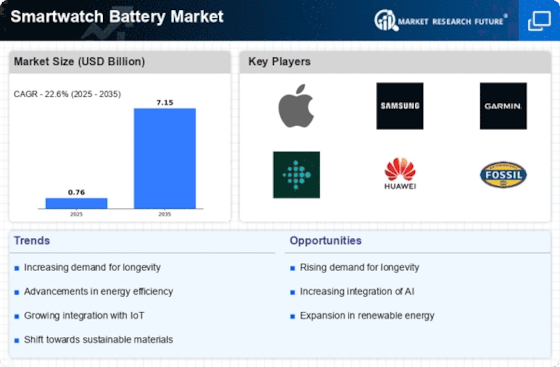
As per Market Research Future analysis, the Smartwatch Battery Market Size was estimated at 0.7601 USD Billion in 2024. The Smartwatch Battery industry is projected to grow from USD 0.9319 Billion in 2025 to USD 7.151 Billion by 2035, exhibiting a compound annual growth rate (CAGR) of 22.6% during the forecast period 2025 - 2035

Key Market Trends & Highlights

The Smartwatch Battery Market is experiencing a transformative shift towards sustainability and enhanced performance.

  • The North American market remains the largest, driven by high consumer demand for advanced wearable technology. The Asia-Pacific region is the fastest-growing market, reflecting a surge in innovative battery technologies and energy density improvements. Smartwatches with battery life of up to 10 days dominate the market, while those offering up to 21 days are rapidly gaining traction. Rising consumer preference for longer battery life and the integration of smart features are key drivers propelling market growth.

Market Size & Forecast

2024 Market Size 0.7601 (USD Billion)
2035 Market Size 7.151 (USD Billion)
CAGR (2025 - 2035) 22.6%
Largest Regional Market Share in 2024 North America

Major Players

Apple (US), Samsung (KR), Garmin (US), Fitbit (US), Huawei (CN), Fossil (US), Xiaomi (CN), Suunto (FI), Withings (FR)

Market Trends

The Smartwatch Battery Market is closely aligned with overall smartwatch market trends, as battery efficiency remains a key purchasing factor influencing smartwatch market growth. Rising adoption across regions such as the Asia pacific smartwatch market, India smartwatch market, and North America is accelerating innovation in battery performance. This shift is indicative of a broader trend towards sustainability, as companies seek to create batteries that not only perform better but also have a reduced environmental impact. Furthermore, the rise of health and fitness tracking features in smartwatches has led to a greater emphasis on battery longevity, as users expect their devices to support extended usage without frequent recharging. In addition to performance enhancements, the Smartwatch Battery Market is witnessing innovations in battery chemistry and design, particularly in the development of advanced smartwatch cell structures. Lithium-ion batteries remain prevalent, yet there is a growing interest in alternative technologies that promise higher efficiency and safety. The integration of solar charging capabilities and the exploration of solid-state batteries are examples of how the market is evolving. As competition intensifies, companies are likely to invest in research and development to stay ahead, potentially leading to breakthroughs in battery for smart watch solutions that could redefine user experiences. Overall, the Smartwatch Battery Market appears poised for growth, with trends suggesting a future where battery technology plays a crucial role in the functionality and appeal of smartwatches across the expanding market for smartwatches.

Sustainability Focus

The Smartwatch Battery Market is increasingly prioritizing sustainability, with manufacturers exploring eco-friendly materials and production processes for smartwatch cell components. This trend reflects a growing consumer awareness regarding environmental issues, prompting companies to develop batteries that minimize ecological footprints.

Enhanced Energy Density

There is a notable push towards improving energy density in smartwatch batteries. This enhancement allows for longer usage times and reduced charging frequency, aligning with consumer expectations for convenience and reliability in wearable technology and advancing smartwatch battery life technology.

Innovative Battery Technologies

The market is witnessing a surge in innovative battery technologies, including solid-state and solar-powered options. These advancements may offer improved safety and efficiency, potentially transforming the landscape of battery for smart watch solutions.

Smartwatch Battery Market Market Drivers

Integration of Smart Features

The integration of smart features in smartwatches is a notable driver for the Smartwatch Battery Market. Features such as heart rate monitoring, sleep tracking, and mobile payments require more power, thus increasing the demand for advanced battery solutions. As manufacturers strive to enhance the functionality of their devices, the need for batteries that can support these features without compromising performance becomes paramount. Market analysis indicates that the introduction of new smart features is likely to increase the average power consumption of smartwatches by approximately 20% over the next few years. This trend necessitates ongoing innovation in battery technology, further propelling the Smartwatch Battery Market.

Growing Focus on Sustainability

The growing focus on sustainability is emerging as a significant driver for the Smartwatch Battery Market. Consumers are increasingly aware of environmental issues and are seeking products that align with their values. This shift is prompting manufacturers to explore eco-friendly battery technologies and materials. For instance, the development of batteries using recyclable materials or those that have a lower environmental impact is gaining traction. Market data indicates that sustainable products are expected to capture a larger share of consumer spending, with projections suggesting a growth rate of around 10% annually in this segment. Consequently, the Smartwatch Battery Market is likely to adapt to these changing consumer preferences by prioritizing sustainability in battery design and production.

Rising Demand for Wearable Technology

The increasing adoption of wearable technology is a primary driver for the Smartwatch Battery Market. As consumers become more health-conscious, the demand for smartwatches that monitor fitness and health metrics continues to rise. According to recent data, the wearable technology market is projected to grow at a compound annual growth rate of approximately 15% over the next five years. This surge in demand necessitates advancements in battery technology to ensure longer usage times and improved performance. Consequently, manufacturers are investing in research and development to create batteries that can support the functionalities of these devices, thereby propelling the Smartwatch Battery Market forward.

Technological Advancements in Battery Life

Technological innovations in battery life are significantly influencing the Smartwatch Battery Market. As smartwatches incorporate more features, such as GPS tracking and health monitoring, the need for longer-lasting batteries becomes critical. Recent advancements in lithium-ion and solid-state battery technologies have shown promise in extending battery life while maintaining compact sizes. For instance, some new battery designs can potentially offer up to 50% more energy density than traditional batteries. This improvement not only enhances user experience but also drives competition among manufacturers to develop superior battery solutions, thereby stimulating growth in the Smartwatch Battery Market.

Consumer Preference for Longer Battery Life

Consumer preferences are shifting towards devices that offer longer battery life, which is a crucial driver for the Smartwatch Battery Market. Surveys indicate that a significant percentage of consumers prioritize battery longevity when selecting a smartwatch. In fact, data suggests that nearly 70% of users express dissatisfaction with battery performance in their current devices. This consumer sentiment compels manufacturers to focus on developing batteries that can sustain longer usage periods without frequent recharging. As a result, the Smartwatch Battery Market is witnessing a trend towards batteries that not only last longer but also charge faster, aligning with consumer expectations.

Market Segment Insights

By Type: Up to 10 Days (Largest) vs. Up to 21 Days (Fastest-Growing)

<p>The Smartwatch Battery Market is diversified across several duration segments, with 'Up to 10 Days' emerging as the largest share holder, appealing to users seeking a balanced duration of use and convenience in charging. Meanwhile, the 'Up to 21 Days' segment showcases significant growth, drawing attention from health-conscious users who prefer longer battery life for uninterrupted fitness tracking and other functionalities, thus enhancing its market presence.</p>

<p>Battery Life: Up to 10 Days (Dominant) vs. Up to 21 Days (Emerging)</p>

<p>The 'Up to 10 Days' battery life segment is renowned for offering an optimal blend of performance and convenience, catering to users who rely on their smartwatches for daily activities without frequent recharging interruptions. In contrast, the 'Up to 21 Days' segment is rapidly gaining traction, fueled by advancements in battery technology and increased consumer demand for prolonged usability without the need for daily charging. This segment appeals particularly to adventure seekers and fitness enthusiasts who prioritize longer battery life, ensuring they can track their activities without the anxiety of a dying battery, thus positioning themselves as an attractive choice in the competitive market.</p>

By Application: Android System Smartwatch (Largest) vs. iOS System Smartwatch (Fastest-Growing)

<p>In the Smartwatch Battery Market, the application segment showcases diverse preferences among users, with the Android System Smartwatch leading the overall market share. This is primarily due to a broader range of devices and more extensive compatibility with various hardware. Meanwhile, the iOS System Smartwatch, while having a smaller share currently, demonstrates significant potential for growth due to increasing user adoption of Apple products and their associated ecosystem. The Windows System Smartwatch remains a niche player with limited market penetration.</p>

<p>Application: Android System (Dominant) vs. iOS System (Emerging)</p>

<p>The Android System Smartwatch is characterized by its extensive compatibility with a wide variety of devices and manufacturers, enabling it to cater to a larger audience base. This dominance is reinforced by the versatility of Android as an operating system, appealing to both budget-conscious consumers and tech enthusiasts. Conversely, the iOS System Smartwatch is rapidly emerging, primarily driven by the growing number of Apple users and the seamless integration within the Apple ecosystem. As this trend continues, it is anticipated that the iOS System will capture a greater share of the market, supported by innovation and brand loyalty.</p>

Get more detailed insights about Smartwatch Battery Market Research Report—Global Forecast till 2035

Regional Insights

North America : Tech Innovation Leader

North America dominates both the Smartwatch Battery Market and the broader us smartwatch market share, driven by high adoption of premium wearable devices. The region also reflects strong participation from brands such as Garmin, influencing garmin smartwatch market share through performance-oriented products. Regulatory support for health-related devices further catalyzes market expansion, with initiatives promoting innovation in the tech sector. The competitive landscape is dominated by key players such as Apple, Garmin, and Fitbit, which are continuously innovating to enhance battery life and performance. The U.S. leads in adoption rates, while Canada follows closely, contributing to the region's robust market dynamics. The presence of major tech companies fosters a vibrant ecosystem for smartwatch battery development, ensuring sustained growth in the coming years.

Europe : Emerging Market Dynamics

Europe’s smartwatch ecosystem contributes significantly to the global smartwatch market share, with growing interest in specialized segments such as the Europe kids smartwatch market and France kids smartwatch market, which require compact and safe battery solutions. The region's demand is fueled by increasing health consciousness among consumers and a growing trend towards fitness tracking. Regulatory frameworks supporting sustainable technology and energy efficiency are also pivotal in driving market growth, encouraging manufacturers to innovate in smartwatch cell and battery systems. Leading countries in this region include Germany, the UK, and France, where consumer interest in smartwatches is rapidly increasing. Key players like Samsung and Withings are actively competing, focusing on enhancing battery life and integrating advanced features. The competitive landscape is characterized by a mix of established brands and emerging startups, fostering innovation and diversity in product offerings.

Asia-Pacific : Rapid Growth and Innovation

Asia-Pacific is an emerging powerhouse in the smartwatch battery market, holding around 25% of the global share, supported by rising disposable incomes and strong momentum in the smartwatch market in India and China. Increasing affordability and innovation are boosting overall smartwatch market size and regional smartwatch market share. The region's growth is driven by rising disposable incomes, increasing smartphone penetration, and a growing interest in health and fitness tracking. Government initiatives promoting digital health and smart technology adoption are also significant catalysts for market expansion, enhancing consumer access to wearable devices. China and Japan continue to lead innovation in battery for smart watch manufacturing, with major players like Huawei and Xiaomi leading the charge. The competitive landscape is vibrant, with numerous local manufacturers entering the market, driving innovation and competitive pricing. This dynamic environment is expected to propel further growth in the smartwatch battery sector, making it a key region for future developments.

Middle East and Africa : Untapped Market Potential

The Middle East and Africa represent a nascent market for smartwatch batteries, holding about 5% of the global share. Emerging adoption trends indicate long-term opportunities aligned with broader smartwatch market research, particularly as awareness and accessibility improve.  The region's growth is primarily driven by increasing smartphone adoption and rising interest in wearable technologies supported by evolving smartwatch battery life technology. Regulatory support for digital health initiatives is gradually emerging, which is expected to enhance market dynamics and consumer engagement in wearable technology. Countries like South Africa and the UAE are leading the way in smartwatch adoption, with a growing number of consumers seeking advanced health monitoring features. The competitive landscape is still developing, with both The Smartwatch Battery Market share. As awareness of smartwatches increases, the region is poised for significant growth in the coming years, presenting ample opportunities for investment and innovation.

Key Players and Competitive Insights

Leading market players are investing heavily in research and development to enhance smartwatch battery life technology and expand their battery for smart watch portfolios, supporting long-term market growth. Market participants are also undertaking a variety of strategic activities to expand their global footprint, with important market developments including new product launches, contractual agreements, mergers and acquisitions, higher investments, and collaboration with other organizations. The Smartwatch Battery Market is intrinsically linked to the smartwatch market analysis, as battery efficiency significantly impacts product competitiveness. Manufacturers track evolving smartwatch market trends to optimize battery development strategies and maintain position within the global smartwatch market share. Manufacturing locally to minimize operational costs is one of the key business tactics used by manufacturers in the global smartwatch battery industry to benefit clients and increase the market sector. In recent years, the smartwatch battery industry has offered some of the most significant advantages to medicine. Major players in the smartwatch battery market are attempting to increase market demand by investing in research and development operations includes Actian Corporation, Oracle, MemSQL, Inc., Microsoft, NuoDB, Inc., SAP SE, Teradata, IBM, Amazon Web Services, Inc., and Alphabet. Services for cloud computing are offered by Amazon Web Services Inc (AWS), a division of Amazon.com, Inc. The company provides a wide range of cloud infrastructure services, including computing, customer engagement, networking, analytics, storage, databases, mobile, developer tools, robotics, game tech, augmented reality and virtual reality, machine learning, content delivery, management tools, media services, app streaming, and security, identity, and compliance. In addition to the US, UK, China, Australia, France, India, Germany, Brazil, Canada, Ireland, Japan, Korea, and Singapore, the corporation also conducts business in these countries. In the US, Seattle, Washington, serves as the home base for AWS.Software for business applications and associated services are offered by SAP SE (SAP). Enterprise resource planning, smart technologies, analytics, financial management, human resources, digital supply chain, network, spend management, employee engagement, customer relationship management, and customer experience are just a few of the many solutions it offers. The business provides a selection of enterprise software and business applications that are made for database and technology operations, cloud, analytics, mobile, and applications.

Key Companies in the Smartwatch Battery Market include

Industry Developments

Recent industry developments reflect increased investment in advanced smartwatch cell production and high-energy density battery for smart watch solutions to meet rising global demand.

May 2022: Enovix Corporation, a pioneer in developing and producing 3D silicon lithium-ion batteries of the next generation, said that it has achieved a critical milestone in technological validation. Additionally, one of the biggest consumer electronics businesses in the world has therefore placed the first order for its high-energy density smartwatch battery. The customer's product development process has entered its next stage with this order.

November 2021: The Tianjin Lishen Battery Co. Ltd. signed a project for industry. It intended to establish the Lishen R&D center project and new energy industrial base in Wuxi Xishan. With an approximate 800 million square meter total land area, this project in Dongguan represents an investment of roughly USD 1.75 billion.

Future Outlook

Smartwatch Battery Market Future Outlook

The Smartwatch Battery Market is projected to grow at a 22.6% CAGR from 2025 to 2035, driven by advancements in battery technology, increasing consumer demand, and the proliferation of smart devices.

New opportunities lie in:

  • <p>Development of ultra-fast charging solutions for <a href="https://www.marketresearchfuture.com/reports/smart-watch-market-967">smartwatches</a>.</p>
  • <p> </p>
  • <p>Expansion into renewable energy sources for battery production.</p>
  • <p>Partnerships with smartwatch manufacturers for integrated battery systems.</p>

By 2035, the Smartwatch Battery Market is expected to achieve substantial growth and innovation.

Market Segmentation

Smartwatch Battery Market Type Outlook

  • Up to 5 Days
  • Up to 7 Days
  • Up to 10 Days
  • Up to 21 Days
  • Up to 30 Days

Smartwatch Battery Market Application Outlook

  • Android System Smartwatch
  • iOS System Smartwatch
  • Windows System Smartwatch

Report Scope

MARKET SIZE 2024 0.7601(USD Billion)
MARKET SIZE 2025 0.9319(USD Billion)
MARKET SIZE 2035 7.151(USD Billion)
COMPOUND ANNUAL GROWTH RATE (CAGR) 22.6% (2025 - 2035)
REPORT COVERAGE Revenue Forecast, Competitive Landscape, Growth Factors, and Trends
BASE YEAR 2024
Market Forecast Period 2025 - 2035
Historical Data 2019 - 2024
Market Forecast Units USD Billion
Key Companies Profiled Apple (US), Samsung (KR), Garmin (US), Fitbit (US), Huawei (CN), Fossil (US), Xiaomi (CN), Suunto (FI), Withings (FR)
Segments Covered Type, Application, Region
Key Market Opportunities Advancements in energy density and fast-charging technologies drive growth in the Smartwatch Battery Market.
Key Market Dynamics Technological advancements in battery efficiency drive competitive dynamics in the Smartwatch Battery Market.
Countries Covered North America, Europe, APAC, South America, MEA

FAQs

What is the current valuation of the Smartwatch Battery Market as of 2024?

<p>The Smartwatch Battery Market was valued at 0.7601 USD Billion in 2024.</p>

What is the projected market valuation for the Smartwatch Battery Market in 2035?

<p>The market is projected to reach a valuation of 7.151 USD Billion by 2035.</p>

What is the expected CAGR for the Smartwatch Battery Market during the forecast period 2025 - 2035?

<p>The expected CAGR for the Smartwatch Battery Market during 2025 - 2035 is 22.6%.</p>

Which companies are considered key players in the Smartwatch Battery Market?

<p>Key players in the market include Apple, Samsung, Garmin, Fitbit, Huawei, Fossil, Xiaomi, Suunto, and Withings.</p>

How does the market segment for smartwatch batteries perform based on battery life?

<p>The segment for battery life shows valuations such as 0.152 USD Billion for up to 5 days and 0.228 USD Billion for up to 7 days.</p>

What are the valuations for smartwatch batteries based on the operating system?

<p>For operating systems, the Android System Smartwatch and iOS System Smartwatch each had a valuation of 0.3041 USD Billion.</p>

What is the market performance for smartwatch batteries lasting up to 21 days?

The market performance for batteries lasting up to 21 days was valued at 0.076 USD Billion.

What is the valuation for smartwatch batteries that last up to 30 days?

The valuation for smartwatch batteries lasting up to 30 days was also 0.076 USD Billion.

How do the valuations for Windows System Smartwatches compare to others?

The valuation for Windows System Smartwatches was 0.1519 USD Billion, indicating a smaller segment compared to Android and iOS.

What trends are anticipated in the Smartwatch Battery Market as it approaches 2035?

Trends suggest substantial growth, with the market likely expanding significantly due to increasing demand and technological advancements.

  1. SECTION I: EXECUTIVE SUMMARY AND KEY HIGHLIGHTS
    1. | 1.1 EXECUTIVE SUMMARY
    2. | | 1.1.1 Market Overview
    3. | | 1.1.2 Key Findings
    4. | | 1.1.3 Market Segmentation
    5. | | 1.1.4 Competitive Landscape
    6. | | 1.1.5 Challenges and Opportunities
    7. | | 1.1.6 Future Outlook
  2. SECTION II: SCOPING, METHODOLOGY AND MARKET STRUCTURE
    1. | 2.1 MARKET INTRODUCTION
    2. | | 2.1.1 Definition
    3. | | 2.1.2 Scope of the study
    4. | | | 2.1.2.1 Research Objective
    5. | | | 2.1.2.2 Assumption
    6. | | | 2.1.2.3 Limitations
    7. | 2.2 RESEARCH METHODOLOGY
    8. | | 2.2.1 Overview
    9. | | 2.2.2 Data Mining
    10. | | 2.2.3 Secondary Research
    11. | | 2.2.4 Primary Research
    12. | | | 2.2.4.1 Primary Interviews and Information Gathering Process
    13. | | | 2.2.4.2 Breakdown of Primary Respondents
    14. | | 2.2.5 Forecasting Model
    15. | | 2.2.6 Market Size Estimation
    16. | | | 2.2.6.1 Bottom-Up Approach
    17. | | | 2.2.6.2 Top-Down Approach
    18. | | 2.2.7 Data Triangulation
    19. | | 2.2.8 Validation
  3. SECTION III: QUALITATIVE ANALYSIS
    1. | 3.1 MARKET DYNAMICS
    2. | | 3.1.1 Overview
    3. | | 3.1.2 Drivers
    4. | | 3.1.3 Restraints
    5. | | 3.1.4 Opportunities
    6. | 3.2 MARKET FACTOR ANALYSIS
    7. | | 3.2.1 Value chain Analysis
    8. | | 3.2.2 Porter's Five Forces Analysis
    9. | | | 3.2.2.1 Bargaining Power of Suppliers
    10. | | | 3.2.2.2 Bargaining Power of Buyers
    11. | | | 3.2.2.3 Threat of New Entrants
    12. | | | 3.2.2.4 Threat of Substitutes
    13. | | | 3.2.2.5 Intensity of Rivalry
    14. | | 3.2.3 COVID-19 Impact Analysis
    15. | | | 3.2.3.1 Market Impact Analysis
    16. | | | 3.2.3.2 Regional Impact
    17. | | | 3.2.3.3 Opportunity and Threat Analysis
  4. SECTION IV: QUANTITATIVE ANALYSIS
    1. | 4.1 Semiconductor & Electronics, BY Type (USD Billion)
    2. | | 4.1.1 Up to 5 Days
    3. | | 4.1.2 Up to 7 Days
    4. | | 4.1.3 Up to 10 Days
    5. | | 4.1.4 Up to 21 Days
    6. | | 4.1.5 Up to 30 Days
    7. | 4.2 Semiconductor & Electronics, BY Application (USD Billion)
    8. | | 4.2.1 Android System Smartwatch
    9. | | 4.2.2 iOS System Smartwatch
    10. | | 4.2.3 Windows System Smartwatch
    11. | 4.3 Semiconductor & Electronics, BY Region (USD Billion)
    12. | | 4.3.1 North America
    13. | | | 4.3.1.1 US
    14. | | | 4.3.1.2 Canada
    15. | | 4.3.2 Europe
    16. | | | 4.3.2.1 Germany
    17. | | | 4.3.2.2 UK
    18. | | | 4.3.2.3 France
    19. | | | 4.3.2.4 Russia
    20. | | | 4.3.2.5 Italy
    21. | | | 4.3.2.6 Spain
    22. | | | 4.3.2.7 Rest of Europe
    23. | | 4.3.3 APAC
    24. | | | 4.3.3.1 China
    25. | | | 4.3.3.2 India
    26. | | | 4.3.3.3 Japan
    27. | | | 4.3.3.4 South Korea
    28. | | | 4.3.3.5 Malaysia
    29. | | | 4.3.3.6 Thailand
    30. | | | 4.3.3.7 Indonesia
    31. | | | 4.3.3.8 Rest of APAC
    32. | | 4.3.4 South America
    33. | | | 4.3.4.1 Brazil
    34. | | | 4.3.4.2 Mexico
    35. | | | 4.3.4.3 Argentina
    36. | | | 4.3.4.4 Rest of South America
    37. | | 4.3.5 MEA
    38. | | | 4.3.5.1 GCC Countries
    39. | | | 4.3.5.2 South Africa
    40. | | | 4.3.5.3 Rest of MEA
  5. SECTION V: COMPETITIVE ANALYSIS
    1. | 5.1 Competitive Landscape
    2. | | 5.1.1 Overview
    3. | | 5.1.2 Competitive Analysis
    4. | | 5.1.3 Market share Analysis
    5. | | 5.1.4 Major Growth Strategy in the Semiconductor & Electronics
    6. | | 5.1.5 Competitive Benchmarking
    7. | | 5.1.6 Leading Players in Terms of Number of Developments in the Semiconductor & Electronics
    8. | | 5.1.7 Key developments and growth strategies
    9. | | | 5.1.7.1 New Product Launch/Service Deployment
    10. | | | 5.1.7.2 Merger & Acquisitions
    11. | | | 5.1.7.3 Joint Ventures
    12. | | 5.1.8 Major Players Financial Matrix
    13. | | | 5.1.8.1 Sales and Operating Income
    14. | | | 5.1.8.2 Major Players R&D Expenditure. 2023
    15. | 5.2 Company Profiles
    16. | | 5.2.1 Apple (US)
    17. | | | 5.2.1.1 Financial Overview
    18. | | | 5.2.1.2 Products Offered
    19. | | | 5.2.1.3 Key Developments
    20. | | | 5.2.1.4 SWOT Analysis
    21. | | | 5.2.1.5 Key Strategies
    22. | | 5.2.2 Samsung (KR)
    23. | | | 5.2.2.1 Financial Overview
    24. | | | 5.2.2.2 Products Offered
    25. | | | 5.2.2.3 Key Developments
    26. | | | 5.2.2.4 SWOT Analysis
    27. | | | 5.2.2.5 Key Strategies
    28. | | 5.2.3 Garmin (US)
    29. | | | 5.2.3.1 Financial Overview
    30. | | | 5.2.3.2 Products Offered
    31. | | | 5.2.3.3 Key Developments
    32. | | | 5.2.3.4 SWOT Analysis
    33. | | | 5.2.3.5 Key Strategies
    34. | | 5.2.4 Fitbit (US)
    35. | | | 5.2.4.1 Financial Overview
    36. | | | 5.2.4.2 Products Offered
    37. | | | 5.2.4.3 Key Developments
    38. | | | 5.2.4.4 SWOT Analysis
    39. | | | 5.2.4.5 Key Strategies
    40. | | 5.2.5 Huawei (CN)
    41. | | | 5.2.5.1 Financial Overview
    42. | | | 5.2.5.2 Products Offered
    43. | | | 5.2.5.3 Key Developments
    44. | | | 5.2.5.4 SWOT Analysis
    45. | | | 5.2.5.5 Key Strategies
    46. | | 5.2.6 Fossil (US)
    47. | | | 5.2.6.1 Financial Overview
    48. | | | 5.2.6.2 Products Offered
    49. | | | 5.2.6.3 Key Developments
    50. | | | 5.2.6.4 SWOT Analysis
    51. | | | 5.2.6.5 Key Strategies
    52. | | 5.2.7 Xiaomi (CN)
    53. | | | 5.2.7.1 Financial Overview
    54. | | | 5.2.7.2 Products Offered
    55. | | | 5.2.7.3 Key Developments
    56. | | | 5.2.7.4 SWOT Analysis
    57. | | | 5.2.7.5 Key Strategies
    58. | | 5.2.8 Suunto (FI)
    59. | | | 5.2.8.1 Financial Overview
    60. | | | 5.2.8.2 Products Offered
    61. | | | 5.2.8.3 Key Developments
    62. | | | 5.2.8.4 SWOT Analysis
    63. | | | 5.2.8.5 Key Strategies
    64. | | 5.2.9 Withings (FR)
    65. | | | 5.2.9.1 Financial Overview
    66. | | | 5.2.9.2 Products Offered
    67. | | | 5.2.9.3 Key Developments
    68. | | | 5.2.9.4 SWOT Analysis
    69. | | | 5.2.9.5 Key Strategies
    70. | 5.3 Appendix
    71. | | 5.3.1 References
    72. | | 5.3.2 Related Reports
  6. LIST OF FIGURES
    1. | 6.1 MARKET SYNOPSIS
    2. | 6.2 NORTH AMERICA MARKET ANALYSIS
    3. | 6.3 US MARKET ANALYSIS BY TYPE
    4. | 6.4 US MARKET ANALYSIS BY APPLICATION
    5. | 6.5 CANADA MARKET ANALYSIS BY TYPE
    6. | 6.6 CANADA MARKET ANALYSIS BY APPLICATION
    7. | 6.7 EUROPE MARKET ANALYSIS
    8. | 6.8 GERMANY MARKET ANALYSIS BY TYPE
    9. | 6.9 GERMANY MARKET ANALYSIS BY APPLICATION
    10. | 6.10 UK MARKET ANALYSIS BY TYPE
    11. | 6.11 UK MARKET ANALYSIS BY APPLICATION
    12. | 6.12 FRANCE MARKET ANALYSIS BY TYPE
    13. | 6.13 FRANCE MARKET ANALYSIS BY APPLICATION
    14. | 6.14 RUSSIA MARKET ANALYSIS BY TYPE
    15. | 6.15 RUSSIA MARKET ANALYSIS BY APPLICATION
    16. | 6.16 ITALY MARKET ANALYSIS BY TYPE
    17. | 6.17 ITALY MARKET ANALYSIS BY APPLICATION
    18. | 6.18 SPAIN MARKET ANALYSIS BY TYPE
    19. | 6.19 SPAIN MARKET ANALYSIS BY APPLICATION
    20. | 6.20 REST OF EUROPE MARKET ANALYSIS BY TYPE
    21. | 6.21 REST OF EUROPE MARKET ANALYSIS BY APPLICATION
    22. | 6.22 APAC MARKET ANALYSIS
    23. | 6.23 CHINA MARKET ANALYSIS BY TYPE
    24. | 6.24 CHINA MARKET ANALYSIS BY APPLICATION
    25. | 6.25 INDIA MARKET ANALYSIS BY TYPE
    26. | 6.26 INDIA MARKET ANALYSIS BY APPLICATION
    27. | 6.27 JAPAN MARKET ANALYSIS BY TYPE
    28. | 6.28 JAPAN MARKET ANALYSIS BY APPLICATION
    29. | 6.29 SOUTH KOREA MARKET ANALYSIS BY TYPE
    30. | 6.30 SOUTH KOREA MARKET ANALYSIS BY APPLICATION
    31. | 6.31 MALAYSIA MARKET ANALYSIS BY TYPE
    32. | 6.32 MALAYSIA MARKET ANALYSIS BY APPLICATION
    33. | 6.33 THAILAND MARKET ANALYSIS BY TYPE
    34. | 6.34 THAILAND MARKET ANALYSIS BY APPLICATION
    35. | 6.35 INDONESIA MARKET ANALYSIS BY TYPE
    36. | 6.36 INDONESIA MARKET ANALYSIS BY APPLICATION
    37. | 6.37 REST OF APAC MARKET ANALYSIS BY TYPE
    38. | 6.38 REST OF APAC MARKET ANALYSIS BY APPLICATION
    39. | 6.39 SOUTH AMERICA MARKET ANALYSIS
    40. | 6.40 BRAZIL MARKET ANALYSIS BY TYPE
    41. | 6.41 BRAZIL MARKET ANALYSIS BY APPLICATION
    42. | 6.42 MEXICO MARKET ANALYSIS BY TYPE
    43. | 6.43 MEXICO MARKET ANALYSIS BY APPLICATION
    44. | 6.44 ARGENTINA MARKET ANALYSIS BY TYPE
    45. | 6.45 ARGENTINA MARKET ANALYSIS BY APPLICATION
    46. | 6.46 REST OF SOUTH AMERICA MARKET ANALYSIS BY TYPE
    47. | 6.47 REST OF SOUTH AMERICA MARKET ANALYSIS BY APPLICATION
    48. | 6.48 MEA MARKET ANALYSIS
    49. | 6.49 GCC COUNTRIES MARKET ANALYSIS BY TYPE
    50. | 6.50 GCC COUNTRIES MARKET ANALYSIS BY APPLICATION
    51. | 6.51 SOUTH AFRICA MARKET ANALYSIS BY TYPE
    52. | 6.52 SOUTH AFRICA MARKET ANALYSIS BY APPLICATION
    53. | 6.53 REST OF MEA MARKET ANALYSIS BY TYPE
    54. | 6.54 REST OF MEA MARKET ANALYSIS BY APPLICATION
    55. | 6.55 KEY BUYING CRITERIA OF SEMICONDUCTOR & ELECTRONICS
    56. | 6.56 RESEARCH PROCESS OF MRFR
    57. | 6.57 DRO ANALYSIS OF SEMICONDUCTOR & ELECTRONICS
    58. | 6.58 DRIVERS IMPACT ANALYSIS: SEMICONDUCTOR & ELECTRONICS
    59. | 6.59 RESTRAINTS IMPACT ANALYSIS: SEMICONDUCTOR & ELECTRONICS
    60. | 6.60 SUPPLY / VALUE CHAIN: SEMICONDUCTOR & ELECTRONICS
    61. | 6.61 SEMICONDUCTOR & ELECTRONICS, BY TYPE, 2024 (% SHARE)
    62. | 6.62 SEMICONDUCTOR & ELECTRONICS, BY TYPE, 2024 TO 2035 (USD Billion)
    63. | 6.63 SEMICONDUCTOR & ELECTRONICS, BY APPLICATION, 2024 (% SHARE)
    64. | 6.64 SEMICONDUCTOR & ELECTRONICS, BY APPLICATION, 2024 TO 2035 (USD Billion)
    65. | 6.65 BENCHMARKING OF MAJOR COMPETITORS
  7. LIST OF TABLES
    1. | 7.1 LIST OF ASSUMPTIONS
    2. | | 7.1.1
    3. | 7.2 North America MARKET SIZE ESTIMATES; FORECAST
    4. | | 7.2.1 BY TYPE, 2025-2035 (USD Billion)
    5. | | 7.2.2 BY APPLICATION, 2025-2035 (USD Billion)
    6. | 7.3 US MARKET SIZE ESTIMATES; FORECAST
    7. | | 7.3.1 BY TYPE, 2025-2035 (USD Billion)
    8. | | 7.3.2 BY APPLICATION, 2025-2035 (USD Billion)
    9. | 7.4 Canada MARKET SIZE ESTIMATES; FORECAST
    10. | | 7.4.1 BY TYPE, 2025-2035 (USD Billion)
    11. | | 7.4.2 BY APPLICATION, 2025-2035 (USD Billion)
    12. | 7.5 Europe MARKET SIZE ESTIMATES; FORECAST
    13. | | 7.5.1 BY TYPE, 2025-2035 (USD Billion)
    14. | | 7.5.2 BY APPLICATION, 2025-2035 (USD Billion)
    15. | 7.6 Germany MARKET SIZE ESTIMATES; FORECAST
    16. | | 7.6.1 BY TYPE, 2025-2035 (USD Billion)
    17. | | 7.6.2 BY APPLICATION, 2025-2035 (USD Billion)
    18. | 7.7 UK MARKET SIZE ESTIMATES; FORECAST
    19. | | 7.7.1 BY TYPE, 2025-2035 (USD Billion)
    20. | | 7.7.2 BY APPLICATION, 2025-2035 (USD Billion)
    21. | 7.8 France MARKET SIZE ESTIMATES; FORECAST
    22. | | 7.8.1 BY TYPE, 2025-2035 (USD Billion)
    23. | | 7.8.2 BY APPLICATION, 2025-2035 (USD Billion)
    24. | 7.9 Russia MARKET SIZE ESTIMATES; FORECAST
    25. | | 7.9.1 BY TYPE, 2025-2035 (USD Billion)
    26. | | 7.9.2 BY APPLICATION, 2025-2035 (USD Billion)
    27. | 7.10 Italy MARKET SIZE ESTIMATES; FORECAST
    28. | | 7.10.1 BY TYPE, 2025-2035 (USD Billion)
    29. | | 7.10.2 BY APPLICATION, 2025-2035 (USD Billion)
    30. | 7.11 Spain MARKET SIZE ESTIMATES; FORECAST
    31. | | 7.11.1 BY TYPE, 2025-2035 (USD Billion)
    32. | | 7.11.2 BY APPLICATION, 2025-2035 (USD Billion)
    33. | 7.12 Rest of Europe MARKET SIZE ESTIMATES; FORECAST
    34. | | 7.12.1 BY TYPE, 2025-2035 (USD Billion)
    35. | | 7.12.2 BY APPLICATION, 2025-2035 (USD Billion)
    36. | 7.13 APAC MARKET SIZE ESTIMATES; FORECAST
    37. | | 7.13.1 BY TYPE, 2025-2035 (USD Billion)
    38. | | 7.13.2 BY APPLICATION, 2025-2035 (USD Billion)
    39. | 7.14 China MARKET SIZE ESTIMATES; FORECAST
    40. | | 7.14.1 BY TYPE, 2025-2035 (USD Billion)
    41. | | 7.14.2 BY APPLICATION, 2025-2035 (USD Billion)
    42. | 7.15 India MARKET SIZE ESTIMATES; FORECAST
    43. | | 7.15.1 BY TYPE, 2025-2035 (USD Billion)
    44. | | 7.15.2 BY APPLICATION, 2025-2035 (USD Billion)
    45. | 7.16 Japan MARKET SIZE ESTIMATES; FORECAST
    46. | | 7.16.1 BY TYPE, 2025-2035 (USD Billion)
    47. | | 7.16.2 BY APPLICATION, 2025-2035 (USD Billion)
    48. | 7.17 South Korea MARKET SIZE ESTIMATES; FORECAST
    49. | | 7.17.1 BY TYPE, 2025-2035 (USD Billion)
    50. | | 7.17.2 BY APPLICATION, 2025-2035 (USD Billion)
    51. | 7.18 Malaysia MARKET SIZE ESTIMATES; FORECAST
    52. | | 7.18.1 BY TYPE, 2025-2035 (USD Billion)
    53. | | 7.18.2 BY APPLICATION, 2025-2035 (USD Billion)
    54. | 7.19 Thailand MARKET SIZE ESTIMATES; FORECAST
    55. | | 7.19.1 BY TYPE, 2025-2035 (USD Billion)
    56. | | 7.19.2 BY APPLICATION, 2025-2035 (USD Billion)
    57. | 7.20 Indonesia MARKET SIZE ESTIMATES; FORECAST
    58. | | 7.20.1 BY TYPE, 2025-2035 (USD Billion)
    59. | | 7.20.2 BY APPLICATION, 2025-2035 (USD Billion)
    60. | 7.21 Rest of APAC MARKET SIZE ESTIMATES; FORECAST
    61. | | 7.21.1 BY TYPE, 2025-2035 (USD Billion)
    62. | | 7.21.2 BY APPLICATION, 2025-2035 (USD Billion)
    63. | 7.22 South America MARKET SIZE ESTIMATES; FORECAST
    64. | | 7.22.1 BY TYPE, 2025-2035 (USD Billion)
    65. | | 7.22.2 BY APPLICATION, 2025-2035 (USD Billion)
    66. | 7.23 Brazil MARKET SIZE ESTIMATES; FORECAST
    67. | | 7.23.1 BY TYPE, 2025-2035 (USD Billion)
    68. | | 7.23.2 BY APPLICATION, 2025-2035 (USD Billion)
    69. | 7.24 Mexico MARKET SIZE ESTIMATES; FORECAST
    70. | | 7.24.1 BY TYPE, 2025-2035 (USD Billion)
    71. | | 7.24.2 BY APPLICATION, 2025-2035 (USD Billion)
    72. | 7.25 Argentina MARKET SIZE ESTIMATES; FORECAST
    73. | | 7.25.1 BY TYPE, 2025-2035 (USD Billion)
    74. | | 7.25.2 BY APPLICATION, 2025-2035 (USD Billion)
    75. | 7.26 Rest of South America MARKET SIZE ESTIMATES; FORECAST
    76. | | 7.26.1 BY TYPE, 2025-2035 (USD Billion)
    77. | | 7.26.2 BY APPLICATION, 2025-2035 (USD Billion)
    78. | 7.27 MEA MARKET SIZE ESTIMATES; FORECAST
    79. | | 7.27.1 BY TYPE, 2025-2035 (USD Billion)
    80. | | 7.27.2 BY APPLICATION, 2025-2035 (USD Billion)
    81. | 7.28 GCC Countries MARKET SIZE ESTIMATES; FORECAST
    82. | | 7.28.1 BY TYPE, 2025-2035 (USD Billion)
    83. | | 7.28.2 BY APPLICATION, 2025-2035 (USD Billion)
    84. | 7.29 South Africa MARKET SIZE ESTIMATES; FORECAST
    85. | | 7.29.1 BY TYPE, 2025-2035 (USD Billion)
    86. | | 7.29.2 BY APPLICATION, 2025-2035 (USD Billion)
    87. | 7.30 Rest of MEA MARKET SIZE ESTIMATES; FORECAST
    88. | | 7.30.1 BY TYPE, 2025-2035 (USD Billion)
    89. | | 7.30.2 BY APPLICATION, 2025-2035 (USD Billion)
    90. | 7.31 PRODUCT LAUNCH/PRODUCT DEVELOPMENT/APPROVAL
    91. | | 7.31.1
    92. | 7.32 ACQUISITION/PARTNERSHIP
    93. | | 7.32.1

Semiconductor & Electronics Market Segmentation

Semiconductor & Electronics By Type (USD Billion, 2025-2035)

  • Up to 5 Days
  • Up to 7 Days
  • Up to 10 Days
  • Up to 21 Days
  • Up to 30 Days

Semiconductor & Electronics By Application (USD Billion, 2025-2035)

  • Android System Smartwatch
  • iOS System Smartwatch
  • Windows System Smartwatch
Infographic

Free Sample Request

Kindly complete the form below to receive a free sample of this Report

Get Free Sample

Customer Strories

Compare Licence

×
Features License Type
Single User Multiuser License Enterprise User
Price $4,950 $5,950 $7,250
Maximum User Access Limit 1 User Upto 10 Users Unrestricted Access Throughout the Organization
Free Customization
Direct Access to Analyst
Deliverable Format
Platform Access
Discount on Next Purchase 10% 15% 15%
Printable Versions