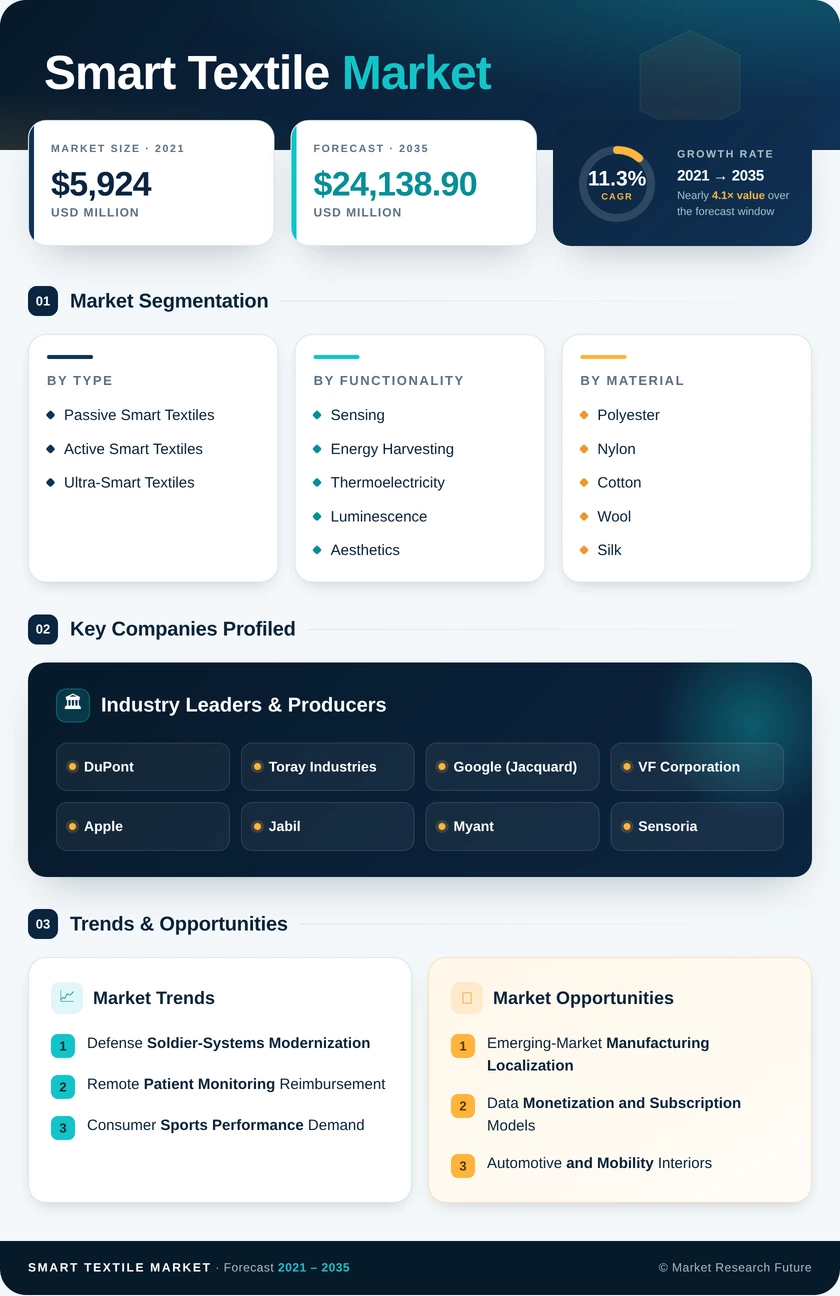
Smart Textile Market (2026 - 2035)

ID: MRFR/CnM/4031-HCR 111 Pages Chitranshi Jaiswal Last Updated: September 15, 2026
Smart Textile Market Research Report Information By Type (Passive Smart Textiles, Active Smart Textiles, and Ultra-Smart Textiles), By Functionality (Sensing, Energy Harvesting, Thermoelectricity, Luminescence and Aesthetics, and Others), By Material (Polyester and Nylon, Cotton, Wool and Silk, and Others), and By Application (Sports and Fitness, Military and Defense, Healthcare, Fashion and Entertainment, Transportation, and Architecture and Others) – Forecast Till 2035
Smart Textile Market
Market Size
Forecast Period2026-2035
CAGR (2026-2035)11.3%
2025 Market SizeUSD 8,292.5 Million
2035 Market SizeUSD 24,138.9 Million
Key Players
DuPont
Toray Industries
Google
VF Corporation
Apple
Jabil
Opportunities
  • Emerging-Market Manufacturing Localization
  • Data Monetization and Subscription Models
  • Automotive and Mobility Interiors
  1. 1 Market Summary | |
    1. 1.1 Study Assumptions & Market Definition | |
    2. 1.2 Scope of the Study | |
    3. 1.3 Research Methodology | |
  2. 2 Key Report Takeaways | |
    1. 2.1 By Technology | |
    2. 2.2 By Sector | |
    3. 2.3 By Geography | |
  3. 3 Market Size & Forecast (2021–2035) | |
    1. 3.1 Historical Market Size (2021–2025) | |
    2. 3.2 Current & Forecast Market Size (2026–2035) | |
    3. 3.3 Market Size by Revenue (USD Million) | |
    4. 3.4 Year-over-Year Growth Analysis | |
  4. 4 Driver Impact Analysis | |
    1. 4.1 Defense Soldier-Systems Modernization | |
    2. 4.2 Remote Patient Monitoring Reimbursement | |
    3. 4.3 Consumer Sports Performance Demand | |
    4. 4.4 Flexible Electronics Miniaturization | |
    5. 4.5 Industrial Worker Safety Mandates | |
    6. 4.6 Sustainability and Traceability Regulation | |
    7. 4.7 Venture and Strategic Capital Inflows | |
  5. 5 Restraints Impact Analysis | |
    1. 5.1 Wash Durability and Reliability Failure | |
    2. 5.2 Unit Cost Premium Over Conventional Apparel | |
    3. 5.3 Absent Testing and Interoperability Standards | |
    4. 5.4 Data Privacy and Medical-Device Compliance | |
    5. 5.5 End-of-Life Recycling Conflict | |
  6. 6 Opportunities | |
    1. 6.1 Emerging-Market Manufacturing Localization | |
    2. 6.2 Data Monetization and Subscription Models | |
    3. 6.3 Automotive and Mobility Interiors | |
    4. 6.4 Energy-Autonomous Defense and Field Systems | |
    5. 6.5 Elder Care and Occupational Health as a Service | |
  7. 7 Regional Market Share & Country-Level Analysis | |
    1. 7.1 North America | | |
      1. 7.1.1 US | | |
      2. 7.1.2 Canada | | |
      3. 7.1.3 Mexico | |
    2. 7.2 Europe | | |
      1. 7.2.1 Germany | | |
      2. 7.2.2 UK | | |
      3. 7.2.3 France | | |
      4. 7.2.4 Italy | | |
      5. 7.2.5 Spain | | |
      6. 7.2.6 Nordic Countries | | |
      7. 7.2.7 Russia | | |
      8. 7.2.8 Rest of Europe | |
    3. 7.3 Asia-Pacific | | |
      1. 7.3.1 China | | |
      2. 7.3.2 India | | |
      3. 7.3.3 Japan | | |
      4. 7.3.4 South Korea | | |
      5. 7.3.5 ASEAN | | |
      6. 7.3.6 Rest of Asia-Pacific | |
    4. 7.4 South America | | |
      1. 7.4.1 Brazil | | |
      2. 7.4.2 Argentina | | |
      3. 7.4.3 Rest of South America | |
    5. 7.5 Middle East & Africa | | |
      1. 7.5.1 Saudi Arabia | | |
      2. 7.5.2 UAE | | |
      3. 7.5.3 South Africa | | |
      4. 7.5.4 Egypt | | |
      5. 7.5.5 Rest of Middle East & Africa | |
  8. 8 Future Outlook (2026–2035) | |
    1. 8.1 On-Garment Intelligence and Edge Processing | |
    2. 8.2 Platform Consolidation and Standardized Connectors | |
    3. 8.3 Energy Autonomy and the End of the Charging Ritual | |
    4. 8.4 Circularity Reporting and Material Accountability | |
  9. 9 Segmentation Analysis | |
    1. 9.1 By Type | | |
      1. 9.1.1 Passive Smart Textiles | | |
      2. 9.1.2 Active Smart Textiles | | |
      3. 9.1.3 Ultra-Smart Textiles | |
    2. 9.2 By Functionality | | |
      1. 9.2.1 Sensing | | |
      2. 9.2.2 Energy Harvesting | | |
      3. 9.2.3 Thermoelectricity | | |
      4. 9.2.4 Luminescence and Aesthetics | | |
      5. 9.2.5 Others | |
    3. 9.3 By Material | | |
      1. 9.3.1 Polyester and Nylon | | |
      2. 9.3.2 Cotton | | |
      3. 9.3.3 Wool and Silk | | |
      4. 9.3.4 Others | |
    4. 9.4 By Application | | |
      1. 9.4.1 Sports and Fitness | | |
      2. 9.4.2 Military and Defense | | |
      3. 9.4.3 Healthcare | | |
      4. 9.4.4 Fashion and Entertainment | | |
      5. 9.4.5 Transportation | | |
      6. 9.4.6 Architecture and Others | |
  10. 10 Competitive Landscape | |
    1. 10.1 Market Concentration Analysis (2026) | |
    2. 10.2 Competitive Benchmarking Matrix | |
    3. 10.3 Company Profiles | | |
      1. 10.3.1 DuPont | | |
      2. 10.3.2 Toray Industries | | |
      3. 10.3.3 Google | | |
      4. 10.3.4 VF Corporation | | |
      5. 10.3.5 Apple | | |
      6. 10.3.6 Jabil | | |
      7. 10.3.7 Myant | | |
      8. 10.3.8 Sensoria | | |
      9. 10.3.9 Xenoma | | |
      10. 10.3.10 Meta | | |
      11. 10.3.11 Laird Performance Materials | | |
      12. 10.3.12 Hexoskin (Carré Technologies) | |
  11. 11 Recent News & Developments | |
  12. 12 Report Scope & Methodology | |
    1. 12.1 Study Period & Base Year | |
    2. 12.2 Data Sources & Triangulation | |
    3. 12.3 Abbreviations | |
  13. 13 Detailed Sources & Citations | |
  14. 14 Frequently Asked Questions | | LIST OF TABLES | |
  15. TABLE 1 Global Smart Textile Market Size & Forecast, by Revenue (USD Million), 2021–2035 | |
  16. TABLE 2 Global Smart Textile Market – Year-over-Year Growth Analysis, 2021–2035 | |
  17. TABLE 3 Driver Impact Analysis – Contribution Weighting by Timeline, 2026–2035 | |
  18. TABLE 4 Restraint Impact Analysis – Drag Weighting by Timeline, 2026–2035 | |
  19. TABLE 5 Global Market Size, by Region, 2021–2035 (USD Million) | |
  20. TABLE 6 North America Market Size, by Country, 2021–2035 (USD Million) | |
  21. TABLE 7 Europe Market Size, by Country, 2021–2035 (USD Million) | |
  22. TABLE 8 Asia-Pacific Market Size, by Country, 2021–2035 (USD Million) | |
  23. TABLE 9 South America Market Size, by Country, 2021–2035 (USD Million) | |
  24. TABLE 10 Middle East & Africa Market Size, by Country, 2021–2035 (USD Million) | |
  25. TABLE 11 Global Market Size, by Type, 2021–2035 (USD Million) | |
  26. TABLE 12 Global Market Size, by Functionality, 2021–2035 (USD Million) | |
  27. TABLE 13 Global Market Size, by Material, 2021–2035 (USD Million) | |
  28. TABLE 14 Global Market Size, by Application, 2021–2035 (USD Million) | |
  29. TABLE 15 North America Market Size, by Application, 2021–2035 (USD Million) | |
  30. TABLE 16 Europe Market Size, by Functionality, 2021–2035 (USD Million) | |
  31. TABLE 17 Asia-Pacific Market Size, by Material, 2021–2035 (USD Million) | |
  32. TABLE 18 Competitive Benchmarking Matrix, 2026 | |
  33. TABLE 19 Company Profiles – Key Players | |
  34. TABLE 20 Recent Developments & Strategic Announcements, 2023–2025 | |
  35. TABLE 21 Report Scope & Methodology Summary | |
  36. TABLE 22 Detailed Sources & Citations Index | | LIST OF FIGURES | |
  37. FIGURE 1 Market Dynamics Overview – Drivers, Restraints and Opportunities | |
  38. FIGURE 2 Industry Value Chain Analysis – Fiber to Finished Garment | |
  39. FIGURE 3 Porter's Five Forces Analysis | |
  40. FIGURE 4 Global Market Size Trend, 2021–2035 (USD Million) | |
  41. FIGURE 5 Year-over-Year Growth Curve, 2022–2035 (%) | |
  42. FIGURE 6 Market Share by Type, 2025 vs 2035 (%) | |
  43. FIGURE 7 Market Share by Functionality, 2025 (%) | |
  44. FIGURE 8 Market Share by Material, 2025 (%) | |
  45. FIGURE 9 Market Share by Application, 2025 vs 2035 (%) | |
  46. FIGURE 10 Regional Market Share Distribution, 2025 (%) | |
  47. FIGURE 11 Regional CAGR Comparison, 2026–2035 (%) | |
  48. FIGURE 12 Country-Level Contribution within Asia-Pacific, 2025 (%) | |
  49. FIGURE 13 Competitive Landscape Positioning Matrix, 2026 | |
  50. FIGURE 14 Top-5 Player Revenue Share Concentration, 2026 (%) | |
  51. FIGURE 15 Patent Filing Trend – Conductive Yarn and Flexible Circuits, 2021–2025

Segmentation Quick Reference

DimensionSub-SegmentsDominant SegmentFastest Growing Segment
By TypePassive Smart Textiles; Active Smart Textiles; Ultra-Smart TextilesPassive Smart TextilesUltra-Smart Textiles
By FunctionalitySensing; Energy Harvesting; Thermoelectricity; Luminescence and Aesthetics; OthersSensingEnergy Harvesting
By MaterialPolyester and Nylon; Cotton; Wool and Silk; OthersPolyester and NylonCotton
By ApplicationSports and Fitness; Military and Defense; Healthcare; Fashion and Entertainment; Transportation; Architecture and OthersSports and FitnessMilitary and Defense
By GeographyNorth America; Europe; Asia-Pacific; South America; Middle East & AfricaNorth AmericaAsia-Pacific


Market Segmentation Overview

By Type

Sub-SegmentKey Trend
Passive Smart TextilesStimuli-responsive finishes moving from premium outdoor into mainstream workwear
Active Smart TextilesShape-memory and adaptive insulation entering multi-season garment platforms
Ultra-Smart TextilesFiber-level processing reducing dependence on attached rigid modules


Type-based demand reflects how much intelligence buyers are willing to pay to embed. Passive constructions carry today's volume because they require no charging, no firmware and no user behaviour change. Ultra-smart products remain a specialist tier through the late 2020s, then broaden as fiber-scale computing costs fall and reliability data accumulates.

By Functionality

Sub-SegmentKey Trend
SensingShift from raw data streaming toward on-garment event classification
Energy HarvestingThermoelectric and kinetic modules targeting microwatt sensing budgets
ThermoelectricityActive heating adopted in cold-chain and extreme-climate industrial roles
Luminescence and AestheticsHigh-visibility workwear standards pulling illuminated garments into compliance use
OthersAntimicrobial and haptic functions expanding clinical and immersive applications


Functional segmentation predicts margin better than any other lens. Sensing dominates because outcomes are measurable and therefore fundable, while harvesting grows fastest by removing the charging behaviour that drives abandonment. Decorative functions carry more commercial weight than they appear to, since visibility rules make them mandatory in several jurisdictions.

By Material

Sub-SegmentKey Trend
Polyester and NylonReliable coating adhesion keeping synthetics as the default integration substrate
CottonComfort-led clinical and elder-care demand forcing conductivity solutions on natural fibers
Wool and SilkPremium thermoregulation attracting luxury and high-end outdoor integration
OthersAramid and elastane blends serving protective and compression applications


Material selection is where most product failures originate. Synthetics remain dominant because conductive coatings bond predictably and survive laundering, whereas cotton demands more complex yarn engineering. Growth on the natural-fiber side is driven entirely by wear duration — patients and care residents wear garments for sixteen hours, not sixty minutes.

By Application

Sub-SegmentKey Trend
Sports and FitnessBiometric capture shifting from flagship novelty to mid-tier product feature
Military and DefenseMulti-year framework contracts specifying physiological monitoring as standard issue
HealthcareReimbursement expansion converting pilots into multi-site clinical deployments
Fashion and EntertainmentInteractive garments used for brand activation and stage performance
TransportationSeat-integrated occupant and posture sensing entering tier-one qualification
Architecture and OthersResponsive interior textiles supporting building comfort and occupancy sensing


Applications diverge sharply on economics. Sport delivers the manufacturing volume that lowers unit costs for everyone else, defense delivers contract certainty, and healthcare delivers the largest long-run value pool once reimbursement matures. Transportation is the wildcard — qualification is slow, but a single production award reshapes supplier revenue for a decade.




Download PDF ×

We do not share your information with anyone. However, we may send you emails based on your report interest from time to time. You may contact us at any time to opt-out.