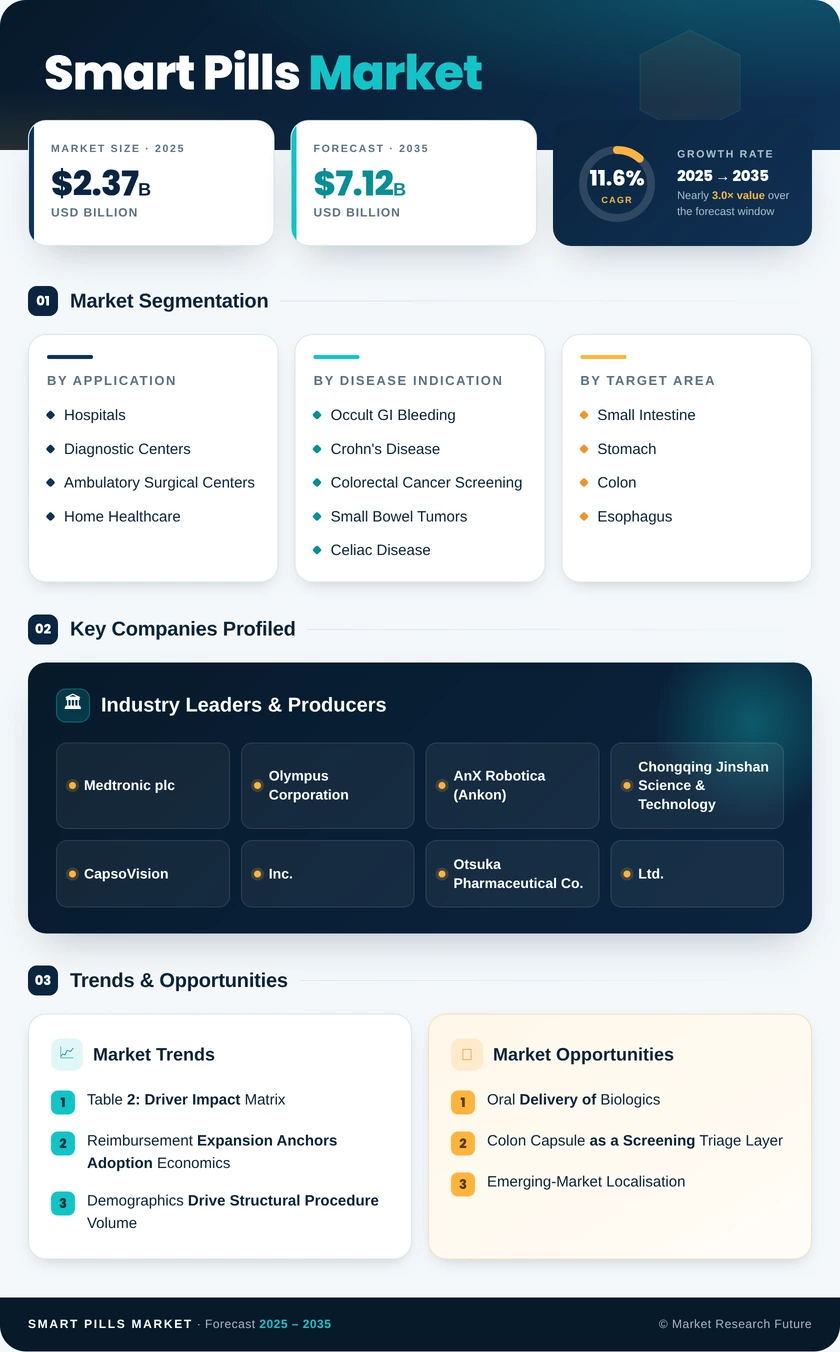
Smart Pills Market (2026 - 2035)

Smart Pills Market Research Report Information By Application (Patient Monitoring and Others), By Target Area (Esophagus, Small Intestine and Others), By Disease Indication (Disease Indication and Others), By End User (Hospitals and Others), And By Region (North America, Europe, Asia-Pacific, And Rest Of The World) - Growth & Industry Forecast To 2035

Forecast Period
2026-2035
CAGR
11.6%
2025 Market Size
USD 2.37 Billion
2035 Market Size
USD 7.12 Billion
Medical Device ● Updated August 24, 2026 Report ID: MRFR/MED/5128-HCR | Pages: 85 | Author: Rahul Gotadki, Nidhi Mandole
  1. 1 Market Summary |
    1. 1.1 Study Assumptions & Market Definition |
    2. 1.2 Scope of the Study |
    3. 1.3 Research Methodology
  2. 2 Key Report Takeaways |
    1. 2.1 By Application Area |
    2. 2.2 By End User |
    3. 2.3 By Geography
  3. 3 Market Size & Forecast (2021–2035) |
    1. 3.1 Historical Market Size (2021–2024) |
    2. 3.2 Base Year Estimate (2025) |
    3. 3.3 Forecast Market Size (2026–2035) |
    4. 3.4 Year-over-Year Growth Analysis
  4. 4 Driver Impact Analysis |
    1. 4.1 Reimbursement Expansion Anchors Adoption Economics |
    2. 4.2 Demographics Drive Structural Procedure Volume |
    3. 4.3 Silicon Economics Reshape Device Design |
    4. 4.4 Artificial Intelligence Compresses Reading Burden
  5. 5 Restraints Impact Analysis |
    1. 5.1 Retention Risk Narrows the Eligible Population |
    2. 5.2 Unit Economics Struggle Against Amortised Endoscopes |
    3. 5.3 Data Governance Adds Friction to Cloud Reading
  6. 6 Opportunities |
    1. 6.1 Oral Delivery of Biologics |
    2. 6.2 Colon Capsule as a Screening Triage Layer |
    3. 6.3 Emerging-Market Localisation |
    4. 6.4 Data Monetisation and Reading-as-a-Service |
    5. 6.5 Continuous Physiological Monitoring |
    6. 6.6 Industry Value Chain Analysis |
    7. 6.7 Porter's Five Forces Analysis
  7. 7 Regional Market Share & Country-Level Analysis |
    1. 7.1 North America | |
      1. 7.1.1 US | |
      2. 7.1.2 Canada | |
      3. 7.1.3 Mexico |
    2. 7.2 Europe | |
      1. 7.2.1 Germany | |
      2. 7.2.2 UK | |
      3. 7.2.3 France | |
      4. 7.2.4 Italy | |
      5. 7.2.5 Spain | |
      6. 7.2.6 Nordic Countries | |
      7. 7.2.7 Russia | |
      8. 7.2.8 Rest of Europe |
    3. 7.3 Asia-Pacific | |
      1. 7.3.1 China | |
      2. 7.3.2 India | |
      3. 7.3.3 Japan | |
      4. 7.3.4 South Korea | |
      5. 7.3.5 ASEAN | |
      6. 7.3.6 Rest of Asia-Pacific |
    4. 7.4 South America | |
      1. 7.4.1 Brazil | |
      2. 7.4.2 Argentina | |
      3. 7.4.3 Rest of South America |
    5. 7.5 Middle East & Africa | |
      1. 7.5.1 Saudi Arabia | |
      2. 7.5.2 UAE | |
      3. 7.5.3 South Africa | |
      4. 7.5.4 Egypt | |
      5. 7.5.5 Rest of Middle East & Africa
  8. 8 Future Outlook (2026–2035) |
    1. 8.1 Autonomous Interpretation Becomes Standard of Care |
    2. 8.2 Therapeutic Capsules Reframe the Category |
    3. 8.3 Platform Economics and Recurring Revenue |
    4. 8.4 Decentralisation and the Home as a Diagnostic Site
  9. 9 Market Segmentation Analysis |
    1. 9.1 By Application Area | |
      1. 9.1.1 Capsule Endoscopy | |
      2. 9.1.2 Drug Delivery | |
      3. 9.1.3 Patient Monitoring |
    2. 9.2 By Disease Indication | |
      1. 9.2.1 Occult GI Bleeding | |
      2. 9.2.2 Crohn's Disease | |
      3. 9.2.3 Colorectal Cancer Screening | |
      4. 9.2.4 Small Bowel Tumors | |
      5. 9.2.5 Celiac Disease | |
      6. 9.2.6 Other Indications |
    3. 9.3 By Target Area | |
      1. 9.3.1 Esophagus | |
      2. 9.3.2 Stomach | |
      3. 9.3.3 Small Intestine | |
      4. 9.3.4 Colon |
    4. 9.4 By End User | |
      1. 9.4.1 Hospitals | |
      2. 9.4.2 Diagnostic Centers | |
      3. 9.4.3 Ambulatory Surgical Centers | |
      4. 9.4.4 Home Healthcare
  10. 10 Competitive Landscape |
    1. 10.1 Market Share Analysis (2026) |
    2. 10.2 Competitive Benchmarking Matrix |
    3. 10.3 Company Profiles | |
      1. 10.3.1 Medtronic plc | |
      2. 10.3.2 Olympus Corporation | |
      3. 10.3.3 AnX Robotica (Ankon) | |
      4. 10.3.4 Chongqing Jinshan Science & Technology | |
      5. 10.3.5 CapsoVision, Inc. | |
      6. 10.3.6 Otsuka Pharmaceutical Co., Ltd. | |
      7. 10.3.7 IntroMedic Co., Ltd. | |
      8. 10.3.8 Check-Cap Ltd. | |
      9. 10.3.9 Rani Therapeutics Holdings | |
      10. 10.3.10 BodyCap SAS | |
      11. 10.3.11 HQ Inc.
  11. 11 Recent News & Developments
  12. 12 Report Scope & Methodology |
    1. 12.1 Study Period & Base Year |
    2. 12.2 Valuation Currency & Assumptions |
    3. 12.3 Abbreviations
  13. 13 Detailed Sources & Citations
  14. 14 Frequently Asked Questions
  15. 15 LIST OF TABLES
  16. 16 LIST OF FIGURES

Segmentation Quick Reference

DimensionSub-SegmentsDominant SegmentFastest Growing Segment
By Application AreaCapsule Endoscopy; Drug Delivery; Patient MonitoringCapsule EndoscopyDrug Delivery
By Disease IndicationOccult GI Bleeding; Crohn's Disease; Colorectal Cancer Screening; Small Bowel Tumors; Celiac Disease; Other IndicationsOccult GI BleedingCeliac Disease
By Target AreaEsophagus; Stomach; Small Intestine; ColonSmall IntestineEsophagus
By End UserHospitals; Diagnostic Centers; Ambulatory Surgical Centers; Home HealthcareHospitalsHome Healthcare
By GeographyNorth America; Europe; Asia-Pacific; South America; Middle East & AfricaNorth AmericaAsia-Pacific


Market Segmentation Overview

By Application Area

Sub-SegmentKey Trend
Capsule EndoscopyPanoramic and dual-camera optics paired with algorithmic lesion triage
Drug DeliveryMicroneedle and osmotic mechanisms targeting oral biologic administration
Patient MonitoringAdherence sensing and continuous physiological telemetry beyond imaging


Imaging revenue funds the category today, but the strategic centre of gravity is shifting. Vendors that treat the capsule as a delivery vehicle rather than a camera are attracting pharmaceutical partners and the longer-duration capital that comes with them.

By Disease Indication

Sub-SegmentKey Trend
Occult GI BleedingGuideline-anchored first-line status sustains baseline referral volume
Crohn's DiseaseRepeat mucosal healing assessments create recurring per-patient demand.
Colorectal Cancer ScreeningCapsule modalities absorbing colonoscopy capacity shortfalls
Small Bowel TumorsDetection sensitivity gains expanding diagnostic yield
Celiac DiseaseNon-invasive monitoring displacing repeat biopsy protocols.
Other IndicationsPolyposis syndromes and unexplained abdominal symptom workups


Indication mix determines revenue durability. Chronic conditions requiring serial assessment generate materially better lifetime value per patient than episodic diagnostic events, which is why Crohn's and celiac monitoring receive outsized clinical development attention.

By Target Area

Sub-SegmentKey Trend
EsophagusBarrett's surveillance and varices screening driving tethered-capsule interest
StomachMagnetically controlled steering enabling directed gastric examination.
Small IntestineRetains structural advantage as the region conventional scopes cannot reach
ColonPrep-reduction protocols improving screening participation rates


Anatomical reach defines competitive differentiation. Small-bowel visualisation remains uncontested territory, while gastric and oesophageal applications are where magnetic control and tethered designs compete directly against established endoscopy.

By End User

Sub-SegmentKey Trend
HospitalsSpecialist referral origination and retention-risk pre-screening capability
Diagnostic CentersThroughput-optimised reading operations and competitive per-study pricing
Ambulatory Surgical CentersOutpatient migration of gastrointestinal procedure volume
Home HealthcareCourier-delivered capsules with app-guided ingestion and recorder return


Care-setting migration follows a predictable arc. Procedures move outward from hospitals once clinical risk is characterised and logistics mature, and capsule ingestion carries fewer facility dependencies than almost any comparable diagnostic intervention.




Download PDF ×

We do not share your information with anyone. However, we may send you emails based on your report interest from time to time. You may contact us at any time to opt-out.