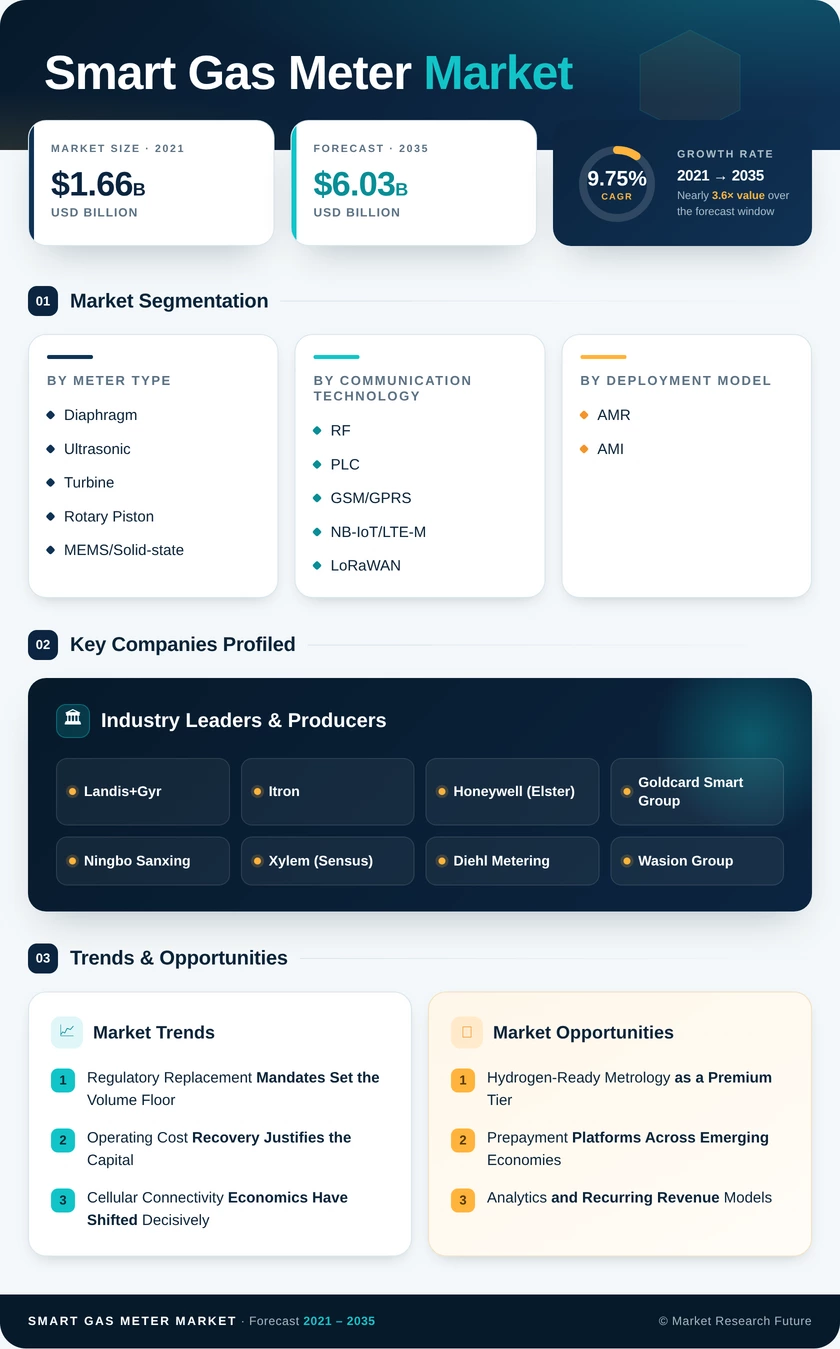
Segmentation Quick Reference
| Dimension | Sub-Segments | Dominant Segment | Fastest Growing Segment |
| By Meter Type | Diaphragm, Ultrasonic, Turbine, Rotary Piston, MEMS/Solid-state | Diaphragm | Ultrasonic |
| By Communication Technology | RF, PLC, GSM/GPRS, NB-IoT/LTE-M, LoRaWAN | RF | NB-IoT/LTE-M |
| By Deployment Model | AMR, AMI | AMR | AMI |
| By End-User | Residential, Commercial, Industrial | Residential | Industrial |
| By Region | North America, Europe, Asia-Pacific, South America, Middle East & Africa | Asia-Pacific | Asia-Pacific |
Market Segmentation Overview
By Meter Type
| Sub-Segment | Key Trend |
| Diaphragm | Retains volume leadership through drop-in retrofit compatibility, though specification committees increasingly treat it as legacy |
| Ultrasonic | Fastest-growing type as hydrogen tolerance and accuracy retention become tender requirements |
| Turbine | Stable industrial niche tied to high-flow custody transfer applications |
| Rotary Piston | Preferred for commercial mid-flow precision where space constraints rule out turbine bodies |
| MEMS/Solid-state | Emerging class benefiting from miniaturisation, lower power draw and extended battery service life |
Meter type selection is increasingly a fuel-futures decision rather than a cost decision. Networks planning hydrogen blends write ultrasonic and solid-state technologies into asset registers years before blending begins, because retrofitting a fleet twice destroys programme economics.
By Communication Technology
| Sub-Segment | Key Trend |
| RF | Largest installed base, favoured where electricity mesh networks already exist |
| PLC | Concentrated in multi-utility deployments sharing physical infrastructure |
| GSM/GPRS | Legacy technology facing sunset pressure as carriers refarm spectrum |
| NB-IoT/LTE-M | Fastest-growing path, supported by long-term carrier commitments and falling module cost |
| LoRaWAN | Selected by municipal utilities wanting private network control and predictable operating cost |
Connectivity choice now hinges on network longevity guarantees. Utilities specifying twenty-year asset lives require written carrier commitments extending past 2035, which has effectively removed second-generation cellular from new tenders.
By Deployment Model
| Sub-Segment | Key Trend |
| AMR | Majority of installed endpoints; delivers labour savings with minimal systems integration |
| AMI | Faster growth on the back of remote shutoff, firmware updates and interval analytics |
The migration from one-way to two-way architecture is gated less by hardware cost than by back-office readiness. Utilities that modernise customer information systems first complete deployment materially faster than those that treat software as a follow-on phase.
By End-User
| Sub-Segment | Key Trend |
| Residential | Largest revenue block by unit volume, driven by replacement mandates and prepayment billing |
| Commercial | Growth tied to multi-tenant sub-metering and building energy management integration |
| Industrial | Fastest-growing end-user as emissions disclosure and energy optimisation justify premium metrology |
End-user mix shapes vendor strategy directly. Residential volume rewards manufacturing scale and installation logistics, while industrial and commercial demand rewards accuracy class, diagnostics depth and integration with plant-level energy systems.


 Noah Malgeri
Co-Founder

 Peter Groot koerkamp
Account and Business Manager

 Younghwan Choi
Senior Retail Manager

 Mark Irwin
Management Consultant

 Akif Moroglu
Strategy & Business Development Director

 Guilherme Gomes Martins
Product Management Director

 Joseph Aguayo
Sales Operations & Pricing Manager

 La Terria Dodd
Program Support Specialist

 Rob Kooiker
Group Product Manager HVAC & Fire Protection GMA