Segmentation Quick Reference
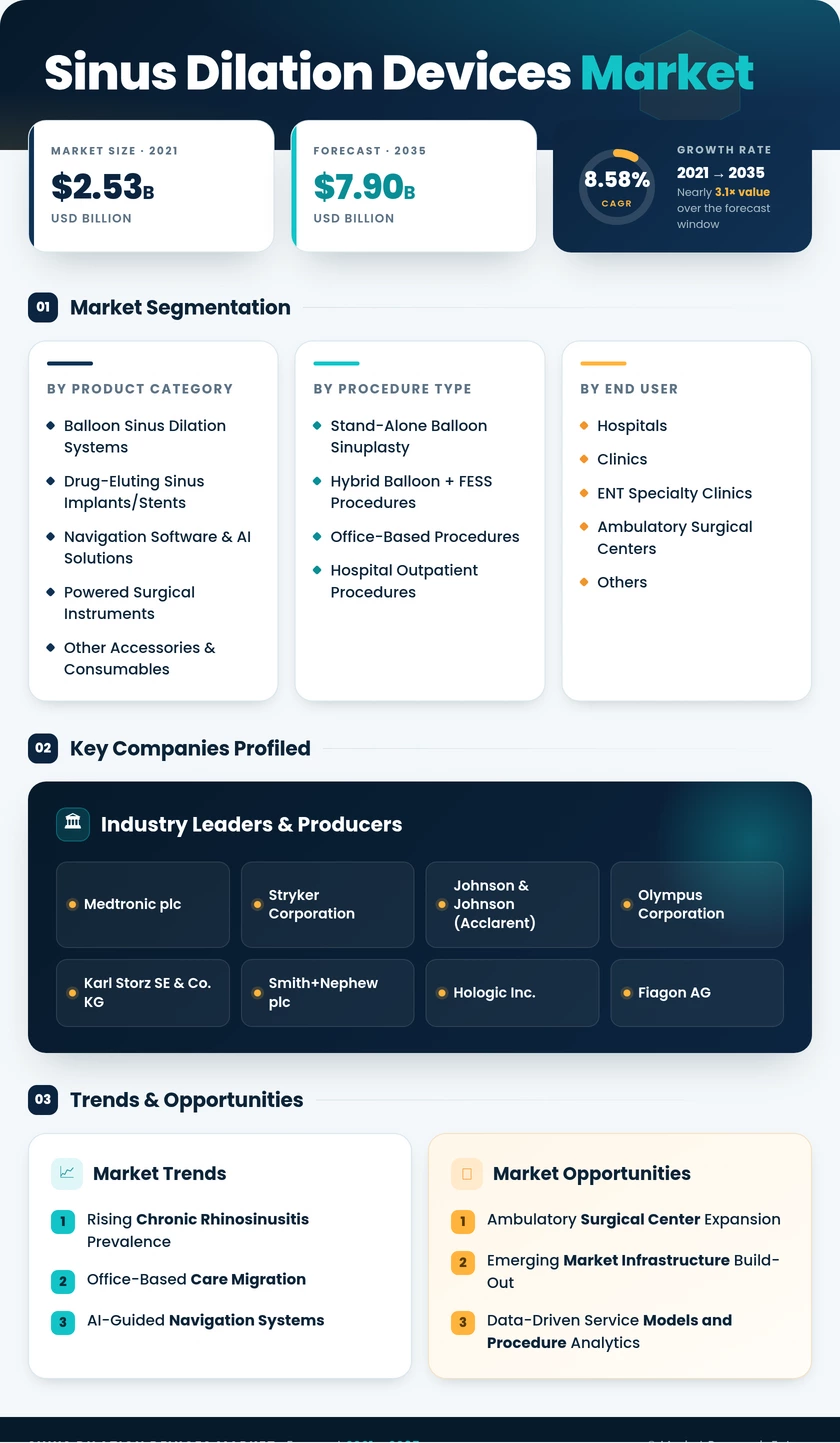
| Dimension | Sub-Segments | Dominant Segment | Fastest Growing Segment |
| By Product Category | Balloon Sinus Dilation Systems, Drug-Eluting Sinus Implants/Stents, Navigation Sinus Dilation Devices Market & AI Solutions, Powered Surgical Instruments, Other Accessories & Consumables | Balloon Sinus Dilation Systems | Navigation Sinus Dilation Devices Market & AI Solutions |
| By Procedure Type | Stand-Alone Balloon Sinuplasty, Hybrid Balloon + FESS Procedures, Office-Based Procedures, Hospital Outpatient Procedures | Stand-Alone Balloon Sinuplasty | Office-Based Procedures |
| By End User | Hospitals and Clinics, ENT Specialty Clinics, Ambulatory Surgical Centers, Others | Hospitals and Clinics | ENT Specialty Clinics |
| By Geography | North America, Europe, Asia-Pacific, South America, Middle East & Africa | North America | Asia-Pacific |
Market Segmentation Overview
By Product Category
| Sub-Segment | Key Trend |
| Balloon Sinus Dilation Systems | Transition to single-use, pre-loaded catheter platforms for office settings |
| Drug-Eluting Sinus Implants/Stents | Expanding clinical evidence driving payer coverage and physician adoption |
| Navigation Sinus Dilation Devices Market & AI Solutions | AI-powered CT segmentation reduces pre-operative planning time significantly. |
| Powered Surgical Instruments | Continued role in hybrid FESS procedures requiring tissue removal |
| Other Accessories & Consumables | Volume-driven growth tracking the overall procedure expansion |
Balloon sinus dilation systems remain the revenue anchor of the global market, though their share is gradually moderating as navigation and implant categories grow at faster rates. Drug-eluting implants are transitioning from specialty use to mainstream adoption as long-term clinical data validates their cost-effectiveness.
By Procedure Type
| Sub-Segment | Key Trend |
| Stand-Alone Balloon Sinuplasty | Dominant procedure due to simplicity and favorable reimbursement economics |
| Hybrid Balloon + FESS Procedures | Preferred for complex multi-sinus and polypoid disease |
| Office-Based Procedures | Fastest growth driven by cost savings and patient convenience |
| Hospital Outpatient Procedures | Stable base but losing share to ambulatory and office settings |
The procedural mix is shifting decisively toward office-based and ambulatory settings, driven by portable device designs and expanded payer coverage for in-office codes. Hybrid procedures retain clinical importance for complex cases but represent a smaller share of total volume growth.
By End User
| Sub-Segment | Key Trend |
| Hospitals and Clinics | Largest channel, but share is gradually declining as outpatient alternatives grow. |
| ENT Specialty Clinics | Fastest-growing channel; physician-owned models align incentives with device adoption. |
| Ambulatory Surgical Centers | Expanding regulatory approvals enabling sinus procedures in ASC settings |
| Others (Research, Military) | Niche applications in training simulation and deployed military healthcare |
Hospitals maintain the largest end-user share due to established referral networks and surgical infrastructure. Still, ENT specialty clinics are demonstrating superior patient throughput metrics and shorter wait times that attract both patients and payers.
By Geography
| Sub-Segment | Key Trend |
| North America | A mature reimbursement landscape and the highest per-capita procedure rates |
| Europe | EU MDR transition reshaping device approval timelines and competitive dynamics |
| Asia-Pacific | Steepest adoption curve driven by infrastructure investment and aging demographics |
| South America | Early-stage growth concentrated in Brazilian private hospital networks. |
| Middle East & Africa | Government healthcare spending and medical tourism are fueling device demand |
North America's dominance reflects decades of reimbursement infrastructure development, while Asia-Pacific's growth trajectory is supported by government health programs targeting specialty surgical capacity. Europe's market evolution is increasingly shaped by the EU HTA regulation framework that will harmonize clinical evidence requirements across member states.