Request Free Sample ×

Kindly complete the form below to receive a free sample of this Report

* Please use a valid business email

Leading companies partner with us for data-driven Insights

clients tt-cursor
Hero Background
English
Chinese
French
Japanese
Korean
German
Spanish

Silicon Carbide Market Analysis

ID: MRFR/CnM/0723-HCR
138 Pages
Chitranshi Jaiswal
March 2026

Silicon Carbide Market Research Report Information By Type (Black Silicon Carbide and Green Silicon Carbide), By Application (Steel & Energy, Automotive, Aerospace & Aviation, Military & Defense, Electronics & Semiconductors, and Medical & Healthcare), And By Region (North America, Europe, Asia-Pacific, And Rest Of The World) – Market Forecast Till 2035

Share:
Download PDF ×

We do not share your information with anyone. However, we may send you emails based on your report interest from time to time. You may contact us at any time to opt-out.

Silicon Carbide Market Infographic
Purchase Options

Market Analysis

Silicon Carbide Market (Global, 2024)

Introduction

The silicon carbide market is about to be transformed as industries increasingly adopt advanced materials that offer superior performance and efficiency. In particular, silicon carbide, with its outstanding thermal conductivity, high breakdown strength, and chemical inertness, is increasingly being used in a wide range of applications in the power-electronics, automotive, and renewable energy industries. The demand for energy-efficient solutions is growing, and the use of silicon carbide in semiconductor devices is gaining momentum, driven by the need to improve the performance of power systems and to reduce energy losses. Furthermore, the transition to electric vehicles and the increased emphasis on sustainability are driving the development of silicon carbide technology, which is now becoming a critical component in the development of next-generation power devices. This report explores the current state of the silicon carbide market and the main trends that will shape it in the coming years.

PESTLE Analysis

Political
In 2024, the politics of the silicon carbide market are heavily influenced by the government’s policies to promote the manufacture of semiconductors. In the United States, the Chips Act of 2021 allocates approximately fifty-two billion dollars to the development of domestic production of semiconductors and related materials. In the European Union, a goal has been set to increase the share of the European Union in global semiconductor production to 20 percent by the year 2030. This goal will also drive the demand for silicon carbide components in a variety of applications.
Economic
In 2024 the silicon carbide market was characterized by rising raw material costs, and silicon carbide prices were about $3,500 per metric ton, a 15% increase over the previous year. The increase was due to the disruptions in the supply chain and to the growing demand from the electric vehicle (EV) sector, which was projected to consume over 30% of all silicon carbide produced. The market for semiconductors was also expected to reach $600 billion in 2024, which would enhance the economic viability of silicon carbide applications.
Social
In 2024, the social trends influencing the choice of technology for the future are in the direction of sustainable and energy-saving ones. This is why silicon carbide is being used more and more in electric vehicles and in the manufacture of alternative energy. Surveys show that 78% of consumers are willing to pay a higher price for products made from eco-friendly materials, which is a good position for silicon carbide. In addition, the awareness of climate change and the need to reduce CO2 emissions pushes the industry to use silicon carbide-based technology, which is known for its high efficiency and low energy consumption.
Technological
In 2024, the capabilities of silicon carbide devices have increased considerably. Using new manufacturing methods, the yield of silicon carbide wafers has risen to about 90 percent, from 75 percent in 2023. In power electronics, the introduction of 1200 Volt MOSFETs enables a higher degree of efficiency and performance in a wide range of applications, from electric vehicles to renewable energy systems. This technological progress is essential for meeting the rising demand for high-performance components in various fields.
Legal
In 2024 the legal framework regulating the silicon carbide market is shaped by strict regulations aimed at ensuring product safety and compliance with the environment. REACH, the European Union regulation on registration of chemical substances, also applies to silicon carbide and affects about 30,000 companies in the EU. According to estimates, the costs of testing and documentation in compliance with these regulations are estimated at up to $ 1.8 million per company, which may have a significant impact on the operating costs of silicon carbide producers.
Environmental
In the year 2024, the market for silicon carbide is becoming increasingly influenced by considerations of the environment. Production of silicon carbide involves the release of approximately ten kilograms of carbon dioxide per kilogram of silicon carbide produced. However, in the next few years, new methods of production are expected to reduce this figure by a factor of twenty. In addition, there will be an increasing demand for silicon carbide in the context of a circular economy. In 2024, approximately ten per cent of all production will be recycled, contributing to the establishment of a circular economy.

Porter's Five Forces

Threat of New Entrants
The silicon carbide market has a moderate barrier to entry, because of the high capital investment required for production and technology. The development of manufacturing processes and the increasing demand for silicon carbide in various applications, however, may attract new players, resulting in a moderate threat level.
Bargaining Power of Suppliers
“Silicon carbide is a relatively abundant source of raw materials, which reduces the bargaining power of the suppliers.” “In addition, the number of suppliers is large, and it is easy for manufacturers to change suppliers when necessary.”
Bargaining Power of Buyers
In the market for silicon carbide, buyers have significant negotiating power because of the presence of many suppliers and the availability of alternative materials. The more price-conscious the buyer, the more powerful the bargaining power.
Threat of Substitutes
“The material silicon carbide is particularly suited for certain applications, but there are alternatives such as gallium nitride and ordinary silicon that can be used as substitutes.” The threat of substitution is moderate, because the performance of these alternatives may not be the same as silicon carbide, but they can still compete in certain markets.
Competitive Rivalry
The market for silicon carbide is characterized by intense competition between established players and new entrants. The rising demand for electric vehicles, alternative energy sources and high-tech electronics is resulting in a highly competitive market and continuous innovation in product development.

SWOT Analysis

Strengths

  • High thermal conductivity and efficiency in power electronics applications.
  • Growing demand in electric vehicle (EV) and renewable energy sectors.
  • Established supply chain and manufacturing capabilities in key regions.

Weaknesses

  • High production costs compared to traditional silicon materials.
  • Limited awareness and understanding of silicon carbide technology among some end-users.
  • Challenges in scaling up production to meet increasing demand.

Opportunities

  • Expansion of electric vehicle market driving demand for silicon carbide components.
  • Potential for new applications in 5G technology and advanced telecommunications.
  • Government incentives and policies promoting renewable energy adoption.

Threats

  • Intense competition from alternative materials and technologies.
  • Economic fluctuations impacting investment in semiconductor technologies.
  • Supply chain disruptions due to geopolitical tensions or natural disasters.

Summary

During the period 2021–2024, the silicon carbide market will be characterized by its technological strengths and a rising demand, especially in the electric vehicles and alternative energy sectors. However, the high cost of production and low awareness of the product will remain obstacles to growth. Competition and disruptions to supply chains will pose the greatest risks to the market. The strategic focus on cost reduction and education could improve the market’s positioning.


Author
Author Profile
Chitranshi Jaiswal
Team Lead - Research

Chitranshi is a Team Leader in the Chemicals & Materials (CnM) and Energy & Power (EnP) domains, with 6+ years of experience in market research. She leads and mentors teams to deliver cross-domain projects that equip clients with actionable insights and growth strategies. She is skilled in market estimation, forecasting, competitive benchmarking, and both primary & secondary research, enabling her to turn complex data into decision-ready insights. An engineer and MBA professional, she combines technical expertise with strategic acumen to solve dynamic market challenges. Chitranshi has successfully managed projects that support market entry, investment planning, and competitive positioning, while building strong client relationships. Certified in Advanced Excel & Power BI she leverages data-driven approaches to ensure accuracy, clarity, and impactful outcomes.

Leave a Comment

FAQs

What is the projected market valuation of the Silicon Carbide Market by 2035?

<p>The Silicon Carbide Market is projected to reach a valuation of 3.431 USD Billion by 2035.</p>

What was the market valuation of the Silicon Carbide Market in 2024?

<p>In 2024, the Silicon Carbide Market was valued at 2.07 USD Billion.</p>

What is the expected CAGR for the Silicon Carbide Market during the forecast period 2025 - 2035?

<p>The expected CAGR for the Silicon Carbide Market during the forecast period 2025 - 2035 is 4.7%.</p>

Which companies are considered key players in the Silicon Carbide Market?

<p>Key players in the Silicon Carbide Market include Cree Inc, Infineon Technologies AG, and STMicroelectronics NV.</p>

What are the main types of Silicon Carbide and their market values?

<p>The main types of Silicon Carbide are Black Silicon Carbide, valued at 1.36 USD Billion, and Green Silicon Carbide, valued at 2.07 USD Billion.</p>

Which application segments are driving growth in the Silicon Carbide Market?

<p>The application segments driving growth include Steel & Energy, Automotive, and Electronics & Semiconductors, with valuations ranging from 0.5 to 0.85 USD Billion.</p>

How does the market for Automotive applications in Silicon Carbide compare to other segments?

The Automotive application segment is projected to grow from 0.4 USD Billion to 0.65 USD Billion, indicating robust demand.

What is the valuation range for the Aerospace & Aviation segment in the Silicon Carbide Market?

The Aerospace &amp; Aviation segment is valued between 0.3 USD Billion and 0.5 USD Billion.

What role do companies like Wolfspeed Inc play in the Silicon Carbide Market?

Companies like Wolfspeed Inc are pivotal in advancing Silicon Carbide technology and expanding market reach.

What is the expected growth trajectory for the Medical & Healthcare segment in the Silicon Carbide Market?

The Medical &amp; Healthcare segment is anticipated to grow from 0.17 USD Billion to 0.25 USD Billion, reflecting increasing applications.

Market Summary

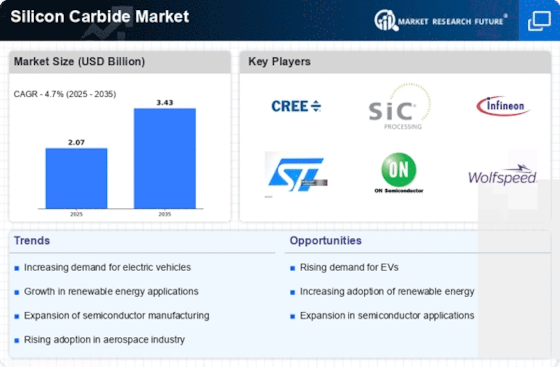
As per Market Research Future analysis, the Silicon Carbide Market Size was estimated at 2.07 USD Billion in 2024. The Silicon Carbide industry is projected to grow from 2.167 USD Billion in 2025 to 3.431 USD Billion by 2035, exhibiting a compound annual growth rate (CAGR) of 4.7% during the forecast period 2025 - 2035

Key Market Trends & Highlights

The Silicon Carbide Market is currently experiencing robust growth driven by technological advancements and increasing demand across various sectors.

  • North America remains the largest market for silicon carbide, driven by its extensive semiconductor applications. The Asia-Pacific region is emerging as the fastest-growing market, fueled by rapid industrialization and electric vehicle adoption. Black silicon carbide continues to dominate the market, while green silicon carbide is witnessing the fastest growth due to its applications in energy-efficient technologies. Key market drivers include the increasing adoption of renewable energy sources and the expansion of electric vehicle infrastructure.

Market Size & Forecast

2024 Market Size 2.07 (USD Billion)
2035 Market Size 3.431 (USD Billion)
CAGR (2025 - 2035) 4.7%
Largest Regional Market Share in 2024 Asia Pacific

Major Players

Cree Inc (US), SiC Processing Inc (US), Infineon Technologies AG (DE), STMicroelectronics NV (FR), ON Semiconductor Corporation (US), Wolfspeed Inc (US), NXP Semiconductors NV (NL), ROHM Semiconductor (JP), Mitsubishi Electric Corporation (JP)

Market Trends

The Silicon Carbide Market is currently experiencing a notable transformation, driven by the increasing demand for high-performance materials across various industries. This compound, known for its exceptional thermal conductivity and electrical properties, is becoming increasingly essential in sectors such as automotive, aerospace, and electronics. The shift towards electric vehicles and renewable energy solutions appears to be a significant factor propelling the growth of this market. As manufacturers seek to enhance efficiency and reduce energy consumption, Silicon Carbide Market is emerging as a preferred choice for power electronics and semiconductor applications. Moreover, the Silicon Carbide Market is likely to benefit from advancements in manufacturing technologies, which may lead to improved product quality and reduced costs. The ongoing research and development efforts in this field suggest a promising future, as innovations could unlock new applications and expand the market's reach. Additionally, the increasing focus on sustainability and environmental considerations may further drive the adoption of Silicon Carbide Market, as it offers potential advantages in energy efficiency and resource conservation. Overall, the market appears poised for continued growth, with various factors converging to create a dynamic landscape for stakeholders.

Rising Demand in Electric Vehicles

The Silicon Carbide Market is witnessing a surge in demand due to the growing adoption of electric vehicles. This trend is largely attributed to the material's ability to enhance the efficiency of power electronics, which are crucial for electric drivetrains. As automakers increasingly prioritize performance and range, Silicon Carbide Market components are becoming integral to achieving these objectives.

Advancements in Manufacturing Techniques

Innovations in manufacturing processes are playing a pivotal role in shaping the Silicon Carbide Market. Enhanced techniques are likely to improve the quality and reduce the costs of Silicon Carbide Market products. This evolution may facilitate broader applications across various sectors, making the material more accessible to manufacturers and consumers alike.

Focus on Sustainability

The growing emphasis on sustainability is influencing the Silicon Carbide Market significantly. As industries strive to minimize their environmental impact, Silicon Carbide Market's potential for energy efficiency and reduced resource consumption is becoming increasingly attractive. This trend may lead to greater adoption of Silicon Carbide Market in applications that prioritize eco-friendliness.

Silicon Carbide Market Market Drivers

Rising Demand for Energy Efficiency

The Silicon Carbide Market is significantly impacted by the rising demand for energy efficiency across various sectors. As industries and consumers alike seek to reduce energy consumption and lower operational costs, silicon carbide technology offers a compelling solution. Its ability to operate at higher efficiencies and lower losses makes it an attractive option for power electronics in industrial applications, automotive systems, and consumer electronics. The energy efficiency market is projected to grow substantially, with silicon carbide devices expected to capture a notable share. This trend underscores the importance of silicon carbide in the Silicon Carbide Market, as it aligns with the global push towards sustainable and efficient energy solutions.

Growth in Semiconductor Applications

The Silicon Carbide Market is significantly influenced by the growth in semiconductor applications. Silicon carbide semiconductors are increasingly utilized in high-performance devices due to their ability to operate at higher temperatures and voltages compared to traditional silicon-based semiconductors. The semiconductor market is anticipated to reach a valuation of over 500 billion USD by 2025, with silicon carbide devices capturing a substantial share. This trend is driven by the need for more efficient power management solutions in various sectors, including automotive, telecommunications, and consumer electronics. As the demand for advanced semiconductor technologies continues to rise, the Silicon Carbide Market is poised for robust growth, reflecting the material's critical role in next-generation electronic devices.

Expansion of Electric Vehicle Infrastructure

The Silicon Carbide Market is benefiting from the expansion of electric vehicle infrastructure. As governments and private sectors invest heavily in charging stations and related technologies, the demand for efficient power electronics is surging. Silicon carbide components are essential for electric vehicle chargers, as they enable faster charging times and improved energy efficiency. The electric vehicle market is projected to grow at a compound annual growth rate of approximately 20% through the next decade. This growth is likely to create a ripple effect in the Silicon Carbide Market, as manufacturers seek to meet the increasing demand for high-performance charging solutions that leverage the advantages of silicon carbide technology.

Increasing Adoption of Renewable Energy Sources

The Silicon Carbide Market is experiencing a notable surge due to the increasing adoption of renewable energy sources. As nations strive to reduce carbon emissions, the demand for efficient power conversion systems has escalated. Silicon carbide, with its superior thermal conductivity and high breakdown voltage, is becoming the material of choice for power electronics in solar inverters and wind turbines. Reports indicate that the market for renewable energy systems is projected to grow at a compound annual growth rate of over 8% in the coming years. This growth is likely to drive the demand for silicon carbide components, as they enhance the efficiency and reliability of energy conversion systems, thereby solidifying their role in the Silicon Carbide Market.

Technological Advancements in Power Electronics

The Silicon Carbide Market is witnessing a transformation driven by technological advancements in power electronics. Innovations in silicon carbide manufacturing processes have led to improved material quality and reduced production costs. These advancements are enabling the development of more efficient and compact power devices, which are crucial for applications in renewable energy systems, electric vehicles, and industrial automation. The power electronics market is expected to grow significantly, with silicon carbide devices playing a pivotal role in enhancing performance and reliability. As these technologies continue to evolve, the Silicon Carbide Market is likely to experience accelerated growth, reflecting the increasing reliance on advanced power solutions.

Market Segment Insights

By Type: Black Silicon Carbide (Largest) vs. Green Silicon Carbide (Fastest-Growing)

<p>In the Silicon Carbide Market, Black Silicon Carbide is currently the largest segment, holding a significant share due to its extensive use in a variety of applications including abrasives and <a href="https://www.marketresearchfuture.com/reports/refractories-market-2393" target="_blank" title="refractories">refractories</a>. On the other hand, Green Silicon Carbide, though smaller in current market share, is gaining traction, particularly in high-performance applications owing to its superior purity and thermal conductivity. This dynamic has led to a competitive landscape that highlights the contrasting strengths of both types.</p>

<p>Silicon Carbide: Black (Dominant) vs. Green (Emerging)</p>

<p>Black Silicon Carbide is recognized for its toughness and ability to withstand high temperatures, making it a preferred choice for abrasive applications and metalworking. This type has established a dominant position in the market due to its cost-effectiveness and versatility. In contrast, Green Silicon Carbide, while emerging, is gaining attention for its exceptional hardness and chemical stability, making it ideal for specialized applications in electronics and renewable energy. As industries increasingly demand advanced materials, Green Silicon Carbide is expected to accelerate in growth, driven by technological advancements and enhanced application areas.</p>

By Application: Steel & Energy (Largest) vs. Automotive (Fastest-Growing)

<p>In the Silicon Carbide Market, the application segment exhibits varied demand across different sectors. Steel and Energy applications hold the largest market share due to the integration of silicon carbide in various high-performance power electronic devices, enhancing efficiency and sustainability within these industries. Meanwhile, sectors like Automotive and Electronics & Semiconductors are also notable, as they increasingly incorporate silicon carbide technologies to meet growing performance and efficiency requirements. As we advance, the Automotive application is evolving into the fastest-growing sector within the Silicon Carbide Market. This growth is fueled by the rising demand for electric vehicles and advanced driver-assistance systems (ADAS), both of which require efficient power solutions that silicon carbide provides. Additionally, the push for energy-efficient solutions across industries points toward significant growth potential for silicon carbide applications, particularly in Electronics and Healthcare as well.</p>

<p>Steel & Energy (Dominant) vs. Automotive (Emerging)</p>

<p>The Steel & Energy sector remains the dominant application for silicon carbide, primarily due to its critical role in improving energy efficiency and reducing wastage in industrial processes. Silicon carbide is essential for high-temperature applications and power electronics, enabling more efficient energy conversion. On the other hand, the Automotive sector is emerging rapidly as it adapts to electric mobility trends and demands for high-performance components. As manufacturers aim to enhance battery efficiency and power electronics in electric vehicles, silicon carbide's high thermal conductivity and voltage tolerance make it an ideal choice. This positions Automotive as a burgeoning segment that, while currently smaller in share, is primed for rapid growth driven by technological advancements and consumer demand.</p>

Get more detailed insights about Silicon Carbide Market Research Report - Forecast to 2035

Regional Insights

North America : Innovation and Leadership Hub

North America represents one of the leading regions in the global silicon carbide market, accounting for approximately 45% of total market share. . The region's growth is driven by increasing demand for electric vehicles (EVs) and renewable energy applications, supported by favorable government regulations and incentives. Strong government initiatives supporting energy-efficient technologies are further boosting the silicon carbide market across the United States and Canada. The competitive landscape in North America is robust, with key players such as Cree Inc, Wolfspeed Inc, and ON Semiconductor leading the charge. The presence of advanced manufacturing facilities and strong R&D capabilities in the U.S. positions it as a leader in silicon carbide technology. Additionally, partnerships between industry and academia are fostering innovation, ensuring that North America remains at the forefront of SiC advancements.

Europe : Emerging Market with Potential

The europe silicon carbide market accounts for roughly 30% of the global silicon carbide market share. . The region's demand is primarily driven by stringent environmental regulations and a strong push towards sustainable energy solutions. The European Union's Green Deal and various national initiatives are catalyzing investments in SiC technologies, particularly in the automotive and energy sectors, enhancing market prospects. Leading countries in Europe include Germany, France, and the Netherlands, where companies like Infineon Technologies and STMicroelectronics are key players. The competitive landscape is characterized by a mix of established firms and innovative startups, all vying for a share of the growing market. Collaborative efforts between industry stakeholders and government bodies are fostering a conducive environment for silicon carbide advancements.

Asia-Pacific : Rapidly Growing Market

The Asia-Pacific region represents one of the fastest-growing segments of the global silicon carbide market, holding approximately 20% of total market share. Strong demand from consumer electronics, automotive manufacturing, and renewable energy sectors is driving rapid expansion. The china silicon carbide market dominates the region due to substantial investments in semiconductor manufacturing and research facilities. Meanwhile, the india silicon carbide market is gradually expanding as government initiatives support domestic semiconductor production and electric vehicle adoption.

Middle East and Africa : Emerging Opportunities Ahead

The Middle East and Africa region is gradually emerging in the silicon carbide market, currently holding about 5% of the global share. The growth is primarily driven by increasing investments in renewable energy projects and the rising demand for efficient power electronics. Governments in the region are recognizing the potential of SiC technologies to support their energy transition goals, leading to a favorable regulatory environment. Countries like South Africa and the UAE are at the forefront of this growth, with initiatives aimed at enhancing energy efficiency and sustainability. The competitive landscape is still developing, with a mix of local and international players beginning to establish a presence. As the region continues to invest in infrastructure and technology, the silicon carbide market is poised for significant growth in the coming years.

Key Players and Competitive Insights

Major market players, while a few well-established vendors are approaching integration with the development of value-added products for the electronics industry. Some players are focused on the development of abrasives-based SiC. Companies are also taking a range of initiatives to grow their worldwide footprint, with key market developments such as new product launches, contractual agreements, increased investments, and collaboration with other players. Competitors in the Silicon Carbide industry must offer cost-effective items to expand and survive in an increasingly competitive and rising market environment.
Some of the business strategies manufacturers adopt in the Silicon Carbide industry are expanding the manufacturing capacity to meet the rising demand for it. In recent years, the Silicon Carbide industry has launched some new products in the market. The Silicon Carbide Market major player such as CUMI EM, AGSCO Corp, Saint-Gobain, ESD-SIC BV, and others are working on expanding the market demand by raising funds for research and development activities.
CUMI EM company in the ceramics, electro minerals, and abrasives sectors. Along with super refractories, electro minerals, industrial ceramics, and ceramic fibers, CUMI was a pioneer in India's production of coated and bonded abrasives. CUMI is broadening the distribution of its products in line with the vision. The company produces over 20,000 different product varieties at 25 different facilities in 25 countries, including India, Russia, South Africa, Australia, China, Thailand, and Canada. Forty-three nations around the world receive CUMI's exports of goods. The company manufactures and distributes silicone carbide ly.
Also, Saint-Gobain is an international company that is one of the leader in the construction industry. The company has a presence in more than 76 countries worldwide.
In May Saint-Gobain completed the sale of its silicon carbide grains and powders business to private equity company OpenGate Capital, which generates annual sales of about €120 million. This transaction is in line with Saint-portfolio Gobain's optimization strategy, which aims to sell off companies with more than €3.0 billion in annual sales by the end of 2019.

Key Companies in the Silicon Carbide Market include

Industry Developments

  • Q2 2024: Infineon Technologies Opens New Silicon Carbide Market Fab in Kulim, Malaysia Infineon Technologies inaugurated a new silicon carbide manufacturing facility in Kulim, Malaysia, to expand its production capacity for SiC power semiconductors, targeting the growing demand from electric vehicles and renewable energy sectors.
  • Q2 2024: Wolfspeed Secures $1 Billion Contract to Supply SiC Wafers to Major EV Manufacturer Wolfspeed announced a multi-year, $1 billion contract to supply silicon carbide wafers to a leading electric vehicle manufacturer, strengthening its position as a key supplier in the automotive power electronics market.
  • Q1 2024: STMicroelectronics and ZF Form Joint Venture for SiC Power Devices STMicroelectronics and ZF Friedrichshafen AG established a joint venture to produce silicon carbide power devices for automotive and industrial applications, aiming to accelerate the adoption of SiC technology in electric mobility.
  • Q2 2024: ROHM Announces Expansion of SiC Production Capacity in Japan ROHM Co., Ltd. revealed plans to expand its silicon carbide production facilities in Japan, investing to meet surging demand from the automotive and industrial sectors.
  • Q1 2024: General Electric Launches New SiC-Based Power Modules for Grid Applications General Electric introduced a new line of silicon carbide-based power modules designed for high-efficiency grid and renewable energy applications, aiming to improve energy conversion and reduce losses.
  • Q2 2024: Infineon Signs Long-Term SiC Wafer Supply Agreement with Showa Denko Infineon Technologies entered a long-term supply agreement with Showa Denko for silicon carbide wafers, securing critical raw materials for its expanding SiC device production.
  • Q1 2024: Wolfspeed Appoints New CEO to Lead Next Phase of SiC Expansion Wolfspeed announced the appointment of a new Chief Executive Officer, signaling a strategic focus on scaling up silicon carbide manufacturing and global market reach.
  • Q2 2024: STMicroelectronics Announces $730 Million Investment in SiC Wafer Plant in Italy STMicroelectronics committed $730 million to build a new silicon carbide wafer manufacturing plant in Catania, Italy, aiming to boost European supply chain resilience for power electronics.
  • Q1 2024: Bosch Opens New SiC Chip Production Line in Germany Bosch inaugurated a new silicon carbide chip production line at its Reutlingen facility, expanding its capacity to supply SiC semiconductors for electric vehicles and industrial applications.
  • Q2 2024: Renesas Electronics Acquires SiC Specialist Transphorm for $339 Million Renesas Electronics completed the acquisition of Transphorm, a specialist in silicon carbide and gallium nitride power semiconductors, to strengthen its portfolio for automotive and industrial markets.
  • Q1 2024: Danfoss Launches New SiC Power Modules for Industrial Drives Danfoss introduced a new range of silicon carbide power modules aimed at improving efficiency and performance in industrial drive applications, targeting sectors such as manufacturing and renewable energy.

Future Outlook

Silicon Carbide Market Future Outlook

The Silicon Carbide Market is projected to grow at a 4.7% CAGR from 2025 to 2035, driven by increasing demand in automotive and electronics sectors.

New opportunities lie in:

  • <p>Development of high-efficiency power electronics for renewable energy applications. Expansion into emerging markets with tailored silicon carbide solutions. Investment in R&amp;D for advanced semiconductor materials and applications.</p>

By 2035, the Silicon Carbide Market is expected to solidify its position as a leader in high-performance materials.

Market Segmentation

Silicon Carbide Market Type Outlook

  • Black Silicon Carbide
  • Green Silicon Carbide

Silicon Carbide Market Application Outlook

  • Steel & Energy
  • Automotive
  • Aerospace & Aviation
  • Military & Defense
  • Electronics & Semiconductors
  • Medical & Healthcare

Report Scope

MARKET SIZE 2024 2.07(USD Billion)
MARKET SIZE 2025 2.167(USD Billion)
MARKET SIZE 2035 3.431(USD Billion)
COMPOUND ANNUAL GROWTH RATE (CAGR) 4.7% (2025 - 2035)
REPORT COVERAGE Revenue Forecast, Competitive Landscape, Growth Factors, and Trends
BASE YEAR 2024
Market Forecast Period 2025 - 2035
Historical Data 2019 - 2024
Market Forecast Units USD Billion
Key Companies Profiled Cree Inc (US), SiC Processing Inc (US), Infineon Technologies AG (DE), STMicroelectronics NV (FR), ON Semiconductor Corporation (US), Wolfspeed Inc (US), NXP Semiconductors NV (NL), ROHM Semiconductor (JP), Mitsubishi Electric Corporation (JP)
Segments Covered Type, Application, Region
Key Market Opportunities Growing demand for electric vehicles drives innovation in the Silicon Carbide Market.
Key Market Dynamics Rising demand for electric vehicles drives innovation and competition in the Silicon Carbide market.
Countries Covered North America, Europe, APAC, South America, MEA

FAQs

What is the projected market valuation of the Silicon Carbide Market by 2035?

<p>The Silicon Carbide Market is projected to reach a valuation of 3.431 USD Billion by 2035.</p>

What was the market valuation of the Silicon Carbide Market in 2024?

<p>In 2024, the Silicon Carbide Market was valued at 2.07 USD Billion.</p>

What is the expected CAGR for the Silicon Carbide Market during the forecast period 2025 - 2035?

<p>The expected CAGR for the Silicon Carbide Market during the forecast period 2025 - 2035 is 4.7%.</p>

Which companies are considered key players in the Silicon Carbide Market?

<p>Key players in the Silicon Carbide Market include Cree Inc, Infineon Technologies AG, and STMicroelectronics NV.</p>

What are the main types of Silicon Carbide and their market values?

<p>The main types of Silicon Carbide are Black Silicon Carbide, valued at 1.36 USD Billion, and Green Silicon Carbide, valued at 2.07 USD Billion.</p>

Which application segments are driving growth in the Silicon Carbide Market?

<p>The application segments driving growth include Steel & Energy, Automotive, and Electronics & Semiconductors, with valuations ranging from 0.5 to 0.85 USD Billion.</p>

How does the market for Automotive applications in Silicon Carbide compare to other segments?

The Automotive application segment is projected to grow from 0.4 USD Billion to 0.65 USD Billion, indicating robust demand.

What is the valuation range for the Aerospace & Aviation segment in the Silicon Carbide Market?

The Aerospace &amp; Aviation segment is valued between 0.3 USD Billion and 0.5 USD Billion.

What role do companies like Wolfspeed Inc play in the Silicon Carbide Market?

Companies like Wolfspeed Inc are pivotal in advancing Silicon Carbide technology and expanding market reach.

What is the expected growth trajectory for the Medical & Healthcare segment in the Silicon Carbide Market?

The Medical &amp; Healthcare segment is anticipated to grow from 0.17 USD Billion to 0.25 USD Billion, reflecting increasing applications.

  1. SECTION I: EXECUTIVE SUMMARY AND KEY HIGHLIGHTS
    1. | 1.1 EXECUTIVE SUMMARY
    2. | | 1.1.1 Market Overview
    3. | | 1.1.2 Key Findings
    4. | | 1.1.3 Market Segmentation
    5. | | 1.1.4 Competitive Landscape
    6. | | 1.1.5 Challenges and Opportunities
    7. | | 1.1.6 Future Outlook
  2. SECTION II: SCOPING, METHODOLOGY AND MARKET STRUCTURE
    1. | 2.1 MARKET INTRODUCTION
    2. | | 2.1.1 Definition
    3. | | 2.1.2 Scope of the study
    4. | | | 2.1.2.1 Research Objective
    5. | | | 2.1.2.2 Assumption
    6. | | | 2.1.2.3 Limitations
    7. | 2.2 RESEARCH METHODOLOGY
    8. | | 2.2.1 Overview
    9. | | 2.2.2 Data Mining
    10. | | 2.2.3 Secondary Research
    11. | | 2.2.4 Primary Research
    12. | | | 2.2.4.1 Primary Interviews and Information Gathering Process
    13. | | | 2.2.4.2 Breakdown of Primary Respondents
    14. | | 2.2.5 Forecasting Model
    15. | | 2.2.6 Market Size Estimation
    16. | | | 2.2.6.1 Bottom-Up Approach
    17. | | | 2.2.6.2 Top-Down Approach
    18. | | 2.2.7 Data Triangulation
    19. | | 2.2.8 Validation
  3. SECTION III: QUALITATIVE ANALYSIS
    1. | 3.1 MARKET DYNAMICS
    2. | | 3.1.1 Overview
    3. | | 3.1.2 Drivers
    4. | | 3.1.3 Restraints
    5. | | 3.1.4 Opportunities
    6. | 3.2 MARKET FACTOR ANALYSIS
    7. | | 3.2.1 Value chain Analysis
    8. | | 3.2.2 Porter's Five Forces Analysis
    9. | | | 3.2.2.1 Bargaining Power of Suppliers
    10. | | | 3.2.2.2 Bargaining Power of Buyers
    11. | | | 3.2.2.3 Threat of New Entrants
    12. | | | 3.2.2.4 Threat of Substitutes
    13. | | | 3.2.2.5 Intensity of Rivalry
    14. | | 3.2.3 COVID-19 Impact Analysis
    15. | | | 3.2.3.1 Market Impact Analysis
    16. | | | 3.2.3.2 Regional Impact
    17. | | | 3.2.3.3 Opportunity and Threat Analysis
  4. SECTION IV: QUANTITATIVE ANALYSIS
    1. | 4.1 Chemicals and Materials, BY Type (USD Billion)
    2. | | 4.1.1 Black Silicon Carbide
    3. | | 4.1.2 Green Silicon Carbide
    4. | 4.2 Chemicals and Materials, BY Application (USD Billion)
    5. | | 4.2.1 Steel & Energy
    6. | | 4.2.2 Automotive
    7. | | 4.2.3 Aerospace & Aviation
    8. | | 4.2.4 Military & Defense
    9. | | 4.2.5 Electronics & Semiconductors
    10. | | 4.2.6 Medical & Healthcare
    11. | 4.3 Chemicals and Materials, BY Region (USD Billion)
    12. | | 4.3.1 North America
    13. | | | 4.3.1.1 US
    14. | | | 4.3.1.2 Canada
    15. | | 4.3.2 Europe
    16. | | | 4.3.2.1 Germany
    17. | | | 4.3.2.2 UK
    18. | | | 4.3.2.3 France
    19. | | | 4.3.2.4 Russia
    20. | | | 4.3.2.5 Italy
    21. | | | 4.3.2.6 Spain
    22. | | | 4.3.2.7 Rest of Europe
    23. | | 4.3.3 APAC
    24. | | | 4.3.3.1 China
    25. | | | 4.3.3.2 India
    26. | | | 4.3.3.3 Japan
    27. | | | 4.3.3.4 South Korea
    28. | | | 4.3.3.5 Malaysia
    29. | | | 4.3.3.6 Thailand
    30. | | | 4.3.3.7 Indonesia
    31. | | | 4.3.3.8 Rest of APAC
    32. | | 4.3.4 South America
    33. | | | 4.3.4.1 Brazil
    34. | | | 4.3.4.2 Mexico
    35. | | | 4.3.4.3 Argentina
    36. | | | 4.3.4.4 Rest of South America
    37. | | 4.3.5 MEA
    38. | | | 4.3.5.1 GCC Countries
    39. | | | 4.3.5.2 South Africa
    40. | | | 4.3.5.3 Rest of MEA
  5. SECTION V: COMPETITIVE ANALYSIS
    1. | 5.1 Competitive Landscape
    2. | | 5.1.1 Overview
    3. | | 5.1.2 Competitive Analysis
    4. | | 5.1.3 Market share Analysis
    5. | | 5.1.4 Major Growth Strategy in the Chemicals and Materials
    6. | | 5.1.5 Competitive Benchmarking
    7. | | 5.1.6 Leading Players in Terms of Number of Developments in the Chemicals and Materials
    8. | | 5.1.7 Key developments and growth strategies
    9. | | | 5.1.7.1 New Product Launch/Service Deployment
    10. | | | 5.1.7.2 Merger & Acquisitions
    11. | | | 5.1.7.3 Joint Ventures
    12. | | 5.1.8 Major Players Financial Matrix
    13. | | | 5.1.8.1 Sales and Operating Income
    14. | | | 5.1.8.2 Major Players R&D Expenditure. 2023
    15. | 5.2 Company Profiles
    16. | | 5.2.1 Cree Inc (US)
    17. | | | 5.2.1.1 Financial Overview
    18. | | | 5.2.1.2 Products Offered
    19. | | | 5.2.1.3 Key Developments
    20. | | | 5.2.1.4 SWOT Analysis
    21. | | | 5.2.1.5 Key Strategies
    22. | | 5.2.2 SiC Processing Inc (US)
    23. | | | 5.2.2.1 Financial Overview
    24. | | | 5.2.2.2 Products Offered
    25. | | | 5.2.2.3 Key Developments
    26. | | | 5.2.2.4 SWOT Analysis
    27. | | | 5.2.2.5 Key Strategies
    28. | | 5.2.3 Infineon Technologies AG (DE)
    29. | | | 5.2.3.1 Financial Overview
    30. | | | 5.2.3.2 Products Offered
    31. | | | 5.2.3.3 Key Developments
    32. | | | 5.2.3.4 SWOT Analysis
    33. | | | 5.2.3.5 Key Strategies
    34. | | 5.2.4 STMicroelectronics NV (FR)
    35. | | | 5.2.4.1 Financial Overview
    36. | | | 5.2.4.2 Products Offered
    37. | | | 5.2.4.3 Key Developments
    38. | | | 5.2.4.4 SWOT Analysis
    39. | | | 5.2.4.5 Key Strategies
    40. | | 5.2.5 ON Semiconductor Corporation (US)
    41. | | | 5.2.5.1 Financial Overview
    42. | | | 5.2.5.2 Products Offered
    43. | | | 5.2.5.3 Key Developments
    44. | | | 5.2.5.4 SWOT Analysis
    45. | | | 5.2.5.5 Key Strategies
    46. | | 5.2.6 Wolfspeed Inc (US)
    47. | | | 5.2.6.1 Financial Overview
    48. | | | 5.2.6.2 Products Offered
    49. | | | 5.2.6.3 Key Developments
    50. | | | 5.2.6.4 SWOT Analysis
    51. | | | 5.2.6.5 Key Strategies
    52. | | 5.2.7 NXP Semiconductors NV (NL)
    53. | | | 5.2.7.1 Financial Overview
    54. | | | 5.2.7.2 Products Offered
    55. | | | 5.2.7.3 Key Developments
    56. | | | 5.2.7.4 SWOT Analysis
    57. | | | 5.2.7.5 Key Strategies
    58. | | 5.2.8 ROHM Semiconductor (JP)
    59. | | | 5.2.8.1 Financial Overview
    60. | | | 5.2.8.2 Products Offered
    61. | | | 5.2.8.3 Key Developments
    62. | | | 5.2.8.4 SWOT Analysis
    63. | | | 5.2.8.5 Key Strategies
    64. | | 5.2.9 Mitsubishi Electric Corporation (JP)
    65. | | | 5.2.9.1 Financial Overview
    66. | | | 5.2.9.2 Products Offered
    67. | | | 5.2.9.3 Key Developments
    68. | | | 5.2.9.4 SWOT Analysis
    69. | | | 5.2.9.5 Key Strategies
    70. | 5.3 Appendix
    71. | | 5.3.1 References
    72. | | 5.3.2 Related Reports
  6. LIST OF FIGURES
    1. | 6.1 MARKET SYNOPSIS
    2. | 6.2 NORTH AMERICA MARKET ANALYSIS
    3. | 6.3 US MARKET ANALYSIS BY TYPE
    4. | 6.4 US MARKET ANALYSIS BY APPLICATION
    5. | 6.5 CANADA MARKET ANALYSIS BY TYPE
    6. | 6.6 CANADA MARKET ANALYSIS BY APPLICATION
    7. | 6.7 EUROPE MARKET ANALYSIS
    8. | 6.8 GERMANY MARKET ANALYSIS BY TYPE
    9. | 6.9 GERMANY MARKET ANALYSIS BY APPLICATION
    10. | 6.10 UK MARKET ANALYSIS BY TYPE
    11. | 6.11 UK MARKET ANALYSIS BY APPLICATION
    12. | 6.12 FRANCE MARKET ANALYSIS BY TYPE
    13. | 6.13 FRANCE MARKET ANALYSIS BY APPLICATION
    14. | 6.14 RUSSIA MARKET ANALYSIS BY TYPE
    15. | 6.15 RUSSIA MARKET ANALYSIS BY APPLICATION
    16. | 6.16 ITALY MARKET ANALYSIS BY TYPE
    17. | 6.17 ITALY MARKET ANALYSIS BY APPLICATION
    18. | 6.18 SPAIN MARKET ANALYSIS BY TYPE
    19. | 6.19 SPAIN MARKET ANALYSIS BY APPLICATION
    20. | 6.20 REST OF EUROPE MARKET ANALYSIS BY TYPE
    21. | 6.21 REST OF EUROPE MARKET ANALYSIS BY APPLICATION
    22. | 6.22 APAC MARKET ANALYSIS
    23. | 6.23 CHINA MARKET ANALYSIS BY TYPE
    24. | 6.24 CHINA MARKET ANALYSIS BY APPLICATION
    25. | 6.25 INDIA MARKET ANALYSIS BY TYPE
    26. | 6.26 INDIA MARKET ANALYSIS BY APPLICATION
    27. | 6.27 JAPAN MARKET ANALYSIS BY TYPE
    28. | 6.28 JAPAN MARKET ANALYSIS BY APPLICATION
    29. | 6.29 SOUTH KOREA MARKET ANALYSIS BY TYPE
    30. | 6.30 SOUTH KOREA MARKET ANALYSIS BY APPLICATION
    31. | 6.31 MALAYSIA MARKET ANALYSIS BY TYPE
    32. | 6.32 MALAYSIA MARKET ANALYSIS BY APPLICATION
    33. | 6.33 THAILAND MARKET ANALYSIS BY TYPE
    34. | 6.34 THAILAND MARKET ANALYSIS BY APPLICATION
    35. | 6.35 INDONESIA MARKET ANALYSIS BY TYPE
    36. | 6.36 INDONESIA MARKET ANALYSIS BY APPLICATION
    37. | 6.37 REST OF APAC MARKET ANALYSIS BY TYPE
    38. | 6.38 REST OF APAC MARKET ANALYSIS BY APPLICATION
    39. | 6.39 SOUTH AMERICA MARKET ANALYSIS
    40. | 6.40 BRAZIL MARKET ANALYSIS BY TYPE
    41. | 6.41 BRAZIL MARKET ANALYSIS BY APPLICATION
    42. | 6.42 MEXICO MARKET ANALYSIS BY TYPE
    43. | 6.43 MEXICO MARKET ANALYSIS BY APPLICATION
    44. | 6.44 ARGENTINA MARKET ANALYSIS BY TYPE
    45. | 6.45 ARGENTINA MARKET ANALYSIS BY APPLICATION
    46. | 6.46 REST OF SOUTH AMERICA MARKET ANALYSIS BY TYPE
    47. | 6.47 REST OF SOUTH AMERICA MARKET ANALYSIS BY APPLICATION
    48. | 6.48 MEA MARKET ANALYSIS
    49. | 6.49 GCC COUNTRIES MARKET ANALYSIS BY TYPE
    50. | 6.50 GCC COUNTRIES MARKET ANALYSIS BY APPLICATION
    51. | 6.51 SOUTH AFRICA MARKET ANALYSIS BY TYPE
    52. | 6.52 SOUTH AFRICA MARKET ANALYSIS BY APPLICATION
    53. | 6.53 REST OF MEA MARKET ANALYSIS BY TYPE
    54. | 6.54 REST OF MEA MARKET ANALYSIS BY APPLICATION
    55. | 6.55 KEY BUYING CRITERIA OF CHEMICALS AND MATERIALS
    56. | 6.56 RESEARCH PROCESS OF MRFR
    57. | 6.57 DRO ANALYSIS OF CHEMICALS AND MATERIALS
    58. | 6.58 DRIVERS IMPACT ANALYSIS: CHEMICALS AND MATERIALS
    59. | 6.59 RESTRAINTS IMPACT ANALYSIS: CHEMICALS AND MATERIALS
    60. | 6.60 SUPPLY / VALUE CHAIN: CHEMICALS AND MATERIALS
    61. | 6.61 CHEMICALS AND MATERIALS, BY TYPE, 2024 (% SHARE)
    62. | 6.62 CHEMICALS AND MATERIALS, BY TYPE, 2024 TO 2035 (USD Billion)
    63. | 6.63 CHEMICALS AND MATERIALS, BY APPLICATION, 2024 (% SHARE)
    64. | 6.64 CHEMICALS AND MATERIALS, BY APPLICATION, 2024 TO 2035 (USD Billion)
    65. | 6.65 BENCHMARKING OF MAJOR COMPETITORS
  7. LIST OF TABLES
    1. | 7.1 LIST OF ASSUMPTIONS
    2. | | 7.1.1
    3. | 7.2 North America MARKET SIZE ESTIMATES; FORECAST
    4. | | 7.2.1 BY TYPE, 2025-2035 (USD Billion)
    5. | | 7.2.2 BY APPLICATION, 2025-2035 (USD Billion)
    6. | 7.3 US MARKET SIZE ESTIMATES; FORECAST
    7. | | 7.3.1 BY TYPE, 2025-2035 (USD Billion)
    8. | | 7.3.2 BY APPLICATION, 2025-2035 (USD Billion)
    9. | 7.4 Canada MARKET SIZE ESTIMATES; FORECAST
    10. | | 7.4.1 BY TYPE, 2025-2035 (USD Billion)
    11. | | 7.4.2 BY APPLICATION, 2025-2035 (USD Billion)
    12. | 7.5 Europe MARKET SIZE ESTIMATES; FORECAST
    13. | | 7.5.1 BY TYPE, 2025-2035 (USD Billion)
    14. | | 7.5.2 BY APPLICATION, 2025-2035 (USD Billion)
    15. | 7.6 Germany MARKET SIZE ESTIMATES; FORECAST
    16. | | 7.6.1 BY TYPE, 2025-2035 (USD Billion)
    17. | | 7.6.2 BY APPLICATION, 2025-2035 (USD Billion)
    18. | 7.7 UK MARKET SIZE ESTIMATES; FORECAST
    19. | | 7.7.1 BY TYPE, 2025-2035 (USD Billion)
    20. | | 7.7.2 BY APPLICATION, 2025-2035 (USD Billion)
    21. | 7.8 France MARKET SIZE ESTIMATES; FORECAST
    22. | | 7.8.1 BY TYPE, 2025-2035 (USD Billion)
    23. | | 7.8.2 BY APPLICATION, 2025-2035 (USD Billion)
    24. | 7.9 Russia MARKET SIZE ESTIMATES; FORECAST
    25. | | 7.9.1 BY TYPE, 2025-2035 (USD Billion)
    26. | | 7.9.2 BY APPLICATION, 2025-2035 (USD Billion)
    27. | 7.10 Italy MARKET SIZE ESTIMATES; FORECAST
    28. | | 7.10.1 BY TYPE, 2025-2035 (USD Billion)
    29. | | 7.10.2 BY APPLICATION, 2025-2035 (USD Billion)
    30. | 7.11 Spain MARKET SIZE ESTIMATES; FORECAST
    31. | | 7.11.1 BY TYPE, 2025-2035 (USD Billion)
    32. | | 7.11.2 BY APPLICATION, 2025-2035 (USD Billion)
    33. | 7.12 Rest of Europe MARKET SIZE ESTIMATES; FORECAST
    34. | | 7.12.1 BY TYPE, 2025-2035 (USD Billion)
    35. | | 7.12.2 BY APPLICATION, 2025-2035 (USD Billion)
    36. | 7.13 APAC MARKET SIZE ESTIMATES; FORECAST
    37. | | 7.13.1 BY TYPE, 2025-2035 (USD Billion)
    38. | | 7.13.2 BY APPLICATION, 2025-2035 (USD Billion)
    39. | 7.14 China MARKET SIZE ESTIMATES; FORECAST
    40. | | 7.14.1 BY TYPE, 2025-2035 (USD Billion)
    41. | | 7.14.2 BY APPLICATION, 2025-2035 (USD Billion)
    42. | 7.15 India MARKET SIZE ESTIMATES; FORECAST
    43. | | 7.15.1 BY TYPE, 2025-2035 (USD Billion)
    44. | | 7.15.2 BY APPLICATION, 2025-2035 (USD Billion)
    45. | 7.16 Japan MARKET SIZE ESTIMATES; FORECAST
    46. | | 7.16.1 BY TYPE, 2025-2035 (USD Billion)
    47. | | 7.16.2 BY APPLICATION, 2025-2035 (USD Billion)
    48. | 7.17 South Korea MARKET SIZE ESTIMATES; FORECAST
    49. | | 7.17.1 BY TYPE, 2025-2035 (USD Billion)
    50. | | 7.17.2 BY APPLICATION, 2025-2035 (USD Billion)
    51. | 7.18 Malaysia MARKET SIZE ESTIMATES; FORECAST
    52. | | 7.18.1 BY TYPE, 2025-2035 (USD Billion)
    53. | | 7.18.2 BY APPLICATION, 2025-2035 (USD Billion)
    54. | 7.19 Thailand MARKET SIZE ESTIMATES; FORECAST
    55. | | 7.19.1 BY TYPE, 2025-2035 (USD Billion)
    56. | | 7.19.2 BY APPLICATION, 2025-2035 (USD Billion)
    57. | 7.20 Indonesia MARKET SIZE ESTIMATES; FORECAST
    58. | | 7.20.1 BY TYPE, 2025-2035 (USD Billion)
    59. | | 7.20.2 BY APPLICATION, 2025-2035 (USD Billion)
    60. | 7.21 Rest of APAC MARKET SIZE ESTIMATES; FORECAST
    61. | | 7.21.1 BY TYPE, 2025-2035 (USD Billion)
    62. | | 7.21.2 BY APPLICATION, 2025-2035 (USD Billion)
    63. | 7.22 South America MARKET SIZE ESTIMATES; FORECAST
    64. | | 7.22.1 BY TYPE, 2025-2035 (USD Billion)
    65. | | 7.22.2 BY APPLICATION, 2025-2035 (USD Billion)
    66. | 7.23 Brazil MARKET SIZE ESTIMATES; FORECAST
    67. | | 7.23.1 BY TYPE, 2025-2035 (USD Billion)
    68. | | 7.23.2 BY APPLICATION, 2025-2035 (USD Billion)
    69. | 7.24 Mexico MARKET SIZE ESTIMATES; FORECAST
    70. | | 7.24.1 BY TYPE, 2025-2035 (USD Billion)
    71. | | 7.24.2 BY APPLICATION, 2025-2035 (USD Billion)
    72. | 7.25 Argentina MARKET SIZE ESTIMATES; FORECAST
    73. | | 7.25.1 BY TYPE, 2025-2035 (USD Billion)
    74. | | 7.25.2 BY APPLICATION, 2025-2035 (USD Billion)
    75. | 7.26 Rest of South America MARKET SIZE ESTIMATES; FORECAST
    76. | | 7.26.1 BY TYPE, 2025-2035 (USD Billion)
    77. | | 7.26.2 BY APPLICATION, 2025-2035 (USD Billion)
    78. | 7.27 MEA MARKET SIZE ESTIMATES; FORECAST
    79. | | 7.27.1 BY TYPE, 2025-2035 (USD Billion)
    80. | | 7.27.2 BY APPLICATION, 2025-2035 (USD Billion)
    81. | 7.28 GCC Countries MARKET SIZE ESTIMATES; FORECAST
    82. | | 7.28.1 BY TYPE, 2025-2035 (USD Billion)
    83. | | 7.28.2 BY APPLICATION, 2025-2035 (USD Billion)
    84. | 7.29 South Africa MARKET SIZE ESTIMATES; FORECAST
    85. | | 7.29.1 BY TYPE, 2025-2035 (USD Billion)
    86. | | 7.29.2 BY APPLICATION, 2025-2035 (USD Billion)
    87. | 7.30 Rest of MEA MARKET SIZE ESTIMATES; FORECAST
    88. | | 7.30.1 BY TYPE, 2025-2035 (USD Billion)
    89. | | 7.30.2 BY APPLICATION, 2025-2035 (USD Billion)
    90. | 7.31 PRODUCT LAUNCH/PRODUCT DEVELOPMENT/APPROVAL
    91. | | 7.31.1
    92. | 7.32 ACQUISITION/PARTNERSHIP
    93. | | 7.32.1

Chemicals and Materials Market Segmentation

Chemicals and Materials By Type (USD Billion, 2025-2035)

  • Black Silicon Carbide
  • Green Silicon Carbide

Chemicals and Materials By Application (USD Billion, 2025-2035)

  • Steel & Energy
  • Automotive
  • Aerospace & Aviation
  • Military & Defense
  • Electronics & Semiconductors
  • Medical & Healthcare
Infographic

Free Sample Request

Kindly complete the form below to receive a free sample of this Report

Get Free Sample

Customer Strories

Compare Licence

×
Features License Type
Single User Multiuser License Enterprise User
Price $4,950 $5,950 $7,250
Maximum User Access Limit 1 User Upto 10 Users Unrestricted Access Throughout the Organization
Free Customization
Direct Access to Analyst
Deliverable Format
Platform Access
Discount on Next Purchase 10% 15% 15%
Printable Versions