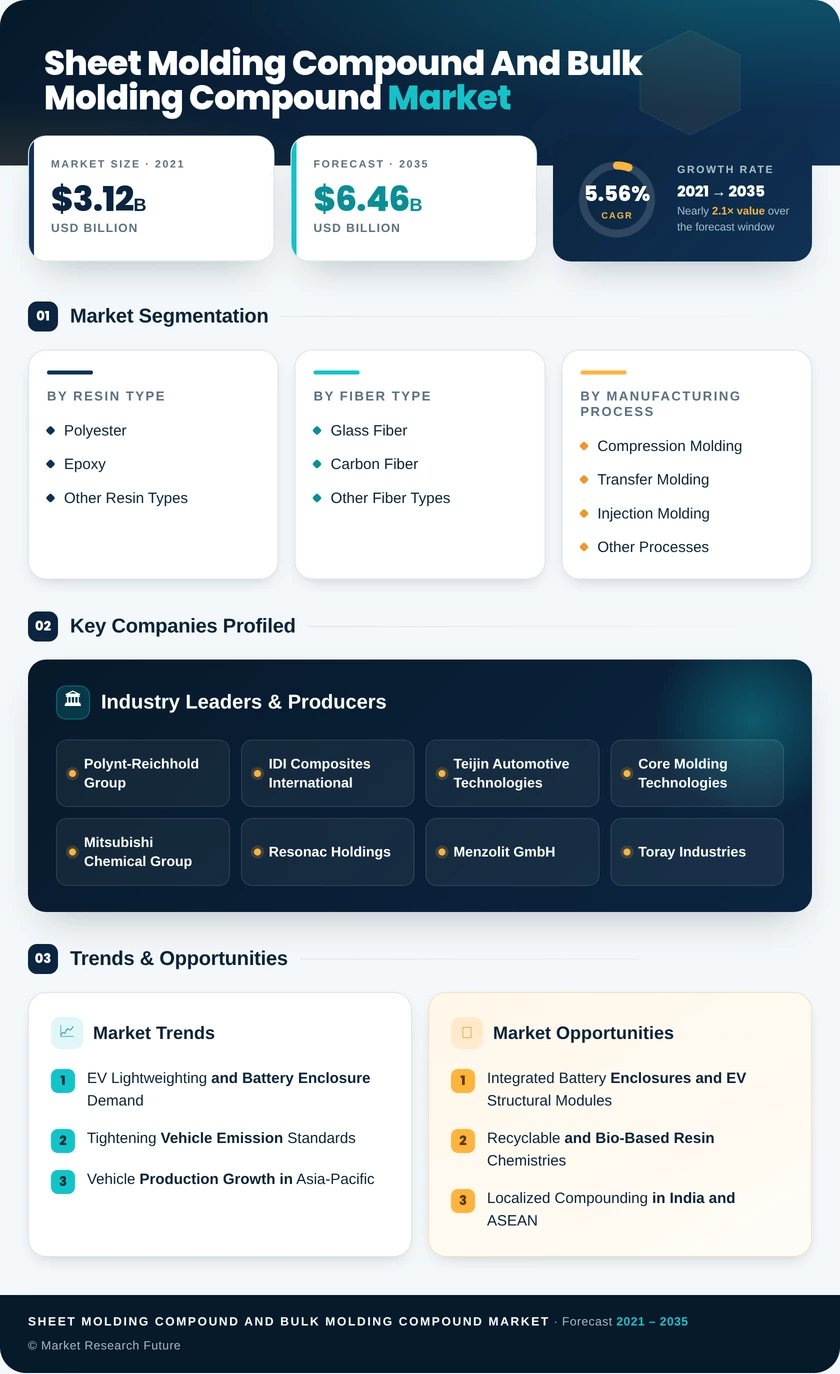
Sheet Molding Compound and Bulk Molding Compound Market (2026 - 2035)

ID: MRFR/CnM/1139-CR 100 Pages Chitranshi Jaiswal Last Updated: October 16, 2026
Sheet Molding Compound and Bulk Molding Compound Market Research Report Information By Resin Type (Polyester, Epoxy, and Other Resin Types), By Fiber Type (Glass Fiber, Carbon Fiber, and Other Fiber Types), By Manufacturing Process (Compression Molding, Transfer Molding, Injection Molding, and Other Processes), and By End-user Industry (Automotive and Transportation, Electrical and Electronics, Building and Construction, Aerospace and Defense, and Other End-user Industries) – Forecast Till 2035.
Sheet Molding Compound and Bulk Molding Compound Market
Market Size
Forecast Period2026-2035
CAGR (2026-2035)5.56%
2025 Market SizeUSD 3.76 Billion
2035 Market SizeUSD 6.46 Billion
Key Players
Polynt-Reichhold Group
IDI Composites International
Teijin Automotive Technologies
Core Molding Technologies
Mitsubishi Chemical Group
Resonac Holdings
Opportunities
  • Integrated Battery Enclosures and EV Structural Modules
  • Recyclable and Bio-Based Resin Chemistries
  • Localized Compounding in India and ASEAN
  1. 1 Market Summary | |
  2. 2 Key Report Takeaways | |
    1. 2.1 By Resin Type | |
    2. 2.2 By Fiber Type | |
    3. 2.3 By Manufacturing Process | |
    4. 2.4 By End-user Industry | |
    5. 2.5 By Region | |
  3. 3 Market Size and Forecast (2021–2035) | |
    1. 3.1 Historical Market Size (2021–2024) | |
    2. 3.2 Base Year and Forecast Market Size (2025–2035) | |
    3. 3.3 Year-over-Year Growth Analysis | |
  4. 4 Driver Impact Analysis | |
    1. 4.1 EV Lightweighting and Battery Enclosure Demand | |
    2. 4.2 Tightening Vehicle Emission Standards | |
    3. 4.3 Vehicle Production Growth in Asia-Pacific | |
    4. 4.4 Grid Expansion and Electrical Enclosure Demand | |
    5. 4.5 Infrastructure Renewal and Corrosion-Resistant Construction | |
    6. 4.6 Carbon Fiber Grades in Aerospace and Premium Vehicles | |
    7. 4.7 Press Automation and Cycle-Time Gains | |
  5. 5 Restraints Impact Analysis | |
    1. 5.1 Limited Recyclability of Thermoset Parts | |
    2. 5.2 Styrene Exposure and Emission Regulation | |
    3. 5.3 Raw Material Price Volatility | |
    4. 5.4 Competition from Thermoplastics and Aluminum | |
    5. 5.5 High Tooling and Press Capital Cost | |
  6. 6 Opportunities | |
    1. 6.1 Integrated Battery Enclosures and EV Structural Modules | |
    2. 6.2 Recyclable and Bio-Based Resin Chemistries | |
    3. 6.3 Localized Compounding in India and ASEAN | |
    4. 6.4 Process-Data Services and Tolling Models | |
    5. 6.5 Charging and Renewable Energy Enclosures | |
  7. 7 Regional Market Share and Country-Level Analysis | |
    1. 7.1 North America | | |
      1. 7.1.1 United States | | |
      2. 7.1.2 Canada | | |
      3. 7.1.3 Mexico | |
    2. 7.2 Europe | | |
      1. 7.2.1 Germany | | |
      2. 7.2.2 United Kingdom | | |
      3. 7.2.3 France | | |
      4. 7.2.4 Italy | | |
      5. 7.2.5 Spain | | |
      6. 7.2.6 Nordic Countries | | |
      7. 7.2.7 Russia | | |
      8. 7.2.8 Rest of Europe | |
    3. 7.3 Asia-Pacific | | |
      1. 7.3.1 China | | |
      2. 7.3.2 India | | |
      3. 7.3.3 Japan | | |
      4. 7.3.4 South Korea | | |
      5. 7.3.5 ASEAN | | |
      6. 7.3.6 Rest of Asia-Pacific | |
    4. 7.4 South America | | |
      1. 7.4.1 Brazil | | |
      2. 7.4.2 Argentina | | |
      3. 7.4.3 Rest of South America | |
    5. 7.5 Middle East & Africa | | |
      1. 7.5.1 Saudi Arabia | | |
      2. 7.5.2 UAE | | |
      3. 7.5.3 South Africa | | |
      4. 7.5.4 Egypt | | |
      5. 7.5.5 Rest of Middle East & Africa | |
  8. 8 Future Outlook (2026–2035) | |
    1. 8.1 Electrification Reshapes Vehicle Content | |
    2. 8.2 Circularity Becomes a Purchasing Criterion | |
    3. 8.3 Simulation-Led Design and Digital Molding | |
    4. 8.4 Grid and Infrastructure Build-Out | |
  9. 9 Segmentation Analysis | |
    1. 9.1 By Resin Type | | |
      1. 9.1.1 Polyester | | |
      2. 9.1.2 Epoxy | | |
      3. 9.1.3 Other Resin Types | |
    2. 9.2 By Fiber Type | | |
      1. 9.2.1 Glass Fiber | | |
      2. 9.2.2 Carbon Fiber | | |
      3. 9.2.3 Other Fiber Types | |
    3. 9.3 By Manufacturing Process | | |
      1. 9.3.1 Compression Molding | | |
      2. 9.3.2 Transfer Molding | | |
      3. 9.3.3 Injection Molding | | |
      4. 9.3.4 Other Processes | |
    4. 9.4 By End-user Industry | | |
      1. 9.4.1 Automotive and Transportation | | |
      2. 9.4.2 Electrical and Electronics | | |
      3. 9.4.3 Building and Construction | | |
      4. 9.4.4 Aerospace and Defense | | |
      5. 9.4.5 Other End-user Industries | |
  10. 10 Competitive Landscape | |
    1. 10.1 Market Concentration Analysis | |
    2. 10.2 Competitive Benchmarking Matrix | |
    3. 10.3 Company Profiles | | |
      1. 10.3.1 Polynt-Reichhold Group | | |
      2. 10.3.2 IDI Composites International | | |
      3. 10.3.3 Teijin Automotive Technologies | | |
      4. 10.3.4 Core Molding Technologies | | |
      5. 10.3.5 Mitsubishi Chemical Group | | |
      6. 10.3.6 Resonac Holdings | | |
      7. 10.3.7 Menzolit GmbH | | |
      8. 10.3.8 Toray Industries | | |
      9. 10.3.9 Huntsman Corporation | | |
      10. 10.3.10 Astar S.A. | | |
      11. 10.3.11 Lorenz Kunststofftechnik GmbH | |
  11. 11 Recent News & Developments | |
  12. 12 Report Scope and Methodology | |
  13. 13 Detailed Sources and Citations | |
  14. 14 Frequently Asked Questions (FAQs) | | LIST OF TABLES | |
  15. TABLE 1 Global Market Snapshot, 2025 and 2035 | |
  16. TABLE 2 Global Market Size & Forecast, by Revenue (USD Billion), 2021–2035 | |
  17. TABLE 3 Driver Impact Analysis | |
  18. TABLE 4 Restraints Impact Analysis | |
  19. TABLE 5 Regional Summary, 2025 | |
  20. TABLE 6 North America Market, by Country, 2025 | |
  21. TABLE 7 Europe Market, by Country, 2025 | |
  22. TABLE 8 Asia-Pacific Market, by Country, 2025 | |
  23. TABLE 9 South America Market, by Country, 2025 | |
  24. TABLE 10 Middle East & Africa Market, by Country, 2025 | |
  25. TABLE 11 Global Market, by Resin Type, 2025 | |
  26. TABLE 12 Global Market, by Fiber Type, 2025 | |
  27. TABLE 13 Global Market, by Manufacturing Process, 2025 | |
  28. TABLE 14 Global Market, by End-user Industry, 2025 | |
  29. TABLE 15 Competitive Benchmarking Matrix | |
  30. TABLE 16 Report Scope and Methodology | |
  31. TABLE 17 Detailed Sources and Citations | |
  32. TABLE 18 Segmentation Quick Reference | | LIST OF FIGURES | |
  33. FIGURE 1 Market Dynamics Overview (Drivers, Restraints, Opportunities) | |
  34. FIGURE 2 Industry Value Chain Analysis | |
  35. FIGURE 3 Porter's Five Forces Analysis | |
  36. FIGURE 4 Global Market Size Trend, 2021–2035 (USD Billion) | |
  37. FIGURE 5 Market Share, by Resin Type, 2025 | |
  38. FIGURE 6 Market Share, by Fiber Type, 2025 | |
  39. FIGURE 7 Market Share, by Manufacturing Process, 2025 | |
  40. FIGURE 8 Market Share, by End-user Industry, 2025 | |
  41. FIGURE 9 Regional Market Share, 2025 | |
  42. FIGURE 10 Country-Level Growth Comparison, 2026–2035 | |
  43. FIGURE 11 Competitive Landscape: Estimated Revenue Share Ranges

Segmentation Quick Reference

DimensionSub-SegmentsDominant SegmentFastest Growing Segment
By Resin TypePolyester; Epoxy; Other Resin TypesPolyester (51.0% share)Epoxy (6.3% CAGR)
By Fiber TypeGlass Fiber; Carbon Fiber; Other Fiber TypesGlass Fiber (74.5% share)Carbon Fiber (6.35% CAGR)
By Manufacturing ProcessCompression Molding; Transfer Molding; Injection Molding; Other ProcessesCompression Molding (68.0% share)Transfer Molding (5.95% CAGR)
By End-user IndustryAutomotive and Transportation; Electrical and Electronics; Building and Construction; Aerospace and Defense; Other End-user IndustriesAutomotive and Transportation (largest share)Automotive and Transportation (6.45% CAGR)
By RegionNorth America; Europe; Asia-Pacific; South America; Middle East & AfricaAsia-Pacific (46.5% share)Asia-Pacific (46.5% share; fastest-growing region)

Market Segmentation Overview

By Resin Type

Sub-SegmentKey Trend
PolyesterLow-styrene grades protect share on legacy compression lines
EpoxyBattery housings and heat-resistant EV components
Other Resin TypesVinyl ester for corrosion service; phenolic for fire-safe interiors

Polyester leads because molders can run it on existing presses with well-understood cure profiles and a deep regional supply base. Epoxy grows fastest as EV battery housing designers trade higher resin cost for lower emissions and better heat resistance. Vinyl ester and phenolic grades stay niche but command premiums in chemical-exposure and fire-rated parts.

By Fiber Type

Sub-SegmentKey Trend
Glass FiberFurnace expansions stabilize supply for high-volume launches
Carbon FiberChopped-fiber grades press on conventional equipment
Other Fiber TypesNatural and hybrid mats for cost-optimized stiffness

Glass Fiber dominates on its balance of cost, stiffness, and dielectric strength, which electrical enclosures and body panels both require. Carbon Fiber grows fastest because aerospace fairings and premium sports cars accept higher material cost to meet weight targets. Hybrid glass-carbon mats are gaining traction where designers need mid-tier stiffness at controlled cost.

By Manufacturing Process

Sub-SegmentKey Trend
Compression MoldingRobotic charge placement and in-press cure monitoring
Transfer MoldingThicker structural sections with embedded foam cores
Injection MoldingHigh-count electrical parts and insert molding
Other ProcessesSpecialty low-volume and prototype work

Compression Molding leads because body panels, lift-gates, and battery lids require large, flat or gently contoured parts that suit high-tonnage presses. Transfer Molding grows fastest as truck roofs and structural members call for controlled resin flow and higher fiber volumes. Injection Molding of bulk grades keeps a steady role in breaker housings and connector bodies where cycle speed decides cost.

By End-user Industry

Sub-SegmentKey Trend
Automotive and TransportationSingle-mold lift-gates, pickup boxes, battery covers
Electrical and ElectronicsMiniaturized flame-retardant housings
Building and ConstructionCorrosion-proof decking and utility enclosures
Aerospace and DefenseCarbon fiber fairings meeting fire-smoke-toxicity rules
Other End-user IndustriesMarine components and sanitary ware

Automotive and Transportation is both the largest and fastest-growing end use, as EV platform refreshes replace welded steel assemblies with single-shot molded parts. Electrical and Electronics follows on demand for thin-wall flame-retardant housings in switchgear and meters. Building and Construction and Aerospace and Defense add smaller but stable volumes tied to corrosion resistance and fire-safety compliance.


Download PDF ×

We do not share your information with anyone. However, we may send you emails based on your report interest from time to time. You may contact us at any time to opt-out.