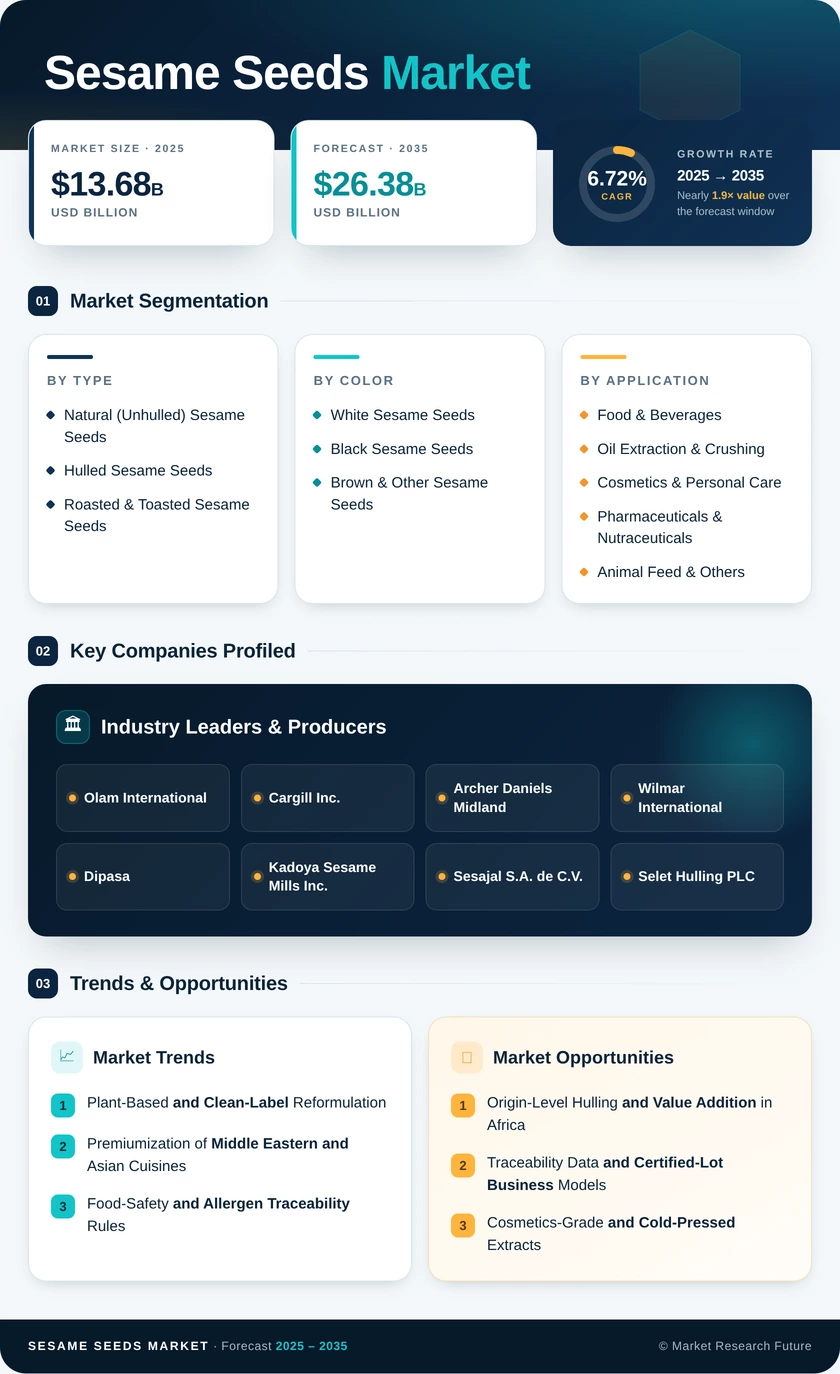
Sesame Seeds Market (2026 - 2035)

ID: MRFR/FnB/6087-HCR 90 Pages Snehal Singh Last Updated: October 22, 2026
Sesame Seeds Market Size, Share, Industry Trend & Analysis Research Report Information By Type (Natural Unhulled Sesame Seeds, Hulled Sesame Seeds, Roasted & Toasted Sesame Seeds), By Color (White Sesame Seeds, Black Sesame Seeds, Brown & Other Sesame Seeds), By Application (Food & Beverages, Oil Extraction & Crushing, Cosmetics & Personal Care, Pharmaceuticals & Nutraceuticals, Animal Feed & Others), By Region (North America, Europe, Asia-Pacific, South America, Middle East & Africa) - Forecast Till 2035
Sesame Seeds Market
Market Size
Forecast Period2026-2035
CAGR (2026-2035)6.72%
2025 Market SizeUSD 13.68 Billion
2035 Market SizeUSD 26.38 Billion
Key Players
Olam International
Cargill Inc.
Archer Daniels Midland
Wilmar International
Dipasa
Kadoya Sesame Mills Inc.
Opportunities
  • Origin-Level Hulling and Value Addition in Africa
  • Traceability Data and Certified-Lot Business Models
  • Cosmetics-Grade and Cold-Pressed Extracts
  1. 1 Market Summary | |
  2. 2 Key Report Takeaways | |
    1. 2.1 By Type | |
    2. 2.2 By Color | |
    3. 2.3 By Application | |
    4. 2.4 By Region | |
  3. 3 Market Size and Forecast (2021–2035) | |
  4. 4 Driver Impact Analysis | |
    1. 4.1 Plant-Based and Clean-Label Reformulation | |
    2. 4.2 Premiumization of Middle Eastern and Asian Cuisines | |
    3. 4.3 Food-Safety and Allergen Traceability Rules | |
    4. 4.4 China's Processing and Import Pull | |
    5. 4.5 Climate-Resilient and Non-Shattering Cultivars | |
    6. 4.6 Cosmetics and Nutraceutical Lignan Demand | |
  5. 5 Restraints Impact Analysis | |
    1. 5.1 Contaminant and Residue Rejections | |
    2. 5.2 Weather Volatility and Low Yields | |
    3. 5.3 Conflict and Origin Concentration | |
    4. 5.4 Freight and Logistics Disruption | |
    5. 5.5 Allergen Exposure and Recall Liability | |
  6. 6 Opportunities | |
    1. 6.1 Origin-Level Hulling and Value Addition in Africa | |
    2. 6.2 Traceability Data and Certified-Lot Business Models | |
    3. 6.3 Cosmetics-Grade and Cold-Pressed Extracts | |
    4. 6.4 Black and Specialty Seed for Premium Foods | |
    5. 6.5 Mechanized Cultivation in the Americas and Australia | |
  7. 7 Regional Market Share and Country-Level Analysis | |
    1. 7.1 North America | | |
      1. 7.1.1 United States | | |
      2. 7.1.2 Canada | | |
      3. 7.1.3 Mexico | |
    2. 7.2 Europe | | |
      1. 7.2.1 Germany | | |
      2. 7.2.2 United Kingdom | | |
      3. 7.2.3 France | | |
      4. 7.2.4 Netherlands | | |
      5. 7.2.5 Russia | | |
      6. 7.2.6 Rest of Europe | |
    3. 7.3 Asia-Pacific | | |
      1. 7.3.1 China | | |
      2. 7.3.2 India | | |
      3. 7.3.3 Japan | | |
      4. 7.3.4 Australia | | |
      5. 7.3.5 Rest of Asia-Pacific | |
    4. 7.4 South America | | |
      1. 7.4.1 Brazil | | |
      2. 7.4.2 Argentina | | |
      3. 7.4.3 Paraguay | | |
      4. 7.4.4 Rest of South America | |
    5. 7.5 Middle East & Africa | | |
      1. 7.5.1 Saudi Arabia | | |
      2. 7.5.2 UAE | | |
      3. 7.5.3 Egypt | | |
      4. 7.5.4 South Africa | | |
      5. 7.5.5 Sudan | | |
      6. 7.5.6 Nigeria | | |
      7. 7.5.7 Ethiopia | | |
      8. 7.5.8 Tanzania | | |
      9. 7.5.9 Rest of Middle East & Africa | |
  8. 8 Future Outlook (2026–2035) | |
    1. 8.1 Climate-Resilient Breeding and Mechanized Farming | |
    2. 8.2 Digital Traceability and AI Grading | |
    3. 8.3 Trade Route Reconfiguration and Origin Diversification | |
    4. 8.4 Health, Sustainability, and Label Claims | |
  9. 9 Segmentation Analysis | |
    1. 9.1 By Type | | |
      1. 9.1.1 Natural (Unhulled) Sesame Seeds | | |
      2. 9.1.2 Hulled Sesame Seeds | | |
      3. 9.1.3 Roasted & Toasted Sesame Seeds | |
    2. 9.2 By Color | | |
      1. 9.2.1 White Sesame Seeds | | |
      2. 9.2.2 Black Sesame Seeds | | |
      3. 9.2.3 Brown & Other Sesame Seeds | |
    3. 9.3 By Application | | |
      1. 9.3.1 Food & Beverages | | |
      2. 9.3.2 Oil Extraction & Crushing | | |
      3. 9.3.3 Cosmetics & Personal Care | | |
      4. 9.3.4 Pharmaceuticals & Nutraceuticals | | |
      5. 9.3.5 Animal Feed & Others | |
  10. 10 Competitive Landscape | |
    1. 10.1 Market Concentration Analysis | |
    2. 10.2 Competitive Benchmarking Matrix | |
    3. 10.3 Company Profiles | | |
      1. 10.3.1 Olam International | | |
      2. 10.3.2 Cargill Inc. | | |
      3. 10.3.3 Archer Daniels Midland | | |
      4. 10.3.4 Wilmar International | | |
      5. 10.3.5 Dipasa | | |
      6. 10.3.6 Kadoya Sesame Mills Inc. | | |
      7. 10.3.7 Sesajal S.A. de C.V. | | |
      8. 10.3.8 Selet Hulling PLC | | |
      9. 10.3.9 Shyam Industries | | |
      10. 10.3.10 Fuerst Day Lawson | |
  11. 11 Recent News & Developments | |
  12. 12 Report Scope and Methodology | |
  13. 13 Detailed Sources and Citations | |
  14. 14 Frequently Asked Questions (FAQs) | | LIST OF TABLES | |
  15. TABLE 1 Global Market Size & Forecast, by Revenue (USD Billion), 2021–2035 | |
  16. TABLE 2 Global Market – Year-over-Year Growth Analysis, 2021–2035 | |
  17. TABLE 3 Driver Impact Analysis, 2026–2035 | |
  18. TABLE 4 Restraints Impact Analysis, 2026–2035 | |
  19. TABLE 5 Global Market Size, by Region, 2025 (USD Billion) | |
  20. TABLE 6 North America Market Size, by Country, 2021–2035 (USD Billion) | |
  21. TABLE 7 Europe Market Size, by Country, 2021–2035 (USD Billion) | |
  22. TABLE 8 Asia-Pacific Market Size, by Country, 2021–2035 (USD Billion) | |
  23. TABLE 9 South America Market Size, by Country, 2021–2035 (USD Billion) | |
  24. TABLE 10 Middle East & Africa Market Size, by Country, 2021–2035 (USD Billion) | |
  25. TABLE 11 Global Market Size, by Type, 2021–2035 (USD Billion) | |
  26. TABLE 12 Global Market Size, by Color, 2021–2035 (USD Billion) | |
  27. TABLE 13 Global Market Size, by Application, 2021–2035 (USD Billion) | |
  28. TABLE 14 Competitive Benchmarking Matrix, 2025 | |
  29. TABLE 15 Report Scope and Methodology | |
  30. TABLE 16 Detailed Sources and Citations | | LIST OF FIGURES | |
  31. FIGURE 1 Market Dynamics Overview – Drivers, Restraints, and Opportunities | |
  32. FIGURE 2 Industry Value Chain Analysis – Farm to Processor to End User | |
  33. FIGURE 3 Porter's Five Forces Analysis | |
  34. FIGURE 4 Global Market Size Trend, 2021–2035 (USD Billion) | |
  35. FIGURE 5 Market Share, by Type, 2025 (%) | |
  36. FIGURE 6 Market Share, by Color, 2025 (%) | |
  37. FIGURE 7 Market Share, by Application, 2025 (%) | |
  38. FIGURE 8 Regional Market Share, 2025 (%) | |
  39. FIGURE 9 Country-Level Share Within Asia-Pacific, 2025 (%) | |
  40. FIGURE 10 Competitive Landscape – Estimated Revenue Share Ranges, 2025

Segmentation Quick Reference

DimensionSub-SegmentsDominant SegmentFastest Growing Segment
By TypeNatural (Unhulled) Sesame Seeds; Hulled Sesame Seeds; Roasted & Toasted Sesame SeedsNatural (Unhulled) Sesame Seeds — 48.5% shareHulled Sesame Seeds — 7.6% CAGR (2026–2035)
By ColorWhite Sesame Seeds; Black Sesame Seeds; Brown & Other Sesame SeedsWhite Sesame Seeds — 62.4% shareBlack Sesame Seeds — 7.9% CAGR (2026–2035)
By ApplicationFood & Beverages; Oil Extraction & Crushing; Cosmetics & Personal Care; Pharmaceuticals & Nutraceuticals; Animal Feed & OthersFood & Beverages — 51.8% shareCosmetics & Personal Care — 8.6% CAGR (2026–2035)
By RegionNorth America; Europe; Asia-Pacific; South America; Middle East & AfricaAsia-Pacific — 42.6% shareMiddle East & Africa — 9.0% CAGR (2026–2035)

Market Segmentation Overview

By Type

Sub-SegmentKey Trend
Natural (Unhulled) Sesame SeedsBulk demand from Chinese and Indian crushers
Hulled Sesame SeedsOutsourced dehulling for bakery and snack lines
Roasted & Toasted Sesame SeedsFlavor-specified product for Asian condiments

Natural (Unhulled) Sesame Seeds lead on volume because crushers value oil yield over appearance and accept minimal processing. Hulled Sesame Seeds grow fastest as food manufacturers buy cleaned, low-microbial seed from certified processors rather than investing in their own dehulling. Roasted & Toasted Sesame Seeds stay niche but profitable, priced on roast consistency.

By Color

Sub-SegmentKey Trend
White Sesame SeedsStandard for bakery toppings and Middle Eastern foods
Black Sesame SeedsRising use in East Asian desserts and drinks
Brown & Other Sesame SeedsPrimarily used for crushing.

White Sesame Seeds dominate because bakery and halva makers prize their mild taste and uniform look. Black Sesame Seeds expand fastest as black sesame desserts and beverages move from East Asia into Western cafés, rewarding exporters with optical sorting. Brown & Other Sesame Seeds compete mainly on price within crushing channels.

By Application

Sub-SegmentKey Trend
Food & BeveragesClean-label bakery, snacks, and condiments
Oil Extraction & CrushingMature Asian cooking oil demand
Cosmetics & Personal CareCold-pressed and CO2-extracted ingredients
Pharmaceuticals & NutraceuticalsSesamin and lignan supplements
Animal Feed & OthersDefatted meal for livestock rations

Food & Beverages leads because sesame appears across bakery, confectionery, snacks, and sauces in nearly every region. Cosmetics & Personal Care grows fastest, driven by clean-beauty formulators paying premiums for cold-pressed and CO2-extracted inputs. Pharmaceuticals & Nutraceuticals follow closely on sesamin research, while Oil Extraction & Crushing and Animal Feed & Others remain volume outlets tied to Asian crushing economics.


Download PDF ×

We do not share your information with anyone. However, we may send you emails based on your report interest from time to time. You may contact us at any time to opt-out.