
Top Industry Leaders in the Self Learning Neuromorphic Chip Market
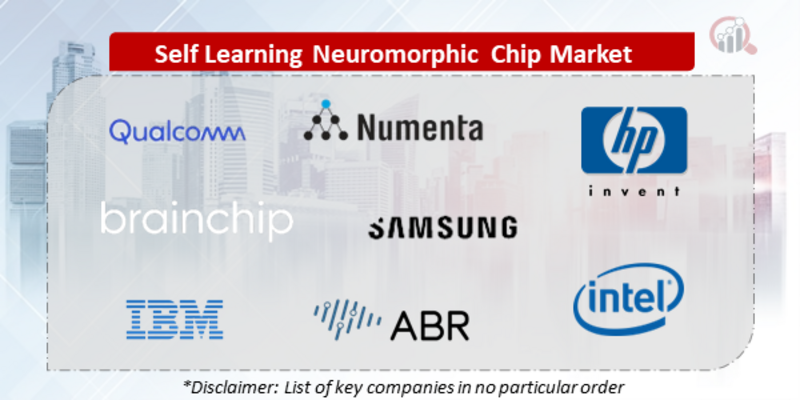
The Competitive Landscape of the Self-Learning Neuromorphic Chip Market
The human brain, the ultimate learning machine, has long inspired technological progress. Today, it finds an echo in the nascent self-learning neuromorphic chip market. These chips, mimicking the neural architecture of the brain, promise revolutionary advancements in artificial intelligence, robotics, and edge computing. Navigating this dynamic space requires a clear understanding of the competitive landscape, the strategies of key players, and the factors shaping its future trajectory.
Key Player:
- Qualcomm
- Numenta
- Samsung Group
- IBM
- Hewlett Packard
- Brainchip Holdings Ltd.
- HRL Laboratories
- Applied Brain Research Inc.
- General Vision
- Intel Corporation
Get In-Depth Insights on Key Self Learning Neuromorphic Chip Companies
Strategies Adopted by Leaders:
- Technology Prowess: Intel's Loihi and Cerebras Systems' CS1 lead the charge with high-density arrays of artificial neurons and powerful interconnect architectures, setting the benchmark for processing power and scalability.
- Vertical Specialization: Brainchip focuses on edge AI applications with low-power neuromorphic chips for drones and robots, while Mythic AI caters to high-performance computing with scalable rack-mounted neuromorphic systems.
- Partnership Play: IBM collaborates with universities and research institutions to accelerate neuromorphic research and development, fostering co-creation and shaping the future of the market.
- Open-Source Platforms: The Open Neuromorphic Platform (ONP) promotes open-source hardware and software tools, lowering entry barriers and empowering new players in the ecosystem.
- Focus on Energy Efficiency: Cerebras Core prioritizes sustainable AI with liquid cooling and efficient chip design, addressing concerns about the high energy consumption of current neuromorphic systems.
Factors for Market Share Analysis:
- Performance and Scalability: Companies offering superior processing power, efficient memory access, and scalable architectures command premium prices and secure market share by enabling faster, more complex, and adaptable AI applications.
- Application Specificity: Tailoring neuromorphic chips to specific applications, like image recognition in autonomous vehicles or natural language processing, is crucial for market penetration and user adoption.
- Development Tools and Software Support: Robust software development kits, training algorithms, and simulation tools are essential for enabling efficient development and deployment of neuromorphic AI solutions.
- Power Consumption and Sustainability: Addressing the high energy footprint of current neuromorphic chips through innovative design and cooling technologies is critical for wider adoption and environmental responsibility.
- Cost Competitiveness and Availability: Balancing advanced features with attractive pricing and ensuring accessibility, particularly for academic and research institutions, is crucial for market growth.
New and Emerging Companies:
- Startups like Groq and InBrain: These innovators focus on niche segments like spiking neural networks and biomimetic chip architectures, pushing the boundaries of neuromorphic hardware and mimicking brain functionality.
- Academia and Research Labs: MIT's Neurotechnology Lab and Stanford University's Human-AI Interaction Lab explore brain-computer interfaces, neuromorphic computing algorithms, and ethical considerations in AI development, shaping the future of the market.
- Established AI and Chipmakers: Companies like Google AI and Nvidia leverage their expertise in AI and semiconductor technologies to enter the neuromorphic chip market, potentially driving down costs and accelerating adoption.
Industry Developments:
Qualcomm:
- November 2023, Demonstrated a neuromorphic computing architecture with improved scalability and power efficiency, targeting edge AI applications.
- July 2023, Partnered with a university to develop new learning algorithms for spiking neural networks on neuromorphic hardware.
Numenta:
- October 2023, Released an open-source neuromorphic hardware platform for researchers and developers to build and experiment with SNNs.
- August 2023, Announced a collaboration with a large cloud provider to offer cloud-based access to its neuromorphic computing platform.
Samsung Group:
- September 2023, Unveiled a prototype neuromorphic chip with high-density neuron and synapse integration, aiming for advanced AI processing.
- December 2023, Invested in a startup developing neuromorphic chips for autonomous vehicle applications.

 Noah Malgeri
Co-Founder
Noah Malgeri
Co-Founder

 Peter Groot koerkamp
Account and Business Manager
Peter Groot koerkamp
Account and Business Manager

 Younghwan Choi
Senior Retail Manager
Younghwan Choi
Senior Retail Manager

 Mark Irwin
Management Consultant
Mark Irwin
Management Consultant

 Akif Moroglu
Strategy & Business Development Director
Akif Moroglu
Strategy & Business Development Director

 Guilherme Gomes Martins
Product Management Director
Guilherme Gomes Martins
Product Management Director

 Joseph Aguayo
Sales Operations & Pricing Manager
Joseph Aguayo
Sales Operations & Pricing Manager

 La Terria Dodd
Program Support Specialist
La Terria Dodd
Program Support Specialist

 Rob Kooiker
Group Product Manager HVAC & Fire Protection GMA
Rob Kooiker
Group Product Manager HVAC & Fire Protection GMA


