Request Free Sample ×

Kindly complete the form below to receive a free sample of this Report

* Please use a valid business email

Leading companies partner with us for data-driven Insights

clients tt-cursor
Hero Background
English
Chinese
French
Japanese
Korean
German
Spanish

Sauces Market Share

ID: MRFR/FnB/2074-HCR
110 Pages
Sakshi Gupta
March 2026

Sauces Market Size, Share, Industry Trend & Analysis Research Report Information By Type (Mustard Sauce, Hot Sauces, Soy Sauce, Barbecue Sauce, Ketchup, and Others), Packaging (Bottles & Jars, Pouches & Sachets, and Others), Distribution Channel (Store-Basedand Non-Store-Based) and By Region (North America, Europe, Asia-Pacific, And Rest Of The World) – Forecast Till 2035

Share:
Download PDF ×

We do not share your information with anyone. However, we may send you emails based on your report interest from time to time. You may contact us at any time to opt-out.

Sauces Market Infographic
Purchase Options

Market Share

Sauces Market Share Analysis

Sauce companies employ a number of methods to gain market share and sales. Businesses use product differentiation to entice consumers by creating unique sauces. This may involve creating organic, gluten-free, or vegan sauces, using premium ingredients, or adding uncommon flavors. Companies try to recruit new consumers and create brand loyalty among sauce aficionados by giving a distinctive taste experience.

In the Sauces Market, price placement is significant as it impacts consumers' buying decisions. Some companies use cheap, delectable sauces to entice customers as a cost leadership strategy. This method excels at attracting value-seeking budget-conscious customers. Premium pricing is used by companies that emphasize high-quality, handcrafted ingredients or formulations. Gourmet or luxury sauces attract clients willing to pay extra for a superior taste.

Market segmentation is important in the sauces sector due to client dietary constraints and cooking preferences. Businesses tailor their sauce choices to certain groups, such as people with dietary limitations. Sugar-free options for health-conscious clients and hot sauces for fire-lovers are examples. Recognizing and meeting the needs of diverse client groups helps companies target market niches and increase market share.

Geographic positioning dominates Sauces Market market share methods. Businesses may tailor their products to regional tastes to reflect regional culinary traditions. Local ingredients and chefs may make sauces more authentic and attractive to particular consumers.

Partnerships and collaborations are helping Sauces Market companies reach new customers and demographics. Partnerships with famous restaurants, chefs, and culinary influencers may boost brand recognition and sauce exposure. Co-branded merchandise, limited-edition releases, and food company alliances improve market share by increasing visibility and consumer interest.

For Sauces Market market share, digital marketing and online buying are crucial. Sauce companies can market their sauces, provide recipes, and connect with consumers online. Launching social media campaigns, partnering with notable individuals, and creating interactive content may boost brand loyalty. E-commerce sites let people browse and purchase a variety of sauces, expanding the brand's reach.

Finally, in the ever-changing Sauces Market, strategic positioning is essential. This sector's enterprises distinguish their goods, establish competitive pricing, separate their target audience by location, develop strategic alliances, and actively connect with consumers online to gain market share. Firms must adapt rapidly to changing client demands, provide cutting-edge products, and promote their brands on digital media to remain ahead of the competition and grow their sauces market share.

Author
Author Profile
Sakshi Gupta
Team Lead - Research

Currently a Team Lead in consumer goods, FMCG, and F&B, she translates rigorous research into decisive strategy. She develops GTM roadmaps, pricing architectures, and competitive benchmarks for companies across Europe, the US, and APAC. She synthesize insights, align cross-functional teams, and drive execution from brief to measurable outcomes. She leads end-to-end engagements with crisp analysis, compelling storytelling, and a strong command of Power BI, Tableau, SQL, and advanced research platforms.

Leave a Comment

FAQs

What is the current valuation of the Sauces Market as of 2024?

<p>The Sauces Market was valued at 58.23 USD Billion in 2024.</p>

What is the projected market valuation for the Sauces Market in 2035?

<p>The Sauces Market is projected to reach a valuation of 104.96 USD Billion by 2035.</p>

What is the expected CAGR for the Sauces Market during the forecast period 2025 - 2035?

<p>The expected CAGR for the Sauces Market during the forecast period 2025 - 2035 is 5.5%.</p>

Which segment of sauces had the highest valuation in 2024?

<p>In 2024, Ketchup had the highest valuation at 20.0 USD Billion.</p>

How much is the Soy Sauce segment projected to grow by 2035?

<p>The Soy Sauce segment is projected to grow from 10.0 USD Billion in 2024 to 18.0 USD Billion by 2035.</p>

What are the leading packaging types in the Sauces Market?

<p>Bottles & Jars lead the packaging types, with a valuation of 30.0 USD Billion in 2024.</p>

What is the projected growth for Hot Sauces by 2035?

Hot Sauces are projected to grow from 8.0 USD Billion in 2024 to 15.0 USD Billion by 2035.

Which companies are considered key players in the Sauces Market?

Key players in the Sauces Market include Unilever, Nestle, Kraft Heinz, and McCormick &amp; Company.

What is the distribution channel with the highest valuation in 2024?

The Store-Based distribution channel had the highest valuation at 34.94 USD Billion in 2024.

How is the Others segment performing in the Sauces Market?

The Others segment is projected to grow from 9.73 USD Billion in 2024 to 18.46 USD Billion by 2035.

Market Summary

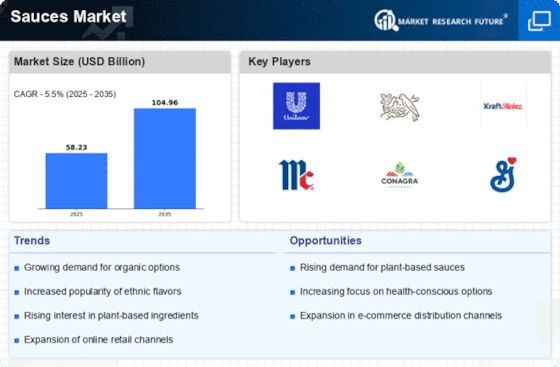
As per Market Research Future analysis, the Sauces Market was estimated at 58.23 USD Billion in 2024. The Sauces industry is projected to grow from 61.43 USD Billion in 2025 to 104.96 USD Billion by 2035, exhibiting a compound annual growth rate (CAGR) of 5.5% during the forecast period 2025 - 2035, supported by growth across segments such as the Barbecue Sauce market, bbq sauce market, and soy sauce market.

Key Market Trends & Highlights

The Sauces Market is experiencing dynamic growth driven by health trends and innovative flavors.

  • Health-conscious offerings are increasingly influencing consumer preferences in the Sauces Market. North America remains the largest market, while Asia-Pacific is recognized as the fastest-growing region. Ketchup continues to dominate as the largest segment, whereas hot sauces are emerging as the fastest-growing category. E-commerce growth and sustainability initiatives are key drivers propelling market expansion.

Market Size & Forecast

2024 Market Size 58.23 (USD Billion)
2035 Market Size 104.96 (USD Billion)
CAGR (2025 - 2035) 5.5%
Largest Regional Market Share in 2024 North America

Major Players

<p><a href="https://www.unilever.co.uk/">Unilever (GB)</a>, Nestle (CH), Kraft Heinz (US), McCormick &amp; Company (US), Conagra Brands (US), General Mills (US), Danone (FR), Bertolli (IT), Pinnacle Foods (US), Heinz (US)</p>

Market Trends

The Sauces Market is currently experiencing a dynamic evolution, driven by changing consumer preferences and an increasing demand for diverse flavors across the dips and sauces market and cooking and pasta sauces market. As culinary exploration becomes more prevalent, consumers are gravitating towards unique and exotic sauces that enhance their dining experiences, including products aligned with the culinary sauces market and condiment sauces market. This shift is accompanied by a growing interest in health-conscious options, prompting manufacturers to innovate with organic and natural ingredients, influencing demand in the vegan sauce market, cheese sauce market, and vegan cheese sauce market. Additionally, the rise of plant-based diets is influencing the types of sauces being developed, as brands seek to cater to a more diverse consumer base. Moreover, the Sauces Market is witnessing a surge in online retail channels, which are becoming increasingly popular among consumers seeking convenience and variety across the dips and sauces market report. Regional flavor adoption is also accelerating demand in segments such as the chili sauce market, chipotle sauce market basket, and fish sauce market basket. This trend is likely to continue as e-commerce platforms expand their offerings and improve accessibility. The integration of technology in marketing strategies is also noteworthy, as brands leverage social media and digital platforms to engage with consumers and promote their products. Overall, the current landscape of the Sauces Market suggests a vibrant and competitive environment, characterized by innovation and adaptability to consumer demands.

Health-Conscious Offerings

There is a noticeable trend towards health-oriented sauces, as consumers increasingly prioritize nutrition and wellness. This shift has led to the development of products that are lower in sugar, sodium, and artificial additives, appealing to a more health-conscious demographic.

Exotic Flavor Profiles

The demand for unique and bold flavors is on the rise, with consumers eager to explore international cuisines, including products associated with the soy sauce Asian market, china seasonings dressings and sauces market, and Europe hot sauce market. This trend encourages manufacturers to experiment with diverse ingredients and flavor combinations, resulting in a broader range of sauces that cater to adventurous palates.

E-Commerce Growth

The expansion of online shopping is reshaping the Sauces Market, as consumers seek convenience and variety. E-commerce platforms are becoming essential for brands to reach a wider audience, allowing for innovative marketing strategies and enhanced customer engagement.

Sauces Market Market Drivers

E-Commerce Growth

The rapid expansion of e-commerce platforms is transforming the retail landscape for the Sauces Market. As consumers increasingly turn to online shopping for convenience and variety, the availability of sauces through digital channels is becoming more pronounced. Recent statistics suggest that online sales of sauces have surged, with a growth rate of approximately 7% annually. This trend is particularly beneficial for niche brands and artisanal producers, who can reach a wider audience without the constraints of traditional retail distribution. The rise of subscription services and direct-to-consumer models further enhances this dynamic, allowing consumers to discover and purchase a diverse range of sauces from the comfort of their homes. Consequently, e-commerce is likely to play a crucial role in shaping the future of the Sauces Market.

Exotic Flavor Profiles

The Sauces Market is currently experiencing a surge in demand for exotic flavor profiles, which seems to be driven by consumers' desire for culinary exploration. As globalization continues to influence food preferences, sauces that incorporate unique and diverse flavors from various cultures are gaining popularity. This trend is particularly evident in the rise of Asian, Latin American, and Mediterranean sauces, which are being embraced by consumers seeking new taste experiences. Market data indicates that the sales of specialty sauces featuring these exotic flavors have increased significantly, with a projected growth rate of around 6% in the coming years. This shift not only enhances the appeal of the Sauces Market but also encourages manufacturers to innovate and diversify their product offerings.

Health-Conscious Offerings

The increasing consumer inclination towards health-conscious eating habits appears to be a pivotal driver in the Sauces Market. As individuals become more aware of the nutritional content of their food, there is a growing demand for sauces that are low in sugar, fat, and artificial ingredients. This trend is reflected in the rise of organic and natural sauces, which have seen a notable increase in sales. According to recent data, the health-focused segment of the Sauces Market is projected to grow at a compound annual growth rate of approximately 5% over the next five years. Manufacturers are responding by reformulating existing products and introducing new lines that cater to this demographic, thereby expanding their market share and appealing to a broader audience.

Sustainability Initiatives

Sustainability initiatives are increasingly influencing consumer choices within the Sauces Market. As environmental concerns gain traction, consumers are gravitating towards brands that prioritize eco-friendly practices, such as sustainable sourcing of ingredients and environmentally responsible packaging. This shift is prompting manufacturers to adopt greener practices, which may include reducing carbon footprints and minimizing waste. Market Research Future indicates that products marketed as sustainable are witnessing a notable uptick in sales, with consumers willing to pay a premium for such offerings. This trend not only aligns with the values of environmentally conscious consumers but also positions brands favorably in a competitive market. As sustainability becomes a core focus, the Sauces Market is likely to evolve, with an increasing number of companies committing to sustainable practices.

Culinary Trends and Innovations

Culinary trends and innovations are playing a significant role in shaping the Sauces Market. As chefs and home cooks alike experiment with new cooking techniques and flavor combinations, there is a growing demand for sauces that complement these evolving culinary practices. The rise of plant-based diets, for instance, has led to an increased interest in sauces that enhance the flavor of vegetable-based dishes. Additionally, innovations in flavor technology are enabling manufacturers to create sauces that cater to specific dietary needs, such as gluten-free or vegan options. Market data suggests that the segment of the Sauces Market focused on innovative and versatile sauces is expected to grow at a rate of around 4% over the next few years. This emphasis on culinary creativity not only enriches the consumer experience but also drives competition among brands to develop unique and appealing products.

Market Segment Insights

By Type: Ketchup (Largest) vs. Hot Sauces (Fastest-Growing)

<p>In the Sauces Market, the distribution of market share among different types reveals Ketchup as the dominant segment, commanding a significant proportion of the overall sales. Mustard Sauce and Soy Sauce follow, tapping into niche markets and consumer preferences. Barbecue Sauce and Hot Sauces have also carved out their segments, with a growing popularity among culinary enthusiasts. Meanwhile, 'Others' encapsulates various emerging sauces that cater to specialized tastes and cuisines.</p>

<p>Ketchup (Dominant) vs. Hot Sauces (Emerging)</p>

<p>Ketchup is a beloved staple in numerous households and restaurants, often viewed as the quintessential condiment for both fast food and home-cooked meals. Its flexibility in pairing with a variety of dishes establishes its dominance in the market. On the other hand, Hot Sauces are emerging as a popular choice among younger consumers who prefer bold flavors and heat in their culinary experiences. Fueled by the trend towards zestier, more adventurous eating, Hot Sauces appeal to millennials and Gen Z, with a rising array of options featuring different heat levels and unique ingredients.</p>

By Packaging: Bottles & Jars (Largest) vs. Pouches & Sachets (Fastest-Growing)

<p>The sauces market has shown a significant distribution of market share among its packaging segments. Bottles and jars lead the pack, capturing a major portion of consumer preference, particularly for more traditional sauce packaging. On the other hand, pouches and sachets are emerging rapidly as a popular choice due to their convenience and innovative design, appealing to the modern on-the-go lifestyle. Others, while present, account for a smaller share, indicating a diversifying market yet dominated by the more established packaging types.</p>

<p>Bottles & Jars (Dominant) vs. Pouches & Sachets (Emerging)</p>

<p>Bottles and jars have long been the dominant packaging choice in the sauces market, well-regarded for their ability to preserve flavors and provide easy dispensing. Their popularity is driven by classic condiments, such as ketchup and sauces, that are commonly found in household kitchens. In contrast, pouches and sachets represent an emerging trend driven by consumer demand for convenience and portability, often catering to single-serving sizes. This packaging type is increasingly favored in retail outlets due to its lightweight nature and reduced storage space. As consumer habits shift towards on-the-go meal solutions, pouches and sachets are likely to gain further traction in the market.</p>

By Distribution Channel: Store-Based (Largest) vs. Non-Store-Based (Fastest-Growing)

<p>In the Sauces Market, the distribution channels are increasingly diversifying, with 'Store-Based' channels holding a significant share due to their established presence and consumer trust. Traditional retail outlets like supermarkets and grocery stores continue to be the primary choice for consumers, contributing to the majority of sales in the market. This preference for physical shopping locations is bolstered by the ability to browse products and access promotions directly, making it a dominant channel in the sector. Conversely, 'Non-Store-Based' channels are emerging as the fastest-growing segment. The increase in online shopping, driven by consumer convenience and the COVID-19 pandemic's impact on shopping habits, has propelled this channel forward. The rise of e-commerce platforms allows consumers to explore a wider variety of sauces from the comfort of their homes, thus attracting a new customer base and changing traditional purchasing behaviors.</p>

<p>Store-Based: Dominant vs. Non-Store-Based: Emerging</p>

<p>The 'Store-Based' distribution channel remains the dominant force in the Sauces Market, characterized by the extensive reach of supermarkets and grocery stores where consumers can directly interact with the products. This channel offers shoppers immediate access to a variety of sauces, enticing promotions, and the reassurance of purchasing familiar brands. In contrast, the 'Non-Store-Based' segment has emerged rapidly, reflecting the changing landscape of consumer shopping preferences. This channel includes online grocery deliveries and e-commerce platforms that provide convenience and a vast selection of sauces not always available in physical stores. The non-store-based approach caters particularly well to younger, tech-savvy consumers who prioritize convenience in their purchasing decisions.</p>

Get more detailed insights about Sauces Market Research Report - Global Forecast till 2035

Regional Insights

North America : Market Leader in Sauces Market

North America is the largest market for sauces, holding approximately 40% of the global share. The region's growth is driven by increasing consumer demand for convenience foods, health-conscious options, and diverse flavor profiles. Regulatory support for food safety and quality standards further catalyzes market expansion. The U.S. is the primary contributor, followed by Canada, which together account for a significant portion of the market.

Europe : Culinary Innovation Hub

Europe is the second-largest market for sauces, capturing around 30% of the global market share. The region's growth is fueled by a rising trend towards gourmet and organic sauces, driven by health-conscious consumers. Stringent food regulations and quality standards also play a crucial role in shaping the market landscape. Countries like Germany and France lead the market, with a strong presence of local and international brands.

Asia-Pacific : Emerging Market Potential

Asia-Pacific is witnessing rapid growth in the sauces market, driven by urbanization and changing lifestyles. The demand surge is closely linked with the expansion of the soy sauce asian market and china seasonings dressings and sauces market, with China and India leading regional consumption.The region holds about 20% of the global market share, with countries like China and India leading the charge. The demand for diverse flavors and international cuisines is on the rise, prompting local manufacturers to innovate and expand their product lines. The competitive landscape is becoming increasingly dynamic, with both local and The Sauces Market share.

Middle East and Africa : Untapped Market Opportunities

The Middle East and Africa region is emerging as a significant player in the sauces market, holding approximately 10% of the global share. The growth is driven by increasing urbanization, a young population, and a growing interest in international cuisines. Countries like South Africa and the UAE are at the forefront of this expansion, with a mix of local and international brands catering to diverse consumer preferences. The competitive landscape is evolving, with new entrants and established players alike.

Key Players and Competitive Insights

The Sauces is currently characterized by a dynamic competitive landscape, driven by evolving consumer preferences and an increasing demand for diverse flavor profiles. Major players such as Unilever (GB), Kraft Heinz (US), and McCormick & Company (US) are strategically positioned to leverage innovation and regional expansion to capture market share. Unilever (GB) focuses on sustainability and health-conscious products, while Kraft Heinz (US) emphasizes brand heritage and product diversification. McCormick & Company (US) is heavily invested in flavor innovation and premium product offerings, collectively shaping a competitive environment that prioritizes quality and consumer engagement. Key business tactics within the Sauces Market include localizing manufacturing and optimizing supply chains to enhance efficiency and responsiveness to market demands. The market structure appears moderately fragmented, with a mix of large multinational corporations and smaller niche players. This fragmentation allows for a variety of consumer choices, while the collective influence of key players drives innovation and competitive pricing strategies. In August 2025, McCormick & Company (US) announced the launch of a new line of organic sauces aimed at health-conscious consumers. This strategic move not only aligns with the growing trend towards organic and clean-label products but also positions McCormick as a leader in the premium segment of the market. The introduction of these products is likely to enhance brand loyalty and attract a new demographic of health-focused consumers. In September 2025, Kraft Heinz (US) revealed a partnership with a leading food technology firm to develop plant-based sauces. This collaboration signifies a shift towards alternative protein sources, reflecting consumer demand for plant-based options. By investing in this area, Kraft Heinz is not only diversifying its product portfolio but also responding to the increasing trend of sustainability and health in food consumption. In July 2025, Unilever (GB) expanded its distribution network in Asia, particularly focusing on emerging markets. This strategic expansion is indicative of Unilever's commitment to capturing growth opportunities in regions with rising disposable incomes and changing dietary habits. By enhancing its presence in these markets, Unilever is likely to strengthen its competitive position and drive sales growth in the long term. As of October 2025, the Sauces Market is witnessing significant trends such as digitalization, sustainability, and the integration of artificial intelligence in product development and marketing strategies. Strategic alliances are increasingly shaping the competitive landscape, enabling companies to pool resources and expertise. Looking ahead, competitive differentiation is expected to evolve from traditional price-based competition to a focus on innovation, technology integration, and supply chain reliability, as companies strive to meet the demands of a more discerning consumer base.

Key Companies in the Sauces Market include

Industry Developments

On March 1, 2024, Heinz started a new line of sauces made from plants and targeting vegans and other health focused customers. These sauces have clear and simple ingredients and eco-friendly packaging which are some of the qualities that more consumers are looking for.

In February 2024, Nestlé launched its Maggi range of low sodium cooking sauces in response to the consumers need for a more health and wellness orientated sauces. These products use natural flavorings which allow these spices to be used together with reduced salt.

In January 2024, Kikkoman began working on soy-based sauces that include probiotics to enter the functional foods market. This is for the market of consumers who are looking for something more than just a flavoring ingredient.

In December 2023, Unilever added more of their Knorr brand sauces using a variety of regional sauces from Asia, Africa, and South America. This is aimed at the increase in the love for global foods among younger generations, especially millennials and gen-zs.

In November 2023, McCormick & Company unveiled a barbeque sauce targeted towards self-grilled foods consumers.

In October 2023, Del Monte Foods made available gourmet sauces made from locally grown organic ingredients. This product line is intended for the consumers who value upmarket and environmentally friendly food products.

On September 20, 2023, Cholula announced a licensing deal with major fast-food companies to expand the company’s reach in foodservice as well as create joint brand hot sauces. This partnership also shows the growing popularity to spiced sauces in restaurants.

In August 2023, the first Tabasco sauce with the taste of truffle was released and claimed to be aimed at upmarket and luxury sectors. This launch is aimed at trying to widen the product set and target more of the affluent crowd.

Future Outlook

Sauces Market Future Outlook

<p>The Sauces Market is projected to grow at a 5.5% CAGR from 2025 to 2035, driven by increasing consumer demand for diverse flavors and health-conscious options.</p>

New opportunities lie in:

  • <p>Expansion into plant-based sauce alternatives Development of premium, artisanal sauces Implementation of e-commerce platforms for direct-to-consumer sales</p>

<p>By 2035, the Sauces Market is expected to achieve robust growth, reflecting evolving consumer preferences.</p>

Market Segmentation

Sauces Market Type Outlook

  • Mustard Sauce
  • Hot Sauces
  • Soy Sauce
  • Barbecue Sauce
  • Ketchup
  • Others

Sauces Market Packaging Outlook

  • Bottles & Jars
  • Pouches & Sachets
  • Others

Sauces Market Distribution Channel Outlook

  • Store-Based
  • Non-Store-Based

Report Scope

MARKET SIZE 2024 58.23(USD Billion)
MARKET SIZE 2025 61.43(USD Billion)
MARKET SIZE 2035 104.96(USD Billion)
COMPOUND ANNUAL GROWTH RATE (CAGR) 5.5% (2025 - 2035)
REPORT COVERAGE Revenue Forecast, Competitive Landscape, Growth Factors, and Trends
BASE YEAR 2024
Market Forecast Period 2025 - 2035
Historical Data 2019 - 2024
Market Forecast Units USD Billion
Key Companies Profiled Unilever (GB), Nestle (CH), Kraft Heinz (US), McCormick & Company (US), Conagra Brands (US), General Mills (US), Danone (FR), Bertolli (IT), Pinnacle Foods (US), Heinz (US)
Segments Covered Type, Region
Key Market Opportunities Growing demand for plant-based and organic sauces presents new opportunities across the vegan sauce market, cheese sauce market, and gluten free soups and sauce market.
Key Market Dynamics Rising consumer demand for organic and health-conscious sauces drives innovation and competition among manufacturers operating within the cooking sauces market, culinary sauces market, and dips and sauces market.
Countries Covered North America, Europe, APAC, South America, MEA

FAQs

What is the current valuation of the Sauces Market as of 2024?

<p>The Sauces Market was valued at 58.23 USD Billion in 2024.</p>

What is the projected market valuation for the Sauces Market in 2035?

<p>The Sauces Market is projected to reach a valuation of 104.96 USD Billion by 2035.</p>

What is the expected CAGR for the Sauces Market during the forecast period 2025 - 2035?

<p>The expected CAGR for the Sauces Market during the forecast period 2025 - 2035 is 5.5%.</p>

Which segment of sauces had the highest valuation in 2024?

<p>In 2024, Ketchup had the highest valuation at 20.0 USD Billion.</p>

How much is the Soy Sauce segment projected to grow by 2035?

<p>The Soy Sauce segment is projected to grow from 10.0 USD Billion in 2024 to 18.0 USD Billion by 2035.</p>

What are the leading packaging types in the Sauces Market?

<p>Bottles & Jars lead the packaging types, with a valuation of 30.0 USD Billion in 2024.</p>

What is the projected growth for Hot Sauces by 2035?

Hot Sauces are projected to grow from 8.0 USD Billion in 2024 to 15.0 USD Billion by 2035.

Which companies are considered key players in the Sauces Market?

Key players in the Sauces Market include Unilever, Nestle, Kraft Heinz, and McCormick &amp; Company.

What is the distribution channel with the highest valuation in 2024?

The Store-Based distribution channel had the highest valuation at 34.94 USD Billion in 2024.

How is the Others segment performing in the Sauces Market?

The Others segment is projected to grow from 9.73 USD Billion in 2024 to 18.46 USD Billion by 2035.

  1. SECTION I: EXECUTIVE SUMMARY AND KEY HIGHLIGHTS
    1. | 1.1 EXECUTIVE SUMMARY
    2. | | 1.1.1 Market Overview
    3. | | 1.1.2 Key Findings
    4. | | 1.1.3 Market Segmentation
    5. | | 1.1.4 Competitive Landscape
    6. | | 1.1.5 Challenges and Opportunities
    7. | | 1.1.6 Future Outlook
  2. SECTION II: SCOPING, METHODOLOGY AND MARKET STRUCTURE
    1. | 2.1 MARKET INTRODUCTION
    2. | | 2.1.1 Definition
    3. | | 2.1.2 Scope of the study
    4. | | | 2.1.2.1 Research Objective
    5. | | | 2.1.2.2 Assumption
    6. | | | 2.1.2.3 Limitations
    7. | 2.2 RESEARCH METHODOLOGY
    8. | | 2.2.1 Overview
    9. | | 2.2.2 Data Mining
    10. | | 2.2.3 Secondary Research
    11. | | 2.2.4 Primary Research
    12. | | | 2.2.4.1 Primary Interviews and Information Gathering Process
    13. | | | 2.2.4.2 Breakdown of Primary Respondents
    14. | | 2.2.5 Forecasting Model
    15. | | 2.2.6 Market Size Estimation
    16. | | | 2.2.6.1 Bottom-Up Approach
    17. | | | 2.2.6.2 Top-Down Approach
    18. | | 2.2.7 Data Triangulation
    19. | | 2.2.8 Validation
  3. SECTION III: QUALITATIVE ANALYSIS
    1. | 3.1 MARKET DYNAMICS
    2. | | 3.1.1 Overview
    3. | | 3.1.2 Drivers
    4. | | 3.1.3 Restraints
    5. | | 3.1.4 Opportunities
    6. | 3.2 MARKET FACTOR ANALYSIS
    7. | | 3.2.1 Value chain Analysis
    8. | | 3.2.2 Porter's Five Forces Analysis
    9. | | | 3.2.2.1 Bargaining Power of Suppliers
    10. | | | 3.2.2.2 Bargaining Power of Buyers
    11. | | | 3.2.2.3 Threat of New Entrants
    12. | | | 3.2.2.4 Threat of Substitutes
    13. | | | 3.2.2.5 Intensity of Rivalry
    14. | | 3.2.3 COVID-19 Impact Analysis
    15. | | | 3.2.3.1 Market Impact Analysis
    16. | | | 3.2.3.2 Regional Impact
    17. | | | 3.2.3.3 Opportunity and Threat Analysis
  4. SECTION IV: QUANTITATIVE ANALYSIS
    1. | 4.1 Food, Beverages & Nutrition, BY Type (USD Billion)
    2. | | 4.1.1 Mustard Sauce
    3. | | 4.1.2 Hot Sauces
    4. | | 4.1.3 Soy Sauce
    5. | | 4.1.4 Barbecue Sauce
    6. | | 4.1.5 Ketchup
    7. | | 4.1.6 Others
    8. | 4.2 Food, Beverages & Nutrition, BY Packaging (USD Billion)
    9. | | 4.2.1 Bottles & Jars
    10. | | 4.2.2 Pouches & Sachets
    11. | | 4.2.3 Others
    12. | 4.3 Food, Beverages & Nutrition, BY Distribution Channel (USD Billion)
    13. | | 4.3.1 Store-Based
    14. | | 4.3.2 Non-Store-Based
    15. | 4.4 Food, Beverages & Nutrition, BY Region (USD Billion)
    16. | | 4.4.1 North America
    17. | | | 4.4.1.1 US
    18. | | | 4.4.1.2 Canada
    19. | | 4.4.2 Europe
    20. | | | 4.4.2.1 Germany
    21. | | | 4.4.2.2 UK
    22. | | | 4.4.2.3 France
    23. | | | 4.4.2.4 Russia
    24. | | | 4.4.2.5 Italy
    25. | | | 4.4.2.6 Spain
    26. | | | 4.4.2.7 Rest of Europe
    27. | | 4.4.3 APAC
    28. | | | 4.4.3.1 China
    29. | | | 4.4.3.2 India
    30. | | | 4.4.3.3 Japan
    31. | | | 4.4.3.4 South Korea
    32. | | | 4.4.3.5 Malaysia
    33. | | | 4.4.3.6 Thailand
    34. | | | 4.4.3.7 Indonesia
    35. | | | 4.4.3.8 Rest of APAC
    36. | | 4.4.4 South America
    37. | | | 4.4.4.1 Brazil
    38. | | | 4.4.4.2 Mexico
    39. | | | 4.4.4.3 Argentina
    40. | | | 4.4.4.4 Rest of South America
    41. | | 4.4.5 MEA
    42. | | | 4.4.5.1 GCC Countries
    43. | | | 4.4.5.2 South Africa
    44. | | | 4.4.5.3 Rest of MEA
  5. SECTION V: COMPETITIVE ANALYSIS
    1. | 5.1 Competitive Landscape
    2. | | 5.1.1 Overview
    3. | | 5.1.2 Competitive Analysis
    4. | | 5.1.3 Market share Analysis
    5. | | 5.1.4 Major Growth Strategy in the Food, Beverages & Nutrition
    6. | | 5.1.5 Competitive Benchmarking
    7. | | 5.1.6 Leading Players in Terms of Number of Developments in the Food, Beverages & Nutrition
    8. | | 5.1.7 Key developments and growth strategies
    9. | | | 5.1.7.1 New Product Launch/Service Deployment
    10. | | | 5.1.7.2 Merger & Acquisitions
    11. | | | 5.1.7.3 Joint Ventures
    12. | | 5.1.8 Major Players Financial Matrix
    13. | | | 5.1.8.1 Sales and Operating Income
    14. | | | 5.1.8.2 Major Players R&D Expenditure. 2023
    15. | 5.2 Company Profiles
    16. | | 5.2.1 Unilever (GB)
    17. | | | 5.2.1.1 Financial Overview
    18. | | | 5.2.1.2 Products Offered
    19. | | | 5.2.1.3 Key Developments
    20. | | | 5.2.1.4 SWOT Analysis
    21. | | | 5.2.1.5 Key Strategies
    22. | | 5.2.2 Nestle (CH)
    23. | | | 5.2.2.1 Financial Overview
    24. | | | 5.2.2.2 Products Offered
    25. | | | 5.2.2.3 Key Developments
    26. | | | 5.2.2.4 SWOT Analysis
    27. | | | 5.2.2.5 Key Strategies
    28. | | 5.2.3 Kraft Heinz (US)
    29. | | | 5.2.3.1 Financial Overview
    30. | | | 5.2.3.2 Products Offered
    31. | | | 5.2.3.3 Key Developments
    32. | | | 5.2.3.4 SWOT Analysis
    33. | | | 5.2.3.5 Key Strategies
    34. | | 5.2.4 McCormick & Company (US)
    35. | | | 5.2.4.1 Financial Overview
    36. | | | 5.2.4.2 Products Offered
    37. | | | 5.2.4.3 Key Developments
    38. | | | 5.2.4.4 SWOT Analysis
    39. | | | 5.2.4.5 Key Strategies
    40. | | 5.2.5 Conagra Brands (US)
    41. | | | 5.2.5.1 Financial Overview
    42. | | | 5.2.5.2 Products Offered
    43. | | | 5.2.5.3 Key Developments
    44. | | | 5.2.5.4 SWOT Analysis
    45. | | | 5.2.5.5 Key Strategies
    46. | | 5.2.6 General Mills (US)
    47. | | | 5.2.6.1 Financial Overview
    48. | | | 5.2.6.2 Products Offered
    49. | | | 5.2.6.3 Key Developments
    50. | | | 5.2.6.4 SWOT Analysis
    51. | | | 5.2.6.5 Key Strategies
    52. | | 5.2.7 Danone (FR)
    53. | | | 5.2.7.1 Financial Overview
    54. | | | 5.2.7.2 Products Offered
    55. | | | 5.2.7.3 Key Developments
    56. | | | 5.2.7.4 SWOT Analysis
    57. | | | 5.2.7.5 Key Strategies
    58. | | 5.2.8 Bertolli (IT)
    59. | | | 5.2.8.1 Financial Overview
    60. | | | 5.2.8.2 Products Offered
    61. | | | 5.2.8.3 Key Developments
    62. | | | 5.2.8.4 SWOT Analysis
    63. | | | 5.2.8.5 Key Strategies
    64. | | 5.2.9 Pinnacle Foods (US)
    65. | | | 5.2.9.1 Financial Overview
    66. | | | 5.2.9.2 Products Offered
    67. | | | 5.2.9.3 Key Developments
    68. | | | 5.2.9.4 SWOT Analysis
    69. | | | 5.2.9.5 Key Strategies
    70. | | 5.2.10 Heinz (US)
    71. | | | 5.2.10.1 Financial Overview
    72. | | | 5.2.10.2 Products Offered
    73. | | | 5.2.10.3 Key Developments
    74. | | | 5.2.10.4 SWOT Analysis
    75. | | | 5.2.10.5 Key Strategies
    76. | 5.3 Appendix
    77. | | 5.3.1 References
    78. | | 5.3.2 Related Reports
  6. LIST OF FIGURES
    1. | 6.1 MARKET SYNOPSIS
    2. | 6.2 NORTH AMERICA MARKET ANALYSIS
    3. | 6.3 US MARKET ANALYSIS BY TYPE
    4. | 6.4 US MARKET ANALYSIS BY PACKAGING
    5. | 6.5 US MARKET ANALYSIS BY DISTRIBUTION CHANNEL
    6. | 6.6 CANADA MARKET ANALYSIS BY TYPE
    7. | 6.7 CANADA MARKET ANALYSIS BY PACKAGING
    8. | 6.8 CANADA MARKET ANALYSIS BY DISTRIBUTION CHANNEL
    9. | 6.9 EUROPE MARKET ANALYSIS
    10. | 6.10 GERMANY MARKET ANALYSIS BY TYPE
    11. | 6.11 GERMANY MARKET ANALYSIS BY PACKAGING
    12. | 6.12 GERMANY MARKET ANALYSIS BY DISTRIBUTION CHANNEL
    13. | 6.13 UK MARKET ANALYSIS BY TYPE
    14. | 6.14 UK MARKET ANALYSIS BY PACKAGING
    15. | 6.15 UK MARKET ANALYSIS BY DISTRIBUTION CHANNEL
    16. | 6.16 FRANCE MARKET ANALYSIS BY TYPE
    17. | 6.17 FRANCE MARKET ANALYSIS BY PACKAGING
    18. | 6.18 FRANCE MARKET ANALYSIS BY DISTRIBUTION CHANNEL
    19. | 6.19 RUSSIA MARKET ANALYSIS BY TYPE
    20. | 6.20 RUSSIA MARKET ANALYSIS BY PACKAGING
    21. | 6.21 RUSSIA MARKET ANALYSIS BY DISTRIBUTION CHANNEL
    22. | 6.22 ITALY MARKET ANALYSIS BY TYPE
    23. | 6.23 ITALY MARKET ANALYSIS BY PACKAGING
    24. | 6.24 ITALY MARKET ANALYSIS BY DISTRIBUTION CHANNEL
    25. | 6.25 SPAIN MARKET ANALYSIS BY TYPE
    26. | 6.26 SPAIN MARKET ANALYSIS BY PACKAGING
    27. | 6.27 SPAIN MARKET ANALYSIS BY DISTRIBUTION CHANNEL
    28. | 6.28 REST OF EUROPE MARKET ANALYSIS BY TYPE
    29. | 6.29 REST OF EUROPE MARKET ANALYSIS BY PACKAGING
    30. | 6.30 REST OF EUROPE MARKET ANALYSIS BY DISTRIBUTION CHANNEL
    31. | 6.31 APAC MARKET ANALYSIS
    32. | 6.32 CHINA MARKET ANALYSIS BY TYPE
    33. | 6.33 CHINA MARKET ANALYSIS BY PACKAGING
    34. | 6.34 CHINA MARKET ANALYSIS BY DISTRIBUTION CHANNEL
    35. | 6.35 INDIA MARKET ANALYSIS BY TYPE
    36. | 6.36 INDIA MARKET ANALYSIS BY PACKAGING
    37. | 6.37 INDIA MARKET ANALYSIS BY DISTRIBUTION CHANNEL
    38. | 6.38 JAPAN MARKET ANALYSIS BY TYPE
    39. | 6.39 JAPAN MARKET ANALYSIS BY PACKAGING
    40. | 6.40 JAPAN MARKET ANALYSIS BY DISTRIBUTION CHANNEL
    41. | 6.41 SOUTH KOREA MARKET ANALYSIS BY TYPE
    42. | 6.42 SOUTH KOREA MARKET ANALYSIS BY PACKAGING
    43. | 6.43 SOUTH KOREA MARKET ANALYSIS BY DISTRIBUTION CHANNEL
    44. | 6.44 MALAYSIA MARKET ANALYSIS BY TYPE
    45. | 6.45 MALAYSIA MARKET ANALYSIS BY PACKAGING
    46. | 6.46 MALAYSIA MARKET ANALYSIS BY DISTRIBUTION CHANNEL
    47. | 6.47 THAILAND MARKET ANALYSIS BY TYPE
    48. | 6.48 THAILAND MARKET ANALYSIS BY PACKAGING
    49. | 6.49 THAILAND MARKET ANALYSIS BY DISTRIBUTION CHANNEL
    50. | 6.50 INDONESIA MARKET ANALYSIS BY TYPE
    51. | 6.51 INDONESIA MARKET ANALYSIS BY PACKAGING
    52. | 6.52 INDONESIA MARKET ANALYSIS BY DISTRIBUTION CHANNEL
    53. | 6.53 REST OF APAC MARKET ANALYSIS BY TYPE
    54. | 6.54 REST OF APAC MARKET ANALYSIS BY PACKAGING
    55. | 6.55 REST OF APAC MARKET ANALYSIS BY DISTRIBUTION CHANNEL
    56. | 6.56 SOUTH AMERICA MARKET ANALYSIS
    57. | 6.57 BRAZIL MARKET ANALYSIS BY TYPE
    58. | 6.58 BRAZIL MARKET ANALYSIS BY PACKAGING
    59. | 6.59 BRAZIL MARKET ANALYSIS BY DISTRIBUTION CHANNEL
    60. | 6.60 MEXICO MARKET ANALYSIS BY TYPE
    61. | 6.61 MEXICO MARKET ANALYSIS BY PACKAGING
    62. | 6.62 MEXICO MARKET ANALYSIS BY DISTRIBUTION CHANNEL
    63. | 6.63 ARGENTINA MARKET ANALYSIS BY TYPE
    64. | 6.64 ARGENTINA MARKET ANALYSIS BY PACKAGING
    65. | 6.65 ARGENTINA MARKET ANALYSIS BY DISTRIBUTION CHANNEL
    66. | 6.66 REST OF SOUTH AMERICA MARKET ANALYSIS BY TYPE
    67. | 6.67 REST OF SOUTH AMERICA MARKET ANALYSIS BY PACKAGING
    68. | 6.68 REST OF SOUTH AMERICA MARKET ANALYSIS BY DISTRIBUTION CHANNEL
    69. | 6.69 MEA MARKET ANALYSIS
    70. | 6.70 GCC COUNTRIES MARKET ANALYSIS BY TYPE
    71. | 6.71 GCC COUNTRIES MARKET ANALYSIS BY PACKAGING
    72. | 6.72 GCC COUNTRIES MARKET ANALYSIS BY DISTRIBUTION CHANNEL
    73. | 6.73 SOUTH AFRICA MARKET ANALYSIS BY TYPE
    74. | 6.74 SOUTH AFRICA MARKET ANALYSIS BY PACKAGING
    75. | 6.75 SOUTH AFRICA MARKET ANALYSIS BY DISTRIBUTION CHANNEL
    76. | 6.76 REST OF MEA MARKET ANALYSIS BY TYPE
    77. | 6.77 REST OF MEA MARKET ANALYSIS BY PACKAGING
    78. | 6.78 REST OF MEA MARKET ANALYSIS BY DISTRIBUTION CHANNEL
    79. | 6.79 KEY BUYING CRITERIA OF FOOD, BEVERAGES & NUTRITION
    80. | 6.80 RESEARCH PROCESS OF MRFR
    81. | 6.81 DRO ANALYSIS OF FOOD, BEVERAGES & NUTRITION
    82. | 6.82 DRIVERS IMPACT ANALYSIS: FOOD, BEVERAGES & NUTRITION
    83. | 6.83 RESTRAINTS IMPACT ANALYSIS: FOOD, BEVERAGES & NUTRITION
    84. | 6.84 SUPPLY / VALUE CHAIN: FOOD, BEVERAGES & NUTRITION
    85. | 6.85 FOOD, BEVERAGES & NUTRITION, BY TYPE, 2024 (% SHARE)
    86. | 6.86 FOOD, BEVERAGES & NUTRITION, BY TYPE, 2024 TO 2035 (USD Billion)
    87. | 6.87 FOOD, BEVERAGES & NUTRITION, BY PACKAGING, 2024 (% SHARE)
    88. | 6.88 FOOD, BEVERAGES & NUTRITION, BY PACKAGING, 2024 TO 2035 (USD Billion)
    89. | 6.89 FOOD, BEVERAGES & NUTRITION, BY DISTRIBUTION CHANNEL, 2024 (% SHARE)
    90. | 6.90 FOOD, BEVERAGES & NUTRITION, BY DISTRIBUTION CHANNEL, 2024 TO 2035 (USD Billion)
    91. | 6.91 BENCHMARKING OF MAJOR COMPETITORS
  7. LIST OF TABLES
    1. | 7.1 LIST OF ASSUMPTIONS
    2. | | 7.1.1
    3. | 7.2 North America MARKET SIZE ESTIMATES; FORECAST
    4. | | 7.2.1 BY TYPE, 2025-2035 (USD Billion)
    5. | | 7.2.2 BY PACKAGING, 2025-2035 (USD Billion)
    6. | | 7.2.3 BY DISTRIBUTION CHANNEL, 2025-2035 (USD Billion)
    7. | 7.3 US MARKET SIZE ESTIMATES; FORECAST
    8. | | 7.3.1 BY TYPE, 2025-2035 (USD Billion)
    9. | | 7.3.2 BY PACKAGING, 2025-2035 (USD Billion)
    10. | | 7.3.3 BY DISTRIBUTION CHANNEL, 2025-2035 (USD Billion)
    11. | 7.4 Canada MARKET SIZE ESTIMATES; FORECAST
    12. | | 7.4.1 BY TYPE, 2025-2035 (USD Billion)
    13. | | 7.4.2 BY PACKAGING, 2025-2035 (USD Billion)
    14. | | 7.4.3 BY DISTRIBUTION CHANNEL, 2025-2035 (USD Billion)
    15. | 7.5 Europe MARKET SIZE ESTIMATES; FORECAST
    16. | | 7.5.1 BY TYPE, 2025-2035 (USD Billion)
    17. | | 7.5.2 BY PACKAGING, 2025-2035 (USD Billion)
    18. | | 7.5.3 BY DISTRIBUTION CHANNEL, 2025-2035 (USD Billion)
    19. | 7.6 Germany MARKET SIZE ESTIMATES; FORECAST
    20. | | 7.6.1 BY TYPE, 2025-2035 (USD Billion)
    21. | | 7.6.2 BY PACKAGING, 2025-2035 (USD Billion)
    22. | | 7.6.3 BY DISTRIBUTION CHANNEL, 2025-2035 (USD Billion)
    23. | 7.7 UK MARKET SIZE ESTIMATES; FORECAST
    24. | | 7.7.1 BY TYPE, 2025-2035 (USD Billion)
    25. | | 7.7.2 BY PACKAGING, 2025-2035 (USD Billion)
    26. | | 7.7.3 BY DISTRIBUTION CHANNEL, 2025-2035 (USD Billion)
    27. | 7.8 France MARKET SIZE ESTIMATES; FORECAST
    28. | | 7.8.1 BY TYPE, 2025-2035 (USD Billion)
    29. | | 7.8.2 BY PACKAGING, 2025-2035 (USD Billion)
    30. | | 7.8.3 BY DISTRIBUTION CHANNEL, 2025-2035 (USD Billion)
    31. | 7.9 Russia MARKET SIZE ESTIMATES; FORECAST
    32. | | 7.9.1 BY TYPE, 2025-2035 (USD Billion)
    33. | | 7.9.2 BY PACKAGING, 2025-2035 (USD Billion)
    34. | | 7.9.3 BY DISTRIBUTION CHANNEL, 2025-2035 (USD Billion)
    35. | 7.10 Italy MARKET SIZE ESTIMATES; FORECAST
    36. | | 7.10.1 BY TYPE, 2025-2035 (USD Billion)
    37. | | 7.10.2 BY PACKAGING, 2025-2035 (USD Billion)
    38. | | 7.10.3 BY DISTRIBUTION CHANNEL, 2025-2035 (USD Billion)
    39. | 7.11 Spain MARKET SIZE ESTIMATES; FORECAST
    40. | | 7.11.1 BY TYPE, 2025-2035 (USD Billion)
    41. | | 7.11.2 BY PACKAGING, 2025-2035 (USD Billion)
    42. | | 7.11.3 BY DISTRIBUTION CHANNEL, 2025-2035 (USD Billion)
    43. | 7.12 Rest of Europe MARKET SIZE ESTIMATES; FORECAST
    44. | | 7.12.1 BY TYPE, 2025-2035 (USD Billion)
    45. | | 7.12.2 BY PACKAGING, 2025-2035 (USD Billion)
    46. | | 7.12.3 BY DISTRIBUTION CHANNEL, 2025-2035 (USD Billion)
    47. | 7.13 APAC MARKET SIZE ESTIMATES; FORECAST
    48. | | 7.13.1 BY TYPE, 2025-2035 (USD Billion)
    49. | | 7.13.2 BY PACKAGING, 2025-2035 (USD Billion)
    50. | | 7.13.3 BY DISTRIBUTION CHANNEL, 2025-2035 (USD Billion)
    51. | 7.14 China MARKET SIZE ESTIMATES; FORECAST
    52. | | 7.14.1 BY TYPE, 2025-2035 (USD Billion)
    53. | | 7.14.2 BY PACKAGING, 2025-2035 (USD Billion)
    54. | | 7.14.3 BY DISTRIBUTION CHANNEL, 2025-2035 (USD Billion)
    55. | 7.15 India MARKET SIZE ESTIMATES; FORECAST
    56. | | 7.15.1 BY TYPE, 2025-2035 (USD Billion)
    57. | | 7.15.2 BY PACKAGING, 2025-2035 (USD Billion)
    58. | | 7.15.3 BY DISTRIBUTION CHANNEL, 2025-2035 (USD Billion)
    59. | 7.16 Japan MARKET SIZE ESTIMATES; FORECAST
    60. | | 7.16.1 BY TYPE, 2025-2035 (USD Billion)
    61. | | 7.16.2 BY PACKAGING, 2025-2035 (USD Billion)
    62. | | 7.16.3 BY DISTRIBUTION CHANNEL, 2025-2035 (USD Billion)
    63. | 7.17 South Korea MARKET SIZE ESTIMATES; FORECAST
    64. | | 7.17.1 BY TYPE, 2025-2035 (USD Billion)
    65. | | 7.17.2 BY PACKAGING, 2025-2035 (USD Billion)
    66. | | 7.17.3 BY DISTRIBUTION CHANNEL, 2025-2035 (USD Billion)
    67. | 7.18 Malaysia MARKET SIZE ESTIMATES; FORECAST
    68. | | 7.18.1 BY TYPE, 2025-2035 (USD Billion)
    69. | | 7.18.2 BY PACKAGING, 2025-2035 (USD Billion)
    70. | | 7.18.3 BY DISTRIBUTION CHANNEL, 2025-2035 (USD Billion)
    71. | 7.19 Thailand MARKET SIZE ESTIMATES; FORECAST
    72. | | 7.19.1 BY TYPE, 2025-2035 (USD Billion)
    73. | | 7.19.2 BY PACKAGING, 2025-2035 (USD Billion)
    74. | | 7.19.3 BY DISTRIBUTION CHANNEL, 2025-2035 (USD Billion)
    75. | 7.20 Indonesia MARKET SIZE ESTIMATES; FORECAST
    76. | | 7.20.1 BY TYPE, 2025-2035 (USD Billion)
    77. | | 7.20.2 BY PACKAGING, 2025-2035 (USD Billion)
    78. | | 7.20.3 BY DISTRIBUTION CHANNEL, 2025-2035 (USD Billion)
    79. | 7.21 Rest of APAC MARKET SIZE ESTIMATES; FORECAST
    80. | | 7.21.1 BY TYPE, 2025-2035 (USD Billion)
    81. | | 7.21.2 BY PACKAGING, 2025-2035 (USD Billion)
    82. | | 7.21.3 BY DISTRIBUTION CHANNEL, 2025-2035 (USD Billion)
    83. | 7.22 South America MARKET SIZE ESTIMATES; FORECAST
    84. | | 7.22.1 BY TYPE, 2025-2035 (USD Billion)
    85. | | 7.22.2 BY PACKAGING, 2025-2035 (USD Billion)
    86. | | 7.22.3 BY DISTRIBUTION CHANNEL, 2025-2035 (USD Billion)
    87. | 7.23 Brazil MARKET SIZE ESTIMATES; FORECAST
    88. | | 7.23.1 BY TYPE, 2025-2035 (USD Billion)
    89. | | 7.23.2 BY PACKAGING, 2025-2035 (USD Billion)
    90. | | 7.23.3 BY DISTRIBUTION CHANNEL, 2025-2035 (USD Billion)
    91. | 7.24 Mexico MARKET SIZE ESTIMATES; FORECAST
    92. | | 7.24.1 BY TYPE, 2025-2035 (USD Billion)
    93. | | 7.24.2 BY PACKAGING, 2025-2035 (USD Billion)
    94. | | 7.24.3 BY DISTRIBUTION CHANNEL, 2025-2035 (USD Billion)
    95. | 7.25 Argentina MARKET SIZE ESTIMATES; FORECAST
    96. | | 7.25.1 BY TYPE, 2025-2035 (USD Billion)
    97. | | 7.25.2 BY PACKAGING, 2025-2035 (USD Billion)
    98. | | 7.25.3 BY DISTRIBUTION CHANNEL, 2025-2035 (USD Billion)
    99. | 7.26 Rest of South America MARKET SIZE ESTIMATES; FORECAST
    100. | | 7.26.1 BY TYPE, 2025-2035 (USD Billion)
    101. | | 7.26.2 BY PACKAGING, 2025-2035 (USD Billion)
    102. | | 7.26.3 BY DISTRIBUTION CHANNEL, 2025-2035 (USD Billion)
    103. | 7.27 MEA MARKET SIZE ESTIMATES; FORECAST
    104. | | 7.27.1 BY TYPE, 2025-2035 (USD Billion)
    105. | | 7.27.2 BY PACKAGING, 2025-2035 (USD Billion)
    106. | | 7.27.3 BY DISTRIBUTION CHANNEL, 2025-2035 (USD Billion)
    107. | 7.28 GCC Countries MARKET SIZE ESTIMATES; FORECAST
    108. | | 7.28.1 BY TYPE, 2025-2035 (USD Billion)
    109. | | 7.28.2 BY PACKAGING, 2025-2035 (USD Billion)
    110. | | 7.28.3 BY DISTRIBUTION CHANNEL, 2025-2035 (USD Billion)
    111. | 7.29 South Africa MARKET SIZE ESTIMATES; FORECAST
    112. | | 7.29.1 BY TYPE, 2025-2035 (USD Billion)
    113. | | 7.29.2 BY PACKAGING, 2025-2035 (USD Billion)
    114. | | 7.29.3 BY DISTRIBUTION CHANNEL, 2025-2035 (USD Billion)
    115. | 7.30 Rest of MEA MARKET SIZE ESTIMATES; FORECAST
    116. | | 7.30.1 BY TYPE, 2025-2035 (USD Billion)
    117. | | 7.30.2 BY PACKAGING, 2025-2035 (USD Billion)
    118. | | 7.30.3 BY DISTRIBUTION CHANNEL, 2025-2035 (USD Billion)
    119. | 7.31 PRODUCT LAUNCH/PRODUCT DEVELOPMENT/APPROVAL
    120. | | 7.31.1
    121. | 7.32 ACQUISITION/PARTNERSHIP
    122. | | 7.32.1

Food, Beverages & Nutrition Market Segmentation

Food, Beverages & Nutrition By Type (USD Billion, 2025-2035)

  • Mustard Sauce
  • Hot Sauces
  • Soy Sauce
  • Barbecue Sauce
  • Ketchup
  • Others

Food, Beverages & Nutrition By Packaging (USD Billion, 2025-2035)

  • Bottles & Jars
  • Pouches & Sachets
  • Others

Food, Beverages & Nutrition By Distribution Channel (USD Billion, 2025-2035)

  • Store-Based
  • Non-Store-Based
Infographic

Free Sample Request

Kindly complete the form below to receive a free sample of this Report

Get Free Sample

Customer Strories

Compare Licence

×
Features License Type
Single User Multiuser License Enterprise User
Price $4,950 $5,950 $7,250
Maximum User Access Limit 1 User Upto 10 Users Unrestricted Access Throughout the Organization
Free Customization
Direct Access to Analyst
Deliverable Format
Platform Access
Discount on Next Purchase 10% 15% 15%
Printable Versions