
Request Free Sample ×

Kindly complete the form below to receive a free sample of this Report

* Please use a valid business email

Leading companies partner with us for data-driven Insights

clients tt-cursor
Hero Background
English
Chinese
French
Japanese
Korean
German
Spanish

Satellite-as-a-Service SataaS Market Analysis

ID: MRFR/AD/12481-HCR
128 Pages
Abbas Raut
March 2026

Satellite-as-a-Service (SataaS) Market Size, Share, Industry Trend & Analysis Research Report Information By Type (Small Satellites and Large Satellites), By Application (Internet Service, Communication Service, and Track Service), And By Region (North America, Europe, Asia-Pacific, And Rest Of The World), – Forecast Till 2035

Share:
Download PDF ×

We do not share your information with anyone. However, we may send you emails based on your report interest from time to time. You may contact us at any time to opt-out.

Satellite-as-a-Service SataaS Market Infographic
Purchase Options

Market Analysis

In-depth Analysis of Satellite-as-a-Service SataaS Market Industry Landscape

The market dynamics of the Satellite as a Service (SaaS) sector depict a rapidly evolving landscape influenced by technological advancements, increasing demand for satellite-based services, and evolving business models. Satellite as a Service refers to the provision of satellite capabilities and resources on a subscription or pay-per-use basis, offering flexible access to satellite communications, Earth observation data, and other satellite-based solutions without the need for significant upfront investment in satellite infrastructure. As the space industry undergoes a transformation driven by innovation and commercialization, the Satellite as a Service market experiences significant growth and disruption.

Technological advancements drive innovation and growth in the Satellite as a Service market. Advances in satellite design, propulsion systems, and miniaturization enable the development of small satellites, also known as CubeSats or nanosatellites, that offer cost-effective and agile solutions for a wide range of applications. Moreover, improvements in launch technology, such as reusable rockets and rideshare opportunities, reduce the cost and complexity of launching satellites into orbit, making space more accessible to startups, small businesses, and government agencies. Additionally, innovations in satellite communication protocols, data processing algorithms, and cloud computing enable efficient data transmission, storage, and analysis in satellite-based services, driving the adoption of Satellite as a Service solutions across diverse industries.

Increasing demand for satellite-based services fuels growth in the Satellite as a Service market. Organizations across various sectors, including telecommunications, agriculture, environmental monitoring, and disaster response, rely on satellite data and communications to support critical operations, monitor assets, and make informed decisions. Moreover, the rise of emerging technologies such as the Internet of Things (IoT), autonomous vehicles, and smart cities drives demand for satellite connectivity to enable seamless connectivity and data exchange in remote or underserved areas. Furthermore, growing interest in space exploration, scientific research, and commercial space activities creates opportunities for Satellite as a Service providers to offer specialized services and solutions to government agencies, research institutions, and space enthusiasts.

Evolving business models and market dynamics shape the Satellite as a Service market. Traditional satellite operators and new entrants are exploring innovative business models such as Software as a Service (SaaS), Platform as a Service (PaaS), and Infrastructure as a Service (IaaS) to offer customizable and scalable solutions to customers. Moreover, partnerships, collaborations, and consortia between satellite operators, technology providers, and ecosystem partners drive ecosystem development, interoperability, and standards adoption in the Satellite as a Service market, fostering growth and innovation. Additionally, the emergence of satellite mega-constellations, such as SpaceX's Starlink and OneWeb, disrupts the traditional satellite market by offering global broadband coverage and high-speed internet access, challenging existing satellite operators and service providers to adapt to new competitive pressures and market dynamics.

Regulatory frameworks and policy initiatives influence the dynamics of the Satellite as a Service market. National and international regulatory bodies establish licensing requirements, spectrum allocation, and orbital debris mitigation guidelines to ensure the safe and responsible use of space resources. Moreover, government incentives, subsidies, and public-private partnerships support the development and commercialization of satellite technologies and services, driving investment and innovation in the Satellite as a Service market. Furthermore, geopolitical tensions, export controls, and national security concerns impact international cooperation, technology transfer, and market access in the global satellite industry, shaping the competitive landscape and market dynamics of Satellite as a Service providers.

In conclusion, the Satellite as a Service market is characterized by dynamic and multifaceted dynamics driven by technological advancements, increasing demand for satellite-based services, evolving business models, and regulatory frameworks. As the space industry continues to evolve and commercialize, there are significant opportunities for growth and innovation in the Satellite as a Service market. By understanding and responding to market trends, customer needs, and regulatory requirements, Satellite as a Service providers can capitalize on emerging opportunities and contribute to the advancement of satellite technology and applications on a global scale.


Author
Author Profile
Abbas Raut
Research Analyst

Abbas Raut is a Senior Research Analyst with 5+ years of experience delivering data-driven insights and strategic recommendations across the Automotive and Aerospace & Defense sectors. He specializes in emerging technologies, industry value chains, and global market dynamics shaping the future of mobility and defense. In automotive, Abbas has led studies on EVs, charging stations, BMS, superchargers, and more, guiding stakeholders through electrification and regulatory shifts. In Aerospace & Defense, he has analyzed markets for military electronics, drones, radars, and electronic warfare solutions, supporting procurement and investment strategies. With expertise in market sizing, forecasting, benchmarking, and technology adoption, Abbas is known for transforming complex datasets into actionable insights that drive strategy, innovation, and growth.

Leave a Comment

FAQs

What is the current valuation of the Satellite-as-a-Service (SataaS) Market?

<p>The Satellite-as-a-Service (SataaS) Market was valued at 5.069 USD Billion in 2024.</p>

What is the projected market size for the SataaS Market by 2035?

The market is expected to reach a valuation of 24.74 USD Billion by 2035.

What is the expected CAGR for the SataaS Market during the forecast period?

The expected CAGR for the Satellite-as-a-Service Market from 2025 to 2035 is 15.5%.

Which companies are considered key players in the SataaS Market?

Key players in the SataaS Market include Planet Labs, Maxar Technologies, Spire Global, and BlackSky.

What are the main types of satellites in the SataaS Market?

The SataaS Market segments into Small Satellites, valued at 12.37 USD Billion, and Large Satellites, also valued at 12.37 USD Billion.

What applications are driving growth in the SataaS Market?

The primary applications include Internet Service, Communication Service, and Track Service, with Communication Service projected at 12.5 USD Billion.

How does the performance of Small Satellites compare to Large Satellites?

Both Small and Large Satellites are projected to reach a valuation of 12.37 USD Billion, indicating balanced growth.

What is the projected growth for Internet Service within the SataaS Market?

The Internet Service segment is expected to grow from 1.5 USD Billion to 7.5 USD Billion by 2035.

What role do companies like ICEYE and Satellogic play in the SataaS Market?

Companies like ICEYE and Satellogic contribute to the innovation and expansion of satellite services, enhancing market competitiveness.

How does the Track Service segment perform in the SataaS Market?

The Track Service segment is projected to grow from 1.069 USD Billion to 4.74 USD Billion by 2035.

Market Summary

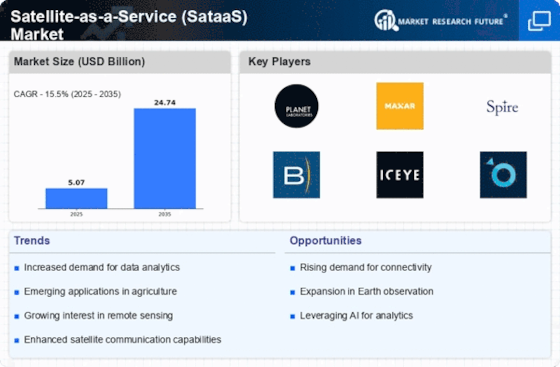
As per Market Research Future analysis, the Satellite-as-a-Service (SataaS) Market Size was estimated at 5.069 USD Billion in 2024. The SataaS industry is projected to grow from 5.855 USD Billion in 2025 to 24.74 USD Billion by 2035, exhibiting a compound annual growth rate (CAGR) of 15.5% during the forecast period 2025 - 2035

Key Market Trends & Highlights

The Satellite-as-a-Service (SataaS) market is poised for substantial growth driven by technological advancements and evolving consumer needs.

  • The demand for real-time data is surging, particularly in North America, as industries seek timely insights for decision-making. Integration with IoT technologies is becoming increasingly prevalent, enhancing the capabilities of satellite services across the Asia-Pacific region. A strong emphasis on sustainability and environmental monitoring is shaping service offerings, especially within the small satellite segment. The market is driven by the growing need for cost-effective solutions and advancements in satellite technology, particularly in the large satellite and communication service segments.

Market Size & Forecast

2024 Market Size 5.069 (USD Billion)
2035 Market Size 24.74 (USD Billion)
CAGR (2025 - 2035) 15.5%
Largest Regional Market Share in 2024 North America

Major Players

Planet Labs (US), Maxar Technologies (US), Spire Global (US), BlackSky (US), ICEYE (FI), <a href="https://satellogic.com/news/blog/">Satellogic </a>(AR), HawkEye 360 (US), OroraTech (DE)

Market Trends

The Satellite-as-a-Service (SataaS) Market is currently experiencing a transformative phase, driven by advancements in technology and increasing demand for satellite-based solutions. Organizations across various sectors are recognizing the potential of satellite services to enhance their operations, improve data collection, and facilitate communication. This trend is particularly evident in industries such as agriculture, telecommunications, and environmental monitoring, where satellite data plays a crucial role in decision-making processes. As a result, the market is witnessing a surge in the adoption of SataaS offerings, which provide flexible and scalable solutions tailored to specific needs. Moreover, the competitive landscape of the Satellite-as-a-Service (SataaS) Market is evolving, with numerous players entering the field. This influx of new entrants is fostering innovation and driving down costs, making satellite services more accessible to a broader range of users. Partnerships between technology firms and satellite operators are becoming increasingly common, as they seek to leverage each other's strengths to deliver comprehensive solutions. The future of the Satellite-as-a-Service (SataaS) Market appears promising, with ongoing developments likely to further enhance service offerings and expand market reach.

Increased Demand for Real-Time Data

Organizations are increasingly seeking real-time data to make informed decisions. The Satellite-as-a-Service (SataaS) Market is responding to this need by providing timely and accurate satellite imagery and analytics, which can be utilized in various applications such as disaster management and urban planning.

Integration with IoT Technologies

The convergence of satellite services with Internet of Things (IoT) technologies is becoming more pronounced. This integration allows for enhanced data collection and monitoring capabilities, enabling businesses to optimize operations and improve efficiency in sectors like logistics and agriculture.

Focus on Sustainability and Environmental Monitoring

There is a growing emphasis on sustainability within the Satellite-as-a-Service (SataaS) Market. Companies are increasingly utilizing satellite data for environmental monitoring, helping to track climate change, deforestation, and natural resource management, thereby contributing to global sustainability efforts.

Satellite-as-a-Service SataaS Market Market Drivers

Enhanced Connectivity Solutions

The Satellite-as-a-Service (SataaS) Market is benefiting from the growing need for enhanced connectivity solutions. As remote areas and underserved regions continue to seek reliable internet access, satellite technology emerges as a viable solution. SataaS providers are increasingly offering broadband services that cater to both individual consumers and businesses in these regions. The demand for connectivity in sectors such as telemedicine, education, and emergency response is driving the adoption of satellite services. Recent reports indicate that the satellite broadband market is expected to grow significantly, with SataaS playing a crucial role in bridging the digital divide and ensuring equitable access to information and services.

Increased Focus on Data Security

Data security has become a paramount concern in the Satellite-as-a-Service (SataaS) Market. As organizations increasingly rely on satellite data for critical operations, the need for robust security measures is more pronounced. SataaS providers are responding by implementing advanced encryption and cybersecurity protocols to protect sensitive information transmitted via satellite networks. This focus on data security not only enhances customer trust but also ensures compliance with regulatory requirements. The growing awareness of cybersecurity threats is likely to drive demand for secure satellite services, potentially leading to a market expansion as businesses prioritize the protection of their data assets in an increasingly interconnected world.

Advancements in Satellite Technology

Technological advancements are playing a pivotal role in the Satellite-as-a-Service (SataaS) Market. Innovations in miniaturization and propulsion systems have led to the development of small satellites, or CubeSats, which are more affordable and easier to deploy. These advancements enable a wider range of applications, from Earth observation to telecommunications. The integration of artificial intelligence and machine learning into satellite operations further enhances data processing capabilities, allowing for real-time analytics. As a result, businesses are increasingly adopting SataaS solutions to harness these technological benefits, thereby driving market growth. The industry is expected to witness a surge in demand for advanced satellite services, potentially reaching a market size of several billion dollars by the end of the decade.

Rising Interest in Earth Observation

The Satellite-as-a-Service (SataaS) Market is witnessing a surge in interest surrounding Earth observation capabilities. Governments and private entities are increasingly recognizing the value of satellite data for monitoring environmental changes, urban development, and disaster management. This heightened awareness is leading to increased investments in satellite infrastructure and services. For instance, the demand for high-resolution imagery and data analytics is on the rise, as organizations seek to make informed decisions based on real-time information. The Earth observation segment is projected to account for a significant share of the SataaS market, with estimates suggesting it could represent over 30% of the total market revenue by 2030.

Growing Need for Cost-Effective Solutions

The Satellite-as-a-Service (SataaS) Market is experiencing a notable shift towards cost-effective solutions. Organizations are increasingly seeking alternatives to traditional satellite ownership, which often entails substantial capital expenditure and maintenance costs. SataaS offers a subscription-based model that allows businesses to access satellite capabilities without the burden of ownership. This trend is particularly evident in sectors such as agriculture and logistics, where companies are leveraging satellite data for precision farming and supply chain optimization. According to recent estimates, the SataaS market is projected to grow at a compound annual growth rate of over 20% in the coming years, driven by the demand for affordable satellite services.

Market Segment Insights

By Type: Small Satellites (Largest) vs. Large Satellites (Fastest-Growing)

<p>In the Satellite-as-a-Service (SataaS) market, the distribution of market share between small and large satellites showcases a strong preference for small satellites, which dominate sales and usage due to their cost-effectiveness and versatility. Small satellites are increasingly utilized across various sectors like Earth observation, telecommunications, and scientific research. Conversely, large satellites, while currently holding a smaller share, are gaining traction due to their enhanced capabilities and the increasing demand for advanced satellite systems capable of delivering high-bandwidth services and greater payload capacity. The growth trends in the SataaS market reveal a significant upward trajectory for large satellites which are recognized as the fastest-growing segment. This rapid growth is driven by advancements in technology that enable the deployment of larger, heavier satellites that provide improved service quality and functionality. As industries seek to harness the power of advanced data analytics and Internet of Things (IoT) applications, large satellites are positioned to meet these evolving demands, suggesting a promising shift in market dynamics over the coming years.</p>

<p>Satellite Type: Small Satellites (Dominant) vs. Large Satellites (Emerging)</p>

<p>Small satellites, known for their compact size and affordability, have become the dominant force in the Satellite-as-a-Service (SataaS) market. Their advantages include rapid deployment, lower launch costs, and flexibility for various applications, making them highly appealing to a range of industries such as agriculture, transportation, and disaster management. In contrast, large satellites, while emerging, are becoming crucial in delivering high-capacity data services and facilitating complex operations that smaller satellites may not support effectively. As advancements in technology continue to evolve, large satellites are increasingly recognized for their ability to provide expansive coverage and superior performance, leading to a growing interest and investment in this segment.</p>

By Application: Internet Service (Largest) vs. Communication Service (Fastest-Growing)

<p>In the Satellite-as-a-Service (SataaS) market, the Internet Service segment holds the largest share, driven by the soaring demand for reliable and high-speed internet access across urban and rural areas. This segment caters to individual users as well as businesses needing robust data connectivity. Meanwhile, the Communication Service segment is witnessing rapid expansion, reflecting the increasing reliance on satellite technologies for global communication and data transmission. This growth is particularly pronounced in remote and underserved regions, where traditional communication infrastructure is often lacking.</p>

<p>Communication Service (Dominant) vs. Track Service (Emerging)</p>

<p>In the Satellite-as-a-Service market, the Communication Service segment is established as a dominant player, enabling seamless transmission of data, voice, and video across vast distances. It supports critical applications across various sectors, including telecommunications and broadcasting. Track Service, although emerging, is gaining traction, especially in logistics and transportation, where satellite tracking improves operational efficiency and security. The emphasis on real-time tracking and monitoring, propelled by advancements in technology, positions Track Service as a burgeoning segment that complements traditional communication offerings.</p>

Get more detailed insights about Satellite-as-a-Service (SataaS) Market Research Report — Global Forecast till 2035

Regional Insights

North America : Innovation and Leadership Hub

North America leads the Satellite-as-a-Service (SataaS) market, driven by technological advancements and a robust demand for satellite data across various sectors. The region holds approximately 60% of the global market share, with the U.S. being the largest contributor, followed by Canada. Regulatory support from agencies like the FCC fosters innovation and investment in satellite technologies, enhancing market growth. The competitive landscape is characterized by major players such as Planet Labs, Maxar Technologies, and Spire Global, which are at the forefront of SataaS offerings. The presence of these companies, along with a strong ecosystem of startups and research institutions, propels North America's market forward. The region's focus on data analytics and AI integration in satellite services further strengthens its position as a leader in The Satellite-as-a-Service (SataaS).

Europe : Emerging Market with Potential

Europe is witnessing significant growth in the Satellite-as-a-Service (SataaS) market, driven by increasing demand for Earth observation data and regulatory support from the European Space Agency (ESA). The region holds about 25% of the global market share, with countries like Germany and France leading the charge. The European Union's initiatives to promote space technology and sustainability are key catalysts for market expansion. Leading countries in Europe include Germany, France, and the UK, where companies like ICEYE and OroraTech are making strides in satellite technology. The competitive landscape is evolving, with a mix of established firms and innovative startups. The presence of strong governmental support and funding for space initiatives enhances the region's attractiveness for SataaS investments.

Asia-Pacific : Rapidly Growing Market

The Asia-Pacific region is rapidly emerging in the Satellite-as-a-Service (SataaS) market, driven by increasing investments in satellite technology and a growing demand for data analytics. The region accounts for approximately 10% of the global market share, with countries like Japan and India leading the way. Government initiatives aimed at enhancing space capabilities and international collaborations are significant growth drivers in this market. Key players in the region include companies like Satellogic and various local startups that are innovating in satellite technology. The competitive landscape is becoming more dynamic, with a focus on cost-effective solutions and tailored services for diverse industries. As the region continues to invest in space infrastructure, the SataaS market is expected to expand significantly in the coming years.

Middle East and Africa : Emerging Powerhouse in Space

The Middle East and Africa region is emerging as a significant player in the Satellite-as-a-Service (SataaS) market, driven by increasing investments in space technology and a growing demand for satellite data. The region holds about 5% of the global market share, with countries like the UAE and South Africa leading the charge. Government initiatives to promote space exploration and satellite technology are key catalysts for market growth. Leading countries in the region include the UAE, which has made substantial investments in satellite technology, and South Africa, which is developing its capabilities. The competitive landscape is evolving, with a mix of established firms and innovative startups. The presence of strong governmental support and funding for space initiatives enhances the region's attractiveness for SataaS investments.

Key Players and Competitive Insights

Leading market players are investing largely in research and development in order to expand their product lines, which will help the Satellite-as-a-Service (SataaS) market grow even more. Market players are also undertaking a various strategic activities to spread their global footprint, with important market developments including higher investments, new product launches, contractual agreements, mergers and acquisitions, and collaboration with the other organizations. To spread and survive in the competitive and growing market climate, the Satellite-as-a-Service (SataaS) industry must offer cost-effective items.
Manufacturing locally to minimize the operational costs is one of the key business tactics used by the manufacturers in the global Satellite-as-a-Service (SataaS) industry to benefit the clients and raise the market sector. In recent years, the Satellite-as-a-Service (SataaS) industry has offered some of the most significant advantages to several industries. Major players in the Satellite-as-a-Service (SataaS) market, including SpaceX, Planet Labs Inc., OneWeb, Spire Global Inc., Capella Space, HawkEye 360, Astro Digital Inc., Loft Orbital, Orbital Insight, and Satellogic, and others, are trying to raise the market demand by investing in the research and the development operations.
SES S.A. (Société Européenne des Satellites) is a global satellite operator and one of the leading players in the satellite communications industry. Headquartered in Luxembourg, SES operates a vast fleet of geostationary and medium Earth orbit satellites, providing a broad range of services, including satellite-enabled internet, broadcasting, maritime and aeronautical connectivity, and government communication solutions. The company is known for its commitment to innovation, consistently investing in advanced satellite technologies to enhance the performance and meet the evolving needs of its customers.
In July 2023, leading satellite operator SES announced the acquisition of DRS Global Enterprise Solutions, a provider of managed network services and solutions for the government and maritime sectors. This acquisition expands SES's capabilities in government and other regulated markets, strengthening its position in the SataaS market.
EchoStar Corporation is a global provider of the satellite communication solutions and services. Headquartered in Englewood, Colorado, the company operates in the fields of satellite services, broadband, and communications. EchoStar is known for its satellite fleet that provides a range of services, including television broadcasting, broadband internet access, and backhaul connectivity. The company has played a significant role in the development and deployment of satellite technologies, contributing to the expansion of communication capabilities worldwide.
In November 2023, EchoStar Corporation, a provider of satellite and video services, completed the acquisition of Hughes Network Systems, a leading provider of the satellite broadband internet services. This acquisition combines two major players in the SataaS market, creating a significant force in the industry.

Key Companies in the Satellite-as-a-Service SataaS Market include

Industry Developments

December 2023: Honeywell announced the acquisition of Satcom Direct, a provider of satellite communication solutions for the aviation industry. This acquisition strengthens Honeywell's position in the rapidly growing aerospace connectivity market.

July 2023: Amazon and SpaceX announced a collaboration for Project Kuiper, Amazon's initiative to launch a constellation of low-earth orbit satellites for internet access. This partnership leverages SpaceX's launch capabilities and Amazon's cloud infrastructure to accelerate the deployment of SataaS solutions.

September 2023: Microsoft and SES announced a partnership to integrate Azure cloud services with SES's satellite network. This partnership aims to provide cloud-based solutions for SataaS applications in areas like remote monitoring, data analytics, and edge computing.

Future Outlook

Satellite-as-a-Service SataaS Market Future Outlook

The Satellite-as-a-Service (SataaS) Market is projected to grow at a 15.5% CAGR from 2025 to 2035, driven by advancements in satellite technology and increasing demand for data services.

New opportunities lie in:

  • Development of customizable satellite payloads for niche industries.
  • Integration of AI-driven analytics for enhanced data processing.
  • Expansion of global partnerships for satellite deployment and maintenance.

By 2035, the SataaS market is expected to be a pivotal component of the global satellite industry.

Market Segmentation

Satellite-as-a-Service SataaS Market Type Outlook

  • Small Satellites
  • Large Satellites

Satellite-as-a-Service SataaS Market Application Outlook

  • Internet Service
  • Communication Service
  • Track Service

Report Scope

MARKET SIZE 2024 5.069(USD Billion)
MARKET SIZE 2025 5.855(USD Billion)
MARKET SIZE 2035 24.74(USD Billion)
COMPOUND ANNUAL GROWTH RATE (CAGR) 15.5% (2025 - 2035)
REPORT COVERAGE Revenue Forecast, Competitive Landscape, Growth Factors, and Trends
BASE YEAR 2024
Market Forecast Period 2025 - 2035
Historical Data 2019 - 2024
Market Forecast Units USD Billion
Key Companies Profiled Planet Labs (US), Maxar Technologies (US), Spire Global (US), BlackSky (US), ICEYE (FI), Satellogic (AR), HawkEye 360 (US), OroraTech (DE)
Segments Covered Type, Application, Region
Key Market Opportunities Integration of advanced analytics and artificial intelligence in Satellite-as-a-Service (SataaS) Market offerings.
Key Market Dynamics Rising demand for flexible satellite solutions drives innovation and competition in the Satellite-as-a-Service market.
Countries Covered North America, Europe, APAC, South America, MEA

FAQs

What is the current valuation of the Satellite-as-a-Service (SataaS) Market?

<p>The Satellite-as-a-Service (SataaS) Market was valued at 5.069 USD Billion in 2024.</p>

What is the projected market size for the SataaS Market by 2035?

The market is expected to reach a valuation of 24.74 USD Billion by 2035.

What is the expected CAGR for the SataaS Market during the forecast period?

The expected CAGR for the Satellite-as-a-Service Market from 2025 to 2035 is 15.5%.

Which companies are considered key players in the SataaS Market?

Key players in the SataaS Market include Planet Labs, Maxar Technologies, Spire Global, and BlackSky.

What are the main types of satellites in the SataaS Market?

The SataaS Market segments into Small Satellites, valued at 12.37 USD Billion, and Large Satellites, also valued at 12.37 USD Billion.

What applications are driving growth in the SataaS Market?

The primary applications include Internet Service, Communication Service, and Track Service, with Communication Service projected at 12.5 USD Billion.

How does the performance of Small Satellites compare to Large Satellites?

Both Small and Large Satellites are projected to reach a valuation of 12.37 USD Billion, indicating balanced growth.

What is the projected growth for Internet Service within the SataaS Market?

The Internet Service segment is expected to grow from 1.5 USD Billion to 7.5 USD Billion by 2035.

What role do companies like ICEYE and Satellogic play in the SataaS Market?

Companies like ICEYE and Satellogic contribute to the innovation and expansion of satellite services, enhancing market competitiveness.

How does the Track Service segment perform in the SataaS Market?

The Track Service segment is projected to grow from 1.069 USD Billion to 4.74 USD Billion by 2035.

  1. SECTION I: EXECUTIVE SUMMARY AND KEY HIGHLIGHTS
    1. | 1.1 EXECUTIVE SUMMARY
    2. | | 1.1.1 Market Overview
    3. | | 1.1.2 Key Findings
    4. | | 1.1.3 Market Segmentation
    5. | | 1.1.4 Competitive Landscape
    6. | | 1.1.5 Challenges and Opportunities
    7. | | 1.1.6 Future Outlook
  2. SECTION II: SCOPING, METHODOLOGY AND MARKET STRUCTURE
    1. | 2.1 MARKET INTRODUCTION
    2. | | 2.1.1 Definition
    3. | | 2.1.2 Scope of the study
    4. | | | 2.1.2.1 Research Objective
    5. | | | 2.1.2.2 Assumption
    6. | | | 2.1.2.3 Limitations
    7. | 2.2 RESEARCH METHODOLOGY
    8. | | 2.2.1 Overview
    9. | | 2.2.2 Data Mining
    10. | | 2.2.3 Secondary Research
    11. | | 2.2.4 Primary Research
    12. | | | 2.2.4.1 Primary Interviews and Information Gathering Process
    13. | | | 2.2.4.2 Breakdown of Primary Respondents
    14. | | 2.2.5 Forecasting Model
    15. | | 2.2.6 Market Size Estimation
    16. | | | 2.2.6.1 Bottom-Up Approach
    17. | | | 2.2.6.2 Top-Down Approach
    18. | | 2.2.7 Data Triangulation
    19. | | 2.2.8 Validation
  3. SECTION III: QUALITATIVE ANALYSIS
    1. | 3.1 MARKET DYNAMICS
    2. | | 3.1.1 Overview
    3. | | 3.1.2 Drivers
    4. | | 3.1.3 Restraints
    5. | | 3.1.4 Opportunities
    6. | 3.2 MARKET FACTOR ANALYSIS
    7. | | 3.2.1 Value chain Analysis
    8. | | 3.2.2 Porter's Five Forces Analysis
    9. | | | 3.2.2.1 Bargaining Power of Suppliers
    10. | | | 3.2.2.2 Bargaining Power of Buyers
    11. | | | 3.2.2.3 Threat of New Entrants
    12. | | | 3.2.2.4 Threat of Substitutes
    13. | | | 3.2.2.5 Intensity of Rivalry
    14. | | 3.2.3 COVID-19 Impact Analysis
    15. | | | 3.2.3.1 Market Impact Analysis
    16. | | | 3.2.3.2 Regional Impact
    17. | | | 3.2.3.3 Opportunity and Threat Analysis
  4. SECTION IV: QUANTITATIVE ANALYSIS
    1. | 4.1 Aerospace & Defense, BY Type (USD Billion)
    2. | | 4.1.1 Small Satellites
    3. | | 4.1.2 Large Satellites
    4. | 4.2 Aerospace & Defense, BY Application (USD Billion)
    5. | | 4.2.1 Internet Service
    6. | | 4.2.2 Communication Service
    7. | | 4.2.3 Track Service
    8. | 4.3 Aerospace & Defense, BY Region (USD Billion)
    9. | | 4.3.1 North America
    10. | | | 4.3.1.1 US
    11. | | | 4.3.1.2 Canada
    12. | | 4.3.2 Europe
    13. | | | 4.3.2.1 Germany
    14. | | | 4.3.2.2 UK
    15. | | | 4.3.2.3 France
    16. | | | 4.3.2.4 Russia
    17. | | | 4.3.2.5 Italy
    18. | | | 4.3.2.6 Spain
    19. | | | 4.3.2.7 Rest of Europe
    20. | | 4.3.3 APAC
    21. | | | 4.3.3.1 China
    22. | | | 4.3.3.2 India
    23. | | | 4.3.3.3 Japan
    24. | | | 4.3.3.4 South Korea
    25. | | | 4.3.3.5 Malaysia
    26. | | | 4.3.3.6 Thailand
    27. | | | 4.3.3.7 Indonesia
    28. | | | 4.3.3.8 Rest of APAC
    29. | | 4.3.4 South America
    30. | | | 4.3.4.1 Brazil
    31. | | | 4.3.4.2 Mexico
    32. | | | 4.3.4.3 Argentina
    33. | | | 4.3.4.4 Rest of South America
    34. | | 4.3.5 MEA
    35. | | | 4.3.5.1 GCC Countries
    36. | | | 4.3.5.2 South Africa
    37. | | | 4.3.5.3 Rest of MEA
  5. SECTION V: COMPETITIVE ANALYSIS
    1. | 5.1 Competitive Landscape
    2. | | 5.1.1 Overview
    3. | | 5.1.2 Competitive Analysis
    4. | | 5.1.3 Market share Analysis
    5. | | 5.1.4 Major Growth Strategy in the Aerospace & Defense
    6. | | 5.1.5 Competitive Benchmarking
    7. | | 5.1.6 Leading Players in Terms of Number of Developments in the Aerospace & Defense
    8. | | 5.1.7 Key developments and growth strategies
    9. | | | 5.1.7.1 New Product Launch/Service Deployment
    10. | | | 5.1.7.2 Merger & Acquisitions
    11. | | | 5.1.7.3 Joint Ventures
    12. | | 5.1.8 Major Players Financial Matrix
    13. | | | 5.1.8.1 Sales and Operating Income
    14. | | | 5.1.8.2 Major Players R&D Expenditure. 2023
    15. | 5.2 Company Profiles
    16. | | 5.2.1 Planet Labs (US)
    17. | | | 5.2.1.1 Financial Overview
    18. | | | 5.2.1.2 Products Offered
    19. | | | 5.2.1.3 Key Developments
    20. | | | 5.2.1.4 SWOT Analysis
    21. | | | 5.2.1.5 Key Strategies
    22. | | 5.2.2 Maxar Technologies (US)
    23. | | | 5.2.2.1 Financial Overview
    24. | | | 5.2.2.2 Products Offered
    25. | | | 5.2.2.3 Key Developments
    26. | | | 5.2.2.4 SWOT Analysis
    27. | | | 5.2.2.5 Key Strategies
    28. | | 5.2.3 Spire Global (US)
    29. | | | 5.2.3.1 Financial Overview
    30. | | | 5.2.3.2 Products Offered
    31. | | | 5.2.3.3 Key Developments
    32. | | | 5.2.3.4 SWOT Analysis
    33. | | | 5.2.3.5 Key Strategies
    34. | | 5.2.4 BlackSky (US)
    35. | | | 5.2.4.1 Financial Overview
    36. | | | 5.2.4.2 Products Offered
    37. | | | 5.2.4.3 Key Developments
    38. | | | 5.2.4.4 SWOT Analysis
    39. | | | 5.2.4.5 Key Strategies
    40. | | 5.2.5 ICEYE (FI)
    41. | | | 5.2.5.1 Financial Overview
    42. | | | 5.2.5.2 Products Offered
    43. | | | 5.2.5.3 Key Developments
    44. | | | 5.2.5.4 SWOT Analysis
    45. | | | 5.2.5.5 Key Strategies
    46. | | 5.2.6 Satellogic (AR)
    47. | | | 5.2.6.1 Financial Overview
    48. | | | 5.2.6.2 Products Offered
    49. | | | 5.2.6.3 Key Developments
    50. | | | 5.2.6.4 SWOT Analysis
    51. | | | 5.2.6.5 Key Strategies
    52. | | 5.2.7 HawkEye 360 (US)
    53. | | | 5.2.7.1 Financial Overview
    54. | | | 5.2.7.2 Products Offered
    55. | | | 5.2.7.3 Key Developments
    56. | | | 5.2.7.4 SWOT Analysis
    57. | | | 5.2.7.5 Key Strategies
    58. | | 5.2.8 OroraTech (DE)
    59. | | | 5.2.8.1 Financial Overview
    60. | | | 5.2.8.2 Products Offered
    61. | | | 5.2.8.3 Key Developments
    62. | | | 5.2.8.4 SWOT Analysis
    63. | | | 5.2.8.5 Key Strategies
    64. | 5.3 Appendix
    65. | | 5.3.1 References
    66. | | 5.3.2 Related Reports
  6. LIST OF FIGURES
    1. | 6.1 MARKET SYNOPSIS
    2. | 6.2 NORTH AMERICA MARKET ANALYSIS
    3. | 6.3 US MARKET ANALYSIS BY TYPE
    4. | 6.4 US MARKET ANALYSIS BY APPLICATION
    5. | 6.5 CANADA MARKET ANALYSIS BY TYPE
    6. | 6.6 CANADA MARKET ANALYSIS BY APPLICATION
    7. | 6.7 EUROPE MARKET ANALYSIS
    8. | 6.8 GERMANY MARKET ANALYSIS BY TYPE
    9. | 6.9 GERMANY MARKET ANALYSIS BY APPLICATION
    10. | 6.10 UK MARKET ANALYSIS BY TYPE
    11. | 6.11 UK MARKET ANALYSIS BY APPLICATION
    12. | 6.12 FRANCE MARKET ANALYSIS BY TYPE
    13. | 6.13 FRANCE MARKET ANALYSIS BY APPLICATION
    14. | 6.14 RUSSIA MARKET ANALYSIS BY TYPE
    15. | 6.15 RUSSIA MARKET ANALYSIS BY APPLICATION
    16. | 6.16 ITALY MARKET ANALYSIS BY TYPE
    17. | 6.17 ITALY MARKET ANALYSIS BY APPLICATION
    18. | 6.18 SPAIN MARKET ANALYSIS BY TYPE
    19. | 6.19 SPAIN MARKET ANALYSIS BY APPLICATION
    20. | 6.20 REST OF EUROPE MARKET ANALYSIS BY TYPE
    21. | 6.21 REST OF EUROPE MARKET ANALYSIS BY APPLICATION
    22. | 6.22 APAC MARKET ANALYSIS
    23. | 6.23 CHINA MARKET ANALYSIS BY TYPE
    24. | 6.24 CHINA MARKET ANALYSIS BY APPLICATION
    25. | 6.25 INDIA MARKET ANALYSIS BY TYPE
    26. | 6.26 INDIA MARKET ANALYSIS BY APPLICATION
    27. | 6.27 JAPAN MARKET ANALYSIS BY TYPE
    28. | 6.28 JAPAN MARKET ANALYSIS BY APPLICATION
    29. | 6.29 SOUTH KOREA MARKET ANALYSIS BY TYPE
    30. | 6.30 SOUTH KOREA MARKET ANALYSIS BY APPLICATION
    31. | 6.31 MALAYSIA MARKET ANALYSIS BY TYPE
    32. | 6.32 MALAYSIA MARKET ANALYSIS BY APPLICATION
    33. | 6.33 THAILAND MARKET ANALYSIS BY TYPE
    34. | 6.34 THAILAND MARKET ANALYSIS BY APPLICATION
    35. | 6.35 INDONESIA MARKET ANALYSIS BY TYPE
    36. | 6.36 INDONESIA MARKET ANALYSIS BY APPLICATION
    37. | 6.37 REST OF APAC MARKET ANALYSIS BY TYPE
    38. | 6.38 REST OF APAC MARKET ANALYSIS BY APPLICATION
    39. | 6.39 SOUTH AMERICA MARKET ANALYSIS
    40. | 6.40 BRAZIL MARKET ANALYSIS BY TYPE
    41. | 6.41 BRAZIL MARKET ANALYSIS BY APPLICATION
    42. | 6.42 MEXICO MARKET ANALYSIS BY TYPE
    43. | 6.43 MEXICO MARKET ANALYSIS BY APPLICATION
    44. | 6.44 ARGENTINA MARKET ANALYSIS BY TYPE
    45. | 6.45 ARGENTINA MARKET ANALYSIS BY APPLICATION
    46. | 6.46 REST OF SOUTH AMERICA MARKET ANALYSIS BY TYPE
    47. | 6.47 REST OF SOUTH AMERICA MARKET ANALYSIS BY APPLICATION
    48. | 6.48 MEA MARKET ANALYSIS
    49. | 6.49 GCC COUNTRIES MARKET ANALYSIS BY TYPE
    50. | 6.50 GCC COUNTRIES MARKET ANALYSIS BY APPLICATION
    51. | 6.51 SOUTH AFRICA MARKET ANALYSIS BY TYPE
    52. | 6.52 SOUTH AFRICA MARKET ANALYSIS BY APPLICATION
    53. | 6.53 REST OF MEA MARKET ANALYSIS BY TYPE
    54. | 6.54 REST OF MEA MARKET ANALYSIS BY APPLICATION
    55. | 6.55 KEY BUYING CRITERIA OF AEROSPACE & DEFENSE
    56. | 6.56 RESEARCH PROCESS OF MRFR
    57. | 6.57 DRO ANALYSIS OF AEROSPACE & DEFENSE
    58. | 6.58 DRIVERS IMPACT ANALYSIS: AEROSPACE & DEFENSE
    59. | 6.59 RESTRAINTS IMPACT ANALYSIS: AEROSPACE & DEFENSE
    60. | 6.60 SUPPLY / VALUE CHAIN: AEROSPACE & DEFENSE
    61. | 6.61 AEROSPACE & DEFENSE, BY TYPE, 2024 (% SHARE)
    62. | 6.62 AEROSPACE & DEFENSE, BY TYPE, 2024 TO 2035 (USD Billion)
    63. | 6.63 AEROSPACE & DEFENSE, BY APPLICATION, 2024 (% SHARE)
    64. | 6.64 AEROSPACE & DEFENSE, BY APPLICATION, 2024 TO 2035 (USD Billion)
    65. | 6.65 BENCHMARKING OF MAJOR COMPETITORS
  7. LIST OF TABLES
    1. | 7.1 LIST OF ASSUMPTIONS
    2. | | 7.1.1
    3. | 7.2 North America MARKET SIZE ESTIMATES; FORECAST
    4. | | 7.2.1 BY TYPE, 2025-2035 (USD Billion)
    5. | | 7.2.2 BY APPLICATION, 2025-2035 (USD Billion)
    6. | 7.3 US MARKET SIZE ESTIMATES; FORECAST
    7. | | 7.3.1 BY TYPE, 2025-2035 (USD Billion)
    8. | | 7.3.2 BY APPLICATION, 2025-2035 (USD Billion)
    9. | 7.4 Canada MARKET SIZE ESTIMATES; FORECAST
    10. | | 7.4.1 BY TYPE, 2025-2035 (USD Billion)
    11. | | 7.4.2 BY APPLICATION, 2025-2035 (USD Billion)
    12. | 7.5 Europe MARKET SIZE ESTIMATES; FORECAST
    13. | | 7.5.1 BY TYPE, 2025-2035 (USD Billion)
    14. | | 7.5.2 BY APPLICATION, 2025-2035 (USD Billion)
    15. | 7.6 Germany MARKET SIZE ESTIMATES; FORECAST
    16. | | 7.6.1 BY TYPE, 2025-2035 (USD Billion)
    17. | | 7.6.2 BY APPLICATION, 2025-2035 (USD Billion)
    18. | 7.7 UK MARKET SIZE ESTIMATES; FORECAST
    19. | | 7.7.1 BY TYPE, 2025-2035 (USD Billion)
    20. | | 7.7.2 BY APPLICATION, 2025-2035 (USD Billion)
    21. | 7.8 France MARKET SIZE ESTIMATES; FORECAST
    22. | | 7.8.1 BY TYPE, 2025-2035 (USD Billion)
    23. | | 7.8.2 BY APPLICATION, 2025-2035 (USD Billion)
    24. | 7.9 Russia MARKET SIZE ESTIMATES; FORECAST
    25. | | 7.9.1 BY TYPE, 2025-2035 (USD Billion)
    26. | | 7.9.2 BY APPLICATION, 2025-2035 (USD Billion)
    27. | 7.10 Italy MARKET SIZE ESTIMATES; FORECAST
    28. | | 7.10.1 BY TYPE, 2025-2035 (USD Billion)
    29. | | 7.10.2 BY APPLICATION, 2025-2035 (USD Billion)
    30. | 7.11 Spain MARKET SIZE ESTIMATES; FORECAST
    31. | | 7.11.1 BY TYPE, 2025-2035 (USD Billion)
    32. | | 7.11.2 BY APPLICATION, 2025-2035 (USD Billion)
    33. | 7.12 Rest of Europe MARKET SIZE ESTIMATES; FORECAST
    34. | | 7.12.1 BY TYPE, 2025-2035 (USD Billion)
    35. | | 7.12.2 BY APPLICATION, 2025-2035 (USD Billion)
    36. | 7.13 APAC MARKET SIZE ESTIMATES; FORECAST
    37. | | 7.13.1 BY TYPE, 2025-2035 (USD Billion)
    38. | | 7.13.2 BY APPLICATION, 2025-2035 (USD Billion)
    39. | 7.14 China MARKET SIZE ESTIMATES; FORECAST
    40. | | 7.14.1 BY TYPE, 2025-2035 (USD Billion)
    41. | | 7.14.2 BY APPLICATION, 2025-2035 (USD Billion)
    42. | 7.15 India MARKET SIZE ESTIMATES; FORECAST
    43. | | 7.15.1 BY TYPE, 2025-2035 (USD Billion)
    44. | | 7.15.2 BY APPLICATION, 2025-2035 (USD Billion)
    45. | 7.16 Japan MARKET SIZE ESTIMATES; FORECAST
    46. | | 7.16.1 BY TYPE, 2025-2035 (USD Billion)
    47. | | 7.16.2 BY APPLICATION, 2025-2035 (USD Billion)
    48. | 7.17 South Korea MARKET SIZE ESTIMATES; FORECAST
    49. | | 7.17.1 BY TYPE, 2025-2035 (USD Billion)
    50. | | 7.17.2 BY APPLICATION, 2025-2035 (USD Billion)
    51. | 7.18 Malaysia MARKET SIZE ESTIMATES; FORECAST
    52. | | 7.18.1 BY TYPE, 2025-2035 (USD Billion)
    53. | | 7.18.2 BY APPLICATION, 2025-2035 (USD Billion)
    54. | 7.19 Thailand MARKET SIZE ESTIMATES; FORECAST
    55. | | 7.19.1 BY TYPE, 2025-2035 (USD Billion)
    56. | | 7.19.2 BY APPLICATION, 2025-2035 (USD Billion)
    57. | 7.20 Indonesia MARKET SIZE ESTIMATES; FORECAST
    58. | | 7.20.1 BY TYPE, 2025-2035 (USD Billion)
    59. | | 7.20.2 BY APPLICATION, 2025-2035 (USD Billion)
    60. | 7.21 Rest of APAC MARKET SIZE ESTIMATES; FORECAST
    61. | | 7.21.1 BY TYPE, 2025-2035 (USD Billion)
    62. | | 7.21.2 BY APPLICATION, 2025-2035 (USD Billion)
    63. | 7.22 South America MARKET SIZE ESTIMATES; FORECAST
    64. | | 7.22.1 BY TYPE, 2025-2035 (USD Billion)
    65. | | 7.22.2 BY APPLICATION, 2025-2035 (USD Billion)
    66. | 7.23 Brazil MARKET SIZE ESTIMATES; FORECAST
    67. | | 7.23.1 BY TYPE, 2025-2035 (USD Billion)
    68. | | 7.23.2 BY APPLICATION, 2025-2035 (USD Billion)
    69. | 7.24 Mexico MARKET SIZE ESTIMATES; FORECAST
    70. | | 7.24.1 BY TYPE, 2025-2035 (USD Billion)
    71. | | 7.24.2 BY APPLICATION, 2025-2035 (USD Billion)
    72. | 7.25 Argentina MARKET SIZE ESTIMATES; FORECAST
    73. | | 7.25.1 BY TYPE, 2025-2035 (USD Billion)
    74. | | 7.25.2 BY APPLICATION, 2025-2035 (USD Billion)
    75. | 7.26 Rest of South America MARKET SIZE ESTIMATES; FORECAST
    76. | | 7.26.1 BY TYPE, 2025-2035 (USD Billion)
    77. | | 7.26.2 BY APPLICATION, 2025-2035 (USD Billion)
    78. | 7.27 MEA MARKET SIZE ESTIMATES; FORECAST
    79. | | 7.27.1 BY TYPE, 2025-2035 (USD Billion)
    80. | | 7.27.2 BY APPLICATION, 2025-2035 (USD Billion)
    81. | 7.28 GCC Countries MARKET SIZE ESTIMATES; FORECAST
    82. | | 7.28.1 BY TYPE, 2025-2035 (USD Billion)
    83. | | 7.28.2 BY APPLICATION, 2025-2035 (USD Billion)
    84. | 7.29 South Africa MARKET SIZE ESTIMATES; FORECAST
    85. | | 7.29.1 BY TYPE, 2025-2035 (USD Billion)
    86. | | 7.29.2 BY APPLICATION, 2025-2035 (USD Billion)
    87. | 7.30 Rest of MEA MARKET SIZE ESTIMATES; FORECAST
    88. | | 7.30.1 BY TYPE, 2025-2035 (USD Billion)
    89. | | 7.30.2 BY APPLICATION, 2025-2035 (USD Billion)
    90. | 7.31 PRODUCT LAUNCH/PRODUCT DEVELOPMENT/APPROVAL
    91. | | 7.31.1
    92. | 7.32 ACQUISITION/PARTNERSHIP
    93. | | 7.32.1

Aerospace & Defense Market Segmentation

Aerospace & Defense By Type (USD Billion, 2025-2035)

  • Small Satellites
  • Large Satellites

Aerospace & Defense By Application (USD Billion, 2025-2035)

  • Internet Service
  • Communication Service
  • Track Service
Infographic

Free Sample Request

Kindly complete the form below to receive a free sample of this Report

Get Free Sample

Customer Strories

Compare Licence

×
Features License Type
Single User Multiuser License Enterprise User
Price $4,950 $5,950 $7,250
Maximum User Access Limit 1 User Upto 10 Users Unrestricted Access Throughout the Organization
Free Customization
Direct Access to Analyst
Deliverable Format
Platform Access
Discount on Next Purchase 10% 15% 15%
Printable Versions