Sandwich Panel Market (2025 - 2035)

ID: MRFR/PCM/1034-CR 123 Pages Varsha More Last Updated: September 18, 2026
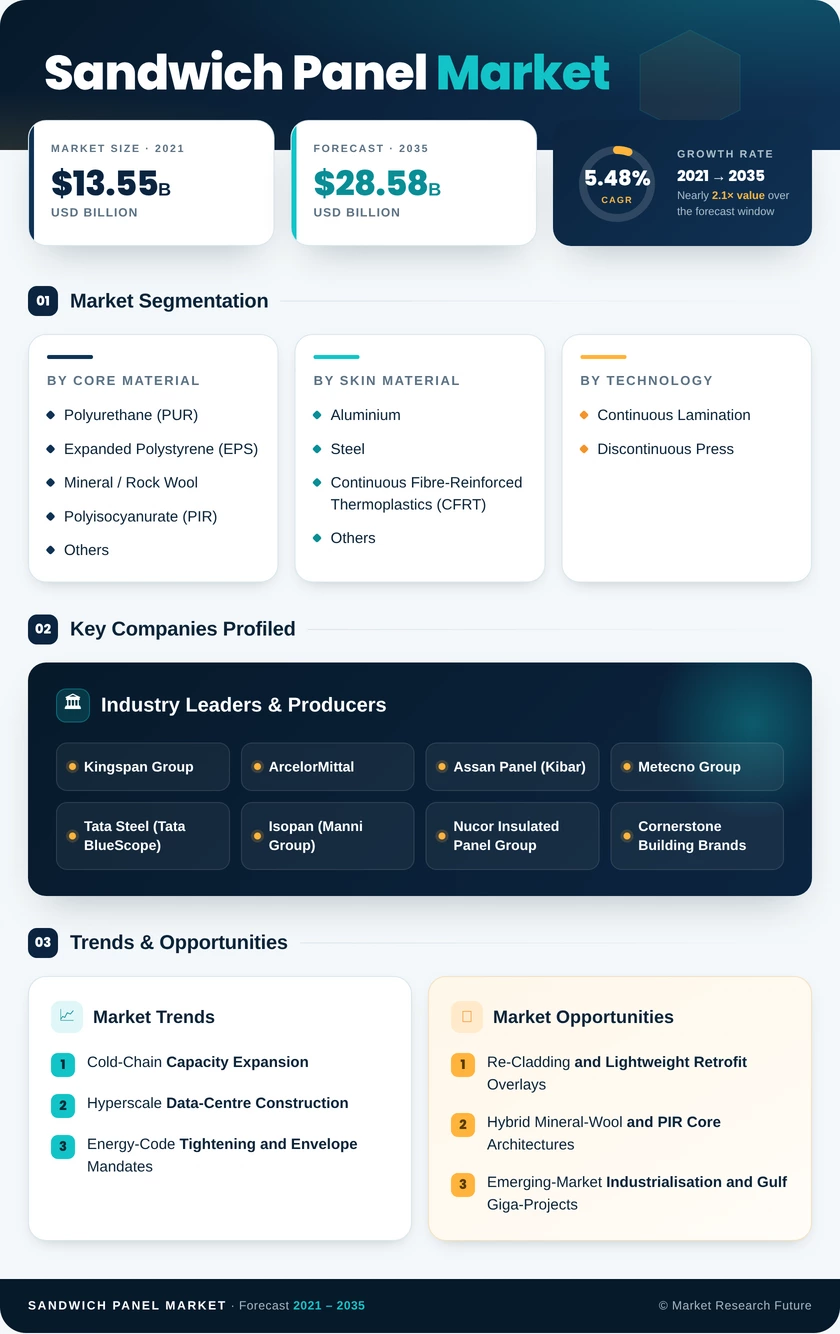
Sandwich Panel Market Research Report Information By Core Material (Polyurethane (PUR), Expanded Polystyrene (EPS), Mineral / Rock Wool, Polyisocyanurate (PIR), and Others (Honeycomb, XPS, Bio-Based)), By Skin Material (Aluminium, Steel (Galvanised / Pre-Coated), Continuous Fibre-Reinforced Thermoplastics (CFRT), and Others (GRP, Wood-Based, Composites)), By Technology (Continuous Lamination and Discontinuous Press), By Application (Wall Panels, Roof Panels, Insulated Panels (Partitions, Ceilings, Cold Rooms), and Others (Floor, Doors, Specialty)), and By End-User Sector (Industrial Buildings, Commercial Buildings, Cold Chain & Food Processing, Residential, and Others (Infrastructure, Transport, Healthcare)) – Forecast Till 2035
Sandwich Panel Market
Market Size
Forecast Period2025-2035
CAGR (2025-2035)5.48%
2025 Market SizeUSD 16.82 Billion
2035 Market SizeUSD 28.58 Billion
Key Players
Kingspan Group
ArcelorMittal
Assan Panel
Metecno Group
Tata Steel
Isopan
Opportunities
  • Re-Cladding and Lightweight Retrofit Overlays
  • Hybrid Mineral-Wool and PIR Core Architectures
  • Emerging-Market Industrialisation and Gulf Giga-Projects
  1. 1 Market Overview | |
    1. 1.1 Study Assumptions & Market Definition | |
    2. 1.2 Scope of the Study | |
    3. 1.3 Research Methodology | |
  2. 2 Market Summary & Key Takeaways | |
    1. 2.1 Key Takeaways by Technology | |
    2. 2.2 Key Takeaways by Sector | |
    3. 2.3 Key Takeaways by Region | |
  3. 3 Global Market Size & Forecast (2021–2035) | |
    1. 3.1 Historical Market Size (2021–2024) | |
    2. 3.2 Base Year Assessment (2025) | |
    3. 3.3 Current & Forecast Market Size (2026–2035) | |
    4. 3.4 Year-over-Year Growth Analysis | |
  4. 4 Market Drivers Analysis | |
    1. 4.1 Cold-Chain Capacity Expansion | |
    2. 4.2 Hyperscale Data-Centre Construction | |
    3. 4.3 Energy-Code Tightening and Envelope Mandates | |
    4. 4.4 Prefabrication Response to Construction Labour Shortage | |
    5. 4.5 Industrial Capex and Manufacturing Nearshoring | |
    6. 4.6 Fire-Safety Re-Cladding and Remediation Programmes | |
    7. 4.7 Continuous-Line Capacity Additions Lowering Delivered Cost | |
  5. 5 Market Restraints Analysis | |
    1. 5.1 Steel and Chemical Feedstock Price Volatility | |
    2. 5.2 Fire-Performance Restrictions on Combustible Cores | |
    3. 5.3 Blowing-Agent Regulation and HFC Phase-Down | |
    4. 5.4 Certified Installer Shortage and Site Logistics | |
    5. 5.5 Competition from Alternative Envelope Systems | |
  6. 6 Market Opportunity Analysis | |
    1. 6.1 Re-Cladding and Lightweight Retrofit Overlays | |
    2. 6.2 Hybrid Mineral-Wool and PIR Core Architectures | |
    3. 6.3 Emerging-Market Industrialisation and Gulf Giga-Projects | |
    4. 6.4 Digital Product Data and Envelope-as-a-Service Models | |
    5. 6.5 Low-Carbon Skins and Recyclable Facings | |
    6. 6.6 Industry Value Chain Analysis | |
    7. 6.7 Porter's Five Forces Analysis | |
  7. 7 Regional Analysis | |
    1. 7.1 North America | | |
      1. 7.1.1 US | | |
      2. 7.1.2 Canada | | |
      3. 7.1.3 Mexico | |
    2. 7.2 Europe | | |
      1. 7.2.1 Germany | | |
      2. 7.2.2 UK | | |
      3. 7.2.3 France | | |
      4. 7.2.4 Italy | | |
      5. 7.2.5 Spain | | |
      6. 7.2.6 Nordic Countries | | |
      7. 7.2.7 Russia | | |
      8. 7.2.8 Rest of Europe | |
    3. 7.3 Asia-Pacific | | |
      1. 7.3.1 China | | |
      2. 7.3.2 India | | |
      3. 7.3.3 Japan | | |
      4. 7.3.4 South Korea | | |
      5. 7.3.5 ASEAN | | |
      6. 7.3.6 Rest of Asia-Pacific | |
    4. 7.4 South America | | |
      1. 7.4.1 Brazil | | |
      2. 7.4.2 Argentina | | |
      3. 7.4.3 Rest of South America | |
    5. 7.5 Middle East & Africa | | |
      1. 7.5.1 Saudi Arabia | | |
      2. 7.5.2 UAE | | |
      3. 7.5.3 South Africa | | |
      4. 7.5.4 Egypt | | |
      5. 7.5.5 Rest of Middle East & Africa | |
  8. 8 Future Outlook (2026–2035) | |
    1. 8.1 Industry
    2. 4.0 and Inline Quality Analytics | |
    3. 8.2 Embodied-Carbon Disclosure as a Specification Filter | |
    4. 8.3 The Cold-Chain and Compute Demand Supercycle | |
    5. 8.4 Circularity and End-of-Life Recovery | |
  9. 9 Segmentation Analysis | |
    1. 9.1 By Core Material | | |
      1. 9.1.1 Polyurethane (PUR) | | |
      2. 9.1.2 Expanded Polystyrene (EPS) | | |
      3. 9.1.3 Mineral / Rock Wool | | |
      4. 9.1.4 Polyisocyanurate (PIR) | | |
      5. 9.1.5 Others (Honeycomb, XPS, Bio-Based) | |
    2. 9.2 By Skin Material | | |
      1. 9.2.1 Aluminium | | |
      2. 9.2.2 Steel (Galvanised / Pre-Coated) | | |
      3. 9.2.3 Continuous Fibre-Reinforced Thermoplastics (CFRT) | | |
      4. 9.2.4 Others (GRP, Wood-Based, Composites) | |
    3. 9.3 By Technology | | |
      1. 9.3.1 Continuous Lamination | | |
      2. 9.3.2 Discontinuous Press | |
    4. 9.4 By Application | | |
      1. 9.4.1 Wall Panels | | |
      2. 9.4.2 Roof Panels | | |
      3. 9.4.3 Insulated Panels | | |
      4. 9.4.4 Others (Floor, Doors, Specialty) | |
    5. 9.5 By End-User Sector | | |
      1. 9.5.1 Industrial Buildings | | |
      2. 9.5.2 Commercial Buildings | | |
      3. 9.5.3 Cold Chain & Food Processing | | |
      4. 9.5.4 Residential | | |
      5. 9.5.5 Others (Infrastructure, Transport, Healthcare) | |
  10. 10 Competitive Landscape | |
    1. 10.1 Market Concentration Analysis (2026) | |
    2. 10.2 Competitive Benchmarking Matrix | |
    3. 10.3 Company Profiles | | |
      1. 10.3.1 Kingspan Group | | |
      2. 10.3.2 ArcelorMittal | | |
      3. 10.3.3 Assan Panel | | |
      4. 10.3.4 Metecno Group | | |
      5. 10.3.5 Tata Steel (Tata BlueScope) | | |
      6. 10.3.6 Isopan (Manni Group) | | |
      7. 10.3.7 Nucor Insulated Panel Group | | |
      8. 10.3.8 Cornerstone Building Brands | | |
      9. 10.3.9 ROCKWOOL Group | | |
      10. 10.3.10 Marcegaglia | | |
      11. 10.3.11 Romakowski | |
  11. 11 Recent Developments & News (2023–2025) | |
  12. 12 Report Scope & Methodology | |
    1. 12.1 Study Period & Base Year | |
    2. 12.2 Data Sources & Validation Approach | |
    3. 12.3 Abbreviations | |
  13. 13 Detailed Sources & Citations | |
  14. 14 Frequently Asked Questions | | LIST OF TABLES | |
  15. TABLE 1 Global Sandwich Panel Market Size & Forecast, by Revenue (USD Billion), 2021–2035 | |
  16. TABLE 2 Global Sandwich Panel Market – Year-over-Year Growth Analysis, 2021–2035 | |
  17. TABLE 3 Driver Impact Analysis – Estimated Contribution to CAGR, 2026–2035 | |
  18. TABLE 4 Restraint Impact Analysis – Estimated Drag on CAGR, 2026–2035 | |
  19. TABLE 5 Global Market Size, by Core Material, 2021–2035 (USD Billion) | |
  20. TABLE 6 Global Market Size, by Skin Material, 2021–2035 (USD Billion) | |
  21. TABLE 7 Global Market Size, by Technology, 2021–2035 (USD Billion) | |
  22. TABLE 8 Global Market Size, by Application, 2021–2035 (USD Billion) | |
  23. TABLE 9 Global Market Size, by End-Use Sector, 2021–2035 (USD Billion) | |
  24. TABLE 10 Global Market Size, by Region, 2021–2035 (USD Billion) | |
  25. TABLE 11 North America Market Size, by Country, 2021–2035 (USD Billion) | |
  26. TABLE 12 Europe Market Size, by Country, 2021–2035 (USD Billion) | |
  27. TABLE 13 Asia-Pacific Market Size, by Country, 2021–2035 (USD Billion) | |
  28. TABLE 14 South America Market Size, by Country, 2021–2035 (USD Billion) | |
  29. TABLE 15 Middle East & Africa Market Size, by Country, 2021–2035 (USD Billion) | |
  30. TABLE 16 North America Market Size, by Core Material, 2021–2035 (USD Billion) | |
  31. TABLE 17 North America Market Size, by End-Use Sector, 2021–2035 (USD Billion) | |
  32. TABLE 18 Europe Market Size, by Core Material, 2021–2035 (USD Billion) | |
  33. TABLE 19 Europe Market Size, by Application, 2021–2035 (USD Billion) | |
  34. TABLE 20 Asia-Pacific Market Size, by Core Material, 2021–2035 (USD Billion) | |
  35. TABLE 21 Asia-Pacific Market Size, by End-Use Sector, 2021–2035 (USD Billion) | |
  36. TABLE 22 South America Market Size, by Skin Material, 2021–2035 (USD Billion) | |
  37. TABLE 23 Middle East & Africa Market Size, by Application, 2021–2035 (USD Billion) | |
  38. TABLE 24 Competitive Benchmarking Matrix – Global Sandwich Panel Market, 2026 | |
  39. TABLE 25 Company Profiles – Key Players, Global Sandwich Panel Market | |
  40. TABLE 26 Recent Developments & Strategic Announcements, 2023–2025 | |
  41. TABLE 27 Report Scope & Methodology Summary | |
  42. TABLE 28 Detailed Sources & Citations Index | | LIST OF FIGURES | |
  43. FIGURE 1 Global Sandwich Panel Market – Market Dynamics Snapshot (Drivers, Restraints, Opportunities) | |
  44. FIGURE 2 Industry Value Chain Analysis – Coil, Core Chemistry, Lamination, Distribution, Installation | |
  45. FIGURE 3 Porter's Five Forces Analysis | |
  46. FIGURE 4 Global Market Size Trend & Forecast, 2021–2035 (USD Billion) | |
  47. FIGURE 5 Year-over-Year Growth Rate Trend, 2022–2035 (%) | |
  48. FIGURE 6 Market Share by Core Material, 2025 vs 2035 (%) | |
  49. FIGURE 7 Market Share by Skin Material, 2025 (%) | |
  50. FIGURE 8 Market Share by Technology, 2025 (%) | |
  51. FIGURE 9 Market Share by Application, 2025 (%) | |
  52. FIGURE 10 Market Share by End-Use Sector, 2025 (%) | |
  53. FIGURE 11 Regional Revenue Share, 2025 (%) | |
  54. FIGURE 12 Regional CAGR Comparison, 2026–2035 (%) | |
  55. FIGURE 13 Asia-Pacific Country-Level Share, 2025 (%) | |
  56. FIGURE 14 Europe Country-Level Share, 2025 (%) | |
  57. FIGURE 15 Competitive Landscape – Estimated Revenue Share Ranges, 2026 | |
  58. FIGURE 16 Competitive Positioning Matrix – Scale vs Fire-Class Product Depth | |
  59. FIGURE 17 Driver Impact Contribution Waterfall, 2026–2035 | |
  60. FIGURE 18 Embodied Carbon Comparison by Skin Material (kg CO₂e/m²)

Segmentation Quick Reference

DimensionSub-SegmentsDominant SegmentFastest Growing Segment
By Core MaterialPolyurethane (PUR), Expanded Polystyrene (EPS), Mineral / Rock Wool, Polyisocyanurate (PIR), OthersPolyurethane (PUR)Mineral / Rock Wool
By Skin MaterialAluminium, Steel, Continuous Fibre-Reinforced Thermoplastics (CFRT), OthersAluminiumCFRT
By TechnologyContinuous Lamination, Discontinuous PressContinuous LaminationContinuous Lamination
By ApplicationWall Panels, Roof Panels, Insulated Panels, OthersWall PanelsInsulated Panels
By End-User SectorIndustrial Buildings, Commercial Buildings, Cold Chain & Food Processing, Residential, OthersIndustrial BuildingsCold Chain & Food Processing
By RegionNorth America, Europe, Asia-Pacific, South America, Middle East & AfricaAsia-PacificAsia-Pacific


Market Segmentation Overview

By Core Material

Sub-SegmentKey Trend
Polyurethane (PUR)Reformulation to HFO blowing agents raises cost but preserves thermal leadership
Expanded Polystyrene (EPS)Losing share in code-tightened markets, retained for cost-led agricultural work
Mineral / Rock WoolA2-s1,d0 classification drives adoption in high-rise, healthcare and data centres
Polyisocyanurate (PIR)Preferred core for refrigerated construction balancing fire and thermal performance
Others (Honeycomb, XPS, Bio-Based)Soy-polyol and recycled-content variants targeting embodied-carbon scoring


Core chemistry is where regulation bites hardest in the Sandwich Panel Market. Fire classification and blowing-agent phase-downs are simultaneously reshaping the product mix, pushing value toward mineral wool and hybrid constructions while polyurethane defends volume on cost per unit of thermal resistance.

By Skin Material

Sub-SegmentKey Trend
AluminiumLow-carbon smelting routes becoming a specification differentiator
Steel (Galvanised / Pre-Coated)Upstream coil integration protects margin against price volatility
Continuous Fibre-Reinforced Thermoplastics (CFRT)Recyclability and reduced cradle-to-gate emissions drive fastest growth
Others (GRP, Wood-Based, Composites)Hygienic and chemical-resistant niches in food and pharmaceutical facilities


Facing selection has shifted from a purely aesthetic and corrosion decision to a carbon-accounting decision. Suppliers with verified declarations across the full facing range hold a structural advantage in public and institutional procurement.

By Technology

Sub-SegmentKey Trend
Continuous LaminationInline density sensing and predictive maintenance cut defect rates below 1%
Discontinuous PressRetained for mineral-wool lamella orientation and short architectural runs


Manufacturing route increasingly determines which tenders a fabricator can enter. Traceability records and tight thickness tolerance are now screening criteria rather than differentiators, which favours capital-intensive continuous operations.

By Application

Sub-SegmentKey Trend
Wall PanelsArchitectural finish range and joint detailing drive premium pricing
Roof PanelsIntegrated weathertightness and photovoltaic-ready profiles gaining traction
Insulated PanelsInterior temperature-controlled enclosures expanding with pharmaceutical demand
Others (Floor, Doors, Specialty)Hygienic access solutions bundled with cold-room packages


Application mix drives revenue per square metre more than volume does. Interior enclosure work carries the fastest growth and the strongest pricing, reflecting cold-chain and life-sciences capital spending.

By End-User Sector

Sub-SegmentKey Trend
Industrial BuildingsReshoring and warehouse automation sustain the largest demand pool
Commercial BuildingsData-centre shells shift specification toward non-combustible cores
Cold Chain & Food ProcessingRefrigerated capacity growth of 4–6% annually underpins premium demand
ResidentialModular housing and roof retrofit provide incremental, code-driven volume
Others (Infrastructure, Transport, Healthcare)Development-bank-financed modular clinics and terminals in emerging markets


End-use concentration in industrial construction gives the industry stable baseline demand but exposes it to manufacturing capex cycles. Cold chain and data centres provide the counter-cyclical growth that will define supplier performance through 2035.




Download PDF ×

We do not share your information with anyone. However, we may send you emails based on your report interest from time to time. You may contact us at any time to opt-out.