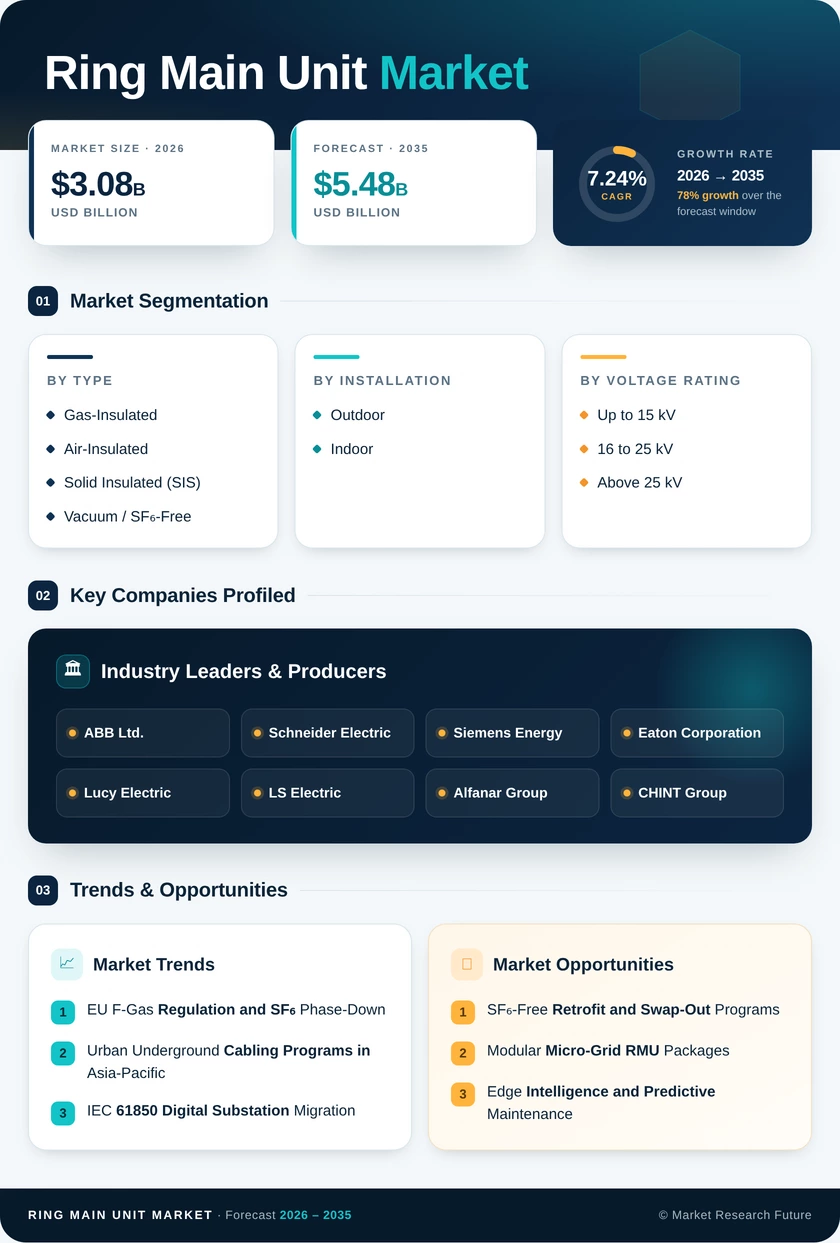
Segmentation Quick Reference
| Dimension | Sub-Segments | Dominant Segment | Fastest Growing Segment |
| Insulation Type | Gas-Insulated, Air-Insulated, Solid Insulated (SIS), Vacuum / SF₆-Free | Gas-Insulated (62% share, 2025) | Solid Insulated / SF₆-Free (10.3% CAGR) |
| Installation | Outdoor, Indoor | Outdoor (61% share, 2025) | Indoor (9.1% CAGR) |
| Voltage Rating | Up to 15 kV, 16 to 25 kV, Above 25 kV | Up to 15 kV (46% share, 2025) | Above 25 kV (8.3% CAGR) |
| Automation Level | Conventional (Manual), Smart / Motorized / Digital | Conventional (82% share, 2025) | Smart / Motorized / Digital (9.7% CAGR) |
| End User | Distribution Utilities, Industrial Facilities, Ring Main Unit Market & Micro-Grids, Commercial & Data Centers | Distribution Utilities (USD 1.52B, 2025) | Ring Main Unit Market & Micro-Grids (9.5% CAGR) |
| Geography | North America, Europe, Asia-Pacific, South America, Middle East & Africa | Asia-Pacific (46% share, 2025) | Asia-Pacific (9.1% CAGR) |
Market Segmentation Overview
By Insulation Type
| Sub-Segment | Key Trend |
| Gas-Insulated | Dominant revenue contributor; facing regulatory sunset under EU F-Gas 2024/573 |
| Air-Insulated | Steady demand in cost-sensitive rural networks across developing economies |
| Solid Insulated (SIS) | Rapid adoption driven by zero-SF₆ compliance and compact footprint advantages |
| Vacuum / SF₆-Free | OEM R&D flagship category; vacuum-interrupter capacity scaling globally |
Insulation type is the most consequential segmentation dimension in the Ring Main Unit Market because regulatory mandates directly dictate technology eligibility. The transition from gas-insulated to SF₆-free platforms will reshape competitive positioning and supply-chain investment through 2035.
By Installation
| Sub-Segment | Key Trend |
| Outdoor | Mainstay for rural, peri-urban, and renewable-park ring-main loops |
| Indoor | Accelerating in dense urban environments and basement-substation applications |
Outdoor installations dominate unit volumes globally, but indoor compact RMU distribution network designs are gaining share as cities push secondary substations underground to reclaim surface space and improve aesthetics.
By Voltage Rating
| Sub-Segment | Key Trend |
| Up to 15 kV | Standard municipal distribution voltage; largest absolute volume |
| 16 to 25 kV | Growing with industrial campus micro-grids and medium-scale solar parks |
| Above 25 kV | Fastest growth driven by offshore wind collector platforms and data-center feeds |
Voltage-rating mix is shifting upward as renewable collector loops and hyperscale data-center campuses specify higher operating voltages for reduced cable losses and improved power density.
By Automation Level
| Sub-Segment | Key Trend |
| Conventional (Manual) | Dominates installed base; cost-effective for simple radial feeders |
| Smart / Motorized / Digital | High-growth segment enabled by IEC 61850 communication and SCADA integration |
Automation-level segmentation captures the digital transformation underway in the Ring Main Unit Market. Utilities with aggressive SAIDI-reduction targets are migrating toward smart RMU remote control IEC 61850 platforms that enable remote fault isolation and self-healing network topologies.
By End User
| Sub-Segment | Key Trend |
| Distribution Utilities | Largest buyer class; driven by network expansion and aging-asset renewal |
| Industrial Facilities | Growing with factory micro-grids and mining electrification |
| Ring Main Unit Market & Micro-Grids | Fastest-growing end user; solar/wind collector loops and DER integration |
| Commercial & Data Centers | Uptime SLAs drive dual-feed ring-main configurations |
End-user diversification is a defining trend in the Ring Main Unit Market. While distribution utilities remain the anchor customer, the rise of renewable developers, data-center operators, and industrial micro-grid owners is broadening the demand base and introducing new performance specifications.