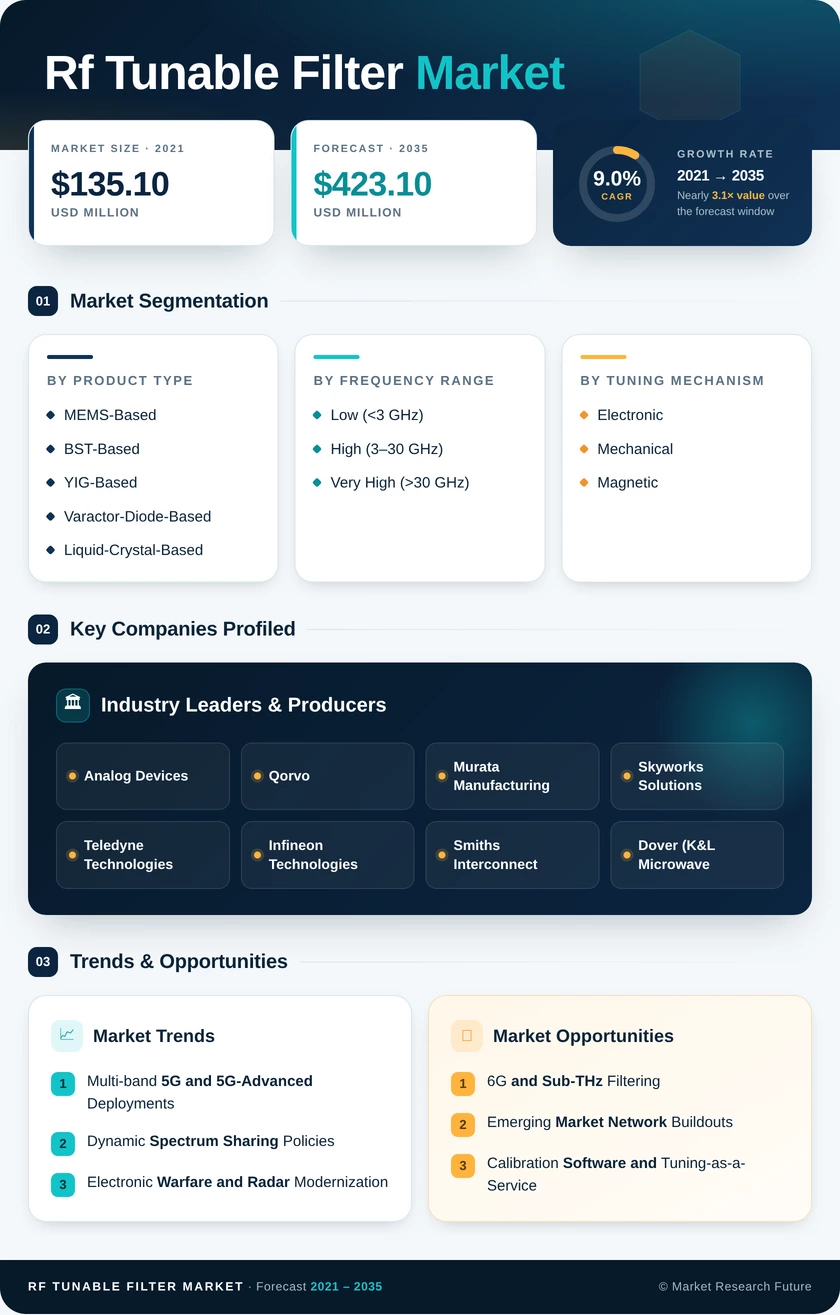
Segmentation Quick Reference
| Dimension | Sub-Segments | Dominant Segment | Fastest Growing Segment |
|---|---|---|---|
| By Product Type | MEMS-Based, BST-Based, YIG-Based, Varactor-Diode-Based, Liquid-Crystal-Based, Digital/Software-Defined | MEMS-Based (36.9% share) | BST-Based (9.5% CAGR) |
| By Frequency Range | Low (<3 GHz), High (3–30 GHz), Very High (>30 GHz) | High (3–30 GHz) (43.9% share) | Very High (>30 GHz) (11.0% CAGR) |
| By Tuning Mechanism | Electronic, Mechanical, Magnetic | Electronic (72.6% share) | Mechanical (9.3% CAGR) |
| By Integration Level | Discrete, Module, System-in-Package | Discrete (59.3% share) | System-in-Package (10.4% CAGR) |
| By Channel Bandwidth | Narrowband (<5% FBW), Wideband (5–20% FBW), Ultra-Wideband (>20% FBW) | Narrowband (<5% FBW) (50.7% share) | Ultra-Wideband (>20% FBW) (9.8% CAGR) |
| By Application | Wireless Infrastructure, 5G/6G Network Equipment, Radar, Electronic Warfare, Avionics, SATCOM, Test & Measurement | Wireless Infrastructure (28.9% share) | 5G/6G Network Equipment (11.6% CAGR) |
| By End-Use Industry | Telecom Operators, Aerospace and Defense, Automotive, Industrial, Consumer Electronics, Healthcare | Telecom Operators (40.4% share) | Automotive (9.9% CAGR) |
| By Region | North America, Europe, Asia-Pacific, South America, Middle East & Africa | North America (34.2% share) | Asia-Pacific (9.7% CAGR) |
Market Segmentation Overview
By Product Type
| Sub-Segment | Key Trend |
|---|---|
| MEMS-Based | MEMS-inside-CMOS processes lower wafer-level cost |
| BST-Based | Thin-film advances widen tuning range |
| YIG-Based | Isolation above 70 dB sustains EW demand |
| Varactor-Diode-Based | Low-cost broadband tuning for radios |
| Liquid-Crystal-Based | Space qualification opens payload use |
| Digital/Software-Defined | Filtering logic moves into programmable silicon |
MEMS-Based filters lead because their silicon-compatible process matches handset production volumes. BST-Based designs grow fastest, as ferroelectric thin films now deliver wider tuning at competitive loss. YIG-Based parts stay confined to defense, where isolation outweighs cost and size.
By Frequency Range
| Sub-Segment | Key Trend |
|---|---|
| Low (<3 GHz) | Stable demand from legacy cellular and public safety |
| High (3–30 GHz) | 5G mid-band and Ku/Ka satellite links |
| Very High (>30 GHz) | mmWave base stations beyond 40 GHz |
High (3–30 GHz) devices lead because 5G mid-band and satellite links sit in this range. Very High (>30 GHz) grows fastest as acoustic and thin-film resonators reach the Q needed for mmWave. Low (<3 GHz) parts remain a steady base for legacy and mission-critical radios.
By Tuning Mechanism
| Sub-Segment | Key Trend |
|---|---|
| Electronic | Software-driven retuning in microseconds |
| Mechanical | Micro-positioned cavities for linearity |
| Magnetic | Low noise susceptibility in defense |
Electronic tuning leads because operators and radio makers want retuning controlled directly by software. Mechanical tuning grows fastest in high-power transmitters where cavity designs deliver linearity electronic elements cannot. Magnetic tuning keeps a smaller defense niche tied to harsh electromagnetic environments.
By Integration Level
| Sub-Segment | Key Trend |
|---|---|
| Discrete | Retrofit and test rack preference |
| Module | Pre-matched filtering for radio units |
| System-in-Package | Smaller footprint and lower bill-of-materials |
Discrete components lead because defense retrofits and test equipment favor standalone, replaceable parts. System-in-Package grows fastest as handset and terminal makers fold tuning, switching and control into one package. Module formats serve radio unit makers who want integration without full SiP development.
By Channel Bandwidth
| Sub-Segment | Key Trend |
|---|---|
| Narrowband (<5% FBW) | Sharp selectivity in crowded spectrum |
| Wideband (5–20% FBW) | Carrier aggregation support |
| Ultra-Wideband (>20% FBW) | Instantaneous coverage for EW receivers |
Narrowband (<5% FBW) designs lead because crowded cellular and defense bands require tight channel selectivity. Ultra-Wideband (>20% FBW) grows fastest as electronic warfare receivers need instantaneous access to large spectrum blocks. Wideband (5–20% FBW) parts fill the middle ground for carrier aggregation radios.
By Application
| Sub-Segment | Key Trend |
|---|---|
| Wireless Infrastructure | Multi-band radios at each site |
| 5G/6G Network Equipment | 5G-Advanced and early 6G gear |
| Radar | Multifunction radar upgrades |
| Electronic Warfare | Threat-adaptive receivers |
| Avionics | Aircraft communication modernization |
| SATCOM | LEO terminal production |
| Test & Measurement | Wideband instrument demand |
Wireless Infrastructure leads because operators install radios covering many bands at every site. 5G/6G Network Equipment grows fastest on 5G-Advanced launches and IMT-2030 trials. Radar and Electronic Warfare add premium, high-isolation demand, while SATCOM follows LEO terminal output.
By End-Use Industry
| Sub-Segment | Key Trend |
|---|---|
| Telecom Operators | Densification and shared spectrum |
| Aerospace and Defense | EW and radar procurement |
| Automotive | Radar, V2X and satellite consolidation |
| Industrial | Private 5G networks |
| Consumer Electronics | Multi-band devices |
| Healthcare | Wireless medical telemetry |
Telecom Operators lead because network densification and shared spectrum require agile filtering at scale. Automotive grows fastest as vehicles consolidate radar, V2X and satellite links into fewer AEC-qualified modules. Aerospace and Defense provides high value per unit and long program lifecycles.


 Noah Malgeri
Co-Founder

 Peter Groot koerkamp
Account and Business Manager

 Younghwan Choi
Senior Retail Manager

 Mark Irwin
Management Consultant

 Akif Moroglu
Strategy & Business Development Director

 Guilherme Gomes Martins
Product Management Director

 Joseph Aguayo
Sales Operations & Pricing Manager

 La Terria Dodd
Program Support Specialist

 Rob Kooiker
Group Product Manager HVAC & Fire Protection GMA