Request Free Sample ×

Kindly complete the form below to receive a free sample of this Report

* Please use a valid business email

Leading companies partner with us for data-driven Insights

clients tt-cursor
Hero Background
English
Chinese
French
Japanese
Korean
German
Spanish

Reverse Vending Machine Market Trends

ID: MRFR/Equip/10673-HCR
128 Pages
Pradeep Nandi
April 2026

Reverse Vending Machine Market research report information By Product Type (Metal recycling machine, Glass recycling machine, Plastic recycling machine, and Hybrid recycling machine), By Capacity, (Less than 300 bottles/Cans, 300 to 700 bottles/Cans, and More than 700 bottles/Cans), By Application, (Railway Station, Airports, Supermarkets, Tourist Places, Shopping Malls, and Others (Bus stand, Institutes, Offices etc.), and By Region (North America, Europe, Asia-Pacific, Middle East and Africa, and South America) - Growth & Industry Forecast to 2035

Share:
Download PDF ×

We do not share your information with anyone. However, we may send you emails based on your report interest from time to time. You may contact us at any time to opt-out.

Reverse Vending Machine Market Infographic
Purchase Options

Market Trends

Key Emerging Trends in the Reverse Vending Machine Market

Within the emerging Reverse Vending Machine (RVM) Market landscape, companies are employing different strategies aimed at establishing and strengthening their market shares. An essential strategy is technological innovation, where firms concentrate on developing advanced RVMs that have improved efficiency, user-friendly interfaces, and new features. Another significant way companies can stay ahead of their competitors in the Reverse Vending Machine Market is through cost leadership. Companies should, therefore, optimize manufacturing processes, source materials efficiently, and achieve economies of scale so that they can make cheaper RVMs without necessarily reducing quality. This low-cost strategy enables companies to offer competitive pricing, thus making their machines affordable to a wider range of clients, leading to increased market share, particularly with an emphasis on increasing sustainability practices. Strategic collaborations and partnerships play an important role in defining market positioning within the Reverse Vending Machine Market. In most cases, businesses enter into partnerships with retailers, beverage producers, or waste management companies to provide integrated recycling solutions for them. The common approach used here is market segmentation whereby firms design RVM solutions tailored specifically for different environments such as retail stores, public places, or recycling centers. This segmentation allows enterprises to effectively address distinct concerns related to diverse waste management requirements and consumer behavior in specific situations, thereby facilitating the appropriateness of RVMs based on their respective applications, hence making companies specialists who handle different types of waste recycling needs. Geographical expansion is one of the primary strategies adopted by firms seeking a wider presence within the reverse vending machine market. Such exploration of new regions and venturing into emerging markets enables organizations to benefit from the increasing demand for sustainable waste management. Brand positioning is essential because customers' confidence and choice in reverse vending machines are influenced by it. Continuous research and development are of utmost importance if a player wants to remain competitive in the ever-changing Reverse Vending Machine Market. When companies understand emerging trends, waste management technologies, and consumer preferences, they can then adjust their RVM solutions accordingly. Consequently, the Reverse Vending Machine Market requires a company that wants to succeed within this tough industry to have an adaptable strategy. These strategies include technological innovation, cost leadership, strategic collaborations, market segmentation, geographical expansion, and brand positioning, which will secure companies' esteemed sustainable market share in the burgeoning field of waste recycling through continuous R&D.


Author
Author Profile
Pradeep Nandi
Senior Research Analyst

I have a bachelor's degree in mechanical engineering and an MBA. I have more than two years of expertise in the retail, food, and beverage, chemical, and material industries, and hence have developed a sound cross-domain expertise. A firm believer in lifelong learning and sharing of knowledge. Having a proclivity for hatching ideas and trying to absorb as much information as possible in a short amount of time. Introducing corporates to the data and insight, which enables them to move from probability to possibility, has been my key areas of interest. 

Leave a Comment

FAQs

What is the current valuation of the Reverse Vending Machine Market?

<p>As of 2024, the market valuation stands at 0.4465 USD Billion.</p>

What is the projected market size for the Reverse Vending Machine Market by 2035?

<p>The market is expected to reach a valuation of 0.8063 USD Billion by 2035.</p>

What is the expected CAGR for the Reverse Vending Machine Market during the forecast period?

<p>The market is anticipated to grow at a CAGR of 5.52% from 2025 to 2035.</p>

Which companies are considered key players in the Reverse Vending Machine Market?

<p>Key players include Tomra Systems ASA, Reverse Vending Corporation, Envipco Holding N.V., and Veolia Environnement S.A.</p>

What are the different types of reverse vending machines available in the market?

<p>The market segments include metal, glass, plastic, and hybrid recycling machines.</p>

How does the capacity of reverse vending machines vary in the market?

<p>Capacity segments range from less than 300 bottles/cans to more than 700 bottles/cans.</p>

What applications are driving the demand for reverse vending machines?

Applications include railway stations, airports, supermarkets, tourist places, and shopping malls.

What was the valuation of metal recycling machines in 2024?

In 2024, the valuation of metal recycling machines was approximately 0.1 USD Billion.

What is the projected valuation for plastic recycling machines by 2035?

Plastic recycling machines are projected to reach a valuation of 0.28 USD Billion by 2035.

Which application segment is expected to have the highest growth in the Reverse Vending Machine Market?

Supermarkets are likely to show the highest growth, with a valuation increase from 0.15 USD Billion in 2024 to 0.25 USD Billion by 2035.

Market Summary

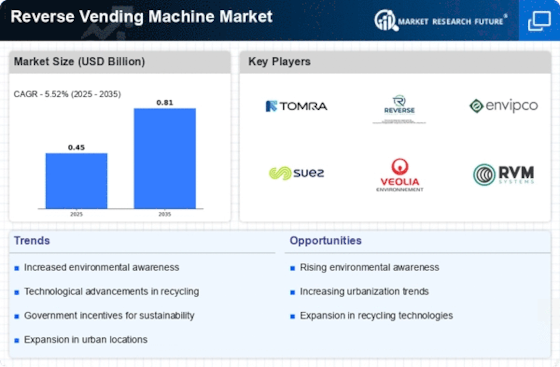
As per Market Research Future analysis, the Reverse Vending Machine Market Size was estimated at 0.4465 USD Billion in 2024. The Reverse Vending Machine industry is projected to grow from USD 0.4711 Billion in 2025 to USD 0.8063 Billion by 2035, exhibiting a compound annual growth rate (CAGR) of 5.52% during the forecast period 2025 - 2035

Key Market Trends & Highlights

The Reverse Vending Machine Market is poised for substantial growth driven by technological advancements and increasing consumer awareness.

  • North America remains the largest market for reverse vending machines, reflecting a strong commitment to recycling initiatives. The Asia-Pacific region is emerging as the fastest-growing market, propelled by rapid urbanization and environmental concerns. Plastic recycling machines dominate the market, while glass recycling machines are witnessing the fastest growth due to rising glass waste management needs. Key market drivers include sustainability initiatives and regulatory support, which are shaping consumer behavior towards recycling practices.

Market Size & Forecast

2024 Market Size 0.4465 (USD Billion)
2035 Market Size 0.8063 (USD Billion)
CAGR (2025 - 2035) 5.52%
Largest Regional Market Share in 2024 Asia Pacific

Major Players

<a href="https://www.tomra.com/reverse-vending/our-offering/reverse-vending-machines">Tomra Systems ASA</a> (NO), Reverse Vending Corporation (US), <a href="https://www.envipco.com/reverse-vending-machines">Envipco </a>Holding N.V. (NL), SUEZ Recycling and Recovery (FR), Coca-Cola European Partners (GB), Lassila &amp; Tikanoja (FI), Veolia Environnement S.A. (FR), RVM Systems (NO), Cleanaway Waste Management Limited (AU)

Market Trends

The Reverse Vending Machine Market is currently experiencing a notable transformation, driven by increasing environmental awareness and the push for sustainable practices. As consumers become more conscious of their ecological footprint, the demand for innovative solutions that facilitate recycling and waste management is on the rise.

Reverse vending machines, which allow users to deposit recyclable materials in exchange for rewards, are gaining traction in various sectors, including retail, public spaces, and educational institutions. This trend reflects a broader societal shift towards circular economic principles, where waste is minimized, and resources are reused effectively. 

Moreover, advancements in technology are enhancing the functionality and user experience of reverse vending machines. Features such as touchless interfaces, mobile app integration, and real-time data analytics are becoming increasingly common. These innovations not only improve operational efficiency but also encourage user engagement by providing instant feedback and rewards.

As municipalities and businesses recognize the potential of reverse vending machines to contribute to waste reduction goals, investment in this market is likely to grow, fostering a more sustainable future. The Reverse Vending Machine Market appears poised for continued expansion as it aligns with global sustainability initiatives and consumer preferences for eco-friendly solutions.

Technological Advancements

The Reverse Vending Machine Market trends are focusing on technological advancements that enhance user interaction and operational efficiency. Innovations such as mobile app connectivity and real-time data tracking are becoming standard features, allowing users to engage more effectively with the machines. These developments not only streamline the recycling process but also provide valuable insights for operators, potentially leading to improved service delivery.

Increased Consumer Awareness

There is a growing trend of heightened consumer awareness regarding environmental issues, which is significantly influencing the Reverse Vending Machine Market. As individuals become more informed about the impact of waste on the planet, they are increasingly seeking out solutions that promote recycling and sustainability. This shift in consumer behavior is likely to drive demand for reverse vending machines in various settings.

Government Initiatives

Government initiatives aimed at promoting recycling and waste reduction are playing a crucial role in shaping the Reverse Vending Machine Market. Policies that encourage the installation of these machines in public spaces and retail environments are emerging, reflecting a commitment to sustainability. Such initiatives not only support environmental goals but also create a favorable landscape for the growth of reverse vending technology.

Reverse Vending Machine Market Market Drivers

Regulatory Support

Regulatory frameworks and government support are increasingly influencing the Reverse Vending Machine Market. Many governments are implementing policies that mandate recycling and waste reduction, thereby creating a favorable environment for the adoption of reverse vending machines. Incentives such as subsidies and grants for businesses that invest in recycling technologies further stimulate market growth. Recent statistics indicate that regions with stringent recycling regulations have seen a notable increase in the installation of reverse vending machines, suggesting a direct correlation between regulatory support and market expansion. This trend is likely to continue as more jurisdictions recognize the importance of sustainable waste management.

Consumer Behavior Shifts

Shifts in consumer behavior towards sustainability and environmental responsibility are significantly impacting the Reverse Vending Machine Market. As consumers become more conscious of their ecological footprint, they are increasingly seeking ways to participate in recycling initiatives. This change in mindset is driving demand for reverse vending machines, which offer a convenient solution for recycling. Market Research Future indicates that a substantial percentage of consumers are willing to engage with machines that provide incentives for recycling, such as cash rewards or discounts. This evolving consumer behavior is likely to propel the market forward, as businesses respond to the demand for accessible recycling options.

Technological Integration

Technological advancements are playing a crucial role in shaping the Reverse Vending Machine Market. The integration of smart technologies, such as IoT and AI, enhances the functionality of these machines, allowing for real-time data collection and user engagement. This technological evolution not only improves operational efficiency but also provides valuable insights into consumer behavior and recycling patterns. As a result, manufacturers are investing in innovative designs and features that cater to the evolving needs of users. The market is expected to witness a surge in demand for technologically advanced reverse vending machines, which could potentially lead to a market valuation exceeding several billion dollars in the coming years.

Sustainability Initiatives

The growing emphasis on sustainability appears to be a primary driver for the Reverse Vending Machine Market. As environmental concerns escalate, businesses and municipalities are increasingly adopting practices that promote recycling and waste reduction. This trend is reflected in the rising number of reverse vending machines deployed in public spaces, which facilitate the collection of recyclable materials. According to recent data, the market for reverse vending machines is projected to grow at a compound annual growth rate of approximately 10% over the next five years. This growth is likely fueled by the increasing demand for eco-friendly solutions and the need for efficient waste management systems.

Partnerships and Collaborations

Strategic partnerships and collaborations among stakeholders are emerging as a vital driver for the Reverse Vending Machine Market. Companies are increasingly joining forces with municipalities, retailers, and environmental organizations to enhance the reach and effectiveness of recycling initiatives. These collaborations often lead to the deployment of reverse vending machines in high-traffic areas, maximizing their visibility and usage. Furthermore, partnerships can facilitate knowledge sharing and resource pooling, which may enhance the overall efficiency of recycling programs. As the market continues to evolve, such alliances are expected to play a crucial role in expanding the presence and impact of reverse vending machines.

Market Segment Insights

By Type: Plastic recycling machine (Largest) vs. Glass recycling machine (Fastest-Growing)

<p>In the Reverse Vending Machine Market, the distribution of market share among the different machine types reveals that plastic recycling machines hold the largest segment share. This is attributed to their widespread adoption in urban areas where plastic waste is prevalent. On the other hand, glass recycling machines are rapidly gaining traction, reflecting a growing environmental commitment among municipalities and companies to promote glass recycling initiatives. The growth trends in this segment are influenced by several factors. Government regulations and consumer awareness about sustainability are encouraging investments in glass recycling technology. Additionally, the rising costs associated with landfill waste disposal push municipalities to deploy reverse vending machines, particularly glass recycling machines, to efficiently manage waste streams and encourage recycling behaviors among the public.</p>

<p>Plastic recycling machine (Dominant) vs. Glass recycling machine (Emerging)</p>

<p>Plastic recycling machines are dominant in the Reverse Vending Machine Market due to their adaptability in various settings, ease of use, and significant consumer engagement. These machines effectively encourage users to return plastic for recycling, thereby contributing to reduced environmental impact. On the other hand, glass recycling machines are emerging as a vital component of waste management strategies, especially in areas with robust recycling programs. They are designed to address specific challenges associated with glass recycling, including breakage and contamination. As municipalities strive to enhance their recycling rates, glass recycling machines are rapidly being integrated into urban infrastructure to facilitate sustainable practices and encourage user participation.</p>

By Capacity: 300 to 700 bottles/Cans (Largest) vs. More than 700 bottles/Cans (Fastest-Growing)

<p>In the Reverse Vending Machine Market, the capacity segment displays notable diversity, with the '300 to 700 bottles/cans' category capturing the largest share. This segment appeals to a wide range of businesses looking to balance efficiency with user engagement. Following closely are the 'More than 700 bottles/cans', which is gaining traction and shows significant promise in terms of adoption as sustainability efforts increase among consumers and corporations alike.</p>

<p>Less than 300 bottles/Cans (Dominant) vs. More than 700 bottles/Cans (Emerging)</p>

<p>The 'Less than 300 bottles/cans' segment is characterized by its accessibility and suitability for smaller venues such as convenience stores and cafes. These machines are often viewed as a cost-effective solution for recycling initiatives, especially in urban areas where space is limited. Conversely, the 'More than 700 bottles/cans' segment is emerging rapidly, primarily driven by large retail chains and municipal recycling programs. These machines enable higher-volume collections and align with corporate sustainability goals, making them strategically favorable in a growing eco-conscious market.</p>

By Application: Supermarkets (Largest) vs. Airports (Fastest-Growing)

<p>In the Reverse Vending Machine Market, the application segment is notably diverse, with significant shares held by supermarkets, railway stations, and airports. Supermarkets dominate the market due to their high foot traffic and consumer focus on recycling initiatives. Conversely, airports have emerged as a vital segment, driven by a heightened emphasis on sustainability and waste reduction in travel environments. Combined with increasing environmental regulations, this duality shapes the landscape of reverse vending machine adoption across various settings.</p>

<p>Supermarkets (Dominant) vs. Airports (Emerging)</p>

<p>Supermarkets are currently the dominant application for reverse vending machines, offering consumers the convenience of recycling while shopping. Their strategic placement encourages behavioral shifts towards sustainable practices. In contrast, airports represent an emerging segment, reflecting a growing commitment to eco-friendly operations. The increasing passenger volume and environmental initiatives are fostering the adoption of reverse vending machines in these venues. Airports face unique challenges related to space and logistics but are progressively integrating these machines as part of broader waste management strategies, appealing to environmentally conscious travelers. Together, these segments illustrate the evolving dynamics within the reverse vending machine market.</p>

Get more detailed insights about Reverse Vending Machine Market Research Report—Global Forecast till 2035

Regional Insights

North America : Sustainability Leader

North America is witnessing a significant surge in the reverse vending machine market, driven by increasing environmental awareness and stringent regulations aimed at reducing waste. The United States holds the largest market share at approximately 60%, followed by Canada at around 25%. This growth is further supported by government initiatives promoting recycling and sustainability, which are catalyzing demand for innovative waste management solutions. The competitive landscape in North America is robust, featuring key players such as Tomra Systems ASA and Reverse Vending Corporation. These companies are leveraging advanced technologies to enhance user experience and operational efficiency. The presence of major beverage companies like Coca-Cola also plays a crucial role in driving the adoption of reverse vending machines, as they seek to meet corporate sustainability goals and consumer expectations.

Europe : Innovative Recycling Hub

Europe is emerging as a pivotal region for the reverse vending machine market, fueled by stringent EU regulations aimed at enhancing recycling rates. Germany leads the market with a share of approximately 40%, followed by Sweden at around 20%. The European Union's Circular Economy Action Plan is a significant regulatory catalyst, promoting the use of reverse vending machines to facilitate bottle and can returns, thereby driving market growth across member states. Leading countries in Europe include Germany, Sweden, and the Netherlands, where companies like Envipco Holding N.V. and SUEZ Recycling and Recovery are prominent. The competitive landscape is characterized by innovation, with firms investing in smart technologies to improve machine efficiency and user engagement. The presence of major beverage partners further strengthens the market, aligning with sustainability initiatives across the region.

Asia-Pacific : Emerging Market Potential

Asia-Pacific is rapidly becoming a significant player in the reverse vending machine market, driven by increasing urbanization and government initiatives promoting recycling. Countries like Japan and Australia are leading the charge, with Japan holding a market share of approximately 30% and Australia at 15%. The region's growth is further supported by rising consumer awareness regarding environmental issues and the need for sustainable waste management solutions. The competitive landscape in Asia-Pacific is evolving, with key players such as Cleanaway Waste Management Limited and RVM Systems expanding their operations. The presence of innovative technologies and partnerships with local governments is enhancing the adoption of reverse vending machines. As countries in the region strive to improve recycling rates, the market is expected to witness substantial growth in the coming years.

Middle East and Africa : Resource-Rich Frontier

The Middle East and Africa region is gradually recognizing the importance of reverse vending machines as part of its waste management strategy. Countries like South Africa and the UAE are at the forefront, with South Africa holding a market share of approximately 20%. The region's growth is driven by increasing urbanization and government efforts to promote recycling and reduce landfill waste, supported by various environmental regulations. In this region, the competitive landscape is still developing, with key players like Veolia Environnement S.A. and Lassila & Tikanoja making strides in establishing their presence. The focus on sustainability is leading to partnerships between governments and private companies to enhance recycling infrastructure. As awareness of environmental issues grows, the demand for reverse vending machines is expected to rise significantly.

Key Players and Competitive Insights

Major reverse vending machine companies are spending a lot of money on R&D to increase their product lines, which will help the Reverse Vending Machine Industry grow even more. Established industry leaders are focusing on the integration of AI-driven material recognition to protect and grow their reverse vending machine market share against emerging low-cost competitors. 
Market participants are also expanding their global footprint through a variety of strategic activities such as new product releases, contractual agreements, mergers and acquisitions, higher investments, and collaboration with other companies. Reverse Vending Machine Market’s competitors must offer cost-effective things in order to flourish and thrive in an increasingly competitive and rising market climate.
One of the primary business strategies adopted by manufacturers in the Reverse Vending Machine industry to benefit clients and expand the Industrial Vending Machines sector is to manufacture locally to reduce operating costs.

Key Companies in the Reverse Vending Machine Market include

Industry Developments

In August 2022, TOMRA M1, the smallest three-material reverse vending machine, was introduced by Tomra Systems ASA. TOMRA M1 requires only 0.62 square meters of floor space, allowing smaller stores to participate in deposit return schemes and recycle. This company is heavily focused on providing economical and tiny RVM that is appropriate for convenience/small retailers.

In November 2021, The G-1 Smart Reverse Vending Machine Market was introduced by Aco Recycling. This Al-powered machine can effortlessly recycle plastic, glass, and aluminum waste. It offers the user a remote monitoring solution.

In June 2021, EcoVend Reverse Vending installed its new RVM 400 reverse vending machines in one of Portugal's leading supermarkets. Plastic bottles are accepted by the RVM 400. In addition, on August 2021, the firm unveiled a new RVM 400 reverse vending machine with improved speech and touchless control features, as well as a huge advertising screen.

Future Outlook

Reverse Vending Machine Market Future Outlook

The Reverse Vending Machine Market analysis reveals the market is projected to grow at a 5.52% CAGR from 2025 to 2035, driven by increasing environmental awareness and government regulations.<br>The future of the Reverse Vending Machine market is defined by the global expansion of deposit return schemes and the integration of smart technologies. As countries transition toward circular economies, the market will increasingly adopt AI-driven sorting and IoT connectivity. These innovations will enhance material recovery efficiency, transforming public recycling into a data-driven, rewarding consumer experience.

New opportunities lie in:

  • <p>Expansion into urban areas with high foot traffic Integration of AI for enhanced user experience Partnerships with retailers for in-store recycling solutions</p>

By 2035, the Reverse Vending Machine Market is expected to be robust, driven by innovation and strategic partnerships.

Market Segmentation

Reverse Vending Machine Market Type Outlook

  • Metal recycling machine
  • Glass recycling machine
  • Plastic recycling machine
  • Hybrid recycling machine

Reverse Vending Machine Market Capacity Outlook

  • Less than 300 bottles/Cans
  • 300 to 700 bottles/Cans
  • More than 700 bottles/Cans

Reverse Vending Machine Market Application Outlook

  • Railway Stations
  • Airports
  • Supermarkets
  • Tourist Places
  • Shopping Malls
  • Others (Bus stand
  • Institutes
  • Offices etc.)

Report Scope

MARKET SIZE 2024 0.4465(USD Billion)
MARKET SIZE 2025 0.4711(USD Billion)
MARKET SIZE 2035 0.8063(USD Billion)
COMPOUND ANNUAL GROWTH RATE (CAGR) 5.52% (2025 - 2035)
REPORT COVERAGE Revenue Forecast, Competitive Landscape, Growth Factors, and Trends
BASE YEAR 2024
Market Forecast Period 2025 - 2035
Historical Data 2019 - 2024
Market Forecast Units USD Billion
Key Companies Profiled Tomra Systems ASA (NO), Reverse Vending Corporation (US), Envipco Holding N.V. (NL), SUEZ Recycling and Recovery (FR), Coca-Cola European Partners (GB), Lassila & Tikanoja (FI), Veolia Environnement S.A. (FR), RVM Systems (NO), Cleanaway Waste Management Limited (AU)
Segments Covered Product Type, Capacity,, Application,, Region
Key Market Opportunities Integration of advanced technology enhances user engagement in the Reverse Vending Machine Market.
Key Market Dynamics Rising environmental awareness drives demand for Reverse Vending Machines, enhancing recycling efficiency and consumer engagement.
Countries Covered North America, Europe, APAC, South America, MEA

FAQs

What is the current valuation of the Reverse Vending Machine Market?

<p>As of 2024, the market valuation stands at 0.4465 USD Billion.</p>

What is the projected market size for the Reverse Vending Machine Market by 2035?

<p>The market is expected to reach a valuation of 0.8063 USD Billion by 2035.</p>

What is the expected CAGR for the Reverse Vending Machine Market during the forecast period?

<p>The market is anticipated to grow at a CAGR of 5.52% from 2025 to 2035.</p>

Which companies are considered key players in the Reverse Vending Machine Market?

<p>Key players include Tomra Systems ASA, Reverse Vending Corporation, Envipco Holding N.V., and Veolia Environnement S.A.</p>

What are the different types of reverse vending machines available in the market?

<p>The market segments include metal, glass, plastic, and hybrid recycling machines.</p>

How does the capacity of reverse vending machines vary in the market?

<p>Capacity segments range from less than 300 bottles/cans to more than 700 bottles/cans.</p>

What applications are driving the demand for reverse vending machines?

Applications include railway stations, airports, supermarkets, tourist places, and shopping malls.

What was the valuation of metal recycling machines in 2024?

In 2024, the valuation of metal recycling machines was approximately 0.1 USD Billion.

What is the projected valuation for plastic recycling machines by 2035?

Plastic recycling machines are projected to reach a valuation of 0.28 USD Billion by 2035.

Which application segment is expected to have the highest growth in the Reverse Vending Machine Market?

Supermarkets are likely to show the highest growth, with a valuation increase from 0.15 USD Billion in 2024 to 0.25 USD Billion by 2035.

  1. SECTION I: EXECUTIVE SUMMARY AND KEY HIGHLIGHTS
    1. | 1.1 EXECUTIVE SUMMARY
    2. | | 1.1.1 Market Overview
    3. | | 1.1.2 Key Findings
    4. | | 1.1.3 Market Segmentation
    5. | | 1.1.4 Competitive Landscape
    6. | | 1.1.5 Challenges and Opportunities
    7. | | 1.1.6 Future Outlook
  2. SECTION II: SCOPING, METHODOLOGY AND MARKET STRUCTURE
    1. | 2.1 MARKET INTRODUCTION
    2. | | 2.1.1 Definition
    3. | | 2.1.2 Scope of the study
    4. | | | 2.1.2.1 Research Objective
    5. | | | 2.1.2.2 Assumption
    6. | | | 2.1.2.3 Limitations
    7. | 2.2 RESEARCH METHODOLOGY
    8. | | 2.2.1 Overview
    9. | | 2.2.2 Data Mining
    10. | | 2.2.3 Secondary Research
    11. | | 2.2.4 Primary Research
    12. | | | 2.2.4.1 Primary Interviews and Information Gathering Process
    13. | | | 2.2.4.2 Breakdown of Primary Respondents
    14. | | 2.2.5 Forecasting Model
    15. | | 2.2.6 Market Size Estimation
    16. | | | 2.2.6.1 Bottom-Up Approach
    17. | | | 2.2.6.2 Top-Down Approach
    18. | | 2.2.7 Data Triangulation
    19. | | 2.2.8 Validation
  3. SECTION III: QUALITATIVE ANALYSIS
    1. | 3.1 MARKET DYNAMICS
    2. | | 3.1.1 Overview
    3. | | 3.1.2 Drivers
    4. | | 3.1.3 Restraints
    5. | | 3.1.4 Opportunities
    6. | 3.2 MARKET FACTOR ANALYSIS
    7. | | 3.2.1 Value chain Analysis
    8. | | 3.2.2 Porter's Five Forces Analysis
    9. | | | 3.2.2.1 Bargaining Power of Suppliers
    10. | | | 3.2.2.2 Bargaining Power of Buyers
    11. | | | 3.2.2.3 Threat of New Entrants
    12. | | | 3.2.2.4 Threat of Substitutes
    13. | | | 3.2.2.5 Intensity of Rivalry
    14. | | 3.2.3 COVID-19 Impact Analysis
    15. | | | 3.2.3.1 Market Impact Analysis
    16. | | | 3.2.3.2 Regional Impact
    17. | | | 3.2.3.3 Opportunity and Threat Analysis
  4. SECTION IV: QUANTITATIVE ANALYSIS
    1. | 4.1 Food, Beverages & Nutrition, BY Type (USD Billion)
    2. | | 4.1.1 Metal recycling machine
    3. | | 4.1.2 Glass recycling machine
    4. | | 4.1.3 Plastic recycling machine
    5. | | 4.1.4 Hybrid recycling machine
    6. | 4.2 Food, Beverages & Nutrition, BY Capacity (USD Billion)
    7. | | 4.2.1 Less than 300 bottles/Cans
    8. | | 4.2.2 300 to 700 bottles/Cans
    9. | | 4.2.3 More than 700 bottles/Cans
    10. | 4.3 Food, Beverages & Nutrition, BY Application (USD Billion)
    11. | | 4.3.1 Railway Stations
    12. | | 4.3.2 Airports
    13. | | 4.3.3 Supermarkets
    14. | | 4.3.4 Tourist Places
    15. | | 4.3.5 Shopping Malls
    16. | | 4.3.6 Others (Bus stand, Institutes, Offices etc.)
    17. | 4.4 Food, Beverages & Nutrition, BY Region (USD Billion)
    18. | | 4.4.1 North America
    19. | | | 4.4.1.1 US
    20. | | | 4.4.1.2 Canada
    21. | | 4.4.2 Europe
    22. | | | 4.4.2.1 Germany
    23. | | | 4.4.2.2 UK
    24. | | | 4.4.2.3 France
    25. | | | 4.4.2.4 Russia
    26. | | | 4.4.2.5 Italy
    27. | | | 4.4.2.6 Spain
    28. | | | 4.4.2.7 Rest of Europe
    29. | | 4.4.3 APAC
    30. | | | 4.4.3.1 China
    31. | | | 4.4.3.2 India
    32. | | | 4.4.3.3 Japan
    33. | | | 4.4.3.4 South Korea
    34. | | | 4.4.3.5 Malaysia
    35. | | | 4.4.3.6 Thailand
    36. | | | 4.4.3.7 Indonesia
    37. | | | 4.4.3.8 Rest of APAC
    38. | | 4.4.4 South America
    39. | | | 4.4.4.1 Brazil
    40. | | | 4.4.4.2 Mexico
    41. | | | 4.4.4.3 Argentina
    42. | | | 4.4.4.4 Rest of South America
    43. | | 4.4.5 MEA
    44. | | | 4.4.5.1 GCC Countries
    45. | | | 4.4.5.2 South Africa
    46. | | | 4.4.5.3 Rest of MEA
  5. SECTION V: COMPETITIVE ANALYSIS
    1. | 5.1 Competitive Landscape
    2. | | 5.1.1 Overview
    3. | | 5.1.2 Competitive Analysis
    4. | | 5.1.3 Market share Analysis
    5. | | 5.1.4 Major Growth Strategy in the Food, Beverages & Nutrition
    6. | | 5.1.5 Competitive Benchmarking
    7. | | 5.1.6 Leading Players in Terms of Number of Developments in the Food, Beverages & Nutrition
    8. | | 5.1.7 Key developments and growth strategies
    9. | | | 5.1.7.1 New Product Launch/Service Deployment
    10. | | | 5.1.7.2 Merger & Acquisitions
    11. | | | 5.1.7.3 Joint Ventures
    12. | | 5.1.8 Major Players Financial Matrix
    13. | | | 5.1.8.1 Sales and Operating Income
    14. | | | 5.1.8.2 Major Players R&D Expenditure. 2023
    15. | 5.2 Company Profiles
    16. | | 5.2.1 Tomra Systems ASA (NO)
    17. | | | 5.2.1.1 Financial Overview
    18. | | | 5.2.1.2 Products Offered
    19. | | | 5.2.1.3 Key Developments
    20. | | | 5.2.1.4 SWOT Analysis
    21. | | | 5.2.1.5 Key Strategies
    22. | | 5.2.2 Reverse Vending Corporation (US)
    23. | | | 5.2.2.1 Financial Overview
    24. | | | 5.2.2.2 Products Offered
    25. | | | 5.2.2.3 Key Developments
    26. | | | 5.2.2.4 SWOT Analysis
    27. | | | 5.2.2.5 Key Strategies
    28. | | 5.2.3 Envipco Holding N.V. (NL)
    29. | | | 5.2.3.1 Financial Overview
    30. | | | 5.2.3.2 Products Offered
    31. | | | 5.2.3.3 Key Developments
    32. | | | 5.2.3.4 SWOT Analysis
    33. | | | 5.2.3.5 Key Strategies
    34. | | 5.2.4 SUEZ Recycling and Recovery (FR)
    35. | | | 5.2.4.1 Financial Overview
    36. | | | 5.2.4.2 Products Offered
    37. | | | 5.2.4.3 Key Developments
    38. | | | 5.2.4.4 SWOT Analysis
    39. | | | 5.2.4.5 Key Strategies
    40. | | 5.2.5 Coca-Cola European Partners (GB)
    41. | | | 5.2.5.1 Financial Overview
    42. | | | 5.2.5.2 Products Offered
    43. | | | 5.2.5.3 Key Developments
    44. | | | 5.2.5.4 SWOT Analysis
    45. | | | 5.2.5.5 Key Strategies
    46. | | 5.2.6 Lassila & Tikanoja (FI)
    47. | | | 5.2.6.1 Financial Overview
    48. | | | 5.2.6.2 Products Offered
    49. | | | 5.2.6.3 Key Developments
    50. | | | 5.2.6.4 SWOT Analysis
    51. | | | 5.2.6.5 Key Strategies
    52. | | 5.2.7 Veolia Environnement S.A. (FR)
    53. | | | 5.2.7.1 Financial Overview
    54. | | | 5.2.7.2 Products Offered
    55. | | | 5.2.7.3 Key Developments
    56. | | | 5.2.7.4 SWOT Analysis
    57. | | | 5.2.7.5 Key Strategies
    58. | | 5.2.8 RVM Systems (NO)
    59. | | | 5.2.8.1 Financial Overview
    60. | | | 5.2.8.2 Products Offered
    61. | | | 5.2.8.3 Key Developments
    62. | | | 5.2.8.4 SWOT Analysis
    63. | | | 5.2.8.5 Key Strategies
    64. | | 5.2.9 Cleanaway Waste Management Limited (AU)
    65. | | | 5.2.9.1 Financial Overview
    66. | | | 5.2.9.2 Products Offered
    67. | | | 5.2.9.3 Key Developments
    68. | | | 5.2.9.4 SWOT Analysis
    69. | | | 5.2.9.5 Key Strategies
    70. | 5.3 Appendix
    71. | | 5.3.1 References
    72. | | 5.3.2 Related Reports
  6. LIST OF FIGURES
    1. | 6.1 MARKET SYNOPSIS
    2. | 6.2 NORTH AMERICA MARKET ANALYSIS
    3. | 6.3 US MARKET ANALYSIS BY TYPE
    4. | 6.4 US MARKET ANALYSIS BY CAPACITY
    5. | 6.5 US MARKET ANALYSIS BY APPLICATION
    6. | 6.6 CANADA MARKET ANALYSIS BY TYPE
    7. | 6.7 CANADA MARKET ANALYSIS BY CAPACITY
    8. | 6.8 CANADA MARKET ANALYSIS BY APPLICATION
    9. | 6.9 EUROPE MARKET ANALYSIS
    10. | 6.10 GERMANY MARKET ANALYSIS BY TYPE
    11. | 6.11 GERMANY MARKET ANALYSIS BY CAPACITY
    12. | 6.12 GERMANY MARKET ANALYSIS BY APPLICATION
    13. | 6.13 UK MARKET ANALYSIS BY TYPE
    14. | 6.14 UK MARKET ANALYSIS BY CAPACITY
    15. | 6.15 UK MARKET ANALYSIS BY APPLICATION
    16. | 6.16 FRANCE MARKET ANALYSIS BY TYPE
    17. | 6.17 FRANCE MARKET ANALYSIS BY CAPACITY
    18. | 6.18 FRANCE MARKET ANALYSIS BY APPLICATION
    19. | 6.19 RUSSIA MARKET ANALYSIS BY TYPE
    20. | 6.20 RUSSIA MARKET ANALYSIS BY CAPACITY
    21. | 6.21 RUSSIA MARKET ANALYSIS BY APPLICATION
    22. | 6.22 ITALY MARKET ANALYSIS BY TYPE
    23. | 6.23 ITALY MARKET ANALYSIS BY CAPACITY
    24. | 6.24 ITALY MARKET ANALYSIS BY APPLICATION
    25. | 6.25 SPAIN MARKET ANALYSIS BY TYPE
    26. | 6.26 SPAIN MARKET ANALYSIS BY CAPACITY
    27. | 6.27 SPAIN MARKET ANALYSIS BY APPLICATION
    28. | 6.28 REST OF EUROPE MARKET ANALYSIS BY TYPE
    29. | 6.29 REST OF EUROPE MARKET ANALYSIS BY CAPACITY
    30. | 6.30 REST OF EUROPE MARKET ANALYSIS BY APPLICATION
    31. | 6.31 APAC MARKET ANALYSIS
    32. | 6.32 CHINA MARKET ANALYSIS BY TYPE
    33. | 6.33 CHINA MARKET ANALYSIS BY CAPACITY
    34. | 6.34 CHINA MARKET ANALYSIS BY APPLICATION
    35. | 6.35 INDIA MARKET ANALYSIS BY TYPE
    36. | 6.36 INDIA MARKET ANALYSIS BY CAPACITY
    37. | 6.37 INDIA MARKET ANALYSIS BY APPLICATION
    38. | 6.38 JAPAN MARKET ANALYSIS BY TYPE
    39. | 6.39 JAPAN MARKET ANALYSIS BY CAPACITY
    40. | 6.40 JAPAN MARKET ANALYSIS BY APPLICATION
    41. | 6.41 SOUTH KOREA MARKET ANALYSIS BY TYPE
    42. | 6.42 SOUTH KOREA MARKET ANALYSIS BY CAPACITY
    43. | 6.43 SOUTH KOREA MARKET ANALYSIS BY APPLICATION
    44. | 6.44 MALAYSIA MARKET ANALYSIS BY TYPE
    45. | 6.45 MALAYSIA MARKET ANALYSIS BY CAPACITY
    46. | 6.46 MALAYSIA MARKET ANALYSIS BY APPLICATION
    47. | 6.47 THAILAND MARKET ANALYSIS BY TYPE
    48. | 6.48 THAILAND MARKET ANALYSIS BY CAPACITY
    49. | 6.49 THAILAND MARKET ANALYSIS BY APPLICATION
    50. | 6.50 INDONESIA MARKET ANALYSIS BY TYPE
    51. | 6.51 INDONESIA MARKET ANALYSIS BY CAPACITY
    52. | 6.52 INDONESIA MARKET ANALYSIS BY APPLICATION
    53. | 6.53 REST OF APAC MARKET ANALYSIS BY TYPE
    54. | 6.54 REST OF APAC MARKET ANALYSIS BY CAPACITY
    55. | 6.55 REST OF APAC MARKET ANALYSIS BY APPLICATION
    56. | 6.56 SOUTH AMERICA MARKET ANALYSIS
    57. | 6.57 BRAZIL MARKET ANALYSIS BY TYPE
    58. | 6.58 BRAZIL MARKET ANALYSIS BY CAPACITY
    59. | 6.59 BRAZIL MARKET ANALYSIS BY APPLICATION
    60. | 6.60 MEXICO MARKET ANALYSIS BY TYPE
    61. | 6.61 MEXICO MARKET ANALYSIS BY CAPACITY
    62. | 6.62 MEXICO MARKET ANALYSIS BY APPLICATION
    63. | 6.63 ARGENTINA MARKET ANALYSIS BY TYPE
    64. | 6.64 ARGENTINA MARKET ANALYSIS BY CAPACITY
    65. | 6.65 ARGENTINA MARKET ANALYSIS BY APPLICATION
    66. | 6.66 REST OF SOUTH AMERICA MARKET ANALYSIS BY TYPE
    67. | 6.67 REST OF SOUTH AMERICA MARKET ANALYSIS BY CAPACITY
    68. | 6.68 REST OF SOUTH AMERICA MARKET ANALYSIS BY APPLICATION
    69. | 6.69 MEA MARKET ANALYSIS
    70. | 6.70 GCC COUNTRIES MARKET ANALYSIS BY TYPE
    71. | 6.71 GCC COUNTRIES MARKET ANALYSIS BY CAPACITY
    72. | 6.72 GCC COUNTRIES MARKET ANALYSIS BY APPLICATION
    73. | 6.73 SOUTH AFRICA MARKET ANALYSIS BY TYPE
    74. | 6.74 SOUTH AFRICA MARKET ANALYSIS BY CAPACITY
    75. | 6.75 SOUTH AFRICA MARKET ANALYSIS BY APPLICATION
    76. | 6.76 REST OF MEA MARKET ANALYSIS BY TYPE
    77. | 6.77 REST OF MEA MARKET ANALYSIS BY CAPACITY
    78. | 6.78 REST OF MEA MARKET ANALYSIS BY APPLICATION
    79. | 6.79 KEY BUYING CRITERIA OF FOOD, BEVERAGES & NUTRITION
    80. | 6.80 RESEARCH PROCESS OF MRFR
    81. | 6.81 DRO ANALYSIS OF FOOD, BEVERAGES & NUTRITION
    82. | 6.82 DRIVERS IMPACT ANALYSIS: FOOD, BEVERAGES & NUTRITION
    83. | 6.83 RESTRAINTS IMPACT ANALYSIS: FOOD, BEVERAGES & NUTRITION
    84. | 6.84 SUPPLY / VALUE CHAIN: FOOD, BEVERAGES & NUTRITION
    85. | 6.85 FOOD, BEVERAGES & NUTRITION, BY TYPE, 2024 (% SHARE)
    86. | 6.86 FOOD, BEVERAGES & NUTRITION, BY TYPE, 2024 TO 2035 (USD Billion)
    87. | 6.87 FOOD, BEVERAGES & NUTRITION, BY CAPACITY, 2024 (% SHARE)
    88. | 6.88 FOOD, BEVERAGES & NUTRITION, BY CAPACITY, 2024 TO 2035 (USD Billion)
    89. | 6.89 FOOD, BEVERAGES & NUTRITION, BY APPLICATION, 2024 (% SHARE)
    90. | 6.90 FOOD, BEVERAGES & NUTRITION, BY APPLICATION, 2024 TO 2035 (USD Billion)
    91. | 6.91 BENCHMARKING OF MAJOR COMPETITORS
  7. LIST OF TABLES
    1. | 7.1 LIST OF ASSUMPTIONS
    2. | | 7.1.1
    3. | 7.2 North America MARKET SIZE ESTIMATES; FORECAST
    4. | | 7.2.1 BY TYPE, 2025-2035 (USD Billion)
    5. | | 7.2.2 BY CAPACITY, 2025-2035 (USD Billion)
    6. | | 7.2.3 BY APPLICATION, 2025-2035 (USD Billion)
    7. | 7.3 US MARKET SIZE ESTIMATES; FORECAST
    8. | | 7.3.1 BY TYPE, 2025-2035 (USD Billion)
    9. | | 7.3.2 BY CAPACITY, 2025-2035 (USD Billion)
    10. | | 7.3.3 BY APPLICATION, 2025-2035 (USD Billion)
    11. | 7.4 Canada MARKET SIZE ESTIMATES; FORECAST
    12. | | 7.4.1 BY TYPE, 2025-2035 (USD Billion)
    13. | | 7.4.2 BY CAPACITY, 2025-2035 (USD Billion)
    14. | | 7.4.3 BY APPLICATION, 2025-2035 (USD Billion)
    15. | 7.5 Europe MARKET SIZE ESTIMATES; FORECAST
    16. | | 7.5.1 BY TYPE, 2025-2035 (USD Billion)
    17. | | 7.5.2 BY CAPACITY, 2025-2035 (USD Billion)
    18. | | 7.5.3 BY APPLICATION, 2025-2035 (USD Billion)
    19. | 7.6 Germany MARKET SIZE ESTIMATES; FORECAST
    20. | | 7.6.1 BY TYPE, 2025-2035 (USD Billion)
    21. | | 7.6.2 BY CAPACITY, 2025-2035 (USD Billion)
    22. | | 7.6.3 BY APPLICATION, 2025-2035 (USD Billion)
    23. | 7.7 UK MARKET SIZE ESTIMATES; FORECAST
    24. | | 7.7.1 BY TYPE, 2025-2035 (USD Billion)
    25. | | 7.7.2 BY CAPACITY, 2025-2035 (USD Billion)
    26. | | 7.7.3 BY APPLICATION, 2025-2035 (USD Billion)
    27. | 7.8 France MARKET SIZE ESTIMATES; FORECAST
    28. | | 7.8.1 BY TYPE, 2025-2035 (USD Billion)
    29. | | 7.8.2 BY CAPACITY, 2025-2035 (USD Billion)
    30. | | 7.8.3 BY APPLICATION, 2025-2035 (USD Billion)
    31. | 7.9 Russia MARKET SIZE ESTIMATES; FORECAST
    32. | | 7.9.1 BY TYPE, 2025-2035 (USD Billion)
    33. | | 7.9.2 BY CAPACITY, 2025-2035 (USD Billion)
    34. | | 7.9.3 BY APPLICATION, 2025-2035 (USD Billion)
    35. | 7.10 Italy MARKET SIZE ESTIMATES; FORECAST
    36. | | 7.10.1 BY TYPE, 2025-2035 (USD Billion)
    37. | | 7.10.2 BY CAPACITY, 2025-2035 (USD Billion)
    38. | | 7.10.3 BY APPLICATION, 2025-2035 (USD Billion)
    39. | 7.11 Spain MARKET SIZE ESTIMATES; FORECAST
    40. | | 7.11.1 BY TYPE, 2025-2035 (USD Billion)
    41. | | 7.11.2 BY CAPACITY, 2025-2035 (USD Billion)
    42. | | 7.11.3 BY APPLICATION, 2025-2035 (USD Billion)
    43. | 7.12 Rest of Europe MARKET SIZE ESTIMATES; FORECAST
    44. | | 7.12.1 BY TYPE, 2025-2035 (USD Billion)
    45. | | 7.12.2 BY CAPACITY, 2025-2035 (USD Billion)
    46. | | 7.12.3 BY APPLICATION, 2025-2035 (USD Billion)
    47. | 7.13 APAC MARKET SIZE ESTIMATES; FORECAST
    48. | | 7.13.1 BY TYPE, 2025-2035 (USD Billion)
    49. | | 7.13.2 BY CAPACITY, 2025-2035 (USD Billion)
    50. | | 7.13.3 BY APPLICATION, 2025-2035 (USD Billion)
    51. | 7.14 China MARKET SIZE ESTIMATES; FORECAST
    52. | | 7.14.1 BY TYPE, 2025-2035 (USD Billion)
    53. | | 7.14.2 BY CAPACITY, 2025-2035 (USD Billion)
    54. | | 7.14.3 BY APPLICATION, 2025-2035 (USD Billion)
    55. | 7.15 India MARKET SIZE ESTIMATES; FORECAST
    56. | | 7.15.1 BY TYPE, 2025-2035 (USD Billion)
    57. | | 7.15.2 BY CAPACITY, 2025-2035 (USD Billion)
    58. | | 7.15.3 BY APPLICATION, 2025-2035 (USD Billion)
    59. | 7.16 Japan MARKET SIZE ESTIMATES; FORECAST
    60. | | 7.16.1 BY TYPE, 2025-2035 (USD Billion)
    61. | | 7.16.2 BY CAPACITY, 2025-2035 (USD Billion)
    62. | | 7.16.3 BY APPLICATION, 2025-2035 (USD Billion)
    63. | 7.17 South Korea MARKET SIZE ESTIMATES; FORECAST
    64. | | 7.17.1 BY TYPE, 2025-2035 (USD Billion)
    65. | | 7.17.2 BY CAPACITY, 2025-2035 (USD Billion)
    66. | | 7.17.3 BY APPLICATION, 2025-2035 (USD Billion)
    67. | 7.18 Malaysia MARKET SIZE ESTIMATES; FORECAST
    68. | | 7.18.1 BY TYPE, 2025-2035 (USD Billion)
    69. | | 7.18.2 BY CAPACITY, 2025-2035 (USD Billion)
    70. | | 7.18.3 BY APPLICATION, 2025-2035 (USD Billion)
    71. | 7.19 Thailand MARKET SIZE ESTIMATES; FORECAST
    72. | | 7.19.1 BY TYPE, 2025-2035 (USD Billion)
    73. | | 7.19.2 BY CAPACITY, 2025-2035 (USD Billion)
    74. | | 7.19.3 BY APPLICATION, 2025-2035 (USD Billion)
    75. | 7.20 Indonesia MARKET SIZE ESTIMATES; FORECAST
    76. | | 7.20.1 BY TYPE, 2025-2035 (USD Billion)
    77. | | 7.20.2 BY CAPACITY, 2025-2035 (USD Billion)
    78. | | 7.20.3 BY APPLICATION, 2025-2035 (USD Billion)
    79. | 7.21 Rest of APAC MARKET SIZE ESTIMATES; FORECAST
    80. | | 7.21.1 BY TYPE, 2025-2035 (USD Billion)
    81. | | 7.21.2 BY CAPACITY, 2025-2035 (USD Billion)
    82. | | 7.21.3 BY APPLICATION, 2025-2035 (USD Billion)
    83. | 7.22 South America MARKET SIZE ESTIMATES; FORECAST
    84. | | 7.22.1 BY TYPE, 2025-2035 (USD Billion)
    85. | | 7.22.2 BY CAPACITY, 2025-2035 (USD Billion)
    86. | | 7.22.3 BY APPLICATION, 2025-2035 (USD Billion)
    87. | 7.23 Brazil MARKET SIZE ESTIMATES; FORECAST
    88. | | 7.23.1 BY TYPE, 2025-2035 (USD Billion)
    89. | | 7.23.2 BY CAPACITY, 2025-2035 (USD Billion)
    90. | | 7.23.3 BY APPLICATION, 2025-2035 (USD Billion)
    91. | 7.24 Mexico MARKET SIZE ESTIMATES; FORECAST
    92. | | 7.24.1 BY TYPE, 2025-2035 (USD Billion)
    93. | | 7.24.2 BY CAPACITY, 2025-2035 (USD Billion)
    94. | | 7.24.3 BY APPLICATION, 2025-2035 (USD Billion)
    95. | 7.25 Argentina MARKET SIZE ESTIMATES; FORECAST
    96. | | 7.25.1 BY TYPE, 2025-2035 (USD Billion)
    97. | | 7.25.2 BY CAPACITY, 2025-2035 (USD Billion)
    98. | | 7.25.3 BY APPLICATION, 2025-2035 (USD Billion)
    99. | 7.26 Rest of South America MARKET SIZE ESTIMATES; FORECAST
    100. | | 7.26.1 BY TYPE, 2025-2035 (USD Billion)
    101. | | 7.26.2 BY CAPACITY, 2025-2035 (USD Billion)
    102. | | 7.26.3 BY APPLICATION, 2025-2035 (USD Billion)
    103. | 7.27 MEA MARKET SIZE ESTIMATES; FORECAST
    104. | | 7.27.1 BY TYPE, 2025-2035 (USD Billion)
    105. | | 7.27.2 BY CAPACITY, 2025-2035 (USD Billion)
    106. | | 7.27.3 BY APPLICATION, 2025-2035 (USD Billion)
    107. | 7.28 GCC Countries MARKET SIZE ESTIMATES; FORECAST
    108. | | 7.28.1 BY TYPE, 2025-2035 (USD Billion)
    109. | | 7.28.2 BY CAPACITY, 2025-2035 (USD Billion)
    110. | | 7.28.3 BY APPLICATION, 2025-2035 (USD Billion)
    111. | 7.29 South Africa MARKET SIZE ESTIMATES; FORECAST
    112. | | 7.29.1 BY TYPE, 2025-2035 (USD Billion)
    113. | | 7.29.2 BY CAPACITY, 2025-2035 (USD Billion)
    114. | | 7.29.3 BY APPLICATION, 2025-2035 (USD Billion)
    115. | 7.30 Rest of MEA MARKET SIZE ESTIMATES; FORECAST
    116. | | 7.30.1 BY TYPE, 2025-2035 (USD Billion)
    117. | | 7.30.2 BY CAPACITY, 2025-2035 (USD Billion)
    118. | | 7.30.3 BY APPLICATION, 2025-2035 (USD Billion)
    119. | 7.31 PRODUCT LAUNCH/PRODUCT DEVELOPMENT/APPROVAL
    120. | | 7.31.1
    121. | 7.32 ACQUISITION/PARTNERSHIP
    122. | | 7.32.1

Food, Beverages & Nutrition Market Segmentation

Food, Beverages & Nutrition By Type (USD Billion, 2025-2035)

  • Metal recycling machine
  • Glass recycling machine
  • Plastic recycling machine
  • Hybrid recycling machine

Food, Beverages & Nutrition By Capacity (USD Billion, 2025-2035)

  • Less than 300 bottles/Cans
  • 300 to 700 bottles/Cans
  • More than 700 bottles/Cans

Food, Beverages & Nutrition By Application (USD Billion, 2025-2035)

  • Railway Stations
  • Airports
  • Supermarkets
  • Tourist Places
  • Shopping Malls
  • Others (Bus stand, Institutes, Offices etc.)
Infographic

Free Sample Request

Kindly complete the form below to receive a free sample of this Report

Get Free Sample

Customer Strories

Compare Licence

×
Features License Type
Single User Multiuser License Enterprise User
Price $4,950 $5,950 $7,250
Maximum User Access Limit 1 User Upto 10 Users Unrestricted Access Throughout the Organization
Free Customization
Direct Access to Analyst
Deliverable Format
Platform Access
Discount on Next Purchase 10% 15% 15%
Printable Versions
%>