Request Free Sample ×

Kindly complete the form below to receive a free sample of this Report

* Please use a valid business email

Leading companies partner with us for data-driven Insights

clients tt-cursor
Hero Background
English
Chinese
French
Japanese
Korean
German
Spanish

Retinal Drugs Market Share

ID: MRFR/Pharma/10215-HCR
128 Pages
Rahul Gotadki
March 2026

Retinal Drugs Market Research Report Information By Distribution Channel (Hospital Pharmacy, Retail Pharmacy, and Online Pharmacy), By Indication (Macular Degeneration, Diabetic Eye Disease, and Others), and By Region (North America, Europe, Asia-Pacific, and Rest Of The World) - Growth & Industry Forecast 2025 To 2035

Share:
Download PDF ×

We do not share your information with anyone. However, we may send you emails based on your report interest from time to time. You may contact us at any time to opt-out.

Retinal Drugs Market Infographic
Purchase Options

Market Share

Retinal Drugs Market Share Analysis

Market share positioning in the retinal drugs area includes vital wanting to address the complicated and concentrated necessities of patients with retinal issues. Organizations in this space convey a scope of techniques to separate their items and establish major areas of strength for a vital market. The underpinning of progress in the Retinal Drugs market lies in innovative work endeavors. Organizations center around making designated treatments that address specific retinal circumstances, for example, age-related macular degeneration (AMD) and diabetic retinopathy. Advancements in drug details and conveyance techniques add to upgraded viability and patient results. Given the multifaceted idea of retinal problems, organizations tailor their medication details to upgrade bioavailability and target delivery to the retina. Specific medication plans, including supported discharge advances, add to delayed drug adequacy, decreasing the recurrence of organization, and working on understanding consistency. Thorough clinical preliminaries are a critical part of laying out the viability and security of retinal drugs. Organizations put resources into all around planned preliminaries to create logical proof supporting the utilization of their items. Also, the assortment of genuine proof further builds up the security and adequacy of these drugs in different patient populaces. Recognizing the effect of retinal problems on patients' lives, organizations put resources into patient help programs. These drives give assets, instructive materials, and monetary help to patients, encouraging a feeling of local area and promotion. Patient-driven approaches add to positive brand discernment and dependability. Drug delivery assumes a significant part in the viability of retinal drugs. Organizations put resources into imaginative medication conveyance advancements, including supported discharge inserts and intravitreal conveyance frameworks. These headways work on the comfort of organization and add to positive patient encounters.

Author
Author Profile
Rahul Gotadki
Research Manager

He holds an experience of about 9+ years in Market Research and Business Consulting, working under the spectrum of Life Sciences and Healthcare domains. Rahul conceptualizes and implements a scalable business strategy and provides strategic leadership to the clients. His expertise lies in market estimation, competitive intelligence, pipeline analysis, customer assessment, etc.

Leave a Comment

FAQs

What is the projected market valuation of the Retinal Drugs Market by 2035?

<p>The Retinal Drugs Market is projected to reach a valuation of 12.08 USD Billion by 2035.</p>

What was the market valuation of the Retinal Drugs Market in 2024?

<p>In 2024, the market valuation of the Retinal Drugs Market was 6.166 USD Billion.</p>

What is the expected CAGR for the Retinal Drugs Market during the forecast period 2025 - 2035?

<p>The expected CAGR for the Retinal Drugs Market during the forecast period 2025 - 2035 is 6.3%.</p>

Which companies are considered key players in the Retinal Drugs Market?

<p>Key players in the Retinal Drugs Market include Regeneron Pharmaceuticals, Novartis, Roche, Bayer, Allergan, Santen Pharmaceutical, Pfizer, Apellis Pharmaceuticals, and Horizon Therapeutics.</p>

What are the main distribution channels for retinal drugs?

<p>The main distribution channels for retinal drugs include Hospital Pharmacy, Retail Pharmacy, and Online Pharmacy.</p>

What was the market size for Hospital Pharmacy in the Retinal Drugs Market in 2024?

<p>In 2024, the market size for Hospital Pharmacy in the Retinal Drugs Market was 2.5 USD Billion.</p>

What is the projected market size for Online Pharmacy in the Retinal Drugs Market by 2035?

The projected market size for Online Pharmacy in the Retinal Drugs Market is expected to reach 3.08 USD Billion by 2035.

What indications are covered in the Retinal Drugs Market?

The indications covered in the Retinal Drugs Market include Macular Degeneration, Diabetic Eye Disease, and Others.

What was the market size for Macular Degeneration in 2024?

In 2024, the market size for Macular Degeneration was 3.1 USD Billion.

What is the projected market size for Diabetic Eye Disease by 2035?

The projected market size for Diabetic Eye Disease in the Retinal Drugs Market is expected to reach 4.5 USD Billion by 2035.

Market Summary

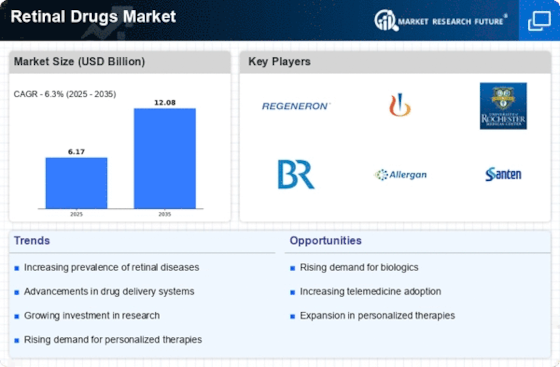
As per Market Research Future analysis, the Retinal Drugs Market Size was estimated at 6.166 USD Billion in 2024. The Retinal Drugs industry is projected to grow from 6.554 USD Billion in 2025 to 12.08 USD Billion by 2035, exhibiting a compound annual growth rate (CAGR) of 6.3% during the forecast period 2025 - 2035

Key Market Trends & Highlights

The Retinal Drugs Market is poised for substantial growth driven by innovative therapies and increasing awareness of eye health.

  • The emergence of gene therapy is transforming treatment options for retinal disorders. North America remains the largest market, while Asia-Pacific is recognized as the fastest-growing region. Hospital pharmacy continues to dominate the market, whereas online pharmacy is rapidly gaining traction. Rising prevalence of retinal disorders and technological advancements in drug development are key drivers of market growth.

Market Size & Forecast

2024 Market Size 6.166 (USD Billion)
2035 Market Size 12.08 (USD Billion)
CAGR (2025 - 2035) 6.3%
Largest Regional Market Share in 2024 North America

Major Players

Regeneron Pharmaceuticals (US), Novartis (CH), Roche (CH), Bayer (DE), Allergan (IE), Santen Pharmaceutical (JP), Pfizer (US), Apellis Pharmaceuticals (US), Horizon Therapeutics (IE)

Market Trends

The Retinal Drugs Market is currently experiencing a dynamic evolution, driven by advancements in therapeutic options and an increasing prevalence of retinal diseases. The rise in awareness regarding eye health, coupled with a growing aging population, appears to be propelling demand for innovative treatments. Pharmaceutical companies are investing significantly in research and development, aiming to introduce novel therapies that target various retinal conditions. This trend suggests a shift towards personalized medicine, where treatments are tailored to individual patient needs, potentially enhancing efficacy and patient outcomes. Moreover, the competitive landscape of the Retinal Drugs Market is becoming increasingly complex, with numerous players vying for market share. Collaborations between biotechnology firms and academic institutions are fostering innovation, leading to the development of cutting-edge therapies. Regulatory agencies are also playing a crucial role in shaping the market, as they establish guidelines that ensure the safety and efficacy of new drugs. As the market continues to evolve, it is likely that emerging technologies, such as gene therapy and sustained-release drug delivery systems, will further transform treatment paradigms, offering hope for patients suffering from debilitating retinal disorders.

Emergence of Gene Therapy

The Retinal Drugs Market is witnessing a notable shift towards gene therapy as a viable treatment option for inherited retinal diseases. This innovative approach aims to address the underlying genetic causes of conditions, potentially offering long-term solutions rather than symptomatic relief. As research progresses, the integration of gene therapy into clinical practice may redefine treatment strategies, providing new hope for patients.

Increased Focus on Personalized Medicine

There is a growing emphasis on personalized medicine within the Retinal Drugs Market, where therapies are tailored to the unique genetic and phenotypic characteristics of individual patients. This trend suggests that treatments may become more effective, as they are designed to target specific pathways involved in retinal diseases. The potential for improved patient outcomes is driving interest in this approach.

Advancements in Drug Delivery Systems

Innovations in drug delivery systems are emerging as a critical trend in the Retinal Drugs Market. Enhanced delivery mechanisms, such as sustained-release formulations and implantable devices, are being developed to improve the efficacy and convenience of treatments. These advancements may lead to better patient adherence and overall treatment success, addressing some of the challenges associated with traditional administration methods.

Retinal Drugs Market Market Drivers

Rising Prevalence of Retinal Disorders

The increasing incidence of retinal disorders, such as age-related macular degeneration and diabetic retinopathy, is a primary driver of the Retinal Drugs Market. According to recent estimates, the prevalence of diabetic retinopathy is projected to rise significantly, affecting millions worldwide. This surge in retinal disorders necessitates the development and availability of effective retinal drugs, thereby propelling market growth. As the population ages, the demand for innovative treatments is likely to escalate, leading to a robust market environment. The Retinal Drugs Market is expected to witness substantial investments in research and development, aimed at addressing these growing health concerns. Furthermore, the rising awareness among healthcare professionals and patients regarding retinal health is anticipated to contribute positively to market dynamics.

Regulatory Support for Innovative Therapies

Regulatory bodies are increasingly providing support for the development of innovative therapies within the Retinal Drugs Market. Initiatives aimed at expediting the approval process for breakthrough therapies are becoming more prevalent. This regulatory environment encourages pharmaceutical companies to invest in the development of novel retinal drugs, as the pathway to market entry appears more accessible. Additionally, the introduction of orphan drug designations for treatments targeting rare retinal disorders is likely to incentivize research in this area. As a result, the Retinal Drugs Market may witness a rise in the number of approved therapies, ultimately benefiting patients with limited treatment options. The proactive stance of regulatory agencies could significantly influence market dynamics in the coming years.

Growing Investment in Research and Development

The Retinal Drugs Market is experiencing a surge in investment directed towards research and development initiatives. Pharmaceutical companies are recognizing the unmet medical needs associated with retinal diseases, prompting increased funding for innovative drug development. In recent years, several companies have allocated substantial resources to explore novel therapeutic approaches, including gene therapy and biologics. This trend is expected to continue, as the potential for breakthrough treatments becomes more apparent. The financial commitment to R&D is likely to yield a pipeline of new retinal drugs, enhancing treatment options for patients. Furthermore, collaborations between academic institutions and industry players are fostering an environment conducive to innovation, thereby driving the growth of the Retinal Drugs Market.

Technological Advancements in Drug Development

Technological innovations in drug development are transforming the Retinal Drugs Market. The advent of advanced imaging techniques and high-throughput screening methods has enhanced the ability to identify potential drug candidates for retinal diseases. These technologies facilitate the rapid assessment of drug efficacy and safety, thereby expediting the development process. Moreover, the integration of artificial intelligence in drug discovery is likely to streamline the identification of novel therapeutic targets. As a result, pharmaceutical companies are increasingly investing in these technologies, which could lead to a surge in the availability of new retinal drugs. The Retinal Drugs Market stands to benefit from these advancements, as they may enable the introduction of more effective and targeted therapies for patients suffering from retinal disorders.

Increasing Awareness and Education on Eye Health

The growing emphasis on eye health awareness is a crucial driver of the Retinal Drugs Market. Public health campaigns and educational initiatives are fostering a better understanding of retinal disorders among patients and healthcare providers. This heightened awareness is likely to lead to earlier diagnosis and treatment of retinal diseases, thereby increasing the demand for retinal drugs. Furthermore, as patients become more informed about their treatment options, they may actively seek out therapies, contributing to market growth. The Retinal Drugs Market is expected to benefit from this trend, as healthcare systems prioritize eye health and allocate resources towards improving patient outcomes. The collaboration between healthcare professionals and patient advocacy groups is also anticipated to play a vital role in promoting awareness and education.


Market Segment Insights

By Distribution Channel: Hospital Pharmacy (Largest) vs. Online Pharmacy (Fastest-Growing)

In the Retinal Drugs Market, the distribution channels exhibit a dynamic landscape, with Hospital <a href="https://www.marketresearchfuture.com/reports/pharmacy-market-12003">Pharmacy </a>representing the largest segment in terms of market share. Retail pharmacies also play a significant role, although they hold a relatively smaller share compared to hospital settings. Online Pharmacy is progressively capturing attention due to increasing demand for convenient access to medications, allowing patients to obtain retinal drugs through digital platforms.

Hospital Pharmacy (Dominant) vs. Online Pharmacy (Emerging)

Hospital Pharmacy remains the dominant player in the distribution of retinal drugs, characterized by a comprehensive range of services, including direct patient care and specialized administration of medications. Meanwhile, <a href="https://www.marketresearchfuture.com/reports/epharmacy-market-6615">Online Pharmacy</a> is emerging as a significant force in the market, driven by the growing trend of e-commerce, accessibility, and the shift towards telehealth solutions. Patients are increasingly opting for the convenience of online platforms, which offer home delivery options and user-friendly interfaces for prescription management. This shift indicates a potential future where Online Pharmacies could redefine how retinal drugs are distributed and accessed.

By Indication: Macular Degeneration (Largest) vs. Diabetic Eye Disease (Fastest-Growing)

The retinal drugs market shows a distinctive distribution of share among its indication segments. Macular Degeneration currently holds the largest share, driven by the increasing aged population and the rising prevalence of age-related eye disorders. Diabetic Eye Disease, while smaller in share, is rapidly gaining attention due to the escalating number of diabetes cases worldwide, creating a significant demand for effective treatment options. This dynamic reflects the shifting focus towards chronic diseases as both segments demonstrate unique treatment needs and patient demographics. In terms of growth trends, <a href="https://www.marketresearchfuture.com/reports/macular-degeneration-treatment-market-21337">Macular Degeneration</a> remains a robust segment, propelled by advancements in treatment methodologies and enhanced awareness among healthcare providers. Conversely, the Diabetic Eye Disease segment is emerging quickly, driven by lifestyle-related changes leading to a rise in diabetes cases. With ongoing research into innovative therapies, both segments are projected to experience substantial growth, highlighting the adaptability of the retinal drugs market to evolving health challenges.

Macular Degeneration (Dominant) vs. Diabetic Eye Disease (Emerging)

Macular Degeneration is the dominant player in the retinal drugs market, characterized by its established treatment protocols and a well-defined patient demographic primarily consisting of older adults. This segment benefits from ongoing research and development, resulting in advanced therapies that improve patient outcomes. In contrast, Diabetic Eye Disease is an emerging segment that is rapidly gaining traction due to the increasing prevalence of diabetes which significantly impacts diabetic retinopathy cases. This segment showcases a diverse patient population and requires tailored treatment approaches, thereby attracting significant interest from pharmaceutical companies looking to address unmet medical needs. With the dual focus on therapies for both segments, stakeholders are keen on exploring innovative strategies that cater to these distinct market demands.

Get more detailed insights about Retinal Drugs Market Research Report—Global Forecast till 2035

Regional Insights

North America : Leading Market for Retinal Drugs Market

North America is the largest market for retinal drugs, accounting for approximately 45% of the global market share. The region's growth is driven by increasing prevalence of retinal diseases, advancements in drug development, and supportive regulatory frameworks. The demand for innovative therapies, particularly in the U.S., is further fueled by a robust healthcare infrastructure and high healthcare expenditure. The competitive landscape in North America is characterized by the presence of major players such as Regeneron Pharmaceuticals and Pfizer. The U.S. leads in market share, followed by Canada, which is witnessing a rise in demand for retinal therapies. The focus on research and development, along with strategic collaborations among key players, is expected to enhance market growth in the coming years.

Europe : Emerging Market Dynamics

Europe is the second-largest market for retinal drugs, holding around 30% of the global market share. The region's growth is propelled by an aging population, increasing incidence of retinal disorders, and favorable reimbursement policies. Regulatory bodies are actively promoting innovative treatments, which is expected to enhance market access and patient outcomes across member states. Leading countries in Europe include Germany, France, and the UK, where significant investments in healthcare and research are evident. The competitive landscape features key players like Novartis and Roche, who are focusing on expanding their product portfolios. The presence of advanced healthcare systems and ongoing clinical trials further contribute to the region's dynamic market environment.

Asia-Pacific : Rapidly Growing Market Potential

Asia-Pacific is witnessing rapid growth in the retinal drugs market, accounting for approximately 20% of the global share. The region's expansion is driven by increasing awareness of retinal diseases, rising disposable incomes, and improvements in healthcare infrastructure. Countries like China and India are experiencing a surge in demand for advanced retinal therapies, supported by government initiatives to enhance healthcare access. China is the largest market in the region, followed by Japan and India, where local pharmaceutical companies are increasingly investing in research and development. The competitive landscape is evolving, with both multinational and domestic players striving to capture market share. Collaborations and partnerships are becoming common as companies aim to leverage local expertise and distribution networks.

Middle East and Africa : Untapped Market Opportunities

The Middle East and Africa represent an emerging market for retinal drugs, holding about 5% of the global market share. The growth in this region is driven by increasing healthcare investments, rising awareness of retinal diseases, and a growing population. However, challenges such as limited access to healthcare and varying regulatory environments can hinder market expansion. Countries like South Africa and the UAE are leading the way in adopting advanced retinal therapies. The competitive landscape is still developing, with a mix of local and international players. Key companies are focusing on establishing partnerships to enhance distribution and access to innovative treatments. As healthcare systems improve and awareness increases, the potential for growth in the retinal drugs market in this region is significant.

Key Players and Competitive Insights

The Retinal Drugs Market is currently characterized by a dynamic competitive landscape, driven by increasing prevalence of retinal diseases and a growing demand for innovative therapies. Key players such as Regeneron Pharmaceuticals (US), Novartis (CH), and Roche (CH) are strategically positioned to leverage their extensive research capabilities and established market presence. Regeneron Pharmaceuticals (US) focuses on innovation, particularly with its flagship product, Eylea, which has seen significant uptake in the treatment of age-related macular degeneration (AMD). Meanwhile, Novartis (CH) emphasizes partnerships and collaborations to enhance its product pipeline, particularly in gene therapy, which could revolutionize treatment paradigms. Roche (CH) is also investing heavily in digital transformation, aiming to integrate advanced analytics into its drug development processes, thereby enhancing efficiency and patient outcomes.The business tactics employed by these companies reflect a concerted effort to optimize supply chains and localize manufacturing, which is crucial in a moderately fragmented market. The collective influence of these key players shapes a competitive structure that is increasingly focused on innovation and patient-centric solutions. As companies strive to differentiate themselves, the emphasis on localized production and streamlined supply chains becomes paramount, allowing for quicker responses to market demands and regulatory changes.

In August Regeneron Pharmaceuticals (US) announced a strategic partnership with a leading biotechnology firm to co-develop a next-generation retinal drug targeting diabetic retinopathy. This collaboration is expected to enhance Regeneron’s research capabilities and accelerate the development timeline, potentially positioning the company as a leader in this therapeutic area. The strategic importance of this partnership lies in its potential to expand Regeneron’s portfolio and address unmet medical needs in a growing patient population.

In September Novartis (CH) launched a new initiative aimed at integrating artificial intelligence into its clinical trial processes for retinal drugs. This move is indicative of the company's commitment to leveraging technology to enhance trial efficiency and patient recruitment. By adopting AI, Novartis aims to reduce time-to-market for its innovative therapies, thereby gaining a competitive edge in the rapidly evolving retinal drugs landscape. The implications of this initiative could be profound, as it may set a new standard for clinical trials in the industry.

In October Roche (CH) unveiled a new digital platform designed to facilitate real-time data sharing among healthcare providers and patients using its retinal therapies. This platform is expected to enhance patient engagement and adherence to treatment regimens, ultimately improving clinical outcomes. The strategic significance of this development lies in Roche's ability to harness digital tools to foster a more integrated healthcare ecosystem, which is increasingly becoming a competitive differentiator in the market.

As of October the Retinal Drugs Market is witnessing trends that emphasize digitalization, sustainability, and the integration of artificial intelligence. Strategic alliances are becoming increasingly vital, as companies recognize the need to pool resources and expertise to navigate the complexities of drug development. Looking ahead, competitive differentiation is likely to evolve from traditional price-based competition to a focus on innovation, technological advancements, and supply chain reliability. This shift underscores the importance of agility and responsiveness in meeting the needs of patients and healthcare providers alike.

Key Companies in the Retinal Drugs Market include

Industry Developments

March 2021 In order to create a new class of biologicals for the treatment of diabetic retinopathy and ischemic retinal disorders, SemaThera Inc. established a licensing arrangement and a research partnership with Roche.

December 2022 The phase 1 clinical trials of OLX301A for the treatment of wet and dry muscle degeneration have been registered by Olix Pharmaceuticals in the United States.

Future Outlook

Retinal Drugs Market Future Outlook

The Retinal Drugs Market is projected to grow at a 6.3% CAGR from 2025 to 2035, driven by technological advancements, increasing prevalence of retinal diseases, and rising healthcare expenditure.

New opportunities lie in:

  • Development of personalized medicine for retinal disorders</p><p>Expansion of telemedicine platforms for remote patient monitoring</p><p>Investment in AI-driven drug discovery for retinal therapies

By 2035, the Retinal Drugs Market is expected to achieve substantial growth, reflecting evolving healthcare needs.

Market Segmentation

Retinal Drugs Market Indication Outlook

  • Macular Degeneration
  • Diabetic Eye Disease
  • Others

Retinal Drugs Market Distribution Channel Outlook

  • Hospital Pharmacy
  • Retail Pharmacy
  • Online Pharmacy

Report Scope

MARKET SIZE 2024 6.166(USD Billion)
MARKET SIZE 2025 6.554(USD Billion)
MARKET SIZE 2035 12.08(USD Billion)
COMPOUND ANNUAL GROWTH RATE (CAGR) 6.3% (2025 - 2035)
REPORT COVERAGE Revenue Forecast, Competitive Landscape, Growth Factors, and Trends
BASE YEAR 2024
Market Forecast Period 2025 - 2035
Historical Data 2019 - 2024
Market Forecast Units USD Billion
Key Companies Profiled Regeneron Pharmaceuticals (US), Novartis (CH), Roche (CH), Bayer (DE), Allergan (IE), Santen Pharmaceutical (JP), Pfizer (US), Apellis Pharmaceuticals (US), Horizon Therapeutics (IE)
Segments Covered Distribution Channel, Indication, Region
Key Market Opportunities Advancements in gene therapy and personalized medicine are transforming the Retinal Drugs Market landscape.
Key Market Dynamics Rising demand for innovative therapies drives competition and regulatory scrutiny in the retinal drugs market.
Countries Covered North America, Europe, APAC, South America, MEA

FAQs

What is the projected market valuation of the Retinal Drugs Market by 2035?

<p>The Retinal Drugs Market is projected to reach a valuation of 12.08 USD Billion by 2035.</p>

What was the market valuation of the Retinal Drugs Market in 2024?

<p>In 2024, the market valuation of the Retinal Drugs Market was 6.166 USD Billion.</p>

What is the expected CAGR for the Retinal Drugs Market during the forecast period 2025 - 2035?

<p>The expected CAGR for the Retinal Drugs Market during the forecast period 2025 - 2035 is 6.3%.</p>

Which companies are considered key players in the Retinal Drugs Market?

<p>Key players in the Retinal Drugs Market include Regeneron Pharmaceuticals, Novartis, Roche, Bayer, Allergan, Santen Pharmaceutical, Pfizer, Apellis Pharmaceuticals, and Horizon Therapeutics.</p>

What are the main distribution channels for retinal drugs?

<p>The main distribution channels for retinal drugs include Hospital Pharmacy, Retail Pharmacy, and Online Pharmacy.</p>

What was the market size for Hospital Pharmacy in the Retinal Drugs Market in 2024?

<p>In 2024, the market size for Hospital Pharmacy in the Retinal Drugs Market was 2.5 USD Billion.</p>

What is the projected market size for Online Pharmacy in the Retinal Drugs Market by 2035?

The projected market size for Online Pharmacy in the Retinal Drugs Market is expected to reach 3.08 USD Billion by 2035.

What indications are covered in the Retinal Drugs Market?

The indications covered in the Retinal Drugs Market include Macular Degeneration, Diabetic Eye Disease, and Others.

What was the market size for Macular Degeneration in 2024?

In 2024, the market size for Macular Degeneration was 3.1 USD Billion.

What is the projected market size for Diabetic Eye Disease by 2035?

The projected market size for Diabetic Eye Disease in the Retinal Drugs Market is expected to reach 4.5 USD Billion by 2035.

  1. SECTION I: EXECUTIVE SUMMARY AND KEY HIGHLIGHTS
    1. | 1.1 EXECUTIVE SUMMARY
    2. | | 1.1.1 Market Overview
    3. | | 1.1.2 Key Findings
    4. | | 1.1.3 Market Segmentation
    5. | | 1.1.4 Competitive Landscape
    6. | | 1.1.5 Challenges and Opportunities
    7. | | 1.1.6 Future Outlook
  2. SECTION II: SCOPING, METHODOLOGY AND MARKET STRUCTURE
    1. | 2.1 MARKET INTRODUCTION
    2. | | 2.1.1 Definition
    3. | | 2.1.2 Scope of the study
    4. | | | 2.1.2.1 Research Objective
    5. | | | 2.1.2.2 Assumption
    6. | | | 2.1.2.3 Limitations
    7. | 2.2 RESEARCH METHODOLOGY
    8. | | 2.2.1 Overview
    9. | | 2.2.2 Data Mining
    10. | | 2.2.3 Secondary Research
    11. | | 2.2.4 Primary Research
    12. | | | 2.2.4.1 Primary Interviews and Information Gathering Process
    13. | | | 2.2.4.2 Breakdown of Primary Respondents
    14. | | 2.2.5 Forecasting Model
    15. | | 2.2.6 Market Size Estimation
    16. | | | 2.2.6.1 Bottom-Up Approach
    17. | | | 2.2.6.2 Top-Down Approach
    18. | | 2.2.7 Data Triangulation
    19. | | 2.2.8 Validation
  3. SECTION III: QUALITATIVE ANALYSIS
    1. | 3.1 MARKET DYNAMICS
    2. | | 3.1.1 Overview
    3. | | 3.1.2 Drivers
    4. | | 3.1.3 Restraints
    5. | | 3.1.4 Opportunities
    6. | 3.2 MARKET FACTOR ANALYSIS
    7. | | 3.2.1 Value chain Analysis
    8. | | 3.2.2 Porter's Five Forces Analysis
    9. | | | 3.2.2.1 Bargaining Power of Suppliers
    10. | | | 3.2.2.2 Bargaining Power of Buyers
    11. | | | 3.2.2.3 Threat of New Entrants
    12. | | | 3.2.2.4 Threat of Substitutes
    13. | | | 3.2.2.5 Intensity of Rivalry
    14. | | 3.2.3 COVID-19 Impact Analysis
    15. | | | 3.2.3.1 Market Impact Analysis
    16. | | | 3.2.3.2 Regional Impact
    17. | | | 3.2.3.3 Opportunity and Threat Analysis
  4. SECTION IV: QUANTITATIVE ANALYSIS
    1. | 4.1 Healthcare, BY Distribution Channel (USD Billion)
    2. | | 4.1.1 Hospital Pharmacy
    3. | | 4.1.2 Retail Pharmacy
    4. | | 4.1.3 Online Pharmacy
    5. | 4.2 Healthcare, BY Indication (USD Billion)
    6. | | 4.2.1 Macular Degeneration
    7. | | 4.2.2 Diabetic Eye Disease
    8. | | 4.2.3 Others
    9. | 4.3 Healthcare, BY Region (USD Billion)
    10. | | 4.3.1 North America
    11. | | | 4.3.1.1 US
    12. | | | 4.3.1.2 Canada
    13. | | 4.3.2 Europe
    14. | | | 4.3.2.1 Germany
    15. | | | 4.3.2.2 UK
    16. | | | 4.3.2.3 France
    17. | | | 4.3.2.4 Russia
    18. | | | 4.3.2.5 Italy
    19. | | | 4.3.2.6 Spain
    20. | | | 4.3.2.7 Rest of Europe
    21. | | 4.3.3 APAC
    22. | | | 4.3.3.1 China
    23. | | | 4.3.3.2 India
    24. | | | 4.3.3.3 Japan
    25. | | | 4.3.3.4 South Korea
    26. | | | 4.3.3.5 Malaysia
    27. | | | 4.3.3.6 Thailand
    28. | | | 4.3.3.7 Indonesia
    29. | | | 4.3.3.8 Rest of APAC
    30. | | 4.3.4 South America
    31. | | | 4.3.4.1 Brazil
    32. | | | 4.3.4.2 Mexico
    33. | | | 4.3.4.3 Argentina
    34. | | | 4.3.4.4 Rest of South America
    35. | | 4.3.5 MEA
    36. | | | 4.3.5.1 GCC Countries
    37. | | | 4.3.5.2 South Africa
    38. | | | 4.3.5.3 Rest of MEA
  5. SECTION V: COMPETITIVE ANALYSIS
    1. | 5.1 Competitive Landscape
    2. | | 5.1.1 Overview
    3. | | 5.1.2 Competitive Analysis
    4. | | 5.1.3 Market share Analysis
    5. | | 5.1.4 Major Growth Strategy in the Healthcare
    6. | | 5.1.5 Competitive Benchmarking
    7. | | 5.1.6 Leading Players in Terms of Number of Developments in the Healthcare
    8. | | 5.1.7 Key developments and growth strategies
    9. | | | 5.1.7.1 New Product Launch/Service Deployment
    10. | | | 5.1.7.2 Merger & Acquisitions
    11. | | | 5.1.7.3 Joint Ventures
    12. | | 5.1.8 Major Players Financial Matrix
    13. | | | 5.1.8.1 Sales and Operating Income
    14. | | | 5.1.8.2 Major Players R&D Expenditure. 2023
    15. | 5.2 Company Profiles
    16. | | 5.2.1 Regeneron Pharmaceuticals (US)
    17. | | | 5.2.1.1 Financial Overview
    18. | | | 5.2.1.2 Products Offered
    19. | | | 5.2.1.3 Key Developments
    20. | | | 5.2.1.4 SWOT Analysis
    21. | | | 5.2.1.5 Key Strategies
    22. | | 5.2.2 Novartis (CH)
    23. | | | 5.2.2.1 Financial Overview
    24. | | | 5.2.2.2 Products Offered
    25. | | | 5.2.2.3 Key Developments
    26. | | | 5.2.2.4 SWOT Analysis
    27. | | | 5.2.2.5 Key Strategies
    28. | | 5.2.3 Roche (CH)
    29. | | | 5.2.3.1 Financial Overview
    30. | | | 5.2.3.2 Products Offered
    31. | | | 5.2.3.3 Key Developments
    32. | | | 5.2.3.4 SWOT Analysis
    33. | | | 5.2.3.5 Key Strategies
    34. | | 5.2.4 Bayer (DE)
    35. | | | 5.2.4.1 Financial Overview
    36. | | | 5.2.4.2 Products Offered
    37. | | | 5.2.4.3 Key Developments
    38. | | | 5.2.4.4 SWOT Analysis
    39. | | | 5.2.4.5 Key Strategies
    40. | | 5.2.5 Allergan (IE)
    41. | | | 5.2.5.1 Financial Overview
    42. | | | 5.2.5.2 Products Offered
    43. | | | 5.2.5.3 Key Developments
    44. | | | 5.2.5.4 SWOT Analysis
    45. | | | 5.2.5.5 Key Strategies
    46. | | 5.2.6 Santen Pharmaceutical (JP)
    47. | | | 5.2.6.1 Financial Overview
    48. | | | 5.2.6.2 Products Offered
    49. | | | 5.2.6.3 Key Developments
    50. | | | 5.2.6.4 SWOT Analysis
    51. | | | 5.2.6.5 Key Strategies
    52. | | 5.2.7 Pfizer (US)
    53. | | | 5.2.7.1 Financial Overview
    54. | | | 5.2.7.2 Products Offered
    55. | | | 5.2.7.3 Key Developments
    56. | | | 5.2.7.4 SWOT Analysis
    57. | | | 5.2.7.5 Key Strategies
    58. | | 5.2.8 Apellis Pharmaceuticals (US)
    59. | | | 5.2.8.1 Financial Overview
    60. | | | 5.2.8.2 Products Offered
    61. | | | 5.2.8.3 Key Developments
    62. | | | 5.2.8.4 SWOT Analysis
    63. | | | 5.2.8.5 Key Strategies
    64. | | 5.2.9 Horizon Therapeutics (IE)
    65. | | | 5.2.9.1 Financial Overview
    66. | | | 5.2.9.2 Products Offered
    67. | | | 5.2.9.3 Key Developments
    68. | | | 5.2.9.4 SWOT Analysis
    69. | | | 5.2.9.5 Key Strategies
    70. | 5.3 Appendix
    71. | | 5.3.1 References
    72. | | 5.3.2 Related Reports
  6. LIST OF FIGURES
    1. | 6.1 MARKET SYNOPSIS
    2. | 6.2 NORTH AMERICA MARKET ANALYSIS
    3. | 6.3 US MARKET ANALYSIS BY DISTRIBUTION CHANNEL
    4. | 6.4 US MARKET ANALYSIS BY INDICATION
    5. | 6.5 CANADA MARKET ANALYSIS BY DISTRIBUTION CHANNEL
    6. | 6.6 CANADA MARKET ANALYSIS BY INDICATION
    7. | 6.7 EUROPE MARKET ANALYSIS
    8. | 6.8 GERMANY MARKET ANALYSIS BY DISTRIBUTION CHANNEL
    9. | 6.9 GERMANY MARKET ANALYSIS BY INDICATION
    10. | 6.10 UK MARKET ANALYSIS BY DISTRIBUTION CHANNEL
    11. | 6.11 UK MARKET ANALYSIS BY INDICATION
    12. | 6.12 FRANCE MARKET ANALYSIS BY DISTRIBUTION CHANNEL
    13. | 6.13 FRANCE MARKET ANALYSIS BY INDICATION
    14. | 6.14 RUSSIA MARKET ANALYSIS BY DISTRIBUTION CHANNEL
    15. | 6.15 RUSSIA MARKET ANALYSIS BY INDICATION
    16. | 6.16 ITALY MARKET ANALYSIS BY DISTRIBUTION CHANNEL
    17. | 6.17 ITALY MARKET ANALYSIS BY INDICATION
    18. | 6.18 SPAIN MARKET ANALYSIS BY DISTRIBUTION CHANNEL
    19. | 6.19 SPAIN MARKET ANALYSIS BY INDICATION
    20. | 6.20 REST OF EUROPE MARKET ANALYSIS BY DISTRIBUTION CHANNEL
    21. | 6.21 REST OF EUROPE MARKET ANALYSIS BY INDICATION
    22. | 6.22 APAC MARKET ANALYSIS
    23. | 6.23 CHINA MARKET ANALYSIS BY DISTRIBUTION CHANNEL
    24. | 6.24 CHINA MARKET ANALYSIS BY INDICATION
    25. | 6.25 INDIA MARKET ANALYSIS BY DISTRIBUTION CHANNEL
    26. | 6.26 INDIA MARKET ANALYSIS BY INDICATION
    27. | 6.27 JAPAN MARKET ANALYSIS BY DISTRIBUTION CHANNEL
    28. | 6.28 JAPAN MARKET ANALYSIS BY INDICATION
    29. | 6.29 SOUTH KOREA MARKET ANALYSIS BY DISTRIBUTION CHANNEL
    30. | 6.30 SOUTH KOREA MARKET ANALYSIS BY INDICATION
    31. | 6.31 MALAYSIA MARKET ANALYSIS BY DISTRIBUTION CHANNEL
    32. | 6.32 MALAYSIA MARKET ANALYSIS BY INDICATION
    33. | 6.33 THAILAND MARKET ANALYSIS BY DISTRIBUTION CHANNEL
    34. | 6.34 THAILAND MARKET ANALYSIS BY INDICATION
    35. | 6.35 INDONESIA MARKET ANALYSIS BY DISTRIBUTION CHANNEL
    36. | 6.36 INDONESIA MARKET ANALYSIS BY INDICATION
    37. | 6.37 REST OF APAC MARKET ANALYSIS BY DISTRIBUTION CHANNEL
    38. | 6.38 REST OF APAC MARKET ANALYSIS BY INDICATION
    39. | 6.39 SOUTH AMERICA MARKET ANALYSIS
    40. | 6.40 BRAZIL MARKET ANALYSIS BY DISTRIBUTION CHANNEL
    41. | 6.41 BRAZIL MARKET ANALYSIS BY INDICATION
    42. | 6.42 MEXICO MARKET ANALYSIS BY DISTRIBUTION CHANNEL
    43. | 6.43 MEXICO MARKET ANALYSIS BY INDICATION
    44. | 6.44 ARGENTINA MARKET ANALYSIS BY DISTRIBUTION CHANNEL
    45. | 6.45 ARGENTINA MARKET ANALYSIS BY INDICATION
    46. | 6.46 REST OF SOUTH AMERICA MARKET ANALYSIS BY DISTRIBUTION CHANNEL
    47. | 6.47 REST OF SOUTH AMERICA MARKET ANALYSIS BY INDICATION
    48. | 6.48 MEA MARKET ANALYSIS
    49. | 6.49 GCC COUNTRIES MARKET ANALYSIS BY DISTRIBUTION CHANNEL
    50. | 6.50 GCC COUNTRIES MARKET ANALYSIS BY INDICATION
    51. | 6.51 SOUTH AFRICA MARKET ANALYSIS BY DISTRIBUTION CHANNEL
    52. | 6.52 SOUTH AFRICA MARKET ANALYSIS BY INDICATION
    53. | 6.53 REST OF MEA MARKET ANALYSIS BY DISTRIBUTION CHANNEL
    54. | 6.54 REST OF MEA MARKET ANALYSIS BY INDICATION
    55. | 6.55 KEY BUYING CRITERIA OF HEALTHCARE
    56. | 6.56 RESEARCH PROCESS OF MRFR
    57. | 6.57 DRO ANALYSIS OF HEALTHCARE
    58. | 6.58 DRIVERS IMPACT ANALYSIS: HEALTHCARE
    59. | 6.59 RESTRAINTS IMPACT ANALYSIS: HEALTHCARE
    60. | 6.60 SUPPLY / VALUE CHAIN: HEALTHCARE
    61. | 6.61 HEALTHCARE, BY DISTRIBUTION CHANNEL, 2024 (% SHARE)
    62. | 6.62 HEALTHCARE, BY DISTRIBUTION CHANNEL, 2024 TO 2035 (USD Billion)
    63. | 6.63 HEALTHCARE, BY INDICATION, 2024 (% SHARE)
    64. | 6.64 HEALTHCARE, BY INDICATION, 2024 TO 2035 (USD Billion)
    65. | 6.65 BENCHMARKING OF MAJOR COMPETITORS
  7. LIST OF TABLES
    1. | 7.1 LIST OF ASSUMPTIONS
    2. | | 7.1.1
    3. | 7.2 North America MARKET SIZE ESTIMATES; FORECAST
    4. | | 7.2.1 BY DISTRIBUTION CHANNEL, 2025-2035 (USD Billion)
    5. | | 7.2.2 BY INDICATION, 2025-2035 (USD Billion)
    6. | 7.3 US MARKET SIZE ESTIMATES; FORECAST
    7. | | 7.3.1 BY DISTRIBUTION CHANNEL, 2025-2035 (USD Billion)
    8. | | 7.3.2 BY INDICATION, 2025-2035 (USD Billion)
    9. | 7.4 Canada MARKET SIZE ESTIMATES; FORECAST
    10. | | 7.4.1 BY DISTRIBUTION CHANNEL, 2025-2035 (USD Billion)
    11. | | 7.4.2 BY INDICATION, 2025-2035 (USD Billion)
    12. | 7.5 Europe MARKET SIZE ESTIMATES; FORECAST
    13. | | 7.5.1 BY DISTRIBUTION CHANNEL, 2025-2035 (USD Billion)
    14. | | 7.5.2 BY INDICATION, 2025-2035 (USD Billion)
    15. | 7.6 Germany MARKET SIZE ESTIMATES; FORECAST
    16. | | 7.6.1 BY DISTRIBUTION CHANNEL, 2025-2035 (USD Billion)
    17. | | 7.6.2 BY INDICATION, 2025-2035 (USD Billion)
    18. | 7.7 UK MARKET SIZE ESTIMATES; FORECAST
    19. | | 7.7.1 BY DISTRIBUTION CHANNEL, 2025-2035 (USD Billion)
    20. | | 7.7.2 BY INDICATION, 2025-2035 (USD Billion)
    21. | 7.8 France MARKET SIZE ESTIMATES; FORECAST
    22. | | 7.8.1 BY DISTRIBUTION CHANNEL, 2025-2035 (USD Billion)
    23. | | 7.8.2 BY INDICATION, 2025-2035 (USD Billion)
    24. | 7.9 Russia MARKET SIZE ESTIMATES; FORECAST
    25. | | 7.9.1 BY DISTRIBUTION CHANNEL, 2025-2035 (USD Billion)
    26. | | 7.9.2 BY INDICATION, 2025-2035 (USD Billion)
    27. | 7.10 Italy MARKET SIZE ESTIMATES; FORECAST
    28. | | 7.10.1 BY DISTRIBUTION CHANNEL, 2025-2035 (USD Billion)
    29. | | 7.10.2 BY INDICATION, 2025-2035 (USD Billion)
    30. | 7.11 Spain MARKET SIZE ESTIMATES; FORECAST
    31. | | 7.11.1 BY DISTRIBUTION CHANNEL, 2025-2035 (USD Billion)
    32. | | 7.11.2 BY INDICATION, 2025-2035 (USD Billion)
    33. | 7.12 Rest of Europe MARKET SIZE ESTIMATES; FORECAST
    34. | | 7.12.1 BY DISTRIBUTION CHANNEL, 2025-2035 (USD Billion)
    35. | | 7.12.2 BY INDICATION, 2025-2035 (USD Billion)
    36. | 7.13 APAC MARKET SIZE ESTIMATES; FORECAST
    37. | | 7.13.1 BY DISTRIBUTION CHANNEL, 2025-2035 (USD Billion)
    38. | | 7.13.2 BY INDICATION, 2025-2035 (USD Billion)
    39. | 7.14 China MARKET SIZE ESTIMATES; FORECAST
    40. | | 7.14.1 BY DISTRIBUTION CHANNEL, 2025-2035 (USD Billion)
    41. | | 7.14.2 BY INDICATION, 2025-2035 (USD Billion)
    42. | 7.15 India MARKET SIZE ESTIMATES; FORECAST
    43. | | 7.15.1 BY DISTRIBUTION CHANNEL, 2025-2035 (USD Billion)
    44. | | 7.15.2 BY INDICATION, 2025-2035 (USD Billion)
    45. | 7.16 Japan MARKET SIZE ESTIMATES; FORECAST
    46. | | 7.16.1 BY DISTRIBUTION CHANNEL, 2025-2035 (USD Billion)
    47. | | 7.16.2 BY INDICATION, 2025-2035 (USD Billion)
    48. | 7.17 South Korea MARKET SIZE ESTIMATES; FORECAST
    49. | | 7.17.1 BY DISTRIBUTION CHANNEL, 2025-2035 (USD Billion)
    50. | | 7.17.2 BY INDICATION, 2025-2035 (USD Billion)
    51. | 7.18 Malaysia MARKET SIZE ESTIMATES; FORECAST
    52. | | 7.18.1 BY DISTRIBUTION CHANNEL, 2025-2035 (USD Billion)
    53. | | 7.18.2 BY INDICATION, 2025-2035 (USD Billion)
    54. | 7.19 Thailand MARKET SIZE ESTIMATES; FORECAST
    55. | | 7.19.1 BY DISTRIBUTION CHANNEL, 2025-2035 (USD Billion)
    56. | | 7.19.2 BY INDICATION, 2025-2035 (USD Billion)
    57. | 7.20 Indonesia MARKET SIZE ESTIMATES; FORECAST
    58. | | 7.20.1 BY DISTRIBUTION CHANNEL, 2025-2035 (USD Billion)
    59. | | 7.20.2 BY INDICATION, 2025-2035 (USD Billion)
    60. | 7.21 Rest of APAC MARKET SIZE ESTIMATES; FORECAST
    61. | | 7.21.1 BY DISTRIBUTION CHANNEL, 2025-2035 (USD Billion)
    62. | | 7.21.2 BY INDICATION, 2025-2035 (USD Billion)
    63. | 7.22 South America MARKET SIZE ESTIMATES; FORECAST
    64. | | 7.22.1 BY DISTRIBUTION CHANNEL, 2025-2035 (USD Billion)
    65. | | 7.22.2 BY INDICATION, 2025-2035 (USD Billion)
    66. | 7.23 Brazil MARKET SIZE ESTIMATES; FORECAST
    67. | | 7.23.1 BY DISTRIBUTION CHANNEL, 2025-2035 (USD Billion)
    68. | | 7.23.2 BY INDICATION, 2025-2035 (USD Billion)
    69. | 7.24 Mexico MARKET SIZE ESTIMATES; FORECAST
    70. | | 7.24.1 BY DISTRIBUTION CHANNEL, 2025-2035 (USD Billion)
    71. | | 7.24.2 BY INDICATION, 2025-2035 (USD Billion)
    72. | 7.25 Argentina MARKET SIZE ESTIMATES; FORECAST
    73. | | 7.25.1 BY DISTRIBUTION CHANNEL, 2025-2035 (USD Billion)
    74. | | 7.25.2 BY INDICATION, 2025-2035 (USD Billion)
    75. | 7.26 Rest of South America MARKET SIZE ESTIMATES; FORECAST
    76. | | 7.26.1 BY DISTRIBUTION CHANNEL, 2025-2035 (USD Billion)
    77. | | 7.26.2 BY INDICATION, 2025-2035 (USD Billion)
    78. | 7.27 MEA MARKET SIZE ESTIMATES; FORECAST
    79. | | 7.27.1 BY DISTRIBUTION CHANNEL, 2025-2035 (USD Billion)
    80. | | 7.27.2 BY INDICATION, 2025-2035 (USD Billion)
    81. | 7.28 GCC Countries MARKET SIZE ESTIMATES; FORECAST
    82. | | 7.28.1 BY DISTRIBUTION CHANNEL, 2025-2035 (USD Billion)
    83. | | 7.28.2 BY INDICATION, 2025-2035 (USD Billion)
    84. | 7.29 South Africa MARKET SIZE ESTIMATES; FORECAST
    85. | | 7.29.1 BY DISTRIBUTION CHANNEL, 2025-2035 (USD Billion)
    86. | | 7.29.2 BY INDICATION, 2025-2035 (USD Billion)
    87. | 7.30 Rest of MEA MARKET SIZE ESTIMATES; FORECAST
    88. | | 7.30.1 BY DISTRIBUTION CHANNEL, 2025-2035 (USD Billion)
    89. | | 7.30.2 BY INDICATION, 2025-2035 (USD Billion)
    90. | 7.31 PRODUCT LAUNCH/PRODUCT DEVELOPMENT/APPROVAL
    91. | | 7.31.1
    92. | 7.32 ACQUISITION/PARTNERSHIP
    93. | | 7.32.1

Healthcare Market Segmentation

Healthcare By Distribution Channel (USD Billion, 2025-2035)

  • Hospital Pharmacy
  • Retail Pharmacy
  • Online Pharmacy

Healthcare By Indication (USD Billion, 2025-2035)

  • Macular Degeneration
  • Diabetic Eye Disease
  • Others
Infographic

Free Sample Request

Kindly complete the form below to receive a free sample of this Report

Get Free Sample

Customer Strories

Compare Licence

×
Features License Type
Single User Multiuser License Enterprise User
Price $4,950 $5,950 $7,250
Maximum User Access Limit 1 User Upto 10 Users Unrestricted Access Throughout the Organization
Free Customization
Direct Access to Analyst
Deliverable Format
Platform Access
Discount on Next Purchase 10% 15% 15%
Printable Versions