Regenerative Agriculture Market

ID: MRFR/Agri/20223-HCR
128 Pages
Snehal Singh
Last Updated: June 11, 2026
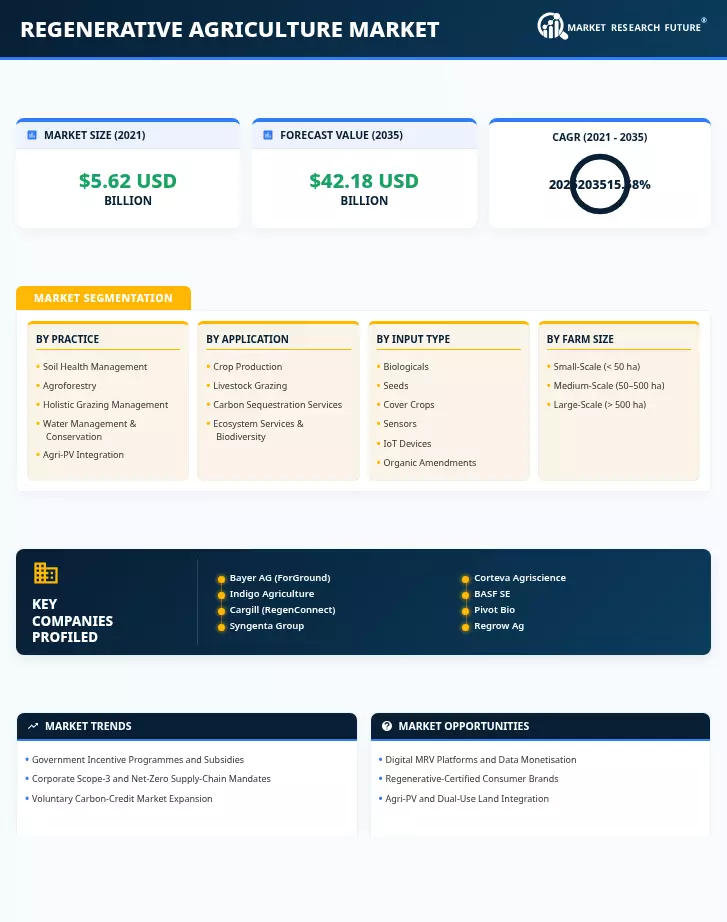
Regenerative Agriculture Market Size, Share, Industry Trend & Analysis Research Report Information By Practice (Soil Health Management, Agroforestry, Holistic Grazing Management, Water Management & Conservation, Agri-PV Integration), By Application (Crop Production, Livestock Grazing, Carbon Sequestration Services, Ecosystem Services & Biodiversity), By Input Type (Biologicals, Seeds and Cover Crops, Sensors and IoT Devices, Organic Amendments), By Farm Size (Small-Scale (< 50 ha), Medium-Scale (50–500 ha), Large-Scale (> 500 ha)) – Forecast Till 2035
Download PDF ×

We do not share your information with anyone. However, we may send you emails based on your report interest from time to time. You may contact us at any time to opt-out.

  1. 1 Market Overview |
    1. 1.1 Study Assumptions & Market Definition |
    2. 1.2 Scope of the Study |
    3. 1.3 Research Methodology
  2. 2 Market Summary & Key Takeaways
  3. 3 Market Dynamics |
    1. 3.1 Market Drivers Analysis | |
      1. 3.1.1 Government Incentive Programmes & Subsidies | |
      2. 3.1.2 Corporate Scope-3 & Net-Zero Supply-Chain Mandates | |
      3. 3.1.3 Voluntary Carbon-Credit Market Expansion | |
      4. 3.1.4 Biologicals & Microbial Inoculant Cost Reduction | |
      5. 3.1.5 Consumer Demand for Regenerative-Certified Products | |
      6. 3.1.6 Donor-Funded Soil Restoration in Sub-Saharan Africa | |
      7. 3.1.7 Digital MRV & IoT-Enabled Verification |
    2. 3.2 Market Restraints Analysis | |
      1. 3.2.1 Transition-Period Yield Uncertainty | |
      2. 3.2.2 Fragmented MRV Standards & Verification Costs | |
      3. 3.2.3 Limited Access to Transition Financing | |
      4. 3.2.4 Landlord–Tenant Split Incentives | |
      5. 3.2.5 Insufficient Agronomic Extension Services |
    3. 3.3 Market Opportunity Analysis | |
      1. 3.3.1 Digital MRV Platforms & Data Monetisation | |
      2. 3.3.2 Regenerative-Certified Consumer Brands | |
      3. 3.3.3 Agri-PV & Dual-Use Land Integration | |
      4. 3.3.4 Emerging-Market Smallholder Aggregation | |
      5. 3.3.5 Tokenised Carbon Marketplaces |
    4. 3.4 Industry Value Chain Analysis |
    5. 3.5 Porter's Five Forces Analysis
  4. 4 Global Regenerative Agriculture Market Size & Forecast (2021–2035) |
    1. 4.1 Historical Market Size (2021–2025) |
    2. 4.2 Current & Forecast Market Size (2026–2035) |
    3. 4.3 Market Size by Revenue (USD Billion) |
    4. 4.4 Year-over-Year Growth Analysis
  5. 5 Segmentation Analysis |
    1. 5.1 By Practice | |
      1. 5.1.1 Soil Health Management | |
      2. 5.1.2 Agroforestry | |
      3. 5.1.3 Holistic Grazing Management | |
      4. 5.1.4 Water Management & Conservation | |
      5. 5.1.5 Agri-PV Integration |
    2. 5.2 By Application | |
      1. 5.2.1 Crop Production | |
      2. 5.2.2 Livestock Grazing | |
      3. 5.2.3 Carbon Sequestration Services | |
      4. 5.2.4 Ecosystem Services & Biodiversity |
    3. 5.3 By Input Type | |
      1. 5.3.1 Biologicals | |
      2. 5.3.2 Seeds and Cover Crops | |
      3. 5.3.3 Sensors and IoT Devices | |
      4. 5.3.4 Organic Amendments | |
      5. 5.3.5 Software and Advisory Services | |
      6. 5.3.6 Equipment and Machinery | |
      7. 5.3.7 Others |
    4. 5.4 By Farm Size | |
      1. 5.4.1 Small-Scale ( 500 ha)
  6. 6 Regional Analysis |
    1. 6.1 North America | |
      1. 6.1.1 United States | |
      2. 6.1.2 Canada | |
      3. 6.1.3 Mexico |
    2. 6.2 Europe | |
      1. 6.2.1 Germany | |
      2. 6.2.2 United Kingdom | |
      3. 6.2.3 France | |
      4. 6.2.4 Italy | |
      5. 6.2.5 Spain | |
      6. 6.2.6 Nordic Countries | |
      7. 6.2.7 Russia | |
      8. 6.2.8 Rest of Europe |
    3. 6.3 Asia-Pacific | |
      1. 6.3.1 China | |
      2. 6.3.2 India | |
      3. 6.3.3 Japan | |
      4. 6.3.4 South Korea | |
      5. 6.3.5 ASEAN | |
      6. 6.3.6 Rest of Asia-Pacific |
    4. 6.4 South America | |
      1. 6.4.1 Brazil | |
      2. 6.4.2 Argentina | |
      3. 6.4.3 Rest of South America |
    5. 6.5 Middle East & Africa | |
      1. 6.5.1 Saudi Arabia | |
      2. 6.5.2 UAE | |
      3. 6.5.3 South Africa | |
      4. 6.5.4 Egypt | |
      5. 6.5.5 Rest of MEA
  7. 7 Competitive Landscape |
    1. 7.1 Market Share Analysis (2025) |
    2. 7.2 Competitive Benchmarking Matrix |
    3. 7.3 Company Profiles | |
      1. 7.3.1 Bayer AG (ForGround) | |
      2. 7.3.2 Indigo Agriculture | |
      3. 7.3.3 Cargill (RegenConnect) | |
      4. 7.3.4 Syngenta Group | |
      5. 7.3.5 Corteva Agriscience | |
      6. 7.3.6 BASF SE | |
      7. 7.3.7 Pivot Bio | |
      8. 7.3.8 Regrow Ag | |
      9. 7.3.9 General Mills | |
      10. 7.3.10 Land O'Lakes (Truterra)
  8. 8 Future Outlook & Strategic Recommendations (2026–2035) |
    1. 8.1 AI-Enabled Precision Regeneration |
    2. 8.2 Platform Economics & Carbon-as-a-Service |
    3. 8.3 Regenerative Supply-Chain Compliance |
    4. 8.4 Biodiversity Credit Markets
  9. 9 Recent Developments & News
  10. 10 Frequently Asked Questions (FAQs)
  11. 11 Report Scope & Methodology |
    1. 11.1 Study Period & Base Year |
    2. 11.2 Data Sources & Citations |
    3. 11.3 Abbreviations
  12. 12 LIST OF TABLES |
  13. TABLE 1 Global Regenerative Agriculture Market Size & Forecast, by Revenue (USD Billion), 2021–2035 |
  14. TABLE 2 Global Regenerative Agriculture Market — Year-over-Year Growth Analysis, 2021–2035 |
  15. TABLE 3 Global Regenerative Agriculture Market — Driver Impact Analysis |
  16. TABLE 4 Global Regenerative Agriculture Market — Restraint Impact Analysis |
  17. TABLE 5 Global Regenerative Agriculture Market Size, by Practice, 2021–2035 (USD Billion) |
  18. TABLE 6 Global Regenerative Agriculture Market Size, by Application, 2021–2035 (USD Billion) |
  19. TABLE 7 Global Regenerative Agriculture Market Size, by Input Type, 2021–2035 (USD Billion) |
  20. TABLE 8 Global Regenerative Agriculture Market Size, by Farm Size, 2021–2035 (USD Billion) |
  21. TABLE 9 Global Regenerative Agriculture Market Size, by Region, 2021–2035 (USD Billion) |
  22. TABLE 10 North America Regenerative Agriculture Market Size, by Country, 2021–2035 (USD Billion) |
  23. TABLE 11 Europe Regenerative Agriculture Market Size, by Country, 2021–2035 (USD Billion) |
  24. TABLE 12 Asia-Pacific Regenerative Agriculture Market Size, by Country, 2021–2035 (USD Billion) |
  25. TABLE 13 South America Regenerative Agriculture Market Size, by Country, 2021–2035 (USD Billion) |
  26. TABLE 14 Middle East & Africa Regenerative Agriculture Market Size, by Country, 2021–2035 (USD Billion) |
  27. TABLE 15 Competitive Benchmarking Matrix — Global Regenerative Agriculture Market, 2025 |
  28. TABLE 16 Company Profiles — Key Players, Global Regenerative Agriculture Market |
  29. TABLE 17 Recent Developments & Strategic Announcements, 2024–2025 |
  30. TABLE 18 Report Scope & Methodology Summary |
  31. TABLE 19 Detailed Sources & Citations
  32. 13 LIST OF FIGURES |
  33. FIGURE 1 Regenerative Agriculture Market Dynamics — Drivers, Restraints & Opportunities |
  34. FIGURE 2 Industry Value Chain Analysis — Regenerative Agriculture Market |
  35. FIGURE 3 Porter's Five Forces Analysis — Regenerative Agriculture Market |
  36. FIGURE 4 Global Regenerative Agriculture Market Size Trend (USD Billion), 2021–2035 |
  37. FIGURE 5 Regenerative Agriculture Market Share, by Practice, 2025 (%) |
  38. FIGURE 6 Regenerative Agriculture Market Share, by Application, 2025 (%) |
  39. FIGURE 7 Regenerative Agriculture Market Share, by Input Type, 2025 (%) |
  40. FIGURE 8 Regenerative Agriculture Market Share, by Farm Size, 2025 (%) |
  41. FIGURE 9 Regenerative Agriculture Market Share, by Region, 2025 (%) |
  42. FIGURE 10 North America Regenerative Agriculture Market — Country Breakdown, 2025 |
  43. FIGURE 11 Europe Regenerative Agriculture Market — Country Breakdown, 2025 |
  44. FIGURE 12 Asia-Pacific Regenerative Agriculture Market — Country Breakdown, 2025 |
  45. FIGURE 13 South America Regenerative Agriculture Market — Country Breakdown, 2025 |
  46. FIGURE 14 Middle East & Africa Regenerative Agriculture Market — Country Breakdown, 2025 |
  47. FIGURE 15 Competitive Landscape — Market Share Heat Map, 2025

Segmentation Quick Reference

DimensionSub-SegmentsDominant SegmentFastest Growing Segment
By PracticeSoil Health Management, Agroforestry, Holistic Grazing Management, Water Management & Conservation, Agri-PV IntegrationSoil Health ManagementAgri-PV Integration
By ApplicationCrop Production, Livestock Grazing, Carbon Sequestration Services, Ecosystem Services & BiodiversityCrop ProductionCarbon Sequestration Services
By Input TypeBiologicals, Seeds and Cover Crops, Sensors and IoT Devices, Organic AmendmentsBiologicalsSensors and IoT Devices
By Farm SizeSmall-Scale (< 50 ha), Medium-Scale (50–500 ha), Large-Scale (> 500 ha)Small-ScaleSmall-Scale


Market Segmentation Overview

By Practice

Sub-SegmentKey Trend
Soil Health ManagementRegulatory mandates for cover cropping and reduced tillage are driving adoption
AgroforestryCarbon-credit revenue enabling tree-based system scale-up
Holistic Grazing ManagementAdaptive multi-paddock grazing linked to methane-reduction targets
Water Management & ConservationDrought-resilience investment in arid and semi-arid regions
Agri-PV IntegrationDual-use land economics delivering solar + grazing revenue stacking


Soil health management remains the backbone of regenerative transitions globally, while agri-PV integration is gaining traction as energy and agriculture converge on shared land assets.

By Application

Sub-SegmentKey Trend
Crop ProductionMultinational sourcing mandates embedding regenerative specs into grain and oilseed contracts
Livestock GrazingAdaptive grazing and silvopasture reduce enteric methane intensity
Carbon Sequestration ServicesTokenised carbon marketplaces are lowering transaction barriers
Ecosystem Services & BiodiversityBiodiversity-credit frameworks creating new payment streams


Crop production commands the largest share due to sheer acreage addressability, while carbon sequestration services represent the most dynamic growth vector.

By Input Type

Sub-SegmentKey Trend
BiologicalsMicrobial inoculants and biostimulants replacing synthetic fertiliser inputs
Seeds and Cover CropsMulti-species cover-crop mixes are gaining ground in integrated rotations
Sensors and IoT DevicesReal-time soil-health monitoring feeding digital MRV platforms
Organic AmendmentsBiochar and compost blends improving soil carbon retention economics


Biologicals dominate input spend as the economics of microbial nitrogen fixation reach cost parity with synthetic alternatives in key crop systems.

By Farm Size

Sub-SegmentKey Trend
Small-Scale (< 50 ha)Carbon-credit aggregation models enabling smallholder participation
Medium-Scale (50–500 ha)Corporate contract farming embedding regenerative requirements
Large-Scale (> 500 ha)Enterprise-level precision no-till and digital MRV deployment


Small-scale farms hold both the majority share and the fastest growth trajectory, as aggregation platforms transform fragmented smallholdings into viable carbon-credit cohorts.