Request Free Sample ×

Kindly complete the form below to receive a free sample of this Report

* Please use a valid business email

Leading companies partner with us for data-driven Insights

clients tt-cursor
Hero Background
English
Chinese
French
Japanese
Korean
German
Spanish

Refined Nickel Market Trends

ID: MRFR/CnM/6396-HCR
140 Pages
Chitranshi Jaiswal
Last Updated: April 21, 2026

Refined Nickel Market Research Report Information by Applications (Stainless Steel, Batteries and Plating), End-Use Industry (Industrial Machinery, Metallurgy, Automotive, Building and Construction), Region (Asia-Pacific, North America, Europe, Latin America and others) - Forecast till 2035

Share:
Download PDF ×

We do not share your information with anyone. However, we may send you emails based on your report interest from time to time. You may contact us at any time to opt-out.

Refined Nickel Market Infographic
Purchase Options

Market Trends

Key Emerging Trends in the Refined Nickel Market

The Refined Nickel Market: New Trends As a result of several factors that are known to influence this important industrial metal for many reasons; it has been observed that over time, trends have been formed within its industry which can be categorized into three general areas; namely price volatility driven by supply chain disruptions and geopolitical issues fluctuating prices caused by supply chain hitches as well as political problems related to national boundaries which includes natural resources such as strategic minerals.. In recent years there has been a significant increase in demand for stainless steel products leading to a corresponding rise in consumption levels across all spheres including construction sector which thus necessitates equally increased demand for Refined Nickel since it is used extensively during production process.

The rising need for nickel in electric vehicles batteries is another significant market trend. Global car manufacturing is gradually shifting towards electric mobility, as can be shown by the increasing demand for refined nickel in battery production. In the current e-mobility revolution, Nickel has a huge impact on the energy density and performance of lithium-ion batteries. Governments all over the world have committed to reducing carbon emissions and promoting sustainable transportation solutions, which will keep this trend alive.

Refined nickel market has been impeded due to price fluctuations caused by political events and interruptions in supply chain. In addition, severe disruptions may occur within some countries that are concentrated on nickel production, thereby destabilizing the world supply and resulting in changes in prices. Furthermore, these continued trade conflicts between world’s largest economies make it difficult to predict future dynamics of this market segment.

Another important trend worth mentioning here is exploration into alternative sources of nickel such as NPI (nickel pig iron) and laterites deposits. The need for diversifying supplies also gave rise to other types of deposits such as Sulphide deposits which became highly appreciated among miners; this happened when they started being referred to as traditional ones as opposed to such alternatives as campfires or burning pyres used by peasants during medieval timesi.e., “traditional”. In addition, refined nickel availability and its price are influenced by new technologies used today during its extraction processes.

The Asia-Pacific region remains significant due to strong industrialization drives, particularly noticeable in China and India where there has been massive infrastructure development over time. These two countries are large stainless steel consumers which means that they have become stainless steel processing centers while still serving as primary end-user markets for finished stainless products made from Refined Nickel. The growth of middle class population groups coupled with urbanization leads to an increased need for stainless steel products thus maintaining momentum on Refined Nickel Market across this part of the globe.

Author
Author Profile
Chitranshi Jaiswal
Team Lead - Research

Chitranshi is a Team Leader in the Chemicals & Materials (CnM) and Energy & Power (EnP) domains, with 6+ years of experience in market research. She leads and mentors teams to deliver cross-domain projects that equip clients with actionable insights and growth strategies. She is skilled in market estimation, forecasting, competitive benchmarking, and both primary & secondary research, enabling her to turn complex data into decision-ready insights. An engineer and MBA professional, she combines technical expertise with strategic acumen to solve dynamic market challenges. Chitranshi has successfully managed projects that support market entry, investment planning, and competitive positioning, while building strong client relationships. Certified in Advanced Excel & Power BI she leverages data-driven approaches to ensure accuracy, clarity, and impactful outcomes.

Leave a Comment

FAQs

What is the projected market valuation of the Refined Nickel Market by 2035?

<p>The Refined Nickel Market is projected to reach a valuation of 3.33 USD Million by 2035.</p>

What was the market valuation of the Refined Nickel Market in 2024?

<p>In 2024, the overall market valuation of the Refined Nickel Market was 2.163 USD Million.</p>

What is the expected CAGR for the Refined Nickel Market during the forecast period 2025 - 2035?

<p>The expected CAGR for the Refined Nickel Market during the forecast period 2025 - 2035 is 4.0%.</p>

Which companies are considered key players in the Refined Nickel Market?

<p>Key players in the Refined Nickel Market include Norilsk Nickel, Vale S.A., BHP Group, Glencore, and others.</p>

What application segment is projected to have the highest valuation in the Refined Nickel Market?

<p>The Stainless Steel application segment is projected to have the highest valuation, increasing from 1.1 USD Million to 1.65 USD Million.</p>

How does the Automotive and Transportation end-use industry segment perform in the Refined Nickel Market?

<p>The Automotive and Transportation end-use industry segment is expected to grow from 0.55 USD Million to 0.8 USD Million.</p>

What is the valuation range for the Nonferrous Alloy application segment in the Refined Nickel Market?

<p>The Nonferrous Alloy application segment has a valuation range projected to increase from 0.5 USD Million to 0.75 USD Million.</p>

What is the expected growth trend for the Electronics end-use industry segment?

<p>The Electronics end-use industry segment is anticipated to grow from 0.35 USD Million to 0.5 USD Million.</p>

What does the performance of the Plating application segment indicate about the Refined Nickel Market?

<p>The Plating application segment indicates a growth from 0.3 USD Million to 0.45 USD Million, reflecting increasing demand.</p>

How does the Building and Construction end-use industry segment compare to others in the Refined Nickel Market?

<p>The Building and Construction end-use industry segment is projected to grow from 0.35 USD Million to 0.5 USD Million, showing moderate growth compared to others.</p>

Market Summary

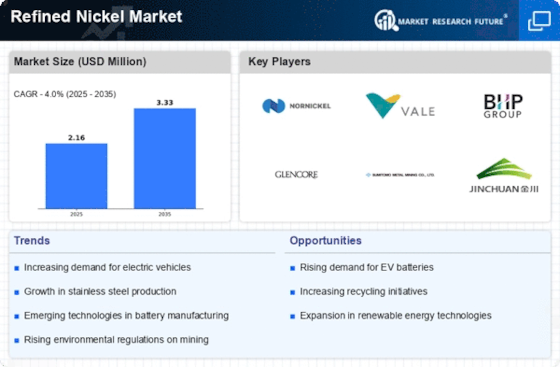
As per Market Research Future analysis, the Refined Nickel Market Size was estimated at 2.163 USD Million in 2024. The Refined Nickel industry is projected to grow from USD 2.25 Million in 2025 to USD 3.33 Million by 2035, exhibiting a compound annual growth rate (CAGR) of 4.0% during the forecast period 2025 - 2035

Key Market Trends & Highlights

The refined nickel market is currently experiencing robust growth driven by sustainability and technological advancements.

  • North America remains the largest market for refined nickel, primarily due to its extensive stainless steel production. Asia-Pacific is recognized as the fastest-growing region, fueled by increasing demand for batteries in electric vehicles. The stainless steel segment continues to dominate the market, while the electronics segment is witnessing rapid growth. Sustainable demand growth and technological advancements in production are key drivers influencing the refined nickel market.

Market Size & Forecast

2024 Market Size 2.163 (USD Million)
2035 Market Size 3.33 (USD Million)
CAGR (2025 - 2035) 4.0%
Largest Regional Market Share in 2024 Asia Pacific

Major Players

Norilsk Nickel (RU), Vale S.A. (BR), BHP Group (GB), Glencore (CH), Sumitomo Metal Mining Co. (JP), Jinchuan Group International Resources Co. Ltd. (CN), Sherritt International Corporation (CA), Eurasian Resources Group (KZ), Anglo American plc (GB)

Market Trends

The Refined Nickel Market is currently experiencing a dynamic phase characterized by evolving demand patterns and supply chain adjustments. The increasing utilization of refined nickel in electric vehicle batteries and renewable energy technologies appears to be a driving force behind this trend. As industries pivot towards sustainable practices, the need for high-purity nickel is likely to intensify, suggesting a potential shift in production strategies among key players. Furthermore, geopolitical factors and trade policies may influence market dynamics, as countries seek to secure their supply chains and reduce dependency on external sources. In addition, the Refined Nickel Market seems to be witnessing advancements in extraction and processing technologies. Innovations in hydrometallurgical and pyrometallurgical methods could enhance efficiency and reduce environmental impact, thereby attracting investment. The interplay between regulatory frameworks and technological progress may create opportunities for new entrants while challenging established firms to adapt. Overall, the landscape of the Refined Nickel Market is multifaceted, with various elements contributing to its evolution and shaping future trajectories.

Sustainable Demand Growth

The demand for refined nickel is increasingly driven by the shift towards sustainable energy solutions. Industries are focusing on electric vehicles and renewable energy storage, which require high-quality nickel. This trend indicates a long-term growth potential as manufacturers align with environmental goals.

Technological Advancements in Production

Innovations in nickel extraction and processing technologies are transforming the Refined Nickel Market. Enhanced methods may lead to improved efficiency and reduced environmental impact, potentially reshaping competitive dynamics among producers.

Geopolitical Influences on Supply Chains

Geopolitical factors are playing a crucial role in the Refined Nickel Market. Trade policies and international relations may affect supply chains, prompting countries to prioritize domestic production and secure resources, which could alter market stability.

Refined Nickel Market Market Drivers

Sustainable Demand Growth

The refined nickel market is experiencing a notable surge in demand driven by the increasing emphasis on sustainability. Industries such as electric vehicle (EV) manufacturing and renewable energy storage are pivotal in this growth. As governments and corporations commit to reducing carbon emissions, the demand for nickel in lithium-ion batteries is projected to rise significantly. In 2025, the refined nickel market is expected to witness a compound annual growth rate (CAGR) of approximately 6.5%, reflecting the shift towards greener technologies. This trend indicates a robust future for the refined nickel market, as it aligns with global sustainability goals and the transition to a low-carbon economy.

Geopolitical Influences on Supply Chains

The refined nickel market is significantly affected by geopolitical factors that influence supply chains. Countries rich in nickel reserves, such as Indonesia and the Philippines, play a crucial role in the global supply of refined nickel. Trade policies, tariffs, and international relations can disrupt these supply chains, leading to fluctuations in availability and pricing. In 2025, the refined nickel market may face challenges due to potential trade tensions or regulatory changes in key producing nations. Such geopolitical dynamics could create uncertainty, impacting the stability and growth of the refined nickel market.

Increasing Investment in Mining Projects

Investment in mining projects is a critical driver for the refined nickel market. As demand for refined nickel rises, mining companies are increasingly allocating resources to explore and develop new nickel deposits. In 2025, the refined nickel market is likely to see a surge in capital investments aimed at expanding production capacities. This influx of investment not only supports the growth of the refined nickel market but also fosters technological advancements in mining operations. Additionally, partnerships between mining firms and technology companies may enhance exploration efficiency, further bolstering the refined nickel market.

Technological Advancements in Production

Innovations in production technologies are reshaping the refined nickel market. Enhanced extraction and refining processes, such as hydrometallurgical methods, are improving efficiency and reducing costs. These advancements not only increase the yield of refined nickel but also minimize environmental impacts, aligning with the industry's sustainability objectives. In 2025, the refined nickel market is likely to benefit from these technological improvements, which could lead to a more competitive landscape. Furthermore, the integration of automation and artificial intelligence in production facilities may streamline operations, thereby enhancing productivity and profitability within the refined nickel market.

Regulatory Frameworks and Environmental Standards

The refined nickel market is influenced by evolving regulatory frameworks and environmental standards. Governments are implementing stricter regulations to ensure sustainable mining practices and reduce environmental impacts. In 2025, compliance with these regulations will be paramount for companies operating within the refined nickel market. Adhering to environmental standards may necessitate investments in cleaner technologies and processes, which could initially increase operational costs. However, these regulations also present opportunities for companies to differentiate themselves through sustainable practices, potentially enhancing their market position within the refined nickel market.

Market Segment Insights

By Application: Stainless Steel (Largest) vs. Batteries (Fastest-Growing)

In the refined nickel market, stainless steel remains the largest application segment, representing a substantial portion of total demand. Nickel is essential in stainless steel production, contributing to its strength and corrosion resistance. Other significant applications include nonferrous alloys and plating, which collectively account for a noteworthy share, while alloy steel &amp; casting, batteries, and others round out the market's diverse applications.

Stainless Steel (Dominant) vs. Batteries (Emerging)

Stainless steel is a dominant player in the refined nickel market due to its widespread use across various industries, including construction and automotive. The substantial demand for durable and corrosion-resistant materials makes it a key application. On the other hand, the battery segment is emerging rapidly, primarily driven by the growing electric vehicle market and renewable energy storage solutions. As technology advances, the integration of nickel into battery production is expected to increase, positioning it as a crucial application segment with significant growth potential.

By End-Use Industry: Metallurgy (Largest) vs. Electronics (Fastest-Growing)

In the Refined Nickel Market, the end-use industry segment displays a diverse distribution, with metallurgy holding the largest market share. This segment encapsulates a significant portion of nickel usage, primarily due to its indispensable role in stainless steel production and various alloy formulations. Other sectors such as automotive and transportation, as well as industrial machinery, also contribute to consumer demand, yet their market shares remain comparatively lower. Electronics, while currently a smaller segment, is rapidly gaining traction due to technological advancements and increasing demand for nickel in batteries and electronic components. The growth trends within the Refined Nickel Market highlight a robust escalation in sectors such as electronics, where the need for advanced materials drives demand. The automotive industry is also witnessing transformations with the shift towards electric vehicles, thereby creating new avenues for nickel usage. As sustainability and technological innovations reshape these industries, the growth trajectory for both metallurgy and electronics is poised to accelerate, reflecting dynamic changes in consumer preferences and regulatory frameworks. Consequently, sectors that adapt to these emerging trends are likely to seize substantial market opportunities.

Metallurgy: Dominant vs. Electronics: Emerging

In the refined nickel market, metallurgy stands out as the dominant end-use sector, primarily due to its critical application in stainless steel and various metal alloys. This segment leverages nickel's unique properties, such as corrosion resistance and strength, making it essential in various industries, including construction and manufacturing. In contrast, the electronics segment is emerging rapidly, driven by the proliferation of electric vehicles and the growing demand for batteries, particularly lithium-ion types. Despite its smaller share, this segment's growth is significant and propelled by innovation in consumer electronics and renewable energy technologies. The dynamic nature of both sectors reflects their interdependence, where metallurgy's established market presence is complemented by electronics' fast-paced evolution, positioning refined nickel as a crucial material in future industrial applications.

By Form: Nickel Pig Iron (Largest) vs. Nickel Sulfate (Fastest-Growing)

The nickel market is characterized by a diverse array of forms, with Nickel Pig Iron emerging as the largest segment due to its cost-effectiveness in steelmaking processes. Following closely is Nickel Sulfate, which is witnessing rapid adoption, particularly in the battery sector. Other forms like <a href="https://www.marketresearchfuture.com/reports/nickel-carbonate-market-28231">Nickel Carbonate</a>, Nickel Metal, and Nickel Oxide capture the interests of specific industries such as electronics and aerospace, yet they hold smaller shares in comparison. Overall, the distribution highlights Nickel Pig Iron's dominant position while signifying the rising importance of Nickel Sulfate in emerging technologies.

Nickel Pig Iron (Dominant) vs. Nickel Sulfate (Emerging)

Nickel Pig Iron is primarily utilized in the production of stainless steel and is favored for its economic advantages, making it essential in industrial applications. Its dominance is attributed to the growing demand for high-quality steel, particularly in construction and manufacturing. On the other hand, Nickel Sulfate is gaining prominence in the energy sector, especially for electric vehicle batteries. Its emerging status is fueled by the transition towards cleaner technologies and energy storage solutions, while innovations in nickel processing continue to bolster its market appeal. As industries pivot towards sustainability, both segments will likely play crucial roles in shaping the nickel market's future.

By Purity Level: High Purity Nickel (Largest) vs. Nickel Compounds (Fastest-Growing)

In the nickel market, the purity level segment showcases a diverse landscape with varying demands for high purity nickel, low purity nickel, nickel alloys, nickel compounds, and nickel concentrates. High purity nickel holds a significant portion of the market share, driven by its essential use in battery production and electronics. Conversely, low purity nickel and nickel alloys cater primarily to construction and industrial applications, maintaining steady shares without rapid growth.

High Purity Nickel (Dominant) vs. Nickel Compounds (Emerging)

High purity nickel is predominant in the market, known for its exceptional conductivity and resistance to corrosion, making it indispensable in the manufacture of batteries, particularly for electric vehicles and electronics. On the other hand, nickel compounds, such as nickel sulfate, are emerging rapidly due to their crucial role in the production of advanced battery technologies. The increasing demand for sustainable energy solutions is fueling the growth of nickel compounds, making them a significant focus for market players aiming to innovate and expand their portfolios.

By Source: Primary Nickel Mining (Largest) vs. Recycling (Fastest-Growing)

The nickel market is characterized by diverse sources, with Primary Nickel Mining holding the largest share. This segment benefits from extensive mining operations and established supply chains, positioning it as the backbone of the nickel supply. In contrast, the Recycling segment is gaining significant traction as it addresses environmental concerns and rising demand for sustainable practices. This shift toward recycling is driven by the need to reduce reliance on virgin materials, ultimately enhancing its market share over time.

Primary Nickel Mining (Dominant) vs. Recycling (Emerging)

Primary Nickel Mining is the dominant force in the nickel market, with its large-scale operations focusing on extracting nickel from ores. This segment is marked by high capital investments, sophisticated extraction technologies, and established global supply chains. On the other hand, Recycling is emerging as a vital segment due to growing sustainability trends and regulatory pressures. This segment primarily involves recovering nickel from used products, such as batteries and stainless steel, significantly reducing environmental impact while meeting the rising demand for nickel in various applications, including electric vehicles and energy storage.

Get more detailed insights about Refined Nickel Market Research Report - Forecast till 2035

Regional Insights

North America : Emerging Nickel Market

North America is witnessing a significant growth in the nickel market, driven by increasing demand from the electric vehicle (EV) sector and renewable energy storage solutions. The regional market size is projected at $5.0 billion, reflecting a growing interest in sustainable technologies. Regulatory support for green initiatives is further catalyzing this growth, as governments push for reduced carbon emissions and enhanced energy efficiency. Leading countries in this region include the USA and Canada, where major players like Vale S.A. and BHP Group are actively involved in nickel production. The competitive landscape is characterized by a mix of established companies and emerging players, all vying for market share. The focus on sustainable mining practices and innovation in nickel processing technologies is expected to enhance the region's position in the global market.

Europe : Sustainable Nickel Production

Europe's nickel market is characterized by a strong emphasis on sustainability and regulatory compliance, with a market size of $7.0 billion. The region is experiencing growth driven by the increasing demand for nickel in battery production and electric vehicles. European regulations are pushing for greener practices, which is leading to innovations in nickel extraction and processing, thereby enhancing market dynamics and attracting investments. Key players in Europe include Glencore plc and Sumitomo Metal Mining Co., Ltd., with countries like Finland and Norway leading in production. The competitive landscape is robust, with a focus on sustainable mining practices and recycling initiatives. The European Union's commitment to reducing carbon emissions is expected to further boost the demand for nickel, positioning the region as a leader in the global market.

Asia-Pacific : Dominant Market Leader

Asia-Pacific holds the largest share of The nickel market, with a size of $15.0 billion, driven by rapid industrialization and the booming electric vehicle sector. Countries like China and Indonesia are at the forefront, with significant investments in nickel mining and processing. The region's growth is further supported by favorable government policies and increasing demand for stainless steel and batteries, making it a key player in the global supply chain. The competitive landscape is dominated by major players such as Norilsk Nickel and China Molybdenum Co., Ltd. The presence of large-scale mining operations and advanced processing facilities enhances the region's capacity to meet global demand. As the market evolves, innovations in sustainable mining practices are expected to play a crucial role in maintaining the region's leadership in the nickel market.

Middle East and Africa : Emerging Market Potential

The Middle East and Africa region is emerging as a potential player in the nickel market, with a market size of $3.0 billion. The growth is driven by increasing investments in mining infrastructure and the rising demand for nickel in various industrial applications. Regulatory frameworks are gradually evolving to support sustainable mining practices, which is expected to attract foreign investments and enhance market dynamics. Countries like South Africa and Zambia are leading the charge in nickel production, with several key players exploring opportunities in the region. The competitive landscape is still developing, but the presence of companies like Eurasian Resources Group indicates a growing interest in tapping into the region's mineral wealth. As the market matures, the focus on sustainable practices will be crucial for long-term growth.

Key Players and Competitive Insights

The nickel market is currently characterized by a dynamic competitive landscape, driven by increasing demand for electric vehicle (EV) batteries and renewable energy technologies. Major players such as Vale S.A. (BR), Norilsk Nickel (RU), and BHP Group (AU) are strategically positioning themselves to capitalize on these growth opportunities. Vale S.A. (BR) has focused on enhancing its production capabilities while investing in sustainable mining practices, which aligns with global trends towards environmental responsibility. Norilsk Nickel (RU), on the other hand, has been emphasizing technological innovation to improve efficiency and reduce emissions, thereby reinforcing its competitive edge. BHP Group (AU) has pursued a strategy of regional expansion, particularly in Indonesia, to secure access to high-quality nickel reserves, which is crucial for meeting the rising demand in the EV sector.
In terms of business tactics, companies are increasingly localizing manufacturing and optimizing supply chains to enhance resilience and responsiveness to market fluctuations. The competitive structure of the nickel market appears moderately fragmented, with a few dominant players exerting considerable influence. This fragmentation allows for a diverse range of strategies, as companies seek to differentiate themselves through innovation and operational excellence.
In November 2025, Vale S.A. (BR) announced a partnership with a leading battery manufacturer to develop a new line of nickel sulfate products tailored for the EV market. This strategic move is likely to enhance Vale's position in the battery supply chain, enabling it to capture a larger share of the growing demand for high-purity nickel products. The collaboration underscores the importance of strategic alliances in driving innovation and meeting customer needs in a rapidly evolving market.
Similarly, in October 2025, Norilsk Nickel (RU) unveiled a new initiative aimed at reducing its carbon footprint by 30% by 2030. This ambitious goal reflects the company's commitment to sustainability and positions it favorably among environmentally conscious investors and customers. By investing in cleaner technologies, Norilsk Nickel is not only addressing regulatory pressures but also enhancing its brand reputation in a market increasingly focused on sustainable practices.
In September 2025, BHP Group (AU) completed the acquisition of a nickel exploration company in Indonesia, which is expected to bolster its resource base and production capacity. This acquisition is strategically significant as it allows BHP to tap into Indonesia's rich nickel reserves, thereby securing a competitive advantage in the supply of nickel for battery production. The move illustrates BHP's proactive approach to ensuring long-term supply security in a market where demand is projected to surge.
As of December 2025, current competitive trends in the nickel market are heavily influenced by digitalization, sustainability, and the integration of artificial intelligence (AI) in operations. Companies are increasingly forming strategic alliances to enhance their technological capabilities and market reach. The shift from price-based competition to a focus on innovation, technology, and supply chain reliability is becoming evident. As the market evolves, differentiation through sustainable practices and advanced technologies will likely define the competitive landscape, shaping the future of the nickel market.

Key Companies in the Refined Nickel Market include

Industry Developments

Future Outlook

Refined Nickel Market Future Outlook

The refined nickel market is projected to grow at a 4.0% CAGR from 2025 to 2035, driven by increasing demand in electric vehicle batteries and renewable energy technologies.

New opportunities lie in:

  • <p>Expansion into battery-grade nickel production facilities. Development of sustainable nickel extraction technologies. Strategic partnerships with electric vehicle manufacturers for supply agreements.</p>

By 2035, the refined nickel market is expected to be robust, driven by technological advancements and strategic collaborations.

Market Segmentation

Refined Nickel Market Application Outlook

  • Stainless steel
  • Nonferrous alloy
  • Plating
  • Alloy steel & casting
  • Batteries
  • Others

Refined Nickel Market End-Use Industry Outlook

  • Metallurgy
  • Industrial Machinery
  • Electronics
  • Automotive and transportation
  • Building and construction
  • Others

Report Scope

MARKET SIZE 2024 2.163(USD Million)
MARKET SIZE 2025 2.25(USD Million)
MARKET SIZE 2035 3.33(USD Million)
COMPOUND ANNUAL GROWTH RATE (CAGR) 4.0% (2025 - 2035)
REPORT COVERAGE Revenue Forecast, Competitive Landscape, Growth Factors, and Trends
BASE YEAR 2024
Market Forecast Period 2025 - 2035
Historical Data 2019 - 2024
Market Forecast Units USD Million
Key Companies Profiled Norilsk Nickel (RU), Vale S.A. (BR), BHP Group (GB), Glencore (CH), Sumitomo Metal Mining Co. (JP), Jinchuan Group International Resources Co. Ltd. (CN), Sherritt International Corporation (CA), Eurasian Resources Group (KZ), Anglo American plc (GB)
Segments Covered Applications
Key Market Opportunities Growing demand for electric vehicle batteries drives expansion in the Refined Nickel Market.
Key Market Dynamics Rising demand for electric vehicles drives refined nickel consumption, influencing supply chain dynamics and competitive market forces.
Countries Covered North America, Europe, APAC, South America, MEA

FAQs

What is the projected market valuation of the Refined Nickel Market by 2035?

<p>The Refined Nickel Market is projected to reach a valuation of 3.33 USD Million by 2035.</p>

What was the market valuation of the Refined Nickel Market in 2024?

<p>In 2024, the overall market valuation of the Refined Nickel Market was 2.163 USD Million.</p>

What is the expected CAGR for the Refined Nickel Market during the forecast period 2025 - 2035?

<p>The expected CAGR for the Refined Nickel Market during the forecast period 2025 - 2035 is 4.0%.</p>

Which companies are considered key players in the Refined Nickel Market?

<p>Key players in the Refined Nickel Market include Norilsk Nickel, Vale S.A., BHP Group, Glencore, and others.</p>

What application segment is projected to have the highest valuation in the Refined Nickel Market?

<p>The Stainless Steel application segment is projected to have the highest valuation, increasing from 1.1 USD Million to 1.65 USD Million.</p>

How does the Automotive and Transportation end-use industry segment perform in the Refined Nickel Market?

<p>The Automotive and Transportation end-use industry segment is expected to grow from 0.55 USD Million to 0.8 USD Million.</p>

What is the valuation range for the Nonferrous Alloy application segment in the Refined Nickel Market?

<p>The Nonferrous Alloy application segment has a valuation range projected to increase from 0.5 USD Million to 0.75 USD Million.</p>

What is the expected growth trend for the Electronics end-use industry segment?

<p>The Electronics end-use industry segment is anticipated to grow from 0.35 USD Million to 0.5 USD Million.</p>

What does the performance of the Plating application segment indicate about the Refined Nickel Market?

<p>The Plating application segment indicates a growth from 0.3 USD Million to 0.45 USD Million, reflecting increasing demand.</p>

How does the Building and Construction end-use industry segment compare to others in the Refined Nickel Market?

<p>The Building and Construction end-use industry segment is projected to grow from 0.35 USD Million to 0.5 USD Million, showing moderate growth compared to others.</p>

  1. SECTION I: EXECUTIVE SUMMARY AND KEY HIGHLIGHTS |
    1. EXECUTIVE SUMMARY | |
      1. Market Overview | |
      2. Key Findings | |
      3. Market Segmentation | |
      4. Competitive Landscape | |
      5. Challenges and Opportunities | |
      6. Future Outlook 2
  2. SECTION II: SCOPING, METHODOLOGY AND MARKET STRUCTURE |
    1. MARKET INTRODUCTION | |
      1. Definition | |
      2. Scope of the study | | |
    2. RESEARCH METHODOLOGY | |
      1. Overview | |
      2. Data Mining | |
      3. Secondary Research | |
      4. Primary Research | | |
      5. Forecasting Model | |
      6. Market Size Estimation | | |
      7. Data Triangulation | |
      8. Validation 3
  3. SECTION III: QUALITATIVE ANALYSIS |
    1. MARKET DYNAMICS | |
      1. Overview | |
      2. Drivers | |
      3. Restraints | |
      4. Opportunities |
    2. MARKET FACTOR ANALYSIS | |
      1. Value chain Analysis | |
      2. Porter's Five Forces Analysis | | |
      3. COVID-19 Impact Analysis | | |
  4. SECTION IV: QUANTITATIVE ANALYSIS |
    1. Chemicals and Materials, BY Application (USD Million) | |
      1. Stainless steel | |
      2. Nonferrous alloy | |
      3. Plating | |
      4. Alloy steel & casting | |
      5. Batteries | |
      6. Others |
    2. Chemicals and Materials, BY End-Use Industry (USD Million) | |
      1. Metallurgy | |
      2. Industrial Machinery | |
      3. Electronics | |
      4. Automotive and transportation | |
      5. Building and construction | |
      6. Others |
    3. Chemicals and Materials, BY Region (USD Million) | |
      1. North America | | |
      2. Europe | | |
      3. APAC | | |
      4. South America | | |
      5. MEA | | |
  5. SECTION V: COMPETITIVE ANALYSIS |
    1. Competitive Landscape | |
      1. Overview | |
      2. Competitive Analysis | |
      3. Market share Analysis | |
      4. Major Growth Strategy in the Chemicals and Materials | |
      5. Competitive Benchmarking | |
      6. Leading Players in Terms of Number of Developments in the Chemicals and Materials | |
      7. Key developments and growth strategies | | |
      8. Major Players Financial Matrix | | |
    2. Company Profiles | |
      1. Norilsk Nickel (RU) | | |
      2. Vale S.A. (BR) | | |
      3. BHP Group (GB) | | |
      4. Glencore (CH) | | |
      5. Sumitomo Metal Mining Co. (JP) | | |
      6. Jinchuan Group International Resources Co. Ltd. (CN) | | |
      7. Sherritt International Corporation (CA) | | |
      8. Eurasian Resources Group (KZ) | | |
      9. Anglo American plc (GB) | | |
    3. Appendix | |
      1. References | |
      2. Related Reports 6 LIST OF FIGURES |
    4. MARKET SYNOPSIS |
    5. NORTH AMERICA MARKET ANALYSIS |
    6. US MARKET ANALYSIS BY APPLICATION |
    7. US MARKET ANALYSIS BY END-USE INDUSTRY |
    8. CANADA MARKET ANALYSIS BY APPLICATION |
    9. CANADA MARKET ANALYSIS BY END-USE INDUSTRY |
    10. EUROPE MARKET ANALYSIS |
    11. GERMANY MARKET ANALYSIS BY APPLICATION |
    12. GERMANY MARKET ANALYSIS BY END-USE INDUSTRY |
    13. UK MARKET ANALYSIS BY APPLICATION |
    14. UK MARKET ANALYSIS BY END-USE INDUSTRY |
    15. FRANCE MARKET ANALYSIS BY APPLICATION |
    16. FRANCE MARKET ANALYSIS BY END-USE INDUSTRY |
    17. RUSSIA MARKET ANALYSIS BY APPLICATION |
    18. RUSSIA MARKET ANALYSIS BY END-USE INDUSTRY |
    19. ITALY MARKET ANALYSIS BY APPLICATION |
    20. ITALY MARKET ANALYSIS BY END-USE INDUSTRY |
    21. SPAIN MARKET ANALYSIS BY APPLICATION |
    22. SPAIN MARKET ANALYSIS BY END-USE INDUSTRY |
    23. REST OF EUROPE MARKET ANALYSIS BY APPLICATION |
    24. REST OF EUROPE MARKET ANALYSIS BY END-USE INDUSTRY |
    25. APAC MARKET ANALYSIS |
    26. CHINA MARKET ANALYSIS BY APPLICATION |
    27. CHINA MARKET ANALYSIS BY END-USE INDUSTRY |
    28. INDIA MARKET ANALYSIS BY APPLICATION |
    29. INDIA MARKET ANALYSIS BY END-USE INDUSTRY |
    30. JAPAN MARKET ANALYSIS BY APPLICATION |
    31. JAPAN MARKET ANALYSIS BY END-USE INDUSTRY |
    32. SOUTH KOREA MARKET ANALYSIS BY APPLICATION |
    33. SOUTH KOREA MARKET ANALYSIS BY END-USE INDUSTRY |
    34. MALAYSIA MARKET ANALYSIS BY APPLICATION |
    35. MALAYSIA MARKET ANALYSIS BY END-USE INDUSTRY |
    36. THAILAND MARKET ANALYSIS BY APPLICATION |
    37. THAILAND MARKET ANALYSIS BY END-USE INDUSTRY |
    38. INDONESIA MARKET ANALYSIS BY APPLICATION |
    39. INDONESIA MARKET ANALYSIS BY END-USE INDUSTRY |
    40. REST OF APAC MARKET ANALYSIS BY APPLICATION |
    41. REST OF APAC MARKET ANALYSIS BY END-USE INDUSTRY |
    42. SOUTH AMERICA MARKET ANALYSIS |
    43. BRAZIL MARKET ANALYSIS BY APPLICATION |
    44. BRAZIL MARKET ANALYSIS BY END-USE INDUSTRY |
    45. MEXICO MARKET ANALYSIS BY APPLICATION |
    46. MEXICO MARKET ANALYSIS BY END-USE INDUSTRY |
    47. ARGENTINA MARKET ANALYSIS BY APPLICATION |
    48. ARGENTINA MARKET ANALYSIS BY END-USE INDUSTRY |
    49. REST OF SOUTH AMERICA MARKET ANALYSIS BY APPLICATION |
    50. REST OF SOUTH AMERICA MARKET ANALYSIS BY END-USE INDUSTRY |
    51. MEA MARKET ANALYSIS |
    52. GCC COUNTRIES MARKET ANALYSIS BY APPLICATION |
    53. GCC COUNTRIES MARKET ANALYSIS BY END-USE INDUSTRY |
    54. SOUTH AFRICA MARKET ANALYSIS BY APPLICATION |
    55. SOUTH AFRICA MARKET ANALYSIS BY END-USE INDUSTRY |
    56. REST OF MEA MARKET ANALYSIS BY APPLICATION |
    57. REST OF MEA MARKET ANALYSIS BY END-USE INDUSTRY |
    58. KEY BUYING CRITERIA OF CHEMICALS AND MATERIALS |
    59. RESEARCH PROCESS OF MRFR |
    60. DRO ANALYSIS OF CHEMICALS AND MATERIALS |
    61. DRIVERS IMPACT ANALYSIS: CHEMICALS AND MATERIALS |
    62. RESTRAINTS IMPACT ANALYSIS: CHEMICALS AND MATERIALS |
    63. SUPPLY / VALUE CHAIN: CHEMICALS AND MATERIALS |
    64. CHEMICALS AND MATERIALS, BY APPLICATION, 2024 (% SHARE) |
    65. CHEMICALS AND MATERIALS, BY APPLICATION, 2024 TO 2035 (USD Million) |
    66. CHEMICALS AND MATERIALS, BY END-USE INDUSTRY, 2024 (% SHARE) |
    67. CHEMICALS AND MATERIALS, BY END-USE INDUSTRY, 2024 TO 2035 (USD Million) |
    68. BENCHMARKING OF MAJOR COMPETITORS 7 LIST OF TABLES |
    69. LIST OF ASSUMPTIONS | |
      1. |
    70. North America MARKET SIZE ESTIMATES; FORECAST | |
      1. BY APPLICATION, 2025-2035 (USD Million) | |
      2. BY END-USE INDUSTRY, 2025-2035 (USD Million) |
    71. US MARKET SIZE ESTIMATES; FORECAST | |
      1. BY APPLICATION, 2025-2035 (USD Million) | |
      2. BY END-USE INDUSTRY, 2025-2035 (USD Million) |
    72. Canada MARKET SIZE ESTIMATES; FORECAST | |
      1. BY APPLICATION, 2025-2035 (USD Million) | |
      2. BY END-USE INDUSTRY, 2025-2035 (USD Million) |
    73. Europe MARKET SIZE ESTIMATES; FORECAST | |
      1. BY APPLICATION, 2025-2035 (USD Million) | |
      2. BY END-USE INDUSTRY, 2025-2035 (USD Million) |
    74. Germany MARKET SIZE ESTIMATES; FORECAST | |
      1. BY APPLICATION, 2025-2035 (USD Million) | |
      2. BY END-USE INDUSTRY, 2025-2035 (USD Million) |
    75. UK MARKET SIZE ESTIMATES; FORECAST | |
      1. BY APPLICATION, 2025-2035 (USD Million) | |
      2. BY END-USE INDUSTRY, 2025-2035 (USD Million) |
    76. France MARKET SIZE ESTIMATES; FORECAST | |
      1. BY APPLICATION, 2025-2035 (USD Million) | |
      2. BY END-USE INDUSTRY, 2025-2035 (USD Million) |
    77. Russia MARKET SIZE ESTIMATES; FORECAST | |
      1. BY APPLICATION, 2025-2035 (USD Million) | |
      2. BY END-USE INDUSTRY, 2025-2035 (USD Million) |
    78. Italy MARKET SIZE ESTIMATES; FORECAST | |
      1. BY APPLICATION, 2025-2035 (USD Million) | |
      2. BY END-USE INDUSTRY, 2025-2035 (USD Million) |
    79. Spain MARKET SIZE ESTIMATES; FORECAST | |
      1. BY APPLICATION, 2025-2035 (USD Million) | |
      2. BY END-USE INDUSTRY, 2025-2035 (USD Million) |
    80. Rest of Europe MARKET SIZE ESTIMATES; FORECAST | |
      1. BY APPLICATION, 2025-2035 (USD Million) | |
      2. BY END-USE INDUSTRY, 2025-2035 (USD Million) |
    81. APAC MARKET SIZE ESTIMATES; FORECAST | |
      1. BY APPLICATION, 2025-2035 (USD Million) | |
      2. BY END-USE INDUSTRY, 2025-2035 (USD Million) |
    82. China MARKET SIZE ESTIMATES; FORECAST | |
      1. BY APPLICATION, 2025-2035 (USD Million) | |
      2. BY END-USE INDUSTRY, 2025-2035 (USD Million) |
    83. India MARKET SIZE ESTIMATES; FORECAST | |
      1. BY APPLICATION, 2025-2035 (USD Million) | |
      2. BY END-USE INDUSTRY, 2025-2035 (USD Million) |
    84. Japan MARKET SIZE ESTIMATES; FORECAST | |
      1. BY APPLICATION, 2025-2035 (USD Million) | |
      2. BY END-USE INDUSTRY, 2025-2035 (USD Million) |
    85. South Korea MARKET SIZE ESTIMATES; FORECAST | |
      1. BY APPLICATION, 2025-2035 (USD Million) | |
      2. BY END-USE INDUSTRY, 2025-2035 (USD Million) |
    86. Malaysia MARKET SIZE ESTIMATES; FORECAST | |
      1. BY APPLICATION, 2025-2035 (USD Million) | |
      2. BY END-USE INDUSTRY, 2025-2035 (USD Million) |
    87. Thailand MARKET SIZE ESTIMATES; FORECAST | |
      1. BY APPLICATION, 2025-2035 (USD Million) | |
      2. BY END-USE INDUSTRY, 2025-2035 (USD Million) |
    88. Indonesia MARKET SIZE ESTIMATES; FORECAST | |
      1. BY APPLICATION, 2025-2035 (USD Million) | |
      2. BY END-USE INDUSTRY, 2025-2035 (USD Million) |
    89. Rest of APAC MARKET SIZE ESTIMATES; FORECAST | |
      1. BY APPLICATION, 2025-2035 (USD Million) | |
      2. BY END-USE INDUSTRY, 2025-2035 (USD Million) |
    90. South America MARKET SIZE ESTIMATES; FORECAST | |
      1. BY APPLICATION, 2025-2035 (USD Million) | |
      2. BY END-USE INDUSTRY, 2025-2035 (USD Million) |
    91. Brazil MARKET SIZE ESTIMATES; FORECAST | |
      1. BY APPLICATION, 2025-2035 (USD Million) | |
      2. BY END-USE INDUSTRY, 2025-2035 (USD Million) |
    92. Mexico MARKET SIZE ESTIMATES; FORECAST | |
      1. BY APPLICATION, 2025-2035 (USD Million) | |
      2. BY END-USE INDUSTRY, 2025-2035 (USD Million) |
    93. Argentina MARKET SIZE ESTIMATES; FORECAST | |
      1. BY APPLICATION, 2025-2035 (USD Million) | |
      2. BY END-USE INDUSTRY, 2025-2035 (USD Million) |
    94. Rest of South America MARKET SIZE ESTIMATES; FORECAST | |
      1. BY APPLICATION, 2025-2035 (USD Million) | |
      2. BY END-USE INDUSTRY, 2025-2035 (USD Million) |
    95. MEA MARKET SIZE ESTIMATES; FORECAST | |
      1. BY APPLICATION, 2025-2035 (USD Million) | |
      2. BY END-USE INDUSTRY, 2025-2035 (USD Million) |
    96. GCC Countries MARKET SIZE ESTIMATES; FORECAST | |
      1. BY APPLICATION, 2025-2035 (USD Million) | |
      2. BY END-USE INDUSTRY, 2025-2035 (USD Million) |
    97. South Africa MARKET SIZE ESTIMATES; FORECAST | |
      1. BY APPLICATION, 2025-2035 (USD Million) | |
      2. BY END-USE INDUSTRY, 2025-2035 (USD Million) |
    98. Rest of MEA MARKET SIZE ESTIMATES; FORECAST | |
      1. BY APPLICATION, 2025-2035 (USD Million) | |
      2. BY END-USE INDUSTRY, 2025-2035 (USD Million) |
    99. PRODUCT LAUNCH/PRODUCT DEVELOPMENT/APPROVAL | |
      1. |
    100. ACQUISITION/PARTNERSHIP | |

Chemicals and Materials Market Segmentation

Chemicals and Materials By Application (USD Million, 2025-2035)

  • Stainless steel
  • Nonferrous alloy
  • Plating
  • Alloy steel & casting
  • Batteries
  • Others

Chemicals and Materials By End-Use Industry (USD Million, 2025-2035)

  • Metallurgy
  • Industrial Machinery
  • Electronics
  • Automotive and transportation
  • Building and construction
  • Others
Infographic

Free Sample Request

Kindly complete the form below to receive a free sample of this Report

Get Free Sample

Customer Strories

Compare Licence

×
Features License Type
Single User Multiuser License Enterprise User
Price $4,950 $5,950 $7,250
Maximum User Access Limit 1 User Upto 10 Users Unrestricted Access Throughout the Organization
Free Customization
Direct Access to Analyst
Deliverable Format
Platform Access
Discount on Next Purchase 10% 15% 15%
Printable Versions