Request Free Sample ×

Kindly complete the form below to receive a free sample of this Report

* Please use a valid business email

Leading companies partner with us for data-driven Insights

clients tt-cursor
Hero Background
English
Chinese
French
Japanese
Korean
German
Spanish

Radiation Oncology Market Share

ID: MRFR/HC/10828-CR
200 Pages
Vikita Thakur
July 2024

Radiation Oncology Market Research Report: Size, Share, Trend Analysis By Treatment Type (External Beam Radiation Therapy, Brachytherapy, Systemic Radiation Therapy, Stereotactic Radiosurgery), By Applications (Breast Cancer, Prostate Cancer, Lung Cancer, Brain Cancer, Head and Neck Cancer), By End Users (Hospitals, Outpatient Clinics, Cancer Research Institutes, Ambulatory Surgery Centers), By Technology (Linear Accelerators, Radioisotopes, Particle Therapy, Tomotherapy) and By Regional (North America, Europe, South America, Asia Pacific, Middle East and Africa) - Growth Outlook & Industry Forecast 2025 To 2035

Share:
Download PDF ×

We do not share your information with anyone. However, we may send you emails based on your report interest from time to time. You may contact us at any time to opt-out.

Radiation Oncology Market Infographic
Purchase Options

Market Share

Radiation Oncology Market Share Analysis

The radiation oncology market, a vital part of cancer therapy, is developing with new ways to gain market share. Radiation therapy equipment technology is a major market share positioning strategy. This industry actively invests in R&D to produce cutting-edge technology like linear accelerators and brachytherapy systems. These innovative technologies increase precision, treatment timelines, and patient outcomes, giving enterprises an edge and making them Radiation Oncology Market leaders.

Collaborations shape Radiation Oncology market share dynamics. Many firms form strategic partnerships with healthcare, research, and other stakeholders. Knowledge, experience, and resources are shared in these collaborations, expediting radiation treatment solution development and acceptance. Radiation Oncology Market share positioning requires a patient-centric strategy. Successful firms focus radiation treatment patients' comfort and well-being. Treatment solutions should minimize adverse effects, shorten treatment time, and improve patient experience. Patient satisfaction improves treatment efficacy and healthcare provider relations, impacting market share through word-of-mouth recommendations and referrals.

Specialization in certain cancers or treatment methods is another important Radiation Oncology market share strategy. Companies typically specialize in treating certain cancers or using certain radiation therapies. A corporation may specialize in proton treatment or head-and-neck malignancies. This tailored strategy helps enterprises to become leaders in niche niches, meeting patients' and healthcare providers' particular demands and obtaining a large market share.

Continuous education and training also help market share positioning. Companies fund programs that teach healthcare professionals how to utilize their radiation therapy equipment and tell them about industry advances. This boosts healthcare practitioners' skills and brand loyalty. Educational programs establish organizations as radiation oncology thought leaders, affecting market share by developing healthcare professional confidence.

In Radiation Oncology, cost and accessibility are key to market penetration. As technology advances and production grows up, firms optimize prices and make radiation treatment solutions more affordable to more healthcare institutions. Hospitals and clinics want affordable radiation oncology equipment, increasing market share through adoption.

Radiation Oncology market share positioning depends on regulatory compliance and safety requirements. Companies that follow regulations and emphasize patient safety gain healthcare provider and regulatory trust. A reputation for quality and safety standards makes enterprises trusted radiation treatment partners and boosts market share.

Author
Author Profile
Vikita Thakur
Senior Research Analyst

She holds an experience of about 5+ years in market research and business consulting projects for sectors such as life sciences, medical devices, and healthcare IT. She possesses a robust background in data analysis, market estimation, competitive intelligence, pipeline analysis market trend identification, and consumer behavior insights. Her expertise lies in technical Sales support, client interaction and project management, designing and implementing market research studies, conducting competitive analysis, and synthesizing complex data into actionable recommendations that drive business growth.

Leave a Comment

FAQs

What is the projected market valuation of the Radiation Oncology Market by 2035?

<p>The Radiation Oncology Market is projected to reach a valuation of 20.79 USD Billion by 2035.</p>

What was the market valuation of the market in 2024?

In 2024, the overall market valuation was 8.9 USD Billion.

What is the expected CAGR for the Radiation Oncology Market during the forecast period 2025 - 2035?

<p>The expected CAGR for the Radiation Oncology Market during the forecast period 2025 - 2035 is 8.02%.</p>

Which treatment type segment is anticipated to have the highest growth in the market?

The External Beam Radiation Therapy segment is anticipated to grow from 3.56 USD Billion in 2024 to 8.25 USD Billion by 2035.

What are the key applications driving the market?

Key applications include Lung Cancer, projected to grow from 2.0 USD Billion in 2024 to 4.8 USD Billion by 2035.

Which end user segment is expected to dominate the Radiation Oncology Market?

<p>Hospitals are expected to dominate the end user segment, growing from 3.56 USD Billion in 2024 to 8.25 USD Billion by 2035.</p>

What technological advancements are influencing the Radiation Oncology Market?

<p>Linear Accelerators are projected to grow from 3.5 USD Billion in 2024 to 8.0 USD Billion by 2035, indicating significant technological advancements.</p>

Who are the leading companies in the market?

Key players in the market include Varian Medical Systems, Elekta AB, and Siemens Healthineers.

What is the projected growth for the Brachytherapy segment in the market?

The Brachytherapy segment is projected to grow from 1.78 USD Billion in 2024 to 4.05 USD Billion by 2035.

How does the market for Systemic Radiation Therapy compare to other treatment types?

<p>The Systemic Radiation Therapy segment is expected to grow from 1.34 USD Billion in 2024 to 3.05 USD Billion by 2035, indicating a steady increase.</p>

Market Summary

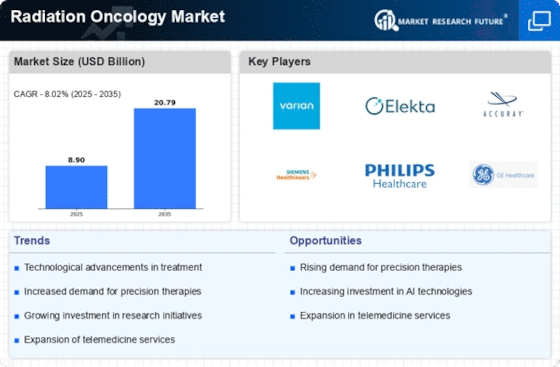
According to Market Research Future analysis, the Radiation Oncology Market Size was valued at USD 8.9 Billion in 2024 & the market is projected to grow from USD 9.614 Billion in 2025 to USD 20.79 Billion by 2035, registering a CAGR of 8.02% during the forecast period 2025–2035. North America led the market with over 44.94% share, generating around USD 4 billion in revenue.
 
Rising global cancer incidence and increasing demand for advanced, non-invasive treatment options are key growth drivers of the radiation oncology market. Technological advancements in precision radiotherapy and expanding healthcare infrastructure are accelerating adoption of radiation-based cancer treatments worldwide.
 
According to WHO, cancer cases reached approximately 20 million globally in 2022, causing nearly 10 million deaths, while IHME highlights cancer as a leading cause of global disease burden, significantly increasing demand for advanced radiation oncology treatment solutions.

Key Market Trends & Highlights

The Radiation Oncology Market is poised for substantial growth driven by technological advancements and increasing cancer incidence.

  • North America accounts for over 44.94% market share in 2024, driven by high cancer prevalence and advanced healthcare systems. Europe market valued at USD 2.67 billion in 2024, holding 30% share with rising cancer incidence and strong regulations. Global cancer cases reached 20 million in 2022, significantly driving demand for advanced radiation oncology treatment technologies worldwide. External beam radiation therapy dominates with 63% share due to widespread use and advanced precision treatment capabilities.

Market Size & Forecast

2024 Market Size 8.9 (USD Billion)
2035 Market Size 20.79 (USD Billion)
CAGR (2025 - 2035) 8.02%
Largest Regional Market Share in 2024 North America

Major Players

Companies such as Varian Medical Systems (US), Elekta AB (SE), Accuray Incorporated (US), <a href="https://www.siemens-healthineers.com/en-us/education/personalized-education-by-solution/solution/imaging-and-therapy/radiation-oncology">Siemens Healthineers</a> (DE), Philips Healthcare (NL), <a href="https://www.gehealthcare.com/specialties/oncology-solutions/radiation-oncology" target="_blank" rel="noopener">GE Healthcare</a> (US), CIVCO Medical Solutions (US), RaySearch Laboratories (SE), ViewRay Inc. (US)  are some of the major participants in the global market.

Market Trends

The radiation oncology market size is currently experiencing a transformative phase, driven by advancements in technology and an increasing emphasis on personalized treatment approaches. Innovations such as precision radiotherapy and image-guided techniques are enhancing the efficacy of cancer treatments, allowing for more targeted interventions that minimize damage to surrounding healthy tissues. Furthermore, the integration of artificial intelligence and machine learning into treatment planning is streamlining processes and improving patient outcomes.

As healthcare systems worldwide adapt to these changes, the demand for sophisticated radiation oncology solutions is likely to rise, reflecting a shift towards more patient-centric care. In addition to technological advancements, the market is influenced by a growing awareness of cancer prevention and early detection. Public health initiatives and educational campaigns are fostering a culture of proactive health management, which may lead to increased screening and earlier diagnoses.

This trend could potentially drive the demand for radiation therapy as a primary high focus treatment center modality. Moreover, collaborations between research institutions and healthcare providers are expected to yield novel therapies and enhance the overall landscape of cancer care, positioning the market for sustained growth in the coming years.

Technological Advancements

The Radiation Oncology Market is witnessing rapid technological progress, particularly in the development of advanced high focus treatment center modalities. Innovations such as stereotactic body radiotherapy and adaptive radiotherapy are becoming more prevalent, allowing for precise targeting of tumors while sparing healthy tissues. This trend indicates a shift towards more effective and less invasive treatment options.

WHO reports that radiotherapy is required in approximately 50% of all cancer cases, while advanced techniques like stereotactic radiotherapy can improve tumor control rates by up to 90%, significantly enhancing treatment precision and outcomes across various cancer types globally.

Personalized Medicine

There is a notable movement towards personalized medicine within the Radiation Oncology Market. Tailoring high focus treatment center plans based on individual patient characteristics, including genetic profiles and tumor biology, appears to enhance therapeutic efficacy. This approach not only improves outcomes but also minimizes unnecessary side effects, reflecting a broader trend in healthcare.

According to IHME and global oncology research, precision medicine approaches have improved survival rates by up to 25% in certain cancers, while increasing integration of genomic profiling in over 60% of oncology studies is supporting personalized radiation therapy planning and improved patient outcomes.

Increased Collaboration

The Radiation Oncology Market is experiencing heightened collaboration among various stakeholders, including academic institutions, healthcare providers, and industry players. Such partnerships are likely to facilitate research and development of innovative therapies, thereby accelerating the introduction of new treatment options. This trend underscores the importance of collective efforts in advancing cancer care.

PAHO highlights that regional cancer control programs and collaborations have expanded across more than 30 countries in the Americas, while WHO initiatives support global partnerships in oncology research, accelerating development and accessibility of advanced radiation therapies for improved cancer care outcomes.

Radiation Oncology Market Market Drivers

Aging Population

The demographic shift towards an aging population is a significant driver of the Radiation Oncology Market. As individuals age, the risk of developing cancer increases, leading to a higher demand for radiation therapy among older adults.
 
According to the United Nations, the number of people aged 60 years and older is projected to double by 2050, reaching over 2 billion. This demographic trend is likely to result in a substantial increase in cancer cases, thereby necessitating enhanced radiation oncology services.
 
Healthcare providers are responding to this trend by expanding their radiation therapy capabilities and investing in specialized training for practitioners. The aging population not only drives demand for radiation oncology but also encourages the development of tailored treatment approaches that consider the unique needs of older patients.

Technological Innovations

Technological advancements play a crucial role in shaping the Radiation Oncology Market. Innovations such as intensity-modulated radiation therapy (IMRT), image-guided radiation therapy (IGRT), and robotic-assisted radiation delivery systems are revolutionizing treatment protocols. These technologies enhance the precision of radiation delivery, minimizing damage to surrounding healthy tissues and improving patient outcomes.
 
The market is witnessing a shift towards more sophisticated treatment options, with The market expected to reach approximately USD 8 billion by 2025. Furthermore, the integration of artificial intelligence and machine learning in treatment planning and patient management is anticipated to streamline processes and enhance the overall efficiency of radiation oncology services. As these technologies continue to evolve, they are likely to drive further growth in the market.

Rising Incidence of Cancer

The increasing prevalence of cancer worldwide is a primary driver of the Radiation Oncology Market. According to the World Health Organization, cancer cases are projected to rise by 70% over the next two decades. This alarming trend necessitates the expansion of radiation oncology services to meet the growing demand for effective treatment options.
 
As more patients seek radiation therapy, healthcare providers are investing in advanced technologies and treatment modalities. The market is thus experiencing a surge in demand for innovative solutions, including stereotactic body radiation therapy and proton therapy, which are becoming increasingly popular due to their precision and reduced side effects. This rising incidence of cancer not only drives market growth but also encourages research and development in radiation oncology, leading to improved patient outcomes.

Regulatory Support and Funding

Regulatory support and increased funding for cancer research and treatment are pivotal in driving the Radiation Oncology Market. Governments and health organizations are recognizing the critical need for effective cancer therapies and are allocating resources to support research initiatives. This funding is often directed towards the development of new radiation technologies and treatment protocols, fostering innovation within the industry.
 
For instance, the National Cancer Institute has significantly increased its budget for cancer research, which includes advancements in radiation oncology. Additionally, favorable regulatory policies are being implemented to expedite the approval of new radiation therapies, further stimulating market growth. As a result, the market is likely to benefit from enhanced research capabilities and the introduction of novel treatment options that improve patient care.

Growing Awareness and Screening Programs

Increased awareness about cancer and the importance of early detection is significantly influencing the Radiation Oncology Market. Public health initiatives and screening programs are being implemented to educate populations about cancer risks and the benefits of early diagnosis. This heightened awareness leads to earlier treatment interventions, which often include radiation therapy.
 
As a result, more patients are being referred for radiation oncology services, contributing to market growth. The American Cancer Society reports that early-stage cancers have a higher survival rate, which further emphasizes the need for effective treatment options. Consequently, the demand for radiation oncology services is expected to rise, as healthcare systems adapt to accommodate the influx of patients seeking timely and effective cancer treatments.

Market Segment Insights

By Treatment Type: External Beam Radiation Therapy (Largest) vs. Stereotactic Radiosurgery (Fastest-Growing)

External Beam Radiation Therapy (EBRT) holds the largest Radiation Oncology Market share at 63%, primarily due to its broad application in treating various cancers. This therapy is widely utilized across hospitals and cancer treatment centers, providing significant benefits such as precision in targeting tumors while sparing adjacent healthy tissues. Brachytherapy and Systemic Radiation Therapy also contribute to the market; however, their shares are notably smaller compared to EBRT. The diverse range of treatment options allows practitioners to tailor therapy based on patient needs and tumor characteristics, sustaining a competitive landscape in this market segment. Growth trends in the market indicate a robust expansion, particularly for Stereotactic Radiosurgery (SRS), which is recognized as the fastest-growing treatment type. The increasing preference for non-invasive surgical radiation procedures drives this trend, as well as technological advancements that enhance treatment accuracy and patient outcomes. Furthermore, investments in research and development, coupled with rising prevalence rates of cancers, are propelling the market forward. As new techniques emerge, they contribute to improved treatment efficacy, thereby attracting more patients seeking radiation oncology services.

External Beam Radiation Therapy (Dominant) vs. Stereotactic Radiosurgery (Emerging)

External Beam Radiation Therapy (EBRT) is considered the dominant treatment approach in radiation oncology, leveraging advanced technologies such as intensity-modulated radiation therapy (IMRT) and image-guided radiation therapy (IGRT). It allows oncologists to deliver high doses of radiation selectively to tumors while minimizing exposure to healthy tissues, making it suitable for various cancer types. Additionally, Stereotactic Radiosurgery (SRS) represents an emerging method characterized by its precise, non-invasive approach for treating smaller tumors or metastases. SRS offers benefits such as shorter treatment times and fewer side effects, appealing to patients seeking effective yet less invasive options. This duality in treatment preferences emphasizes the dynamic shifts in patient needs and technological innovations shaping the Radiation Oncology Market.

By Application: Breast Cancer (Largest) vs. Prostate Cancer (Fastest-Growing)

The market reflects a varied distribution of applications, with breast cancer emerging as the most significant segment in the Radiation Oncology Market, with a 34% share. Its substantial market presence is driven by the increasing incidence of breast-related ailments and a growing awareness among patients for early diagnosis and treatment options. Prostate Cancer follows closely, demonstrating rapid growth owing to the rising prevalence of prostate disorders amongst aging male populations, alongside advancements in radiation technology. As such, these segments exhibit a noticeable evolution in treatment methodologies to enhance patient outcomes. Growth trends in the market are fueled by technological advancements, such as improved imaging and treatment planning systems, which enhance the precision and effectiveness of <a title="radiotherapy" href="https://www.marketresearchfuture.com/reports/radiotherapy-market-1526" target="_blank" rel="noopener">radiotherapy</a>. Patients increasingly favor less invasive approaches with fewer side effects, boosting the appeal of radiation therapy for Breast Cancer treatments. The surge in clinical trials continuously showcases the efficacy of radiation therapies, predominantly for Prostate Cancer, thus reinforcing its growth potential. Increased funding and research into novel radiation techniques also contribute significantly to the market dynamics.

Breast Cancer (Dominant) vs. Lung Cancer (Emerging)

In the realm of radiation oncology, Breast Cancer remains the dominant application, making significant strides in treatment efficacy and patient acceptance. The segment's established protocols and a robust infrastructure for detection and treatment place it at the forefront of oncology applications. Conversely, the Lung Cancer sector is emerging as a critical focus area, driven by the alarming rise in lung cancer incidences globally. These two segments exhibit distinct characteristics; while Breast Cancer benefits from extensive historical data and treatment success stories, Lung Cancer is witnessing a rapid evolution in treatment techniques, leading to increased research investments and novel therapeutic approaches. As awareness heightens, and screening programs expand, both segments are likely to evolve based on their unique challenges and opportunities.

By End User: Hospitals (Largest) vs. Outpatient Clinics (Fastest-Growing)

The hospitals segment holds the largest Radiation Oncology Market share at 68% due to their comprehensive facilities and availability of specialized staff necessary for advanced cancer treatments. This segment is pivotal in delivering high-quality radiation therapy equipped with the latest technologies and skilled professionals, making them the primary choice for patients requiring extensive oncological care. On the other hand, outpatient clinics are emerging rapidly, driven by the increasing preference for less invasive treatments and the growing trend of providing healthcare services closer to home. These clinics are appealing due to their ability to offer convenience, shorter wait times, and outpatient treatment options, which are increasingly preferred by patients, thus driving their market expansion.

Hospitals (Dominant) vs. Outpatient Clinics (Emerging)

Hospitals serve as the dominant player in the Radiation Oncology Market due to their extensive resources, comprehensive care capabilities, and the integration of multidisciplinary approaches to cancer treatment. Equipped with advanced radiation therapy technologies, they can offer a wide range of services, including complex treatment plans catered to individual patient needs. In contrast, outpatient clinics are emerging as a strong alternative, catering to the growing demand for accessible and convenient treatment options. These facilities are typically more agile in adopting new technologies and radiation procedures, allowing them to respond quickly to evolving patient needs and preferences, thus solidifying their position in this competitive landscape.

By Technology: Linear Accelerators (Largest) vs. Particle Therapy (Fastest-Growing)

In the Radiation Oncology Market, linear accelerators are currently the most dominant technology, accounting for a substantial market share at 59% due to their widespread use and established efficacy in treating various cancers. Radioisotopes and Tomotherapy also hold significant shares, serving niche markets with specialized needs. <a title="particle therapy" href="https://www.marketresearchfuture.com/reports/particle-therapy-market-7000" target="_blank" rel="noopener">Particle Therapy</a>, while smaller in share, is rapidly gaining traction as new facilities open, reflecting growing clinical confidence and patient outcomes.

Technology: Linear Accelerators (Dominant) vs. Particle Therapy (Emerging)

Linear Accelerators are the backbone of many radiation therapy facilities, known for their precision and effectiveness in delivering radiation to tumors while sparing healthy tissue. They are extensively adopted due to ongoing advancements and favorable reimbursement policies. In contrast, Particle Therapy, particularly proton therapy, is emerging as a promising alternative; it offers unique advantages like lower radiation exposure to healthy tissues, reduced proton beam therapy costs, and is increasingly regarded as a vital option for pediatric and complex cases. The growing body of clinical evidence and patient demand is driving investment and expansion in this innovative technology.

Get more detailed insights about Radiation Oncology Market Research Reports - Forecast to 2035

Regional Insights

North America : Leading Innovation and Adoption

North America leads in the Radiation Oncology Market Size, accounting for over 44.94% of the global revenue in 2024. The region benefits from advanced healthcare infrastructure, high investment in R&D, and a growing prevalence of cancer, driving demand for innovative treatment options.

According to CDC, the U.S. reports over 1.9 million new cancer cases annually, while survival rates have improved significantly due to advanced treatments like radiotherapy, supporting increased adoption of radiation oncology technologies across healthcare systems.

Regulatory support from agencies like the FDA further catalyzes market growth, ensuring the rapid introduction of new technologies and therapies. The United States is the primary contributor, with significant market players such as Varian Medical Systems and GE Healthcare leading the charge.

Canada also plays a vital role, focusing on enhancing treatment accessibility and quality. The competitive landscape is characterized by continuous innovation, with radiation oncology companies investing heavily in advanced technologies like proton therapy and stereotactic radiosurgery to improve patient outcomes.

Europe : Emerging Regulatory Frameworks

Europe Radiation Oncology Market size was valued at USD 2.67 Billion in 2024, making it the second-largest regional market with a 30% share. The region is witnessing a surge in demand due to increasing cancer incidences and a strong emphasis on early diagnosis and treatment. Regulatory frameworks, such as the European Medicines Agency's guidelines, are fostering innovation and ensuring patient safety, which is crucial for market expansion.

WHO Europe reports over 3.7 million new cancer cases annually, with radiotherapy required in nearly half of cases, while increasing investments in oncology infrastructure are boosting adoption of advanced radiation oncology solutions across the region.

Leading countries include Germany, the UK, and France, where significant investments in healthcare technology are being made. Key players like Elekta AB and Siemens Healthineers are at the forefront, driving advancements in radiation therapy. The competitive landscape is marked by collaborations between public and private sectors, enhancing the availability of cutting-edge treatment options across Europe.

Asia-Pacific : Rapid Growth and Expansion

Asia-Pacific is rapidly emerging as a significant player in the radiation oncology equipment market, holding about 20% of the global share. The region's growth is driven by increasing healthcare expenditure, rising cancer prevalence, and a growing awareness of advanced treatment options. Countries like China and India are investing heavily in healthcare infrastructure, which is expected to further boost market demand in the coming years.

China is the largest market in the region, followed by Japan and India, where local manufacturers are increasingly entering the market. The competitive landscape is evolving, with both The Radiation Oncology Market share. Radiation oncology companies like Accuray Incorporated and RaySearch Laboratories are expanding their presence, focusing on innovative solutions tailored to local needs, thus enhancing treatment accessibility and effectiveness.

Middle East and Africa : Untapped Potential and Growth

The Middle East and Africa region is gradually emerging in the radiation oncology market, currently holding about 5% of the global share. The growth is primarily driven by increasing cancer rates and a rising demand for advanced healthcare services. Governments are investing in healthcare infrastructure and technology, which is expected to catalyze market growth in the coming years, particularly in countries like South Africa and the UAE.

South Africa is the leading market in the region, with a growing number of healthcare facilities adopting advanced radiation therapy technologies. The competitive landscape is characterized by a mix of local and international players, with companies like CIVCO Medical Solutions and ViewRay Inc. making strides in enhancing treatment options. The focus on improving healthcare access and quality is pivotal for the region's future growth.

Key Players and Competitive Insights

The Radiation Oncology Market is currently characterized by a dynamic competitive landscape, driven by technological advancements, increasing cancer prevalence, and a growing emphasis on personalized medicine. Major players such as Varian Medical Systems (US), Elekta AB (SE), and Accuray Incorporated (US) are strategically positioned to leverage these trends. Varian Medical Systems (US) focuses on innovation in treatment delivery systems, while Elekta AB (SE) emphasizes precision radiation therapy solutions.
 
Accuray Incorporated (US) is known for its commitment to developing advanced robotic systems for radiation therapy, which collectively shapes a competitive environment that prioritizes technological superiority and patient-centric solutions.In terms of business tactics, companies are increasingly localizing manufacturing to enhance supply chain efficiency and reduce operational costs. The market appears moderately fragmented, with several key players exerting influence over specific segments. This fragmentation allows for niche players to thrive, while larger companies consolidate their market share through strategic partnerships and acquisitions, thereby enhancing their competitive positioning.
 
In August Varian Medical Systems (US) announced a partnership with a leading healthcare provider to integrate its latest treatment planning software into clinical workflows. This collaboration is expected to streamline operations and improve patient outcomes, reflecting Varian's commitment to enhancing the efficiency of radiation therapy. Such strategic alliances are likely to bolster Varian's market presence and reinforce its reputation as a leader in innovative oncology solutions.
 
In September Elekta AB (SE) launched a new linear accelerator that incorporates artificial intelligence to optimize treatment plans. This development signifies Elekta's focus on integrating cutting-edge technology into its product offerings, potentially setting a new standard in the industry. The introduction of AI-driven solutions may enhance treatment precision and patient safety, thereby attracting a broader customer base.
 
In July Accuray Incorporated (US) expanded its global footprint by entering into a distribution agreement with a prominent medical device company in Asia. This strategic move is indicative of Accuray's intent to tap into emerging markets, where the demand for advanced radiation therapy solutions is on the rise. By establishing a presence in these regions, Accuray could significantly enhance its revenue streams and market share.
 
As of October the Radiation Oncology Market is witnessing trends such as digitalization, sustainability, and the integration of artificial intelligence, which are reshaping competitive dynamics. Strategic alliances among key players are fostering innovation and enhancing operational efficiencies. Looking ahead, it is anticipated that competitive differentiation will increasingly hinge on technological advancements and supply chain reliability, rather than solely on price. This shift underscores the importance of innovation and adaptability in maintaining a competitive edge in the evolving landscape of radiation oncology.

Key Companies in the Radiation Oncology Market include

Industry Developments

Recent developments in the Radiation Oncology Market showcase significant advancements and growth opportunities, especially among key players such as RaySearch Laboratories, ViewRay, and Varian Medical Systems. In June 2023, Varian Medical Systems announced a partnership with Elekta to enhance treatment delivery methods and expand patient access to advanced radiation therapies. Additionally, GE Healthcare unveiled its latest innovations in imaging technology aimed at optimizing radiation treatments, while Siemens Healthineers continues to invest in research to improve clinical outcomes.The market has also witnessed notable mergers and acquisitions.

In August 2023, IBA acquired CRAD, strengthening its position in particle therapy technologies, further expanding its product offerings and market reach. Similarly, Accuray announced its acquisition of Mirada Medical in September 2023, which is expected to accelerate the development of software for adaptive radiation therapy, enhancing treatment precision.

Over the last two years, the Radiation Oncology Market has seen a steady growth trajectory, driven by increasing cancer incidences and the rising demand for targeted therapies. The overall market valuation reached new heights, emphasizing the critical role of advanced radiation technologies in enhancing patient outcomes and becoming a key area of investment for healthcare systems worldwide.

Future Outlook

Radiation Oncology Market Future Outlook

The Radiation Oncology Market size is projected to reach USD 20.79 Billion by 2035, growing at a CAGR of 8.02%, driven by technological advancements, increasing cancer prevalence, and enhanced high focus treatment center protocols.

New opportunities lie in:

  • <p>Development of AI-driven treatment planning software</p>
  • <p> </p>
  • <p>Expansion of tele-radiation oncology services</p>
  • <p>Investment in advanced radiation delivery systems</p>

By 2035, the market is expected to be robust, driven by innovation and increased accessibility.

Market Segmentation

Radiation Oncology Market End User Outlook

  • Hospitals
  • Outpatient Clinics
  • Cancer Research Institutes
  • Ambulatory Surgery Centers

Radiation Oncology Market Technology Outlook

  • Linear Accelerators
  • Radioisotopes
  • Particle Therapy
  • Tomotherapy

Radiation Oncology Market Application Outlook

  • Breast Cancer
  • Prostate Cancer
  • Lung Cancer
  • Brain Cancer
  • Head and Neck Cancer

Radiation Oncology Market Treatment Type Outlook

  • External Beam Radiation Therapy
  • Brachytherapy
  • Systemic Radiation Therapy
  • Stereotactic Radiosurgery

Report Scope

MARKET SIZE 2024 8.9(USD Billion)
MARKET SIZE 2025 9.614(USD Billion)
MARKET SIZE 2035 20.79(USD Billion)
COMPOUND ANNUAL GROWTH RATE (CAGR) 8.02% (2025 - 2035)
REPORT COVERAGE Revenue Forecast, Competitive Landscape, Growth Factors, and Trends
BASE YEAR 2024
Market Forecast Period 2025 - 2035
Historical Data 2019 - 2024
Market Forecast Units USD Billion
Key Companies Profiled Varian Medical Systems (US), Elekta AB (SE), Accuray Incorporated (US), Siemens Healthineers (DE), Philips Healthcare (NL), GE Healthcare (US), CIVCO Medical Solutions (US), RaySearch Laboratories (SE), ViewRay Inc. (US)
Segments Covered Treatment Type, Applications, End Users, Technology, Regional
Key Market Opportunities Integration of artificial intelligence in treatment planning enhances precision in the market.
Key Market Dynamics Technological advancements in radiation therapy are reshaping treatment protocols and enhancing patient outcomes in oncology.
Countries Covered North America, Europe, APAC, South America, MEA

FAQs

What is the projected market valuation of the Radiation Oncology Market by 2035?

<p>The Radiation Oncology Market is projected to reach a valuation of 20.79 USD Billion by 2035.</p>

What was the market valuation of the market in 2024?

In 2024, the overall market valuation was 8.9 USD Billion.

What is the expected CAGR for the Radiation Oncology Market during the forecast period 2025 - 2035?

<p>The expected CAGR for the Radiation Oncology Market during the forecast period 2025 - 2035 is 8.02%.</p>

Which treatment type segment is anticipated to have the highest growth in the market?

The External Beam Radiation Therapy segment is anticipated to grow from 3.56 USD Billion in 2024 to 8.25 USD Billion by 2035.

What are the key applications driving the market?

Key applications include Lung Cancer, projected to grow from 2.0 USD Billion in 2024 to 4.8 USD Billion by 2035.

Which end user segment is expected to dominate the Radiation Oncology Market?

<p>Hospitals are expected to dominate the end user segment, growing from 3.56 USD Billion in 2024 to 8.25 USD Billion by 2035.</p>

What technological advancements are influencing the Radiation Oncology Market?

<p>Linear Accelerators are projected to grow from 3.5 USD Billion in 2024 to 8.0 USD Billion by 2035, indicating significant technological advancements.</p>

Who are the leading companies in the market?

Key players in the market include Varian Medical Systems, Elekta AB, and Siemens Healthineers.

What is the projected growth for the Brachytherapy segment in the market?

The Brachytherapy segment is projected to grow from 1.78 USD Billion in 2024 to 4.05 USD Billion by 2035.

How does the market for Systemic Radiation Therapy compare to other treatment types?

<p>The Systemic Radiation Therapy segment is expected to grow from 1.34 USD Billion in 2024 to 3.05 USD Billion by 2035, indicating a steady increase.</p>

  1. SECTION I: EXECUTIVE SUMMARY AND KEY HIGHLIGHTS |
    1. EXECUTIVE SUMMARY | |
      1. Market Overview | |
      2. Key Findings | |
      3. Market Segmentation | |
      4. Competitive Landscape | |
      5. Challenges and Opportunities | |
      6. Future Outlook 2
  2. SECTION II: SCOPING, METHODOLOGY AND MARKET STRUCTURE |
    1. MARKET INTRODUCTION | |
      1. Definition | |
      2. Scope of the study | | |
    2. RESEARCH METHODOLOGY | |
      1. Overview | |
      2. Data Mining | |
      3. Secondary Research | |
      4. Primary Research | | |
      5. Forecasting Model | |
      6. Market Size Estimation | | |
      7. Data Triangulation | |
      8. Validation 3
  3. SECTION III: QUALITATIVE ANALYSIS |
    1. MARKET DYNAMICS | |
      1. Overview | |
      2. Drivers | |
      3. Restraints | |
      4. Opportunities |
    2. MARKET FACTOR ANALYSIS | |
      1. Value chain Analysis | |
      2. Porter's Five Forces Analysis | | |
      3. COVID-19 Impact Analysis | | |
  4. SECTION IV: QUANTITATIVE ANALYSIS |
    1. Healthcare, BY Treatment Type (USD Billion) | |
      1. External Beam Radiation Therapy | |
      2. Brachytherapy | |
      3. Systemic Radiation Therapy | |
      4. Stereotactic Radiosurgery |
    2. Healthcare, BY Application (USD Billion) | |
      1. Breast Cancer | |
      2. Prostate Cancer | |
      3. Lung Cancer | |
      4. Brain Cancer | |
      5. Head and Neck Cancer |
    3. Healthcare, BY End User (USD Billion) | |
      1. Hospitals | |
      2. Outpatient Clinics | |
      3. Cancer Research Institutes | |
      4. Ambulatory Surgery Centers |
    4. Healthcare, BY Technology (USD Billion) | |
      1. Linear Accelerators | |
      2. Radioisotopes | |
      3. Particle Therapy | |
      4. Tomotherapy |
    5. Healthcare, BY Region (USD Billion) | |
      1. North America | | |
      2. Europe | | |
      3. APAC | | |
      4. South America | | |
      5. MEA | | |
  5. SECTION V: COMPETITIVE ANALYSIS |
    1. Competitive Landscape | |
      1. Overview | |
      2. Competitive Analysis | |
      3. Market share Analysis | |
      4. Major Growth Strategy in the Healthcare | |
      5. Competitive Benchmarking | |
      6. Leading Players in Terms of Number of Developments in the Healthcare | |
      7. Key developments and growth strategies | | |
      8. Major Players Financial Matrix | | |
    2. Company Profiles | |
      1. Varian Medical Systems (US) | | |
      2. Elekta AB (SE) | | |
      3. Accuray Incorporated (US) | | |
      4. Siemens Healthineers (DE) | | |
      5. Philips Healthcare (NL) | | |
      6. GE Healthcare (US) | | |
      7. CIVCO Medical Solutions (US) | | |
      8. RaySearch Laboratories (SE) | | |
      9. ViewRay Inc. (US) | | |
    3. Appendix | |
      1. References | |
      2. Related Reports 6 LIST OF FIGURES |
    4. MARKET SYNOPSIS |
    5. NORTH AMERICA MARKET ANALYSIS |
    6. US MARKET ANALYSIS BY TREATMENT TYPE |
    7. US MARKET ANALYSIS BY APPLICATION |
    8. US MARKET ANALYSIS BY END USER |
    9. US MARKET ANALYSIS BY TECHNOLOGY |
    10. CANADA MARKET ANALYSIS BY TREATMENT TYPE |
    11. CANADA MARKET ANALYSIS BY APPLICATION |
    12. CANADA MARKET ANALYSIS BY END USER |
    13. CANADA MARKET ANALYSIS BY TECHNOLOGY |
    14. EUROPE MARKET ANALYSIS |
    15. GERMANY MARKET ANALYSIS BY TREATMENT TYPE |
    16. GERMANY MARKET ANALYSIS BY APPLICATION |
    17. GERMANY MARKET ANALYSIS BY END USER |
    18. GERMANY MARKET ANALYSIS BY TECHNOLOGY |
    19. UK MARKET ANALYSIS BY TREATMENT TYPE |
    20. UK MARKET ANALYSIS BY APPLICATION |
    21. UK MARKET ANALYSIS BY END USER |
    22. UK MARKET ANALYSIS BY TECHNOLOGY |
    23. FRANCE MARKET ANALYSIS BY TREATMENT TYPE |
    24. FRANCE MARKET ANALYSIS BY APPLICATION |
    25. FRANCE MARKET ANALYSIS BY END USER |
    26. FRANCE MARKET ANALYSIS BY TECHNOLOGY |
    27. RUSSIA MARKET ANALYSIS BY TREATMENT TYPE |
    28. RUSSIA MARKET ANALYSIS BY APPLICATION |
    29. RUSSIA MARKET ANALYSIS BY END USER |
    30. RUSSIA MARKET ANALYSIS BY TECHNOLOGY |
    31. ITALY MARKET ANALYSIS BY TREATMENT TYPE |
    32. ITALY MARKET ANALYSIS BY APPLICATION |
    33. ITALY MARKET ANALYSIS BY END USER |
    34. ITALY MARKET ANALYSIS BY TECHNOLOGY |
    35. SPAIN MARKET ANALYSIS BY TREATMENT TYPE |
    36. SPAIN MARKET ANALYSIS BY APPLICATION |
    37. SPAIN MARKET ANALYSIS BY END USER |
    38. SPAIN MARKET ANALYSIS BY TECHNOLOGY |
    39. REST OF EUROPE MARKET ANALYSIS BY TREATMENT TYPE |
    40. REST OF EUROPE MARKET ANALYSIS BY APPLICATION |
    41. REST OF EUROPE MARKET ANALYSIS BY END USER |
    42. REST OF EUROPE MARKET ANALYSIS BY TECHNOLOGY |
    43. APAC MARKET ANALYSIS |
    44. CHINA MARKET ANALYSIS BY TREATMENT TYPE |
    45. CHINA MARKET ANALYSIS BY APPLICATION |
    46. CHINA MARKET ANALYSIS BY END USER |
    47. CHINA MARKET ANALYSIS BY TECHNOLOGY |
    48. INDIA MARKET ANALYSIS BY TREATMENT TYPE |
    49. INDIA MARKET ANALYSIS BY APPLICATION |
    50. INDIA MARKET ANALYSIS BY END USER |
    51. INDIA MARKET ANALYSIS BY TECHNOLOGY |
    52. JAPAN MARKET ANALYSIS BY TREATMENT TYPE |
    53. JAPAN MARKET ANALYSIS BY APPLICATION |
    54. JAPAN MARKET ANALYSIS BY END USER |
    55. JAPAN MARKET ANALYSIS BY TECHNOLOGY |
    56. SOUTH KOREA MARKET ANALYSIS BY TREATMENT TYPE |
    57. SOUTH KOREA MARKET ANALYSIS BY APPLICATION |
    58. SOUTH KOREA MARKET ANALYSIS BY END USER |
    59. SOUTH KOREA MARKET ANALYSIS BY TECHNOLOGY |
    60. MALAYSIA MARKET ANALYSIS BY TREATMENT TYPE |
    61. MALAYSIA MARKET ANALYSIS BY APPLICATION |
    62. MALAYSIA MARKET ANALYSIS BY END USER |
    63. MALAYSIA MARKET ANALYSIS BY TECHNOLOGY |
    64. THAILAND MARKET ANALYSIS BY TREATMENT TYPE |
    65. THAILAND MARKET ANALYSIS BY APPLICATION |
    66. THAILAND MARKET ANALYSIS BY END USER |
    67. THAILAND MARKET ANALYSIS BY TECHNOLOGY |
    68. INDONESIA MARKET ANALYSIS BY TREATMENT TYPE |
    69. INDONESIA MARKET ANALYSIS BY APPLICATION |
    70. INDONESIA MARKET ANALYSIS BY END USER |
    71. INDONESIA MARKET ANALYSIS BY TECHNOLOGY |
    72. REST OF APAC MARKET ANALYSIS BY TREATMENT TYPE |
    73. REST OF APAC MARKET ANALYSIS BY APPLICATION |
    74. REST OF APAC MARKET ANALYSIS BY END USER |
    75. REST OF APAC MARKET ANALYSIS BY TECHNOLOGY |
    76. SOUTH AMERICA MARKET ANALYSIS |
    77. BRAZIL MARKET ANALYSIS BY TREATMENT TYPE |
    78. BRAZIL MARKET ANALYSIS BY APPLICATION |
    79. BRAZIL MARKET ANALYSIS BY END USER |
    80. BRAZIL MARKET ANALYSIS BY TECHNOLOGY |
    81. MEXICO MARKET ANALYSIS BY TREATMENT TYPE |
    82. MEXICO MARKET ANALYSIS BY APPLICATION |
    83. MEXICO MARKET ANALYSIS BY END USER |
    84. MEXICO MARKET ANALYSIS BY TECHNOLOGY |
    85. ARGENTINA MARKET ANALYSIS BY TREATMENT TYPE |
    86. ARGENTINA MARKET ANALYSIS BY APPLICATION |
    87. ARGENTINA MARKET ANALYSIS BY END USER |
    88. ARGENTINA MARKET ANALYSIS BY TECHNOLOGY |
    89. REST OF SOUTH AMERICA MARKET ANALYSIS BY TREATMENT TYPE |
    90. REST OF SOUTH AMERICA MARKET ANALYSIS BY APPLICATION |
    91. REST OF SOUTH AMERICA MARKET ANALYSIS BY END USER |
    92. REST OF SOUTH AMERICA MARKET ANALYSIS BY TECHNOLOGY |
    93. MEA MARKET ANALYSIS |
    94. GCC COUNTRIES MARKET ANALYSIS BY TREATMENT TYPE |
    95. GCC COUNTRIES MARKET ANALYSIS BY APPLICATION |
    96. GCC COUNTRIES MARKET ANALYSIS BY END USER |
    97. GCC COUNTRIES MARKET ANALYSIS BY TECHNOLOGY |
    98. SOUTH AFRICA MARKET ANALYSIS BY TREATMENT TYPE |
    99. SOUTH AFRICA MARKET ANALYSIS BY APPLICATION |
    100. SOUTH AFRICA MARKET ANALYSIS BY END USER |
    101. SOUTH AFRICA MARKET ANALYSIS BY TECHNOLOGY |
    102. REST OF MEA MARKET ANALYSIS BY TREATMENT TYPE |
    103. REST OF MEA MARKET ANALYSIS BY APPLICATION |
    104. REST OF MEA MARKET ANALYSIS BY END USER |
    105. REST OF MEA MARKET ANALYSIS BY TECHNOLOGY |
    106. KEY BUYING CRITERIA OF HEALTHCARE |
    107. RESEARCH PROCESS OF MRFR |
    108. DRO ANALYSIS OF HEALTHCARE |
    109. DRIVERS IMPACT ANALYSIS: HEALTHCARE |
    110. RESTRAINTS IMPACT ANALYSIS: HEALTHCARE |
    111. SUPPLY / VALUE CHAIN: HEALTHCARE |
    112. HEALTHCARE, BY TREATMENT TYPE, 2024 (% SHARE) |
    113. HEALTHCARE, BY TREATMENT TYPE, 2024 TO 2035 (USD Billion) |
    114. HEALTHCARE, BY APPLICATION, 2024 (% SHARE) |
    115. HEALTHCARE, BY APPLICATION, 2024 TO 2035 (USD Billion) |
    116. HEALTHCARE, BY END USER, 2024 (% SHARE) |
    117. HEALTHCARE, BY END USER, 2024 TO 2035 (USD Billion) |
    118. HEALTHCARE, BY TECHNOLOGY, 2024 (% SHARE) |
    119. HEALTHCARE, BY TECHNOLOGY, 2024 TO 2035 (USD Billion) |
    120. BENCHMARKING OF MAJOR COMPETITORS 7 LIST OF TABLES |
    121. LIST OF ASSUMPTIONS | |
      1. |
    122. North America MARKET SIZE ESTIMATES; FORECAST | |
      1. BY TREATMENT TYPE, 2025-2035 (USD Billion) | |
      2. BY APPLICATION, 2025-2035 (USD Billion) | |
      3. BY END USER, 2025-2035 (USD Billion) | |
      4. BY TECHNOLOGY, 2025-2035 (USD Billion) |
    123. US MARKET SIZE ESTIMATES; FORECAST | |
      1. BY TREATMENT TYPE, 2025-2035 (USD Billion) | |
      2. BY APPLICATION, 2025-2035 (USD Billion) | |
      3. BY END USER, 2025-2035 (USD Billion) | |
      4. BY TECHNOLOGY, 2025-2035 (USD Billion) |
    124. Canada MARKET SIZE ESTIMATES; FORECAST | |
      1. BY TREATMENT TYPE, 2025-2035 (USD Billion) | |
      2. BY APPLICATION, 2025-2035 (USD Billion) | |
      3. BY END USER, 2025-2035 (USD Billion) | |
      4. BY TECHNOLOGY, 2025-2035 (USD Billion) |
    125. Europe MARKET SIZE ESTIMATES; FORECAST | |
      1. BY TREATMENT TYPE, 2025-2035 (USD Billion) | |
      2. BY APPLICATION, 2025-2035 (USD Billion) | |
      3. BY END USER, 2025-2035 (USD Billion) | |
      4. BY TECHNOLOGY, 2025-2035 (USD Billion) |
    126. Germany MARKET SIZE ESTIMATES; FORECAST | |
      1. BY TREATMENT TYPE, 2025-2035 (USD Billion) | |
      2. BY APPLICATION, 2025-2035 (USD Billion) | |
      3. BY END USER, 2025-2035 (USD Billion) | |
      4. BY TECHNOLOGY, 2025-2035 (USD Billion) |
    127. UK MARKET SIZE ESTIMATES; FORECAST | |
      1. BY TREATMENT TYPE, 2025-2035 (USD Billion) | |
      2. BY APPLICATION, 2025-2035 (USD Billion) | |
      3. BY END USER, 2025-2035 (USD Billion) | |
      4. BY TECHNOLOGY, 2025-2035 (USD Billion) |
    128. France MARKET SIZE ESTIMATES; FORECAST | |
      1. BY TREATMENT TYPE, 2025-2035 (USD Billion) | |
      2. BY APPLICATION, 2025-2035 (USD Billion) | |
      3. BY END USER, 2025-2035 (USD Billion) | |
      4. BY TECHNOLOGY, 2025-2035 (USD Billion) |
    129. Russia MARKET SIZE ESTIMATES; FORECAST | |
      1. BY TREATMENT TYPE, 2025-2035 (USD Billion) | |
      2. BY APPLICATION, 2025-2035 (USD Billion) | |
      3. BY END USER, 2025-2035 (USD Billion) | |
      4. BY TECHNOLOGY, 2025-2035 (USD Billion) |
    130. Italy MARKET SIZE ESTIMATES; FORECAST | |
      1. BY TREATMENT TYPE, 2025-2035 (USD Billion) | |
      2. BY APPLICATION, 2025-2035 (USD Billion) | |
      3. BY END USER, 2025-2035 (USD Billion) | |
      4. BY TECHNOLOGY, 2025-2035 (USD Billion) |
    131. Spain MARKET SIZE ESTIMATES; FORECAST | |
      1. BY TREATMENT TYPE, 2025-2035 (USD Billion) | |
      2. BY APPLICATION, 2025-2035 (USD Billion) | |
      3. BY END USER, 2025-2035 (USD Billion) | |
      4. BY TECHNOLOGY, 2025-2035 (USD Billion) |
    132. Rest of Europe MARKET SIZE ESTIMATES; FORECAST | |
      1. BY TREATMENT TYPE, 2025-2035 (USD Billion) | |
      2. BY APPLICATION, 2025-2035 (USD Billion) | |
      3. BY END USER, 2025-2035 (USD Billion) | |
      4. BY TECHNOLOGY, 2025-2035 (USD Billion) |
    133. APAC MARKET SIZE ESTIMATES; FORECAST | |
      1. BY TREATMENT TYPE, 2025-2035 (USD Billion) | |
      2. BY APPLICATION, 2025-2035 (USD Billion) | |
      3. BY END USER, 2025-2035 (USD Billion) | |
      4. BY TECHNOLOGY, 2025-2035 (USD Billion) |
    134. China MARKET SIZE ESTIMATES; FORECAST | |
      1. BY TREATMENT TYPE, 2025-2035 (USD Billion) | |
      2. BY APPLICATION, 2025-2035 (USD Billion) | |
      3. BY END USER, 2025-2035 (USD Billion) | |
      4. BY TECHNOLOGY, 2025-2035 (USD Billion) |
    135. India MARKET SIZE ESTIMATES; FORECAST | |
      1. BY TREATMENT TYPE, 2025-2035 (USD Billion) | |
      2. BY APPLICATION, 2025-2035 (USD Billion) | |
      3. BY END USER, 2025-2035 (USD Billion) | |
      4. BY TECHNOLOGY, 2025-2035 (USD Billion) |
    136. Japan MARKET SIZE ESTIMATES; FORECAST | |
      1. BY TREATMENT TYPE, 2025-2035 (USD Billion) | |
      2. BY APPLICATION, 2025-2035 (USD Billion) | |
      3. BY END USER, 2025-2035 (USD Billion) | |
      4. BY TECHNOLOGY, 2025-2035 (USD Billion) |
    137. South Korea MARKET SIZE ESTIMATES; FORECAST | |
      1. BY TREATMENT TYPE, 2025-2035 (USD Billion) | |
      2. BY APPLICATION, 2025-2035 (USD Billion) | |
      3. BY END USER, 2025-2035 (USD Billion) | |
      4. BY TECHNOLOGY, 2025-2035 (USD Billion) |
    138. Malaysia MARKET SIZE ESTIMATES; FORECAST | |
      1. BY TREATMENT TYPE, 2025-2035 (USD Billion) | |
      2. BY APPLICATION, 2025-2035 (USD Billion) | |
      3. BY END USER, 2025-2035 (USD Billion) | |
      4. BY TECHNOLOGY, 2025-2035 (USD Billion) |
    139. Thailand MARKET SIZE ESTIMATES; FORECAST | |
      1. BY TREATMENT TYPE, 2025-2035 (USD Billion) | |
      2. BY APPLICATION, 2025-2035 (USD Billion) | |
      3. BY END USER, 2025-2035 (USD Billion) | |
      4. BY TECHNOLOGY, 2025-2035 (USD Billion) |
    140. Indonesia MARKET SIZE ESTIMATES; FORECAST | |
      1. BY TREATMENT TYPE, 2025-2035 (USD Billion) | |
      2. BY APPLICATION, 2025-2035 (USD Billion) | |
      3. BY END USER, 2025-2035 (USD Billion) | |
      4. BY TECHNOLOGY, 2025-2035 (USD Billion) |
    141. Rest of APAC MARKET SIZE ESTIMATES; FORECAST | |
      1. BY TREATMENT TYPE, 2025-2035 (USD Billion) | |
      2. BY APPLICATION, 2025-2035 (USD Billion) | |
      3. BY END USER, 2025-2035 (USD Billion) | |
      4. BY TECHNOLOGY, 2025-2035 (USD Billion) |
    142. South America MARKET SIZE ESTIMATES; FORECAST | |
      1. BY TREATMENT TYPE, 2025-2035 (USD Billion) | |
      2. BY APPLICATION, 2025-2035 (USD Billion) | |
      3. BY END USER, 2025-2035 (USD Billion) | |
      4. BY TECHNOLOGY, 2025-2035 (USD Billion) |
    143. Brazil MARKET SIZE ESTIMATES; FORECAST | |
      1. BY TREATMENT TYPE, 2025-2035 (USD Billion) | |
      2. BY APPLICATION, 2025-2035 (USD Billion) | |
      3. BY END USER, 2025-2035 (USD Billion) | |
      4. BY TECHNOLOGY, 2025-2035 (USD Billion) |
    144. Mexico MARKET SIZE ESTIMATES; FORECAST | |
      1. BY TREATMENT TYPE, 2025-2035 (USD Billion) | |
      2. BY APPLICATION, 2025-2035 (USD Billion) | |
      3. BY END USER, 2025-2035 (USD Billion) | |
      4. BY TECHNOLOGY, 2025-2035 (USD Billion) |
    145. Argentina MARKET SIZE ESTIMATES; FORECAST | |
      1. BY TREATMENT TYPE, 2025-2035 (USD Billion) | |
      2. BY APPLICATION, 2025-2035 (USD Billion) | |
      3. BY END USER, 2025-2035 (USD Billion) | |
      4. BY TECHNOLOGY, 2025-2035 (USD Billion) |
    146. Rest of South America MARKET SIZE ESTIMATES; FORECAST | |
      1. BY TREATMENT TYPE, 2025-2035 (USD Billion) | |
      2. BY APPLICATION, 2025-2035 (USD Billion) | |
      3. BY END USER, 2025-2035 (USD Billion) | |
      4. BY TECHNOLOGY, 2025-2035 (USD Billion) |
    147. MEA MARKET SIZE ESTIMATES; FORECAST | |
      1. BY TREATMENT TYPE, 2025-2035 (USD Billion) | |
      2. BY APPLICATION, 2025-2035 (USD Billion) | |
      3. BY END USER, 2025-2035 (USD Billion) | |
      4. BY TECHNOLOGY, 2025-2035 (USD Billion) |
    148. GCC Countries MARKET SIZE ESTIMATES; FORECAST | |
      1. BY TREATMENT TYPE, 2025-2035 (USD Billion) | |
      2. BY APPLICATION, 2025-2035 (USD Billion) | |
      3. BY END USER, 2025-2035 (USD Billion) | |
      4. BY TECHNOLOGY, 2025-2035 (USD Billion) |
    149. South Africa MARKET SIZE ESTIMATES; FORECAST | |
      1. BY TREATMENT TYPE, 2025-2035 (USD Billion) | |
      2. BY APPLICATION, 2025-2035 (USD Billion) | |
      3. BY END USER, 2025-2035 (USD Billion) | |
      4. BY TECHNOLOGY, 2025-2035 (USD Billion) |
    150. Rest of MEA MARKET SIZE ESTIMATES; FORECAST | |
      1. BY TREATMENT TYPE, 2025-2035 (USD Billion) | |
      2. BY APPLICATION, 2025-2035 (USD Billion) | |
      3. BY END USER, 2025-2035 (USD Billion) | |
      4. BY TECHNOLOGY, 2025-2035 (USD Billion) |
    151. PRODUCT LAUNCH/PRODUCT DEVELOPMENT/APPROVAL | |
      1. |
    152. ACQUISITION/PARTNERSHIP | |

Healthcare Market Segmentation

Healthcare By Treatment Type (USD Billion, 2025-2035)

  • External Beam Radiation Therapy
  • Brachytherapy
  • Systemic Radiation Therapy
  • Stereotactic Radiosurgery

Healthcare By Application (USD Billion, 2025-2035)

  • Breast Cancer
  • Prostate Cancer
  • Lung Cancer
  • Brain Cancer
  • Head and Neck Cancer

Healthcare By End User (USD Billion, 2025-2035)

  • Hospitals
  • Outpatient Clinics
  • Cancer Research Institutes
  • Ambulatory Surgery Centers

Healthcare By Technology (USD Billion, 2025-2035)

  • Linear Accelerators
  • Radioisotopes
  • Particle Therapy
  • Tomotherapy
Infographic

Free Sample Request

Kindly complete the form below to receive a free sample of this Report

Get Free Sample

Customer Strories

Compare Licence

×
Features License Type
Single User Multiuser License Enterprise User
Price $4,950 $5,950 $7,250
Maximum User Access Limit 1 User Upto 10 Users Unrestricted Access Throughout the Organization
Free Customization
Direct Access to Analyst
Deliverable Format
Platform Access
Discount on Next Purchase 10% 15% 15%
Printable Versions