Request Free Sample ×

Kindly complete the form below to receive a free sample of this Report

* Please use a valid business email

Leading companies partner with us for data-driven Insights

clients tt-cursor
Hero Background
English
Chinese
French
Japanese
Korean
German
Spanish

Pulse Oximeters Market Analysis

ID: MRFR/MED/4216-HCR
200 Pages
Vikita Thakur
Last Updated: April 06, 2026

Pulse Oximeters Market Research Report: Size, Share, Trend Analysis By Types (Portable Pulse Oximeters, Stationary Pulse Oximeters, Fingertip Pulse Oximeters, Wrist Pulse Oximeters), By Technology (Conventional Pulse Oximeters, Smart Pulse Oximeters, Wearable Pulse Oximeters), By End Use (Hospitals, Homecare, Emergency Services, Ambulatory Surgical Centers) - Growth Outlook & Industry Forecast 2025 To 2035

Share:
Download PDF ×

We do not share your information with anyone. However, we may send you emails based on your report interest from time to time. You may contact us at any time to opt-out.

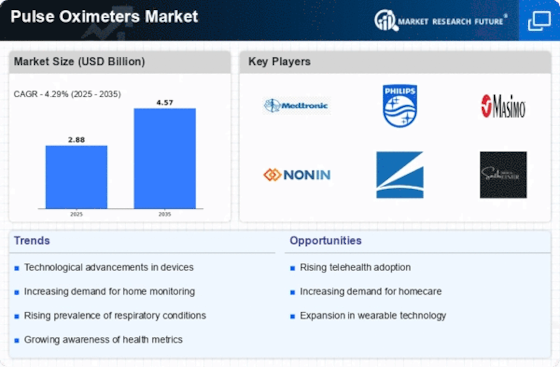
Pulse Oximeters Market Infographic
Purchase Options

Market Analysis

In-depth Analysis of Pulse Oximeters Market Industry Landscape

Global health monitoring trends significantly influence the dynamics of the pulse oximeters market. With a growing emphasis on personal health management, the demand for pulse oximeters has surged, driven by increased awareness of their role in monitoring oxygen saturation levels—a critical parameter in respiratory health. The market dynamics are significantly impacted by the growth of remote patient monitoring and at-home healthcare. By enabling healthcare professionals to evaluate patients' oxygen levels remotely and reducing the need for frequent in-person visits, pulse oximeters play a critical role in remote monitoring and drive market trends toward patient-oriented and autonomous healthcare solutions.The need for pulse oximeters is increasing as respiratory health remains a global concern, which is driving market trends in the creation of devices catered to certain respiratory requirements. The market is significantly influenced by the expanding use of pulse oximeters in pediatric applications. Monitoring oxygen saturation levels in children, especially those with respiratory illnesses or during surgery, impacts market dynamics, fostering the development of pediatric-friendly oximeters and driving market growth in pediatric healthcare settings. By incorporating pulse oximeters into telehealth systems, the future can be shaped. The market is seeing changes in the development of pulse oximeters that smoothly interface with telemedicine systems that allow immediate time remote monitoring of patients. This is because the demand for linked health devices has increased due to the emergence of telehealth services. Considerations of global health disparities and the need for increased access to healthcare characterize the market. Affordable and accessible pulse oximeters are vital in addressing health inequalities, influencing market dynamics and contributing to global health initiatives. The market dynamics are influenced by integrating pulse oximeters into sports and fitness applications. Athletes and fitness enthusiasts use these devices to monitor oxygen levels during training, impacting market trends in developing rugged and high-performance pulse oximeters for sports-related activities. The market is significantly shaped by education and awareness initiatives about monitoring oxygen saturation levels. Efforts to educate healthcare professionals and the general public impact market dynamics, fostering informed decision-making and increasing the overall adoption of pulse oximeters.

Author
Author Profile
Vikita Thakur
Senior Research Analyst

She holds an experience of about 5+ years in market research and business consulting projects for sectors such as life sciences, medical devices, and healthcare IT. She possesses a robust background in data analysis, market estimation, competitive intelligence, pipeline analysis market trend identification, and consumer behavior insights. Her expertise lies in technical Sales support, client interaction and project management, designing and implementing market research studies, conducting competitive analysis, and synthesizing complex data into actionable recommendations that drive business growth.

Leave a Comment

FAQs

What is the current market valuation of the market in 2025?

The market is valued at approximately 2.88 USD Billion in 2024.

What is the projected market size for the Pulse Oximeters Market by 2035?

<p>The market is expected to reach approximately 4.573 USD Billion by 2035.</p>

What is the expected CAGR for the Pulse Oximeters Market during the forecast period 2025 - 2035?

<p>The expected CAGR for the Pulse Oximeters Market during this period is 4.29%.</p>

Which companies are considered key players in the Pulse Oximeters Market?

<p>Key players include Medtronic, Philips, Masimo, Nonin Medical, Nihon Kohden, Smiths Medical, GE Healthcare, Honeywell, and Zebra Medical Technologies.</p>

What are the different types of pulse oximeters available in the market?

<p>The market segments include Portable, Stationary, Fingertip, and Wrist Pulse Oximeters.</p>

How did the valuation of Portable Pulse Oximeters change from 2024 to 2025?

<p>The valuation for Portable Pulse Oximeters increased from 0.8 USD Billion in 2024 to an estimated 1.2 USD Billion in 2025.</p>

What is the market performance of Conventional Pulse Oximeters in 2025?

<p>Conventional Pulse Oximeters are projected to have a valuation of approximately 2.25 USD Billion by 2035.</p>

What end-use segments are driving the Pulse Oximeters Market?

<p>The end-use segments include Hospitals, Homecare, Emergency Services, and Ambulatory Surgical Centers.</p>

What is the projected valuation for Homecare Pulse Oximeters by 2035?

<p>Homecare Pulse Oximeters are expected to reach a valuation of around 1.3 USD Billion by 2035.</p>

How do Smart Pulse Oximeters compare to Wearable Pulse Oximeters in terms of market valuation?

<p>Smart Pulse Oximeters are projected to reach 1.45 USD Billion, while Wearable Pulse Oximeters are expected to reach 1.1 USD Billion by 2035.</p>

Market Summary

According to Market Research Future analysis, the Pulse Oximeters Market size was valued at USD 2.88 Billion in 2024. The market is projected to grow from USD 3.004 Billion in 2025 to USD 4.573 Billion by 2035, exhibiting a CAGR of 4.29% during the forecast period 2025-2035. North America led the market with over 45% share, generating around USD 1.3 billion in revenue.
 
Rising demand for efficient clinical data management and real-time diagnostic accuracy is driving laboratory informatics adoption globally. Integration of automated systems improves workflow efficiency, reduces errors, and supports data-driven healthcare decisions across hospitals, diagnostic centers, and research laboratories.
 
WHO reports noncommunicable diseases account for 41 million deaths annually, representing 74% of global mortality, increasing diagnostic workload across laboratories. Enhanced data management systems are essential to handle rising testing volumes, improve accuracy, and strengthen healthcare infrastructure efficiency worldwide.

Key Market Trends & Highlights

The Pulse Oximeters Market is experiencing robust growth driven by technological advancements and a shift towards home healthcare solutions.

  • Rising respiratory disorders and aging population drive global pulse oximeters demand across hospitals and homecare settings. Technological advancements and mobile integration accelerate adoption of smart pulse oximeters enhancing remote patient monitoring capabilities globally. Homecare segment growth supported by chronic disease prevalence increases demand for portable and user-friendly monitoring devices worldwide. North America leads global market with over 45% revenue share due to advanced healthcare infrastructure and high disease burden. Europe holds 30% market share valued at USD 0.86 billion driven by strong regulatory standards and preventive healthcare focus.

Market Size & Forecast

2024 Market Size 2.88 (USD Billion)
2035 Market Size 4.573 (USD Billion)
CAGR (2025 - 2035) 4.29%
Largest Regional Market Share in 2024 North America

Major Players

Companies such as <a title="Medtronic" href="https://www.medtronic.com/en-us/healthcare-professionals/products/patient-monitoring/pulse-oximetry.html" target="_blank" rel="noopener">Medtronic</a> (US), Philips (NL), Masimo (US), <a title="Nonin Medical" href="https://www.nonin.com/technologies/pulse-oximetry/?srsltid=AfmBOorvEXVG3XlUO1dp-inUeNqPEgqmrppftdYz6XEUFNnDGGpwuFVv" target="_blank" rel="noopener">Nonin Medical</a> (US), Nihon Kohden (JP), Smiths Medical (US), GE Healthcare (US), Honeywell (US), Zebra Medical Technologies (IL) are some of the major participants in the global market.

Market Trends

The Pulse Oximeters Market is currently experiencing notable growth, driven by an increasing awareness of health monitoring and the rising prevalence of respiratory conditions. The pulse oximeter market encompasses a variety of devices that measure blood oxygen saturation levels, which are essential for assessing respiratory function. The demand for these devices is further fueled by advancements in technology, leading to the development of more accurate and user-friendly models.

Additionally, the integration of pulse oximeters with mobile health applications appears to enhance their appeal, as consumers seek convenient ways to monitor their health. Moreover, the market is witnessing a shift towards home healthcare solutions. As individuals become more proactive about their health, the need for portable and easy-to-use devices is likely to increase.

This trend is complemented by the growing aging population, which often requires continuous monitoring of oxygen levels. Manufacturers are responding to these demands by innovating and expanding their product lines, potentially leading to a more competitive landscape. Overall, the market seems poised for sustained growth, driven by technological advancements and changing consumer preferences.

Technological Advancements

The market is benefiting from rapid technological innovations. Newer models are being developed with enhanced accuracy, connectivity features, and user-friendly interfaces. These advancements are likely to attract a broader consumer base, including both healthcare professionals and individuals seeking personal health monitoring.

WHO highlights that laboratory diagnostics are critical in managing diseases responsible for 41 million deaths annually worldwide, requiring advanced digital systems for accuracy. Integration of automated lab workflows improves efficiency, reduces diagnostic errors, and enhances large-scale disease surveillance and reporting systems globally.

Shift Towards Home Healthcare

There is a noticeable trend towards home healthcare solutions within the market. As more consumers prioritize health management at home, the demand for portable and easy-to-use devices is expected to rise. This shift is particularly relevant for the aging population, which often requires regular monitoring.

CDC data shows chronic diseases affect 6 in 10 adults in the U.S., and 4 in 10 have two or more conditions, increasing demand for decentralized diagnostic solutions and remote laboratory data access systems to support continuous patient monitoring and care efficiency.

Integration with Mobile Health Applications

The integration of pulse oximeters with mobile health applications is emerging as a significant trend. This synergy allows users to track their oxygen levels conveniently and share data with healthcare providers. Such features may enhance user engagement and promote proactive health management.

PAHO reports that digital health adoption in the Americas supports improved access for over 1 billion people, enabling remote health monitoring and data sharing. Mobile-integrated laboratory systems enhance diagnostic tracking, patient engagement, and faster clinical decision-making across healthcare networks.

Pulse Oximeters Market Market Drivers

Aging Population

The demographic shift towards an aging population is poised to have a profound impact on the Pulse Oximeters Market. As individuals age, they often experience a decline in respiratory function and an increase in comorbidities, which heightens the need for regular monitoring of oxygen saturation. Data indicates that the proportion of individuals aged 65 and older is steadily increasing, leading to a higher prevalence of age-related health issues.
 
This demographic trend is likely to drive demand for pulse oximeters, as healthcare systems adapt to the needs of older patients. Additionally, the market may see growth in the development of user-friendly devices tailored for elderly users, enhancing accessibility and encouraging self-monitoring.

Increased Focus on Preventive Healthcare

The growing emphasis on preventive healthcare is emerging as a key driver for the Pulse Oximeters Market. As healthcare systems worldwide shift towards proactive management of health conditions, the demand for devices that facilitate early detection of potential issues is rising.
 
Pulse oximeters play a crucial role in this paradigm by enabling individuals to monitor their oxygen levels regularly, thus identifying potential respiratory problems before they escalate. This trend is supported by initiatives aimed at promoting health awareness and encouraging self-monitoring among patients. Consequently, the market is likely to experience growth as more consumers recognize the value of these devices in maintaining their health and preventing complications.

Rising Prevalence of Respiratory Diseases

The increasing incidence of respiratory diseases, such as chronic obstructive pulmonary disease (COPD) and asthma, is a primary driver for the Pulse Oximeters Market. According to recent health statistics, respiratory diseases account for a significant portion of global morbidity and mortality. This trend necessitates the use of pulse oximeters for continuous monitoring of oxygen saturation levels, particularly in patients with chronic conditions.
 
The demand for accurate and reliable monitoring devices is expected to rise, as healthcare providers seek to improve patient outcomes. Furthermore, the market is likely to benefit from the growing awareness among patients regarding the importance of monitoring their oxygen levels, leading to increased adoption of these devices in both clinical and home settings.

Rising Demand for Home Healthcare Solutions

The increasing demand for home healthcare solutions is significantly impacting the Pulse Oximeters Market. As patients seek to manage their health conditions from the comfort of their homes, the need for portable and easy-to-use monitoring devices is becoming more pronounced. Market analysis indicates that the home healthcare segment is expanding rapidly, driven by factors such as convenience, cost-effectiveness, and the desire for personalized care.
 
Pulse oximeters, being non-invasive and user-friendly, are well-positioned to meet this demand. Furthermore, the market is likely to benefit from partnerships between manufacturers and home healthcare providers, facilitating the distribution of these devices to a broader audience.

Technological Innovations in Medical Devices

Technological advancements in medical devices are significantly influencing the Pulse Oximeters Market. Innovations such as non-invasive monitoring, wireless connectivity, and integration with telehealth platforms are enhancing the functionality and appeal of pulse oximeters. These advancements not only improve the accuracy of readings but also facilitate real-time data sharing with healthcare providers.

 
Market data suggests that the introduction of smart pulse oximeters, which can sync with mobile applications, is gaining traction among consumers. This trend indicates a shift towards more sophisticated monitoring solutions that cater to the needs of both patients and healthcare professionals. As technology continues to evolve, the market is expected to expand, driven by the demand for more efficient and user-friendly devices.

Market Segment Insights

By Type: Fingertip Pulse Oximeters (Largest) vs. Portable Pulse Oximeters (Fastest-Growing)

The market exhibits diverse segmentation, with Fingertip Pulse Oximeters holding the largest pulse oximeters market share at 62% due to their ease of use and availability. Their compact size, affordability, and accuracy appeal significantly to home users and healthcare providers, solidifying their dominant position. Portable Pulse Oximeters are rapidly gaining traction for their versatility and convenience, particularly among individuals requiring continuous monitoring outside clinical settings. As health awareness increases and telehealth becomes more mainstream, the demand for Portable Pulse Oximeters is expected to soar. Drivers such as a rise in chronic respiratory diseases and advancements in miniaturization technology contribute to the growth of this segment. Furthermore, the growing trend of self-monitoring and home healthcare solutions supports the expanding market for portable devices.

Fingertip Pulse Oximeters (Dominant) vs. Portable Pulse Oximeters (Emerging)

Fingertip Pulse Oximeters are characterized by their compact design and straightforward functionality, making them a preferred choice among consumers for personal health monitoring. Their widespread acceptance in home healthcare is bolstered by their cost-effectiveness and user-friendly nature. In contrast, Portable Pulse Oximeters represent an emerging category, appealing to a growing demographic of patients requiring mobility and ease of use. These devices are designed for high portability and are often utilized in various environments, including hospitals, clinics, and during travel. The integration of advanced features such as Bluetooth connectivity and real-time data sharing enhances their appeal, setting the stage for significant growth as healthcare shifts towards more accessible and user-centric solutions.

By Technology: Conventional Pulse Oximeters (Largest) vs. Smart Pulse Oximeters (Fastest-Growing)

The market is segmented into three main categories: Conventional Pulse Oximeters, Smart Pulse Oximeters, and Wearable Pulse Oximeters. Among these, Conventional Pulse Oximeters hold the largest share of the Pulse Oximeters Market at 55% due to their widespread use in hospitals and clinics for basic oxygen saturation monitoring. However, Smart Pulse Oximeters are gaining a considerable share as they offer advanced features like Bluetooth connectivity and integration with mobile health applications, appealing to health-conscious consumers.

Technology: Conventional Pulse Oximeters (Dominant) vs. Smart Pulse Oximeters (Emerging)

Conventional Pulse Oximeters remain dominant within the market, primarily employed in clinical settings for their reliability and cost-effectiveness. These devices are known for their accuracy in measuring blood oxygen levels and pulse rates, making them essential tools in emergency and surgical units. On the other hand, Smart Pulse Oximeters, identified as the emerging technology, incorporate advanced functionalities such as data logging and remote monitoring, positioning them effectively in the home healthcare segment. Their rise is driven by the increasing consumer demand for health tracking devices, with integration capabilities that cater to personalized health management.

By End Use: Hospitals (Largest) vs. Homecare (Fastest-Growing)

The market displays a varied share distribution across its end-use segments, with hospitals commanding the largest Pulse Oximeters Market share at 60%. This dominance can be attributed to the high demand for monitoring vital signs in critical care settings. Homecare follows as a significant segment, exhibiting a growing preference among patients for at-home health monitoring devices. Emerging trends indicate that the homecare sector is rapidly evolving, driven by an increasing aging population and a surge in chronic respiratory conditions. As patients seek comfort and convenience, the adoption of pulse oximeters in residential settings is accelerating. This trend highlights the shift towards patient-centered care and the rising preference for remote healthcare solutions.

Hospitals (Dominant) vs. Emergency Services (Emerging)

Hospitals represent the dominant force in the market share, primarily due to their continuous need for precise and reliable patient monitoring in high-stakes environments. The ability to provide real-time data on blood oxygen saturation during surgeries and critical care enhances patient outcomes significantly. In contrast, emergency services are emerging as a vital segment, fueled by the demand for agile and efficient medical responses in pre-hospital situations. This segment focuses on portable and quick-access devices that can be swiftly deployed in emergency situations, emphasizing the necessity of prompt patient evaluation. Together, these segments illustrate the diverse applications and vital importance of pulse oximeters across healthcare settings.

Get more detailed insights about Pulse Oximeters Market Research Report - Forecast to 2035

Regional Insights

North America : Healthcare Innovation Leader

North America dominated the global Pulse Oximeters Market in 2024, reaching a market size of USD 1.3 billion. The region's growth is driven by advanced healthcare infrastructure, increasing prevalence of respiratory diseases, and a rising geriatric population. Regulatory support from agencies like the FDA further catalyzes market expansion, ensuring safety and efficacy in medical devices. 

The United States leads the pulse oximeter market, followed by Canada, with key players such as Medtronic, Masimo, and GE Healthcare dominating the landscape. The competitive environment is characterized by continuous innovation and strategic partnerships, enhancing product offerings and pulse oximetry market reach. The presence of established healthcare systems facilitates the adoption of advanced pulse oximetry technologies, ensuring sustained growth in this sector.

CDC reports that 6 in 10 U.S. adults live with at least one chronic disease, and 4 in 10 have two or more conditions, significantly increasing demand for continuous monitoring devices. This strengthens adoption of pulse oximeters in clinical and homecare settings.

Europe : Emerging Market Dynamics

Europe is witnessing significant growth in the market, accounting for around 30% of the global share. Factors such as increasing healthcare expenditure, a focus on preventive healthcare, and the rising incidence of chronic diseases are driving demand. Regulatory frameworks, including the EU Medical Device Regulation, ensure high standards for product safety and efficacy, fostering consumer confidence.

Leading countries in this region include Germany, France, and the UK, where companies like Philips and Nihon Kohden are prominent. The competitive landscape is marked by innovation and collaboration among manufacturers, healthcare providers, and research institutions. This synergy is crucial for developing advanced pulse oximetry solutions that meet the evolving needs of healthcare systems across Europe.

WHO Europe highlights that population aged 60+ will reach nearly 34% by 2050, increasing healthcare monitoring needs. Rising respiratory and cardiovascular disease prevalence enhances demand for pulse oximeters, supporting preventive healthcare systems and strengthening digital monitoring adoption across the region.

Asia-Pacific : Rapidly Growing Healthcare Sector

Asia-Pacific is rapidly emerging as a significant player in the market, holding approximately 20% of the global share. The region's growth is fueled by increasing healthcare investments, rising awareness of health monitoring, and a growing population with chronic health conditions. Government initiatives aimed at improving healthcare access and quality are also pivotal in driving market expansion.

Countries like Japan, China, and India are at the forefront, with key players such as Nihon Kohden and Nonin Medical leading the pulse oximetry market. The competitive landscape is evolving, with local manufacturers increasingly entering the market, enhancing competition and driving innovation. The focus on affordable healthcare solutions is expected to further boost the adoption of pulse oximeters in this region.

Middle East and Africa : Untapped Market Potential

The Middle East and Africa region is gradually developing its market, currently holding about 5% of the global share. The growth is primarily driven by increasing investments in healthcare infrastructure, rising awareness of health monitoring, and a growing prevalence of respiratory diseases. Government initiatives aimed at improving healthcare access are also contributing to pulse oximetry market expansion.

Countries like South Africa and the UAE are leading the market, with a mix of local and international players. The competitive landscape is characterized by a focus on affordability and accessibility, with companies striving to meet the unique healthcare needs of the region. As healthcare systems evolve, the demand for pulse oximeters is expected to rise significantly, presenting opportunities for growth.

Key Players and Competitive Insights

The Pulse Oximeters Market is currently characterized by a dynamic competitive landscape, driven by technological advancements and an increasing demand for non-invasive monitoring solutions. Key players such as Medtronic (US), Philips (NL), and Masimo (US) are strategically positioned to leverage innovation and expand their market presence. Medtronic (US) focuses on integrating advanced sensor technologies into its devices, enhancing accuracy and user experience. Philips (NL) emphasizes digital health solutions, aiming to create a seamless ecosystem for patient monitoring.
 
Meanwhile, Masimo (US) is known for its proprietary signal extraction technology, which differentiates its products in terms of performance and reliability. Collectively, these strategies contribute to a competitive environment that prioritizes innovation and user-centric solutions. In terms of business tactics, companies are increasingly localizing manufacturing to reduce costs and improve supply chain efficiency. This approach is particularly relevant in a moderately fragmented market where several players vie for market share.
 
The competitive structure is influenced by the presence of both established firms and emerging players, each contributing to a diverse range of product offerings. The collective influence of these key players shapes market dynamics, as they adapt to changing consumer preferences and regulatory requirements. In August 2025, Philips (NL) announced a strategic partnership with a leading telehealth provider to enhance remote patient monitoring capabilities. This collaboration aims to integrate Philips' pulse oximeters with telehealth platforms, facilitating real-time data sharing and improving patient outcomes.
 
The strategic importance of this move lies in its potential to position Philips as a leader in the growing telehealth market, aligning with the increasing demand for remote healthcare solutions. In September 2025, Masimo (US) launched a new line of pulse oximeters designed specifically for pediatric use, incorporating features tailored to the unique needs of children. This product launch reflects Masimo's commitment to innovation and its focus on niche markets. By addressing the specific requirements of pediatric patients, Masimo aims to capture a segment of the market that has been historically underserved, thereby enhancing its competitive edge.
 
In July 2025, Medtronic (US) expanded its manufacturing capabilities in Asia, aiming to streamline production and reduce lead times for its pulse oximeter devices. This strategic move is indicative of Medtronic's focus on optimizing its supply chain and responding to the growing demand in the Asia-Pacific region. By enhancing its manufacturing footprint, Medtronic is likely to improve its operational efficiency and strengthen its market position.
 
As of October 2025, the market is witnessing trends such as digitalization, sustainability, and the integration of artificial intelligence in product development. Strategic alliances are increasingly shaping the competitive landscape, enabling companies to pool resources and expertise. Looking ahead, competitive differentiation is expected to evolve, with a shift from price-based competition to a focus on innovation, technology, and supply chain reliability. Companies that can effectively leverage these trends are likely to secure a stronger foothold in the market.

Key Companies in the Pulse Oximeters Market include

Industry Developments

Recent developments in the Pulse Oximeters Market reflect significant strides in technology and healthcare. Companies like Medtronic, Philips, and Masimo have introduced advanced models incorporating wireless technology and improved accuracy, catering to increased demand in hospital and home care settings. The market has seen a notable growth trajectory, projected to expand significantly, driven by rising awareness about chronic respiratory diseases and the ongoing impact of the COVID-19 pandemic. 

In terms of mergers and acquisitions, Nellcor announced a strategic acquisition in April 2023 aimed at enhancing its product offerings and market reach, while GE Healthcare is investing in R&D to innovate its pulse oximeter range. Additionally, Bistos received FDA clearance for a new pulse oximeter model in June 2023, further instigating competitive dynamics. 

Over the past few years, key happenings include Koninklijke Philips unveiling its latest pulse oximeter technology in November 2022, which integrates artificial intelligence for real-time monitoring. Overall, the market is characterized by continuous innovations and partnerships, which are crucial for maintaining competitive advantage and addressing the growing needs of healthcare providers globally.

Future Outlook

Pulse Oximeters Market Future Outlook

The Pulse Oximeters Market size is projected to reach USD 4.573 Billion by 2035, growing at a CAGR of 4.29%, driven by technological advancements, increasing healthcare awareness, and rising chronic diseases.

New opportunities lie in:

  • <p>Development of portable, connected pulse oximeters for remote patient monitoring. Expansion into emerging markets with affordable, high-quality devices. Integration of AI for predictive analytics in patient health management.</p>

By 2035, the Pulse Oximeters Market is expected to achieve robust growth, driven by innovation and expanding applications.

Market Segmentation

Pulse Oximeters Market Type Outlook

  • Portable Pulse Oximeters
  • Stationary Pulse Oximeters
  • Fingertip Pulse Oximeters
  • Wrist Pulse Oximeters

Pulse Oximeters Market End Use Outlook

  • Hospitals
  • Homecare
  • Emergency Services
  • Ambulatory Surgical Centers

Pulse Oximeters Market Technology Outlook

  • Conventional Pulse Oximeters
  • Smart Pulse Oximeters
  • Wearable Pulse Oximeters

Report Scope

MARKET SIZE 2024 2.88(USD Billion)
MARKET SIZE 2025 3.004(USD Billion)
MARKET SIZE 2035 4.573(USD Billion)
COMPOUND ANNUAL GROWTH RATE (CAGR) 4.29% (2025 - 2035)
REPORT COVERAGE Revenue Forecast, Competitive Landscape, Growth Factors, and Trends
BASE YEAR 2024
Market Forecast Period 2025 - 2035
Historical Data 2019 - 2024
Market Forecast Units USD Billion
Key Companies Profiled Medtronic (US), Philips (NL), Masimo (US), Nonin Medical (US), Nihon Kohden (JP), Smiths Medical (US), GE Healthcare (US), Honeywell (US), Zebra Medical Technologies (IL)
Segments Covered Types, Technology, End Use
Key Market Opportunities Integration of advanced sensors and telehealth solutions enhances accessibility in the Pulse Oximeters Market.
Key Market Dynamics Technological advancements and regulatory changes drive innovation and competition in the pulse oximeters market.
Countries Covered North America, Europe, APAC, South America, MEA

FAQs

What is the current market valuation of the market in 2025?

The market is valued at approximately 2.88 USD Billion in 2024.

What is the projected market size for the Pulse Oximeters Market by 2035?

<p>The market is expected to reach approximately 4.573 USD Billion by 2035.</p>

What is the expected CAGR for the Pulse Oximeters Market during the forecast period 2025 - 2035?

<p>The expected CAGR for the Pulse Oximeters Market during this period is 4.29%.</p>

Which companies are considered key players in the Pulse Oximeters Market?

<p>Key players include Medtronic, Philips, Masimo, Nonin Medical, Nihon Kohden, Smiths Medical, GE Healthcare, Honeywell, and Zebra Medical Technologies.</p>

What are the different types of pulse oximeters available in the market?

<p>The market segments include Portable, Stationary, Fingertip, and Wrist Pulse Oximeters.</p>

How did the valuation of Portable Pulse Oximeters change from 2024 to 2025?

<p>The valuation for Portable Pulse Oximeters increased from 0.8 USD Billion in 2024 to an estimated 1.2 USD Billion in 2025.</p>

What is the market performance of Conventional Pulse Oximeters in 2025?

<p>Conventional Pulse Oximeters are projected to have a valuation of approximately 2.25 USD Billion by 2035.</p>

What end-use segments are driving the Pulse Oximeters Market?

<p>The end-use segments include Hospitals, Homecare, Emergency Services, and Ambulatory Surgical Centers.</p>

What is the projected valuation for Homecare Pulse Oximeters by 2035?

<p>Homecare Pulse Oximeters are expected to reach a valuation of around 1.3 USD Billion by 2035.</p>

How do Smart Pulse Oximeters compare to Wearable Pulse Oximeters in terms of market valuation?

<p>Smart Pulse Oximeters are projected to reach 1.45 USD Billion, while Wearable Pulse Oximeters are expected to reach 1.1 USD Billion by 2035.</p>

  1. SECTION I: EXECUTIVE SUMMARY AND KEY HIGHLIGHTS |
    1. EXECUTIVE SUMMARY | |
      1. Market Overview | |
      2. Key Findings | |
      3. Market Segmentation | |
      4. Competitive Landscape | |
      5. Challenges and Opportunities | |
      6. Future Outlook 2
  2. SECTION II: SCOPING, METHODOLOGY AND MARKET STRUCTURE |
    1. MARKET INTRODUCTION | |
      1. Definition | |
      2. Scope of the study | | |
    2. RESEARCH METHODOLOGY | |
      1. Overview | |
      2. Data Mining | |
      3. Secondary Research | |
      4. Primary Research | | |
      5. Forecasting Model | |
      6. Market Size Estimation | | |
      7. Data Triangulation | |
      8. Validation 3
  3. SECTION III: QUALITATIVE ANALYSIS |
    1. MARKET DYNAMICS | |
      1. Overview | |
      2. Drivers | |
      3. Restraints | |
      4. Opportunities |
    2. MARKET FACTOR ANALYSIS | |
      1. Value chain Analysis | |
      2. Porter's Five Forces Analysis | | |
      3. COVID-19 Impact Analysis | | |
  4. SECTION IV: QUANTITATIVE ANALYSIS |
    1. Healthcare, BY Type (USD Billion) | |
      1. Portable Pulse Oximeters | |
      2. Stationary Pulse Oximeters | |
      3. Fingertip Pulse Oximeters | |
      4. Wrist Pulse Oximeters |
    2. Healthcare, BY Technology (USD Billion) | |
      1. Conventional Pulse Oximeters | |
      2. Smart Pulse Oximeters | |
      3. Wearable Pulse Oximeters |
    3. Healthcare, BY End Use (USD Billion) | |
      1. Hospitals | |
      2. Homecare | |
      3. Emergency Services | |
      4. Ambulatory Surgical Centers |
    4. Healthcare, BY Region (USD Billion) | |
      1. North America | | |
      2. Europe | | |
      3. APAC | | |
      4. South America | | |
      5. MEA | | |
  5. SECTION V: COMPETITIVE ANALYSIS |
    1. Competitive Landscape | |
      1. Overview | |
      2. Competitive Analysis | |
      3. Market share Analysis | |
      4. Major Growth Strategy in the Healthcare | |
      5. Competitive Benchmarking | |
      6. Leading Players in Terms of Number of Developments in the Healthcare | |
      7. Key developments and growth strategies | | |
      8. Major Players Financial Matrix | | |
    2. Company Profiles | |
      1. Medtronic (US) | | |
      2. Philips (NL) | | |
      3. Masimo (US) | | |
      4. Nonin Medical (US) | | |
      5. Nihon Kohden (JP) | | |
      6. Smiths Medical (US) | | |
      7. GE Healthcare (US) | | |
      8. Honeywell (US) | | |
      9. Zebra Medical Technologies (IL) | | |
    3. Appendix | |
      1. References | |
      2. Related Reports 6 LIST OF FIGURES |
    4. MARKET SYNOPSIS |
    5. NORTH AMERICA MARKET ANALYSIS |
    6. US MARKET ANALYSIS BY TYPE |
    7. US MARKET ANALYSIS BY TECHNOLOGY |
    8. US MARKET ANALYSIS BY END USE |
    9. CANADA MARKET ANALYSIS BY TYPE |
    10. CANADA MARKET ANALYSIS BY TECHNOLOGY |
    11. CANADA MARKET ANALYSIS BY END USE |
    12. EUROPE MARKET ANALYSIS |
    13. GERMANY MARKET ANALYSIS BY TYPE |
    14. GERMANY MARKET ANALYSIS BY TECHNOLOGY |
    15. GERMANY MARKET ANALYSIS BY END USE |
    16. UK MARKET ANALYSIS BY TYPE |
    17. UK MARKET ANALYSIS BY TECHNOLOGY |
    18. UK MARKET ANALYSIS BY END USE |
    19. FRANCE MARKET ANALYSIS BY TYPE |
    20. FRANCE MARKET ANALYSIS BY TECHNOLOGY |
    21. FRANCE MARKET ANALYSIS BY END USE |
    22. RUSSIA MARKET ANALYSIS BY TYPE |
    23. RUSSIA MARKET ANALYSIS BY TECHNOLOGY |
    24. RUSSIA MARKET ANALYSIS BY END USE |
    25. ITALY MARKET ANALYSIS BY TYPE |
    26. ITALY MARKET ANALYSIS BY TECHNOLOGY |
    27. ITALY MARKET ANALYSIS BY END USE |
    28. SPAIN MARKET ANALYSIS BY TYPE |
    29. SPAIN MARKET ANALYSIS BY TECHNOLOGY |
    30. SPAIN MARKET ANALYSIS BY END USE |
    31. REST OF EUROPE MARKET ANALYSIS BY TYPE |
    32. REST OF EUROPE MARKET ANALYSIS BY TECHNOLOGY |
    33. REST OF EUROPE MARKET ANALYSIS BY END USE |
    34. APAC MARKET ANALYSIS |
    35. CHINA MARKET ANALYSIS BY TYPE |
    36. CHINA MARKET ANALYSIS BY TECHNOLOGY |
    37. CHINA MARKET ANALYSIS BY END USE |
    38. INDIA MARKET ANALYSIS BY TYPE |
    39. INDIA MARKET ANALYSIS BY TECHNOLOGY |
    40. INDIA MARKET ANALYSIS BY END USE |
    41. JAPAN MARKET ANALYSIS BY TYPE |
    42. JAPAN MARKET ANALYSIS BY TECHNOLOGY |
    43. JAPAN MARKET ANALYSIS BY END USE |
    44. SOUTH KOREA MARKET ANALYSIS BY TYPE |
    45. SOUTH KOREA MARKET ANALYSIS BY TECHNOLOGY |
    46. SOUTH KOREA MARKET ANALYSIS BY END USE |
    47. MALAYSIA MARKET ANALYSIS BY TYPE |
    48. MALAYSIA MARKET ANALYSIS BY TECHNOLOGY |
    49. MALAYSIA MARKET ANALYSIS BY END USE |
    50. THAILAND MARKET ANALYSIS BY TYPE |
    51. THAILAND MARKET ANALYSIS BY TECHNOLOGY |
    52. THAILAND MARKET ANALYSIS BY END USE |
    53. INDONESIA MARKET ANALYSIS BY TYPE |
    54. INDONESIA MARKET ANALYSIS BY TECHNOLOGY |
    55. INDONESIA MARKET ANALYSIS BY END USE |
    56. REST OF APAC MARKET ANALYSIS BY TYPE |
    57. REST OF APAC MARKET ANALYSIS BY TECHNOLOGY |
    58. REST OF APAC MARKET ANALYSIS BY END USE |
    59. SOUTH AMERICA MARKET ANALYSIS |
    60. BRAZIL MARKET ANALYSIS BY TYPE |
    61. BRAZIL MARKET ANALYSIS BY TECHNOLOGY |
    62. BRAZIL MARKET ANALYSIS BY END USE |
    63. MEXICO MARKET ANALYSIS BY TYPE |
    64. MEXICO MARKET ANALYSIS BY TECHNOLOGY |
    65. MEXICO MARKET ANALYSIS BY END USE |
    66. ARGENTINA MARKET ANALYSIS BY TYPE |
    67. ARGENTINA MARKET ANALYSIS BY TECHNOLOGY |
    68. ARGENTINA MARKET ANALYSIS BY END USE |
    69. REST OF SOUTH AMERICA MARKET ANALYSIS BY TYPE |
    70. REST OF SOUTH AMERICA MARKET ANALYSIS BY TECHNOLOGY |
    71. REST OF SOUTH AMERICA MARKET ANALYSIS BY END USE |
    72. MEA MARKET ANALYSIS |
    73. GCC COUNTRIES MARKET ANALYSIS BY TYPE |
    74. GCC COUNTRIES MARKET ANALYSIS BY TECHNOLOGY |
    75. GCC COUNTRIES MARKET ANALYSIS BY END USE |
    76. SOUTH AFRICA MARKET ANALYSIS BY TYPE |
    77. SOUTH AFRICA MARKET ANALYSIS BY TECHNOLOGY |
    78. SOUTH AFRICA MARKET ANALYSIS BY END USE |
    79. REST OF MEA MARKET ANALYSIS BY TYPE |
    80. REST OF MEA MARKET ANALYSIS BY TECHNOLOGY |
    81. REST OF MEA MARKET ANALYSIS BY END USE |
    82. KEY BUYING CRITERIA OF HEALTHCARE |
    83. RESEARCH PROCESS OF MRFR |
    84. DRO ANALYSIS OF HEALTHCARE |
    85. DRIVERS IMPACT ANALYSIS: HEALTHCARE |
    86. RESTRAINTS IMPACT ANALYSIS: HEALTHCARE |
    87. SUPPLY / VALUE CHAIN: HEALTHCARE |
    88. HEALTHCARE, BY TYPE, 2024 (% SHARE) |
    89. HEALTHCARE, BY TYPE, 2024 TO 2035 (USD Billion) |
    90. HEALTHCARE, BY TECHNOLOGY, 2024 (% SHARE) |
    91. HEALTHCARE, BY TECHNOLOGY, 2024 TO 2035 (USD Billion) |
    92. HEALTHCARE, BY END USE, 2024 (% SHARE) |
    93. HEALTHCARE, BY END USE, 2024 TO 2035 (USD Billion) |
    94. BENCHMARKING OF MAJOR COMPETITORS 7 LIST OF TABLES |
    95. LIST OF ASSUMPTIONS | |
      1. |
    96. North America MARKET SIZE ESTIMATES; FORECAST | |
      1. BY TYPE, 2025-2035 (USD Billion) | |
      2. BY TECHNOLOGY, 2025-2035 (USD Billion) | |
      3. BY END USE, 2025-2035 (USD Billion) |
    97. US MARKET SIZE ESTIMATES; FORECAST | |
      1. BY TYPE, 2025-2035 (USD Billion) | |
      2. BY TECHNOLOGY, 2025-2035 (USD Billion) | |
      3. BY END USE, 2025-2035 (USD Billion) |
    98. Canada MARKET SIZE ESTIMATES; FORECAST | |
      1. BY TYPE, 2025-2035 (USD Billion) | |
      2. BY TECHNOLOGY, 2025-2035 (USD Billion) | |
      3. BY END USE, 2025-2035 (USD Billion) |
    99. Europe MARKET SIZE ESTIMATES; FORECAST | |
      1. BY TYPE, 2025-2035 (USD Billion) | |
      2. BY TECHNOLOGY, 2025-2035 (USD Billion) | |
      3. BY END USE, 2025-2035 (USD Billion) |
    100. Germany MARKET SIZE ESTIMATES; FORECAST | |
      1. BY TYPE, 2025-2035 (USD Billion) | |
      2. BY TECHNOLOGY, 2025-2035 (USD Billion) | |
      3. BY END USE, 2025-2035 (USD Billion) |
    101. UK MARKET SIZE ESTIMATES; FORECAST | |
      1. BY TYPE, 2025-2035 (USD Billion) | |
      2. BY TECHNOLOGY, 2025-2035 (USD Billion) | |
      3. BY END USE, 2025-2035 (USD Billion) |
    102. France MARKET SIZE ESTIMATES; FORECAST | |
      1. BY TYPE, 2025-2035 (USD Billion) | |
      2. BY TECHNOLOGY, 2025-2035 (USD Billion) | |
      3. BY END USE, 2025-2035 (USD Billion) |
    103. Russia MARKET SIZE ESTIMATES; FORECAST | |
      1. BY TYPE, 2025-2035 (USD Billion) | |
      2. BY TECHNOLOGY, 2025-2035 (USD Billion) | |
      3. BY END USE, 2025-2035 (USD Billion) |
    104. Italy MARKET SIZE ESTIMATES; FORECAST | |
      1. BY TYPE, 2025-2035 (USD Billion) | |
      2. BY TECHNOLOGY, 2025-2035 (USD Billion) | |
      3. BY END USE, 2025-2035 (USD Billion) |
    105. Spain MARKET SIZE ESTIMATES; FORECAST | |
      1. BY TYPE, 2025-2035 (USD Billion) | |
      2. BY TECHNOLOGY, 2025-2035 (USD Billion) | |
      3. BY END USE, 2025-2035 (USD Billion) |
    106. Rest of Europe MARKET SIZE ESTIMATES; FORECAST | |
      1. BY TYPE, 2025-2035 (USD Billion) | |
      2. BY TECHNOLOGY, 2025-2035 (USD Billion) | |
      3. BY END USE, 2025-2035 (USD Billion) |
    107. APAC MARKET SIZE ESTIMATES; FORECAST | |
      1. BY TYPE, 2025-2035 (USD Billion) | |
      2. BY TECHNOLOGY, 2025-2035 (USD Billion) | |
      3. BY END USE, 2025-2035 (USD Billion) |
    108. China MARKET SIZE ESTIMATES; FORECAST | |
      1. BY TYPE, 2025-2035 (USD Billion) | |
      2. BY TECHNOLOGY, 2025-2035 (USD Billion) | |
      3. BY END USE, 2025-2035 (USD Billion) |
    109. India MARKET SIZE ESTIMATES; FORECAST | |
      1. BY TYPE, 2025-2035 (USD Billion) | |
      2. BY TECHNOLOGY, 2025-2035 (USD Billion) | |
      3. BY END USE, 2025-2035 (USD Billion) |
    110. Japan MARKET SIZE ESTIMATES; FORECAST | |
      1. BY TYPE, 2025-2035 (USD Billion) | |
      2. BY TECHNOLOGY, 2025-2035 (USD Billion) | |
      3. BY END USE, 2025-2035 (USD Billion) |
    111. South Korea MARKET SIZE ESTIMATES; FORECAST | |
      1. BY TYPE, 2025-2035 (USD Billion) | |
      2. BY TECHNOLOGY, 2025-2035 (USD Billion) | |
      3. BY END USE, 2025-2035 (USD Billion) |
    112. Malaysia MARKET SIZE ESTIMATES; FORECAST | |
      1. BY TYPE, 2025-2035 (USD Billion) | |
      2. BY TECHNOLOGY, 2025-2035 (USD Billion) | |
      3. BY END USE, 2025-2035 (USD Billion) |
    113. Thailand MARKET SIZE ESTIMATES; FORECAST | |
      1. BY TYPE, 2025-2035 (USD Billion) | |
      2. BY TECHNOLOGY, 2025-2035 (USD Billion) | |
      3. BY END USE, 2025-2035 (USD Billion) |
    114. Indonesia MARKET SIZE ESTIMATES; FORECAST | |
      1. BY TYPE, 2025-2035 (USD Billion) | |
      2. BY TECHNOLOGY, 2025-2035 (USD Billion) | |
      3. BY END USE, 2025-2035 (USD Billion) |
    115. Rest of APAC MARKET SIZE ESTIMATES; FORECAST | |
      1. BY TYPE, 2025-2035 (USD Billion) | |
      2. BY TECHNOLOGY, 2025-2035 (USD Billion) | |
      3. BY END USE, 2025-2035 (USD Billion) |
    116. South America MARKET SIZE ESTIMATES; FORECAST | |
      1. BY TYPE, 2025-2035 (USD Billion) | |
      2. BY TECHNOLOGY, 2025-2035 (USD Billion) | |
      3. BY END USE, 2025-2035 (USD Billion) |
    117. Brazil MARKET SIZE ESTIMATES; FORECAST | |
      1. BY TYPE, 2025-2035 (USD Billion) | |
      2. BY TECHNOLOGY, 2025-2035 (USD Billion) | |
      3. BY END USE, 2025-2035 (USD Billion) |
    118. Mexico MARKET SIZE ESTIMATES; FORECAST | |
      1. BY TYPE, 2025-2035 (USD Billion) | |
      2. BY TECHNOLOGY, 2025-2035 (USD Billion) | |
      3. BY END USE, 2025-2035 (USD Billion) |
    119. Argentina MARKET SIZE ESTIMATES; FORECAST | |
      1. BY TYPE, 2025-2035 (USD Billion) | |
      2. BY TECHNOLOGY, 2025-2035 (USD Billion) | |
      3. BY END USE, 2025-2035 (USD Billion) |
    120. Rest of South America MARKET SIZE ESTIMATES; FORECAST | |
      1. BY TYPE, 2025-2035 (USD Billion) | |
      2. BY TECHNOLOGY, 2025-2035 (USD Billion) | |
      3. BY END USE, 2025-2035 (USD Billion) |
    121. MEA MARKET SIZE ESTIMATES; FORECAST | |
      1. BY TYPE, 2025-2035 (USD Billion) | |
      2. BY TECHNOLOGY, 2025-2035 (USD Billion) | |
      3. BY END USE, 2025-2035 (USD Billion) |
    122. GCC Countries MARKET SIZE ESTIMATES; FORECAST | |
      1. BY TYPE, 2025-2035 (USD Billion) | |
      2. BY TECHNOLOGY, 2025-2035 (USD Billion) | |
      3. BY END USE, 2025-2035 (USD Billion) |
    123. South Africa MARKET SIZE ESTIMATES; FORECAST | |
      1. BY TYPE, 2025-2035 (USD Billion) | |
      2. BY TECHNOLOGY, 2025-2035 (USD Billion) | |
      3. BY END USE, 2025-2035 (USD Billion) |
    124. Rest of MEA MARKET SIZE ESTIMATES; FORECAST | |
      1. BY TYPE, 2025-2035 (USD Billion) | |
      2. BY TECHNOLOGY, 2025-2035 (USD Billion) | |
      3. BY END USE, 2025-2035 (USD Billion) |
    125. PRODUCT LAUNCH/PRODUCT DEVELOPMENT/APPROVAL | |
      1. |
    126. ACQUISITION/PARTNERSHIP | |

Healthcare Market Segmentation

Healthcare By Type (USD Billion, 2025-2035)

  • Portable Pulse Oximeters
  • Stationary Pulse Oximeters
  • Fingertip Pulse Oximeters
  • Wrist Pulse Oximeters

Healthcare By Technology (USD Billion, 2025-2035)

  • Conventional Pulse Oximeters
  • Smart Pulse Oximeters
  • Wearable Pulse Oximeters

Healthcare By End Use (USD Billion, 2025-2035)

  • Hospitals
  • Homecare
  • Emergency Services
  • Ambulatory Surgical Centers
Infographic

Free Sample Request

Kindly complete the form below to receive a free sample of this Report

Get Free Sample

Customer Strories

Compare Licence

×
Features License Type
Single User Multiuser License Enterprise User
Price $4,950 $5,950 $7,250
Maximum User Access Limit 1 User Upto 10 Users Unrestricted Access Throughout the Organization
Free Customization
Direct Access to Analyst
Deliverable Format
Platform Access
Discount on Next Purchase 10% 15% 15%
Printable Versions