×
Request Free Sample ×

Kindly complete the form below to receive a free sample of this Report

* Please use a valid business email

Leading companies partner with us for data-driven Insights

clients tt-cursor
Hero Background
English
Chinese
French
Japanese
Korean
German
Spanish

Prestressed Steel Wire Strands Market Trends

ID: MRFR/CnM/9472-CR
110 Pages
Anshula Mandaokar
October 2022

Prestressed Steel Wire And Strands Market Research Report Information By Product (Wire, Strand) Coating Type (Uncoated, Galvanized, Epoxy Coated, HDPE Coated, Others) Application (Railroad Industry, Construction Equipment, Bridges & Flyovers, Energy, Others) Forecast 2030

Share:
Download PDF ×

We do not share your information with anyone. However, we may send you emails based on your report interest from time to time. You may contact us at any time to opt-out.

Prestressed Steel Wire Strands Market Infographic
×
Prestressed Steel Wire Strands Market Infographic Full View
Purchase Options

Market Trends

Key Emerging Trends in the Prestressed Steel Wire Strands Market

The global issue of global warming is wreaking havoc on the environment, making it imperative to adopt measures that can effectively mitigate its impact. One highly effective strategy in this regard is enhancing energy efficiency in the construction sector. By reducing the consumption of natural resources, land, raw materials, and energy in the construction of buildings, a substantial decrease in greenhouse gas (GHG) emissions can be achieved. This approach aligns with the broader goal of creating structures that are not only high-performing but also environmentally friendly. Among the materials contributing to this cause is prestressing steel strand coated with epoxy, recognized for its cost-effectiveness and time-saving attributes in concrete projects.

The significance of energy efficiency is underscored by the achievements of programs such as the Energy Star Programme. In 2020, approximately 6,500 commercial buildings earned the ENERGY STAR label, resulting in savings of USD 1.6 billion and the prevention of more than 5 million metric tons of GHG emissions. ENERGY STAR certified buildings, on average, consume 35% less energy compared to typical buildings nationwide. Over 800 companies have partnered with the EPA's Energy Star program, representing a diverse range of industrial sectors, including food industries, bakeries, steel mills, petroleum refineries, and pharmaceutical plants. Notably, studies reveal that Energy Star certified buildings command a premium of up to 16% for both sales and rental rates.

The impact of energy-efficient construction practices is not limited to developed nations. In India, where buildings account for over 30% of electricity consumption, there is a growing realization of the importance of adopting energy-efficient measures. Moreover, considering that two-thirds of the buildings that will exist in India by 2030 are yet to be constructed, the opportunity to incorporate energy-efficient technologies is substantial. The rapid pace of urbanization in recent years has led to a significant expansion of urban building floor area, thereby increasing the demand for prestressing steel.

The demand for prestressing steel wire and strands is expected to surge in the coming decades, driven by the ongoing trend of urbanization and the pressing need to address energy security and GHG emissions. The construction industry's reliance on prestressing steel underscores its role not only in ensuring structural integrity but also in contributing to sustainable and environmentally conscious building practices. As the world grapples with the challenges posed by climate change, the adoption of energy-efficient construction materials like prestressing steel emerges as a crucial step toward creating a more sustainable and resilient future. By embracing these technologies, the construction industry can play a pivotal role in mitigating the environmental impact of global warming and fostering a more sustainable built environment for future generations.


Author
Anshula Mandaokar
Team Lead - Research

Anshula Mandaokar holds an academic degree in Chemical Engineering and has been contributing to the field for more than 5 years. She has expertise in Market Research and Business Consulting and serves as a Team Lead for a reputed Market Research firm under the Chemicals and Materials domain spectrum. She has worked on multiple projects, generating explicit results in a quick turnaround time. Her understanding of data interpretation justifies her role as a leader.

Leave a Comment

FAQs

What growth rate global prestressed steel wire and strands market would register in the future?

The global prestressed steel wire and strands market would register a growth of 4.79%.

Which industry will play a crucial role in taking the prestressed steel wire and strands market ahead?

Construction Equipment, will play a crucial role in taking the prestressed steel wire and strands market ahead

What is the key restraining factor for the global prestressed steel wire and strands market?

Fluctuating prices of raw materials and related regulations.

Which Asia-Pacific country would set the trend in the prestressed steel wire and strands market?

Yes, North America country would set the trend in the prestressed steel wire and strands market

Market Summary

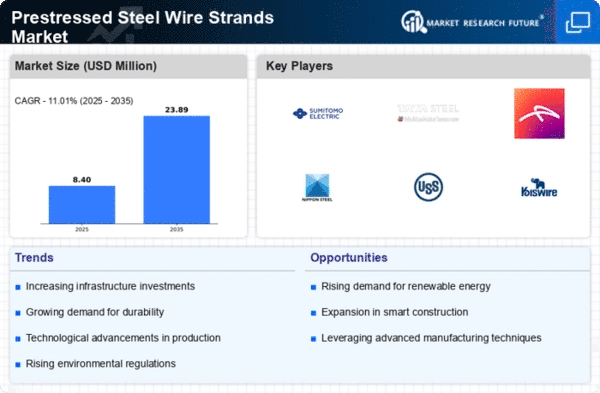
As per MRFR analysis, the Prestressed Steel Wire Strands Market Size was estimated at 7.57 USD Million in 2024. The Prestressed Steel Wire Strands industry is projected to grow from 8.41 in 2025 to 23.89 by 2035, exhibiting a compound annual growth rate (CAGR) of 11.01 during the forecast period 2025 - 2035.

Key Market Trends & Highlights

The Prestressed Steel Wire Strands Market is poised for growth driven by sustainability and technological advancements.

  • North America remains the largest market for prestressed steel wire strands, reflecting robust demand in the construction sector. Asia-Pacific is identified as the fastest-growing region, driven by rapid urbanization and infrastructure projects. The construction segment dominates the market, while the infrastructure segment is experiencing the highest growth rates. Key market drivers include rising demand in the construction sector and sustainability initiatives that promote eco-friendly practices.

Market Size & Forecast

2024 Market Size 7.57 (USD Million)
2035 Market Size 23.89 (USD Million)
CAGR (2025 - 2035) 11.01%
Largest Regional Market Share in 2024 Asia-Pacific

Major Players

<p>Sumitomo Electric Industries (JP), Tata Steel (IN), ArcelorMittal (LU), Nippon Steel Corporation (JP), U.S. Steel (US), Kiswire Ltd. (KR), Insteel Industries (US), Saarstahl AG (DE), Bekaert (BE)</p>

Market Trends

The Prestressed Steel Wire Strands Market is currently experiencing a notable evolution, driven by various factors that influence construction and infrastructure development. The demand for prestressed steel wire strands is primarily linked to their application in enhancing the strength and durability of concrete structures. As urbanization continues to expand, the need for robust construction materials becomes increasingly critical. This market appears to be benefiting from advancements in manufacturing technologies, which may lead to improved product quality and performance. Furthermore, the growing emphasis on sustainable construction practices suggests a potential shift towards materials that offer both efficiency and environmental benefits. In addition, the Prestressed Steel Wire Strands Market is likely to witness a diversification of applications beyond traditional uses. Industries such as transportation, energy, and commercial construction are increasingly adopting these materials for their structural integrity and longevity. This trend indicates a broader acceptance of prestressed steel wire strands in various sectors, potentially leading to new opportunities for manufacturers. As the market evolves, stakeholders may need to adapt to changing regulations and standards that govern material usage, ensuring compliance while meeting the demands of a dynamic construction landscape.

Sustainability Focus

The emphasis on sustainable construction practices is reshaping the Prestressed Steel Wire Strands Market. Manufacturers are exploring eco-friendly materials and processes, which may enhance the appeal of prestressed steel wire strands in environmentally conscious projects.

Technological Advancements

Innovations in manufacturing techniques are likely to improve the quality and performance of prestressed steel wire strands. Enhanced production methods could lead to stronger, more reliable products, thereby expanding their applications in various construction sectors.

Diversification of Applications

The Prestressed Steel Wire Strands Market is witnessing a trend towards diversification, with increasing adoption in sectors such as transportation and energy. This broadening of applications suggests a growing recognition of the benefits these materials offer in enhancing structural integrity.

Prestressed Steel Wire Strands Market Market Drivers

Market Growth Projections

The Global Prestressed Steel Wire And Strands Market Industry is poised for substantial growth, with projections indicating a market size of 3.88 USD Billion in 2024 and an anticipated increase to 6.47 USD Billion by 2035. This growth trajectory, characterized by a CAGR of 4.75% from 2025 to 2035, underscores the increasing reliance on prestressed materials in construction and infrastructure projects. The market dynamics reflect a convergence of factors, including technological advancements, regulatory support, and rising demand across various sectors, suggesting a robust future for prestressed steel wire and strands.

Global Urbanization Trends

The ongoing trend of urbanization is a significant factor propelling the Global Prestressed Steel Wire And Strands Market Industry. As populations migrate towards urban areas, the demand for housing, transportation, and public facilities escalates. Prestressed steel wire and strands are essential in meeting these demands due to their strength and versatility. The increasing urban population necessitates the construction of high-rise buildings and expansive infrastructure projects, thereby driving the market forward. This trend is expected to contribute to the projected growth of the market, aligning with the broader global economic development objectives.

Infrastructure Development

The Global Prestressed Steel Wire And Strands Market Industry is experiencing a surge in demand driven by extensive infrastructure development projects worldwide. Governments are increasingly investing in transportation networks, bridges, and high-rise buildings, which require robust materials like prestressed steel wire and strands. For instance, the global market is projected to reach 3.88 USD Billion in 2024, reflecting the rising need for durable construction materials. This trend is likely to continue as urbanization accelerates, particularly in emerging economies, where infrastructure projects are pivotal for economic growth. The emphasis on sustainable construction practices further enhances the relevance of prestressed steel solutions.

Technological Advancements

Technological innovations in the manufacturing processes of prestressed steel wire and strands are significantly influencing the Global Prestressed Steel Wire And Strands Market Industry. Enhanced production techniques, including advanced heat treatment and surface coating methods, improve the performance and longevity of these materials. Such advancements not only increase the efficiency of production but also reduce costs, making prestressed steel solutions more accessible to a broader range of applications. As a result, the market is expected to grow at a CAGR of 4.75% from 2025 to 2035, indicating a strong future trajectory driven by ongoing technological improvements.

Rising Demand in Construction Sector

The construction sector's robust growth is a primary driver for the Global Prestressed Steel Wire And Strands Market Industry. With the increasing number of residential and commercial projects, the demand for high-strength materials is on the rise. Prestressed steel wire and strands are favored for their ability to enhance structural integrity and reduce material usage. As the market evolves, it is anticipated to expand to 6.47 USD Billion by 2035, reflecting the sustained interest in innovative construction solutions. This growth is further fueled by the global push for energy-efficient buildings, where prestressed materials play a crucial role in achieving sustainability goals.

Regulatory Support for Infrastructure Projects

Government policies and regulations that support infrastructure development are pivotal for the Global Prestressed Steel Wire And Strands Market Industry. Many countries are implementing frameworks that prioritize the construction of resilient infrastructure, which inherently requires high-quality materials like prestressed steel. For example, initiatives aimed at enhancing transportation systems and public utilities create a favorable environment for the adoption of prestressed solutions. This regulatory backing not only stimulates market growth but also encourages investments in research and development, ensuring that the industry remains competitive and innovative in meeting future demands.

Market Segment Insights

By Application: Construction (Largest) vs. Infrastructure (Fastest-Growing)

<p>The Prestressed Steel Wire Strands Market exhibits a diverse application landscape, with the construction sector commanding the largest share due to the rising demand for durable and flexible materials in building infrastructure. This sector significantly contributes to the overall market, driven by both residential and commercial construction projects. On the other hand, infrastructure applications are gaining traction, fueled by increased investments in urban development and reconstruction of existing facilities, thus emerging as a robust segment. Growth trends are dominated by factors such as urbanization, population growth, and government expenditure on public projects. The construction sector benefits from a steady influx of projects, while the burgeoning infrastructure sector is spurred by sustainability initiatives and unforeseen repair needs of aged structures. As the demand for high-performance materials grows, prestressed steel wire strands are becoming essential in achieving efficiency and longevity in various applications, reflecting the dynamic nature of this market.</p>

<p>Construction: Prestressed Steel Wire Strands (Dominant) vs. Infrastructure (Emerging)</p>

<p>In the Prestressed Steel Wire Strands Market, construction remains the dominant application due to the material's inherent advantages such as high tensile strength and resistance to fatigue, making it ideal for beams and slabs in commercial and residential buildings. This dominant position is complemented by a steady demand for infrastructure projects, where prestressed steel wire strands are increasingly recognized for their ability to enhance the structural integrity and lifespan of bridges and highways. The emerging infrastructure segment is characterized by rapid advancements in construction techniques and recycling initiatives, which favor the adoption of high-performance materials. With sustainability becoming central to infrastructure development, expect prestressed steel wire strands to play a crucial role in innovative projects aimed at improving efficiency and environmental responsibility.</p>

By End Use: Residential (Largest) vs. Commercial (Fastest-Growing)

<p>The Prestressed Steel Wire Strands Market is witnessing a diverse distribution among various end-use segments. Residential applications currently represent the largest share, attributed to the growing demand for housing and infrastructure development. On the contrary, the commercial segment is rapidly evolving, fueled by increasing investments in commercial buildings and public infrastructures, highlighting the sector's critical role in market dynamics. Analyzing growth trends, the residential end use continues to thrive, driven by home <a href="https://www.marketresearchfuture.com/reports/construction-market-16065">construction</a> and renovation projects. Meanwhile, the commercial segment is characterized by an upward trajectory due to urbanization, rising demand for efficient construction materials, and government initiatives promoting infrastructure projects. This dual growth signifies a robust competitive landscape, with each segment focusing on specific applications and innovations to meet evolving market needs.</p>

<p>Residential (Dominant) vs. Industrial (Emerging)</p>

<p>The residential segment of the Prestressed Steel Wire Strands Market is dominant due to its substantial demand in the construction of houses, apartments, and residential complexes. This segment benefits from stable housing trends and renovation activities. In contrast, the industrial segment is emerging, driven by the need for robust construction solutions in factories, warehouses, and manufacturing plants. Industrial applications often require high-strength materials capable of withstanding heavy loads and demanding operational conditions. While residential projects prioritize aesthetics and cost-efficiency, industrial applications focus on durability and performance, presenting unique challenges and opportunities for manufacturers within the sector.</p>

By Material Type: High Carbon Steel (Largest) vs. Stainless Steel (Fastest-Growing)

<p>The Prestressed Steel Wire Strands Market exhibits a diverse distribution of material types, with High Carbon Steel leading the market significantly. Its inherent properties, such as high tensile strength and durability, align perfectly with the demanding applications in construction and infrastructure projects. Meanwhile, Stainless Steel is emerging quickly, gaining attention for its corrosion resistance and longevity, making it particularly appealing in environments prone to moisture and chemical exposure. Low Carbon Steel and Alloy Steel follow, commanding sizeable shares but lagging in growth compared to the leaders.</p>

<p>High Carbon Steel (Dominant) vs. Stainless Steel (Emerging)</p>

<p>High Carbon Steel remains the dominant material in the Prestressed Steel Wire Strands Market due to its superior strength and ability to withstand significant tension. Used predominantly in high-stress applications like bridges and precast concrete structures, it offers reliability and performance. In contrast, Stainless Steel, while still emerging, is poised to capture a larger market share as it meets the increasing demand for corrosion-resistant construction materials. Its enhanced durability under harsh conditions makes it an attractive option for modern infrastructure projects, particularly where longevity and maintenance reduction are priorities. As sustainability concerns grow, the need for more environmentally friendly materials also favors Stainless Steel, setting it up for continued growth.</p>

By Manufacturing Process: Hot Rolling (Largest) vs. Cold Drawing (Fastest-Growing)

<p>In the Prestressed Steel Wire Strands Market, the manufacturing process segment is primarily dominated by Hot Rolling, which accounts for a significant portion of the market share. Hot Rolling has established itself as the leading process due to its efficiency and cost-effectiveness, making it the go-to choice for many manufacturers. Following closely is Cold Drawing, which is gaining traction and rapidly increasing its market share, driven by demand for high-strength wire strands and improved product quality.</p>

<p>Cold Drawing (Fastest-Growing) vs. Wire Drawing (Emerging)</p>

<p>Cold Drawing stands out as the fastest-growing segment within the Prestressed Steel Wire Strands Market, primarily due to its ability to produce wires with enhanced mechanical properties. This process involves drawing wire through a series of dies to reduce its diameter, which leads to increased strength and better fatigue resistance. On the other hand, Wire Drawing also plays a significant role but is considered an emerging method, as it focuses on creating wire from larger steel rods. While Wire Drawing is crucial for specific applications, it does not match the growth pace and demand seen in Cold Drawing, which caters to newer construction and engineering projects.</p>

By Diameter Size: 5 mm to 10 mm (Largest) vs. More than 15 mm (Fastest-Growing)

<p>In the Prestressed Steel Wire Strands Market, the diameter size segment exhibits a varied distribution of market share across four distinct categories. The range of 5 mm to 10 mm dominates the market, holding the largest share, primarily due to its versatility and extensive application in construction projects. Conversely, the segment of 'More than 15 mm' is emerging rapidly, capturing increased attention from major construction firms seeking robust materials for large-scale infrastructure.</p>

<p>Diameter Size: 5 mm to 10 mm (Dominant) vs. More than 15 mm (Emerging)</p>

<p>The diameter size segment of 5 mm to 10 mm stands as a dominant force in the Prestressed Steel Wire Strands Market, celebrated for its adaptability across various construction applications such as bridges and high-rise buildings. This size range provides the required tension strength, making it preferred among engineers and contractors. On the other hand, the 'More than 15 mm' category is emerging as a fast-growing segment, driven by the increasing demand for sturdier materials in heavy-duty applications like industrial facilities and large infrastructure projects. This segment's growth is further fueled by ongoing advancements in manufacturing processes and a stronger focus on sustainability in construction.</p>

Get more detailed insights about Prestressed Steel Wire And Strands Market Research Report—Global Forecast till 2035

Regional Insights

North America : Established Market with Growth Potential

The North American prestressed steel wire strands market is projected to reach $1.5 billion by December 2025. Key growth drivers include increasing infrastructure investments and a rising demand for durable construction materials. Regulatory support for sustainable building practices is also a significant catalyst, enhancing market dynamics. The region's focus on innovation and quality standards further boosts demand, positioning it for steady growth in the coming years. Leading countries in this region include the U.S. and Canada, where major players like U.S. Steel and Insteel Industries dominate the market. The competitive landscape is characterized by a mix of established firms and emerging players, all striving to enhance product offerings and expand market share. The presence of key manufacturers ensures a robust supply chain, catering to various sectors such as construction and manufacturing.

Europe : Innovative Hub for Steel Solutions

Europe's prestressed steel wire strands market is expected to reach $1.2 billion by December 2025, driven by stringent regulations promoting sustainability and innovation. The region's commitment to reducing carbon emissions and enhancing energy efficiency in construction is a key growth driver. Additionally, the increasing demand for high-quality materials in infrastructure projects supports market expansion, making Europe a leader in sustainable construction practices. Germany, France, and the UK are the leading countries in this market, with companies like ArcelorMittal and Bekaert playing pivotal roles. The competitive landscape is marked by a focus on technological advancements and eco-friendly solutions. European manufacturers are increasingly investing in R&D to develop innovative products that meet regulatory standards and customer expectations, ensuring their competitive edge in the global market.

Asia-Pacific : Dominant Market with High Demand

The Asia-Pacific region is the largest market for prestressed steel wire strands, projected to reach $4.0 billion by December 2025. This growth is fueled by rapid urbanization, increasing infrastructure development, and a booming construction sector. Countries like China and India are at the forefront, with significant investments in transportation and housing projects. Regulatory frameworks promoting infrastructure development further enhance market dynamics, making this region a powerhouse in the industry. China, Japan, and India are the leading countries, with major players like Sumitomo Electric Industries and Tata Steel dominating the landscape. The competitive environment is characterized by a mix of local and international firms, all vying for market share. The presence of key manufacturers ensures a steady supply of high-quality products, catering to the growing demand in various sectors, including construction and engineering.

Middle East and Africa : Emerging Market with Growth Opportunities

The Middle East and Africa's prestressed steel wire strands market is anticipated to reach $1.87 billion by December 2025. The region is witnessing a surge in infrastructure projects, driven by government initiatives aimed at economic diversification and urban development. Increased investments in construction and transportation sectors are key growth drivers, supported by favorable regulatory environments that encourage foreign investment and technology transfer. Leading countries in this region include the UAE, South Africa, and Saudi Arabia, where local and international players are increasingly active. The competitive landscape is evolving, with companies like Kiswire Ltd. and Saarstahl AG making significant inroads. The presence of key manufacturers and a growing demand for high-quality materials position the region for substantial growth in the prestressed steel wire strands market.

Key Players and Competitive Insights

The Prestressed Steel Wire Strands Market is characterized by a competitive landscape that is increasingly shaped by innovation, strategic partnerships, and regional expansions. Key players such as Sumitomo Electric Industries (Japan), Tata Steel (India), and Bekaert (Belgium) are actively pursuing strategies that enhance their market positioning. For instance, Sumitomo Electric Industries (Japan) has focused on technological advancements in manufacturing processes, which not only improve product quality but also reduce production costs. Similarly, Tata Steel (India) has been investing in sustainable practices, aligning its operations with global environmental standards, thereby appealing to a more eco-conscious customer base. Collectively, these strategies contribute to a dynamic competitive environment where companies are not only vying for market share but also striving to lead in innovation and sustainability.In terms of business tactics, companies are increasingly localizing manufacturing to reduce lead times and optimize supply chains. This approach appears to be particularly effective in a moderately fragmented market, where the collective influence of key players can significantly impact pricing and availability. The competitive structure is evolving, with larger firms leveraging their scale to enhance operational efficiencies while smaller players focus on niche markets and specialized products.


In November Bekaert (Belgium) announced a strategic partnership with a leading construction firm to develop advanced prestressed concrete solutions. This collaboration is expected to enhance Bekaert's product offerings and expand its market reach, particularly in the infrastructure sector. The strategic importance of this partnership lies in its potential to drive innovation in construction methodologies, thereby positioning Bekaert as a leader in the development of sustainable building materials.


In October Tata Steel (India) launched a new line of eco-friendly prestressed steel wire strands, which are produced using recycled materials. This initiative not only aligns with global sustainability trends but also caters to the growing demand for environmentally responsible construction materials. The launch signifies Tata Steel's commitment to reducing its carbon footprint and enhancing its competitive edge in a market that increasingly values sustainability.


In September Sumitomo Electric Industries (Japan) expanded its manufacturing capabilities by investing in a new facility in Southeast Asia. This move is anticipated to bolster its production capacity and improve supply chain efficiency in a region that is witnessing rapid infrastructure development. The strategic importance of this expansion lies in its potential to enhance Sumitomo's responsiveness to market demands and strengthen its position in the Asia-Pacific region.


As of December the competitive trends in the Prestressed Steel Wire Strands Market are increasingly defined by digitalization, sustainability, and the integration of advanced technologies such as AI. Strategic alliances are becoming more prevalent, as companies recognize the value of collaboration in driving innovation and enhancing operational efficiencies. Looking ahead, the competitive differentiation is likely to evolve from traditional price-based competition to a focus on technological advancements, supply chain reliability, and sustainable practices. This shift underscores the importance of innovation as a key driver of success in the market.

Key Companies in the Prestressed Steel Wire Strands Market include

Industry Developments

Future Outlook

Prestressed Steel Wire Strands Market Future Outlook

<p>The Prestressed Steel Wire Strands Market is projected to grow at 11.01% CAGR from 2025 to 2035, driven by infrastructure development, urbanization, and technological advancements.</p>

New opportunities lie in:

  • <p>Expansion into renewable energy sector projects Development of high-performance, corrosion-resistant strands Implementation of automated manufacturing processes for efficiency</p>

<p>By 2035, the market is poised for robust growth, reflecting increased demand and innovation.</p>

Market Segmentation

Prestressed Steel Wire Strands Market End Use Outlook

  • Residential
  • Commercial
  • Industrial
  • Public Works
  • Utilities

Prestressed Steel Wire Strands Market Application Outlook

  • Construction
  • Infrastructure
  • Mining
  • Transportation
  • Energy

Prestressed Steel Wire Strands Market Diameter Size Outlook

  • Less than 5 mm
  • 5 mm to 10 mm
  • 10 mm to 15 mm
  • More than 15 mm

Prestressed Steel Wire Strands Market Material Type Outlook

  • High Carbon Steel
  • Low Carbon Steel
  • Stainless Steel
  • Alloy Steel

Prestressed Steel Wire Strands Market Manufacturing Process Outlook

  • Hot Rolling
  • Cold Drawing
  • Wire Drawing
  • Heat Treatment

Report Scope

MARKET SIZE 2024 7.57(USD Million)
MARKET SIZE 2025 8.41(USD Million)
MARKET SIZE 2035 23.89(USD Million)
COMPOUND ANNUAL GROWTH RATE (CAGR) 11.01% (2025 - 2035)
REPORT COVERAGE Revenue Forecast, Competitive Landscape, Growth Factors, and Trends
BASE YEAR 2024
Market Forecast Period 2025 - 2035
Historical Data 2019 - 2024
Market Forecast Units USD Million
Key Companies Profiled Sumitomo Electric Industries (JP), Tata Steel (IN), ArcelorMittal (LU), Nippon Steel Corporation (JP), U.S. Steel (US), Kiswire Ltd. (KR), Insteel Industries (US), Saarstahl AG (DE), Bekaert (BE)
Segments Covered Application, End Use, Material Type, Manufacturing Process, Diameter Size
Key Market Opportunities Growing demand for sustainable construction materials drives innovation in the Prestressed Steel Wire Strands Market.
Key Market Dynamics Rising demand for durable construction materials drives innovation and competition in the Prestressed Steel Wire Strands market.
Countries Covered North America, Europe, APAC, South America, MEA

FAQs

What growth rate global prestressed steel wire and strands market would register in the future?

The global prestressed steel wire and strands market would register a growth of 4.79%.

Which industry will play a crucial role in taking the prestressed steel wire and strands market ahead?

Construction Equipment, will play a crucial role in taking the prestressed steel wire and strands market ahead

What is the key restraining factor for the global prestressed steel wire and strands market?

Fluctuating prices of raw materials and related regulations.

Which Asia-Pacific country would set the trend in the prestressed steel wire and strands market?

Yes, North America country would set the trend in the prestressed steel wire and strands market

  1. SECTION I: EXECUTIVE SUMMARY AND KEY HIGHLIGHTS |
    1. EXECUTIVE SUMMARY |
      1. Market Overview |
      2. Key Findings |
      3. Market Segmentation |
      4. Competitive Landscape |
      5. Challenges and Opportunities |
      6. Future Outlook 2
  2. SECTION II: SCOPING, METHODOLOGY AND MARKET STRUCTURE |
    1. MARKET INTRODUCTION |
      1. Definition |
      2. Scope of the study |--
    2. RESEARCH METHODOLOGY |
      1. Overview |
      2. Data Mining |
      3. Secondary Research |
      4. Primary Research |--
      5. Forecasting Model |
      6. Market Size Estimation |--
      7. Data Triangulation |
      8. Validation 3
  3. SECTION III: QUALITATIVE ANALYSIS |
    1. MARKET DYNAMICS |
      1. Overview |
      2. Drivers |
      3. Restraints |
      4. Opportunities |
    2. MARKET FACTOR ANALYSIS |
      1. Value chain Analysis |
      2. Porter's Five Forces Analysis |--
      3. COVID-19 Impact Analysis |--
  4. SECTION IV: QUANTITATIVE ANALYSIS |
    1. Chemicals and Materials, BY Application (USD Million) |
      1. Construction |
      2. Infrastructure |
      3. Mining |
      4. Transportation |
      5. Energy |
    2. Chemicals and Materials, BY End Use (USD Million) |
      1. Residential |
      2. Commercial |
      3. Industrial |
      4. Public Works |
      5. Utilities |
    3. Chemicals and Materials, BY Material Type (USD Million) |
      1. High Carbon Steel |
      2. Low Carbon Steel |
      3. Stainless Steel |
      4. Alloy Steel |
    4. Chemicals and Materials, BY Manufacturing Process (USD Million) |
      1. Hot Rolling |
      2. Cold Drawing |
      3. Wire Drawing |
      4. Heat Treatment |
    5. Chemicals and Materials, BY Diameter Size (USD Million) |
      1. Less than 5 mm |
      2. 5 mm to 10 mm |
      3. 10 mm to 15 mm |
      4. More than 15 mm |
    6. Chemicals and Materials, BY Region (USD Million) |
      1. North America |--
      2. Europe |--
      3. APAC |--
      4. South America |--
      5. MEA |--
  5. SECTION V: COMPETITIVE ANALYSIS |
    1. Competitive Landscape |
      1. Overview |
      2. Competitive Analysis |
      3. Market share Analysis |
      4. Major Growth Strategy in the Chemicals and Materials |
      5. Competitive Benchmarking |
      6. Leading Players in Terms of Number of Developments in the Chemicals and Materials |
      7. Key developments and growth strategies |--
      8. Major Players Financial Matrix |--
    2. Company Profiles |
      1. Sumitomo Electric Industries (JP) |--
      2. Tata Steel (IN) |--
      3. ArcelorMittal (LU) |--
      4. Nippon Steel Corporation (JP) |--
      5. U.S. Steel (US) |--
      6. Kiswire Ltd. (KR) |--
      7. Insteel Industries (US) |--
      8. Saarstahl AG (DE) |--
      9. Bekaert (BE) |--
    3. Appendix |
      1. References |
      2. Related Reports

Chemicals and Materials Market Segmentation

Chemicals and Materials By Application (USD Million, 2025-2035)

  • Construction
  • Infrastructure
  • Mining
  • Transportation
  • Energy

Chemicals and Materials By End Use (USD Million, 2025-2035)

  • Residential
  • Commercial
  • Industrial
  • Public Works
  • Utilities

Chemicals and Materials By Material Type (USD Million, 2025-2035)

  • High Carbon Steel
  • Low Carbon Steel
  • Stainless Steel
  • Alloy Steel

Chemicals and Materials By Manufacturing Process (USD Million, 2025-2035)

  • Hot Rolling
  • Cold Drawing
  • Wire Drawing
  • Heat Treatment

Chemicals and Materials By Diameter Size (USD Million, 2025-2035)

  • Less than 5 mm
  • 5 mm to 10 mm
  • 10 mm to 15 mm
  • More than 15 mm
Infographic

Free Sample Request

Kindly complete the form below to receive a free sample of this Report

Get Free Sample

Customer Strories

Compare Licence

×
Features License Type
Single User Multiuser License Enterprise User
Price $4,950 $5,950 $7,250
Maximum User Access Limit 1 User Upto 10 Users Unrestricted Access Throughout the Organization
Free Customization
Direct Access to Analyst
Deliverable Format
Platform Access
Discount on Next Purchase 10% 15% 15%
Printable Versions