Request Free Sample ×

Kindly complete the form below to receive a free sample of this Report

* Please use a valid business email

Leading companies partner with us for data-driven Insights

clients tt-cursor
Hero Background
English
Chinese
French
Japanese
Korean
German
Spanish

Power Semiconductor Market Share

ID: MRFR/SEM/0672-HCR
100 Pages
Aarti Dhapte
December 2024

Power Semiconductor Market Size, Share and Research Report By Module (Power Modules and Power Discrete), By Application (Industrial, Automotive, Aerospace, Military and Consumer Electronics), By Component (Rectifier, Diode and Thyristor), By Material (Silicon Carbide, Gan and Silicon), and By Region (North America, Europe, Asia-Pacific, and Rest Of The World) - Industry Forecast Till 2035

Share:
Download PDF ×

We do not share your information with anyone. However, we may send you emails based on your report interest from time to time. You may contact us at any time to opt-out.

Power Semiconductor Market Infographic
Purchase Options

Market Share

Introduction: Navigating the Competitive Landscape of Power Semiconductors

The power semiconductor market is experiencing unprecedented competition, driven by rapid technological developments, changing regulations and a strong demand for energy efficiency and sustainable development. The main players, including system suppliers, IT service providers and system houses, are using the latest technology, such as artificial intelligence, the Internet of Things and green solutions, to establish their leadership in the market. Suppliers are focusing on improving the performance and reliability of their products, while IT companies are putting their focus on a perfect connection and automation. The new entrants, especially the AI startups, are challenging the established thinking and are changing the positioning of the suppliers. The opportunities for growth in the region, especially in Asia-Pacific and North America, are increasing, which is reflected in the strategic trends towards local production and sustainable production. In this dynamic environment, it is important to understand the technologically based differentiators that will determine market share and competitive advantage in the coming years.

Competitive Positioning

Full-Suite Integrators

These vendors offer a comprehensive range of power semiconductor solutions, integrating various technologies to serve diverse applications.

Vendor Competitive Edge Solution Focus Regional Focus
Infineon Strong portfolio in power management Power MOSFETs, IGBTs Global
ON Semiconductor Expertise in energy-efficient solutions Power management ICs North America, Europe, Asia
Texas Instruments Broad analog and embedded processing Power management solutions Global
STMicroelectronics Diverse semiconductor technologies Power MOSFETs, IGBTs Global

Specialized Technology Vendors

These vendors focus on niche technologies within the power semiconductor space, providing specialized solutions for specific applications.

Vendor Competitive Edge Solution Focus Regional Focus
Vishay Intertechnology Wide range of passive and active components Power resistors, MOSFETs Global
Renesas Electronics Strong in automotive applications Power management ICs Asia, North America
Nexperia Expertise in discrete semiconductors Discrete MOSFETs, diodes Global
Littelfuse Focus on circuit protection solutions Fuses, TVS diodes Global

Infrastructure & Equipment Providers

These vendors supply essential equipment and infrastructure for the production and application of power semiconductors.

Vendor Competitive Edge Solution Focus Regional Focus
Mitsubishi Electric Corporation Strong in industrial applications IGBTs, power modules Asia, Europe
Toshiba Innovative power device technologies Power MOSFETs, IGBTs Asia, North America
Fuji Electric Expertise in power electronics IGBT modules, power converters Asia, Europe
Semikron Focus on power semiconductor modules IGBT modules, power modules Global

Emerging Players & Regional Champions

  • GaN SYSTEMS of Canada specializes in gallium nitride power semiconductors for high-efficiency applications. It has recently won a contract to supply GaN power switches to a major manufacturer of EVs. GaN is replacing silicon in high-efficiency applications.
  • Navitas Semiconductor (USA): focuses on GaN power ICs for fast charging and renewable energy applications. Recently it has teamed up with a leading mobile phone manufacturer to develop integrated charging solutions, thus complementing the traditional silicon suppliers with smaller, lighter, and more efficient solutions.
  • Power Integrations (US): Offers power conversion solutions based on energy-efficiency principles. It recently launched a new family of ICs for EV chargers, thereby establishing itself as a challenger to established players by offering superior performance and lower costs.
  • The first is Infineon. Infineon is a well-established company, but its recent focus on silicon carbide technology for use in the automobile makes it a regional champion. It has recently been awarded contracts from several European carmakers, enabling it to compete more successfully against the silicon suppliers.

Regional Trends: In 2024, there is a noticeable trend towards the use of wide bandgap semiconductors, such as GaN and SiC, prompted by the growing demand for higher efficiency in electric vehicles and in the use of alternative energy sources. North America and Europe are the most specialised regions, with considerable R&D investment in advanced power semiconductors. In the meantime, Asia-Pacific is becoming a major manufacturing centre, with the local industry growing stronger.

Collaborations & M&A Movements

  • Infineon and ST have joined together to develop next-generation power-diode solutions for the energy-saving drive of electric vehicles.
  • In the beginning of 2024, Texas Instruments acquired the Analog Devices power-management division, in order to extend its product range and market share in the field of power semiconductors, in order to meet the increasing demand for power-efficient solutions in the field of consumer electronics.
  • NXP Semiconductors and ON Semiconductors have entered into a joint venture to develop advanced power-management ICs for applications in the field of sustainable energy, thereby strengthening their position in the market for sustainable energy in the face of increasing regulatory pressure for green technology.

Competitive Summary Table

Capability Leading Players Remarks
High-Efficiency Power Conversion Infineon Technologies, Texas Instruments CoolSiC technology from Infineon is well known for its power conversion applications. TI's power-management ICs are used extensively in the digital and mobile devices market. The company's power-management ICs are a good example of the company's strengths in high-efficiency solutions.
Wide Bandgap Semiconductors Cree (Wolfspeed), ON Semiconductor SiC has been a key technology in high-power applications, especially in electric vehicles and in applications for the production of energy from renewable sources. But the growth of GaN technology has also been very rapid. GaN solutions from ON Semiconductor are enabling the development of smaller, lighter and more efficient power systems.
Thermal Management Solutions STMicroelectronics, Nexperia STMicroelectronics offers advanced thermal management solutions integrated with their power semiconductors, enhancing reliability. Nexperia focuses on robust thermal performance in their MOSFETs, which are critical for automotive applications.
Integration with IoT NXP Semiconductors, Analog Devices NXP is leveraging its power semiconductors in IoT applications, providing secure and efficient power management. Analog Devices integrates power management with their sensor technologies, enhancing overall system performance in smart devices.
Sustainability Initiatives Renesas Electronics, Infineon Technologies Renesas is committed to sustainability, focusing on eco-friendly manufacturing processes and energy-efficient products. Infineon has launched initiatives to reduce carbon footprint in production, aligning with global sustainability goals.

Conclusion: Navigating Power Semiconductor Market Dynamics

In 2024, the power-semiconductor market will be characterized by intense competition and significant fragmentation. Several companies will compete for the same share of the market, both from the historical and the new point of view. The regional trends are characterized by a growing focus on automation and sustainability, especially in North America and Asia-Pacific, where the demand for energy-saving solutions is increasing. Strategically, suppliers must strategically position themselves and rely on advanced capabilities such as artificial intelligence-driven design, flexible production and sustainable practices. The big companies, meanwhile, are focused on optimizing their existing technology, while new entrants are introducing innovations at a rapid pace, often outpacing the established way of thinking. It is therefore essential for decision-makers to be able to combine these capabilities in their strategies.

Author
Author Profile
Aarti Dhapte
AVP - Research

A consulting professional focused on helping businesses navigate complex markets through structured research and strategic insights. I partner with clients to solve high-impact business problems across market entry strategy, competitive intelligence, and opportunity assessment. Over the course of my experience, I have led and contributed to 100+ market research and consulting engagements, delivering insights across multiple industries and geographies, and supporting strategic decisions linked to $500M+ market opportunities. My core expertise lies in building robust market sizing, forecasting, and commercial models (top-down and bottom-up), alongside deep-dive competitive and industry analysis. I have played a key role in shaping go-to-market strategies, investment cases, and growth roadmaps, enabling clients to make confident, data-backed decisions in dynamic markets.

Leave a Comment

FAQs

What is the projected market valuation of The Global Power Semiconductor by 2035?

<p>The projected market valuation for The Global Power Semiconductor is 134.5 USD Billion by 2035.</p>

What was the market valuation of The Global Power Semiconductor in 2024?

<p>The overall market valuation of The Global Power Semiconductor was 69.4 USD Billion in 2024.</p>

What is the expected CAGR for The Global Power Semiconductor during the forecast period 2025 - 2035?

<p>The expected CAGR for The Global Power Semiconductor during the forecast period 2025 - 2035 is 6.2%.</p>

Which companies are considered key players in The Global Power Semiconductor?

<p>Key players in The Global Power Semiconductor include Infineon Technologies, Texas Instruments, ON Semiconductor, and STMicroelectronics.</p>

What are the projected valuations for the Power Modules and Power Discrete segments by 2035?

<p>The projected valuation for the Power Modules segment is expected to reach 60.0 USD Billion, while Power Discrete may reach 74.5 USD Billion by 2035.</p>

How does the Consumer Electronics application segment perform in terms of valuation?

<p>The Consumer Electronics application segment had a valuation of 35.4 USD Billion in 2024 and is projected to reach 61.5 USD Billion by 2035.</p>

What are the expected valuations for Silicon Carbide and GaN materials by 2035?

Silicon Carbide is projected to reach 30.0 USD Billion, while GaN may reach 25.0 USD Billion by 2035.

What was the valuation of the Industrial application segment in 2024?

The Industrial application segment was valued at 15.0 USD Billion in 2024.

What are the projected valuations for the Thyristor component segment by 2035?

The Thyristor component segment is projected to reach 46.5 USD Billion by 2035.

How do the valuations of the Automotive and Aerospace application segments compare by 2035?

By 2035, the Automotive application segment is projected to reach 25.0 USD Billion, whereas the Aerospace segment may reach 10.0 USD Billion.

Market Summary

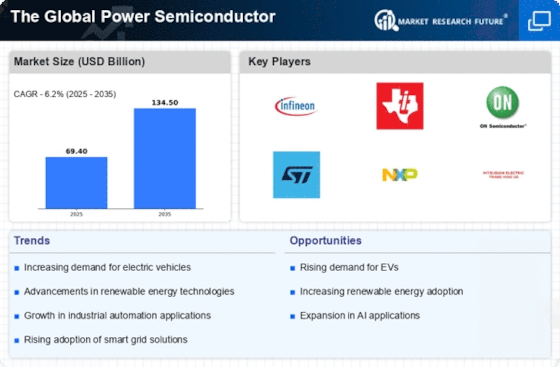
As per Market Research Future analysis, The Global Power Semiconductor Market was estimated at 69.4 USD Billion in 2024. The power semiconductor industry is projected to grow from 73.7 USD Billion in 2025 to 134.5 USD Billion by 2035, exhibiting a compound annual growth rate (CAGR) of 6.2% during the forecast period 2025 - 2035

Key Market Trends & Highlights

The Global Power Semiconductor Market is poised for substantial growth driven by technological advancements and increasing demand across various sectors.

  • The rise of electric vehicles is significantly influencing the demand for power semiconductors, particularly in the automotive segment. North America remains the largest market for power semiconductors, while Asia-Pacific is emerging as the fastest-growing region. Power modules continue to dominate the market, whereas power discrete devices are experiencing rapid growth. Key drivers include the surge in consumer electronics demand and the expansion of industrial automation, particularly in renewable energy applications.

Market Size & Forecast

2024 Market Size 69.4 (USD Billion)
2035 Market Size 134.5 (USD Billion)
CAGR (2025 - 2035) 6.2%
Largest Regional Market Share in 2024 Asia Pacific

Major Players

Infineon Technologies (DE), Texas Instruments (US), ON Semiconductor (US), STMicroelectronics (FR), NXP Semiconductors (NL), Mitsubishi Electric (JP), Renesas Electronics (JP), Vishay Intertechnology (US), Broadcom Inc. (US)

Market Trends

The Global Power Semiconductor Market is currently experiencing a transformative phase, driven by the increasing demand for energy-efficient solutions across various sectors. This market encompasses a wide range of devices that manage and convert electrical power, playing a crucial role in applications such as renewable energy systems, electric vehicles, and industrial automation. As the world shifts towards sustainable energy practices, the relevance of power semiconductors becomes more pronounced, suggesting a robust growth trajectory in the coming years. Furthermore, advancements in technology, including the development of wide bandgap semiconductors, are likely to enhance performance and efficiency, thereby attracting further investment and innovation. In addition to technological advancements, regulatory frameworks aimed at reducing carbon emissions are influencing The Global Power Semiconductor Market. Governments worldwide are implementing policies that promote the adoption of clean energy technologies, which in turn drives the demand for power semiconductor devices. This evolving landscape indicates that stakeholders must remain agile and responsive to emerging trends and consumer preferences. The interplay between technological innovation and regulatory support appears to be a key factor shaping the future of this market, potentially leading to new opportunities and challenges for industry participants.

Rise of Electric Vehicles

The increasing adoption of electric vehicles is significantly impacting The Global Power Semiconductor Market. As automakers transition towards electrification, the demand for efficient power management solutions is surging. This trend is likely to drive innovation in semiconductor technologies, enhancing performance and reducing energy consumption.

Growth in Renewable Energy

The shift towards renewable energy sources is reshaping The Global Power Semiconductor Market. Solar and wind energy systems require advanced power management solutions to optimize energy conversion and storage. This trend suggests a growing need for semiconductors that can efficiently handle fluctuating energy inputs.

Advancements in Wide Bandgap Semiconductors

The development of wide bandgap semiconductor materials is poised to revolutionize The Global Power Semiconductor Market. These materials offer superior performance in high-temperature and high-voltage applications, indicating a potential shift in industry standards and practices as manufacturers seek to enhance efficiency and reliability.

Power Semiconductor Market Market Drivers

Expansion of Industrial Automation

The ongoing expansion of industrial automation is significantly influencing The Global Power Semiconductor Industry. As industries increasingly adopt automation technologies, the need for reliable and efficient power management solutions becomes paramount. In 2025, the industrial automation sector is expected to witness a robust growth rate, with power semiconductors playing a crucial role in driving efficiency and reducing operational costs. The integration of power semiconductors in robotics, control systems, and machinery enhances performance and energy efficiency. This trend indicates a shift towards smart manufacturing, where power semiconductors are integral to optimizing processes and improving productivity, thereby propelling the market forward.

Growth in Renewable Energy Sources

The transition towards renewable energy sources is a significant driver for The Global Power Semiconductor Industry. As nations strive to reduce carbon emissions and enhance energy sustainability, the adoption of solar, wind, and other renewable technologies is accelerating. In 2025, investments in renewable energy infrastructure are projected to increase, leading to a heightened demand for power semiconductors that facilitate energy conversion and management. Power semiconductors are essential in inverters and converters used in renewable energy systems, ensuring efficient energy transfer. This growth not only supports environmental goals but also positions power semiconductors as critical components in the evolving energy landscape.

Emergence of Smart Grid Technologies

The emergence of smart grid technologies is reshaping The Global Power Semiconductor Industry. As energy distribution systems evolve, the need for efficient power management solutions becomes increasingly critical. In 2025, the implementation of smart grid technologies is expected to accelerate, driven by the demand for improved energy efficiency and reliability. Power semiconductors are integral to smart grid applications, facilitating real-time monitoring and control of energy flows. This trend indicates a shift towards more resilient and responsive energy systems, where power semiconductors play a key role in enhancing grid stability and integrating renewable energy sources. The growth of smart grid technologies is likely to propel the demand for power semiconductors, further solidifying their importance in the energy sector.

Surge in Consumer Electronics Demand

The increasing demand for consumer electronics is a pivotal driver for The Global Power Semiconductor Industry. As technology advances, devices such as smartphones, tablets, and laptops require more efficient power management solutions. In 2025, the consumer electronics sector is projected to account for a substantial share of the power semiconductor market, driven by innovations in energy-efficient designs. The proliferation of smart home devices and wearables further amplifies this trend, necessitating advanced power management systems. This surge in demand not only enhances the performance of electronic devices but also contributes to the overall growth of the power semiconductor market, as manufacturers seek to integrate more sophisticated semiconductor solutions to meet consumer expectations.

Advancements in Electric Vehicle Technology

The advancements in electric vehicle technology are driving transformative changes in The Global Power Semiconductor Industry. As electric vehicles gain traction, the demand for high-performance power semiconductors is surging. In 2025, the electric vehicle market is anticipated to expand significantly, with power semiconductors playing a vital role in enhancing battery management systems and electric drivetrains. These semiconductors are crucial for improving energy efficiency and performance, thereby addressing consumer concerns regarding range and charging times. The integration of advanced power semiconductor technologies in electric vehicles not only supports the automotive industry's shift towards electrification but also contributes to the overall growth of the power semiconductor market.

Market Segment Insights

By Module: Power Modules (Largest) vs. Power Discrete (Fastest-Growing)

The Global Power Semiconductor Market shows a significant distribution between Power Modules and Power Discrete components. Power Modules hold the largest market share, being preferred in applications requiring high power density and efficiency, such as electric vehicles and renewable energy systems. In contrast, Power Discrete semiconductors are gaining traction due to their versatility and the increasing demand for smaller, more efficient electronic devices, contributing to a dynamic market landscape.

Power Modules (Dominant) vs. Power Discrete (Emerging)

Power Modules are recognized for their robustness and efficiency in handling high power applications, making them the dominant segment within The Global Power Semiconductor Market. They are widely employed in sectors such as automotive, industrial automation, and renewable energy, benefitting from technological advancements and a growing push towards electrification. On the other hand, Power Discrete components are emerging as crucial players, favored for their adaptability in diverse applications, including consumer electronics and communication systems. Their growth can be attributed to the demand for compact solutions that offer high performance, driving innovation and increased market presence.

By Application: Industrial (Largest) vs. Automotive (Fastest-Growing)

The Global Power Semiconductor Market exhibits a diverse application landscape, with industrial applications commanding the largest market share. Sectors such as manufacturing and automation leverage power semiconductors for efficient power conversion and control. Automotive applications, however, are rapidly evolving, fueled by the increasing demand for electric vehicles (EVs) and hybrid technologies, positioning them as the fastest-growing segment in the market.

Automotive (Dominant) vs. Aerospace (Emerging)

In The Global Power Semiconductor Market, the automotive sector stands out as the dominant force, driven by the surge in electric vehicle production and the integration of more electronic systems in modern vehicles. Advanced power semiconductor devices enhance efficiency and performance in electric and autonomous driving technologies. Meanwhile, the aerospace sector emerges as a vital application area, experiencing growth through innovations in satellite and drone technologies. This market segment requires high-performance components that can operate reliably under extreme conditions, making it increasingly important as aerospace technology continues to advance.

By Component: Rectifier (Largest) vs. Diode (Fastest-Growing)

The Global Power Semiconductor Market's component segment is diversified among three main categories: Rectifiers, Diodes, and Thyristors. Among these, Rectifiers constitute the largest share, driven by their widespread application in power conversion systems and consumer electronics. In contrast, Diodes are rapidly gaining traction as the fastest-growing segment due to advancements in efficiency and performance, particularly in renewable energy applications and electric vehicles. Thyristors, while crucial for high-power applications, have a smaller market share compared to the other two components.

Diodes (Dominant) vs. Thyristors (Emerging)

Diodes represent a dominant force in The Global Power Semiconductor Market, known for their essential role in converting and controlling electric power in various applications, including rectification, voltage regulation, and signal modulation. They are experiencing robust growth, driven by the demand for energy-efficient solutions. Thyristors, categorized as an emerging segment, are increasingly utilized in high-power applications such as motor drives and power inverters. Their ability to handle high voltages and currents with efficiency positions them as an important alternative in specific applications, even as they face competition from newer, more efficient technologies.

By Material: Silicon Carbide (Largest) vs. GaN (Fastest-Growing)

In The Global Power Semiconductor Market, the material segment is dominated by Silicon Carbide (SiC), which has established itself as the largest player due to its superior thermal conductivity and efficiency in high-voltage applications. GaN has emerged as a significant contender, particularly in the realm of high-frequency devices, gaining traction among manufacturers looking for enhanced performance characteristics. Silicon, while still a considerable presence in power semiconductor applications, is showing relatively slower growth in comparison to its SiC and GaN counterparts, primarily due to the maturity of the technology and growing competition from advanced materials.

Silicon Carbide (Dominant) vs. GaN (Emerging)

Silicon Carbide (SiC) stands out as the dominant material in The Global Power Semiconductor Market, capturing attention for its unparalleled ability to operate under high temperatures and voltages, making it ideal for electric vehicles and renewable energy systems. Its characteristics allow for reduced energy loss and increased efficiency, making it a preferred choice for applications requiring robust performance. On the other hand, Gallium Nitride (GaN) is recognized as an emerging material, particularly favored in compact and high-frequency power conversion systems. GaN devices are becoming increasingly popular in consumer electronics and communication technology, winning over a segment of manufacturers seeking cutting-edge efficiency and smaller form factors.

Get more detailed insights about Power Semiconductor Market Research Report- Forecast to 2035

Regional Insights

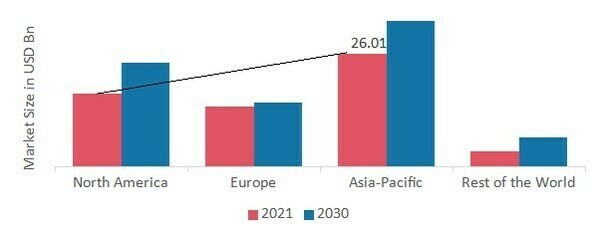
By region, the study provides the market insights into North America, Europe, Asia-Pacific, and the Rest of the World. The Asia Pacific power semiconductor market accounted for USD 26.01 billion in 2021 and is expected to exhibit a 43.60% CAGR during the study period. It is anticipated that the Asia-Pacific region will dominate the market for power semiconductors due to its domination of the global semiconductor industry and the support of governmental laws. Approximately 65% of the global market for discrete semiconductors is made up of China, Japan, Taiwan, and South Korea.

Further, the major countries studied in the market report are: The U.S., Canada, Germany, France, the UK, Italy, Spain, China, Japan, India, Australia, South Korea, and Brazil.

Figure 3: Power Semiconductor Market SHARE BY REGION 2021 (%)Power Semiconductor Market SHARE BY REGION 2021


North America power semiconductor market accounts for the fastest growing market share. The expansion of end-user industries like automotive, IT and telecommunications, military and aerospace, consumer electronics, and others is closely correlated with the growth of the power semiconductor market in North America. Moreover, US power semiconductor market held the largest market share, and the Canada power semiconductor market was the fastest-growing market in this region.Europe power semiconductor market is expected to grow at a substantial CAGR from 2024 to 2032. The market is expanding due to the rising adoption of advanced technologies and semiconductors across numerous sectors.

Many sectors focused on semiconductors have benefited from the increasing regional government involvement in research programme promotion, which is backed by a high-tech networking environment. Further, the UK power semiconductor market held the largest market share, and the Germany power semiconductor market was the fastest-growing market in the region.

Key Players and Competitive Insights

Major market players are spending a lot on R&D to increase their product lines, which will help the power semiconductor industry grow even more. Market participants are also taking various strategic initiatives to grow their worldwide footprint, including new product launches, contractual agreements, mergers and acquisitions, increased investments, market developments and collaboration with other organizations.Competitors in the industry must offer cost-effective items to expand and survive in an increasingly competitive and rising market industry.One of the primary business strategies manufacturers adopt in the global power semiconductor industry to benefit clients and expand the sector is manufacturing locally to reduce operating costs. In recent years, power semiconductor industry has provided medicine with some of the most significant benefits.The power semiconductor market major player such as Infineon, Vishay Intertechnology, Renesas Electronics, ON Semiconductor, Texas Instruments, Mitsubishi Electric Corporation, Littelfuse, Toshiba, Fuji Electric, Nexperia, Semekron and STMicroelectronics.A global Japanese manufacturer of electronics and electrical equipment with its headquarters in Tokyo, Japan, Mitsubishi Electric Corporation was founded on January 15, 1921. It is one of Mitsubishi's primary businesses.

In February the SLIMDIP-X power semiconductor module from Mitsubishi Electric Corporation, which offers low thermal resistance and noise for household appliance inverter systems, was recently released.The new SLIMDIPTM series module is intended to streamline and minimise the size of inverter systems used in appliances including refrigerators, washing machines, and air conditioners.The Netherlands' Nijmegen is home to the headquarters of the semiconductor firm Nexperia. It is a division of the Chinese business Wingtech Technology, which is partly owned by the government. It has front-end plants in Greater Manchester, England, and Hamburg, Germany.

In April the availability of Nexperia's second-generation 650 V GaN FETs, which support 80 PLUS Titanium-class power supply running at 2 kW and higher, was announced.In comparison to earlier technology and rival gadgets, it provides a significant performance boost.

Key Companies in the Power Semiconductor Market include

Industry Developments

  • Q2 2024: Infineon opens new $1.8 billion power semiconductor plant in Austria Infineon Technologies inaugurated a new power semiconductor manufacturing facility in Villach, Austria, aimed at expanding its capacity for automotive and industrial applications.
  • Q2 2024: ON Semiconductor Announces $600 Million Investment in New Silicon Carbide Facility ON Semiconductor revealed plans to invest $600 million in a new silicon carbide (SiC) manufacturing plant in the United States to meet rising demand from electric vehicle and renewable energy sectors.
  • Q2 2024: Navitas Semiconductor raises $70 million in Series D funding to expand GaN power chip production Navitas Semiconductor secured $70 million in Series D funding to accelerate the development and production of gallium nitride (GaN) power semiconductors for data centers and fast chargers.
  • Q3 2024: STMicroelectronics and Renault sign multi-year power semiconductor supply agreement STMicroelectronics entered into a multi-year contract to supply power semiconductors to Renault for use in electric vehicle powertrains.
  • Q3 2024: Infineon and Foxconn sign strategic partnership for automotive power semiconductors Infineon Technologies and Foxconn announced a strategic partnership to co-develop and supply power semiconductor solutions for next-generation electric vehicles.
  • Q3 2024: Mitsubishi Electric acquires minority stake in US-based power semiconductor startup Mitsubishi Electric acquired a minority equity stake in a US-based startup specializing in advanced power semiconductor devices for industrial and automotive markets.
  • Q4 2024: Wolfspeed opens world’s largest silicon carbide device fab in New York Wolfspeed officially opened its new silicon carbide device fabrication facility in New York, which is expected to significantly increase global SiC supply for EV and renewable energy applications.
  • Q4 2024: Texas Instruments announces $11 billion expansion of Sherman, Texas power semiconductor plant Texas Instruments announced an $11 billion investment to expand its Sherman, Texas plant, focusing on increased production of analog and power semiconductors.
  • Q1 2025: NXP Semiconductors launches new automotive power management IC family NXP Semiconductors introduced a new family of automotive power management integrated circuits (ICs) designed for next-generation electric and hybrid vehicles.
  • Q1 2025: Hitachi Energy and ABB sign partnership to develop advanced power semiconductor modules Hitachi Energy and ABB entered a partnership to jointly develop advanced power semiconductor modules for grid and industrial applications.
  • Q2 2025: ROHM Semiconductor opens new R&D center for power devices in Germany ROHM Semiconductor inaugurated a new research and development center in Germany focused on innovation in power semiconductor devices for automotive and industrial sectors.
  • Q2 2025: Infineon Technologies appoints new CEO to drive power semiconductor growth Infineon Technologies announced the appointment of a new CEO, with a mandate to accelerate growth in the power semiconductor market, particularly in automotive and renewable energy segments.

Future Outlook

Power Semiconductor Market Future Outlook

The Global Power Semiconductor Market is projected to grow at a 6.2% CAGR from 2025 to 2035, driven by advancements in electric vehicles, renewable energy integration, and increasing demand for energy efficiency.

New opportunities lie in:

  • Development of high-efficiency power modules for electric vehicles</p><p>Expansion into renewable energy applications with advanced semiconductor solutions</p><p>Investment in smart grid technologies to enhance energy distribution efficiency

By 2035, the market is expected to solidify its position as a leader in energy-efficient technologies.

Market Segmentation

Power Semiconductor Market Module Outlook

  • Power Modules
  • Power Discrete

Power Semiconductor Market Material Outlook

  • Silicon Carbide
  • GaN
  • Silicon

Power Semiconductor Market Component Outlook

  • Rectifier
  • Diode
  • Thyristor

Power Semiconductor Market Application Outlook

  • Industrial
  • Automotive
  • Aerospace
  • Military
  • Consumer Electronics

Report Scope

MARKET SIZE 2024 69.4(USD Billion)
MARKET SIZE 2025 73.7(USD Billion)
MARKET SIZE 2035 134.5(USD Billion)
COMPOUND ANNUAL GROWTH RATE (CAGR) 6.2% (2025 - 2035)
REPORT COVERAGE Revenue Forecast, Competitive Landscape, Growth Factors, and Trends
BASE YEAR 2024
Market Forecast Period 2025 - 2035
Historical Data 2019 - 2024
Market Forecast Units USD Billion
Key Companies Profiled Infineon Technologies (DE), Texas Instruments (US), ON Semiconductor (US), STMicroelectronics (FR), NXP Semiconductors (NL), Mitsubishi Electric (JP), Renesas Electronics (JP), Vishay Intertechnology (US), Broadcom Inc. (US)
Segments Covered Module, Application, Component, Material, Region
Key Market Opportunities Advancements in electric vehicle technology drive demand for efficient power semiconductor solutions.
Key Market Dynamics Technological advancements drive demand for power semiconductors, enhancing efficiency in various applications across industries.
Countries Covered North America, Europe, APAC, South America, MEA

FAQs

What is the projected market valuation of The Global Power Semiconductor by 2035?

<p>The projected market valuation for The Global Power Semiconductor is 134.5 USD Billion by 2035.</p>

What was the market valuation of The Global Power Semiconductor in 2024?

<p>The overall market valuation of The Global Power Semiconductor was 69.4 USD Billion in 2024.</p>

What is the expected CAGR for The Global Power Semiconductor during the forecast period 2025 - 2035?

<p>The expected CAGR for The Global Power Semiconductor during the forecast period 2025 - 2035 is 6.2%.</p>

Which companies are considered key players in The Global Power Semiconductor?

<p>Key players in The Global Power Semiconductor include Infineon Technologies, Texas Instruments, ON Semiconductor, and STMicroelectronics.</p>

What are the projected valuations for the Power Modules and Power Discrete segments by 2035?

<p>The projected valuation for the Power Modules segment is expected to reach 60.0 USD Billion, while Power Discrete may reach 74.5 USD Billion by 2035.</p>

How does the Consumer Electronics application segment perform in terms of valuation?

<p>The Consumer Electronics application segment had a valuation of 35.4 USD Billion in 2024 and is projected to reach 61.5 USD Billion by 2035.</p>

What are the expected valuations for Silicon Carbide and GaN materials by 2035?

Silicon Carbide is projected to reach 30.0 USD Billion, while GaN may reach 25.0 USD Billion by 2035.

What was the valuation of the Industrial application segment in 2024?

The Industrial application segment was valued at 15.0 USD Billion in 2024.

What are the projected valuations for the Thyristor component segment by 2035?

The Thyristor component segment is projected to reach 46.5 USD Billion by 2035.

How do the valuations of the Automotive and Aerospace application segments compare by 2035?

By 2035, the Automotive application segment is projected to reach 25.0 USD Billion, whereas the Aerospace segment may reach 10.0 USD Billion.

  1. SECTION I: EXECUTIVE SUMMARY AND KEY HIGHLIGHTS
    1. | 1.1 EXECUTIVE SUMMARY
    2. | | 1.1.1 Market Overview
    3. | | 1.1.2 Key Findings
    4. | | 1.1.3 Market Segmentation
    5. | | 1.1.4 Competitive Landscape
    6. | | 1.1.5 Challenges and Opportunities
    7. | | 1.1.6 Future Outlook
  2. SECTION II: SCOPING, METHODOLOGY AND MARKET STRUCTURE
    1. | 2.1 MARKET INTRODUCTION
    2. | | 2.1.1 Definition
    3. | | 2.1.2 Scope of the study
    4. | | | 2.1.2.1 Research Objective
    5. | | | 2.1.2.2 Assumption
    6. | | | 2.1.2.3 Limitations
    7. | 2.2 RESEARCH METHODOLOGY
    8. | | 2.2.1 Overview
    9. | | 2.2.2 Data Mining
    10. | | 2.2.3 Secondary Research
    11. | | 2.2.4 Primary Research
    12. | | | 2.2.4.1 Primary Interviews and Information Gathering Process
    13. | | | 2.2.4.2 Breakdown of Primary Respondents
    14. | | 2.2.5 Forecasting Model
    15. | | 2.2.6 Market Size Estimation
    16. | | | 2.2.6.1 Bottom-Up Approach
    17. | | | 2.2.6.2 Top-Down Approach
    18. | | 2.2.7 Data Triangulation
    19. | | 2.2.8 Validation
  3. SECTION III: QUALITATIVE ANALYSIS
    1. | 3.1 MARKET DYNAMICS
    2. | | 3.1.1 Overview
    3. | | 3.1.2 Drivers
    4. | | 3.1.3 Restraints
    5. | | 3.1.4 Opportunities
    6. | 3.2 MARKET FACTOR ANALYSIS
    7. | | 3.2.1 Value chain Analysis
    8. | | 3.2.2 Porter's Five Forces Analysis
    9. | | | 3.2.2.1 Bargaining Power of Suppliers
    10. | | | 3.2.2.2 Bargaining Power of Buyers
    11. | | | 3.2.2.3 Threat of New Entrants
    12. | | | 3.2.2.4 Threat of Substitutes
    13. | | | 3.2.2.5 Intensity of Rivalry
    14. | | 3.2.3 COVID-19 Impact Analysis
    15. | | | 3.2.3.1 Market Impact Analysis
    16. | | | 3.2.3.2 Regional Impact
    17. | | | 3.2.3.3 Opportunity and Threat Analysis
  4. SECTION IV: QUANTITATIVE ANALYSIS
    1. | 4.1 Semiconductor & Electronics, BY Module (USD Billion)
    2. | | 4.1.1 Power Modules
    3. | | 4.1.2 Power Discrete
    4. | 4.2 Semiconductor & Electronics, BY Application (USD Billion)
    5. | | 4.2.1 Industrial
    6. | | 4.2.2 Automotive
    7. | | 4.2.3 Aerospace
    8. | | 4.2.4 Military
    9. | | 4.2.5 Consumer Electronics
    10. | 4.3 Semiconductor & Electronics, BY Component (USD Billion)
    11. | | 4.3.1 Rectifier
    12. | | 4.3.2 Diode
    13. | | 4.3.3 Thyristor
    14. | 4.4 Semiconductor & Electronics, BY Material (USD Billion)
    15. | | 4.4.1 Silicon Carbide
    16. | | 4.4.2 GaN
    17. | | 4.4.3 Silicon
    18. | 4.5 Semiconductor & Electronics, BY Region (USD Billion)
    19. | | 4.5.1 North America
    20. | | | 4.5.1.1 US
    21. | | | 4.5.1.2 Canada
    22. | | 4.5.2 Europe
    23. | | | 4.5.2.1 Germany
    24. | | | 4.5.2.2 UK
    25. | | | 4.5.2.3 France
    26. | | | 4.5.2.4 Russia
    27. | | | 4.5.2.5 Italy
    28. | | | 4.5.2.6 Spain
    29. | | | 4.5.2.7 Rest of Europe
    30. | | 4.5.3 APAC
    31. | | | 4.5.3.1 China
    32. | | | 4.5.3.2 India
    33. | | | 4.5.3.3 Japan
    34. | | | 4.5.3.4 South Korea
    35. | | | 4.5.3.5 Malaysia
    36. | | | 4.5.3.6 Thailand
    37. | | | 4.5.3.7 Indonesia
    38. | | | 4.5.3.8 Rest of APAC
    39. | | 4.5.4 South America
    40. | | | 4.5.4.1 Brazil
    41. | | | 4.5.4.2 Mexico
    42. | | | 4.5.4.3 Argentina
    43. | | | 4.5.4.4 Rest of South America
    44. | | 4.5.5 MEA
    45. | | | 4.5.5.1 GCC Countries
    46. | | | 4.5.5.2 South Africa
    47. | | | 4.5.5.3 Rest of MEA
  5. SECTION V: COMPETITIVE ANALYSIS
    1. | 5.1 Competitive Landscape
    2. | | 5.1.1 Overview
    3. | | 5.1.2 Competitive Analysis
    4. | | 5.1.3 Market share Analysis
    5. | | 5.1.4 Major Growth Strategy in the Semiconductor & Electronics
    6. | | 5.1.5 Competitive Benchmarking
    7. | | 5.1.6 Leading Players in Terms of Number of Developments in the Semiconductor & Electronics
    8. | | 5.1.7 Key developments and growth strategies
    9. | | | 5.1.7.1 New Product Launch/Service Deployment
    10. | | | 5.1.7.2 Merger & Acquisitions
    11. | | | 5.1.7.3 Joint Ventures
    12. | | 5.1.8 Major Players Financial Matrix
    13. | | | 5.1.8.1 Sales and Operating Income
    14. | | | 5.1.8.2 Major Players R&D Expenditure. 2023
    15. | 5.2 Company Profiles
    16. | | 5.2.1 Infineon Technologies (DE)
    17. | | | 5.2.1.1 Financial Overview
    18. | | | 5.2.1.2 Products Offered
    19. | | | 5.2.1.3 Key Developments
    20. | | | 5.2.1.4 SWOT Analysis
    21. | | | 5.2.1.5 Key Strategies
    22. | | 5.2.2 Texas Instruments (US)
    23. | | | 5.2.2.1 Financial Overview
    24. | | | 5.2.2.2 Products Offered
    25. | | | 5.2.2.3 Key Developments
    26. | | | 5.2.2.4 SWOT Analysis
    27. | | | 5.2.2.5 Key Strategies
    28. | | 5.2.3 ON Semiconductor (US)
    29. | | | 5.2.3.1 Financial Overview
    30. | | | 5.2.3.2 Products Offered
    31. | | | 5.2.3.3 Key Developments
    32. | | | 5.2.3.4 SWOT Analysis
    33. | | | 5.2.3.5 Key Strategies
    34. | | 5.2.4 STMicroelectronics (FR)
    35. | | | 5.2.4.1 Financial Overview
    36. | | | 5.2.4.2 Products Offered
    37. | | | 5.2.4.3 Key Developments
    38. | | | 5.2.4.4 SWOT Analysis
    39. | | | 5.2.4.5 Key Strategies
    40. | | 5.2.5 NXP Semiconductors (NL)
    41. | | | 5.2.5.1 Financial Overview
    42. | | | 5.2.5.2 Products Offered
    43. | | | 5.2.5.3 Key Developments
    44. | | | 5.2.5.4 SWOT Analysis
    45. | | | 5.2.5.5 Key Strategies
    46. | | 5.2.6 Mitsubishi Electric (JP)
    47. | | | 5.2.6.1 Financial Overview
    48. | | | 5.2.6.2 Products Offered
    49. | | | 5.2.6.3 Key Developments
    50. | | | 5.2.6.4 SWOT Analysis
    51. | | | 5.2.6.5 Key Strategies
    52. | | 5.2.7 Renesas Electronics (JP)
    53. | | | 5.2.7.1 Financial Overview
    54. | | | 5.2.7.2 Products Offered
    55. | | | 5.2.7.3 Key Developments
    56. | | | 5.2.7.4 SWOT Analysis
    57. | | | 5.2.7.5 Key Strategies
    58. | | 5.2.8 Vishay Intertechnology (US)
    59. | | | 5.2.8.1 Financial Overview
    60. | | | 5.2.8.2 Products Offered
    61. | | | 5.2.8.3 Key Developments
    62. | | | 5.2.8.4 SWOT Analysis
    63. | | | 5.2.8.5 Key Strategies
    64. | | 5.2.9 Broadcom Inc. (US)
    65. | | | 5.2.9.1 Financial Overview
    66. | | | 5.2.9.2 Products Offered
    67. | | | 5.2.9.3 Key Developments
    68. | | | 5.2.9.4 SWOT Analysis
    69. | | | 5.2.9.5 Key Strategies
    70. | 5.3 Appendix
    71. | | 5.3.1 References
    72. | | 5.3.2 Related Reports
  6. LIST OF FIGURES
    1. | 6.1 MARKET SYNOPSIS
    2. | 6.2 NORTH AMERICA MARKET ANALYSIS
    3. | 6.3 US MARKET ANALYSIS BY MODULE
    4. | 6.4 US MARKET ANALYSIS BY APPLICATION
    5. | 6.5 US MARKET ANALYSIS BY COMPONENT
    6. | 6.6 US MARKET ANALYSIS BY MATERIAL
    7. | 6.7 CANADA MARKET ANALYSIS BY MODULE
    8. | 6.8 CANADA MARKET ANALYSIS BY APPLICATION
    9. | 6.9 CANADA MARKET ANALYSIS BY COMPONENT
    10. | 6.10 CANADA MARKET ANALYSIS BY MATERIAL
    11. | 6.11 EUROPE MARKET ANALYSIS
    12. | 6.12 GERMANY MARKET ANALYSIS BY MODULE
    13. | 6.13 GERMANY MARKET ANALYSIS BY APPLICATION
    14. | 6.14 GERMANY MARKET ANALYSIS BY COMPONENT
    15. | 6.15 GERMANY MARKET ANALYSIS BY MATERIAL
    16. | 6.16 UK MARKET ANALYSIS BY MODULE
    17. | 6.17 UK MARKET ANALYSIS BY APPLICATION
    18. | 6.18 UK MARKET ANALYSIS BY COMPONENT
    19. | 6.19 UK MARKET ANALYSIS BY MATERIAL
    20. | 6.20 FRANCE MARKET ANALYSIS BY MODULE
    21. | 6.21 FRANCE MARKET ANALYSIS BY APPLICATION
    22. | 6.22 FRANCE MARKET ANALYSIS BY COMPONENT
    23. | 6.23 FRANCE MARKET ANALYSIS BY MATERIAL
    24. | 6.24 RUSSIA MARKET ANALYSIS BY MODULE
    25. | 6.25 RUSSIA MARKET ANALYSIS BY APPLICATION
    26. | 6.26 RUSSIA MARKET ANALYSIS BY COMPONENT
    27. | 6.27 RUSSIA MARKET ANALYSIS BY MATERIAL
    28. | 6.28 ITALY MARKET ANALYSIS BY MODULE
    29. | 6.29 ITALY MARKET ANALYSIS BY APPLICATION
    30. | 6.30 ITALY MARKET ANALYSIS BY COMPONENT
    31. | 6.31 ITALY MARKET ANALYSIS BY MATERIAL
    32. | 6.32 SPAIN MARKET ANALYSIS BY MODULE
    33. | 6.33 SPAIN MARKET ANALYSIS BY APPLICATION
    34. | 6.34 SPAIN MARKET ANALYSIS BY COMPONENT
    35. | 6.35 SPAIN MARKET ANALYSIS BY MATERIAL
    36. | 6.36 REST OF EUROPE MARKET ANALYSIS BY MODULE
    37. | 6.37 REST OF EUROPE MARKET ANALYSIS BY APPLICATION
    38. | 6.38 REST OF EUROPE MARKET ANALYSIS BY COMPONENT
    39. | 6.39 REST OF EUROPE MARKET ANALYSIS BY MATERIAL
    40. | 6.40 APAC MARKET ANALYSIS
    41. | 6.41 CHINA MARKET ANALYSIS BY MODULE
    42. | 6.42 CHINA MARKET ANALYSIS BY APPLICATION
    43. | 6.43 CHINA MARKET ANALYSIS BY COMPONENT
    44. | 6.44 CHINA MARKET ANALYSIS BY MATERIAL
    45. | 6.45 INDIA MARKET ANALYSIS BY MODULE
    46. | 6.46 INDIA MARKET ANALYSIS BY APPLICATION
    47. | 6.47 INDIA MARKET ANALYSIS BY COMPONENT
    48. | 6.48 INDIA MARKET ANALYSIS BY MATERIAL
    49. | 6.49 JAPAN MARKET ANALYSIS BY MODULE
    50. | 6.50 JAPAN MARKET ANALYSIS BY APPLICATION
    51. | 6.51 JAPAN MARKET ANALYSIS BY COMPONENT
    52. | 6.52 JAPAN MARKET ANALYSIS BY MATERIAL
    53. | 6.53 SOUTH KOREA MARKET ANALYSIS BY MODULE
    54. | 6.54 SOUTH KOREA MARKET ANALYSIS BY APPLICATION
    55. | 6.55 SOUTH KOREA MARKET ANALYSIS BY COMPONENT
    56. | 6.56 SOUTH KOREA MARKET ANALYSIS BY MATERIAL
    57. | 6.57 MALAYSIA MARKET ANALYSIS BY MODULE
    58. | 6.58 MALAYSIA MARKET ANALYSIS BY APPLICATION
    59. | 6.59 MALAYSIA MARKET ANALYSIS BY COMPONENT
    60. | 6.60 MALAYSIA MARKET ANALYSIS BY MATERIAL
    61. | 6.61 THAILAND MARKET ANALYSIS BY MODULE
    62. | 6.62 THAILAND MARKET ANALYSIS BY APPLICATION
    63. | 6.63 THAILAND MARKET ANALYSIS BY COMPONENT
    64. | 6.64 THAILAND MARKET ANALYSIS BY MATERIAL
    65. | 6.65 INDONESIA MARKET ANALYSIS BY MODULE
    66. | 6.66 INDONESIA MARKET ANALYSIS BY APPLICATION
    67. | 6.67 INDONESIA MARKET ANALYSIS BY COMPONENT
    68. | 6.68 INDONESIA MARKET ANALYSIS BY MATERIAL
    69. | 6.69 REST OF APAC MARKET ANALYSIS BY MODULE
    70. | 6.70 REST OF APAC MARKET ANALYSIS BY APPLICATION
    71. | 6.71 REST OF APAC MARKET ANALYSIS BY COMPONENT
    72. | 6.72 REST OF APAC MARKET ANALYSIS BY MATERIAL
    73. | 6.73 SOUTH AMERICA MARKET ANALYSIS
    74. | 6.74 BRAZIL MARKET ANALYSIS BY MODULE
    75. | 6.75 BRAZIL MARKET ANALYSIS BY APPLICATION
    76. | 6.76 BRAZIL MARKET ANALYSIS BY COMPONENT
    77. | 6.77 BRAZIL MARKET ANALYSIS BY MATERIAL
    78. | 6.78 MEXICO MARKET ANALYSIS BY MODULE
    79. | 6.79 MEXICO MARKET ANALYSIS BY APPLICATION
    80. | 6.80 MEXICO MARKET ANALYSIS BY COMPONENT
    81. | 6.81 MEXICO MARKET ANALYSIS BY MATERIAL
    82. | 6.82 ARGENTINA MARKET ANALYSIS BY MODULE
    83. | 6.83 ARGENTINA MARKET ANALYSIS BY APPLICATION
    84. | 6.84 ARGENTINA MARKET ANALYSIS BY COMPONENT
    85. | 6.85 ARGENTINA MARKET ANALYSIS BY MATERIAL
    86. | 6.86 REST OF SOUTH AMERICA MARKET ANALYSIS BY MODULE
    87. | 6.87 REST OF SOUTH AMERICA MARKET ANALYSIS BY APPLICATION
    88. | 6.88 REST OF SOUTH AMERICA MARKET ANALYSIS BY COMPONENT
    89. | 6.89 REST OF SOUTH AMERICA MARKET ANALYSIS BY MATERIAL
    90. | 6.90 MEA MARKET ANALYSIS
    91. | 6.91 GCC COUNTRIES MARKET ANALYSIS BY MODULE
    92. | 6.92 GCC COUNTRIES MARKET ANALYSIS BY APPLICATION
    93. | 6.93 GCC COUNTRIES MARKET ANALYSIS BY COMPONENT
    94. | 6.94 GCC COUNTRIES MARKET ANALYSIS BY MATERIAL
    95. | 6.95 SOUTH AFRICA MARKET ANALYSIS BY MODULE
    96. | 6.96 SOUTH AFRICA MARKET ANALYSIS BY APPLICATION
    97. | 6.97 SOUTH AFRICA MARKET ANALYSIS BY COMPONENT
    98. | 6.98 SOUTH AFRICA MARKET ANALYSIS BY MATERIAL
    99. | 6.99 REST OF MEA MARKET ANALYSIS BY MODULE
    100. | 6.100 REST OF MEA MARKET ANALYSIS BY APPLICATION
    101. | 6.101 REST OF MEA MARKET ANALYSIS BY COMPONENT
    102. | 6.102 REST OF MEA MARKET ANALYSIS BY MATERIAL
    103. | 6.103 KEY BUYING CRITERIA OF SEMICONDUCTOR & ELECTRONICS
    104. | 6.104 RESEARCH PROCESS OF MRFR
    105. | 6.105 DRO ANALYSIS OF SEMICONDUCTOR & ELECTRONICS
    106. | 6.106 DRIVERS IMPACT ANALYSIS: SEMICONDUCTOR & ELECTRONICS
    107. | 6.107 RESTRAINTS IMPACT ANALYSIS: SEMICONDUCTOR & ELECTRONICS
    108. | 6.108 SUPPLY / VALUE CHAIN: SEMICONDUCTOR & ELECTRONICS
    109. | 6.109 SEMICONDUCTOR & ELECTRONICS, BY MODULE, 2024 (% SHARE)
    110. | 6.110 SEMICONDUCTOR & ELECTRONICS, BY MODULE, 2024 TO 2035 (USD Billion)
    111. | 6.111 SEMICONDUCTOR & ELECTRONICS, BY APPLICATION, 2024 (% SHARE)
    112. | 6.112 SEMICONDUCTOR & ELECTRONICS, BY APPLICATION, 2024 TO 2035 (USD Billion)
    113. | 6.113 SEMICONDUCTOR & ELECTRONICS, BY COMPONENT, 2024 (% SHARE)
    114. | 6.114 SEMICONDUCTOR & ELECTRONICS, BY COMPONENT, 2024 TO 2035 (USD Billion)
    115. | 6.115 SEMICONDUCTOR & ELECTRONICS, BY MATERIAL, 2024 (% SHARE)
    116. | 6.116 SEMICONDUCTOR & ELECTRONICS, BY MATERIAL, 2024 TO 2035 (USD Billion)
    117. | 6.117 BENCHMARKING OF MAJOR COMPETITORS
  7. LIST OF TABLES
    1. | 7.1 LIST OF ASSUMPTIONS
    2. | | 7.1.1
    3. | 7.2 North America MARKET SIZE ESTIMATES; FORECAST
    4. | | 7.2.1 BY MODULE, 2025-2035 (USD Billion)
    5. | | 7.2.2 BY APPLICATION, 2025-2035 (USD Billion)
    6. | | 7.2.3 BY COMPONENT, 2025-2035 (USD Billion)
    7. | | 7.2.4 BY MATERIAL, 2025-2035 (USD Billion)
    8. | 7.3 US MARKET SIZE ESTIMATES; FORECAST
    9. | | 7.3.1 BY MODULE, 2025-2035 (USD Billion)
    10. | | 7.3.2 BY APPLICATION, 2025-2035 (USD Billion)
    11. | | 7.3.3 BY COMPONENT, 2025-2035 (USD Billion)
    12. | | 7.3.4 BY MATERIAL, 2025-2035 (USD Billion)
    13. | 7.4 Canada MARKET SIZE ESTIMATES; FORECAST
    14. | | 7.4.1 BY MODULE, 2025-2035 (USD Billion)
    15. | | 7.4.2 BY APPLICATION, 2025-2035 (USD Billion)
    16. | | 7.4.3 BY COMPONENT, 2025-2035 (USD Billion)
    17. | | 7.4.4 BY MATERIAL, 2025-2035 (USD Billion)
    18. | 7.5 Europe MARKET SIZE ESTIMATES; FORECAST
    19. | | 7.5.1 BY MODULE, 2025-2035 (USD Billion)
    20. | | 7.5.2 BY APPLICATION, 2025-2035 (USD Billion)
    21. | | 7.5.3 BY COMPONENT, 2025-2035 (USD Billion)
    22. | | 7.5.4 BY MATERIAL, 2025-2035 (USD Billion)
    23. | 7.6 Germany MARKET SIZE ESTIMATES; FORECAST
    24. | | 7.6.1 BY MODULE, 2025-2035 (USD Billion)
    25. | | 7.6.2 BY APPLICATION, 2025-2035 (USD Billion)
    26. | | 7.6.3 BY COMPONENT, 2025-2035 (USD Billion)
    27. | | 7.6.4 BY MATERIAL, 2025-2035 (USD Billion)
    28. | 7.7 UK MARKET SIZE ESTIMATES; FORECAST
    29. | | 7.7.1 BY MODULE, 2025-2035 (USD Billion)
    30. | | 7.7.2 BY APPLICATION, 2025-2035 (USD Billion)
    31. | | 7.7.3 BY COMPONENT, 2025-2035 (USD Billion)
    32. | | 7.7.4 BY MATERIAL, 2025-2035 (USD Billion)
    33. | 7.8 France MARKET SIZE ESTIMATES; FORECAST
    34. | | 7.8.1 BY MODULE, 2025-2035 (USD Billion)
    35. | | 7.8.2 BY APPLICATION, 2025-2035 (USD Billion)
    36. | | 7.8.3 BY COMPONENT, 2025-2035 (USD Billion)
    37. | | 7.8.4 BY MATERIAL, 2025-2035 (USD Billion)
    38. | 7.9 Russia MARKET SIZE ESTIMATES; FORECAST
    39. | | 7.9.1 BY MODULE, 2025-2035 (USD Billion)
    40. | | 7.9.2 BY APPLICATION, 2025-2035 (USD Billion)
    41. | | 7.9.3 BY COMPONENT, 2025-2035 (USD Billion)
    42. | | 7.9.4 BY MATERIAL, 2025-2035 (USD Billion)
    43. | 7.10 Italy MARKET SIZE ESTIMATES; FORECAST
    44. | | 7.10.1 BY MODULE, 2025-2035 (USD Billion)
    45. | | 7.10.2 BY APPLICATION, 2025-2035 (USD Billion)
    46. | | 7.10.3 BY COMPONENT, 2025-2035 (USD Billion)
    47. | | 7.10.4 BY MATERIAL, 2025-2035 (USD Billion)
    48. | 7.11 Spain MARKET SIZE ESTIMATES; FORECAST
    49. | | 7.11.1 BY MODULE, 2025-2035 (USD Billion)
    50. | | 7.11.2 BY APPLICATION, 2025-2035 (USD Billion)
    51. | | 7.11.3 BY COMPONENT, 2025-2035 (USD Billion)
    52. | | 7.11.4 BY MATERIAL, 2025-2035 (USD Billion)
    53. | 7.12 Rest of Europe MARKET SIZE ESTIMATES; FORECAST
    54. | | 7.12.1 BY MODULE, 2025-2035 (USD Billion)
    55. | | 7.12.2 BY APPLICATION, 2025-2035 (USD Billion)
    56. | | 7.12.3 BY COMPONENT, 2025-2035 (USD Billion)
    57. | | 7.12.4 BY MATERIAL, 2025-2035 (USD Billion)
    58. | 7.13 APAC MARKET SIZE ESTIMATES; FORECAST
    59. | | 7.13.1 BY MODULE, 2025-2035 (USD Billion)
    60. | | 7.13.2 BY APPLICATION, 2025-2035 (USD Billion)
    61. | | 7.13.3 BY COMPONENT, 2025-2035 (USD Billion)
    62. | | 7.13.4 BY MATERIAL, 2025-2035 (USD Billion)
    63. | 7.14 China MARKET SIZE ESTIMATES; FORECAST
    64. | | 7.14.1 BY MODULE, 2025-2035 (USD Billion)
    65. | | 7.14.2 BY APPLICATION, 2025-2035 (USD Billion)
    66. | | 7.14.3 BY COMPONENT, 2025-2035 (USD Billion)
    67. | | 7.14.4 BY MATERIAL, 2025-2035 (USD Billion)
    68. | 7.15 India MARKET SIZE ESTIMATES; FORECAST
    69. | | 7.15.1 BY MODULE, 2025-2035 (USD Billion)
    70. | | 7.15.2 BY APPLICATION, 2025-2035 (USD Billion)
    71. | | 7.15.3 BY COMPONENT, 2025-2035 (USD Billion)
    72. | | 7.15.4 BY MATERIAL, 2025-2035 (USD Billion)
    73. | 7.16 Japan MARKET SIZE ESTIMATES; FORECAST
    74. | | 7.16.1 BY MODULE, 2025-2035 (USD Billion)
    75. | | 7.16.2 BY APPLICATION, 2025-2035 (USD Billion)
    76. | | 7.16.3 BY COMPONENT, 2025-2035 (USD Billion)
    77. | | 7.16.4 BY MATERIAL, 2025-2035 (USD Billion)
    78. | 7.17 South Korea MARKET SIZE ESTIMATES; FORECAST
    79. | | 7.17.1 BY MODULE, 2025-2035 (USD Billion)
    80. | | 7.17.2 BY APPLICATION, 2025-2035 (USD Billion)
    81. | | 7.17.3 BY COMPONENT, 2025-2035 (USD Billion)
    82. | | 7.17.4 BY MATERIAL, 2025-2035 (USD Billion)
    83. | 7.18 Malaysia MARKET SIZE ESTIMATES; FORECAST
    84. | | 7.18.1 BY MODULE, 2025-2035 (USD Billion)
    85. | | 7.18.2 BY APPLICATION, 2025-2035 (USD Billion)
    86. | | 7.18.3 BY COMPONENT, 2025-2035 (USD Billion)
    87. | | 7.18.4 BY MATERIAL, 2025-2035 (USD Billion)
    88. | 7.19 Thailand MARKET SIZE ESTIMATES; FORECAST
    89. | | 7.19.1 BY MODULE, 2025-2035 (USD Billion)
    90. | | 7.19.2 BY APPLICATION, 2025-2035 (USD Billion)
    91. | | 7.19.3 BY COMPONENT, 2025-2035 (USD Billion)
    92. | | 7.19.4 BY MATERIAL, 2025-2035 (USD Billion)
    93. | 7.20 Indonesia MARKET SIZE ESTIMATES; FORECAST
    94. | | 7.20.1 BY MODULE, 2025-2035 (USD Billion)
    95. | | 7.20.2 BY APPLICATION, 2025-2035 (USD Billion)
    96. | | 7.20.3 BY COMPONENT, 2025-2035 (USD Billion)
    97. | | 7.20.4 BY MATERIAL, 2025-2035 (USD Billion)
    98. | 7.21 Rest of APAC MARKET SIZE ESTIMATES; FORECAST
    99. | | 7.21.1 BY MODULE, 2025-2035 (USD Billion)
    100. | | 7.21.2 BY APPLICATION, 2025-2035 (USD Billion)
    101. | | 7.21.3 BY COMPONENT, 2025-2035 (USD Billion)
    102. | | 7.21.4 BY MATERIAL, 2025-2035 (USD Billion)
    103. | 7.22 South America MARKET SIZE ESTIMATES; FORECAST
    104. | | 7.22.1 BY MODULE, 2025-2035 (USD Billion)
    105. | | 7.22.2 BY APPLICATION, 2025-2035 (USD Billion)
    106. | | 7.22.3 BY COMPONENT, 2025-2035 (USD Billion)
    107. | | 7.22.4 BY MATERIAL, 2025-2035 (USD Billion)
    108. | 7.23 Brazil MARKET SIZE ESTIMATES; FORECAST
    109. | | 7.23.1 BY MODULE, 2025-2035 (USD Billion)
    110. | | 7.23.2 BY APPLICATION, 2025-2035 (USD Billion)
    111. | | 7.23.3 BY COMPONENT, 2025-2035 (USD Billion)
    112. | | 7.23.4 BY MATERIAL, 2025-2035 (USD Billion)
    113. | 7.24 Mexico MARKET SIZE ESTIMATES; FORECAST
    114. | | 7.24.1 BY MODULE, 2025-2035 (USD Billion)
    115. | | 7.24.2 BY APPLICATION, 2025-2035 (USD Billion)
    116. | | 7.24.3 BY COMPONENT, 2025-2035 (USD Billion)
    117. | | 7.24.4 BY MATERIAL, 2025-2035 (USD Billion)
    118. | 7.25 Argentina MARKET SIZE ESTIMATES; FORECAST
    119. | | 7.25.1 BY MODULE, 2025-2035 (USD Billion)
    120. | | 7.25.2 BY APPLICATION, 2025-2035 (USD Billion)
    121. | | 7.25.3 BY COMPONENT, 2025-2035 (USD Billion)
    122. | | 7.25.4 BY MATERIAL, 2025-2035 (USD Billion)
    123. | 7.26 Rest of South America MARKET SIZE ESTIMATES; FORECAST
    124. | | 7.26.1 BY MODULE, 2025-2035 (USD Billion)
    125. | | 7.26.2 BY APPLICATION, 2025-2035 (USD Billion)
    126. | | 7.26.3 BY COMPONENT, 2025-2035 (USD Billion)
    127. | | 7.26.4 BY MATERIAL, 2025-2035 (USD Billion)
    128. | 7.27 MEA MARKET SIZE ESTIMATES; FORECAST
    129. | | 7.27.1 BY MODULE, 2025-2035 (USD Billion)
    130. | | 7.27.2 BY APPLICATION, 2025-2035 (USD Billion)
    131. | | 7.27.3 BY COMPONENT, 2025-2035 (USD Billion)
    132. | | 7.27.4 BY MATERIAL, 2025-2035 (USD Billion)
    133. | 7.28 GCC Countries MARKET SIZE ESTIMATES; FORECAST
    134. | | 7.28.1 BY MODULE, 2025-2035 (USD Billion)
    135. | | 7.28.2 BY APPLICATION, 2025-2035 (USD Billion)
    136. | | 7.28.3 BY COMPONENT, 2025-2035 (USD Billion)
    137. | | 7.28.4 BY MATERIAL, 2025-2035 (USD Billion)
    138. | 7.29 South Africa MARKET SIZE ESTIMATES; FORECAST
    139. | | 7.29.1 BY MODULE, 2025-2035 (USD Billion)
    140. | | 7.29.2 BY APPLICATION, 2025-2035 (USD Billion)
    141. | | 7.29.3 BY COMPONENT, 2025-2035 (USD Billion)
    142. | | 7.29.4 BY MATERIAL, 2025-2035 (USD Billion)
    143. | 7.30 Rest of MEA MARKET SIZE ESTIMATES; FORECAST
    144. | | 7.30.1 BY MODULE, 2025-2035 (USD Billion)
    145. | | 7.30.2 BY APPLICATION, 2025-2035 (USD Billion)
    146. | | 7.30.3 BY COMPONENT, 2025-2035 (USD Billion)
    147. | | 7.30.4 BY MATERIAL, 2025-2035 (USD Billion)
    148. | 7.31 PRODUCT LAUNCH/PRODUCT DEVELOPMENT/APPROVAL
    149. | | 7.31.1
    150. | 7.32 ACQUISITION/PARTNERSHIP
    151. | | 7.32.1

Semiconductor & Electronics Market Segmentation

Semiconductor & Electronics By Module (USD Billion, 2025-2035)

  • Power Modules
  • Power Discrete

Semiconductor & Electronics By Application (USD Billion, 2025-2035)

  • Industrial
  • Automotive
  • Aerospace
  • Military
  • Consumer Electronics

Semiconductor & Electronics By Component (USD Billion, 2025-2035)

  • Rectifier
  • Diode
  • Thyristor

Semiconductor & Electronics By Material (USD Billion, 2025-2035)

  • Silicon Carbide
  • GaN
  • Silicon
Infographic

Free Sample Request

Kindly complete the form below to receive a free sample of this Report

Get Free Sample

Customer Strories

Compare Licence

×
Features License Type
Single User Multiuser License Enterprise User
Price $4,950 $5,950 $7,250
Maximum User Access Limit 1 User Upto 10 Users Unrestricted Access Throughout the Organization
Free Customization
Direct Access to Analyst
Deliverable Format
Platform Access
Discount on Next Purchase 10% 15% 15%
Printable Versions