Powder Coatings Market (2026 - 2035)

ID: MRFR/CnM/3117-CR 256 Pages Priya Nagrale Last Updated: October 14, 2026
Powder Coatings Market Research Report Information By Resin Type (Epoxy, Polyester, Epoxy-Polyester, Polyurethane, Acrylic, and Other Resin Types (Polyvinyl Chloride, Polyolefins)), By Coating Type (Thermoset Powder Coatings and Thermoplastic Powder Coatings), By End-use Industry (Architecture and Decorative, Automotive, Industrial, and Others (Furniture, Appliances, etc.)), and By Substrate (Metal, MDF and Wood, Plastics and Composites, and Glass and Other Non-conductive Substrates) – Forecast Till 2035.
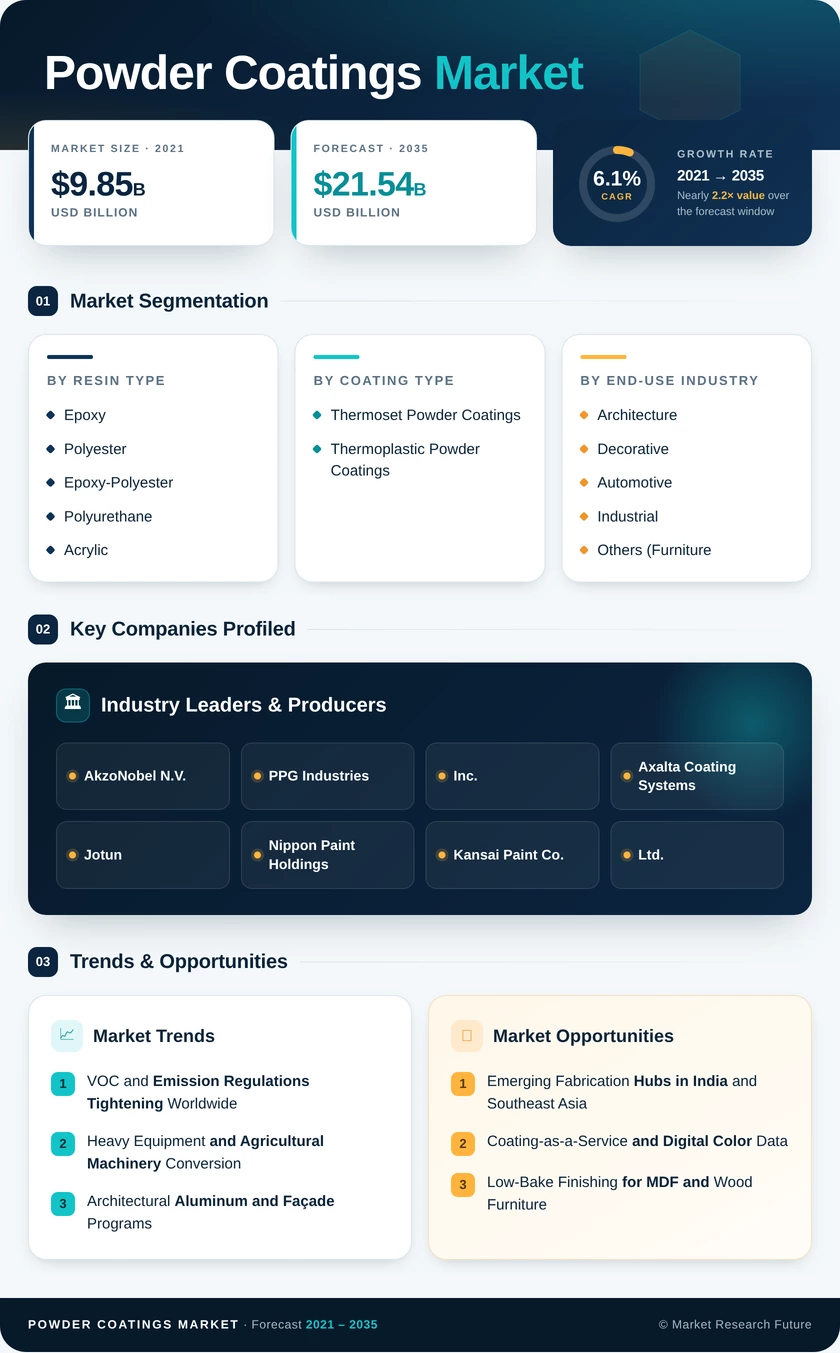
Powder Coatings Market
Market Size
Forecast Period2026-2035
CAGR (2026-2035)6.1%
2025 Market SizeUSD 11.91 Billion
2035 Market SizeUSD 21.54 Billion
Key Players
AkzoNobel N.V.
PPG Industries, Inc.
Axalta Coating Systems
Jotun
Nippon Paint Holdings
Kansai Paint Co., Ltd.
Opportunities
  • Emerging Fabrication Hubs in India and Southeast Asia
  • Coating-as-a-Service and Digital Color Data
  • Low-Bake Finishing for MDF and Wood Furniture
  1. 1 Market Summary | |
  2. 2 Key Report Takeaways | |
    1. 2.1 By Resin Type | |
    2. 2.2 By Coating Type | |
    3. 2.3 By End-use Industry | |
    4. 2.4 By Substrate | |
    5. 2.5 By Region | |
  3. 3 Market Size and Forecast (2021–2035) | |
  4. 4 Driver Impact Analysis | |
    1. 4.1 VOC and Emission Regulations Tightening Worldwide | |
    2. 4.2 Heavy Equipment and Agricultural Machinery Conversion | |
    3. 4.3 Architectural Aluminum and Façade Programs | |
    4. 4.4 EV Battery Housings and Underbody Parts | |
    5. 4.5 Renewable Energy Infrastructure | |
    6. 4.6 Appliance Manufacturing Localization in Asia | |
    7. 4.7 Low-Cure Chemistry Expanding Addressable Substrates | |
  5. 5 Restraints Impact Analysis | |
    1. 5.1 Raw Material and Titanium Dioxide Price Volatility | |
    2. 5.2 High Capital Cost of Line Conversion | |
    3. 5.3 Thin-Film and Color-Change Limitations | |
    4. 5.4 TGIC Hazard Classification and Curing Agent Substitution | |
    5. 5.5 Curing Energy Costs and Carbon Pricing | |
  6. 6 Opportunities | |
    1. 6.1 Emerging Fabrication Hubs in India and Southeast Asia | |
    2. 6.2 Coating-as-a-Service and Digital Color Data | |
    3. 6.3 Low-Bake Finishing for MDF and Wood Furniture | |
    4. 6.4 Recyclable Thermoplastic and Bio-Based Resins | |
    5. 6.5 Offshore Wind and Coastal Infrastructure Protection | |
  7. 7 Regional Market Share and Country-Level Analysis | |
    1. 7.1 Asia-Pacific | | |
      1. 7.1.1 China | | |
      2. 7.1.2 India | | |
      3. 7.1.3 Japan | | |
      4. 7.1.4 South Korea | | |
      5. 7.1.5 Rest of Asia-Pacific | |
    2. 7.2 North America | | |
      1. 7.2.1 United States | | |
      2. 7.2.2 Canada | | |
      3. 7.2.3 Mexico | |
    3. 7.3 Europe | | |
      1. 7.3.1 Germany | | |
      2. 7.3.2 France | | |
      3. 7.3.3 United Kingdom | | |
      4. 7.3.4 Italy | | |
      5. 7.3.5 Rest of Europe | |
    4. 7.4 South America | | |
      1. 7.4.1 Brazil | | |
      2. 7.4.2 Argentina | | |
      3. 7.4.3 Rest of South America | |
    5. 7.5 Middle-East and Africa | | |
      1. 7.5.1 Saudi Arabia | | |
      2. 7.5.2 South Africa | | |
      3. 7.5.3 Rest of Middle-East and Africa | |
  8. 8 Future Outlook (2026–2035) | |
    1. 8.1 Automated, AI-Guided Application Lines | |
    2. 8.2 Electrification Supercycle | |
    3. 8.3 Decarbonized Curing | |
    4. 8.4 Sustainability Reporting and Product Disclosure | |
  9. 9 Segmentation Analysis | |
    1. 9.1 By Resin Type | | |
      1. 9.1.1 Epoxy | | |
      2. 9.1.2 Polyester | | |
      3. 9.1.3 Epoxy-Polyester | | |
      4. 9.1.4 Polyurethane | | |
      5. 9.1.5 Acrylic | | |
      6. 9.1.6 Other Resin Types (Polyvinyl Chloride, Polyolefins) | |
    2. 9.2 By Coating Type | | |
      1. 9.2.1 Thermoset Powder Coatings | | |
      2. 9.2.2 Thermoplastic Powder Coatings | |
    3. 9.3 By End-use Industry | | |
      1. 9.3.1 Architecture and Decorative | | |
      2. 9.3.2 Automotive | | |
      3. 9.3.3 Industrial | | |
      4. 9.3.4 Others (Furniture, Appliances, etc.) | |
    4. 9.4 By Substrate | | |
      1. 9.4.1 Metal | | |
      2. 9.4.2 MDF and Wood | | |
      3. 9.4.3 Plastics and Composites | | |
      4. 9.4.4 Glass and Other Non-conductive Substrates | |
  10. 10 Competitive Landscape | |
    1. 10.1 Market Concentration Analysis | |
    2. 10.2 Competitive Benchmarking Table | |
  11. 11 Recent News & Developments | |
  12. 12 Report Scope and Methodology | |
  13. 13 Detailed Sources and Citations | |
  14. 14 Frequently Asked Questions (FAQs) | | LIST OF TABLES | |
  15. TABLE 1 Report Snapshot — Study Period, Market Size and CAGR | |
  16. TABLE 2 Global Market Size and Forecast, by Revenue (USD Billion), 2021–2035 | |
  17. TABLE 3 Driver Impact Analysis, 2026–2035 | |
  18. TABLE 4 Restraints Impact Analysis, 2026–2035 | |
  19. TABLE 5 Regional Summary, 2025 | |
  20. TABLE 6 Asia-Pacific Country-Level Analysis | |
  21. TABLE 7 North America Country-Level Analysis | |
  22. TABLE 8 Europe Country-Level Analysis | |
  23. TABLE 9 South America Country-Level Analysis | |
  24. TABLE 10 Middle-East and Africa Country-Level Analysis | |
  25. TABLE 11 Segmentation by Resin Type | |
  26. TABLE 12 Segmentation by Coating Type | |
  27. TABLE 13 Segmentation by End-use Industry | |
  28. TABLE 14 Segmentation by Substrate | |
  29. TABLE 15 Competitive Benchmarking Table | |
  30. TABLE 16 Report Scope and Methodology | |
  31. TABLE 17 Detailed Sources and Citations | |
  32. TABLE 18 Segmentation Quick Reference | | LIST OF FIGURES | |
  33. FIGURE 1 Market Dynamics Overview — Drivers, Restraints and Opportunities | |
  34. FIGURE 2 Industry Value Chain Analysis | |
  35. FIGURE 3 Porter's Five Forces Analysis | |
  36. FIGURE 4 Global Market Size Trend (USD Billion), 2021–2035 | |
  37. FIGURE 5 Share by Resin Type, 2025 | |
  38. FIGURE 6 Share by Coating Type, 2025 | |
  39. FIGURE 7 Share by End-use Industry, 2025 | |
  40. FIGURE 8 Share by Substrate, 2025 | |
  41. FIGURE 9 Regional Share, 2025 | |
  42. FIGURE 10 Competitive Landscape Positioning Matrix

Segmentation Quick Reference

DimensionSub-SegmentsDominant SegmentFastest Growing Segment
By Resin TypeEpoxy, Polyester, Epoxy-Polyester, Polyurethane, Acrylic, Other Resin Types (Polyvinyl Chloride, Polyolefins)Polyester (36.4% share)Polyurethane (6.8% CAGR)
By Coating TypeThermoset Powder Coatings, Thermoplastic Powder CoatingsThermoset Powder Coatings (85.6% share)Thermoplastic Powder Coatings (6.6% CAGR)
By End-use IndustryArchitecture and Decorative, Automotive, Industrial, Others (Furniture, Appliances, etc.)Industrial (6.9% CAGR)Industrial (6.9% CAGR)
By SubstrateMetal, MDF and Wood, Plastics and Composites, Glass and Other Non-conductive SubstratesMetal (86.6% share)MDF and Wood (6.5% CAGR)
By RegionAsia-Pacific, North America, Europe, South America, Middle-East and AfricaAsia-Pacific (6.6% CAGR)Asia-Pacific (6.6% CAGR)

Market Segmentation Overview

By Resin Type

Sub-SegmentKey Trend
EpoxyCorrosion-critical interiors, pipelines and EV battery parts
PolyesterTGIC-free, AAMA 2605-rated outdoor grades
Epoxy-PolyesterCost-balanced hybrids for indoor furniture and HVAC
PolyurethaneAbrasion-resistant systems for oil-and-gas and machinery
AcrylicHigh-gloss finishes for decorative wheels
Other Resin Types (Polyvinyl Chloride, Polyolefins)Thick-film dip coatings for racks and wire goods

Polyester leads at a 36.4% share because its UV stability suits façades and outdoor equipment that Epoxy cannot serve without chalking. Polyurethane grows fastest, at a 6.8% CAGR, as pipeline and heavy-equipment buyers pay a premium for abrasion resistance. Epoxy-Polyester holds its ground indoors, where balanced cost and performance matter more than weathering.

By Coating Type

Sub-SegmentKey Trend
Thermoset Powder CoatingsLow-cure and super-durable cross-linked grades
Thermoplastic Powder CoatingsRecyclable polyolefin and nylon systems

Thermoset Powder Coatings dominate with an 85.6% share because cross-linked films resist detergents, salt and solvents on chassis, appliances and battery trays. Thermoplastic Powder Coatings grow faster, at a 6.6% CAGR, as electronics and vehicle interior makers seek remeltable finishes that support recyclability targets. Hardness limitations keep thermoplastics in low-stress uses for now.

By End-use Industry

Sub-SegmentKey Trend
Architecture and DecorativeAAMA-rated aluminum façades and refurbishment
AutomotiveEV underbodies, battery housings and wheels
IndustrialSingle-coat powder on machinery and agricultural equipment
Others (Furniture, Appliances, etc.)Zero-VOC appliance and furniture lines

Industrial both leads and grows fastest, at a 6.9% CAGR, as equipment builders convert two-coat liquid systems to single-coat powder to cut warranty claims. Architecture and Decorative ranks next in Gulf and European façade demand. Automotive adoption concentrates on EV battery and underbody parts, while exterior panels stay largely liquid.

By Substrate

Sub-SegmentKey Trend
MetalElectrostatic application on steel and aluminum
MDF and WoodPrimer-free low-bake polyester finishes
Plastics and CompositesConductive primers enabling lightweight parts
Glass and Other Non-conductive SubstratesDecorative textures for partitions and lighting

Metal dominates with an 86.6% share because conductive steel and aluminum accept electrostatic charge without extra preparation. MDF and Wood grows fastest, at a 6.5% CAGR, as low-bake polyesters curing near 120 °C give furniture makers seamless edges without solvent stains. Plastics and Composites remain constrained by the cost of conductive primers.


Download PDF ×

We do not share your information with anyone. However, we may send you emails based on your report interest from time to time. You may contact us at any time to opt-out.