Request Free Sample ×

Kindly complete the form below to receive a free sample of this Report

* Please use a valid business email

Leading companies partner with us for data-driven Insights

clients tt-cursor
Hero Background
English
Chinese
French
Japanese
Korean
German
Spanish

Portable Scanner Market Analysis

ID: MRFR/SEM/4645-HCR
100 Pages
Nirmit Biswas
March 2026

Portable Scanner Market Size, Share and Research Report By Type (Stationary Scanner, Non-Rugged Barcode Scanner and Automatic Scanner), By Technology (2D Imager and Linear Imager Laser Scanners) And By Region (North America, Europe, Asia-Pacific, And Rest Of The World) –Industry Forecast Till 2035

Share:
Download PDF ×

We do not share your information with anyone. However, we may send you emails based on your report interest from time to time. You may contact us at any time to opt-out.

Portable Scanner Market Infographic
Purchase Options

Market Analysis

In-depth Analysis of Portable Scanner Market Industry Landscape

Portable scanning devices’ technological advancement shapes its dynamics. The evolution of scanning technology has resulted into many compact high performance devices capable of working on a wide variety of document types. Features such as wireless connectivity; cloud integration among others have made portable scanners attractive to consumers who prefer them over other traditional types as they opt for leading-edge items instead of backward ones.As today’s customers are becoming increasingly inclined toward the cutting-edge features, manufacturers cannot avoid research and development investments aimed at staying ahead of technological innovation that frequently bring forth ever-evolving consumer needs.

Consumer behavior and preferences have significant influences on the dynamics of portable scanner markets.The trend towards remote work as well as need for flexible mobile solutions have driven their proliferation. These are factors such as user friendly interfaces, compatibility with various operating systems and seamless integration within mobile devices that resonate well with contemporary customers.

The dynamics of portable scanners market are also affected by global economic conditions and geopolitical factors. Economic downturns can impact consumer spending on electronic products like portable scanners thus affecting their demand. Trade policies, tariffs or geopolitical tensions often interrupt supply chains hence impacting availability and costs of commodities across different regions. In addition, global economy is interconnected leading to complex market dynamics that necessitates adaptation by companies to changing external factors.

Distribution channels and partnerships significantly affect the dynamics of portable scanner markets. Accessibility of such devices to consumers therefore depends on effective distribution strategies, partnership with retailers and collaborations with other technology firms. For instance, companies usually find new ways to contact a wide range of demographic profiles while trying gain a competitive advantage over other competitors within industry. On the other side strategic alliances between software developers, cloud service providers or business solution vendors can improve overall value proposition thereby influencing positively the market dynamics.


Author
Author Profile
Nirmit Biswas
Senior Research Analyst

With 5+ years of expertise in Market Intelligence and Strategic Research, Nirmit Biswas specializes in ICT, Semiconductors, and BFSI. Backed by an MBA in Financial Services and a Computer Science foundation, Nirmit blends technical depth with business acumen. He has successfully led 100+ projects for global enterprises and startups, including Amazon, Cisco, L&T and Huawei, delivering market estimations, competitive benchmarking, and GTM strategies. His focus lies in transforming complex data into clear, actionable insights that drive growth, innovation, and investment decisions. Recognized for bridging engineering innovation with executive strategy, Nirmit helps businesses navigate dynamic markets with confidence.

Leave a Comment

FAQs

What is the current valuation of the Portable Scanner Market?

<p>The Portable Scanner Market was valued at 1.871 USD Billion in 2024.</p>

What is the projected market size for the Portable Scanner Market by 2035?

<p>The market is projected to reach 3.033 USD Billion by 2035.</p>

What is the expected CAGR for the Portable Scanner Market from 2025 to 2035?

<p>The expected CAGR for the Portable Scanner Market during the forecast period 2025 - 2035 is 4.49%.</p>

Which companies are the key players in the Portable Scanner Market?

<p>Key players in the market include Canon, Fujitsu, Epson, Brother, Doxie, Neat, IRIS, Plustek, and Visioneer.</p>

What are the main segments of the Portable Scanner Market?

<p>The main segments include Type and Technology, with various categories under each.</p>

How did the Stationary Scanner segment perform in 2024?

<p>The Stationary Scanner segment was valued at 0.5 USD Billion in 2024.</p>

What is the projected growth for the Non-Rugged Barcode Scanner segment by 2035?

The Non-Rugged Barcode Scanner segment is expected to grow from 0.6 USD Billion in 2024 to 0.9 USD Billion by 2035.

What is the valuation of the Automatic Scanner segment in 2024?

The Automatic Scanner segment was valued at 0.771 USD Billion in 2024.

What are the projected values for 2D Imager technology by 2035?

The 2D Imager technology is projected to grow from 0.9355 USD Billion in 2024 to 1.4695 USD Billion by 2035.

How does the Linear Imager Laser Scanner segment compare in growth to other segments?

The Linear Imager Laser Scanner segment is expected to grow from 0.9355 USD Billion in 2024 to 1.5635 USD Billion by 2035, indicating robust performance.

Market Summary

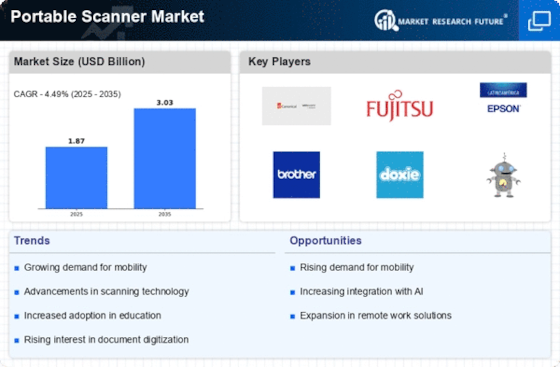
As per Market Research Future analysis, the Portable Scanner Market Size was estimated at 1.871 USD Billion in 2024. The Portable Scanner industry is projected to grow from 1.955 USD Billion in 2025 to 3.033 USD Billion by 2035, exhibiting a compound annual growth rate (CAGR) of 4.49% during the forecast period 2025 - 2035

Key Market Trends & Highlights

The Portable Scanner Market is experiencing robust growth driven by technological advancements and increasing demand for mobility.

  • North America remains the largest market for portable scanners, driven by a strong emphasis on document management solutions. Asia-Pacific is the fastest-growing region, reflecting a rising demand for remote work solutions and mobility. Stationary scanners continue to dominate the market, while non-rugged barcode scanners are emerging as the fastest-growing segment. Technological advancements in scanning and consumer preference for compact devices are key drivers propelling market expansion.

Market Size & Forecast

2024 Market Size 1.871 (USD Billion)
2035 Market Size 3.033 (USD Billion)
CAGR (2025 - 2035) 4.49%
Largest Regional Market Share in 2024 North America

Major Players

Canon (JP), Fujitsu (JP), Epson (JP), Brother (JP), Doxie (US), Neat (US), IRIS (BE), Plustek (TW), Visioneer (US)

Market Trends

The Portable Scanner Market is currently experiencing a notable evolution, driven by advancements in technology and changing consumer preferences. As individuals and businesses increasingly seek efficient solutions for document management, the demand for portable scanners appears to be on the rise. These devices offer convenience, enabling users to digitize documents on-the-go, which aligns with the growing trend of remote work and mobile productivity. Furthermore, the integration of wireless connectivity features enhances usability, allowing for seamless sharing and storage of scanned materials. This shift towards digital solutions suggests a broader transformation in how information is processed and managed in various sectors. In addition to technological advancements, the Portable Scanner Market is influenced by the increasing emphasis on sustainability. Consumers are becoming more aware of environmental impacts, prompting manufacturers to develop eco-friendly products. This trend indicates a potential shift towards scanners that utilize recyclable materials and energy-efficient technologies. As the market continues to evolve, it is likely that innovation will play a crucial role in shaping the future landscape of portable scanning solutions, catering to the diverse needs of users across different industries.

Technological Advancements

The Portable Scanner Market is witnessing rapid technological innovations, particularly in areas such as image processing and connectivity. Enhanced features like wireless capabilities and mobile app integration are becoming standard, allowing users to easily manage and share scanned documents.

Sustainability Focus

There is a growing trend towards sustainability within the Portable Scanner Market, as manufacturers increasingly prioritize eco-friendly designs. This includes the use of recyclable materials and energy-efficient components, appealing to environmentally conscious consumers.

Increased Demand for Mobility

The demand for portable scanning solutions is rising, driven by the need for mobility in both personal and professional settings. Users are seeking lightweight, compact devices that facilitate document digitization anywhere, reflecting a shift towards more flexible work environments.

Portable Scanner Market Market Drivers

Growing Adoption in Education Sector

The Portable Scanner Market is increasingly being adopted in the education sector, where the need for digitizing educational materials is paramount. Students and educators utilize portable scanners to convert textbooks, notes, and other printed materials into digital formats for easier access and sharing. Recent statistics reveal that educational institutions are investing more in technology, with portable scanners being a key component of this shift. The market for portable scanners in education is expected to expand significantly, as institutions recognize the benefits of digital resources in enhancing learning experiences. This trend indicates a promising future for the Portable Scanner Market, particularly in educational applications.

Technological Advancements in Scanning

The Portable Scanner Market is experiencing a surge in technological advancements that enhance scanning capabilities. Innovations such as improved image processing algorithms and higher resolution sensors are making portable scanners more efficient and user-friendly. For instance, the integration of wireless connectivity options, such as Bluetooth and Wi-Fi, allows users to easily transfer scanned documents to various devices. According to recent data, the market for portable scanners is projected to grow at a compound annual growth rate of approximately 8% over the next five years. This growth is largely driven by the increasing adoption of portable scanners in both personal and professional settings, as users seek more efficient ways to digitize documents on the go.

Consumer Preference for Compact Devices

The Portable Scanner Market is influenced by a growing consumer preference for compact and multifunctional devices. As individuals seek to minimize clutter and maximize efficiency, portable scanners that offer multiple functionalities, such as scanning, copying, and emailing, are becoming increasingly popular. This trend is reflected in market data, which shows that sales of compact portable scanners have increased by approximately 20% in the past year. Consumers are drawn to the convenience and versatility of these devices, which align with modern lifestyles that prioritize mobility and efficiency. This shift in consumer behavior is likely to propel the Portable Scanner Market forward, as manufacturers innovate to meet these evolving demands.

Rising Demand for Remote Work Solutions

The Portable Scanner Market is witnessing a notable increase in demand for remote work solutions. As more professionals work from home or in hybrid environments, the need for portable scanning devices has become more pronounced. Portable scanners offer the flexibility to digitize documents without being tethered to a traditional office setup. Market data indicates that the demand for portable scanners has risen by nearly 15% in the last year alone, as businesses and individuals seek to maintain productivity outside of conventional office spaces. This trend suggests that the Portable Scanner Market is well-positioned to capitalize on the evolving work landscape, providing essential tools for document management and organization.

Increased Focus on Document Management Solutions

The Portable Scanner Market is benefiting from an increased focus on document management solutions across various sectors. Organizations are recognizing the importance of efficient document handling and storage, leading to a rise in the adoption of portable scanners. These devices facilitate the quick digitization of documents, which can then be easily organized and retrieved. Market analysis suggests that the document management software market is projected to grow by over 10% annually, further driving the demand for portable scanners as complementary tools. This synergy between document management solutions and portable scanning technology indicates a robust growth trajectory for the Portable Scanner Market.

Market Segment Insights

By Type: Stationary Scanner (Largest) vs. Non-Rugged Barcode Scanner (Fastest-Growing)

<p>In the Portable Scanner Market, the Stationary Scanner segment holds the largest share, dominating the landscape due to its widespread adoption in various sectors. This segment is particularly favored for its reliability and performance, catering to businesses requiring consistent and accurate scanning solutions. On the other hand, the Non-Rugged Barcode Scanner segment is rapidly gaining traction, appealing to retail and logistics sectors where efficiency and speed are paramount. As the market evolves, these scanners are becoming integral for operations requiring flexible scanning solutions in diverse environments.</p>

<p>Stationary Scanner (Dominant) vs. Non-Rugged Barcode Scanner (Emerging)</p>

<p>The Stationary Scanner is characterized by its robust design and high scanning capability, making it the preferred choice for businesses that prioritize accuracy and volume processing. These scanners are instrumental in settings like warehouses and registration systems, enabling efficient data capture without cumbersome manual processes. Conversely, the Non-Rugged Barcode Scanner is making waves as an emerging technology, designed for versatility and ease of use in retail and inventory management. Its lightweight design and user-friendly interface make it an excellent choice for quick scans on the go, catering to an increasing demand for portable and efficient scanning solutions.</p>

By Technology: 2D Imager (Largest) vs. Linear Imager Laser Scanners (Fastest-Growing)

<p>The Portable Scanner Market is characterized by a significant distribution of market share between 2D imagers and linear imager laser scanners. 2D imagers currently dominate this segment due to their versatility and efficiency in capturing detailed scans across various applications. They have become the preferred choice for consumers and businesses alike, capitalizing on advancements in imaging technology that enhance their performance in both speed and accuracy. Conversely, linear imager laser scanners are emerging as the fastest-growing segment in the market. This growth can be attributed to their cost-effectiveness and ability to accurately read barcodes in diverse environments. As industries increasingly rely on efficient scanning solutions for inventory management and point-of-sale systems, linear imagers are likely to see a sustained increase in demand, highlighting a shift in consumer preferences towards these devices.</p>

<p>Technology: 2D Imager (Dominant) vs. Linear Imager Laser Scanners (Emerging)</p>

<p>The 2D imager technology remains the dominant choice in the Portable Scanner Market due to its superior capabilities in reading a wide range of barcodes and high-resolution image capture. These devices are ideal for various applications, from retail to healthcare, where accuracy and speed are critical. In contrast, linear imager laser scanners are emerging as a compelling alternative, particularly for businesses looking for economical solutions. They excel in straightforward barcode scanning tasks and are widely used in inventory management and supply chain operations. While they may not match the versatility of 2D imagers, their affordability and efficiency are driving their adoption, making them a notable segment in the market.</p>

Get more detailed insights about Portable Scanner Market Research Report – Forecast to 2035

Regional Insights

North America : Tech-Driven Market Growth

North America is the largest market for portable scanners, holding approximately 40% of the global share. The growth is driven by increasing demand for mobile document management solutions and advancements in scanning technology. Regulatory support for digital transformation in businesses further fuels this trend, with initiatives promoting paperless environments. The U.S. and Canada are the primary contributors to this market, showcasing a robust adoption of portable scanning solutions. The competitive landscape in North America is dominated by key players such as Canon, Fujitsu, and Epson, who are continuously innovating to meet consumer needs. The presence of established companies like Doxie and Neat also enhances market dynamics, offering specialized products for niche segments. The region's focus on technological advancements and user-friendly designs positions it as a leader in the portable scanner market.

Europe : Emerging Market with Potential

Europe is witnessing significant growth in the portable scanner market, accounting for approximately 30% of the global share. The demand is driven by the increasing need for efficient document management solutions across various sectors, including healthcare and education. Regulatory frameworks promoting digitalization and sustainability are also key catalysts for market growth. Countries like Germany and the UK are leading this trend, with a strong emphasis on adopting innovative technologies. The competitive landscape in Europe features a mix of established brands and emerging players. Companies like IRIS and Plustek are gaining traction, while traditional players like Brother and Epson continue to dominate. The region's focus on quality and efficiency in portable scanning solutions is evident, with a growing number of partnerships and collaborations aimed at enhancing product offerings. The market is poised for further expansion as digital transformation initiatives gain momentum.

Asia-Pacific : Rapidly Growing Market Segment

Asia-Pacific is rapidly emerging as a significant player in the portable scanner market, holding around 25% of the global share. The growth is primarily driven by increasing urbanization, rising disposable incomes, and a growing emphasis on digital documentation in countries like China and India. Government initiatives aimed at promoting digital literacy and technological adoption are also contributing to market expansion, making it a key region for future growth. The competitive landscape in Asia-Pacific is characterized by a mix of local and international players. Companies such as Canon and Fujitsu are well-established, while local brands are also gaining market share by offering cost-effective solutions. The region's diverse consumer base and varying needs present both challenges and opportunities for manufacturers, driving innovation and customization in portable scanning technologies. As businesses increasingly adopt digital solutions, the demand for portable scanners is expected to rise significantly.

Middle East and Africa : Untapped Market Opportunities

The Middle East and Africa region is currently the smallest market for portable scanners, holding about 5% of the global share. However, there is significant potential for growth driven by increasing investments in technology and infrastructure. The demand for portable scanners is expected to rise as businesses and educational institutions seek efficient document management solutions. Government initiatives aimed at enhancing digital capabilities are also expected to catalyze market growth in the coming years. Countries like South Africa and the UAE are leading the way in adopting portable scanning technologies, with a growing number of local and international players entering the market. The competitive landscape is evolving, with companies focusing on affordability and accessibility to cater to the diverse needs of consumers. As awareness of the benefits of digital documentation increases, the portable scanner market in this region is poised for significant expansion.

Key Players and Competitive Insights

The Portable Scanner Market is currently characterized by a dynamic competitive landscape, driven by technological advancements and evolving consumer preferences. Key players such as Canon (Japan), Fujitsu (Japan), and Epson (Japan) are at the forefront, each adopting distinct strategies to enhance their market positioning. Canon (Japan) emphasizes innovation in product design, focusing on compact and user-friendly models that cater to both personal and professional needs. Fujitsu (Japan), on the other hand, has been actively pursuing partnerships to expand its reach in emerging markets, while Epson (Japan) is leveraging its expertise in imaging technology to integrate advanced features such as wireless connectivity and cloud services into its scanners. Collectively, these strategies contribute to a competitive environment that is increasingly focused on technological differentiation and customer-centric solutions.In terms of business tactics, companies are localizing manufacturing and optimizing supply chains to enhance efficiency and reduce costs. The Portable Scanner Market appears moderately fragmented, with a mix of established players and emerging brands vying for market share. This competitive structure allows for a diverse range of products and innovations, as companies strive to meet the varying demands of consumers across different regions.

In August Epson (Japan) announced the launch of its latest portable scanner model, which features enhanced scanning speed and improved image quality. This strategic move is significant as it not only reinforces Epson's commitment to innovation but also positions the company to capture a larger share of the market by appealing to professionals who require high-quality scans on the go. The introduction of this model is likely to strengthen Epson's competitive edge in a market that increasingly values efficiency and performance.

In September Fujitsu (Japan) entered into a strategic partnership with a leading software provider to integrate advanced document management solutions with its portable scanners. This collaboration is indicative of Fujitsu's focus on enhancing the user experience by offering comprehensive solutions that go beyond mere hardware. By aligning its products with software capabilities, Fujitsu is poised to attract businesses looking for integrated solutions, thereby expanding its market presence.

In October Canon (Japan) unveiled a new line of portable scanners designed specifically for remote work environments. This initiative reflects Canon's recognition of the growing trend towards flexible work arrangements and the need for portable solutions that facilitate productivity. By addressing this emerging demand, Canon is likely to enhance its relevance in the market and appeal to a broader audience, including remote workers and small businesses.

As of October the Portable Scanner Market is witnessing trends that emphasize digitalization, sustainability, and the integration of artificial intelligence. Companies are increasingly forming strategic alliances to enhance their technological capabilities and market reach. The competitive differentiation is shifting from price-based strategies to a focus on innovation, technology integration, and supply chain reliability. This evolution suggests that future competition will hinge on the ability to deliver advanced features and seamless user experiences, thereby redefining the parameters of success in the Portable Scanner Market.

Key Companies in the Portable Scanner Market include

Industry Developments

February 2022: The DS-790WN wireless network color portable scanner with flexible connectivity was unveiled by Seiko Epson Corporation. The DS-790WN produces high-quality scans quickly so businesses can confidently manage documents. It is designed for dependability and convenience of use in a variety of industries, including government, service bureau, higher education, banking, and healthcare corporations.

Future Outlook

Portable Scanner Market Future Outlook

The Portable Scanner Market is projected to grow at a 4.49% CAGR from 2025 to 2035, driven by technological advancements, increasing mobile workforce, and demand for digitization.

New opportunities lie in:

  • Integration of AI for enhanced scanning accuracy</p><p>Development of eco-friendly portable scanners</p><p>Expansion into emerging markets with tailored solutions

By 2035, the Portable Scanner Market is expected to achieve robust growth and increased market penetration.

Market Segmentation

Portable Scanner Market Type Outlook

  • Stationary Scanner
  • Non-Rugged Barcode Scanner
  • Automatic Scanner

Portable Scanner Market Technology Outlook

  • 2D Imager
  • Linear Imager Laser Scanners

Report Scope

MARKET SIZE 2024 1.871(USD Billion)
MARKET SIZE 2025 1.955(USD Billion)
MARKET SIZE 2035 3.033(USD Billion)
COMPOUND ANNUAL GROWTH RATE (CAGR) 4.49% (2025 - 2035)
REPORT COVERAGE Revenue Forecast, Competitive Landscape, Growth Factors, and Trends
BASE YEAR 2024
Market Forecast Period 2025 - 2035
Historical Data 2019 - 2024
Market Forecast Units USD Billion
Key Companies Profiled Canon (JP), Fujitsu (JP), Epson (JP), Brother (JP), Doxie (US), Neat (US), IRIS (BE), Plustek (TW), Visioneer (US)
Segments Covered Type, Technology, Region
Key Market Opportunities Integration of artificial intelligence enhances efficiency and accuracy in the Portable Scanner Market.
Key Market Dynamics Rising demand for mobile documentation solutions drives innovation and competition in the portable scanner market.
Countries Covered North America, Europe, APAC, South America, MEA

FAQs

What is the current valuation of the Portable Scanner Market?

<p>The Portable Scanner Market was valued at 1.871 USD Billion in 2024.</p>

What is the projected market size for the Portable Scanner Market by 2035?

<p>The market is projected to reach 3.033 USD Billion by 2035.</p>

What is the expected CAGR for the Portable Scanner Market from 2025 to 2035?

<p>The expected CAGR for the Portable Scanner Market during the forecast period 2025 - 2035 is 4.49%.</p>

Which companies are the key players in the Portable Scanner Market?

<p>Key players in the market include Canon, Fujitsu, Epson, Brother, Doxie, Neat, IRIS, Plustek, and Visioneer.</p>

What are the main segments of the Portable Scanner Market?

<p>The main segments include Type and Technology, with various categories under each.</p>

How did the Stationary Scanner segment perform in 2024?

<p>The Stationary Scanner segment was valued at 0.5 USD Billion in 2024.</p>

What is the projected growth for the Non-Rugged Barcode Scanner segment by 2035?

The Non-Rugged Barcode Scanner segment is expected to grow from 0.6 USD Billion in 2024 to 0.9 USD Billion by 2035.

What is the valuation of the Automatic Scanner segment in 2024?

The Automatic Scanner segment was valued at 0.771 USD Billion in 2024.

What are the projected values for 2D Imager technology by 2035?

The 2D Imager technology is projected to grow from 0.9355 USD Billion in 2024 to 1.4695 USD Billion by 2035.

How does the Linear Imager Laser Scanner segment compare in growth to other segments?

The Linear Imager Laser Scanner segment is expected to grow from 0.9355 USD Billion in 2024 to 1.5635 USD Billion by 2035, indicating robust performance.

  1. SECTION I: EXECUTIVE SUMMARY AND KEY HIGHLIGHTS
    1. | 1.1 EXECUTIVE SUMMARY
    2. | | 1.1.1 Market Overview
    3. | | 1.1.2 Key Findings
    4. | | 1.1.3 Market Segmentation
    5. | | 1.1.4 Competitive Landscape
    6. | | 1.1.5 Challenges and Opportunities
    7. | | 1.1.6 Future Outlook
  2. SECTION II: SCOPING, METHODOLOGY AND MARKET STRUCTURE
    1. | 2.1 MARKET INTRODUCTION
    2. | | 2.1.1 Definition
    3. | | 2.1.2 Scope of the study
    4. | | | 2.1.2.1 Research Objective
    5. | | | 2.1.2.2 Assumption
    6. | | | 2.1.2.3 Limitations
    7. | 2.2 RESEARCH METHODOLOGY
    8. | | 2.2.1 Overview
    9. | | 2.2.2 Data Mining
    10. | | 2.2.3 Secondary Research
    11. | | 2.2.4 Primary Research
    12. | | | 2.2.4.1 Primary Interviews and Information Gathering Process
    13. | | | 2.2.4.2 Breakdown of Primary Respondents
    14. | | 2.2.5 Forecasting Model
    15. | | 2.2.6 Market Size Estimation
    16. | | | 2.2.6.1 Bottom-Up Approach
    17. | | | 2.2.6.2 Top-Down Approach
    18. | | 2.2.7 Data Triangulation
    19. | | 2.2.8 Validation
  3. SECTION III: QUALITATIVE ANALYSIS
    1. | 3.1 MARKET DYNAMICS
    2. | | 3.1.1 Overview
    3. | | 3.1.2 Drivers
    4. | | 3.1.3 Restraints
    5. | | 3.1.4 Opportunities
    6. | 3.2 MARKET FACTOR ANALYSIS
    7. | | 3.2.1 Value chain Analysis
    8. | | 3.2.2 Porter's Five Forces Analysis
    9. | | | 3.2.2.1 Bargaining Power of Suppliers
    10. | | | 3.2.2.2 Bargaining Power of Buyers
    11. | | | 3.2.2.3 Threat of New Entrants
    12. | | | 3.2.2.4 Threat of Substitutes
    13. | | | 3.2.2.5 Intensity of Rivalry
    14. | | 3.2.3 COVID-19 Impact Analysis
    15. | | | 3.2.3.1 Market Impact Analysis
    16. | | | 3.2.3.2 Regional Impact
    17. | | | 3.2.3.3 Opportunity and Threat Analysis
  4. SECTION IV: QUANTITATIVE ANALYSIS
    1. | 4.1 Semiconductor & Electronics, BY Type (USD Billion)
    2. | | 4.1.1 Stationary Scanner
    3. | | 4.1.2 Non-Rugged Barcode Scanner
    4. | | 4.1.3 Automatic Scanner
    5. | 4.2 Semiconductor & Electronics, BY Technology (USD Billion)
    6. | | 4.2.1 2D Imager
    7. | | 4.2.2 Linear Imager Laser Scanners
    8. | 4.3 Semiconductor & Electronics, BY Region (USD Billion)
    9. | | 4.3.1 North America
    10. | | | 4.3.1.1 US
    11. | | | 4.3.1.2 Canada
    12. | | 4.3.2 Europe
    13. | | | 4.3.2.1 Germany
    14. | | | 4.3.2.2 UK
    15. | | | 4.3.2.3 France
    16. | | | 4.3.2.4 Russia
    17. | | | 4.3.2.5 Italy
    18. | | | 4.3.2.6 Spain
    19. | | | 4.3.2.7 Rest of Europe
    20. | | 4.3.3 APAC
    21. | | | 4.3.3.1 China
    22. | | | 4.3.3.2 India
    23. | | | 4.3.3.3 Japan
    24. | | | 4.3.3.4 South Korea
    25. | | | 4.3.3.5 Malaysia
    26. | | | 4.3.3.6 Thailand
    27. | | | 4.3.3.7 Indonesia
    28. | | | 4.3.3.8 Rest of APAC
    29. | | 4.3.4 South America
    30. | | | 4.3.4.1 Brazil
    31. | | | 4.3.4.2 Mexico
    32. | | | 4.3.4.3 Argentina
    33. | | | 4.3.4.4 Rest of South America
    34. | | 4.3.5 MEA
    35. | | | 4.3.5.1 GCC Countries
    36. | | | 4.3.5.2 South Africa
    37. | | | 4.3.5.3 Rest of MEA
  5. SECTION V: COMPETITIVE ANALYSIS
    1. | 5.1 Competitive Landscape
    2. | | 5.1.1 Overview
    3. | | 5.1.2 Competitive Analysis
    4. | | 5.1.3 Market share Analysis
    5. | | 5.1.4 Major Growth Strategy in the Semiconductor & Electronics
    6. | | 5.1.5 Competitive Benchmarking
    7. | | 5.1.6 Leading Players in Terms of Number of Developments in the Semiconductor & Electronics
    8. | | 5.1.7 Key developments and growth strategies
    9. | | | 5.1.7.1 New Product Launch/Service Deployment
    10. | | | 5.1.7.2 Merger & Acquisitions
    11. | | | 5.1.7.3 Joint Ventures
    12. | | 5.1.8 Major Players Financial Matrix
    13. | | | 5.1.8.1 Sales and Operating Income
    14. | | | 5.1.8.2 Major Players R&D Expenditure. 2023
    15. | 5.2 Company Profiles
    16. | | 5.2.1 Canon (JP)
    17. | | | 5.2.1.1 Financial Overview
    18. | | | 5.2.1.2 Products Offered
    19. | | | 5.2.1.3 Key Developments
    20. | | | 5.2.1.4 SWOT Analysis
    21. | | | 5.2.1.5 Key Strategies
    22. | | 5.2.2 Fujitsu (JP)
    23. | | | 5.2.2.1 Financial Overview
    24. | | | 5.2.2.2 Products Offered
    25. | | | 5.2.2.3 Key Developments
    26. | | | 5.2.2.4 SWOT Analysis
    27. | | | 5.2.2.5 Key Strategies
    28. | | 5.2.3 Epson (JP)
    29. | | | 5.2.3.1 Financial Overview
    30. | | | 5.2.3.2 Products Offered
    31. | | | 5.2.3.3 Key Developments
    32. | | | 5.2.3.4 SWOT Analysis
    33. | | | 5.2.3.5 Key Strategies
    34. | | 5.2.4 Brother (JP)
    35. | | | 5.2.4.1 Financial Overview
    36. | | | 5.2.4.2 Products Offered
    37. | | | 5.2.4.3 Key Developments
    38. | | | 5.2.4.4 SWOT Analysis
    39. | | | 5.2.4.5 Key Strategies
    40. | | 5.2.5 Doxie (US)
    41. | | | 5.2.5.1 Financial Overview
    42. | | | 5.2.5.2 Products Offered
    43. | | | 5.2.5.3 Key Developments
    44. | | | 5.2.5.4 SWOT Analysis
    45. | | | 5.2.5.5 Key Strategies
    46. | | 5.2.6 Neat (US)
    47. | | | 5.2.6.1 Financial Overview
    48. | | | 5.2.6.2 Products Offered
    49. | | | 5.2.6.3 Key Developments
    50. | | | 5.2.6.4 SWOT Analysis
    51. | | | 5.2.6.5 Key Strategies
    52. | | 5.2.7 IRIS (BE)
    53. | | | 5.2.7.1 Financial Overview
    54. | | | 5.2.7.2 Products Offered
    55. | | | 5.2.7.3 Key Developments
    56. | | | 5.2.7.4 SWOT Analysis
    57. | | | 5.2.7.5 Key Strategies
    58. | | 5.2.8 Plustek (TW)
    59. | | | 5.2.8.1 Financial Overview
    60. | | | 5.2.8.2 Products Offered
    61. | | | 5.2.8.3 Key Developments
    62. | | | 5.2.8.4 SWOT Analysis
    63. | | | 5.2.8.5 Key Strategies
    64. | | 5.2.9 Visioneer (US)
    65. | | | 5.2.9.1 Financial Overview
    66. | | | 5.2.9.2 Products Offered
    67. | | | 5.2.9.3 Key Developments
    68. | | | 5.2.9.4 SWOT Analysis
    69. | | | 5.2.9.5 Key Strategies
    70. | 5.3 Appendix
    71. | | 5.3.1 References
    72. | | 5.3.2 Related Reports
  6. LIST OF FIGURES
    1. | 6.1 MARKET SYNOPSIS
    2. | 6.2 NORTH AMERICA MARKET ANALYSIS
    3. | 6.3 US MARKET ANALYSIS BY TYPE
    4. | 6.4 US MARKET ANALYSIS BY TECHNOLOGY
    5. | 6.5 CANADA MARKET ANALYSIS BY TYPE
    6. | 6.6 CANADA MARKET ANALYSIS BY TECHNOLOGY
    7. | 6.7 EUROPE MARKET ANALYSIS
    8. | 6.8 GERMANY MARKET ANALYSIS BY TYPE
    9. | 6.9 GERMANY MARKET ANALYSIS BY TECHNOLOGY
    10. | 6.10 UK MARKET ANALYSIS BY TYPE
    11. | 6.11 UK MARKET ANALYSIS BY TECHNOLOGY
    12. | 6.12 FRANCE MARKET ANALYSIS BY TYPE
    13. | 6.13 FRANCE MARKET ANALYSIS BY TECHNOLOGY
    14. | 6.14 RUSSIA MARKET ANALYSIS BY TYPE
    15. | 6.15 RUSSIA MARKET ANALYSIS BY TECHNOLOGY
    16. | 6.16 ITALY MARKET ANALYSIS BY TYPE
    17. | 6.17 ITALY MARKET ANALYSIS BY TECHNOLOGY
    18. | 6.18 SPAIN MARKET ANALYSIS BY TYPE
    19. | 6.19 SPAIN MARKET ANALYSIS BY TECHNOLOGY
    20. | 6.20 REST OF EUROPE MARKET ANALYSIS BY TYPE
    21. | 6.21 REST OF EUROPE MARKET ANALYSIS BY TECHNOLOGY
    22. | 6.22 APAC MARKET ANALYSIS
    23. | 6.23 CHINA MARKET ANALYSIS BY TYPE
    24. | 6.24 CHINA MARKET ANALYSIS BY TECHNOLOGY
    25. | 6.25 INDIA MARKET ANALYSIS BY TYPE
    26. | 6.26 INDIA MARKET ANALYSIS BY TECHNOLOGY
    27. | 6.27 JAPAN MARKET ANALYSIS BY TYPE
    28. | 6.28 JAPAN MARKET ANALYSIS BY TECHNOLOGY
    29. | 6.29 SOUTH KOREA MARKET ANALYSIS BY TYPE
    30. | 6.30 SOUTH KOREA MARKET ANALYSIS BY TECHNOLOGY
    31. | 6.31 MALAYSIA MARKET ANALYSIS BY TYPE
    32. | 6.32 MALAYSIA MARKET ANALYSIS BY TECHNOLOGY
    33. | 6.33 THAILAND MARKET ANALYSIS BY TYPE
    34. | 6.34 THAILAND MARKET ANALYSIS BY TECHNOLOGY
    35. | 6.35 INDONESIA MARKET ANALYSIS BY TYPE
    36. | 6.36 INDONESIA MARKET ANALYSIS BY TECHNOLOGY
    37. | 6.37 REST OF APAC MARKET ANALYSIS BY TYPE
    38. | 6.38 REST OF APAC MARKET ANALYSIS BY TECHNOLOGY
    39. | 6.39 SOUTH AMERICA MARKET ANALYSIS
    40. | 6.40 BRAZIL MARKET ANALYSIS BY TYPE
    41. | 6.41 BRAZIL MARKET ANALYSIS BY TECHNOLOGY
    42. | 6.42 MEXICO MARKET ANALYSIS BY TYPE
    43. | 6.43 MEXICO MARKET ANALYSIS BY TECHNOLOGY
    44. | 6.44 ARGENTINA MARKET ANALYSIS BY TYPE
    45. | 6.45 ARGENTINA MARKET ANALYSIS BY TECHNOLOGY
    46. | 6.46 REST OF SOUTH AMERICA MARKET ANALYSIS BY TYPE
    47. | 6.47 REST OF SOUTH AMERICA MARKET ANALYSIS BY TECHNOLOGY
    48. | 6.48 MEA MARKET ANALYSIS
    49. | 6.49 GCC COUNTRIES MARKET ANALYSIS BY TYPE
    50. | 6.50 GCC COUNTRIES MARKET ANALYSIS BY TECHNOLOGY
    51. | 6.51 SOUTH AFRICA MARKET ANALYSIS BY TYPE
    52. | 6.52 SOUTH AFRICA MARKET ANALYSIS BY TECHNOLOGY
    53. | 6.53 REST OF MEA MARKET ANALYSIS BY TYPE
    54. | 6.54 REST OF MEA MARKET ANALYSIS BY TECHNOLOGY
    55. | 6.55 KEY BUYING CRITERIA OF SEMICONDUCTOR & ELECTRONICS
    56. | 6.56 RESEARCH PROCESS OF MRFR
    57. | 6.57 DRO ANALYSIS OF SEMICONDUCTOR & ELECTRONICS
    58. | 6.58 DRIVERS IMPACT ANALYSIS: SEMICONDUCTOR & ELECTRONICS
    59. | 6.59 RESTRAINTS IMPACT ANALYSIS: SEMICONDUCTOR & ELECTRONICS
    60. | 6.60 SUPPLY / VALUE CHAIN: SEMICONDUCTOR & ELECTRONICS
    61. | 6.61 SEMICONDUCTOR & ELECTRONICS, BY TYPE, 2024 (% SHARE)
    62. | 6.62 SEMICONDUCTOR & ELECTRONICS, BY TYPE, 2024 TO 2035 (USD Billion)
    63. | 6.63 SEMICONDUCTOR & ELECTRONICS, BY TECHNOLOGY, 2024 (% SHARE)
    64. | 6.64 SEMICONDUCTOR & ELECTRONICS, BY TECHNOLOGY, 2024 TO 2035 (USD Billion)
    65. | 6.65 BENCHMARKING OF MAJOR COMPETITORS
  7. LIST OF TABLES
    1. | 7.1 LIST OF ASSUMPTIONS
    2. | | 7.1.1
    3. | 7.2 North America MARKET SIZE ESTIMATES; FORECAST
    4. | | 7.2.1 BY TYPE, 2025-2035 (USD Billion)
    5. | | 7.2.2 BY TECHNOLOGY, 2025-2035 (USD Billion)
    6. | 7.3 US MARKET SIZE ESTIMATES; FORECAST
    7. | | 7.3.1 BY TYPE, 2025-2035 (USD Billion)
    8. | | 7.3.2 BY TECHNOLOGY, 2025-2035 (USD Billion)
    9. | 7.4 Canada MARKET SIZE ESTIMATES; FORECAST
    10. | | 7.4.1 BY TYPE, 2025-2035 (USD Billion)
    11. | | 7.4.2 BY TECHNOLOGY, 2025-2035 (USD Billion)
    12. | 7.5 Europe MARKET SIZE ESTIMATES; FORECAST
    13. | | 7.5.1 BY TYPE, 2025-2035 (USD Billion)
    14. | | 7.5.2 BY TECHNOLOGY, 2025-2035 (USD Billion)
    15. | 7.6 Germany MARKET SIZE ESTIMATES; FORECAST
    16. | | 7.6.1 BY TYPE, 2025-2035 (USD Billion)
    17. | | 7.6.2 BY TECHNOLOGY, 2025-2035 (USD Billion)
    18. | 7.7 UK MARKET SIZE ESTIMATES; FORECAST
    19. | | 7.7.1 BY TYPE, 2025-2035 (USD Billion)
    20. | | 7.7.2 BY TECHNOLOGY, 2025-2035 (USD Billion)
    21. | 7.8 France MARKET SIZE ESTIMATES; FORECAST
    22. | | 7.8.1 BY TYPE, 2025-2035 (USD Billion)
    23. | | 7.8.2 BY TECHNOLOGY, 2025-2035 (USD Billion)
    24. | 7.9 Russia MARKET SIZE ESTIMATES; FORECAST
    25. | | 7.9.1 BY TYPE, 2025-2035 (USD Billion)
    26. | | 7.9.2 BY TECHNOLOGY, 2025-2035 (USD Billion)
    27. | 7.10 Italy MARKET SIZE ESTIMATES; FORECAST
    28. | | 7.10.1 BY TYPE, 2025-2035 (USD Billion)
    29. | | 7.10.2 BY TECHNOLOGY, 2025-2035 (USD Billion)
    30. | 7.11 Spain MARKET SIZE ESTIMATES; FORECAST
    31. | | 7.11.1 BY TYPE, 2025-2035 (USD Billion)
    32. | | 7.11.2 BY TECHNOLOGY, 2025-2035 (USD Billion)
    33. | 7.12 Rest of Europe MARKET SIZE ESTIMATES; FORECAST
    34. | | 7.12.1 BY TYPE, 2025-2035 (USD Billion)
    35. | | 7.12.2 BY TECHNOLOGY, 2025-2035 (USD Billion)
    36. | 7.13 APAC MARKET SIZE ESTIMATES; FORECAST
    37. | | 7.13.1 BY TYPE, 2025-2035 (USD Billion)
    38. | | 7.13.2 BY TECHNOLOGY, 2025-2035 (USD Billion)
    39. | 7.14 China MARKET SIZE ESTIMATES; FORECAST
    40. | | 7.14.1 BY TYPE, 2025-2035 (USD Billion)
    41. | | 7.14.2 BY TECHNOLOGY, 2025-2035 (USD Billion)
    42. | 7.15 India MARKET SIZE ESTIMATES; FORECAST
    43. | | 7.15.1 BY TYPE, 2025-2035 (USD Billion)
    44. | | 7.15.2 BY TECHNOLOGY, 2025-2035 (USD Billion)
    45. | 7.16 Japan MARKET SIZE ESTIMATES; FORECAST
    46. | | 7.16.1 BY TYPE, 2025-2035 (USD Billion)
    47. | | 7.16.2 BY TECHNOLOGY, 2025-2035 (USD Billion)
    48. | 7.17 South Korea MARKET SIZE ESTIMATES; FORECAST
    49. | | 7.17.1 BY TYPE, 2025-2035 (USD Billion)
    50. | | 7.17.2 BY TECHNOLOGY, 2025-2035 (USD Billion)
    51. | 7.18 Malaysia MARKET SIZE ESTIMATES; FORECAST
    52. | | 7.18.1 BY TYPE, 2025-2035 (USD Billion)
    53. | | 7.18.2 BY TECHNOLOGY, 2025-2035 (USD Billion)
    54. | 7.19 Thailand MARKET SIZE ESTIMATES; FORECAST
    55. | | 7.19.1 BY TYPE, 2025-2035 (USD Billion)
    56. | | 7.19.2 BY TECHNOLOGY, 2025-2035 (USD Billion)
    57. | 7.20 Indonesia MARKET SIZE ESTIMATES; FORECAST
    58. | | 7.20.1 BY TYPE, 2025-2035 (USD Billion)
    59. | | 7.20.2 BY TECHNOLOGY, 2025-2035 (USD Billion)
    60. | 7.21 Rest of APAC MARKET SIZE ESTIMATES; FORECAST
    61. | | 7.21.1 BY TYPE, 2025-2035 (USD Billion)
    62. | | 7.21.2 BY TECHNOLOGY, 2025-2035 (USD Billion)
    63. | 7.22 South America MARKET SIZE ESTIMATES; FORECAST
    64. | | 7.22.1 BY TYPE, 2025-2035 (USD Billion)
    65. | | 7.22.2 BY TECHNOLOGY, 2025-2035 (USD Billion)
    66. | 7.23 Brazil MARKET SIZE ESTIMATES; FORECAST
    67. | | 7.23.1 BY TYPE, 2025-2035 (USD Billion)
    68. | | 7.23.2 BY TECHNOLOGY, 2025-2035 (USD Billion)
    69. | 7.24 Mexico MARKET SIZE ESTIMATES; FORECAST
    70. | | 7.24.1 BY TYPE, 2025-2035 (USD Billion)
    71. | | 7.24.2 BY TECHNOLOGY, 2025-2035 (USD Billion)
    72. | 7.25 Argentina MARKET SIZE ESTIMATES; FORECAST
    73. | | 7.25.1 BY TYPE, 2025-2035 (USD Billion)
    74. | | 7.25.2 BY TECHNOLOGY, 2025-2035 (USD Billion)
    75. | 7.26 Rest of South America MARKET SIZE ESTIMATES; FORECAST
    76. | | 7.26.1 BY TYPE, 2025-2035 (USD Billion)
    77. | | 7.26.2 BY TECHNOLOGY, 2025-2035 (USD Billion)
    78. | 7.27 MEA MARKET SIZE ESTIMATES; FORECAST
    79. | | 7.27.1 BY TYPE, 2025-2035 (USD Billion)
    80. | | 7.27.2 BY TECHNOLOGY, 2025-2035 (USD Billion)
    81. | 7.28 GCC Countries MARKET SIZE ESTIMATES; FORECAST
    82. | | 7.28.1 BY TYPE, 2025-2035 (USD Billion)
    83. | | 7.28.2 BY TECHNOLOGY, 2025-2035 (USD Billion)
    84. | 7.29 South Africa MARKET SIZE ESTIMATES; FORECAST
    85. | | 7.29.1 BY TYPE, 2025-2035 (USD Billion)
    86. | | 7.29.2 BY TECHNOLOGY, 2025-2035 (USD Billion)
    87. | 7.30 Rest of MEA MARKET SIZE ESTIMATES; FORECAST
    88. | | 7.30.1 BY TYPE, 2025-2035 (USD Billion)
    89. | | 7.30.2 BY TECHNOLOGY, 2025-2035 (USD Billion)
    90. | 7.31 PRODUCT LAUNCH/PRODUCT DEVELOPMENT/APPROVAL
    91. | | 7.31.1
    92. | 7.32 ACQUISITION/PARTNERSHIP
    93. | | 7.32.1

Semiconductor & Electronics Market Segmentation

Semiconductor & Electronics By Type (USD Billion, 2025-2035)

  • Stationary Scanner
  • Non-Rugged Barcode Scanner
  • Automatic Scanner

Semiconductor & Electronics By Technology (USD Billion, 2025-2035)

  • 2D Imager
  • Linear Imager Laser Scanners
Infographic

Free Sample Request

Kindly complete the form below to receive a free sample of this Report

Get Free Sample

Customer Strories

Compare Licence

×
Features License Type
Single User Multiuser License Enterprise User
Price $4,950 $5,950 $7,250
Maximum User Access Limit 1 User Upto 10 Users Unrestricted Access Throughout the Organization
Free Customization
Direct Access to Analyst
Deliverable Format
Platform Access
Discount on Next Purchase 10% 15% 15%
Printable Versions