
Request Free Sample ×

Kindly complete the form below to receive a free sample of this Report

* Please use a valid business email

Leading companies partner with us for data-driven Insights

clients tt-cursor
Hero Background
English
Chinese
French
Japanese
Korean
German
Spanish

Portable Electric Vehicle Charger Market Analysis

ID: MRFR/AT/10449-CR
150 Pages
Shubham Munde
July 2023

Portable Electric Vehicle Charger Market Research Report Information By Service Type (Gas-fuelled Charger and Battery EV Charger), By Current Type (AC and DC), By End-user (Electric Vehicles, Aviation and Others), By Application (Roadside Assistance Companies, Utilities, Shared Fleet Operator and Others) and By Region (North America, Europe, Asia-Pacific, Rest of the World - Global Industry Size, Share, Growth, Trends and Forecast To 2035

Share:
Download PDF ×

We do not share your information with anyone. However, we may send you emails based on your report interest from time to time. You may contact us at any time to opt-out.

Portable Electric Vehicle Charger Market Infographic
Purchase Options

Market Analysis

In-depth Analysis of Portable Electric Vehicle Charger Market Industry Landscape

The substantial growth in the electric vehicle (EV) market in recent years, there is a parallel surge in the demand for charging infrastructure to cater to the evolving needs of electric vehicle owners. However, the challenge persists, especially in rural areas or regions characterized by lower population densities, where charging infrastructure is often sparse. This deficiency in charging accessibility is expected to propel the demand for portable electric vehicle chargers.

For electric vehicle drivers frequently on the move or residing in areas with limited charging infrastructure, portable chargers emerge as indispensable and flexible charging solutions. These chargers boast the versatility to connect to various power sources, including household outlets and solar panels. Their adaptability enables electric vehicle owners to charge their vehicles conveniently at home, the workplace, or during their travels.

The significance of portable electric vehicle chargers becomes particularly pronounced in addressing the charging needs of electric vehicle users in regions where charging infrastructure is underdeveloped or limited. By serving as a reliable and convenient charging alternative, portable chargers help bridge the gap, ensuring that electric vehicle drivers have access to charging facilities regardless of the prevailing infrastructure limitations.

The demand for more practical and accessible charging options is not only a response to the inadequacies in charging infrastructure but is also fueled by the overarching trend of increasing popularity of electric vehicles. As more consumers opt for electric automobiles, there is a parallel uptick in the demand for portable electric vehicle chargers. These chargers become integral components in meeting the charging requirements of a growing electric vehicle user base.

The portable nature of these chargers caters to the dynamic lifestyle of electric vehicle owners, offering them the freedom to charge their vehicles in a variety of settings. Whether at home, work, or on the road, portable electric vehicle chargers provide a seamless and efficient charging experience. Moreover, the ability to connect to diverse power sources, such as solar panels, aligns with the broader trend of incorporating sustainable energy solutions into the electric vehicle ecosystem.

In essence, the growth in the electric vehicle market has accentuated the need for a robust charging infrastructure, prompting the rise in demand for portable electric vehicle chargers. These chargers play a pivotal role in addressing the challenges posed by limited charging accessibility, particularly in rural or less densely populated areas. As electric vehicles continue to gain traction, portable chargers contribute significantly to the evolving landscape, ensuring that electric vehicle owners have reliable and accessible charging options wherever they go.


Author
Author Profile
Shubham Munde
Team Lead - Research

Shubham brings over 7 years of expertise in Market Intelligence and Strategic Consulting, with a strong focus on the Automotive, Aerospace, and Defense sectors. Backed by a solid foundation in semiconductors, electronics, and software, he has successfully delivered high-impact syndicated and custom research on a global scale. His core strengths include market sizing, forecasting, competitive intelligence, consumer insights, and supply chain mapping. Widely recognized for developing scalable growth strategies, Shubham empowers clients to navigate complex markets and achieve a lasting competitive edge. Trusted by start-ups and Fortune 500 companies alike, he consistently converts challenges into strategic opportunities that drive sustainable growth.

Leave a Comment

FAQs

What is the current valuation of the Portable Electric Vehicle Charger Market?

<p>The market valuation reached 175.74 USD Billion in 2024.</p>

What is the projected market size for the Portable Electric Vehicle Charger Market by 2035?

<p>The market is expected to grow to 1513.34 USD Billion by 2035.</p>

What is the expected CAGR for the Portable Electric Vehicle Charger Market during the forecast period 2025 - 2035?

<p>The market is anticipated to experience a CAGR of 21.62% from 2025 to 2035.</p>

Which companies are considered key players in the Portable Electric Vehicle Charger Market?

<p>Key players include Tesla, ChargePoint, Blink Charging, EVBox, Wallbox, Siemens, ABB, Schneider Electric, and Leviton.</p>

What are the main segments of the Portable Electric Vehicle Charger Market?

<p>The market segments include Type, Current Type, End-user, and Application.</p>

How does the valuation of Battery EV Chargers compare to Gas-fuelled Chargers?

Battery EV Chargers are valued at 140.74 USD Billion, significantly higher than Gas-fuelled Chargers at 35.0 USD Billion.

What is the valuation of AC and DC chargers in the market?

AC chargers are valued at 70.0 USD Billion, while DC chargers are valued at 105.74 USD Billion.

Which end-user segment has the highest valuation in the Portable Electric Vehicle Charger Market?

The Electric Vehicles segment leads with a valuation of 70.0 USD Billion.

What applications are driving growth in the Portable Electric Vehicle Charger Market?

Roadside Assistance Companies and Utilities are key applications, valued at 35.0 USD Billion and 50.0 USD Billion, respectively.

What trends are influencing the Portable Electric Vehicle Charger Market?

The increasing adoption of electric vehicles and advancements in charging technology are likely influencing market growth.

Market Summary

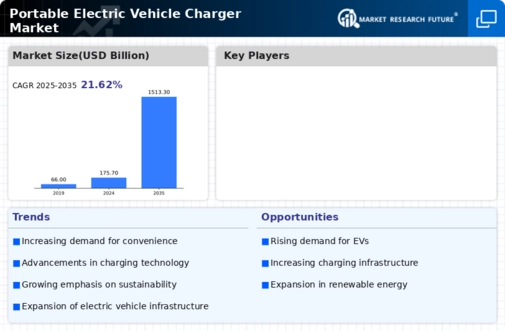
As per Market Research Future analysis, the Portable Electric Vehicle Charger Market Size was estimated at 175.74 USD Billion in 2024. The Portable Electric Vehicle Charger industry is projected to grow from 213.74 USD Billion in 2025 to 1513.34 USD Billion by 2035, exhibiting a compound annual growth rate (CAGR) of 21.6% during the forecast period 2025 - 2035.

Key Market Trends & Highlights

The Portable Electric Vehicle Charger Market is poised for substantial growth driven by technological advancements and increasing infrastructure.

  • Technological advancements are enhancing the efficiency and convenience of portable electric vehicle chargers. North America remains the largest market, while Asia-Pacific is emerging as the fastest-growing region for portable charging solutions. The Battery EV Charger segment dominates the market, whereas the Gas-fuelled Charger segment is witnessing rapid growth. Increased adoption of electric vehicles and government incentives are key drivers propelling market expansion.

Market Size & Forecast

2024 Market Size 175.74 (USD Billion)
2035 Market Size 1513.34 (USD Billion)
CAGR (2025 - 2035) 21.62%
Largest Regional Market Share in 2024 Europe

Major Players

Tesla (US), ChargePoint (US), Blink Charging (US), EVBox (NL), Wallbox (ES), Siemens (DE), ABB (CH), Schneider Electric (FR), Leviton (US)

Market Trends

The Portable Electric Vehicle Charger Market is currently experiencing a notable transformation, driven by the increasing adoption of electric vehicles and the growing emphasis on sustainable transportation solutions. As consumers become more environmentally conscious, the demand for efficient and convenient charging options is rising. This market appears to be evolving rapidly, with advancements in technology and infrastructure playing a crucial role in shaping its future.

The integration of smart features, such as mobile app connectivity and real-time monitoring, seems to enhance user experience and convenience, potentially attracting a broader customer base. Moreover, the Portable Electric Vehicle Charger Market is likely to benefit from the expansion of charging networks and government initiatives aimed at promoting electric vehicle usage.

As more public and private entities invest in charging infrastructure, the accessibility of portable chargers is expected to improve significantly. This trend may lead to increased consumer confidence in electric vehicles, further propelling market growth. Overall, the Portable Electric Vehicle Charger Market appears poised for substantial development, with various factors converging to create a dynamic and promising landscape for stakeholders in the industry.

Technological Advancements

The Portable Electric Vehicle Charger Market is witnessing rapid technological innovations, which enhance charging efficiency and user convenience. Developments in battery technology and charging speed are likely to attract more consumers, as they seek faster and more reliable solutions for their electric vehicles.

Growing Infrastructure

The expansion of charging infrastructure is a critical trend influencing the Portable Electric Vehicle Charger Market. As more charging stations become available in urban and rural areas, the accessibility of portable chargers is expected to improve, encouraging wider adoption of electric vehicles.

Sustainability Focus

There is an increasing emphasis on sustainability within the Portable Electric Vehicle Charger Market. Consumers are becoming more aware of their environmental impact, leading to a higher demand for eco-friendly charging solutions. This trend suggests that manufacturers may prioritize sustainable materials and practices in their product development.

Portable Electric Vehicle Charger Market Market Drivers

Expansion of Charging Infrastructure

The expansion of charging infrastructure is a vital factor propelling the Portable Electric Vehicle Charger Market. As more charging stations are established in urban and rural areas, the need for portable chargers becomes increasingly apparent. In 2025, it is anticipated that the number of public charging stations will double, providing greater accessibility for electric vehicle owners. This expansion not only alleviates range anxiety but also encourages the adoption of portable charging solutions, as users seek flexibility in their charging options. The Portable Electric Vehicle Charger Market stands to gain from this trend, as enhanced infrastructure supports the overall growth of electric vehicle usage.

Government Incentives and Regulations

Government incentives and regulations play a crucial role in shaping the Portable Electric Vehicle Charger Market. Many governments are implementing policies to promote electric vehicle adoption, including tax credits, rebates, and grants for EV buyers. These initiatives not only encourage consumers to purchase electric vehicles but also stimulate the demand for portable chargers. For instance, in 2025, several countries are expected to introduce stricter emissions regulations, further driving the need for portable charging solutions. This regulatory environment creates a favorable landscape for the Portable Electric Vehicle Charger Market, as manufacturers and consumers alike respond to these incentives and requirements.

Increased Adoption of Electric Vehicles

The rising adoption of electric vehicles (EVs) is a primary driver for the Portable Electric Vehicle Charger Market. As consumers increasingly opt for EVs due to environmental concerns and cost savings, the demand for portable chargers is expected to surge. In 2025, it is estimated that the number of electric vehicles on the road will exceed 30 million, creating a substantial need for accessible charging solutions. This trend indicates a shift in consumer behavior, where convenience and flexibility in charging options become paramount. The Portable Electric Vehicle Charger Market is likely to benefit from this growing consumer base, as more individuals seek portable charging solutions that can accommodate their on-the-go lifestyles.

Technological Innovations in Charging Solutions

Technological innovations are significantly influencing the Portable Electric Vehicle Charger Market. Advancements in battery technology, charging speed, and connectivity features are enhancing the functionality and appeal of portable chargers. For example, the introduction of fast-charging capabilities allows users to recharge their vehicles more quickly, addressing one of the primary concerns associated with electric vehicle ownership. In 2025, it is projected that the market for fast-charging portable chargers will grow by over 25%, reflecting the increasing consumer demand for efficient charging solutions. These innovations not only improve user experience but also position the Portable Electric Vehicle Charger Market for sustained growth.

Rising Consumer Awareness of Environmental Issues

The growing consumer awareness of environmental issues is a significant driver for the Portable Electric Vehicle Charger Market. As individuals become more conscious of their carbon footprints, the shift towards electric vehicles and, consequently, portable charging solutions is likely to accelerate. In 2025, surveys indicate that over 70% of consumers prioritize sustainability when making purchasing decisions, which directly impacts the demand for electric vehicles and their associated charging infrastructure. This heightened awareness fosters a favorable environment for the Portable Electric Vehicle Charger Market, as consumers actively seek out eco-friendly charging options that align with their values.

Market Segment Insights

By Type: Battery EV Charger (Largest) vs. Gas-fuelled Charger (Fastest-Growing)

<p>The Portable Electric Vehicle Charger Market is increasingly shaped by distinct charger types. Currently, the Battery EV Charger holds the largest market share, primarily due to its widespread adoption among electric vehicle users seeking convenience and sustainability. In contrast, the Gas-fuelled Charger is gaining traction, particularly among consumers interested in hybrid solutions that prioritize flexibility and ease of use. This diversification in charger type reflects broader consumer preferences and industry trends towards dual-fuel technology.</p>

<p>Charger Type: Battery EV Charger (Dominant) vs. Gas-fuelled Charger (Emerging)</p>

<p>The Battery EV Charger segment stands out as the dominant player in the Portable Electric Vehicle Charger Market. Its established presence stems from the growing demand for fully electric vehicles, coupled with advancements in battery technology that enhance charging efficiency and speed. On the other hand, the Gas-fuelled Charger is emerging as a significant contender, appealing to a niche market of hybrid vehicle owners. This segment offers unique benefits such as rapid refueling capabilities and reduced range anxiety, making it an attractive alternative for consumers who require flexibility in charging solutions. Both segments are poised for growth as the market evolves, driven by technological innovations and changing consumer preferences.</p>

By Current Type: AC (Largest) vs. DC (Fastest-Growing)

<p>In the Portable Electric Vehicle Charger Market, the segment 'Current Type' primarily consists of AC and DC chargers. Among these, AC chargers represent the largest share, largely due to their established presence in residential and commercial applications. They have been widely adopted for their compatibility with various electric vehicles, making them a go-to choice for everyday users. On the other hand, DC chargers, although currently smaller in market share, are rapidly gaining traction in the fast-charging segment, especially in commercial and public charging stations.</p>

<p>Current Type: AC (Dominant) vs. DC (Emerging)</p>

<p>AC chargers are considered the dominant segment in the Portable Electric Vehicle Charger Market due to their widespread usage and compatibility with most electric vehicle models. They are efficient for long-duration charging sessions, primarily used in home installations and workplaces, providing a convenient solution for electric vehicle owners. In contrast, DC chargers are emerging as the fastest-growing segment, catering to the need for quick charging solutions. These chargers are powerful and cater to commercial settings, where time-saving is critical. The rise in the adoption of electric vehicles and the development of fast-charging infrastructure are key drivers for the growing popularity of DC chargers.</p>

By End-user: Passenger Car (Largest) vs. Commercial Car (Fastest-Growing)

<p>The Portable Electric Vehicle Charger Market is predominantly driven by the passenger car segment, which holds a significant share compared to others such as commercial cars, aviation, and miscellaneous users. This segment's large presence is largely attributed to the rising number of electric passenger vehicles on the road, supported by government incentives and growing consumer preferences toward more sustainable options. Other segments, while smaller, still contribute to the overall increase in demand for portable chargers, as diverse end-users recognize the need for convenient charging solutions.</p>

<p>Passenger Car (Dominant) vs. Commercial Car (Emerging)</p>

<p>The passenger car segment stands out as the dominant player in the Portable Electric Vehicle Charger Market, primarily due to the surge in consumer electric vehicles, which are increasingly equipped with portable charging solutions. This segment benefits from advancements in battery technology and the growing consumer inclination toward electric mobility. Conversely, the commercial car segment is emerging rapidly, driven by businesses transitioning their fleets to electric models in a bid to enhance sustainability and reduce operating costs. As regulations tighten, the demand for portable chargers in commercial applications is expected to rise significantly, fueled by the need for reliable and efficient charging options.</p>

By Application: Roadside Assistance Companies (Largest) vs. Utilities (Fastest-Growing)

<p>In the Portable Electric Vehicle Charger Market, the application segment is witnessing a dynamic distribution of market share among key players. Roadside assistance companies currently hold the largest share, attributing it to the increasing reliance on electric vehicles and the rise in mobility services. On the other hand, utilities are emerging as a strong contender, rapidly growing in significance as they invest in infrastructure to support electric vehicle charging needs.</p>

<p>Roadside Assistance Companies (Dominant) vs. Utilities (Emerging)</p>

<p>Roadside assistance companies dominate the Portable Electric Vehicle Charger Market by providing essential support and charging solutions to electric vehicle owners stranded on the road. Their established operational frameworks and customer trust provide a significant advantage, enabling rapid deployment of charging solutions. Conversely, utilities represent an emerging segment, driven by the push for sustainable energy and electrification efforts. They are focusing on creating robust charging networks as part of a broader strategy to adapt to the growing electric vehicle market, demonstrating increasing investments and partnerships to improve service delivery.</p>

Get more detailed insights about Portable Electric Vehicle Charger Market Research Report—Global Forecast till 2035

Regional Insights

North America : Leading Innovation and Adoption

North America is the largest market for portable electric vehicle chargers, holding approximately 45% of the global market share. The region's growth is driven by increasing electric vehicle adoption, supportive government policies, and advancements in charging technology. Regulatory incentives, such as tax credits and grants for EV infrastructure, further catalyze market expansion. The U.S. and Canada are the primary contributors to this growth, with a strong focus on sustainability and reducing carbon emissions. The competitive landscape in North America is robust, featuring key players like Tesla, ChargePoint, and Blink Charging. These companies are at the forefront of innovation, offering a range of portable charging solutions. The presence of established manufacturers and a growing network of charging stations enhance market accessibility. As consumer awareness and demand for electric vehicles rise, the market is expected to continue its upward trajectory, supported by ongoing investments in EV infrastructure.

Europe : Sustainable Mobility Initiatives

Europe is witnessing significant growth in the portable electric vehicle charger market, accounting for approximately 30% of the global share. The region's commitment to sustainability and stringent emissions regulations are key drivers of this market expansion. Countries like Germany and France are leading the charge, supported by government initiatives aimed at increasing EV adoption and enhancing charging infrastructure. The European Green Deal and various national policies are pivotal in shaping the market landscape. Leading countries in Europe include Germany, France, and the Netherlands, where the presence of major players like EVBox and Siemens is notable. The competitive environment is characterized by innovation and collaboration among manufacturers, utilities, and governments. As the demand for electric vehicles continues to rise, the market is expected to grow, driven by advancements in technology and increased investment in charging networks.

Asia-Pacific : Emerging Market Potential

Asia-Pacific is rapidly emerging as a significant player in the portable electric vehicle charger market, holding around 20% of the global market share. The region's growth is fueled by rising urbanization, government incentives for electric vehicles, and increasing environmental awareness among consumers. Countries like China and Japan are leading the market, with substantial investments in EV infrastructure and technology. Regulatory frameworks promoting electric mobility are also contributing to market expansion. China stands out as the largest market in the region, with a vast network of charging stations and a strong presence of local manufacturers. Japan follows closely, with companies like ABB and Schneider Electric playing crucial roles in the market. The competitive landscape is evolving, with both established players and new entrants focusing on innovative charging solutions to meet the growing demand for electric vehicles in the region.

Middle East and Africa : Growing Interest in EV Solutions

The Middle East and Africa region is gradually developing its portable electric vehicle charger market, currently holding about 5% of the global share. The growth is primarily driven by increasing investments in renewable energy and a rising interest in electric vehicles. Countries like South Africa and the UAE are at the forefront, with government initiatives aimed at promoting sustainable transportation and reducing carbon footprints. Regulatory support is essential for fostering market growth in this region. In South Africa, the government is implementing policies to encourage electric vehicle adoption, while the UAE is investing heavily in EV infrastructure. The competitive landscape is still in its infancy, with a mix of local and international players entering the market. As awareness of electric vehicles grows, the region is expected to see a gradual increase in the adoption of portable charging solutions, supported by ongoing investments and regulatory frameworks.

Key Players and Competitive Insights

The portable electric vehicle charger market is considered highly competitive and includes merger and acquisition activities, partnerships, and expansion of product portfolios by leading players with an emphasis on innovation, convenience, and smart charging to strengthen their market position.
Key market players, such as Tesla, ChargePoint, Blink Charging, EVBox, and Wallbox, actively engage in the development of compact, user-friendly, fast-charging portable solutions to meet the growing demand for flexible electric vehicle charging. Major industrial players like Siemens, ABB, and Schneider Electric leverage their vast resources and strong electrical infrastructure expertise to facilitate the delivery of reliable and efficient electric car portable chargers. Companies like Leviton have continued in product improvement relative to safety and compatibility on multiple model vehicles. In a nutshell, continuous technological advancements, increasing penetration of electric vehicles, and strategic product launches will define the landscape as fast-evolving and dynamic.
In December 2025: Uno Minda has launched a new portable EV wall charger for home use featuring a 7.4 kW Type 2 fast-charging output, IP65 weatherproofing, multi-connectivity options including Wi-Fi, Ethernet, Bluetooth and cellular for remote monitoring, and multiple safety protections for overvoltage, overcurrent, overheating and short circuits, aiming to support India’s growing electric vehicle charging infrastructure.
In June 2025: China’s battery swap stations are gaining momentum as a fast alternative to conventional charging, with network expansion driven by companies like Nio and CATL that can replace depleted EV batteries with fully charged ones in around five minutes, aiming to reduce range anxiety and offer a more convenient experience for commercial and passenger EV users.

Key Companies in the Portable Electric Vehicle Charger Market include

Industry Developments

Besen International Group Co., Ltd: 2025: Besen has adopted a combined B2B and B2C market strategy, catering to both individual users and establishing partnerships with government agencies, commercial real estate developers, and fleet operators. The company offers customized solutions to integrate charging equipment seamlessly and provides comprehensive support from product selection to after-sales service. Besen's professional technical team ensures prompt and efficient service experiences for all customers.

Shell plc: 2024: Shell Recharge, the EV charging arm of Shell plc, has been integrating EV charging stations into its existing gas stations. This strategy leverages Shell's extensive network to provide convenient charging options for EV drivers, facilitating the transition to electric mobility. The company's brand recognition and widespread presence offer a significant advantage in the market.

Guangzhou Electway Technology Co., Ltd.

September 15, 2023: Electway participated in the 2023 Shenzhen International CPSE (Charging Pile and Battery Swap Station Exhibition). They introduced their DC Charging Adapter Series, designed to meet the growing demand for efficient EV charging solutions. Visitors responded positively to the adapter's advanced features and compatibility with various EV models.

April 2022 - Heliox has signed a supply agreement with PACCAR Parts to support the North American rollout of PACCAR's electric vehicles. Heliox will provide mobile 25 kW and 50 kW chargers to PACCAR dealers and customers developing electric truck fleets.

Future Outlook

Portable Electric Vehicle Charger Market Future Outlook

The Portable Electric Vehicle Charger Market is projected to grow at a 21.62% CAGR from 2025 to 2035, driven by increasing EV adoption, technological advancements, and supportive government policies.

New opportunities lie in:

  • <p>Development of mobile charging units for urban areas Partnerships with renewable energy providers for sustainable charging solutions Integration of smart technology for real-time charging management</p>

By 2035, the market is expected to be robust, driven by innovation and increasing demand.

Market Segmentation

Portable Electric Vehicle Charger Market Type Outlook

  • Gas-fuelled Charger
  • Battery EV Charger

Portable Electric Vehicle Charger Market End-user Outlook

  • Electric Vehicles
  • Commercial Car
  • Passenger Car
  • Aviation
  • Others

Portable Electric Vehicle Charger Market Application Outlook

  • Roadside Assistance Companies
  • Utilities
  • Shared Fleet Operator
  • Others

Portable Electric Vehicle Charger Market Current Type Outlook

  • AC
  • DC

Report Scope

MARKET SIZE 2024 175.74(USD Billion)
MARKET SIZE 2025 213.74(USD Billion)
MARKET SIZE 2035 1513.34(USD Billion)
COMPOUND ANNUAL GROWTH RATE (CAGR) 21.62% (2025 - 2035)
REPORT COVERAGE Revenue Forecast, Competitive Landscape, Growth Factors, and Trends
BASE YEAR 2024
Market Forecast Period 2025 - 2035
Historical Data 2019 - 2024
Market Forecast Units USD Billion
Key Companies Profiled Tesla (US), ChargePoint (US), Blink Charging (US), EVBox (NL), Wallbox (ES), Siemens (DE), ABB (CH), Schneider Electric (FR), Leviton (US)
Segments Covered Service Type, Current Type, End-user, Application, Region
Key Market Opportunities Growing demand for fast-charging solutions drives innovation in the Portable Electric Vehicle Charger Market.
Key Market Dynamics Rising consumer demand for convenient charging solutions drives innovation and competition in the portable electric vehicle charger market.
Countries Covered North America, Europe, APAC, South America, MEA

FAQs

What is the current valuation of the Portable Electric Vehicle Charger Market?

<p>The market valuation reached 175.74 USD Billion in 2024.</p>

What is the projected market size for the Portable Electric Vehicle Charger Market by 2035?

<p>The market is expected to grow to 1513.34 USD Billion by 2035.</p>

What is the expected CAGR for the Portable Electric Vehicle Charger Market during the forecast period 2025 - 2035?

<p>The market is anticipated to experience a CAGR of 21.62% from 2025 to 2035.</p>

Which companies are considered key players in the Portable Electric Vehicle Charger Market?

<p>Key players include Tesla, ChargePoint, Blink Charging, EVBox, Wallbox, Siemens, ABB, Schneider Electric, and Leviton.</p>

What are the main segments of the Portable Electric Vehicle Charger Market?

<p>The market segments include Type, Current Type, End-user, and Application.</p>

How does the valuation of Battery EV Chargers compare to Gas-fuelled Chargers?

Battery EV Chargers are valued at 140.74 USD Billion, significantly higher than Gas-fuelled Chargers at 35.0 USD Billion.

What is the valuation of AC and DC chargers in the market?

AC chargers are valued at 70.0 USD Billion, while DC chargers are valued at 105.74 USD Billion.

Which end-user segment has the highest valuation in the Portable Electric Vehicle Charger Market?

The Electric Vehicles segment leads with a valuation of 70.0 USD Billion.

What applications are driving growth in the Portable Electric Vehicle Charger Market?

Roadside Assistance Companies and Utilities are key applications, valued at 35.0 USD Billion and 50.0 USD Billion, respectively.

What trends are influencing the Portable Electric Vehicle Charger Market?

The increasing adoption of electric vehicles and advancements in charging technology are likely influencing market growth.

  1. SECTION I: EXECUTIVE SUMMARY AND KEY HIGHLIGHTS
    1. | 1.1 EXECUTIVE SUMMARY
    2. | | 1.1.1 Market Overview
    3. | | 1.1.2 Key Findings
    4. | | 1.1.3 Market Segmentation
    5. | | 1.1.4 Competitive Landscape
    6. | | 1.1.5 Challenges and Opportunities
    7. | | 1.1.6 Future Outlook
  2. SECTION II: SCOPING, METHODOLOGY AND MARKET STRUCTURE
    1. | 2.1 MARKET INTRODUCTION
    2. | | 2.1.1 Definition
    3. | | 2.1.2 Scope of the study
    4. | | | 2.1.2.1 Research Objective
    5. | | | 2.1.2.2 Assumption
    6. | | | 2.1.2.3 Limitations
    7. | 2.2 RESEARCH METHODOLOGY
    8. | | 2.2.1 Overview
    9. | | 2.2.2 Data Mining
    10. | | 2.2.3 Secondary Research
    11. | | 2.2.4 Primary Research
    12. | | | 2.2.4.1 Primary Interviews and Information Gathering Process
    13. | | | 2.2.4.2 Breakdown of Primary Respondents
    14. | | 2.2.5 Forecasting Model
    15. | | 2.2.6 Market Size Estimation
    16. | | | 2.2.6.1 Bottom-Up Approach
    17. | | | 2.2.6.2 Top-Down Approach
    18. | | 2.2.7 Data Triangulation
    19. | | 2.2.8 Validation
  3. SECTION III: QUALITATIVE ANALYSIS
    1. | 3.1 MARKET DYNAMICS
    2. | | 3.1.1 Overview
    3. | | 3.1.2 Drivers
    4. | | 3.1.3 Restraints
    5. | | 3.1.4 Opportunities
    6. | 3.2 MARKET FACTOR ANALYSIS
    7. | | 3.2.1 Value chain Analysis
    8. | | 3.2.2 Porter's Five Forces Analysis
    9. | | | 3.2.2.1 Bargaining Power of Suppliers
    10. | | | 3.2.2.2 Bargaining Power of Buyers
    11. | | | 3.2.2.3 Threat of New Entrants
    12. | | | 3.2.2.4 Threat of Substitutes
    13. | | | 3.2.2.5 Intensity of Rivalry
    14. | | 3.2.3 COVID-19 Impact Analysis
    15. | | | 3.2.3.1 Market Impact Analysis
    16. | | | 3.2.3.2 Regional Impact
    17. | | | 3.2.3.3 Opportunity and Threat Analysis
  4. SECTION IV: QUANTITATIVE ANALYSIS
    1. | 4.1 Automobile, BY Type (USD Billion)
    2. | | 4.1.1 Gas-fuelled Charger
    3. | | 4.1.2 Battery EV Charger
    4. | 4.2 Automobile, BY Current Type (USD Billion)
    5. | | 4.2.1 AC
    6. | | 4.2.2 DC
    7. | 4.3 Automobile, BY End-user (USD Billion)
    8. | | 4.3.1 Electric Vehicles
    9. | | 4.3.2 Commercial Car
    10. | | 4.3.3 Passenger Car
    11. | | 4.3.4 Aviation
    12. | | 4.3.5 Others
    13. | 4.4 Automobile, BY Application (USD Billion)
    14. | | 4.4.1 Roadside Assistance Companies
    15. | | 4.4.2 Utilities
    16. | | 4.4.3 Shared Fleet Operator
    17. | | 4.4.4 Others
    18. | 4.5 Automobile, BY Region (USD Billion)
    19. | | 4.5.1 North America
    20. | | | 4.5.1.1 US
    21. | | | 4.5.1.2 Canada
    22. | | 4.5.2 Europe
    23. | | | 4.5.2.1 Germany
    24. | | | 4.5.2.2 UK
    25. | | | 4.5.2.3 France
    26. | | | 4.5.2.4 Russia
    27. | | | 4.5.2.5 Italy
    28. | | | 4.5.2.6 Spain
    29. | | | 4.5.2.7 Rest of Europe
    30. | | 4.5.3 APAC
    31. | | | 4.5.3.1 China
    32. | | | 4.5.3.2 India
    33. | | | 4.5.3.3 Japan
    34. | | | 4.5.3.4 South Korea
    35. | | | 4.5.3.5 Malaysia
    36. | | | 4.5.3.6 Thailand
    37. | | | 4.5.3.7 Indonesia
    38. | | | 4.5.3.8 Rest of APAC
    39. | | 4.5.4 South America
    40. | | | 4.5.4.1 Brazil
    41. | | | 4.5.4.2 Mexico
    42. | | | 4.5.4.3 Argentina
    43. | | | 4.5.4.4 Rest of South America
    44. | | 4.5.5 MEA
    45. | | | 4.5.5.1 GCC Countries
    46. | | | 4.5.5.2 South Africa
    47. | | | 4.5.5.3 Rest of MEA
  5. SECTION V: COMPETITIVE ANALYSIS
    1. | 5.1 Competitive Landscape
    2. | | 5.1.1 Overview
    3. | | 5.1.2 Competitive Analysis
    4. | | 5.1.3 Market share Analysis
    5. | | 5.1.4 Major Growth Strategy in the Automobile
    6. | | 5.1.5 Competitive Benchmarking
    7. | | 5.1.6 Leading Players in Terms of Number of Developments in the Automobile
    8. | | 5.1.7 Key developments and growth strategies
    9. | | | 5.1.7.1 New Product Launch/Service Deployment
    10. | | | 5.1.7.2 Merger & Acquisitions
    11. | | | 5.1.7.3 Joint Ventures
    12. | | 5.1.8 Major Players Financial Matrix
    13. | | | 5.1.8.1 Sales and Operating Income
    14. | | | 5.1.8.2 Major Players R&D Expenditure. 2023
    15. | 5.2 Company Profiles
    16. | | 5.2.1 Tesla (US)
    17. | | | 5.2.1.1 Financial Overview
    18. | | | 5.2.1.2 Products Offered
    19. | | | 5.2.1.3 Key Developments
    20. | | | 5.2.1.4 SWOT Analysis
    21. | | | 5.2.1.5 Key Strategies
    22. | | 5.2.2 ChargePoint (US)
    23. | | | 5.2.2.1 Financial Overview
    24. | | | 5.2.2.2 Products Offered
    25. | | | 5.2.2.3 Key Developments
    26. | | | 5.2.2.4 SWOT Analysis
    27. | | | 5.2.2.5 Key Strategies
    28. | | 5.2.3 Blink Charging (US)
    29. | | | 5.2.3.1 Financial Overview
    30. | | | 5.2.3.2 Products Offered
    31. | | | 5.2.3.3 Key Developments
    32. | | | 5.2.3.4 SWOT Analysis
    33. | | | 5.2.3.5 Key Strategies
    34. | | 5.2.4 EVBox (NL)
    35. | | | 5.2.4.1 Financial Overview
    36. | | | 5.2.4.2 Products Offered
    37. | | | 5.2.4.3 Key Developments
    38. | | | 5.2.4.4 SWOT Analysis
    39. | | | 5.2.4.5 Key Strategies
    40. | | 5.2.5 Wallbox (ES)
    41. | | | 5.2.5.1 Financial Overview
    42. | | | 5.2.5.2 Products Offered
    43. | | | 5.2.5.3 Key Developments
    44. | | | 5.2.5.4 SWOT Analysis
    45. | | | 5.2.5.5 Key Strategies
    46. | | 5.2.6 Siemens (DE)
    47. | | | 5.2.6.1 Financial Overview
    48. | | | 5.2.6.2 Products Offered
    49. | | | 5.2.6.3 Key Developments
    50. | | | 5.2.6.4 SWOT Analysis
    51. | | | 5.2.6.5 Key Strategies
    52. | | 5.2.7 ABB (CH)
    53. | | | 5.2.7.1 Financial Overview
    54. | | | 5.2.7.2 Products Offered
    55. | | | 5.2.7.3 Key Developments
    56. | | | 5.2.7.4 SWOT Analysis
    57. | | | 5.2.7.5 Key Strategies
    58. | | 5.2.8 Schneider Electric (FR)
    59. | | | 5.2.8.1 Financial Overview
    60. | | | 5.2.8.2 Products Offered
    61. | | | 5.2.8.3 Key Developments
    62. | | | 5.2.8.4 SWOT Analysis
    63. | | | 5.2.8.5 Key Strategies
    64. | | 5.2.9 Leviton (US)
    65. | | | 5.2.9.1 Financial Overview
    66. | | | 5.2.9.2 Products Offered
    67. | | | 5.2.9.3 Key Developments
    68. | | | 5.2.9.4 SWOT Analysis
    69. | | | 5.2.9.5 Key Strategies
    70. | 5.3 Appendix
    71. | | 5.3.1 References
    72. | | 5.3.2 Related Reports
  6. LIST OF FIGURES
    1. | 6.1 MARKET SYNOPSIS
    2. | 6.2 NORTH AMERICA MARKET ANALYSIS
    3. | 6.3 US MARKET ANALYSIS BY TYPE
    4. | 6.4 US MARKET ANALYSIS BY CURRENT TYPE
    5. | 6.5 US MARKET ANALYSIS BY END-USER
    6. | 6.6 US MARKET ANALYSIS BY APPLICATION
    7. | 6.7 CANADA MARKET ANALYSIS BY TYPE
    8. | 6.8 CANADA MARKET ANALYSIS BY CURRENT TYPE
    9. | 6.9 CANADA MARKET ANALYSIS BY END-USER
    10. | 6.10 CANADA MARKET ANALYSIS BY APPLICATION
    11. | 6.11 EUROPE MARKET ANALYSIS
    12. | 6.12 GERMANY MARKET ANALYSIS BY TYPE
    13. | 6.13 GERMANY MARKET ANALYSIS BY CURRENT TYPE
    14. | 6.14 GERMANY MARKET ANALYSIS BY END-USER
    15. | 6.15 GERMANY MARKET ANALYSIS BY APPLICATION
    16. | 6.16 UK MARKET ANALYSIS BY TYPE
    17. | 6.17 UK MARKET ANALYSIS BY CURRENT TYPE
    18. | 6.18 UK MARKET ANALYSIS BY END-USER
    19. | 6.19 UK MARKET ANALYSIS BY APPLICATION
    20. | 6.20 FRANCE MARKET ANALYSIS BY TYPE
    21. | 6.21 FRANCE MARKET ANALYSIS BY CURRENT TYPE
    22. | 6.22 FRANCE MARKET ANALYSIS BY END-USER
    23. | 6.23 FRANCE MARKET ANALYSIS BY APPLICATION
    24. | 6.24 RUSSIA MARKET ANALYSIS BY TYPE
    25. | 6.25 RUSSIA MARKET ANALYSIS BY CURRENT TYPE
    26. | 6.26 RUSSIA MARKET ANALYSIS BY END-USER
    27. | 6.27 RUSSIA MARKET ANALYSIS BY APPLICATION
    28. | 6.28 ITALY MARKET ANALYSIS BY TYPE
    29. | 6.29 ITALY MARKET ANALYSIS BY CURRENT TYPE
    30. | 6.30 ITALY MARKET ANALYSIS BY END-USER
    31. | 6.31 ITALY MARKET ANALYSIS BY APPLICATION
    32. | 6.32 SPAIN MARKET ANALYSIS BY TYPE
    33. | 6.33 SPAIN MARKET ANALYSIS BY CURRENT TYPE
    34. | 6.34 SPAIN MARKET ANALYSIS BY END-USER
    35. | 6.35 SPAIN MARKET ANALYSIS BY APPLICATION
    36. | 6.36 REST OF EUROPE MARKET ANALYSIS BY TYPE
    37. | 6.37 REST OF EUROPE MARKET ANALYSIS BY CURRENT TYPE
    38. | 6.38 REST OF EUROPE MARKET ANALYSIS BY END-USER
    39. | 6.39 REST OF EUROPE MARKET ANALYSIS BY APPLICATION
    40. | 6.40 APAC MARKET ANALYSIS
    41. | 6.41 CHINA MARKET ANALYSIS BY TYPE
    42. | 6.42 CHINA MARKET ANALYSIS BY CURRENT TYPE
    43. | 6.43 CHINA MARKET ANALYSIS BY END-USER
    44. | 6.44 CHINA MARKET ANALYSIS BY APPLICATION
    45. | 6.45 INDIA MARKET ANALYSIS BY TYPE
    46. | 6.46 INDIA MARKET ANALYSIS BY CURRENT TYPE
    47. | 6.47 INDIA MARKET ANALYSIS BY END-USER
    48. | 6.48 INDIA MARKET ANALYSIS BY APPLICATION
    49. | 6.49 JAPAN MARKET ANALYSIS BY TYPE
    50. | 6.50 JAPAN MARKET ANALYSIS BY CURRENT TYPE
    51. | 6.51 JAPAN MARKET ANALYSIS BY END-USER
    52. | 6.52 JAPAN MARKET ANALYSIS BY APPLICATION
    53. | 6.53 SOUTH KOREA MARKET ANALYSIS BY TYPE
    54. | 6.54 SOUTH KOREA MARKET ANALYSIS BY CURRENT TYPE
    55. | 6.55 SOUTH KOREA MARKET ANALYSIS BY END-USER
    56. | 6.56 SOUTH KOREA MARKET ANALYSIS BY APPLICATION
    57. | 6.57 MALAYSIA MARKET ANALYSIS BY TYPE
    58. | 6.58 MALAYSIA MARKET ANALYSIS BY CURRENT TYPE
    59. | 6.59 MALAYSIA MARKET ANALYSIS BY END-USER
    60. | 6.60 MALAYSIA MARKET ANALYSIS BY APPLICATION
    61. | 6.61 THAILAND MARKET ANALYSIS BY TYPE
    62. | 6.62 THAILAND MARKET ANALYSIS BY CURRENT TYPE
    63. | 6.63 THAILAND MARKET ANALYSIS BY END-USER
    64. | 6.64 THAILAND MARKET ANALYSIS BY APPLICATION
    65. | 6.65 INDONESIA MARKET ANALYSIS BY TYPE
    66. | 6.66 INDONESIA MARKET ANALYSIS BY CURRENT TYPE
    67. | 6.67 INDONESIA MARKET ANALYSIS BY END-USER
    68. | 6.68 INDONESIA MARKET ANALYSIS BY APPLICATION
    69. | 6.69 REST OF APAC MARKET ANALYSIS BY TYPE
    70. | 6.70 REST OF APAC MARKET ANALYSIS BY CURRENT TYPE
    71. | 6.71 REST OF APAC MARKET ANALYSIS BY END-USER
    72. | 6.72 REST OF APAC MARKET ANALYSIS BY APPLICATION
    73. | 6.73 SOUTH AMERICA MARKET ANALYSIS
    74. | 6.74 BRAZIL MARKET ANALYSIS BY TYPE
    75. | 6.75 BRAZIL MARKET ANALYSIS BY CURRENT TYPE
    76. | 6.76 BRAZIL MARKET ANALYSIS BY END-USER
    77. | 6.77 BRAZIL MARKET ANALYSIS BY APPLICATION
    78. | 6.78 MEXICO MARKET ANALYSIS BY TYPE
    79. | 6.79 MEXICO MARKET ANALYSIS BY CURRENT TYPE
    80. | 6.80 MEXICO MARKET ANALYSIS BY END-USER
    81. | 6.81 MEXICO MARKET ANALYSIS BY APPLICATION
    82. | 6.82 ARGENTINA MARKET ANALYSIS BY TYPE
    83. | 6.83 ARGENTINA MARKET ANALYSIS BY CURRENT TYPE
    84. | 6.84 ARGENTINA MARKET ANALYSIS BY END-USER
    85. | 6.85 ARGENTINA MARKET ANALYSIS BY APPLICATION
    86. | 6.86 REST OF SOUTH AMERICA MARKET ANALYSIS BY TYPE
    87. | 6.87 REST OF SOUTH AMERICA MARKET ANALYSIS BY CURRENT TYPE
    88. | 6.88 REST OF SOUTH AMERICA MARKET ANALYSIS BY END-USER
    89. | 6.89 REST OF SOUTH AMERICA MARKET ANALYSIS BY APPLICATION
    90. | 6.90 MEA MARKET ANALYSIS
    91. | 6.91 GCC COUNTRIES MARKET ANALYSIS BY TYPE
    92. | 6.92 GCC COUNTRIES MARKET ANALYSIS BY CURRENT TYPE
    93. | 6.93 GCC COUNTRIES MARKET ANALYSIS BY END-USER
    94. | 6.94 GCC COUNTRIES MARKET ANALYSIS BY APPLICATION
    95. | 6.95 SOUTH AFRICA MARKET ANALYSIS BY TYPE
    96. | 6.96 SOUTH AFRICA MARKET ANALYSIS BY CURRENT TYPE
    97. | 6.97 SOUTH AFRICA MARKET ANALYSIS BY END-USER
    98. | 6.98 SOUTH AFRICA MARKET ANALYSIS BY APPLICATION
    99. | 6.99 REST OF MEA MARKET ANALYSIS BY TYPE
    100. | 6.100 REST OF MEA MARKET ANALYSIS BY CURRENT TYPE
    101. | 6.101 REST OF MEA MARKET ANALYSIS BY END-USER
    102. | 6.102 REST OF MEA MARKET ANALYSIS BY APPLICATION
    103. | 6.103 KEY BUYING CRITERIA OF AUTOMOBILE
    104. | 6.104 RESEARCH PROCESS OF MRFR
    105. | 6.105 DRO ANALYSIS OF AUTOMOBILE
    106. | 6.106 DRIVERS IMPACT ANALYSIS: AUTOMOBILE
    107. | 6.107 RESTRAINTS IMPACT ANALYSIS: AUTOMOBILE
    108. | 6.108 SUPPLY / VALUE CHAIN: AUTOMOBILE
    109. | 6.109 AUTOMOBILE, BY TYPE, 2024 (% SHARE)
    110. | 6.110 AUTOMOBILE, BY TYPE, 2024 TO 2035 (USD Billion)
    111. | 6.111 AUTOMOBILE, BY CURRENT TYPE, 2024 (% SHARE)
    112. | 6.112 AUTOMOBILE, BY CURRENT TYPE, 2024 TO 2035 (USD Billion)
    113. | 6.113 AUTOMOBILE, BY END-USER, 2024 (% SHARE)
    114. | 6.114 AUTOMOBILE, BY END-USER, 2024 TO 2035 (USD Billion)
    115. | 6.115 AUTOMOBILE, BY APPLICATION, 2024 (% SHARE)
    116. | 6.116 AUTOMOBILE, BY APPLICATION, 2024 TO 2035 (USD Billion)
    117. | 6.117 BENCHMARKING OF MAJOR COMPETITORS
  7. LIST OF TABLES
    1. | 7.1 LIST OF ASSUMPTIONS
    2. | | 7.1.1
    3. | 7.2 North America MARKET SIZE ESTIMATES; FORECAST
    4. | | 7.2.1 BY TYPE, 2025-2035 (USD Billion)
    5. | | 7.2.2 BY CURRENT TYPE, 2025-2035 (USD Billion)
    6. | | 7.2.3 BY END-USER, 2025-2035 (USD Billion)
    7. | | 7.2.4 BY APPLICATION, 2025-2035 (USD Billion)
    8. | 7.3 US MARKET SIZE ESTIMATES; FORECAST
    9. | | 7.3.1 BY TYPE, 2025-2035 (USD Billion)
    10. | | 7.3.2 BY CURRENT TYPE, 2025-2035 (USD Billion)
    11. | | 7.3.3 BY END-USER, 2025-2035 (USD Billion)
    12. | | 7.3.4 BY APPLICATION, 2025-2035 (USD Billion)
    13. | 7.4 Canada MARKET SIZE ESTIMATES; FORECAST
    14. | | 7.4.1 BY TYPE, 2025-2035 (USD Billion)
    15. | | 7.4.2 BY CURRENT TYPE, 2025-2035 (USD Billion)
    16. | | 7.4.3 BY END-USER, 2025-2035 (USD Billion)
    17. | | 7.4.4 BY APPLICATION, 2025-2035 (USD Billion)
    18. | 7.5 Europe MARKET SIZE ESTIMATES; FORECAST
    19. | | 7.5.1 BY TYPE, 2025-2035 (USD Billion)
    20. | | 7.5.2 BY CURRENT TYPE, 2025-2035 (USD Billion)
    21. | | 7.5.3 BY END-USER, 2025-2035 (USD Billion)
    22. | | 7.5.4 BY APPLICATION, 2025-2035 (USD Billion)
    23. | 7.6 Germany MARKET SIZE ESTIMATES; FORECAST
    24. | | 7.6.1 BY TYPE, 2025-2035 (USD Billion)
    25. | | 7.6.2 BY CURRENT TYPE, 2025-2035 (USD Billion)
    26. | | 7.6.3 BY END-USER, 2025-2035 (USD Billion)
    27. | | 7.6.4 BY APPLICATION, 2025-2035 (USD Billion)
    28. | 7.7 UK MARKET SIZE ESTIMATES; FORECAST
    29. | | 7.7.1 BY TYPE, 2025-2035 (USD Billion)
    30. | | 7.7.2 BY CURRENT TYPE, 2025-2035 (USD Billion)
    31. | | 7.7.3 BY END-USER, 2025-2035 (USD Billion)
    32. | | 7.7.4 BY APPLICATION, 2025-2035 (USD Billion)
    33. | 7.8 France MARKET SIZE ESTIMATES; FORECAST
    34. | | 7.8.1 BY TYPE, 2025-2035 (USD Billion)
    35. | | 7.8.2 BY CURRENT TYPE, 2025-2035 (USD Billion)
    36. | | 7.8.3 BY END-USER, 2025-2035 (USD Billion)
    37. | | 7.8.4 BY APPLICATION, 2025-2035 (USD Billion)
    38. | 7.9 Russia MARKET SIZE ESTIMATES; FORECAST
    39. | | 7.9.1 BY TYPE, 2025-2035 (USD Billion)
    40. | | 7.9.2 BY CURRENT TYPE, 2025-2035 (USD Billion)
    41. | | 7.9.3 BY END-USER, 2025-2035 (USD Billion)
    42. | | 7.9.4 BY APPLICATION, 2025-2035 (USD Billion)
    43. | 7.10 Italy MARKET SIZE ESTIMATES; FORECAST
    44. | | 7.10.1 BY TYPE, 2025-2035 (USD Billion)
    45. | | 7.10.2 BY CURRENT TYPE, 2025-2035 (USD Billion)
    46. | | 7.10.3 BY END-USER, 2025-2035 (USD Billion)
    47. | | 7.10.4 BY APPLICATION, 2025-2035 (USD Billion)
    48. | 7.11 Spain MARKET SIZE ESTIMATES; FORECAST
    49. | | 7.11.1 BY TYPE, 2025-2035 (USD Billion)
    50. | | 7.11.2 BY CURRENT TYPE, 2025-2035 (USD Billion)
    51. | | 7.11.3 BY END-USER, 2025-2035 (USD Billion)
    52. | | 7.11.4 BY APPLICATION, 2025-2035 (USD Billion)
    53. | 7.12 Rest of Europe MARKET SIZE ESTIMATES; FORECAST
    54. | | 7.12.1 BY TYPE, 2025-2035 (USD Billion)
    55. | | 7.12.2 BY CURRENT TYPE, 2025-2035 (USD Billion)
    56. | | 7.12.3 BY END-USER, 2025-2035 (USD Billion)
    57. | | 7.12.4 BY APPLICATION, 2025-2035 (USD Billion)
    58. | 7.13 APAC MARKET SIZE ESTIMATES; FORECAST
    59. | | 7.13.1 BY TYPE, 2025-2035 (USD Billion)
    60. | | 7.13.2 BY CURRENT TYPE, 2025-2035 (USD Billion)
    61. | | 7.13.3 BY END-USER, 2025-2035 (USD Billion)
    62. | | 7.13.4 BY APPLICATION, 2025-2035 (USD Billion)
    63. | 7.14 China MARKET SIZE ESTIMATES; FORECAST
    64. | | 7.14.1 BY TYPE, 2025-2035 (USD Billion)
    65. | | 7.14.2 BY CURRENT TYPE, 2025-2035 (USD Billion)
    66. | | 7.14.3 BY END-USER, 2025-2035 (USD Billion)
    67. | | 7.14.4 BY APPLICATION, 2025-2035 (USD Billion)
    68. | 7.15 India MARKET SIZE ESTIMATES; FORECAST
    69. | | 7.15.1 BY TYPE, 2025-2035 (USD Billion)
    70. | | 7.15.2 BY CURRENT TYPE, 2025-2035 (USD Billion)
    71. | | 7.15.3 BY END-USER, 2025-2035 (USD Billion)
    72. | | 7.15.4 BY APPLICATION, 2025-2035 (USD Billion)
    73. | 7.16 Japan MARKET SIZE ESTIMATES; FORECAST
    74. | | 7.16.1 BY TYPE, 2025-2035 (USD Billion)
    75. | | 7.16.2 BY CURRENT TYPE, 2025-2035 (USD Billion)
    76. | | 7.16.3 BY END-USER, 2025-2035 (USD Billion)
    77. | | 7.16.4 BY APPLICATION, 2025-2035 (USD Billion)
    78. | 7.17 South Korea MARKET SIZE ESTIMATES; FORECAST
    79. | | 7.17.1 BY TYPE, 2025-2035 (USD Billion)
    80. | | 7.17.2 BY CURRENT TYPE, 2025-2035 (USD Billion)
    81. | | 7.17.3 BY END-USER, 2025-2035 (USD Billion)
    82. | | 7.17.4 BY APPLICATION, 2025-2035 (USD Billion)
    83. | 7.18 Malaysia MARKET SIZE ESTIMATES; FORECAST
    84. | | 7.18.1 BY TYPE, 2025-2035 (USD Billion)
    85. | | 7.18.2 BY CURRENT TYPE, 2025-2035 (USD Billion)
    86. | | 7.18.3 BY END-USER, 2025-2035 (USD Billion)
    87. | | 7.18.4 BY APPLICATION, 2025-2035 (USD Billion)
    88. | 7.19 Thailand MARKET SIZE ESTIMATES; FORECAST
    89. | | 7.19.1 BY TYPE, 2025-2035 (USD Billion)
    90. | | 7.19.2 BY CURRENT TYPE, 2025-2035 (USD Billion)
    91. | | 7.19.3 BY END-USER, 2025-2035 (USD Billion)
    92. | | 7.19.4 BY APPLICATION, 2025-2035 (USD Billion)
    93. | 7.20 Indonesia MARKET SIZE ESTIMATES; FORECAST
    94. | | 7.20.1 BY TYPE, 2025-2035 (USD Billion)
    95. | | 7.20.2 BY CURRENT TYPE, 2025-2035 (USD Billion)
    96. | | 7.20.3 BY END-USER, 2025-2035 (USD Billion)
    97. | | 7.20.4 BY APPLICATION, 2025-2035 (USD Billion)
    98. | 7.21 Rest of APAC MARKET SIZE ESTIMATES; FORECAST
    99. | | 7.21.1 BY TYPE, 2025-2035 (USD Billion)
    100. | | 7.21.2 BY CURRENT TYPE, 2025-2035 (USD Billion)
    101. | | 7.21.3 BY END-USER, 2025-2035 (USD Billion)
    102. | | 7.21.4 BY APPLICATION, 2025-2035 (USD Billion)
    103. | 7.22 South America MARKET SIZE ESTIMATES; FORECAST
    104. | | 7.22.1 BY TYPE, 2025-2035 (USD Billion)
    105. | | 7.22.2 BY CURRENT TYPE, 2025-2035 (USD Billion)
    106. | | 7.22.3 BY END-USER, 2025-2035 (USD Billion)
    107. | | 7.22.4 BY APPLICATION, 2025-2035 (USD Billion)
    108. | 7.23 Brazil MARKET SIZE ESTIMATES; FORECAST
    109. | | 7.23.1 BY TYPE, 2025-2035 (USD Billion)
    110. | | 7.23.2 BY CURRENT TYPE, 2025-2035 (USD Billion)
    111. | | 7.23.3 BY END-USER, 2025-2035 (USD Billion)
    112. | | 7.23.4 BY APPLICATION, 2025-2035 (USD Billion)
    113. | 7.24 Mexico MARKET SIZE ESTIMATES; FORECAST
    114. | | 7.24.1 BY TYPE, 2025-2035 (USD Billion)
    115. | | 7.24.2 BY CURRENT TYPE, 2025-2035 (USD Billion)
    116. | | 7.24.3 BY END-USER, 2025-2035 (USD Billion)
    117. | | 7.24.4 BY APPLICATION, 2025-2035 (USD Billion)
    118. | 7.25 Argentina MARKET SIZE ESTIMATES; FORECAST
    119. | | 7.25.1 BY TYPE, 2025-2035 (USD Billion)
    120. | | 7.25.2 BY CURRENT TYPE, 2025-2035 (USD Billion)
    121. | | 7.25.3 BY END-USER, 2025-2035 (USD Billion)
    122. | | 7.25.4 BY APPLICATION, 2025-2035 (USD Billion)
    123. | 7.26 Rest of South America MARKET SIZE ESTIMATES; FORECAST
    124. | | 7.26.1 BY TYPE, 2025-2035 (USD Billion)
    125. | | 7.26.2 BY CURRENT TYPE, 2025-2035 (USD Billion)
    126. | | 7.26.3 BY END-USER, 2025-2035 (USD Billion)
    127. | | 7.26.4 BY APPLICATION, 2025-2035 (USD Billion)
    128. | 7.27 MEA MARKET SIZE ESTIMATES; FORECAST
    129. | | 7.27.1 BY TYPE, 2025-2035 (USD Billion)
    130. | | 7.27.2 BY CURRENT TYPE, 2025-2035 (USD Billion)
    131. | | 7.27.3 BY END-USER, 2025-2035 (USD Billion)
    132. | | 7.27.4 BY APPLICATION, 2025-2035 (USD Billion)
    133. | 7.28 GCC Countries MARKET SIZE ESTIMATES; FORECAST
    134. | | 7.28.1 BY TYPE, 2025-2035 (USD Billion)
    135. | | 7.28.2 BY CURRENT TYPE, 2025-2035 (USD Billion)
    136. | | 7.28.3 BY END-USER, 2025-2035 (USD Billion)
    137. | | 7.28.4 BY APPLICATION, 2025-2035 (USD Billion)
    138. | 7.29 South Africa MARKET SIZE ESTIMATES; FORECAST
    139. | | 7.29.1 BY TYPE, 2025-2035 (USD Billion)
    140. | | 7.29.2 BY CURRENT TYPE, 2025-2035 (USD Billion)
    141. | | 7.29.3 BY END-USER, 2025-2035 (USD Billion)
    142. | | 7.29.4 BY APPLICATION, 2025-2035 (USD Billion)
    143. | 7.30 Rest of MEA MARKET SIZE ESTIMATES; FORECAST
    144. | | 7.30.1 BY TYPE, 2025-2035 (USD Billion)
    145. | | 7.30.2 BY CURRENT TYPE, 2025-2035 (USD Billion)
    146. | | 7.30.3 BY END-USER, 2025-2035 (USD Billion)
    147. | | 7.30.4 BY APPLICATION, 2025-2035 (USD Billion)
    148. | 7.31 PRODUCT LAUNCH/PRODUCT DEVELOPMENT/APPROVAL
    149. | | 7.31.1
    150. | 7.32 ACQUISITION/PARTNERSHIP
    151. | | 7.32.1

Automobile Market Segmentation

Automobile By Type (USD Billion, 2025-2035)

  • Gas-fuelled Charger
  • Battery EV Charger

Automobile By Current Type (USD Billion, 2025-2035)

  • AC
  • DC

Automobile By End-user (USD Billion, 2025-2035)

  • Electric Vehicles
  • Commercial Car
  • Passenger Car
  • Aviation
  • Others

Automobile By Application (USD Billion, 2025-2035)

  • Roadside Assistance Companies
  • Utilities
  • Shared Fleet Operator
  • Others
Infographic

Free Sample Request

Kindly complete the form below to receive a free sample of this Report

Get Free Sample

Customer Strories

Compare Licence

×
Features License Type
Single User Multiuser License Enterprise User
Price $4,950 $5,950 $7,250
Maximum User Access Limit 1 User Upto 10 Users Unrestricted Access Throughout the Organization
Free Customization
Direct Access to Analyst
Deliverable Format
Platform Access
Discount on Next Purchase 10% 15% 15%
Printable Versions
%>