Request Free Sample ×

Kindly complete the form below to receive a free sample of this Report

* Please use a valid business email

Leading companies partner with us for data-driven Insights

clients tt-cursor
Hero Background
English
Chinese
French
Japanese
Korean
German
Spanish

Polymethyl Methacrylate PMMA Market Share

ID: MRFR/CnM/3436-CR
111 Pages
Chitranshi Jaiswal
September 2023

Polymethyl Methacrylate (PMMA) Market Research Report: By Type (Extruded Sheets, Cast Sheets, Pellets, Beads), By Application (Automotive, Construction, Signs, Displays, Electronics, Others) and  By Regional (North America, Europe, South America, Asia Pacific, Middle East and Africa)  - Forecast to 2035.

Share:
Download PDF ×

We do not share your information with anyone. However, we may send you emails based on your report interest from time to time. You may contact us at any time to opt-out.

Polymethyl Methacrylate PMMA Market Infographic
Purchase Options

Market Share

Polymethyl Methacrylate PMMA Market Share Analysis

In the competitive landscape of the Polymethyl Methacrylate (PMMA) market, market share positioning strategies play a pivotal role in determining the success and growth of companies operating in the industry. PMMA, a transparent thermoplastic often used as a lightweight and shatter-resistant alternative to glass, finds extensive applications in various sectors such as automotive, construction, electronics, and healthcare. To effectively position themselves in the market and gain a competitive edge, companies employ several key strategies.

Firstly, product differentiation is a crucial strategy used by companies to establish their market share positioning. By offering innovative and high-quality PMMA products with unique features, functionalities, and performance characteristics, companies can distinguish themselves from competitors and capture the attention of customers. For example, companies may develop PMMA grades with enhanced optical clarity, UV resistance, impact strength, or chemical resistance to cater to specific industry requirements and applications. Additionally, offering customization options such as color variations, surface textures, and thicknesses can further differentiate products and meet the diverse needs of customers in different market segments. The key drivers of the growing demand for bio-based PMMA is the increasing environmental regulations and initiatives aimed at reducing the usage of fossil-based plastics. Governments and regulatory bodies worldwide are implementing stringent regulations to curb carbon emissions and promote sustainable alternatives.

Moreover, strategic partnerships and collaborations are essential for companies to expand their market share and reach new customer segments. By forming alliances with suppliers, distributors, manufacturers, or research institutions, companies can leverage complementary strengths, resources, and expertise to enhance their market presence and penetration. For instance, partnering with automotive manufacturers to supply PMMA components for vehicle glazing or collaborating with architectural firms to promote PMMA-based building materials can help companies establish themselves as preferred suppliers and gain access to new market opportunities.

Furthermore, geographic expansion is a critical strategy for companies looking to increase their market share and presence in different regions and countries. By targeting emerging markets with high growth potential, companies can capitalize on increasing demand for PMMA products driven by rapid urbanization, infrastructure development, and rising consumer purchasing power. Establishing local production facilities, distribution networks, and sales channels allows companies to better serve regional markets, reduce transportation costs, and respond quickly to customer needs and market trends.

Additionally, investment in research and development (R&D) is vital for companies to maintain their competitive advantage and market share positioning in the PMMA industry. By continuously innovating and improving product formulations, manufacturing processes, and application technologies, companies can stay ahead of the competition and address evolving customer requirements and market trends. Investing in R&D also enables companies to develop sustainable PMMA solutions, such as bio-based or recycled materials, to meet growing demand for environmentally friendly alternatives and comply with regulatory standards.

Moreover, marketing and branding initiatives are essential for companies to effectively communicate their value proposition, strengthen brand awareness, and influence customer perceptions in the PMMA market. By implementing targeted marketing campaigns, advertising strategies, and promotional activities, companies can educate customers about the benefits and applications of PMMA products, showcase their expertise and capabilities, and build trust and loyalty with customers. Additionally, participating in industry events, trade shows, and exhibitions provides companies with opportunities to network with key stakeholders, showcase their products, and stay updated on market trends and competitors' activities.

Furthermore, pricing strategies play a crucial role in market share positioning, as companies seek to balance profitability with competitiveness in the PMMA market. By adopting flexible pricing strategies based on factors such as production costs, market demand, competitor pricing, and customer value perception, companies can optimize their pricing decisions to maximize market share and profitability. Offering competitive pricing packages, volume discounts, and value-added services can help companies attract new customers, retain existing ones, and gain market share in highly competitive market segments.

Author
Author Profile
Chitranshi Jaiswal
Team Lead - Research

Chitranshi is a Team Leader in the Chemicals & Materials (CnM) and Energy & Power (EnP) domains, with 6+ years of experience in market research. She leads and mentors teams to deliver cross-domain projects that equip clients with actionable insights and growth strategies. She is skilled in market estimation, forecasting, competitive benchmarking, and both primary & secondary research, enabling her to turn complex data into decision-ready insights. An engineer and MBA professional, she combines technical expertise with strategic acumen to solve dynamic market challenges. Chitranshi has successfully managed projects that support market entry, investment planning, and competitive positioning, while building strong client relationships. Certified in Advanced Excel & Power BI she leverages data-driven approaches to ensure accuracy, clarity, and impactful outcomes.

Leave a Comment

FAQs

What is the current valuation of the Polymethyl Methacrylate (PMMA) market?

<p>The Polymethyl Methacrylate (PMMA) market was valued at 6.88 USD Billion in 2024.</p>

What is the projected market valuation for PMMA by 2035?

<p>The PMMA market is projected to reach 10.96 USD Billion by 2035.</p>

What is the expected CAGR for the PMMA market during the forecast period?

<p>The expected CAGR for the PMMA market from 2025 to 2035 is 4.32%.</p>

Which segments are included in the PMMA market analysis?

<p>The PMMA market analysis includes segments such as Extruded Sheets, Cast Sheets, Pellets, and Beads.</p>

What are the projected valuations for the Extruded Sheets segment by 2035?

<p>The Extruded Sheets segment is projected to grow from 1.5 USD Billion in 2024 to 2.4 USD Billion by 2035.</p>

How does the Automotive application segment perform in the PMMA market?

<p>The Automotive application segment was valued at 1.5 USD Billion in 2024 and is expected to reach 2.4 USD Billion by 2035.</p>

Who are the key players in the PMMA market?

<p>Key players in the PMMA market include Evonik Industries, Mitsubishi Chemical Corporation, and Dow Chemical Company.</p>

What is the projected growth for the Cast Sheets segment by 2035?

<p>The Cast Sheets segment is anticipated to grow from 2.0 USD Billion in 2024 to 3.2 USD Billion by 2035.</p>

What is the expected performance of the Electronics application segment?

<p>The Electronics application segment was valued at 0.9 USD Billion in 2024 and is projected to reach 1.4 USD Billion by 2035.</p>

What is the growth outlook for the PMMA market's Beads segment?

<p>The Beads segment is expected to grow from 1.58 USD Billion in 2024 to 2.56 USD Billion by 2035.</p>

Market Summary

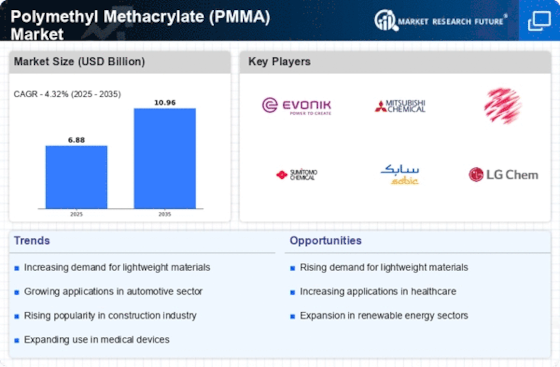
As per Market Research Future analysis, the Polymethyl Methacrylate (PMMA) Market Size was estimated at 6.88 USD Billion in 2024. The PMMA industry is projected to grow from 7.177 USD Billion in 2025 to 10.96 USD Billion by 2035, exhibiting a compound annual growth rate (CAGR) of 4.32% during the forecast period 2025 - 2035

Key Market Trends & Highlights

The Polymethyl Methacrylate (PMMA) market is experiencing robust growth driven by technological advancements and sustainability initiatives.

  • North America remains the largest market for PMMA, driven by its extensive applications in automotive and construction sectors. Asia-Pacific is the fastest-growing region, with increasing demand for PMMA in electronics and healthcare applications. Extruded sheets dominate the PMMA market, while cast sheets are emerging as the fastest-growing segment due to their versatility. Rising demand in the automotive sector and innovations in medical applications are key drivers propelling market expansion.

Market Size & Forecast

2024 Market Size 6.88 (USD Billion)
2035 Market Size 10.96 (USD Billion)
CAGR (2025 - 2035) 4.32%
Largest Regional Market Share in 2024 Asia Pacific

Major Players

Evonik Industries (DE), Mitsubishi Chemical Corporation (JP), Lucite International (GB), Sumitomo Chemical (JP), SABIC (SA), LG Chem (KR), Dow Chemical Company (US), Rohm and Haas Company (US), Kraton Corporation (US)

Market Trends

The Polymethyl Methacrylate (PMMA) Market is currently experiencing a notable transformation, driven by advancements in technology and increasing demand across various sectors. This versatile polymer, known for its clarity and durability, is finding applications in industries such as automotive, construction, and healthcare. The shift towards lightweight materials in automotive manufacturing, coupled with the growing trend of sustainable building practices, appears to be propelling the adoption of PMMA. Furthermore, the healthcare sector's reliance on PMMA for medical devices and equipment suggests a robust growth trajectory, as innovations continue to enhance its properties and applications.

In addition to these factors, the polymethyl methacrylate market is witnessing a rise in consumer awareness regarding the benefits of using PMMA over traditional materials. This shift is likely influenced by the material's recyclability and lower environmental impact. As industries increasingly prioritize sustainability, PMMA's role as an eco-friendly alternative is becoming more pronounced. Overall, the polymethyl methacrylate PMMA market seems poised for expansion, with ongoing research and development efforts likely to unlock new applications and enhance existing ones, thereby solidifying PMMA's position in the global materials landscape.

Sustainability Focus

The emphasis on sustainable materials is reshaping the Polymethyl Methacrylate (PMMA) Market. As industries seek eco-friendly alternatives, PMMA's recyclability and lower environmental footprint are becoming attractive features. This trend indicates a potential shift in consumer preferences towards materials that align with environmental goals.

Technological Advancements

Innovations in manufacturing processes are enhancing the properties of PMMA, making it more versatile and applicable across various sectors. These advancements suggest that the Polymethyl Methacrylate (PMMA) Market could see an increase in demand as new applications emerge, particularly in high-tech industries.

Healthcare Applications

The growing reliance on PMMA in the healthcare sector is noteworthy. Its use in medical devices and equipment highlights the material's importance in advancing healthcare technologies. This trend indicates a strong potential for growth within the Polymethyl Methacrylate (PMMA) Market as the demand for innovative healthcare solutions rises.

Polymethyl Methacrylate PMMA Market Market Drivers

Rising Demand in Automotive Sector

The automotive industry is increasingly adopting Polymethyl Methacrylate (PMMA) for various applications, including interior and exterior components. This trend is driven by PMMA's lightweight nature, which contributes to fuel efficiency and overall vehicle performance. In 2025, the automotive sector is projected to account for a substantial share of the PMMA Market, as manufacturers seek materials that enhance aesthetics while providing durability. The shift towards electric vehicles further amplifies this demand, as PMMA is utilized in components such as displays and lighting systems. As automotive design evolves, the versatility of PMMA positions it as a preferred choice, potentially leading to a compound annual growth rate that reflects the industry's transition towards more sustainable materials.

Innovations in Medical Applications

The healthcare sector is witnessing a surge in the adoption of Polymethyl Methacrylate (PMMA) for various medical applications, including dental prosthetics and intraocular lenses. The PMMA Market is poised for growth as advancements in medical technology continue to enhance the material's properties, making it suitable for a wider range of applications. In 2025, the demand for PMMA in healthcare is expected to rise significantly, driven by the increasing prevalence of age-related eye disorders and the need for durable, biocompatible materials. This trend indicates a promising future for PMMA, as healthcare providers seek innovative solutions that improve patient outcomes while ensuring material safety and efficacy.

Sustainability and Recycling Initiatives

The increasing emphasis on sustainability is influencing the Polymethyl Methacrylate (PMMA) Market, as manufacturers and consumers alike seek eco-friendly materials. PMMA is recyclable, which aligns with the growing trend towards circular economy practices. In 2025, the demand for sustainable PMMA solutions is expected to rise, driven by regulatory pressures and consumer preferences for environmentally responsible products. This shift may lead to innovations in PMMA production processes, enhancing its appeal in various applications. The sustainability focus could potentially reshape the PMMA landscape, encouraging manufacturers to invest in recycling technologies and sustainable sourcing, thereby fostering a more responsible approach to material usage.

Growth in Construction and Infrastructure

The construction and infrastructure sectors are experiencing a notable increase in the use of Polymethyl Methacrylate (PMMA) due to its excellent optical clarity and weather resistance. PMMA is being utilized in applications such as skylights, windows, and signage, which enhances both functionality and aesthetics. The PMMA Market is likely to benefit from ongoing urbanization and infrastructure development projects, which are expected to drive demand for high-performance materials. In 2025, the construction sector is anticipated to represent a significant portion of PMMA consumption, as builders and architects increasingly prioritize materials that offer longevity and visual appeal. This trend suggests a robust growth trajectory for PMMA, aligning with the broader construction industry's recovery and expansion.

Consumer Electronics and Optical Applications

The consumer electronics sector is increasingly incorporating Polymethyl Methacrylate (PMMA) due to its superior optical properties and lightweight characteristics. PMMA is commonly used in the production of screens, lenses, and protective covers, which are essential for modern electronic devices. The PMMA Market is likely to see substantial growth as the demand for high-quality displays and optical components continues to rise. In 2025, the consumer electronics segment is projected to contribute significantly to PMMA consumption, driven by trends such as the proliferation of smart devices and advancements in display technologies. This suggests a favorable outlook for PMMA, as manufacturers prioritize materials that enhance product performance and user experience.

Market Segment Insights

By Type: Extruded Sheets (Largest) vs. Cast Sheets (Fastest-Growing)

In the Polymethyl Methacrylate (PMMA) Market, the segment values showcase a varied distribution, with extruded sheets holding the largest market share. Their versatility and cost-effectiveness drive their wide usage across several applications, from signage to architectural elements. In contrast, cast sheets, although smaller in share, are gaining momentum rapidly due to their superior optical quality and thickness options, catering to specialized markets such as premium displays and protective barriers. The growth trends in the PMMA type segment reveal an upward trajectory, particularly for cast sheets fueled by the increasing demand for high-performing materials in the automotive and electronics industries. Additionally, the rise in sustainable and <a href="https://www.marketresearchfuture.com/reports/lightweight-materials-market-8528">lightweight materials</a> within these sectors propels interest in pellets and beads, which are regarded as emerging products. This highlights a shift where manufacturers are increasingly utilizing PMMA in innovative ways, contributing to the segment's robust growth potential.

Extruded Sheets (Dominant) vs. Beads (Emerging)

Extruded sheets represent the dominant segment in the Polymethyl Methacrylate (PMMA) market due to their favorable production processes and adaptability in various applications, such as furniture, automotive parts, and household products. Their clear visibility and durability ensure they remain the preferred choice for manufacturers seeking reliable materials. In contrast, beads are positioning themselves as an emerging segment by catering to niche markets and applications like the automotive and <a href="https://www.marketresearchfuture.com/reports/construction-market-16065">construction</a> sectors, where lightweight and versatile materials are paramount. The potential for innovation in bespoke formulations, coupled with rising awareness regarding PMMA's environmental impact, allows beads to carve out a unique market presence. As manufacturers explore customization options, the growth of PMMA beads will likely accelerate.

By Application: Automotive (Largest) vs. Electronics (Fastest-Growing)

The Polymethyl Methacrylate (PMMA) market exhibits a diverse application landscape, with the automotive sector holding the largest share. This segment's demand is driven by the need for lightweight materials that enhance vehicle fuel efficiency and design aesthetics. The construction and signs sectors also contribute significantly, leveraging PMMA's durability and clarity, while displays and electronics applications are steadily growing as technological advancements evolve. In recent years, the electronics application has emerged as the fastest-growing segment within the PMMA market. This growth stems from the increasing integration of PMMA in electronic displays, lighting systems, and protective covers. Furthermore, the construction industry is also seeing a surge in PMMA usage, primarily due to its weather-resistant properties and versatility, appealing to modern architectural designs and smart buildings.

Automotive (Dominant) vs. Electronics (Emerging)

The automotive application of Polymethyl Methacrylate (PMMA) stands as a dominant market force, primarily due to the material's exceptional optical clarity, lightweight nature, and impact resistance. Major automotive manufacturers increasingly adopt PMMA for windows, light covers, and instrument panels, offering significant design flexibility and improved aesthetics. On the other hand, the electronics application is an emerging segment, whose growth trajectory is fueled by innovation in consumer electronics, such as smartphones, tablets, and LED lighting. PMMA's lightweight and high-transparency features make it an ideal choice for electronic devices, enabling thinner designs and enhanced user experience. As technology evolves, both segments are expected to see advancements, but automotive remains the go-to for bulk applications.

Get more detailed insights about Polymethyl Methacrylate (PMMA) Market Research Report- Forecast to 2035

Regional Insights

The Polymethyl Methacrylate (PMMA) Market demonstrates notable regional dynamics with distinct segments showing varying growth potential and market value. In North America, the market is valued at 1.75 USD billion in 2024, with a projected increase to 2.79 USD billion by 2035, indicating a significant presence due to robust demand across industries like automotive and healthcare.

Europe follows closely, holding a market valuation of 1.95 USD billion in 2024, expanding to 3.06 USD billion in 2035, benefiting from strong manufacturing capabilities and stringent regulations promoting the use of eco-friendly materials.Asia Pacific dominates the regional landscape with a substantial valuation of 2.88 USD Billion in 2024, projected to reach 4.53 USD Billion in 2035, driven by rapid industrialization and a booming consumer market that significantly supports growth in construction and electronics.

In contrast, South America displays smaller figures, with a valuation of 0.50 USD billion in 2024 and 0.76 USD billion anticipated by 2035, reflecting challenges in economic stability impacting investment. The Middle East and Africa region, valued at 0.80 USD billion in 2024 with a forecasted increase to 1.84 USD billion in 2035, shows potential growth influenced by rising urbanization and infrastructure development initiatives.Overall, the Polymethyl Methacrylate (PMMA) Market segmentation illustrates diverse growth trajectories across regions, influenced by economic factors, industry demands, and regional regulations.

Key Players and Competitive Insights

The Polymethyl Methacrylate (PMMA) Market is characterized by its robust growth and competitive dynamics driven by advancements in technology, increasing demand across various sectors, and the aging infrastructure requiring modern solutions. This market encompasses a range of applications, including automotive, electronics, construction, and healthcare, which further spurs competition among key players. As more industries adopt PMMA for its lightweight and durable properties, manufacturers are aggressively investing in production capabilities, product innovation, and strategic collaborations to enhance their market positions. Competitive insights indicate a focus on sustainability and eco-friendly practices, with companies looking to differentiate their products through higher quality, enhanced performance characteristics, and specialized applications. Evonik Industries AG stands out in the Polymethyl Methacrylate (PMMA) Market due to its strong emphasis on innovation and a diversified product portfolio tailored to meet specific customer needs. The company leverages its extensive research and development capabilities to introduce advanced PMMA formulations that cater to emerging markets and evolving customer preferences. Evonik has established itself as a prominent player by capitalizing on its manufacturing network, ensuring reliable supply chains and consistent product quality. With a commitment to sustainability, the company excels in creating environmentally friendly PMMA products, further solidifying its competitive edge. The strength of Evonik lies not only in its technological prowess but also in its strong customer relationships and strategic partnerships that allow it to maintain leadership in this dynamic market.Chi Mei Corporation is also a significant participant in the Polymethyl Methacrylate (PMMA) Market, recognized for its extensive range of PMMA products that serve various industries such as automotive, display, and medical technology. The company has established a considerable market presence through innovative product solutions focused on high performance and competitive pricing. Chi Mei Corporation's strengths include its strong production capabilities, which support both large-volume orders and customization to meet specific client requirements. The firm actively engages in strategic mergers and acquisitions to enhance its market reach and expand its technological capabilities, positioning itself as a forward-thinking leader in the PMMA segment. Furthermore, its commitment to quality and customer satisfaction has enabled Chi Mei Corporation to foster long-term partnerships, thereby solidifying its reputation in the landscape.

Key Companies in the Polymethyl Methacrylate PMMA Market include

Industry Developments

  • Q2 2024: The expansion of PMMA production facilities, particularly in China, significantly contributed to the positive momentum. In Q2 2024, China saw expansion of polymethyl methacrylate (PMMA) production facilities, which contributed to increased supply and supported an upward price trend in the Asian market.
  • Q2 2024: In India, the market reflected similar trends, with PMMA prices climbing, driven by the expansion of production bases to cater to both domestic and overseas markets. India expanded its PMMA production bases in Q2 2024 to meet growing domestic and international demand, resulting in higher prices and increased market activity.
  • Q2 2024: Major producers raised their basic price quotations in response to the heightened costs of feedstock, which significantly impacted PMMA production costs and prices. European PMMA producers increased their price quotations in Q2 2024 due to rising raw material costs, affecting production costs and market prices.

Future Outlook

Polymethyl Methacrylate PMMA Market Future Outlook

The Polymethyl Methacrylate (PMMA) market is projected to grow at a 4.32% CAGR from 2025 to 2035, driven by increasing demand in automotive, construction, and electronics sectors.

New opportunities lie in:

  • <p>Expansion into bio-based PMMA production methods Development of PMMA composites for lightweight automotive applications Investment in advanced PMMA recycling technologies for sustainability</p>

By 2035, the PMMA market is expected to achieve robust growth, driven by innovation and sustainability initiatives.

Market Segmentation

Polymethyl Methacrylate PMMA Market Type Outlook

  • Extruded Sheets
  • Cast Sheets
  • Pellets
  • Beads

Polymethyl Methacrylate PMMA Market Application Outlook

  • Automotive
  • Construction
  • Signs
  • Displays
  • Electronics
  • Others

Report Scope

MARKET SIZE 2024 6.88(USD Billion)
MARKET SIZE 2025 7.177(USD Billion)
MARKET SIZE 2035 10.96(USD Billion)
COMPOUND ANNUAL GROWTH RATE (CAGR) 4.32% (2025 - 2035)
REPORT COVERAGE Revenue Forecast, Competitive Landscape, Growth Factors, and Trends
BASE YEAR 2024
Market Forecast Period 2025 - 2035
Historical Data 2019 - 2024
Market Forecast Units USD Billion
Key Companies Profiled Evonik Industries (DE), Mitsubishi Chemical Corporation (JP), Lucite International (GB), Sumitomo Chemical (JP), SABIC (SA), LG Chem (KR), Dow Chemical Company (US), Rohm and Haas Company (US), Kraton Corporation (US)
Segments Covered Type, Application, Regional
Key Market Opportunities Growing demand for lightweight, durable materials in automotive and construction sectors enhances Polymethyl Methacrylate (PMMA) Market opportunities.
Key Market Dynamics Rising demand for lightweight materials drives innovation and competition in the Polymethyl Methacrylate (PMMA) market.
Countries Covered North America, Europe, APAC, South America, MEA

FAQs

What is the current valuation of the Polymethyl Methacrylate (PMMA) market?

<p>The Polymethyl Methacrylate (PMMA) market was valued at 6.88 USD Billion in 2024.</p>

What is the projected market valuation for PMMA by 2035?

<p>The PMMA market is projected to reach 10.96 USD Billion by 2035.</p>

What is the expected CAGR for the PMMA market during the forecast period?

<p>The expected CAGR for the PMMA market from 2025 to 2035 is 4.32%.</p>

Which segments are included in the PMMA market analysis?

<p>The PMMA market analysis includes segments such as Extruded Sheets, Cast Sheets, Pellets, and Beads.</p>

What are the projected valuations for the Extruded Sheets segment by 2035?

<p>The Extruded Sheets segment is projected to grow from 1.5 USD Billion in 2024 to 2.4 USD Billion by 2035.</p>

How does the Automotive application segment perform in the PMMA market?

<p>The Automotive application segment was valued at 1.5 USD Billion in 2024 and is expected to reach 2.4 USD Billion by 2035.</p>

Who are the key players in the PMMA market?

<p>Key players in the PMMA market include Evonik Industries, Mitsubishi Chemical Corporation, and Dow Chemical Company.</p>

What is the projected growth for the Cast Sheets segment by 2035?

<p>The Cast Sheets segment is anticipated to grow from 2.0 USD Billion in 2024 to 3.2 USD Billion by 2035.</p>

What is the expected performance of the Electronics application segment?

<p>The Electronics application segment was valued at 0.9 USD Billion in 2024 and is projected to reach 1.4 USD Billion by 2035.</p>

What is the growth outlook for the PMMA market's Beads segment?

<p>The Beads segment is expected to grow from 1.58 USD Billion in 2024 to 2.56 USD Billion by 2035.</p>

  1. SECTION I: EXECUTIVE SUMMARY AND KEY HIGHLIGHTS |
    1. EXECUTIVE SUMMARY | |
      1. Market Overview | |
      2. Key Findings | |
      3. Market Segmentation | |
      4. Competitive Landscape | |
      5. Challenges and Opportunities | |
      6. Future Outlook 2
  2. SECTION II: SCOPING, METHODOLOGY AND MARKET STRUCTURE |
    1. MARKET INTRODUCTION | |
      1. Definition | |
      2. Scope of the study | | |
    2. RESEARCH METHODOLOGY | |
      1. Overview | |
      2. Data Mining | |
      3. Secondary Research | |
      4. Primary Research | | |
      5. Forecasting Model | |
      6. Market Size Estimation | | |
      7. Data Triangulation | |
      8. Validation 3
  3. SECTION III: QUALITATIVE ANALYSIS |
    1. MARKET DYNAMICS | |
      1. Overview | |
      2. Drivers | |
      3. Restraints | |
      4. Opportunities |
    2. MARKET FACTOR ANALYSIS | |
      1. Value chain Analysis | |
      2. Porter's Five Forces Analysis | | |
      3. COVID-19 Impact Analysis | | |
  4. SECTION IV: QUANTITATIVE ANALYSIS |
    1. Chemicals and Materials, BY Type (USD Billion) | |
      1. Extruded Sheets | |
      2. Cast Sheets | |
      3. Pellets | |
      4. Beads |
    2. Chemicals and Materials, BY Application (USD Billion) | |
      1. Automotive | |
      2. Construction | |
      3. Signs | |
      4. Displays | |
      5. Electronics | |
      6. Others |
    3. Chemicals and Materials, BY Region (USD Billion) | |
      1. North America | | |
      2. Europe | | |
      3. APAC | | |
      4. South America | | |
      5. MEA | | |
  5. SECTION V: COMPETITIVE ANALYSIS |
    1. Competitive Landscape | |
      1. Overview | |
      2. Competitive Analysis | |
      3. Market share Analysis | |
      4. Major Growth Strategy in the Chemicals and Materials | |
      5. Competitive Benchmarking | |
      6. Leading Players in Terms of Number of Developments in the Chemicals and Materials | |
      7. Key developments and growth strategies | | |
      8. Major Players Financial Matrix | | |
    2. Company Profiles | |
      1. Evonik Industries (DE) | | |
      2. Mitsubishi Chemical Corporation (JP) | | |
      3. Lucite International (GB) | | |
      4. Sumitomo Chemical (JP) | | |
      5. SABIC (SA) | | |
      6. LG Chem (KR) | | |
      7. Dow Chemical Company (US) | | |
      8. Rohm and Haas Company (US) | | |
      9. Kraton Corporation (US) | | |
    3. Appendix | |
      1. References | |
      2. Related Reports 6 LIST OF FIGURES |
    4. MARKET SYNOPSIS |
    5. NORTH AMERICA MARKET ANALYSIS |
    6. US MARKET ANALYSIS BY TYPE |
    7. US MARKET ANALYSIS BY APPLICATION |
    8. CANADA MARKET ANALYSIS BY TYPE |
    9. CANADA MARKET ANALYSIS BY APPLICATION |
    10. EUROPE MARKET ANALYSIS |
    11. GERMANY MARKET ANALYSIS BY TYPE |
    12. GERMANY MARKET ANALYSIS BY APPLICATION |
    13. UK MARKET ANALYSIS BY TYPE |
    14. UK MARKET ANALYSIS BY APPLICATION |
    15. FRANCE MARKET ANALYSIS BY TYPE |
    16. FRANCE MARKET ANALYSIS BY APPLICATION |
    17. RUSSIA MARKET ANALYSIS BY TYPE |
    18. RUSSIA MARKET ANALYSIS BY APPLICATION |
    19. ITALY MARKET ANALYSIS BY TYPE |
    20. ITALY MARKET ANALYSIS BY APPLICATION |
    21. SPAIN MARKET ANALYSIS BY TYPE |
    22. SPAIN MARKET ANALYSIS BY APPLICATION |
    23. REST OF EUROPE MARKET ANALYSIS BY TYPE |
    24. REST OF EUROPE MARKET ANALYSIS BY APPLICATION |
    25. APAC MARKET ANALYSIS |
    26. CHINA MARKET ANALYSIS BY TYPE |
    27. CHINA MARKET ANALYSIS BY APPLICATION |
    28. INDIA MARKET ANALYSIS BY TYPE |
    29. INDIA MARKET ANALYSIS BY APPLICATION |
    30. JAPAN MARKET ANALYSIS BY TYPE |
    31. JAPAN MARKET ANALYSIS BY APPLICATION |
    32. SOUTH KOREA MARKET ANALYSIS BY TYPE |
    33. SOUTH KOREA MARKET ANALYSIS BY APPLICATION |
    34. MALAYSIA MARKET ANALYSIS BY TYPE |
    35. MALAYSIA MARKET ANALYSIS BY APPLICATION |
    36. THAILAND MARKET ANALYSIS BY TYPE |
    37. THAILAND MARKET ANALYSIS BY APPLICATION |
    38. INDONESIA MARKET ANALYSIS BY TYPE |
    39. INDONESIA MARKET ANALYSIS BY APPLICATION |
    40. REST OF APAC MARKET ANALYSIS BY TYPE |
    41. REST OF APAC MARKET ANALYSIS BY APPLICATION |
    42. SOUTH AMERICA MARKET ANALYSIS |
    43. BRAZIL MARKET ANALYSIS BY TYPE |
    44. BRAZIL MARKET ANALYSIS BY APPLICATION |
    45. MEXICO MARKET ANALYSIS BY TYPE |
    46. MEXICO MARKET ANALYSIS BY APPLICATION |
    47. ARGENTINA MARKET ANALYSIS BY TYPE |
    48. ARGENTINA MARKET ANALYSIS BY APPLICATION |
    49. REST OF SOUTH AMERICA MARKET ANALYSIS BY TYPE |
    50. REST OF SOUTH AMERICA MARKET ANALYSIS BY APPLICATION |
    51. MEA MARKET ANALYSIS |
    52. GCC COUNTRIES MARKET ANALYSIS BY TYPE |
    53. GCC COUNTRIES MARKET ANALYSIS BY APPLICATION |
    54. SOUTH AFRICA MARKET ANALYSIS BY TYPE |
    55. SOUTH AFRICA MARKET ANALYSIS BY APPLICATION |
    56. REST OF MEA MARKET ANALYSIS BY TYPE |
    57. REST OF MEA MARKET ANALYSIS BY APPLICATION |
    58. KEY BUYING CRITERIA OF CHEMICALS AND MATERIALS |
    59. RESEARCH PROCESS OF MRFR |
    60. DRO ANALYSIS OF CHEMICALS AND MATERIALS |
    61. DRIVERS IMPACT ANALYSIS: CHEMICALS AND MATERIALS |
    62. RESTRAINTS IMPACT ANALYSIS: CHEMICALS AND MATERIALS |
    63. SUPPLY / VALUE CHAIN: CHEMICALS AND MATERIALS |
    64. CHEMICALS AND MATERIALS, BY TYPE, 2024 (% SHARE) |
    65. CHEMICALS AND MATERIALS, BY TYPE, 2024 TO 2035 (USD Billion) |
    66. CHEMICALS AND MATERIALS, BY APPLICATION, 2024 (% SHARE) |
    67. CHEMICALS AND MATERIALS, BY APPLICATION, 2024 TO 2035 (USD Billion) |
    68. BENCHMARKING OF MAJOR COMPETITORS 7 LIST OF TABLES |
    69. LIST OF ASSUMPTIONS | |
      1. |
    70. North America MARKET SIZE ESTIMATES; FORECAST | |
      1. BY TYPE, 2025-2035 (USD Billion) | |
      2. BY APPLICATION, 2025-2035 (USD Billion) |
    71. US MARKET SIZE ESTIMATES; FORECAST | |
      1. BY TYPE, 2025-2035 (USD Billion) | |
      2. BY APPLICATION, 2025-2035 (USD Billion) |
    72. Canada MARKET SIZE ESTIMATES; FORECAST | |
      1. BY TYPE, 2025-2035 (USD Billion) | |
      2. BY APPLICATION, 2025-2035 (USD Billion) |
    73. Europe MARKET SIZE ESTIMATES; FORECAST | |
      1. BY TYPE, 2025-2035 (USD Billion) | |
      2. BY APPLICATION, 2025-2035 (USD Billion) |
    74. Germany MARKET SIZE ESTIMATES; FORECAST | |
      1. BY TYPE, 2025-2035 (USD Billion) | |
      2. BY APPLICATION, 2025-2035 (USD Billion) |
    75. UK MARKET SIZE ESTIMATES; FORECAST | |
      1. BY TYPE, 2025-2035 (USD Billion) | |
      2. BY APPLICATION, 2025-2035 (USD Billion) |
    76. France MARKET SIZE ESTIMATES; FORECAST | |
      1. BY TYPE, 2025-2035 (USD Billion) | |
      2. BY APPLICATION, 2025-2035 (USD Billion) |
    77. Russia MARKET SIZE ESTIMATES; FORECAST | |
      1. BY TYPE, 2025-2035 (USD Billion) | |
      2. BY APPLICATION, 2025-2035 (USD Billion) |
    78. Italy MARKET SIZE ESTIMATES; FORECAST | |
      1. BY TYPE, 2025-2035 (USD Billion) | |
      2. BY APPLICATION, 2025-2035 (USD Billion) |
    79. Spain MARKET SIZE ESTIMATES; FORECAST | |
      1. BY TYPE, 2025-2035 (USD Billion) | |
      2. BY APPLICATION, 2025-2035 (USD Billion) |
    80. Rest of Europe MARKET SIZE ESTIMATES; FORECAST | |
      1. BY TYPE, 2025-2035 (USD Billion) | |
      2. BY APPLICATION, 2025-2035 (USD Billion) |
    81. APAC MARKET SIZE ESTIMATES; FORECAST | |
      1. BY TYPE, 2025-2035 (USD Billion) | |
      2. BY APPLICATION, 2025-2035 (USD Billion) |
    82. China MARKET SIZE ESTIMATES; FORECAST | |
      1. BY TYPE, 2025-2035 (USD Billion) | |
      2. BY APPLICATION, 2025-2035 (USD Billion) |
    83. India MARKET SIZE ESTIMATES; FORECAST | |
      1. BY TYPE, 2025-2035 (USD Billion) | |
      2. BY APPLICATION, 2025-2035 (USD Billion) |
    84. Japan MARKET SIZE ESTIMATES; FORECAST | |
      1. BY TYPE, 2025-2035 (USD Billion) | |
      2. BY APPLICATION, 2025-2035 (USD Billion) |
    85. South Korea MARKET SIZE ESTIMATES; FORECAST | |
      1. BY TYPE, 2025-2035 (USD Billion) | |
      2. BY APPLICATION, 2025-2035 (USD Billion) |
    86. Malaysia MARKET SIZE ESTIMATES; FORECAST | |
      1. BY TYPE, 2025-2035 (USD Billion) | |
      2. BY APPLICATION, 2025-2035 (USD Billion) |
    87. Thailand MARKET SIZE ESTIMATES; FORECAST | |
      1. BY TYPE, 2025-2035 (USD Billion) | |
      2. BY APPLICATION, 2025-2035 (USD Billion) |
    88. Indonesia MARKET SIZE ESTIMATES; FORECAST | |
      1. BY TYPE, 2025-2035 (USD Billion) | |
      2. BY APPLICATION, 2025-2035 (USD Billion) |
    89. Rest of APAC MARKET SIZE ESTIMATES; FORECAST | |
      1. BY TYPE, 2025-2035 (USD Billion) | |
      2. BY APPLICATION, 2025-2035 (USD Billion) |
    90. South America MARKET SIZE ESTIMATES; FORECAST | |
      1. BY TYPE, 2025-2035 (USD Billion) | |
      2. BY APPLICATION, 2025-2035 (USD Billion) |
    91. Brazil MARKET SIZE ESTIMATES; FORECAST | |
      1. BY TYPE, 2025-2035 (USD Billion) | |
      2. BY APPLICATION, 2025-2035 (USD Billion) |
    92. Mexico MARKET SIZE ESTIMATES; FORECAST | |
      1. BY TYPE, 2025-2035 (USD Billion) | |
      2. BY APPLICATION, 2025-2035 (USD Billion) |
    93. Argentina MARKET SIZE ESTIMATES; FORECAST | |
      1. BY TYPE, 2025-2035 (USD Billion) | |
      2. BY APPLICATION, 2025-2035 (USD Billion) |
    94. Rest of South America MARKET SIZE ESTIMATES; FORECAST | |
      1. BY TYPE, 2025-2035 (USD Billion) | |
      2. BY APPLICATION, 2025-2035 (USD Billion) |
    95. MEA MARKET SIZE ESTIMATES; FORECAST | |
      1. BY TYPE, 2025-2035 (USD Billion) | |
      2. BY APPLICATION, 2025-2035 (USD Billion) |
    96. GCC Countries MARKET SIZE ESTIMATES; FORECAST | |
      1. BY TYPE, 2025-2035 (USD Billion) | |
      2. BY APPLICATION, 2025-2035 (USD Billion) |
    97. South Africa MARKET SIZE ESTIMATES; FORECAST | |
      1. BY TYPE, 2025-2035 (USD Billion) | |
      2. BY APPLICATION, 2025-2035 (USD Billion) |
    98. Rest of MEA MARKET SIZE ESTIMATES; FORECAST | |
      1. BY TYPE, 2025-2035 (USD Billion) | |
      2. BY APPLICATION, 2025-2035 (USD Billion) |
    99. PRODUCT LAUNCH/PRODUCT DEVELOPMENT/APPROVAL | |
      1. |
    100. ACQUISITION/PARTNERSHIP | |

Chemicals and Materials Market Segmentation

Chemicals and Materials By Type (USD Billion, 2025-2035)

  • Extruded Sheets
  • Cast Sheets
  • Pellets
  • Beads

Chemicals and Materials By Application (USD Billion, 2025-2035)

  • Automotive
  • Construction
  • Signs
  • Displays
  • Electronics
  • Others
Infographic

Free Sample Request

Kindly complete the form below to receive a free sample of this Report

Get Free Sample

Customer Strories

Compare Licence

×
Features License Type
Single User Multiuser License Enterprise User
Price $4,950 $5,950 $7,250
Maximum User Access Limit 1 User Upto 10 Users Unrestricted Access Throughout the Organization
Free Customization
Direct Access to Analyst
Deliverable Format
Platform Access
Discount on Next Purchase 10% 15% 15%
Printable Versions