Phytosterols Market

ID: MRFR/FnB/4006-HCR
200 Pages
Snehal Singh
Last Updated: June 24, 2026
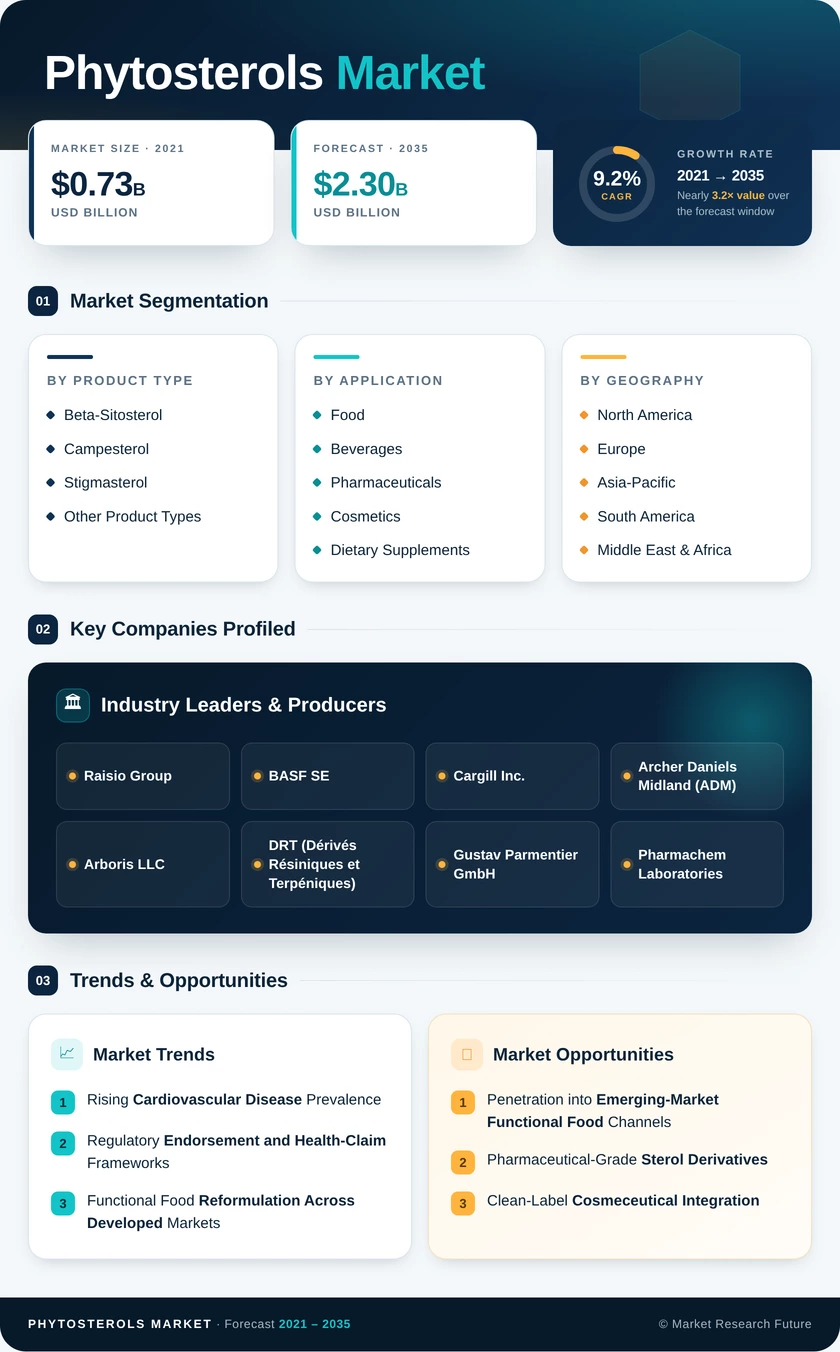
Phytosterols Market Size, Share, Industry Trend & Analysis Research Report By Product Type (Beta-Sitosterol, Campesterol, Stigmasterol, Other Product Types), By Application (Food and Beverages, Pharmaceuticals, Cosmetics, Dietary Supplements, Animal Feed), By Geography (North America, Europe, Asia-Pacific, South America, Middle East & Africa) - Forecast to 2035
Download PDF ×

We do not share your information with anyone. However, we may send you emails based on your report interest from time to time. You may contact us at any time to opt-out.

  1. 1 Market Overview |
    1. 1.1 Study Assumptions & Market Definition |
    2. 1.2 Scope of the Study |
    3. 1.3 Research Methodology
  2. 2 Market Summary & Key Takeaways
  3. 3 Market Dynamics |
    1. 3.1 Market Drivers Analysis | |
      1. 3.1.1 Rising CVD Prevalence & Preventive Health Mandates | |
      2. 3.1.2 Regulatory Endorsement of Sterol Health Claims | |
      3. 3.1.3 Functional Food Reformulation Across Developed Markets | |
      4. 3.1.4 Cosmetics & Personal-Care Ingredient Diversification | |
      5. 3.1.5 Dietary Supplement Retail Channel Expansion | |
      6. 3.1.6 Pharmaceutical Intermediate Demand for Sterol Derivatives | |
      7. 3.1.7 Animal Feed Fortification Adoption |
    2. 3.2 Market Restraints Analysis | |
      1. 3.2.1 Feedstock Price Volatility (Soybean, Tall Oil) | |
      2. 3.2.2 Limited Consumer Awareness in Emerging Economies | |
      3. 3.2.3 Regulatory Divergence Across National Markets | |
      4. 3.2.4 Competition from Alternative Cholesterol-Lowering Ingredients | |
      5. 3.2.5 Bioavailability and Efficacy Perception Gaps |
    3. 3.3 Market Opportunity Analysis | |
      1. 3.3.1 Penetration into Emerging-Market Functional Food Channels | |
      2. 3.3.2 Pharmaceutical-Grade Sterol Derivatives | |
      3. 3.3.3 Clean-Label Cosmeceutical Integration | |
      4. 3.3.4 Data-Driven Personalized Nutrition Platforms | |
      5. 3.3.5 Animal Feed Fortification in Livestock-Intensive Economies |
    4. 3.4 Industry Value Chain Analysis |
    5. 3.5 Porter's Five Forces Analysis
  4. 4 Global Phytosterols Market Size & Forecast (2021–2035) |
    1. 4.1 Historical Market Size (2021–2025) |
    2. 4.2 Current & Forecast Market Size (2026–2035) |
    3. 4.3 Market Size by Revenue (USD Billion) |
    4. 4.4 Year-over-Year Growth Analysis
  5. 5 Segmentation Analysis |
    1. 5.1 By Product Type | |
      1. 5.1.1 Beta-Sitosterol | |
      2. 5.1.2 Campesterol | |
      3. 5.1.3 Stigmasterol | |
      4. 5.1.4 Other Product Types |
    2. 5.2 By Application | |
      1. 5.2.1 Food and Beverages | |
      2. 5.2.2 Pharmaceuticals | |
      3. 5.2.3 Cosmetics | |
      4. 5.2.4 Dietary Supplements | |
      5. 5.2.5 Animal Feed
  6. 6 Regional Analysis |
    1. 6.1 North America | |
      1. 6.1.1 United States | |
      2. 6.1.2 Canada | |
      3. 6.1.3 Mexico |
    2. 6.2 Europe | |
      1. 6.2.1 Germany | |
      2. 6.2.2 United Kingdom | |
      3. 6.2.3 France | |
      4. 6.2.4 Italy | |
      5. 6.2.5 Spain | |
      6. 6.2.6 Nordic Countries | |
      7. 6.2.7 Russia | |
      8. 6.2.8 Rest of Europe |
    3. 6.3 Asia-Pacific | |
      1. 6.3.1 China | |
      2. 6.3.2 India | |
      3. 6.3.3 Japan | |
      4. 6.3.4 South Korea | |
      5. 6.3.5 ASEAN | |
      6. 6.3.6 Rest of Asia-Pacific |
    4. 6.4 South America | |
      1. 6.4.1 Brazil | |
      2. 6.4.2 Argentina | |
      3. 6.4.3 Rest of South America |
    5. 6.5 Middle East & Africa | |
      1. 6.5.1 Saudi Arabia | |
      2. 6.5.2 UAE | |
      3. 6.5.3 South Africa | |
      4. 6.5.4 Egypt | |
      5. 6.5.5 Rest of MEA
  7. 7 Competitive Landscape |
    1. 7.1 Market Share Analysis (2025) |
    2. 7.2 Competitive Benchmarking Matrix |
    3. 7.3 Company Profiles | |
      1. 7.3.1 Raisio Group | |
      2. 7.3.2 BASF SE | |
      3. 7.3.3 Cargill Inc. | |
      4. 7.3.4 Archer Daniels Midland (ADM) | |
      5. 7.3.5 Arboris LLC | |
      6. 7.3.6 DRT (Dérivés Résiniques et Terpéniques) | |
      7. 7.3.7 Gustav Parmentier GmbH | |
      8. 7.3.8 Pharmachem Laboratories | |
      9. 7.3.9 Xi'an Healthful Biotechnology | |
      10. 7.3.10 Fenchem Biotek
  8. 8 Future Outlook & Strategic Recommendations (2026–2035) |
    1. 8.1 Precision Nutrition and AI-Driven Formulation |
    2. 8.2 Sustainability and ESG-Aligned Supply Chains |
    3. 8.3 Convergence of Nutraceuticals and Pharmaceuticals |
    4. 8.4 Next-Generation Extraction Technologies
  9. 9 Recent Developments & News
  10. 10 Frequently Asked Questions (FAQs)
  11. 11 Report Scope & Methodology |
    1. 11.1 Study Period & Base Year |
    2. 11.2 Data Sources & Citations |
    3. 11.3 Abbreviations
  12. 12 LIST OF TABLES |
  13. TABLE 1 Global Phytosterols Market Size & Forecast, by Revenue (USD Billion), 2021–2035 |
  14. TABLE 2 Global Phytosterols Market — Year-over-Year Growth Analysis, 2021–2035 |
  15. TABLE 3 Global Phytosterols Market — Driver Impact Analysis |
  16. TABLE 4 Global Phytosterols Market — Restraint Impact Analysis |
  17. TABLE 5 Global Phytosterols Market Size, by Product Type, 2021–2035 (USD Billion) |
  18. TABLE 6 Global Phytosterols Market Size, by Application, 2021–2035 (USD Billion) |
  19. TABLE 7 Global Phytosterols Market Size, by Region, 2021–2035 (USD Billion) |
  20. TABLE 8 North America Phytosterols Market Size, by Country, 2021–2035 (USD Billion) |
  21. TABLE 9 Europe Phytosterols Market Size, by Country, 2021–2035 (USD Billion) |
  22. TABLE 10 Asia-Pacific Phytosterols Market Size, by Country, 2021–2035 (USD Billion) |
  23. TABLE 11 South America Phytosterols Market Size, by Country, 2021–2035 (USD Billion) |
  24. TABLE 12 Middle East & Africa Phytosterols Market Size, by Country, 2021–2035 (USD Billion) |
  25. TABLE 13 Competitive Benchmarking Matrix — Global Phytosterols Market, 2025 |
  26. TABLE 14 Company Profiles — Key Players, Global Phytosterols Market |
  27. TABLE 15 Recent Developments & Strategic Announcements, 2023–2025 |
  28. TABLE 16 Report Scope & Methodology Summary |
  29. TABLE 17 Detailed Sources and Citations |
  30. TABLE 18 North America Phytosterols Market Size, by Product Type, 2021–2035 (USD Billion) |
  31. TABLE 19 North America Phytosterols Market Size, by Application, 2021–2035 (USD Billion) |
  32. TABLE 20 Europe Phytosterols Market Size, by Product Type, 2021–2035 (USD Billion) |
  33. TABLE 21 Europe Phytosterols Market Size, by Application, 2021–2035 (USD Billion) |
  34. TABLE 22 Asia-Pacific Phytosterols Market Size, by Product Type, 2021–2035 (USD Billion) |
  35. TABLE 23 Asia-Pacific Phytosterols Market Size, by Application, 2021–2035 (USD Billion) |
  36. TABLE 24 South America Phytosterols Market Size, by Product Type, 2021–2035 (USD Billion) |
  37. TABLE 25 South America Phytosterols Market Size, by Application, 2021–2035 (USD Billion) |
  38. TABLE 26 Middle East & Africa Phytosterols Market Size, by Product Type, 2021–2035 (USD Billion) |
  39. TABLE 27 Middle East & Africa Phytosterols Market Size, by Application, 2021–2035 (USD Billion) |
  40. TABLE 28 United States Phytosterols Market Size, by Product Type, 2021–2035 (USD Billion) |
  41. TABLE 29 United States Phytosterols Market Size, by Application, 2021–2035 (USD Billion) |
  42. TABLE 30 Canada Phytosterols Market Size, by Product Type, 2021–2035 (USD Billion) |
  43. TABLE 31 Canada Phytosterols Market Size, by Application, 2021–2035 (USD Billion) |
  44. TABLE 32 Mexico Phytosterols Market Size, by Product Type, 2021–2035 (USD Billion) |
  45. TABLE 33 Mexico Phytosterols Market Size, by Application, 2021–2035 (USD Billion) |
  46. TABLE 34 Germany Phytosterols Market Size, by Product Type, 2021–2035 (USD Billion) |
  47. TABLE 35 Germany Phytosterols Market Size, by Application, 2021–2035 (USD Billion) |
  48. TABLE 36 United Kingdom Phytosterols Market Size, by Product Type, 2021–2035 (USD Billion) |
  49. TABLE 37 United Kingdom Phytosterols Market Size, by Application, 2021–2035 (USD Billion) |
  50. TABLE 38 France Phytosterols Market Size, by Product Type, 2021–2035 (USD Billion) |
  51. TABLE 39 France Phytosterols Market Size, by Application, 2021–2035 (USD Billion) |
  52. TABLE 40 China Phytosterols Market Size, by Product Type, 2021–2035 (USD Billion) |
  53. TABLE 41 China Phytosterols Market Size, by Application, 2021–2035 (USD Billion) |
  54. TABLE 42 India Phytosterols Market Size, by Product Type, 2021–2035 (USD Billion) |
  55. TABLE 43 India Phytosterols Market Size, by Application, 2021–2035 (USD Billion) |
  56. TABLE 44 Japan Phytosterols Market Size, by Product Type, 2021–2035 (USD Billion) |
  57. TABLE 45 Japan Phytosterols Market Size, by Application, 2021–2035 (USD Billion) |
  58. TABLE 46 Brazil Phytosterols Market Size, by Product Type, 2021–2035 (USD Billion) |
  59. TABLE 47 Brazil Phytosterols Market Size, by Application, 2021–2035 (USD Billion) |
  60. TABLE 48 Saudi Arabia Phytosterols Market Size, by Product Type, 2021–2035 (USD Billion) |
  61. TABLE 49 Saudi Arabia Phytosterols Market Size, by Application, 2021–2035 (USD Billion)
  62. 13 LIST OF FIGURES |
  63. FIGURE 1 Global Phytosterols Market Dynamics — Drivers, Restraints & Opportunities |
  64. FIGURE 2 Industry Value Chain Analysis — Phytosterols Market |
  65. FIGURE 3 Porter's Five Forces Analysis — Global Phytosterols Market |
  66. FIGURE 4 Global Phytosterols Market Size Trend & Forecast (USD Billion), 2021–2035 |
  67. FIGURE 5 Global Phytosterols Market Share, by Product Type (%), 2025 |
  68. FIGURE 6 Global Phytosterols Market Share, by Application (%), 2025 |
  69. FIGURE 7 Global Phytosterols Market Share, by Region (%), 2025 |
  70. FIGURE 8 North America Phytosterols Market Size Trend (USD Billion), 2021–2035 |
  71. FIGURE 9 Europe Phytosterols Market Size Trend (USD Billion), 2021–2035 |
  72. FIGURE 10 Asia-Pacific Phytosterols Market Size Trend (USD Billion), 2021–2035 |
  73. FIGURE 11 South America Phytosterols Market Size Trend (USD Billion), 2021–2035 |
  74. FIGURE 12 Middle East & Africa Phytosterols Market Size Trend (USD Billion), 2021–2035 |
  75. FIGURE 13 Competitive Landscape — Market Share Analysis, 2025 |
  76. FIGURE 14 Competitive Benchmarking Radar Chart — Top 10 Players |
  77. FIGURE 15 Product Type Segment Revenue Mix (USD Billion), 2025 vs 2035 |
  78. FIGURE 16 Application Segment Revenue Mix (USD Billion), 2025 vs 2035 |
  79. FIGURE 17 Regional CAGR Comparison (2026–2035) |
  80. FIGURE 18 Year-over-Year Growth Rate Analysis (%), 2021–2035

Segmentation Quick Reference

DimensionSub-SegmentsDominant SegmentFastest Growing Segment
By Product TypeBeta-Sitosterol, Campesterol, Stigmasterol, Other Product TypesBeta-SitosterolStigmasterol
By ApplicationFood and Beverages, Pharmaceuticals, Cosmetics, Dietary Supplements, Animal FeedFood and BeveragesDietary Supplements
By GeographyNorth America, Europe, Asia-Pacific, South America, Middle East & AfricaEuropeAsia-Pacific


Market Segmentation Overview

By Product Type

Sub-SegmentKey Trend
Beta-SitosterolDominant sterol in functional food formulations; backed by extensive clinical evidence for LDL reduction
CampesterolGrowing adoption in cosmetic emollients and multi-sterol nutraceutical blends
StigmasterolAccelerating pharmaceutical demand as a precursor for corticosteroid synthesis
Other Product TypesNiche applications in research-grade reagents and specialty industrial uses


Beta-Sitosterol remains the commercial anchor of the phytosterol product landscape, benefiting from the widest regulatory acceptance and the deepest library of clinical efficacy data. Stigmasterol is capturing increasing investment from pharmaceutical API manufacturers seeking plant-derived alternatives to animal-sourced steroid precursors, positioning it as the highest-growth product category through 2035.

By Application

Sub-SegmentKey Trend
Food and BeveragesEstablished functional dairy and spread franchises; expansion into plant-based beverages
Dietary SupplementsRapid e-commerce growth; capsule and softgel format convenience driving adoption
PharmaceuticalsHigh-purity sterol isolates for steroidal drug semi-synthesis
CosmeticsClean-beauty demand for plant-derived anti-inflammatory and barrier-repair actives
Animal FeedEmerging research on immune modulation and lipid metabolism in poultry and swine


Food and Beverages holds the largest application share, anchored by legacy sterol-enriched spread and dairy brands in Europe and North America. Dietary Supplements is the fastest-growing application, propelled by direct-to-consumer distribution models and growing consumer preference for non-pharmaceutical cholesterol management options. The Cosmetics and Animal Feed segments are at earlier stages of commercialization but show strong forward momentum.