Request Free Sample ×

Kindly complete the form below to receive a free sample of this Report

* Please use a valid business email

Leading companies partner with us for data-driven Insights

clients tt-cursor
Hero Background

Europe Photonic Integrated Circuit Market

ID: MRFR/SEM/55601-HCR
200 Pages
Aarti Dhapte
December 2024

Europe Photonic Integrated Circuit Market Size, Share and Research Report By Substrate Material (Silicon, Indium Phosphide, Gallium Arsenide, Lithium Niobate), By Integration Type (Hybrid Integrated PIC, Monolithic Integration PIC), By Integration Level (Small-Scale PIC, Medium-Scale PIC, Large-Scale PIC), By Application (Optical Fiber Communication, Optical Fiber Sensor, Biomedical, Quantum Computing, Others), and By Regional (Germany, UK, France, Russia, Italy, Spain, Rest of Europe)- Industry Forecast Till 2035

Share:
Download PDF ×

We do not share your information with anyone. However, we may send you emails based on your report interest from time to time. You may contact us at any time to opt-out.

Europe Photonic Integrated Circuit Market Infographic
Purchase Options

Europe Photonic Integrated Circuit Market Summary

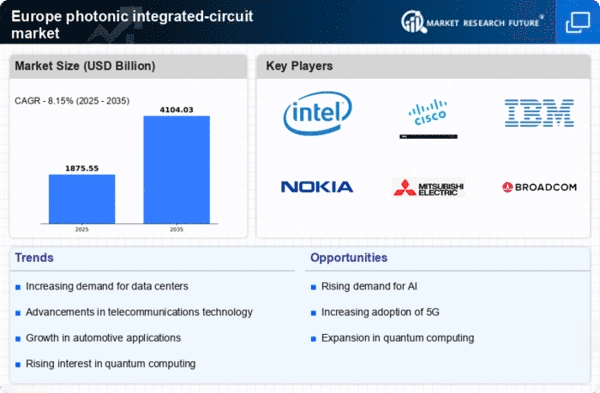
As per Market Research Future analysis, the Photonic Integrated-circuit market Size was estimated at 1734.21 USD Billion in 2024. The photonic integrated-circuit market industry is projected to grow from 1875.55 USD Billion in 2025 to 4104.03 USD Billion by 2035, exhibiting a compound annual growth rate (CAGR) of 8.1% during the forecast period 2025 - 2035

Key Market Trends & Highlights

The Europe photonic integrated-circuit market is poised for substantial growth driven by technological advancements and increasing demand.

  • Germany remains the largest market for photonic integrated circuits, reflecting a robust industrial base and innovation ecosystem.
  • The UK is emerging as the fastest-growing region, propelled by significant investments in research and development.
  • There is a notable rise in demand for high-speed communication solutions, which is reshaping market dynamics across various sectors.
  • Advancements in photonic technologies and the growing demand for data centers are key drivers fueling market expansion.

Market Size & Forecast

2024 Market Size 1734.21 (USD Billion)
2035 Market Size 4104.03 (USD Billion)
CAGR (2025 - 2035) 8.15%

Major Players

Intel Corporation (US), Cisco Systems Inc (US), IBM Corporation (US), Nokia Corporation (FI), Mitsubishi Electric Corporation (JP), Broadcom Inc (US), Lumentum Operations LLC (US), Infinera Corporation (US)

Our Impact
Enabled $4.3B Revenue Impact for Fortune 500 and Leading Multinationals
Partnering with 2000+ Global Organizations Each Year
30K+ Citations by Top-Tier Firms in the Industry

Europe Photonic Integrated Circuit Market Trends

The photonic integrated-circuit market is currently experiencing a transformative phase, driven by advancements in technology and increasing demand for high-speed data transmission. In Europe, the emphasis on energy efficiency and sustainability is shaping the development of photonic integrated circuits, which are essential for applications in telecommunications, data centers, and consumer electronics. The integration of photonics with electronics is fostering innovation, leading to enhanced performance and reduced power consumption. As industries seek to optimize their operations, the adoption of these circuits is likely to accelerate, reflecting a broader trend towards digitalization and smart technologies. Moreover, the regulatory landscape in Europe is evolving, with policies aimed at promoting research and development in photonics. This supportive environment encourages collaboration between academia and industry, facilitating the commercialization of new technologies. The photonic integrated-circuit market is poised for growth as companies invest in R&D to create cutting-edge solutions that meet the demands of various sectors. The focus on miniaturization and integration is expected to drive further advancements, making these circuits integral to future technological innovations. Overall, the market appears to be on a promising trajectory, with numerous opportunities for stakeholders to explore.

Rising Demand for High-Speed Communication

The need for faster data transmission is propelling the photonic integrated-circuit market. As digital communication expands, industries are increasingly relying on these circuits to enhance bandwidth and reduce latency. This trend is particularly evident in telecommunications and data centers, where high-speed connectivity is crucial for operational efficiency.

Focus on Energy Efficiency

Energy consumption is a critical concern in technology development. The photonic integrated-circuit market is responding to this challenge by creating solutions that minimize power usage while maximizing performance. This focus on energy efficiency aligns with broader sustainability goals across various sectors, making these circuits more attractive to businesses.

Supportive Regulatory Environment

European policies are increasingly favoring innovation in photonics. Government initiatives aimed at fostering research and development are creating a conducive atmosphere for the photonic integrated-circuit market. This support encourages collaboration between research institutions and industry players, facilitating the introduction of advanced technologies.

Europe Photonic Integrated Circuit Market Drivers

Emergence of 5G Technology

The rollout of 5G technology across Europe is poised to be a major driver for the photonic integrated-circuit market. 5G networks demand higher data rates and lower latency, which photonic integrated circuits can provide. As telecommunications companies invest heavily in 5G infrastructure, the need for advanced photonic solutions becomes increasingly critical. Analysts predict that the 5G market in Europe will exceed €50 billion by 2025, creating substantial opportunities for the photonic integrated-circuit market industry. This growth is likely to stimulate innovation and collaboration among technology providers, further enhancing the capabilities of photonic integrated circuits.

Growing Demand for Data Centers

The increasing demand for data centers in Europe is significantly impacting the photonic integrated-circuit market. With the rise of cloud computing and big data analytics, data centers require high-speed and efficient communication systems. Photonic integrated circuits offer the necessary bandwidth and speed, making them essential for modern data center infrastructure. Reports indicate that the European data center market is expected to reach €10 billion by 2026, with a substantial portion of this investment directed towards photonic technologies. This trend suggests that the photonic integrated-circuit market industry will benefit from the expansion of data centers, as companies seek to enhance their operational efficiency and reduce latency.

Advancements in Photonic Technologies

The photonic integrated-circuit market in Europe is experiencing a surge due to rapid advancements in photonic technologies. Innovations in materials and fabrication techniques are enhancing the performance and reducing the costs of photonic integrated circuits. For instance, the introduction of silicon photonics has enabled the integration of optical components on a single chip, leading to improved data transmission rates. This technological evolution is projected to drive the market growth, with estimates suggesting a compound annual growth rate (CAGR) of approximately 20% over the next five years. As companies invest in research and development, the photonic integrated-circuit market industry is likely to witness a proliferation of new applications across telecommunications, data centers, and consumer electronics.

Sustainability and Environmental Considerations

Sustainability is becoming a crucial factor influencing the photonic integrated-circuit market in Europe. As environmental concerns grow, there is a push for greener technologies that minimize energy consumption and reduce carbon footprints. Photonic integrated circuits are inherently more energy-efficient compared to traditional electronic circuits, making them an attractive option for companies aiming to meet sustainability goals. The European market is witnessing a shift towards eco-friendly solutions, with projections indicating that the demand for energy-efficient technologies could increase by 30% in the coming years. This trend suggests that the photonic integrated-circuit market industry will play a vital role in supporting sustainable practices across various sectors.

Increased Investment in Research and Development

Investment in research and development (R&D) within the photonic integrated-circuit market is on the rise in Europe. Governments and private entities are recognizing the strategic importance of photonics in various sectors, including telecommunications, healthcare, and automotive. Funding initiatives and collaborative projects are being established to foster innovation in photonic technologies. For example, the European Union has allocated significant resources to support photonic research, with funding exceeding €1 billion for various projects. This influx of investment is expected to accelerate advancements in the photonic integrated-circuit market industry, leading to new applications and improved performance metrics.


Market Segment Insights

By Application: Telecommunications (Largest) vs. Data Communication (Fastest-Growing)

In the Europe photonic integrated circuit market, the application segment showcases a diverse distribution of market share across various fields. Telecommunications dominates the landscape, driven by the increasing demand for high-speed internet and advanced networking infrastructures. Alongside it, data communication is gaining momentum, propelled by the expansion of cloud computing services and the need for robust data transfer capabilities. Sensing, healthcare, and consumer electronics also contribute to the segment, although to a lesser extent compared to the leading two applications.

Telecommunications: Dominant vs. Data Communication: Emerging

Telecommunications is the dominant application in the Europe photonic integrated circuit market, characterized by its extensive integration into broadband networks and mobile communications. It plays a crucial role in enhancing signal transmission speeds and reliability. In contrast, data communication, though currently emerging, is swiftly becoming vital as the need for data center connectivity and high-bandwidth links surges. This application leverages advancements in photonic technology to facilitate faster and more efficient data transfer, making it a core focus for innovation and investment as digital trends and IoT continue to evolve.

By End Use: Information Technology (Largest) vs. Automotive (Fastest-Growing)

In the European photonic integrated circuit market, the Information Technology segment holds the largest portion, reflecting a significant demand for high-speed communication and data processing capabilities. This segment benefits from the ongoing digital transformation and increased adoption of cloud computing, which drives the need for advanced integrated circuitry solutions. Meanwhile, the Automotive segment is emerging rapidly as electric and autonomous vehicles require sophisticated light-based technologies for improved safety, navigation, and communication systems. The growth trends in the photonic integrated circuit market are largely driven by technological advancements and the need for enhanced performance in various applications. The Information Technology sector continues to evolve, with an emphasis on creating more efficient and reliable systems. Conversely, the Automotive sector is witnessing rapid growth fueled by government regulations pushing for greener technologies and the automakers' dedication to incorporating photonic circuits into next-gen vehicles for features like LiDAR systems and better connectivity.

Information Technology: Dominant vs. Automotive: Emerging

The Information Technology segment of the photonic integrated circuit market in Europe is characterized by its established dominance, driven by the exponential growth in data traffic and the demand for faster, more efficient data transmission methods. This segment focuses on developing cutting-edge solutions that enhance performance in data centers and cloud platforms, establishing a robust infrastructure. In contrast, the Automotive segment is emerging with rapid innovations, particularly as electric and autonomous vehicles become prevalent. This segment leverages photonic circuits for innovations such as LiDAR and advanced safety systems, reflecting its adaptation to meet the industry's need for smarter and more connected vehicles. The interplay between both segments illustrates the broader impact of photonic technology across diverse end-use applications.

By Technology: Silicon Photonics (Largest) vs. Indium Phosphide (Fastest-Growing)

In the Europe photonic integrated circuit market, Silicon Photonics holds the largest market share, driven by its widespread adoption in data centers and telecommunications. This technology benefits from its compatibility with existing silicon-based technology, making it the preferred choice for many manufacturers. Conversely, Indium Phosphide is emerging as the fastest-growing segment due to its superior performance in high-frequency applications, making it particularly attractive for applications in optical communication and sensing technologies.

Technology: Silicon Photonics (Dominant) vs. Indium Phosphide (Emerging)

Silicon Photonics dominates the Europe photonic integrated circuit market, widely embraced for its ability to integrate optical and electronic functions on a single chip. This technology offers robust scalability and low-cost manufacturing, making it an ideal choice for high-volume applications. On the other hand, Indium Phosphide is recognized as an emerging technology, known for its high electron mobility and efficiency in laser operations. Its capability to support high-speed data transmission and advanced optical devices positions Indium Phosphide as a critical player in the future, especially within the ever-evolving telecommunications landscape.

By Component Type: Lasers (Largest) vs. Waveguides (Fastest-Growing)

In the European photonic integrated circuit market, components such as lasers hold the largest share, providing crucial functionalities in various applications, including telecommunications and medical devices. Meanwhile, waveguides are gaining traction, attributed to advancements in technology that enhance their efficiency and integration into circuits. Other components like detectors, modulators, and amplifiers also contribute significantly to the market yet trail behind in terms of overall market share and application versatility.

Lasers (Dominant) vs. Modulators (Emerging)

Lasers remain the dominant component type in the photonic integrated circuit market due to their essential role in generating coherent light for numerous applications. Their versatility ensures a steady demand across sectors such as communications, data transmission, and sensing technology. On the other hand, modulators are emerging as a vital component, enhancing the functionality of photonic circuits by enabling the control of light signals. The increasing need for faster and more efficient data processing systems is propelling the adoption of modulators, allowing them to carve out a significant position in the market, particularly in high-speed communication networks.

By Material Type: Silicon (Largest) vs. Indium Phosphide (Fastest-Growing)

The 'Material Type' segment in the Europe photonic integrated circuit market displays a diverse array of materials that cater to different application needs. Silicon holds the largest market share due to its established use in various photonic applications, including telecommunications and data processing. Following closely is Indium Phosphide, which, while smaller in share, is rapidly gaining traction due to its advantageous properties in high-speed and high-frequency applications, making it a key player in next-generation communication technologies. Growth trends in this segment point towards increasing adoption of advanced materials like Indium Phosphide, driven by rising demand for faster and more efficient communication systems. Innovations in manufacturing processes and the development of new applications for Silicon Nitride and Gallium Arsenide are also fueling growth. As industries push for higher performance photonic integrated circuits, the market is expected to see a shift towards these emerging materials that can offer enhanced capabilities and efficiency.

Silicon (Dominant) vs. Indium Phosphide (Emerging)

Silicon, as the dominant material in the Europe photonic integrated circuit market, boasts a robust infrastructure and extensive application range, particularly in standard photonics used for data communication and optical sensing. Its favorable electrical properties and compatibility with existing semiconductor technology make it the material of choice for many manufacturers. In contrast, Indium Phosphide is considered an emerging material, showing promise in high-performance applications such as optical fiber communication and integrated optoelectronics. Its ability to operate at higher frequencies and its efficiency in converting light to electrical signals position it as a challenging competitor to traditional materials. As technology steadily advances, Indium Phosphide's uptake is likely to accelerate, reflecting the industry's need for faster, more efficient photonic devices.

Get more detailed insights about Europe Photonic Integrated Circuit Market

Regional Insights

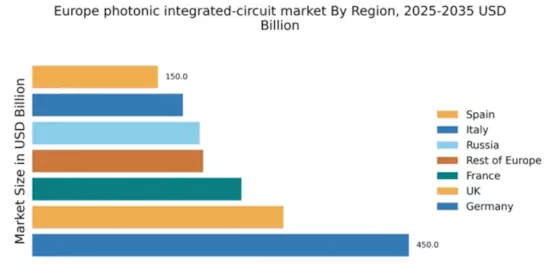
The Europe Photonic Integrated Circuit Market exhibits significant diversity across various nations, making it a focal point for technological advancements and investment. Germany, as a leading player, is known for its robust manufacturing capabilities and commitment to Research and Development, establishing itself as a significant contributor within the market.

The UK showcases a growing preference for high-speed data transmission and networking solutions, driven by increasing demands in telecommunications. France, with its strong emphasis on innovation and technology, plays a vital role in advancing photonic applications across sectors like healthcare and environmental monitoring.

Meanwhile, Russia’s focus on digital transformation and modernization contributes to the market's expansion, highlighting its potential in defense and communication sectors. Italy and Spain are emerging markets, with increased governmental support for technological initiatives and a burgeoning startup ecosystem that enhances growth opportunities.

The Rest of Europe is also essential, benefiting from collaborative projects and initiatives between various countries, which create synergies in technology and application development. These regions collectively enhance the Europe Photonic Integrated Circuit Market landscape, showcasing potential for evolution and significant contributions to various industries.

Europe Photonic Integrated Circuit Market Regional Image

Key Players and Competitive Insights

The photonic integrated-circuit market is currently characterized by a dynamic competitive landscape, driven by advancements in technology and increasing demand for high-speed data transmission. Key players such as Intel Corporation (US), Nokia Corporation (FI), and Lumentum Operations LLC (US) are at the forefront, each adopting distinct strategies to enhance their market positioning. Intel Corporation (US) focuses on innovation through substantial investments in research and development, aiming to lead in the integration of photonics with semiconductor technologies. Meanwhile, Nokia Corporation (FI) emphasizes partnerships and collaborations, particularly in the telecommunications sector, to expand its photonic solutions portfolio. Lumentum Operations LLC (US) is strategically positioned through its focus on optical components and subsystems, catering to a diverse range of applications, including data centers and telecommunications, thereby shaping the competitive environment with its specialized offerings.The market structure appears moderately fragmented, with several players vying for market share through various business tactics. Companies are increasingly localizing manufacturing to reduce lead times and optimize supply chains, which is crucial in meeting the growing demand for photonic integrated circuits. This localization strategy not only enhances operational efficiency but also allows companies to respond swiftly to market changes, thereby influencing the overall competitive dynamics.
In September Intel Corporation (US) announced a strategic partnership with a leading European telecommunications provider to develop next-generation optical interconnects. This collaboration is expected to enhance Intel's capabilities in delivering high-performance photonic solutions, thereby solidifying its position in the market. The strategic importance of this partnership lies in its potential to accelerate the deployment of advanced optical technologies, which are essential for meeting the increasing bandwidth demands of modern networks.
In October Nokia Corporation (FI) unveiled a new line of photonic integrated circuits designed specifically for 5G applications. This launch is significant as it aligns with the growing global push towards 5G infrastructure, positioning Nokia as a key player in the telecommunications market. The introduction of these circuits is likely to enhance network efficiency and performance, further establishing Nokia's reputation as a leader in innovative photonic solutions.
In August Lumentum Operations LLC (US) expanded its product offerings by acquiring a smaller firm specializing in advanced photonic technologies. This acquisition is indicative of Lumentum's strategy to bolster its technological capabilities and diversify its product range. By integrating these advanced technologies, Lumentum aims to enhance its competitive edge in the rapidly evolving photonic landscape, catering to the increasing demand for high-performance optical components.
As of November current trends in the photonic integrated-circuit market are heavily influenced by digitalization, sustainability, and the integration of artificial intelligence (AI). Strategic alliances are becoming increasingly vital, as companies seek to leverage complementary strengths to drive innovation and enhance product offerings. The competitive differentiation is likely to evolve from traditional price-based competition towards a focus on technological innovation, reliability in supply chains, and sustainable practices. This shift underscores the importance of adaptability and forward-thinking strategies in navigating the complexities of the market.

Key Companies in the Europe Photonic Integrated Circuit Market include

Industry Developments

The Europe Photonic Integrated Circuit Market has seen significant growth, driven by advancements in telecommunications and data centers. STMicroelectronics continues to enhance its portfolio, focusing on integrating photonic technologies into semiconductor solutions.

Nokia is actively investing in R&D to improve optical networks, while Infinera Corporation has launched innovative solutions that leverage photonic integration for enhanced data transmission capabilities. Cambridge Photonics and Teledyne E2V are also making strides in the development of photonic devices, addressing applications in sensing and communication.

Recent months highlighted potential collaboration, with Rigetti Computing expanding its quantum computing initiatives, which may involve photonic integration, particularly noted in September 2023. Additionally, the constant demand for faster internet and the rise of 5G technologies are boosting the market.

In terms of mergers and acquisitions, there have been speculative talks regarding potential partnerships involving Cree, Incorporated and Rohde & Schwarz, although no definitive announcements have been made as of October 2023.

The combined efforts of these companies reflect a growing interest in harnessing photonic integrated circuits' capabilities, ensuring a robust landscape for future innovations in this dynamic sector across Europe.

Future Outlook

Europe Photonic Integrated Circuit Market Future Outlook

The photonic integrated-circuit market is projected to grow at an 8.15% CAGR from 2025 to 2035, driven by advancements in telecommunications, data centers, and consumer electronics.

New opportunities lie in:

  • Development of high-speed optical interconnects for data centers. Integration of photonic circuits in consumer electronics for enhanced performance. Expansion of photonic sensors in industrial automation applications.

By 2035, the market is expected to achieve substantial growth, driven by technological advancements and increasing demand.

Market Segmentation

Europe Photonic Integrated Circuit Market Application Outlook

  • Optical Fiber Communication
  • Optical Fiber Sensors
  • Biomedical applications
  • Quantum Computing
  • Others

Europe Photonic Integrated Circuit Market Integration Type Outlook

  • Hybrid Integrated PIC
  • Monolithic Integration PIC

Europe Photonic Integrated Circuit Market Integration Level Outlook

  • Small-Scale PIC
  • Medium-Scale PIC
  • Large-Scale PIC

Europe Photonic Integrated Circuit Market Substrate Material Outlook

  • Silicon
  • Indium Phosphide
  • Gallium Arsenide
  • Lithium Niobate

Report Scope

MARKET SIZE 2024 1734.21(USD Billion)
MARKET SIZE 2025 1875.55(USD Billion)
MARKET SIZE 2035 4104.03(USD Billion)
COMPOUND ANNUAL GROWTH RATE (CAGR) 8.15% (2025 - 2035)
REPORT COVERAGE Revenue Forecast, Competitive Landscape, Growth Factors, and Trends
BASE YEAR 2024
Market Forecast Period 2025 - 2035
Historical Data 2019 - 2024
Market Forecast Units USD Billion
Key Companies Profiled Intel Corporation (US), Cisco Systems Inc (US), IBM Corporation (US), Nokia Corporation (FI), Mitsubishi Electric Corporation (JP), Broadcom Inc (US), Lumentum Operations LLC (US), Infinera Corporation (US)
Segments Covered Substrate Material, Integration Type, Integration Level, Application
Key Market Opportunities Advancements in telecommunications and data centers drive demand for photonic integrated-circuit market innovations.
Key Market Dynamics Technological advancements drive innovation in photonic integrated-circuit applications, enhancing competitive dynamics in Europe.
Countries Covered Germany, UK, France, Russia, Italy, Spain, Rest of Europe
Author
Author Profile
Aarti Dhapte LinkedIn
AVP - Research

A consulting professional focused on helping businesses navigate complex markets through structured research and strategic insights. I partner with clients to solve high-impact business problems across market entry strategy, competitive intelligence, and opportunity assessment. Over the course of my experience, I have led and contributed to 100+ market research and consulting engagements, delivering insights across multiple industries and geographies, and supporting strategic decisions linked to $500M+ market opportunities. My core expertise lies in building robust market sizing, forecasting, and commercial models (top-down and bottom-up), alongside deep-dive competitive and industry analysis. I have played a key role in shaping go-to-market strategies, investment cases, and growth roadmaps, enabling clients to make confident, data-backed decisions in dynamic markets.

Leave a Comment

FAQs

What is the current valuation of the Europe photonic integrated circuit market?

<p>The market valuation was 1734.21 USD Billion in 2024.</p>

What is the projected market size for the Europe photonic integrated circuit market by 2035?

<p>The projected valuation for 2035 is 9847.16 USD Billion.</p>

What is the expected CAGR for the Europe photonic integrated circuit market during the forecast period?

<p>The expected CAGR for the market from 2025 to 2035 is 17.1%.</p>

Which application segments are driving growth in the Europe photonic integrated circuit market?

<p>Key application segments include Telecommunications, Data Communication, and Sensing, with valuations reaching 2200.0, 2800.0, and 1600.0 USD Billion respectively.</p>

What are the leading technologies in the Europe photonic integrated circuit market?

<p>Silicon Photonics and Indium Phosphide are leading technologies, with market sizes of 3000.0 and 2200.0 USD Billion respectively.</p>

Who are the key players in the Europe photonic integrated circuit market?

<p>Key players include Intel Corporation, STMicroelectronics, Bosch, and Cree, Inc.</p>

What are the primary components contributing to the Europe photonic integrated circuit market?

<p>Primary components include Modulators and Waveguides, valued at 2500.0 and 2300.0 USD Billion respectively.</p>

How does the automotive sector impact the Europe photonic integrated circuit market?

<p>The automotive sector is projected to reach a valuation of 1700.0 USD Billion, indicating its growing influence.</p>

What materials are predominantly used in the Europe photonic integrated circuit market?

<p>Silicon and Polymer are predominant materials, with market sizes of 3400.0 and 1947.16 USD Billion respectively.</p>

What is the significance of the healthcare segment in the Europe photonic integrated circuit market?

<p>The healthcare segment is expected to reach a valuation of 1700.0 USD Billion, highlighting its importance in the market.</p>

Download Free Sample

Kindly complete the form below to receive a free sample of this Report

Compare Licence

×
Features License Type
Single User Multiuser License Enterprise User
Price $4,950 $5,950 $7,250
Maximum User Access Limit 1 User Upto 10 Users Unrestricted Access Throughout the Organization
Free Customization
Direct Access to Analyst
Deliverable Format
Platform Access
Discount on Next Purchase 10% 15% 15%
Printable Versions