Request Free Sample ×

Kindly complete the form below to receive a free sample of this Report

* Please use a valid business email

Leading companies partner with us for data-driven Insights

clients tt-cursor
Hero Background
English
Chinese
French
Japanese
Korean
German
Spanish

Pervious Pavement Market Trends

ID: MRFR/PCM/1791-HCR
110 Pages
Sakshi Gupta
April 2026

Pervious Pavement Market Research Report Information By Materials (Pervious Concrete, Porous Asphalt, Interlocking Concrete Pavers), By Design (Hydrological, Structural), By Applications (Hardscape, Floors) And By Region (North America, Europe, Asia-Pacific, And Rest Of The World) –Market Forecast Till 2035

Share:
Download PDF ×

We do not share your information with anyone. However, we may send you emails based on your report interest from time to time. You may contact us at any time to opt-out.

Pervious Pavement Market Infographic
Purchase Options

Market Trends

Key Emerging Trends in the Pervious Pavement Market

The most important factor for pervious materials as these are highly porous, and cannot be used in many constructional activities. In this outlook, the number one problem of permeable pavements is the small load bearing characteristics. However, it also cannot be applied in areas where the pollution is high because of pre-treatment. This, through, is one of the major impediments to making the wider usage of the present payment methods.

The construction companies like their bit also incur a high cost of installing pervious treatments, which are not durable. In addition to epoxy-coated bars the cost is also higher for reinforcing steel bars. Moreover, the use of pervious pavements to some portion of parking lots and trucks too. Besides, the run-offs in the adjacent areas are also in need of being protected along with the pervious concrete. Which in turn makes the costs of maintenance higher.

Sustainable and eco-friendly urban development approaches are currently gaining traction in the Pervious Pavement market, indicating the intensifying environmental concerns. Pervious pavement, a surface which is otherwise known as permeable pavement or porous pavement, is a type of pavement that allows water to pass through, encouraging natural infiltration and minimizing stormwater runoff. One key trend in the market nowadays is higher use of porous pavements for urban stormwater management. With the continuously increasing problems such as urban flooding, water pollution, and drainage systems that are inadequate, porous pavements provide an effective and sustainable way to manage and control these issues. This shift conforms to worldwide efforts towards such resilient and environmentally friendly urban infrastructure.

Another feature of this market is that the sector for new materials and innovative design is growing fast. To improve the durability and the overall efficiency of a pervious pavement system manufacturers have been inventing new materials like permeable concrete, porous asphalt, and interlocking permeable pavers. The concern of property developers to use innovative materials and designs ensures that they provide durable and high-performance solutions for sustainable urban development.

The adoption of pervious paving in the green infrastructure initiative is on the rise. Permeable paving together with green infrastructure practices do a good job of letting water seep into the ground, facilitate groundwater recharge, and help vegetation to grow. This confluence coincides with the ever-expanding awareness of the multi-dimensional gains of green infrastructure, such as better air quality, promotion of biodiversity, and climate resilience. This trend in particular reinforces the comprehensive perspective adopted in the sustainable urban planning and development.

Author
Author Profile
Sakshi Gupta
Team Lead - Research

Currently a Team Lead in consumer goods, FMCG, and F&B, she translates rigorous research into decisive strategy. She develops GTM roadmaps, pricing architectures, and competitive benchmarks for companies across Europe, the US, and APAC. She synthesize insights, align cross-functional teams, and drive execution from brief to measurable outcomes. She leads end-to-end engagements with crisp analysis, compelling storytelling, and a strong command of Power BI, Tableau, SQL, and advanced research platforms.

Leave a Comment

FAQs

What is the current valuation of the Pervious Pavement Market as of 2024?

<p>The Pervious Pavement Market was valued at 20.44 USD Billion in 2024.</p>

What is the projected market size for the Pervious Pavement Market by 2035?

<p>The market is projected to reach 33.0 USD Billion by 2035.</p>

What is the expected CAGR for the Pervious Pavement Market during the forecast period 2025 - 2035?

<p>The expected CAGR for the Pervious Pavement Market during 2025 - 2035 is 4.45%.</p>

Which companies are considered key players in the Pervious Pavement Market?

<p>Key players include Oldcastle Infrastructure, NexGen Paving, Pervious Solutions, Eco-Pavement, Permeable Paving, AquaPave, Stormwater Management, and GreenPave.</p>

What are the main types of products in the Pervious Pavement Market?

<p>The main types include Pervious Concrete, Porous Asphalt, and Interlocking Concrete Pavers.</p>

How did the valuation of Pervious Concrete compare to other segments in 2024?

<p>In 2024, Pervious Concrete was valued at 8.0 to 12.0 USD Billion, indicating a strong position among other segments.</p>

What is the valuation range for the Hydrological design segment in the Pervious Pavement Market?

The Hydrological design segment was valued between 8.0 and 12.0 USD Billion in 2024.

What applications are driving growth in the Pervious Pavement Market?

The primary applications driving growth include Hardscape and Floors, each valued between 10.22 and 16.5 USD Billion.

How does the Structural design segment compare to other segments in terms of valuation?

The Structural design segment was valued between 12.44 and 21.0 USD Billion, suggesting a robust market presence.

What trends are expected to influence the Pervious Pavement Market in the coming years?

Trends likely to influence the market include increasing demand for sustainable construction practices and innovative paving solutions.

Market Summary

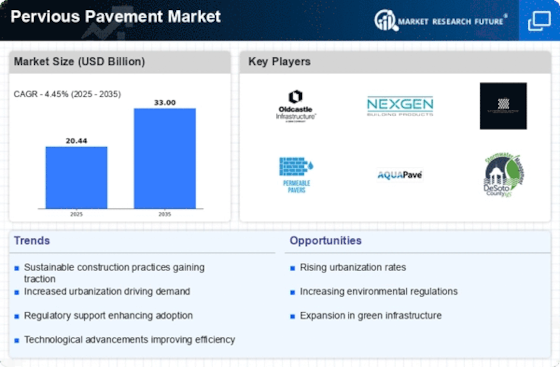
As per Market Research Future analysis, the Pervious Pavement Market Size was estimated at 20.44 USD Billion in 2024. The Pervious Pavement industry is projected to grow from 21.35 USD Billion in 2025 to 33.0 USD Billion by 2035, exhibiting a compound annual growth rate (CAGR) of 4.45% during the forecast period 2025 - 2035

Key Market Trends & Highlights

The Pervious Pavement Market is experiencing a robust shift towards sustainability and innovation.

  • The market is increasingly driven by a focus on sustainability, with stakeholders prioritizing eco-friendly solutions. Technological advancements are enhancing the performance and application of pervious pavement materials, particularly in urban settings. North America remains the largest market, while the Asia-Pacific region is emerging as the fastest-growing area for pervious pavement solutions. Key market drivers include environmental benefits and urbanization trends, which are fostering regulatory incentives for the adoption of pervious concrete and porous asphalt.

Market Size & Forecast

2024 Market Size 20.44 (USD Billion)
2035 Market Size 33.0 (USD Billion)
CAGR (2025 - 2035) 4.45%
Largest Regional Market Share in 2024 Europe

Major Players

Oldcastle Infrastructure (US), NexGen Paving (US), Pervious Solutions (US), Eco-Pavement (US), Permeable Paving (US), AquaPave (US), Stormwater Management (US), GreenPave (US)

Market Trends

The Pervious Pavement Market is currently experiencing a notable evolution, driven by increasing environmental awareness and the need for sustainable urban development. This market encompasses various materials and technologies designed to allow water to permeate through the surface, thereby reducing runoff and promoting groundwater recharge. As urban areas continue to expand, the demand for effective stormwater management solutions becomes more pressing. Consequently, municipalities and developers are increasingly adopting pervious pavement systems to mitigate flooding and enhance water quality. Furthermore, the integration of these systems into green infrastructure initiatives appears to be gaining traction, as stakeholders recognize their potential to contribute to ecological balance in urban settings. In addition to environmental benefits, the Pervious Pavement Market is influenced by advancements in material science and engineering. Innovations in permeable concrete, porous asphalt, and other permeable materials are likely to enhance performance characteristics, making them more appealing to a broader range of applications. Moreover, the growing emphasis on climate resilience and sustainable construction practices suggests that the market will continue to expand. As awareness of the advantages of pervious pavement systems increases, it seems plausible that their adoption will become more widespread across various sectors, including residential, commercial, and industrial developments.

Sustainability Focus

The Pervious Pavement Market is increasingly aligned with sustainability goals, as stakeholders prioritize eco-friendly solutions. This trend reflects a broader commitment to reducing environmental impact and enhancing urban resilience.

Technological Advancements

Innovations in material technology are transforming the Pervious Pavement Market. Enhanced performance characteristics of permeable materials are likely to broaden their applicability and effectiveness in diverse environments.

Regulatory Support

Government policies and regulations are increasingly favoring the use of pervious pavement systems. This trend indicates a growing recognition of their role in effective stormwater management and urban planning.

Pervious Pavement Market Market Drivers

Urbanization Trends

Rapid urbanization is a significant driver for the Pervious Pavement Market. As cities expand, the need for effective stormwater management solutions becomes paramount. Pervious pavements offer a viable alternative to traditional materials, addressing the challenges posed by increased impervious surfaces. The United Nations projects that by 2050, nearly 68% of the world's population will reside in urban areas, intensifying the demand for sustainable infrastructure. In this context, pervious pavements can play a crucial role in mitigating flooding and enhancing urban resilience. The integration of these materials into urban planning is likely to become a standard practice, thereby boosting the Pervious Pavement Market.

Regulatory Incentives

The Pervious Pavement Market is also influenced by regulatory incentives aimed at promoting sustainable construction practices. Governments are increasingly implementing policies that encourage the use of permeable materials in new developments. For instance, some regions offer tax breaks or grants for projects that incorporate pervious pavements, recognizing their benefits in stormwater management and environmental protection. These regulations not only stimulate demand but also create a competitive advantage for developers who adopt such practices. As more jurisdictions establish guidelines favoring permeable surfaces, the Pervious Pavement Market is poised for growth, driven by compliance and sustainability goals.

Environmental Benefits

The Pervious Pavement Market is increasingly driven by the growing awareness of environmental sustainability. Pervious pavements facilitate stormwater management by allowing water to infiltrate through the surface, reducing runoff and minimizing flooding risks. This characteristic is particularly crucial in urban areas where impervious surfaces dominate. According to recent studies, the implementation of pervious pavement can reduce surface runoff by up to 80%, thereby enhancing groundwater recharge. As municipalities and developers prioritize eco-friendly construction practices, the demand for pervious pavements is expected to rise. This trend aligns with broader environmental goals, such as reducing urban heat islands and improving water quality, further propelling the Pervious Pavement Market.

Economic Considerations

Economic factors play a pivotal role in shaping the Pervious Pavement Market. The initial investment in pervious pavement systems may be higher than traditional options; however, the long-term savings associated with reduced stormwater management costs and lower maintenance requirements can be substantial. Studies indicate that the lifecycle cost of pervious pavements can be lower due to their ability to mitigate flooding and reduce the need for extensive drainage systems. As municipalities and developers recognize the economic benefits of adopting pervious pavements, the market is likely to experience growth. This economic rationale, combined with environmental considerations, positions the Pervious Pavement Market favorably for future expansion.

Technological Innovations

Technological advancements are reshaping the Pervious Pavement Market, leading to the development of more efficient and durable materials. Innovations in material science have resulted in the creation of permeable concrete and asphalt that not only allow water infiltration but also enhance load-bearing capacity. These advancements are crucial for urban applications where durability is essential. Furthermore, the integration of smart technologies, such as sensors for monitoring water levels and pavement conditions, is emerging as a trend within the industry. Such innovations could potentially improve the performance and longevity of pervious pavements, thereby increasing their adoption in various construction projects.

Market Segment Insights

By Type: Pervious Concrete (Largest) vs. Porous Asphalt (Fastest-Growing)

<p>The Pervious Pavement Market is primarily segmented into three types: Pervious Concrete, Porous Asphalt, and Interlocking Concrete Pavers. Among these, Pervious Concrete holds the largest market share, due to its increasing adoption for sustainable practices in urban infrastructure. Its excellent permeability and drainage capabilities make it a popular choice for mitigating stormwater runoff. Conversely, Porous Asphalt is rapidly gaining traction, characterized by its ability to reduce surface runoff and improve water quality, thus positioning itself as the fastest-growing segment in the market.</p>

<p>Pervious Concrete (Dominant) vs. Interlocking Concrete Pavers (Emerging)</p>

<p>Pervious Concrete is well-regarded for its strength and durability while allowing water to permeate through its structure, making it an ideal solution for eco-friendly construction projects. Its ability to manage stormwater runoff effectively has made it the dominant choice in the market. On the other hand, Interlocking Concrete Pavers, although considered an emerging segment, offer versatility and aesthetic appeal, contributing to their gradual market presence. They provide flexibility in design and installation, making them a favored option in landscaping and residential applications. Both segments embody advancements in sustainable engineering but cater to differing needs within the Pervious Pavement Market.</p>

By Design: Hydrological (Largest) vs. Structural (Fastest-Growing)

<p>In the Pervious Pavement Market, the design segment is characterized by a clear distribution between hydrological and structural categories. The hydrological design is the most prominent, as it focuses on the pavement's ability to manage stormwater and groundwater efficiently. This attribute aligns with the increasing demand for environmentally sustainable infrastructure solutions. Conversely, the structural design segment, though smaller in market share, is rapidly gaining traction due to its emphasis on load-bearing capacities and durability, which are essential for urban development projects.</p>

<p>Design: Hydrological (Dominant) vs. Structural (Emerging)</p>

<p>The hydrological design segment in the Pervious Pavement Market is noted for its ability to facilitate effective water drainage and management, making it a dominant choice for projects focused on sustainability and environmental concerns. Its characteristics include permeability and infiltration rates that significantly reduce runoff. On the other hand, the structural design segment is emerging, driven by urbanization and the need for enhanced durability in pavements. This segment appeals to construction projects requiring robust performance under heavy loads, thereby positioning itself as a viable alternative to traditional paving materials.</p>

By Applications: Hardscape (Largest) vs. Floors (Fastest-Growing)

<p>Within the Pervious Pavement Market, the Hardscape application segment holds the largest market share. This segment covers various materials used in outdoor structures like walkways, patios, and driveways. Hardscape solutions are favored for their aesthetics and functionality, allowing for effective stormwater management while maintaining a natural landscape. The Floors application segment, while smaller, is rapidly gaining traction due to increasing urbanization and a shift towards sustainable building practices. The focus is on creating permeable surfaces that manage rainwater efficiently, thus enhancing environmental sustainability.</p>

<p>Applications: Hardscape (Dominant) vs. Floors (Emerging)</p>

<p>The Hardscape segment is the dominant category in the Pervious Pavement Market, recognized for its extensive use in outdoor construction projects. This includes pavements and surfaces that are not only functional but also enhance the aesthetic appeal of various landscapes. The demand for Hardscape solutions stems from their effective stormwater management capabilities, which allow for significant water infiltration and minimal runoff. On the other hand, the Floors segment is emerging as a crucial player, particularly in commercial and residential spaces looking to implement eco-friendly flooring solutions. With rising awareness about environmental issues, Floors made from pervious materials are increasingly being perceived as a sustainable alternative, catering to a niche but growing market that prioritizes both durability and eco-friendliness.</p>

Get more detailed insights about Pervious Pavement Market Research Report- Global Forecast 2035

Regional Insights

North America : Sustainable Infrastructure Leader

North America is the largest market for pervious pavement, holding approximately 45% of the global share. The region's growth is driven by increasing urbanization, stringent environmental regulations, and a rising focus on sustainable construction practices. The demand for effective stormwater management solutions is also a significant catalyst, with many states implementing regulations that promote permeable surfaces to reduce runoff and improve water quality. The United States is the leading country in this market, with key players such as Oldcastle Infrastructure, NexGen Paving, and Eco-Pavement dominating the landscape. The competitive environment is characterized by innovation in materials and technology, with companies focusing on enhancing the durability and aesthetic appeal of pervious pavements. The presence of established firms and ongoing investments in infrastructure projects further solidify North America's position in the market.

Europe : Emerging Green Solutions Hub

Europe is witnessing significant growth in the pervious pavement market, accounting for approximately 30% of the global share. The region's expansion is fueled by increasing environmental awareness, government incentives for sustainable construction, and the implementation of the EU's Green Deal, which emphasizes eco-friendly infrastructure. Countries are adopting regulations that mandate the use of permeable materials in urban planning to mitigate flooding and enhance groundwater recharge. Leading countries in this market include Germany, the UK, and France, where local governments are actively promoting the use of pervious pavements. The competitive landscape features a mix of established companies and innovative startups, with key players like Eco-Pavement and Pervious Solutions making significant strides. The focus on research and development is driving advancements in material technology, ensuring that Europe remains at the forefront of sustainable paving solutions.

Asia-Pacific : Rapid Urbanization Catalyst

Asia-Pacific is emerging as a significant player in the pervious pavement market, holding around 20% of the global share. The region's rapid urbanization, coupled with increasing environmental concerns, is driving demand for sustainable paving solutions. Governments are implementing policies to manage stormwater effectively, leading to a rise in the adoption of permeable pavements in urban areas. Countries like China and India are at the forefront, with substantial investments in infrastructure development. China is the largest market in the region, with a growing number of projects focusing on green building practices. The competitive landscape is evolving, with both local and international players vying for market share. Companies such as AquaPave and Stormwater Management are expanding their operations, leveraging innovative technologies to enhance product performance. The increasing awareness of environmental sustainability is expected to further boost market growth in the coming years.

Middle East and Africa : Emerging Market Potential

The Middle East and Africa region is gradually recognizing the potential of the pervious pavement market, currently holding about 5% of the global share. The growth is primarily driven by urban expansion and the need for effective stormwater management solutions in arid climates. Governments are beginning to implement regulations that encourage the use of permeable materials in construction, particularly in urban areas prone to flooding and water scarcity. Countries like South Africa and the UAE are leading the charge, with initiatives aimed at promoting sustainable infrastructure. The competitive landscape is still developing, with a mix of local and international companies entering the market. Key players are focusing on educating stakeholders about the benefits of pervious pavements, which is crucial for increasing adoption rates. As awareness grows, the market is expected to expand significantly in the coming years.

Key Players and Competitive Insights

Leading market players are investing heavily in research and development to expand their product lines, which will help the Pervious Pavement Market grow even more. Market participants are also undertaking various strategic activities to expand their footprint, with important market developments including new product launches, contractual agreements, mergers and acquisitions, higher investments, and collaboration with other organizations. To expand and survive in a more competitive and rising market climate, the Pervious Pavement industry must offer cost-effective items. Manufacturing locally to minimize operational costs is one of the key business tactics used by manufacturers in the Pervious Pavement industry to benefit clients and increase the market sector. In recent years, the Pervious Pavement industry has offered some of the most significant advantages to medicine. Major players in the Pervious Pavement Market, including LafargeHolcim (Switzerland), CEMEX S.A.B. de C.V. (Mexico), CRH plc (Ireland), BASF SE (Germany), Sika AG (Switzerland), Balfour Beatty plc (U.K.), UltraTech Cement Limited (India), Boral Limited (Australia), Raffin Construction Co. (U.S.), and Chaney Enterprise (U.S.)., and others, are attempting to increase market demand by investing in research and development operations. Sika is a prominent company specializing in developing and producing specialty chemicals for the building and automotive sectors. They are recognized for their expertise in bonding, sealing, damping, reinforcing, and protecting systems and products. Sika has established itself as a key player with a presence in 101 countries and an extensive network of over 300 factories. Recently, Sika completed the acquisition of MBCC Group, a significant strategic move that enhanced its market position and broadened its product portfolio. Sika is also dedicated to promoting sustainable practices in the construction industry, driving innovation, and advancing the adoption of environmentally friendly construction solutions. Eurovia is one of the leading service providers of highway maintenance services to the UK local authority market and draws together expertise from a wide range of services, including asphalt production, road markings, signs manufacture, CCTV installation and maintenance, surfacing, and specialist treatment solutions to offer a highly specialized and flexible service. Eurovia Company engaging in transport infrastructure construction and urban growth announced the acquisition of the paving division of Lane Construction of SaliniImpregilo (Paris), an industrial group involved in the construction of major, complex infrastructure projects.

Key Companies in the Pervious Pavement Market include

Industry Developments

August 2021: Eurovia Company engaging in transport infrastructure construction and urban growth, announced the acquisition of the paving division of Lane Construction of SaliniImpregilo (Paris), an industrial group involved in constructing major, complex infrastructure projects.

March 2021: the research team at Washington State University in the U.S. published their study of a one of its kind previous pavement they developed using recycled carbon fiber, solving a high-tech waste issue while addressing the environmental challenge of stormwater runoff.

July 2023: the city of Austin, Texas, announced plans to install pervious pavement in several parking lots and other areas as part of its efforts to reduce flooding. August 2023: the Indian government announced a new program to promote the use of pervious pavements in urban areas. The program includes a financial incentive of up to 50% of the cost of installing pervious pavement.

Future Outlook

Pervious Pavement Market Future Outlook

The Pervious Pavement Market is projected to grow at a 4.45% CAGR from 2025 to 2035, driven by urbanization, environmental regulations, and sustainable construction practices.

New opportunities lie in:

  • <p>Development of innovative permeable materials for enhanced durability Integration of smart technology for real-time monitoring of pavement performance Expansion into emerging markets with tailored solutions for local needs</p>

By 2035, the Pervious Pavement Market is expected to achieve robust growth and increased adoption globally.

Market Segmentation

Pervious Pavement Market Type Outlook

  • Pervious Concrete
  • Porous Asphalt
  • Interlocking Concrete Pavers

Pervious Pavement Market Design Outlook

  • Hydrological
  • Structural

Pervious Pavement Market Applications Outlook

  • Hardscape
  • Floors

Report Scope

MARKET SIZE 2024 20.44(USD Billion)
MARKET SIZE 2025 21.35(USD Billion)
MARKET SIZE 2035 33.0(USD Billion)
COMPOUND ANNUAL GROWTH RATE (CAGR) 4.45% (2025 - 2035)
REPORT COVERAGE Revenue Forecast, Competitive Landscape, Growth Factors, and Trends
BASE YEAR 2024
Market Forecast Period 2025 - 2035
Historical Data 2019 - 2024
Market Forecast Units USD Billion
Key Companies Profiled Oldcastle Infrastructure (US), NexGen Paving (US), Pervious Solutions (US), Eco-Pavement (US), Permeable Paving (US), AquaPave (US), Stormwater Management (US), GreenPave (US)
Segments Covered Materials, Design, Applications, Region
Key Market Opportunities Growing demand for sustainable urban drainage solutions drives innovation in the Pervious Pavement Market.
Key Market Dynamics Rising environmental regulations drive demand for pervious pavement solutions, enhancing urban sustainability and stormwater management.
Countries Covered North America, Europe, APAC, South America, MEA

FAQs

What is the current valuation of the Pervious Pavement Market as of 2024?

<p>The Pervious Pavement Market was valued at 20.44 USD Billion in 2024.</p>

What is the projected market size for the Pervious Pavement Market by 2035?

<p>The market is projected to reach 33.0 USD Billion by 2035.</p>

What is the expected CAGR for the Pervious Pavement Market during the forecast period 2025 - 2035?

<p>The expected CAGR for the Pervious Pavement Market during 2025 - 2035 is 4.45%.</p>

Which companies are considered key players in the Pervious Pavement Market?

<p>Key players include Oldcastle Infrastructure, NexGen Paving, Pervious Solutions, Eco-Pavement, Permeable Paving, AquaPave, Stormwater Management, and GreenPave.</p>

What are the main types of products in the Pervious Pavement Market?

<p>The main types include Pervious Concrete, Porous Asphalt, and Interlocking Concrete Pavers.</p>

How did the valuation of Pervious Concrete compare to other segments in 2024?

<p>In 2024, Pervious Concrete was valued at 8.0 to 12.0 USD Billion, indicating a strong position among other segments.</p>

What is the valuation range for the Hydrological design segment in the Pervious Pavement Market?

The Hydrological design segment was valued between 8.0 and 12.0 USD Billion in 2024.

What applications are driving growth in the Pervious Pavement Market?

The primary applications driving growth include Hardscape and Floors, each valued between 10.22 and 16.5 USD Billion.

How does the Structural design segment compare to other segments in terms of valuation?

The Structural design segment was valued between 12.44 and 21.0 USD Billion, suggesting a robust market presence.

What trends are expected to influence the Pervious Pavement Market in the coming years?

Trends likely to influence the market include increasing demand for sustainable construction practices and innovative paving solutions.

  1. SECTION I: EXECUTIVE SUMMARY AND KEY HIGHLIGHTS
    1. | 1.1 EXECUTIVE SUMMARY
    2. | | 1.1.1 Market Overview
    3. | | 1.1.2 Key Findings
    4. | | 1.1.3 Market Segmentation
    5. | | 1.1.4 Competitive Landscape
    6. | | 1.1.5 Challenges and Opportunities
    7. | | 1.1.6 Future Outlook
  2. SECTION II: SCOPING, METHODOLOGY AND MARKET STRUCTURE
    1. | 2.1 MARKET INTRODUCTION
    2. | | 2.1.1 Definition
    3. | | 2.1.2 Scope of the study
    4. | | | 2.1.2.1 Research Objective
    5. | | | 2.1.2.2 Assumption
    6. | | | 2.1.2.3 Limitations
    7. | 2.2 RESEARCH METHODOLOGY
    8. | | 2.2.1 Overview
    9. | | 2.2.2 Data Mining
    10. | | 2.2.3 Secondary Research
    11. | | 2.2.4 Primary Research
    12. | | | 2.2.4.1 Primary Interviews and Information Gathering Process
    13. | | | 2.2.4.2 Breakdown of Primary Respondents
    14. | | 2.2.5 Forecasting Model
    15. | | 2.2.6 Market Size Estimation
    16. | | | 2.2.6.1 Bottom-Up Approach
    17. | | | 2.2.6.2 Top-Down Approach
    18. | | 2.2.7 Data Triangulation
    19. | | 2.2.8 Validation
  3. SECTION III: QUALITATIVE ANALYSIS
    1. | 3.1 MARKET DYNAMICS
    2. | | 3.1.1 Overview
    3. | | 3.1.2 Drivers
    4. | | 3.1.3 Restraints
    5. | | 3.1.4 Opportunities
    6. | 3.2 MARKET FACTOR ANALYSIS
    7. | | 3.2.1 Value chain Analysis
    8. | | 3.2.2 Porter's Five Forces Analysis
    9. | | | 3.2.2.1 Bargaining Power of Suppliers
    10. | | | 3.2.2.2 Bargaining Power of Buyers
    11. | | | 3.2.2.3 Threat of New Entrants
    12. | | | 3.2.2.4 Threat of Substitutes
    13. | | | 3.2.2.5 Intensity of Rivalry
    14. | | 3.2.3 COVID-19 Impact Analysis
    15. | | | 3.2.3.1 Market Impact Analysis
    16. | | | 3.2.3.2 Regional Impact
    17. | | | 3.2.3.3 Opportunity and Threat Analysis
  4. SECTION IV: QUANTITATIVE ANALYSIS
    1. | 4.1 Packaging & Transport, BY Type (USD Billion)
    2. | | 4.1.1 Pervious Concrete
    3. | | 4.1.2 Porous Asphalt
    4. | | 4.1.3 Interlocking Concrete Pavers
    5. | 4.2 Packaging & Transport, BY Design (USD Billion)
    6. | | 4.2.1 Hydrological
    7. | | 4.2.2 Structural
    8. | 4.3 Packaging & Transport, BY Applications (USD Billion)
    9. | | 4.3.1 Hardscape
    10. | | 4.3.2 Floors
    11. | 4.4 Packaging & Transport, BY Region (USD Billion)
    12. | | 4.4.1 North America
    13. | | | 4.4.1.1 US
    14. | | | 4.4.1.2 Canada
    15. | | 4.4.2 Europe
    16. | | | 4.4.2.1 Germany
    17. | | | 4.4.2.2 UK
    18. | | | 4.4.2.3 France
    19. | | | 4.4.2.4 Russia
    20. | | | 4.4.2.5 Italy
    21. | | | 4.4.2.6 Spain
    22. | | | 4.4.2.7 Rest of Europe
    23. | | 4.4.3 APAC
    24. | | | 4.4.3.1 China
    25. | | | 4.4.3.2 India
    26. | | | 4.4.3.3 Japan
    27. | | | 4.4.3.4 South Korea
    28. | | | 4.4.3.5 Malaysia
    29. | | | 4.4.3.6 Thailand
    30. | | | 4.4.3.7 Indonesia
    31. | | | 4.4.3.8 Rest of APAC
    32. | | 4.4.4 South America
    33. | | | 4.4.4.1 Brazil
    34. | | | 4.4.4.2 Mexico
    35. | | | 4.4.4.3 Argentina
    36. | | | 4.4.4.4 Rest of South America
    37. | | 4.4.5 MEA
    38. | | | 4.4.5.1 GCC Countries
    39. | | | 4.4.5.2 South Africa
    40. | | | 4.4.5.3 Rest of MEA
  5. SECTION V: COMPETITIVE ANALYSIS
    1. | 5.1 Competitive Landscape
    2. | | 5.1.1 Overview
    3. | | 5.1.2 Competitive Analysis
    4. | | 5.1.3 Market share Analysis
    5. | | 5.1.4 Major Growth Strategy in the Packaging & Transport
    6. | | 5.1.5 Competitive Benchmarking
    7. | | 5.1.6 Leading Players in Terms of Number of Developments in the Packaging & Transport
    8. | | 5.1.7 Key developments and growth strategies
    9. | | | 5.1.7.1 New Product Launch/Service Deployment
    10. | | | 5.1.7.2 Merger & Acquisitions
    11. | | | 5.1.7.3 Joint Ventures
    12. | | 5.1.8 Major Players Financial Matrix
    13. | | | 5.1.8.1 Sales and Operating Income
    14. | | | 5.1.8.2 Major Players R&D Expenditure. 2023
    15. | 5.2 Company Profiles
    16. | | 5.2.1 Oldcastle Infrastructure (US)
    17. | | | 5.2.1.1 Financial Overview
    18. | | | 5.2.1.2 Products Offered
    19. | | | 5.2.1.3 Key Developments
    20. | | | 5.2.1.4 SWOT Analysis
    21. | | | 5.2.1.5 Key Strategies
    22. | | 5.2.2 NexGen Paving (US)
    23. | | | 5.2.2.1 Financial Overview
    24. | | | 5.2.2.2 Products Offered
    25. | | | 5.2.2.3 Key Developments
    26. | | | 5.2.2.4 SWOT Analysis
    27. | | | 5.2.2.5 Key Strategies
    28. | | 5.2.3 Pervious Solutions (US)
    29. | | | 5.2.3.1 Financial Overview
    30. | | | 5.2.3.2 Products Offered
    31. | | | 5.2.3.3 Key Developments
    32. | | | 5.2.3.4 SWOT Analysis
    33. | | | 5.2.3.5 Key Strategies
    34. | | 5.2.4 Eco-Pavement (US)
    35. | | | 5.2.4.1 Financial Overview
    36. | | | 5.2.4.2 Products Offered
    37. | | | 5.2.4.3 Key Developments
    38. | | | 5.2.4.4 SWOT Analysis
    39. | | | 5.2.4.5 Key Strategies
    40. | | 5.2.5 Permeable Paving (US)
    41. | | | 5.2.5.1 Financial Overview
    42. | | | 5.2.5.2 Products Offered
    43. | | | 5.2.5.3 Key Developments
    44. | | | 5.2.5.4 SWOT Analysis
    45. | | | 5.2.5.5 Key Strategies
    46. | | 5.2.6 AquaPave (US)
    47. | | | 5.2.6.1 Financial Overview
    48. | | | 5.2.6.2 Products Offered
    49. | | | 5.2.6.3 Key Developments
    50. | | | 5.2.6.4 SWOT Analysis
    51. | | | 5.2.6.5 Key Strategies
    52. | | 5.2.7 Stormwater Management (US)
    53. | | | 5.2.7.1 Financial Overview
    54. | | | 5.2.7.2 Products Offered
    55. | | | 5.2.7.3 Key Developments
    56. | | | 5.2.7.4 SWOT Analysis
    57. | | | 5.2.7.5 Key Strategies
    58. | | 5.2.8 GreenPave (US)
    59. | | | 5.2.8.1 Financial Overview
    60. | | | 5.2.8.2 Products Offered
    61. | | | 5.2.8.3 Key Developments
    62. | | | 5.2.8.4 SWOT Analysis
    63. | | | 5.2.8.5 Key Strategies
    64. | 5.3 Appendix
    65. | | 5.3.1 References
    66. | | 5.3.2 Related Reports
  6. LIST OF FIGURES
    1. | 6.1 MARKET SYNOPSIS
    2. | 6.2 NORTH AMERICA MARKET ANALYSIS
    3. | 6.3 US MARKET ANALYSIS BY TYPE
    4. | 6.4 US MARKET ANALYSIS BY DESIGN
    5. | 6.5 US MARKET ANALYSIS BY APPLICATIONS
    6. | 6.6 CANADA MARKET ANALYSIS BY TYPE
    7. | 6.7 CANADA MARKET ANALYSIS BY DESIGN
    8. | 6.8 CANADA MARKET ANALYSIS BY APPLICATIONS
    9. | 6.9 EUROPE MARKET ANALYSIS
    10. | 6.10 GERMANY MARKET ANALYSIS BY TYPE
    11. | 6.11 GERMANY MARKET ANALYSIS BY DESIGN
    12. | 6.12 GERMANY MARKET ANALYSIS BY APPLICATIONS
    13. | 6.13 UK MARKET ANALYSIS BY TYPE
    14. | 6.14 UK MARKET ANALYSIS BY DESIGN
    15. | 6.15 UK MARKET ANALYSIS BY APPLICATIONS
    16. | 6.16 FRANCE MARKET ANALYSIS BY TYPE
    17. | 6.17 FRANCE MARKET ANALYSIS BY DESIGN
    18. | 6.18 FRANCE MARKET ANALYSIS BY APPLICATIONS
    19. | 6.19 RUSSIA MARKET ANALYSIS BY TYPE
    20. | 6.20 RUSSIA MARKET ANALYSIS BY DESIGN
    21. | 6.21 RUSSIA MARKET ANALYSIS BY APPLICATIONS
    22. | 6.22 ITALY MARKET ANALYSIS BY TYPE
    23. | 6.23 ITALY MARKET ANALYSIS BY DESIGN
    24. | 6.24 ITALY MARKET ANALYSIS BY APPLICATIONS
    25. | 6.25 SPAIN MARKET ANALYSIS BY TYPE
    26. | 6.26 SPAIN MARKET ANALYSIS BY DESIGN
    27. | 6.27 SPAIN MARKET ANALYSIS BY APPLICATIONS
    28. | 6.28 REST OF EUROPE MARKET ANALYSIS BY TYPE
    29. | 6.29 REST OF EUROPE MARKET ANALYSIS BY DESIGN
    30. | 6.30 REST OF EUROPE MARKET ANALYSIS BY APPLICATIONS
    31. | 6.31 APAC MARKET ANALYSIS
    32. | 6.32 CHINA MARKET ANALYSIS BY TYPE
    33. | 6.33 CHINA MARKET ANALYSIS BY DESIGN
    34. | 6.34 CHINA MARKET ANALYSIS BY APPLICATIONS
    35. | 6.35 INDIA MARKET ANALYSIS BY TYPE
    36. | 6.36 INDIA MARKET ANALYSIS BY DESIGN
    37. | 6.37 INDIA MARKET ANALYSIS BY APPLICATIONS
    38. | 6.38 JAPAN MARKET ANALYSIS BY TYPE
    39. | 6.39 JAPAN MARKET ANALYSIS BY DESIGN
    40. | 6.40 JAPAN MARKET ANALYSIS BY APPLICATIONS
    41. | 6.41 SOUTH KOREA MARKET ANALYSIS BY TYPE
    42. | 6.42 SOUTH KOREA MARKET ANALYSIS BY DESIGN
    43. | 6.43 SOUTH KOREA MARKET ANALYSIS BY APPLICATIONS
    44. | 6.44 MALAYSIA MARKET ANALYSIS BY TYPE
    45. | 6.45 MALAYSIA MARKET ANALYSIS BY DESIGN
    46. | 6.46 MALAYSIA MARKET ANALYSIS BY APPLICATIONS
    47. | 6.47 THAILAND MARKET ANALYSIS BY TYPE
    48. | 6.48 THAILAND MARKET ANALYSIS BY DESIGN
    49. | 6.49 THAILAND MARKET ANALYSIS BY APPLICATIONS
    50. | 6.50 INDONESIA MARKET ANALYSIS BY TYPE
    51. | 6.51 INDONESIA MARKET ANALYSIS BY DESIGN
    52. | 6.52 INDONESIA MARKET ANALYSIS BY APPLICATIONS
    53. | 6.53 REST OF APAC MARKET ANALYSIS BY TYPE
    54. | 6.54 REST OF APAC MARKET ANALYSIS BY DESIGN
    55. | 6.55 REST OF APAC MARKET ANALYSIS BY APPLICATIONS
    56. | 6.56 SOUTH AMERICA MARKET ANALYSIS
    57. | 6.57 BRAZIL MARKET ANALYSIS BY TYPE
    58. | 6.58 BRAZIL MARKET ANALYSIS BY DESIGN
    59. | 6.59 BRAZIL MARKET ANALYSIS BY APPLICATIONS
    60. | 6.60 MEXICO MARKET ANALYSIS BY TYPE
    61. | 6.61 MEXICO MARKET ANALYSIS BY DESIGN
    62. | 6.62 MEXICO MARKET ANALYSIS BY APPLICATIONS
    63. | 6.63 ARGENTINA MARKET ANALYSIS BY TYPE
    64. | 6.64 ARGENTINA MARKET ANALYSIS BY DESIGN
    65. | 6.65 ARGENTINA MARKET ANALYSIS BY APPLICATIONS
    66. | 6.66 REST OF SOUTH AMERICA MARKET ANALYSIS BY TYPE
    67. | 6.67 REST OF SOUTH AMERICA MARKET ANALYSIS BY DESIGN
    68. | 6.68 REST OF SOUTH AMERICA MARKET ANALYSIS BY APPLICATIONS
    69. | 6.69 MEA MARKET ANALYSIS
    70. | 6.70 GCC COUNTRIES MARKET ANALYSIS BY TYPE
    71. | 6.71 GCC COUNTRIES MARKET ANALYSIS BY DESIGN
    72. | 6.72 GCC COUNTRIES MARKET ANALYSIS BY APPLICATIONS
    73. | 6.73 SOUTH AFRICA MARKET ANALYSIS BY TYPE
    74. | 6.74 SOUTH AFRICA MARKET ANALYSIS BY DESIGN
    75. | 6.75 SOUTH AFRICA MARKET ANALYSIS BY APPLICATIONS
    76. | 6.76 REST OF MEA MARKET ANALYSIS BY TYPE
    77. | 6.77 REST OF MEA MARKET ANALYSIS BY DESIGN
    78. | 6.78 REST OF MEA MARKET ANALYSIS BY APPLICATIONS
    79. | 6.79 KEY BUYING CRITERIA OF PACKAGING & TRANSPORT
    80. | 6.80 RESEARCH PROCESS OF MRFR
    81. | 6.81 DRO ANALYSIS OF PACKAGING & TRANSPORT
    82. | 6.82 DRIVERS IMPACT ANALYSIS: PACKAGING & TRANSPORT
    83. | 6.83 RESTRAINTS IMPACT ANALYSIS: PACKAGING & TRANSPORT
    84. | 6.84 SUPPLY / VALUE CHAIN: PACKAGING & TRANSPORT
    85. | 6.85 PACKAGING & TRANSPORT, BY TYPE, 2024 (% SHARE)
    86. | 6.86 PACKAGING & TRANSPORT, BY TYPE, 2024 TO 2035 (USD Billion)
    87. | 6.87 PACKAGING & TRANSPORT, BY DESIGN, 2024 (% SHARE)
    88. | 6.88 PACKAGING & TRANSPORT, BY DESIGN, 2024 TO 2035 (USD Billion)
    89. | 6.89 PACKAGING & TRANSPORT, BY APPLICATIONS, 2024 (% SHARE)
    90. | 6.90 PACKAGING & TRANSPORT, BY APPLICATIONS, 2024 TO 2035 (USD Billion)
    91. | 6.91 BENCHMARKING OF MAJOR COMPETITORS
  7. LIST OF TABLES
    1. | 7.1 LIST OF ASSUMPTIONS
    2. | | 7.1.1
    3. | 7.2 North America MARKET SIZE ESTIMATES; FORECAST
    4. | | 7.2.1 BY TYPE, 2025-2035 (USD Billion)
    5. | | 7.2.2 BY DESIGN, 2025-2035 (USD Billion)
    6. | | 7.2.3 BY APPLICATIONS, 2025-2035 (USD Billion)
    7. | 7.3 US MARKET SIZE ESTIMATES; FORECAST
    8. | | 7.3.1 BY TYPE, 2025-2035 (USD Billion)
    9. | | 7.3.2 BY DESIGN, 2025-2035 (USD Billion)
    10. | | 7.3.3 BY APPLICATIONS, 2025-2035 (USD Billion)
    11. | 7.4 Canada MARKET SIZE ESTIMATES; FORECAST
    12. | | 7.4.1 BY TYPE, 2025-2035 (USD Billion)
    13. | | 7.4.2 BY DESIGN, 2025-2035 (USD Billion)
    14. | | 7.4.3 BY APPLICATIONS, 2025-2035 (USD Billion)
    15. | 7.5 Europe MARKET SIZE ESTIMATES; FORECAST
    16. | | 7.5.1 BY TYPE, 2025-2035 (USD Billion)
    17. | | 7.5.2 BY DESIGN, 2025-2035 (USD Billion)
    18. | | 7.5.3 BY APPLICATIONS, 2025-2035 (USD Billion)
    19. | 7.6 Germany MARKET SIZE ESTIMATES; FORECAST
    20. | | 7.6.1 BY TYPE, 2025-2035 (USD Billion)
    21. | | 7.6.2 BY DESIGN, 2025-2035 (USD Billion)
    22. | | 7.6.3 BY APPLICATIONS, 2025-2035 (USD Billion)
    23. | 7.7 UK MARKET SIZE ESTIMATES; FORECAST
    24. | | 7.7.1 BY TYPE, 2025-2035 (USD Billion)
    25. | | 7.7.2 BY DESIGN, 2025-2035 (USD Billion)
    26. | | 7.7.3 BY APPLICATIONS, 2025-2035 (USD Billion)
    27. | 7.8 France MARKET SIZE ESTIMATES; FORECAST
    28. | | 7.8.1 BY TYPE, 2025-2035 (USD Billion)
    29. | | 7.8.2 BY DESIGN, 2025-2035 (USD Billion)
    30. | | 7.8.3 BY APPLICATIONS, 2025-2035 (USD Billion)
    31. | 7.9 Russia MARKET SIZE ESTIMATES; FORECAST
    32. | | 7.9.1 BY TYPE, 2025-2035 (USD Billion)
    33. | | 7.9.2 BY DESIGN, 2025-2035 (USD Billion)
    34. | | 7.9.3 BY APPLICATIONS, 2025-2035 (USD Billion)
    35. | 7.10 Italy MARKET SIZE ESTIMATES; FORECAST
    36. | | 7.10.1 BY TYPE, 2025-2035 (USD Billion)
    37. | | 7.10.2 BY DESIGN, 2025-2035 (USD Billion)
    38. | | 7.10.3 BY APPLICATIONS, 2025-2035 (USD Billion)
    39. | 7.11 Spain MARKET SIZE ESTIMATES; FORECAST
    40. | | 7.11.1 BY TYPE, 2025-2035 (USD Billion)
    41. | | 7.11.2 BY DESIGN, 2025-2035 (USD Billion)
    42. | | 7.11.3 BY APPLICATIONS, 2025-2035 (USD Billion)
    43. | 7.12 Rest of Europe MARKET SIZE ESTIMATES; FORECAST
    44. | | 7.12.1 BY TYPE, 2025-2035 (USD Billion)
    45. | | 7.12.2 BY DESIGN, 2025-2035 (USD Billion)
    46. | | 7.12.3 BY APPLICATIONS, 2025-2035 (USD Billion)
    47. | 7.13 APAC MARKET SIZE ESTIMATES; FORECAST
    48. | | 7.13.1 BY TYPE, 2025-2035 (USD Billion)
    49. | | 7.13.2 BY DESIGN, 2025-2035 (USD Billion)
    50. | | 7.13.3 BY APPLICATIONS, 2025-2035 (USD Billion)
    51. | 7.14 China MARKET SIZE ESTIMATES; FORECAST
    52. | | 7.14.1 BY TYPE, 2025-2035 (USD Billion)
    53. | | 7.14.2 BY DESIGN, 2025-2035 (USD Billion)
    54. | | 7.14.3 BY APPLICATIONS, 2025-2035 (USD Billion)
    55. | 7.15 India MARKET SIZE ESTIMATES; FORECAST
    56. | | 7.15.1 BY TYPE, 2025-2035 (USD Billion)
    57. | | 7.15.2 BY DESIGN, 2025-2035 (USD Billion)
    58. | | 7.15.3 BY APPLICATIONS, 2025-2035 (USD Billion)
    59. | 7.16 Japan MARKET SIZE ESTIMATES; FORECAST
    60. | | 7.16.1 BY TYPE, 2025-2035 (USD Billion)
    61. | | 7.16.2 BY DESIGN, 2025-2035 (USD Billion)
    62. | | 7.16.3 BY APPLICATIONS, 2025-2035 (USD Billion)
    63. | 7.17 South Korea MARKET SIZE ESTIMATES; FORECAST
    64. | | 7.17.1 BY TYPE, 2025-2035 (USD Billion)
    65. | | 7.17.2 BY DESIGN, 2025-2035 (USD Billion)
    66. | | 7.17.3 BY APPLICATIONS, 2025-2035 (USD Billion)
    67. | 7.18 Malaysia MARKET SIZE ESTIMATES; FORECAST
    68. | | 7.18.1 BY TYPE, 2025-2035 (USD Billion)
    69. | | 7.18.2 BY DESIGN, 2025-2035 (USD Billion)
    70. | | 7.18.3 BY APPLICATIONS, 2025-2035 (USD Billion)
    71. | 7.19 Thailand MARKET SIZE ESTIMATES; FORECAST
    72. | | 7.19.1 BY TYPE, 2025-2035 (USD Billion)
    73. | | 7.19.2 BY DESIGN, 2025-2035 (USD Billion)
    74. | | 7.19.3 BY APPLICATIONS, 2025-2035 (USD Billion)
    75. | 7.20 Indonesia MARKET SIZE ESTIMATES; FORECAST
    76. | | 7.20.1 BY TYPE, 2025-2035 (USD Billion)
    77. | | 7.20.2 BY DESIGN, 2025-2035 (USD Billion)
    78. | | 7.20.3 BY APPLICATIONS, 2025-2035 (USD Billion)
    79. | 7.21 Rest of APAC MARKET SIZE ESTIMATES; FORECAST
    80. | | 7.21.1 BY TYPE, 2025-2035 (USD Billion)
    81. | | 7.21.2 BY DESIGN, 2025-2035 (USD Billion)
    82. | | 7.21.3 BY APPLICATIONS, 2025-2035 (USD Billion)
    83. | 7.22 South America MARKET SIZE ESTIMATES; FORECAST
    84. | | 7.22.1 BY TYPE, 2025-2035 (USD Billion)
    85. | | 7.22.2 BY DESIGN, 2025-2035 (USD Billion)
    86. | | 7.22.3 BY APPLICATIONS, 2025-2035 (USD Billion)
    87. | 7.23 Brazil MARKET SIZE ESTIMATES; FORECAST
    88. | | 7.23.1 BY TYPE, 2025-2035 (USD Billion)
    89. | | 7.23.2 BY DESIGN, 2025-2035 (USD Billion)
    90. | | 7.23.3 BY APPLICATIONS, 2025-2035 (USD Billion)
    91. | 7.24 Mexico MARKET SIZE ESTIMATES; FORECAST
    92. | | 7.24.1 BY TYPE, 2025-2035 (USD Billion)
    93. | | 7.24.2 BY DESIGN, 2025-2035 (USD Billion)
    94. | | 7.24.3 BY APPLICATIONS, 2025-2035 (USD Billion)
    95. | 7.25 Argentina MARKET SIZE ESTIMATES; FORECAST
    96. | | 7.25.1 BY TYPE, 2025-2035 (USD Billion)
    97. | | 7.25.2 BY DESIGN, 2025-2035 (USD Billion)
    98. | | 7.25.3 BY APPLICATIONS, 2025-2035 (USD Billion)
    99. | 7.26 Rest of South America MARKET SIZE ESTIMATES; FORECAST
    100. | | 7.26.1 BY TYPE, 2025-2035 (USD Billion)
    101. | | 7.26.2 BY DESIGN, 2025-2035 (USD Billion)
    102. | | 7.26.3 BY APPLICATIONS, 2025-2035 (USD Billion)
    103. | 7.27 MEA MARKET SIZE ESTIMATES; FORECAST
    104. | | 7.27.1 BY TYPE, 2025-2035 (USD Billion)
    105. | | 7.27.2 BY DESIGN, 2025-2035 (USD Billion)
    106. | | 7.27.3 BY APPLICATIONS, 2025-2035 (USD Billion)
    107. | 7.28 GCC Countries MARKET SIZE ESTIMATES; FORECAST
    108. | | 7.28.1 BY TYPE, 2025-2035 (USD Billion)
    109. | | 7.28.2 BY DESIGN, 2025-2035 (USD Billion)
    110. | | 7.28.3 BY APPLICATIONS, 2025-2035 (USD Billion)
    111. | 7.29 South Africa MARKET SIZE ESTIMATES; FORECAST
    112. | | 7.29.1 BY TYPE, 2025-2035 (USD Billion)
    113. | | 7.29.2 BY DESIGN, 2025-2035 (USD Billion)
    114. | | 7.29.3 BY APPLICATIONS, 2025-2035 (USD Billion)
    115. | 7.30 Rest of MEA MARKET SIZE ESTIMATES; FORECAST
    116. | | 7.30.1 BY TYPE, 2025-2035 (USD Billion)
    117. | | 7.30.2 BY DESIGN, 2025-2035 (USD Billion)
    118. | | 7.30.3 BY APPLICATIONS, 2025-2035 (USD Billion)
    119. | 7.31 PRODUCT LAUNCH/PRODUCT DEVELOPMENT/APPROVAL
    120. | | 7.31.1
    121. | 7.32 ACQUISITION/PARTNERSHIP
    122. | | 7.32.1

Packaging & Transport Market Segmentation

Packaging & Transport By Type (USD Billion, 2025-2035)

  • Pervious Concrete
  • Porous Asphalt
  • Interlocking Concrete Pavers

Packaging & Transport By Design (USD Billion, 2025-2035)

  • Hydrological
  • Structural

Packaging & Transport By Applications (USD Billion, 2025-2035)

  • Hardscape
  • Floors
Infographic

Free Sample Request

Kindly complete the form below to receive a free sample of this Report

Get Free Sample

Customer Strories

Compare Licence

×
Features License Type
Single User Multiuser License Enterprise User
Price $4,950 $5,950 $7,250
Maximum User Access Limit 1 User Upto 10 Users Unrestricted Access Throughout the Organization
Free Customization
Direct Access to Analyst
Deliverable Format
Platform Access
Discount on Next Purchase 10% 15% 15%
Printable Versions
%>