
Request Free Sample ×

Kindly complete the form below to receive a free sample of this Report

* Please use a valid business email

Leading companies partner with us for data-driven Insights

clients tt-cursor
Hero Background
English
Chinese
French
Japanese
Korean
German
Spanish

Personal Protective Equipment Market Analysis

ID: MRFR/Equip/2538-CR
136 Pages
Snehal Singh
February 2020

Personal Protective Equipment Market Size, Share & Growth Analysis Report By Type (Head Protection, Eye Protection, Hearing Protection, Respiratory Protection, Hand Protection), By Material (Cloth, Rubber, Plastic, Metal, Composite), By End Use (Construction, Manufacturing, Healthcare, Oil and Gas, Chemical), By Distribution Channel (Online, Retail, Direct Sales, Distributors) and By Regional (North America, Europe, South America, Asia Pacific, Middle East and Africa) - Trends & Industry Forecast to 2035

Share:
Download PDF ×

We do not share your information with anyone. However, we may send you emails based on your report interest from time to time. You may contact us at any time to opt-out.

Personal Protective Equipment Market Infographic
Purchase Options

Market Analysis

In-depth Analysis of Personal Protective Equipment Market Industry Landscape

Growing awareness of workplace safety has become a top priority for manufacturing industries worldwide. The emphasis on safety is not just about meeting regulations; it's seen as a way to achieve high turnover rates, increased productivity, and a boost in employee morale, ultimately contributing to the overall growth of organizations. To actively promote a safe and healthy environment and reduce work-related injuries and incidents stemming from unsafe conditions, many manufacturing companies are implementing safety awareness programs. These programs often include initiatives like safety awareness weeks or in-house training sessions.

Workplace injuries, especially those affecting the head and hands, frequently occur due to factors like electric current or fire. These incidents shine a spotlight on the importance of workplace safety, leading to a heightened awareness among employees and employers alike. In manufacturing settings, operators often work in extreme conditions, exposing them to highly toxic gases and substances that can harm their health. The demand for high-quality personal protective equipment (PPE) that is heat-resistant and cut-resistant rises in such environments to prevent injuries. Finger and hand injuries, according to the US Department of Labor, make up over 25% of total workplace injuries. Taking steps to prevent these injuries is crucial not only for the well-being of workers but also to minimize the loss of productive workdays. Unfortunately, in many developing countries, there is a lack of awareness regarding safety protection equipment for workers, contributing to an increase in workplace accidents. Therefore, as injuries continue to be a concern in various manufacturing industries, the adoption of personal protective equipment becomes imperative for companies.

The International Labour Organization (ILO) reports alarming statistics, stating that approximately 2.3 million men and women lose their lives each year due to work-related accidents or diseases, translating to over 6,000 deaths daily. Globally, there are around 340 million workplace accidents and 160 million cases of work-related diseases annually. In the United States alone, the Bureau of Labor Statistics recorded 5,333 fatal work injuries in 2019, marking the highest annual total since 2007, up from 5,250 in 2018. These sobering figures underscore the urgent need for increased awareness and proactive measures to enhance workplace safety. Companies are not only responsible for meeting safety regulations but are increasingly recognizing the benefits of prioritizing the well-being of their workforce. As workplace safety awareness continues to grow, it is expected to result in safer working conditions, fewer injuries, and a positive impact on the overall success and sustainability of organizations worldwide.


Growing awareness of workplace safety has become a top priority for manufacturing industries worldwide. The emphasis on safety is not just about meeting regulations; it's seen as a way to achieve high turnover rates, increased productivity, and a boost in employee morale, ultimately contributing to the overall growth of organizations. To actively promote a safe and healthy environment and reduce work-related injuries and incidents stemming from unsafe conditions, many manufacturing companies are implementing safety awareness programs. These programs often include initiatives like safety awareness weeks or in-house training sessions.

Workplace injuries, especially those affecting the head and hands, frequently occur due to factors like electric current or fire. These incidents shine a spotlight on the importance of workplace safety, leading to a heightened awareness among employees and employers alike. In manufacturing settings, operators often work in extreme conditions, exposing them to highly toxic gases and substances that can harm their health. The demand for high-quality personal protective equipment (PPE) that is heat-resistant and cut-resistant rises in such environments to prevent injuries. Finger and hand injuries, according to the US Department of Labor, make up over 25% of total workplace injuries. Taking steps to prevent these injuries is crucial not only for the well-being of workers but also to minimize the loss of productive workdays. Unfortunately, in many developing countries, there is a lack of awareness regarding safety protection equipment for workers, contributing to an increase in workplace accidents. Therefore, as injuries continue to be a concern in various manufacturing industries, the adoption of personal protective equipment becomes imperative for companies.

The International Labour Organization (ILO) reports alarming statistics, stating that approximately 2.3 million men and women lose their lives each year due to work-related accidents or diseases, translating to over 6,000 deaths daily. Globally, there are around 340 million workplace accidents and 160 million cases of work-related diseases annually. In the United States alone, the Bureau of Labor Statistics recorded 5,333 fatal work injuries in 2019, marking the highest annual total since 2007, up from 5,250 in 2018.

These sobering figures underscore the urgent need for increased awareness and proactive measures to enhance workplace safety. Companies are not only responsible for meeting safety regulations but are increasingly recognizing the benefits of prioritizing the well-being of their workforce. As workplace safety awareness continues to grow, it is expected to result in safer working conditions, fewer injuries, and a positive impact on the overall success and sustainability of organizations worldwide.

Author
Author Profile
Snehal Singh
Manager - Research

High acumen in analyzing complex macro & micro markets with more than 6 years of work experience in the field of market research. By implementing her analytical skills in forecasting and estimation into market research reports, she has expertise in Packaging, Construction, and Equipment domains. She handles a team size of 20-25 resources and ensures smooth running of the projects, associated marketing activities, and client servicing.

Leave a Comment

FAQs

What is the projected market valuation of the Personal Protective Equipment Market by 2035?

<p>The Personal Protective Equipment Market is projected to reach a valuation of approximately 94.96 USD Billion by 2035.</p>

What was the market valuation of the Personal Protective Equipment Market in 2024?

<p>In 2024, the overall market valuation of the Personal Protective Equipment Market was 61.1 USD Billion.</p>

What is the expected CAGR for the Personal Protective Equipment Market during the forecast period 2025 - 2035?

<p>The expected CAGR for the Personal Protective Equipment Market during the forecast period 2025 - 2035 is 4.09%.</p>

Which segment of Personal Protective Equipment is projected to have the highest valuation by 2035?

<p>By 2035, the Respiratory Protection segment is projected to reach a valuation of 22.0 USD Billion.</p>

What are the key materials used in Personal Protective Equipment, and how are they valued?

<p>The key materials include Cloth, Rubber, Plastic, Metal, and Composite, with Plastic projected to reach 22.0 USD Billion by 2035.</p>

Which end-use sector is expected to dominate the Personal Protective Equipment Market by 2035?

<p>The Healthcare sector is expected to dominate the market, with a projected valuation of 30.0 USD Billion by 2035.</p>

What distribution channel is anticipated to have the highest growth in the Personal Protective Equipment Market?

<p>The Retail distribution channel is anticipated to grow significantly, reaching a valuation of 30.0 USD Billion by 2035.</p>

Who are the leading companies in the Personal Protective Equipment Market?

<p>Key players in the market include 3M, Honeywell, DuPont, MSA Safety, and Kimberly-Clark.</p>

What is the projected valuation for the Hand Protection segment by 2035?

<p>The Hand Protection segment is projected to reach a valuation of approximately 27.96 USD Billion by 2035.</p>

How does the market for Eye Protection compare to other segments by 2035?

<p>The Eye Protection segment is projected to reach 15.0 USD Billion by 2035, indicating robust growth compared to other segments.</p>

Market Summary

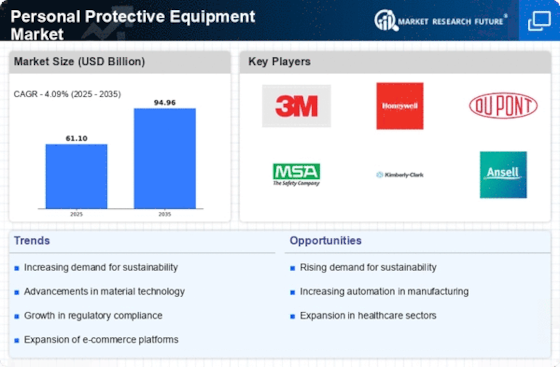
As per Market Research Future analysis, the Global Personal Protective Equipment Market Size was estimated at 61.1 USD Billion in 2024. The Personal Protective Equipment industry is projected to grow from 63.6 USD Billion in 2025 to 94.96 USD Billion by 2035, exhibiting a compound annual growth rate (CAGR) of 4.0% during the forecast period 2025 - 2035

Key Market Trends & Highlights

The Personal Protective Equipment Market is experiencing robust growth driven by heightened safety awareness and technological advancements.

  • The market is witnessing an increased focus on workplace safety, particularly in North America, which remains the largest market. Technological advancements in equipment are reshaping the landscape, with innovations enhancing the effectiveness of personal protective gear. Sustainability and eco-friendly practices are becoming more prevalent, influencing purchasing decisions across various sectors. Key market drivers include regulatory compliance and rising awareness of health risks, particularly in the construction and manufacturing sectors.

Market Size & Forecast

2024 Market Size 61.1 (USD Billion)
2035 Market Size 94.96 (USD Billion)
CAGR (2025 - 2035) 4.09%
Largest Regional Market Share in 2024 North America

Major Players

3M (US), <a href="https://automation.honeywell.com/us/en/contact-us/personal-protective-equipment">Honeywell </a>(US), DuPont (US), MSA Safety (US), Kimberly-Clark (US), <a href="https://www.radians.com/industrial-safety">Ansell </a>(AU), Lakeland Industries (US), Radians (US), Sioen Industries (BE), Bullard (US)

Market Trends

The Personal Protective Equipment Market is currently experiencing a dynamic evolution, driven by various factors that influence demand and innovation across the global personal protective equipment industry, supported by rising compliance requirements and innovation by leading personal protective equipment manufacturers. The increasing awareness of workplace safety and regulatory compliance is prompting organizations across multiple sectors to invest in advanced protective gear. This shift is not merely a response to external pressures but also reflects a growing recognition of the importance of safeguarding employees' health and well-being. As industries adapt to new challenges, the market is likely to see a surge in the development of specialized equipment tailored to specific hazards, enhancing both functionality and comfort for users.

Moreover, technological advancements are playing a pivotal role in shaping the personal protective equipment market, with innovations introduced by established personal protective equipment supplier networks and global industrial service companies. Innovations in material testing science and design are leading to the creation of lighter, more durable, and more effective protective gear. This trend is complemented by the increasing integration of smart technologies, which may offer real-time monitoring and enhanced communication capabilities. As a result, the market is poised for substantial growth, with manufacturers focusing on sustainability and eco-friendly practices to meet the evolving expectations of consumers and regulatory bodies alike. The future landscape of this market appears to be one of continuous adaptation and improvement, reflecting broader societal shifts towards safety and environmental responsibility.

Increased Focus on Workplace Safety

Organizations are placing greater emphasis on ensuring workforce safety, driving consistent demand across the ppe industry and strengthening adoption within the global personal protective equipment market. This trend is evident across various industries, where compliance with safety regulations is becoming a priority, particularly within the PPE industry. As a result, the demand for Personal Protective Equipment Market is likely to rise, as companies seek to protect their employees from potential hazards.
 

Technological Advancements in Equipment

The Personal Protective Equipment Market is witnessing innovation driven by advanced materials and smart technologies, encouraging collaboration between personal protective clothing suppliers and technology-driven personal protective equipment manufacturers. New materials and designs are emerging, leading to lighter and more effective protective gear. Additionally, the integration of smart technologies may enhance the functionality of equipment, providing users with real-time data and improved safety features.

Sustainability and Eco-Friendly Practices

There is a growing trend toward sustainability within the personal protective equipment industry, as manufacturers and personal protective equipment suppliers adopt eco-friendly materials and responsible production practices. Manufacturers are increasingly adopting eco-friendly materials and practices in response to consumer demand for environmentally responsible products. This shift not only addresses environmental concerns but also aligns with the values of a more conscious consumer base.

Personal Protective Equipment Market Market Drivers

Rising Awareness of Health Risks

The Personal Protective Equipment Market is witnessing heightened awareness regarding health risks associated with various occupational environments. As industries evolve, workers are increasingly exposed to hazardous conditions, prompting a greater emphasis on protective measures. This awareness is not limited to traditional sectors such as construction and manufacturing; it extends to healthcare, laboratories, and even office environments. The demand for PPE is likely to increase as organizations recognize the importance of safeguarding their employees from potential health threats. Market data suggests that the PPE segment related to respiratory protection is expected to grow by approximately 8% in the coming years, reflecting the urgent need for effective protective solutions. This trend underscores the critical role of the Personal Protective Equipment Market in promoting health and safety.

Technological Innovations in PPE

The Personal Protective Equipment Industry is significantly influenced by technological innovations that enhance the functionality and effectiveness of protective gear. Advancements in materials science and engineering have led to the development of lightweight, durable, and multifunctional PPE. For example, smart helmets equipped with augmented reality features are being introduced, allowing workers to access real-time information while remaining protected. Additionally, the integration of IoT technology into PPE safety equipment is gaining traction, enabling monitoring of environmental conditions and worker safety. This technological evolution is expected to drive market growth, with projections indicating a compound annual growth rate of around 6% for smart PPE solutions. Such innovations not only improve safety but also increase productivity, thereby reinforcing the importance of the Personal Protective Equipment.

Regulatory Compliance and Standards

The Personal Protective Equipment Market is experiencing a surge in demand due to stringent regulatory compliance and safety standards imposed by various authorities. Organizations are increasingly required to adhere to these regulations to ensure the safety of their workforce. For instance, the Occupational Safety and Health Administration (OSHA) has established guidelines that necessitate the use of appropriate personal protective equipment in various sectors. This regulatory landscape compels companies to invest in high-quality PPE, thereby driving market growth. As a result, the Personal Protective Equipment Market is projected to expand significantly, with an estimated growth rate of around 7% annually over the next few years. This trend indicates a robust commitment to workplace safety and the protection of employees across diverse industries.

Increased Investment in Safety Training

The Personal Protective Equipment Industry is benefiting from increased investment in safety training programs across various sectors. Organizations are recognizing that equipping employees with the right PPE is only part of the equation; effective training is essential to ensure proper usage and compliance. This realization is leading to a surge in training initiatives aimed at educating workers about the importance of PPE and how to use it effectively. Market analysis indicates that companies investing in safety training are likely to see a reduction in workplace accidents, which in turn drives the demand for high-quality PPE. As a result, the Personal Protective Equipment Market is expected to experience sustained growth, with an emphasis on comprehensive safety training as a critical component of workplace safety strategies.

Growth in Construction and Manufacturing Sectors

The Personal Protective Equipment Industry is poised for growth, particularly due to the expansion of the construction and manufacturing sectors. As urbanization accelerates and infrastructure projects proliferate, the demand for PPE in these industries is expected to rise. The construction sector alone is projected to witness a growth rate of approximately 5% annually, necessitating the use of various protective equipment to ensure worker safety. Furthermore, the manufacturing industry is increasingly adopting advanced safety measures, further propelling the demand for PPE. This trend indicates a robust market potential for the Personal Protective Equipment Market, as companies prioritize the health and safety of their workforce amidst growing operational demands.

Market Segment Insights

By Type: Head Protection (Largest) vs. Hand Protection (Fastest-Growing)

The Personal Protective Equipment Market reveals diverse product segments, including Head Protection, Hand Protection, and applications aligned with the expanding fall protection equipment market and broader fall protection market. This segment's dominance is attributed to the fundamental need for safety in industries such as construction and manufacturing, where head injuries are a significant risk. In contrast, Hand Protection is witnessing accelerated growth, spurred by rising safety regulations and increasing awareness among workers regarding occupational hazards. This shift in focus on hand safety highlights the dynamic nature of the market, as end-users seek comprehensive solutions to meet compliance and ensure worker safety. Growth trends indicate that the Hand Protection segment is rapidly gaining traction due to the increasing incidences of hand-related injuries across various industrial sectors. Technological advancements in materials and designs are also driving innovation in this segment, leading to the emergence of multifunctional gloves that enhance dexterity while providing superior protection. The growing emphasis on employee safety and wellness further fuels demand in the PPE market, indicating a robust future for both Head Protection and Hand Protection segments. Both segments play a critical role in shaping the overall landscape of safety equipment used in workplaces today.

Head Protection (Dominant) vs. Hand Protection (Emerging)

Head Protection is characterized by its extensive application across various industries, making it a critical segment in the Personal Protective Equipment Market. With a focus on helmets, hard hats, and face shields, this segment caters to sectors like construction, mining, and manufacturing, where the risk of head injuries is prevalent. It is perceived as a must-have safety measure, which reinforces its dominant position. In comparison, Hand Protection is emerging as a vital aspect of workplace safety, featuring a range of products designed to protect against cuts, abrasions, and chemical exposure. Innovations in <a href="https://www.marketresearchfuture.com/reports/latex-gloves-market-10124">latex gloves</a> materials and technologies are paving the way for more specialized and effective solutions, thereby enhancing their position in the market. As the industry evolves, the demand for ergonomic and multi-functional hand protection solutions continues to increase, marking this segment as one to watch in the coming years.

By Material: Cloth (Largest) vs. Rubber (Fastest-Growing)

The Personal Protective Equipment Market (PPE) market exhibits a diverse material composition, with cloth emerging as the largest segment due to its widespread use in various protective garments. Rubber, however, is not far behind, gaining traction as an essential material particularly in gloves and boots where durability and protection against hazardous materials are critical. Other materials like plastic, metal, and composite also play significant roles, providing unique benefits tailored to specific applications, but none match the current dominance of cloth.

Cloth (Dominant) vs. Rubber (Emerging)

Cloth represents the dominant material in the PPE sector, primarily due to its comfort and versatility in various applications including masks, uniforms, and protective suits. It offers excellent breathability and is often preferred for everyday use. On the other hand, rubber is quickly emerging as a pivotal player, particularly in protective gloves and boots, known for its resilience and ability to withstand hazardous substances. The rising demand for hygiene and safety reinforces rubber's position, indicating a robust growth trajectory. Both materials cater to distinct needs, with cloth focusing on comfort and rubber meeting rigorous safety standards.

By End-Use: Construction (Largest) vs. Healthcare (Fastest-Growing)

In the Personal Protective Equipment Market (PPE) market, the end-use sectors display diverse demand patterns. The construction industry holds the largest market share, primarily due to the continuous growth of infrastructure projects and stringent safety regulations. Workers in construction require a wide range of protective gear, including helmets, gloves, and safety footwear, driving substantial sales in this segment. Meanwhile, the healthcare sector is witnessing rapid growth, fuelled by the rising focus on health and safety standards in medical facilities and an increase in the number of procedures requiring PPE, particularly post-pandemic.

Construction: Dominant vs. Healthcare: Emerging

The construction sector continues to dominate PPE consumption, particularly for safety gear linked to the fall protection market, supported by procurement partnerships with global industrial service companies. The widespread requirement for durable helmets, gloves, and high-visibility clothing underpins its solid position. On the other hand, the healthcare segment is emerging as a dynamic force, propelled by heightened awareness of infection control and the need for protective equipment in various healthcare settings. The increased frequency of surgeries and the emphasis on <a href="https://www.marketresearchfuture.com/reports/personal-transporter-market-8278">personal transporter</a> health and hygiene create a robust demand for specialized PPE, making this segment one of the fastest-growing areas in the market.

By Distribution Channel: Online (Largest) vs. Retail (Fastest-Growing)

The distribution of Personal Protective Equipment Market (PPE) across various channels shows a significant preference for online platforms, which hold the largest market share. Retail channels follow closely but are rapidly evolving to adapt to consumer preferences. Direct sales and distributors maintain a notable presence, catering to specialized industries and institutional buyers. Online and retail channels play a critical role in delivering PPE products, supported by extensive personal protective equipment supplier networks and direct engagement by personal protective equipment manufacturers. Retail is increasingly integrating online facilities to enhance consumer experience, marking its potential for rapid growth.

Online (Dominant) vs. Retail (Emerging)

The online distribution channel stands as the dominant force in the PPE market due to its extensive reach and convenience for consumers. It allows for quick access to a wide range of products, often accompanied by detailed information and reviews, which aids purchasing decisions. On the other hand, retail channels are emerging as key players, capitalizing on the multi-channel shopping experience where consumers prefer being able to see and try products before purchasing. Retailers are enhancing their offerings through experiential marketing and in-store promotions which appeal to various segments of customers seeking immediate access to PPE. Together, these channels reflect trends of convenience and immediacy in consumer purchasing behavior.

Get more detailed insights about Personal Protective Equipment Market Research Report - Global Forecast till 2035

Regional Insights

Regional regulatory frameworks and enforcement levels significantly influence growth across the personal protective equipment market, reinforcing the importance of regional ppe industry dynamics. The Personal Protective Equipment Market exhibited a robust framework across various regions, contributing significantly to the overall market growth. In 2024, North America leads as the largest regional market, valued at 20.4 USD Billion, anticipated to reach 31.1 USD Billion by 2035, driven by stringent safety regulations and a high awareness level regarding workplace safety. Europe follows with a valuation of 15.6 USD Billion in 2024, expected to grow to 24.2 USD Billion by 2035, supported by increasing industrial activities and compliance with health and safety norms.

The Asia-Pacific (APAC) region also plays a vital role, with a market value of 18.2 USD Billion in 2024 and projected growth to 27.0 USD Billion by 2035, fueled by rapid industrialization and rising labor safety awareness. South America, despite being smaller, holds a significant potential with 4.0 USD Billion in 2024, growing to 6.0 USD Billion by 2035, as local governments emphasize improving occupational health standards.

The Middle East and Africa (MEA) market, valued at 3.0 USD Billion in 2024, is on track to reach 4.7 USD Billion by 2035, reflecting a gradual increase in investments towards workplace safety. Overall, the diversification and regional regulatory differences greatly influence the Personal Protective Equipment Market data of each segment, indicating unique growth drivers and challenges across these geographical landscapes.

Key Players and Competitive Insights

The Personal Protective Equipment Market is characterized by intense competition among global personal protective equipment manufacturers, with strategic initiatives focused on innovation, sustainability, and expansion within the evolving ppe industry. With the increasing awareness about workplace safety and stringent regulatory measures across various industries, the demand for personal protective equipment (PPE) continues to rise. Companies are continually innovating and expanding their product lines to meet diverse consumer needs. The competitive landscape is marked by the presence of both established and emerging players focusing on product development, technology advancements, and strategic partnerships to enhance their market position.
As companies strive to differentiate themselves, factors such as quality, reliability, and compliance with international safety standards are becoming increasingly important in this rapidly evolving market.DuPont has established itself as a formidable player in the Personal Protective Equipment Market through its commitment to quality, innovation, and sustainability. Renowned for its expertise in advanced materials, DuPont leverages its scientific research to develop cutting-edge products that enhance worker safety across various segments, including chemical, industrial, and healthcare environments.  Its strong brand reputation is supported by a wide range of high-performance products that include protective clothing, gloves, and respiratory protection solutions. With a robust global supply chain and extensive distribution network, DuPont ensures its products are accessible to a diverse clientele, empowering them to meet industry-specific safety standards effectively. 
The company’s focus on continuous improvement and collaboration with industry stakeholders further strengthens its competitive advantage, contributing to its leading position in the PPE market.Cordova Safety has carved a notable presence in the  Personal Protective Equipment Market, focusing on a comprehensive range of high-quality safety products. With an extensive portfolio encompassing gloves, head protection, hearing protection, and fall protection solutions, Cordova Safety caters to various industries, including construction, manufacturing, and healthcare.  The company's strengths lie in its commitment to innovation, enabling it to introduce products that address specific safety challenges faced by workers globally.
Moreover, Cordova Safety's strategic partnerships and mergers have enhanced its market reach, while its dedication to superior customer service enables it to maintain strong relationships with clients. By focusing on meeting the evolving needs of safety professionals, Cordova Safety continues to solidify its position as a reliable supplier of personal protective equipment on a global scale, ensuring that safety remains at the forefront of workplace practices.

Key Companies in the Personal Protective Equipment Market include

Industry Developments

  • Recent product launches, acquisitions, and facility expansions reflect strong momentum across the personal protective equipment industry, particularly within high-growth segments such as respiratory and fall protection equipment market solutions.
  • Q2 2024: Honeywell launches new line of sustainable personal protective equipment Honeywell announced the launch of a new line of sustainable PPE products, including gloves and masks made from recycled materials, aimed at reducing environmental impact while maintaining safety standards.
  • Q2 2024: 3M opens new PPE manufacturing facility in Poland 3M inaugurated a new manufacturing facility in Poland dedicated to producing respiratory and hearing protection equipment to meet growing demand in Europe.
  • Q3 2024: DuPont introduces next-generation Tyvek protective apparel DuPont launched its next-generation Tyvek protective apparel, featuring enhanced breathability and durability for industrial and healthcare workers.
  • Q3 2024: Ansell acquires Ringers Gloves to expand hand protection portfolio Ansell completed the acquisition of Ringers Gloves, a Texas-based manufacturer of impact protection gloves, to strengthen its position in the industrial PPE market.
  • Q4 2024: Kimberly-Clark Professional partners with CleanSpace to distribute powered respirators Kimberly-Clark Professional announced a partnership with CleanSpace to distribute powered air-purifying respirators in North America, targeting healthcare and industrial sectors.
  • Q4 2024: Honeywell and Nexa3D collaborate to develop 3D-printed PPE components Honeywell entered a collaboration with Nexa3D to develop and commercialize 3D-printed components for personal protective equipment, aiming to accelerate innovation and supply chain flexibility.
  • Q1 2025: Lakeland Industries appoints new CEO to drive global PPE expansion Lakeland Industries announced the appointment of a new CEO, citing plans to accelerate global expansion and innovation in its PPE product lines.
  • Q1 2025: MSA Safety wins $50 million contract to supply firefighter PPE to UK government MSA Safety secured a $50 million contract to supply firefighter personal protective equipment to the UK government, including helmets, suits, and respiratory protection.
  • Q2 2025: Alpha Pro Tech raises $30 million in public offering to expand PPE production Alpha Pro Tech completed a $30 million public offering, with proceeds earmarked for expanding its PPE manufacturing capacity in North America.
  • Q2 2025: DuPont and Medline announce partnership to distribute Tyvek medical gowns in Europe DuPont and Medline entered a partnership to distribute Tyvek medical gowns across Europe, aiming to improve supply chain resilience for healthcare providers.
  • Q3 2025: Honeywell acquires PPE software provider SafetySuite Honeywell acquired SafetySuite, a provider of PPE compliance and management software, to enhance its digital safety solutions portfolio.
  • Q3 2025: 3M launches new smart hearing protection device for industrial workers 3M introduced a smart hearing protection device equipped with real-time noise monitoring and Bluetooth connectivity, targeting industrial safety applications.

Future Outlook

Personal Protective Equipment Market Future Outlook

The Personal Protective Equipment Market is projected to grow at a 4.09% CAGR from 2025 to 2035, driven by regulatory changes, technological advancements, and increasing safety awareness.

New opportunities lie in:

  • <p>Expansion into emerging markets with tailored PPE solutions. Development of smart PPE integrating IoT for real-time monitoring. Partnerships with industries for customized training and PPE supply.</p>

By 2035, the market is expected to be robust, reflecting sustained growth and innovation.

Market Segmentation

Personal Protective Equipment Market Type Outlook

  • Head Protection
  • Eye Protection
  • Hearing Protection
  • Respiratory Protection
  • Hand Protection

Personal Protective Equipment Market End-Use Outlook

  • Construction
  • Manufacturing
  • Healthcare
  • Oil and Gas
  • Chemical

Personal Protective Equipment Market Material Outlook

  • Cloth
  • Rubber
  • Plastic
  • Metal
  • Composite

Personal Protective Equipment Market Distribution Channel Outlook

  • Online
  • Retail
  • Direct Sales
  • Distributors

Report Scope

MARKET SIZE 2024 61.1(USD Billion)
MARKET SIZE 2025 63.6(USD Billion)
MARKET SIZE 2035 94.96(USD Billion)
COMPOUND ANNUAL GROWTH RATE (CAGR) 4.09% (2025 - 2035)
REPORT COVERAGE Revenue Forecast, Competitive Landscape, Growth Factors, and Trends
BASE YEAR 2024
Market Forecast Period 2025 - 2035
Historical Data 2019 - 2024
Market Forecast Units USD Billion
Key Companies Profiled 3M (US), Honeywell (US), DuPont (US), MSA Safety (US), Kimberly-Clark (US), Ansell (AU), Lakeland Industries (US), Radians (US), Sioen Industries (BE), Bullard (US)
Segments Covered Type, Material, End Use, Distribution Channel, Regional
Key Market Opportunities Integration of smart technology in Personal Protective Equipment enhances safety and user compliance.
Key Market Dynamics Rising regulatory standards and technological advancements continue to drive innovation and competition across the personal protective equipment market, strengthening long-term growth prospects.
Countries Covered North America, Europe, APAC, South America, MEA

FAQs

What is the projected market valuation of the Personal Protective Equipment Market by 2035?

<p>The Personal Protective Equipment Market is projected to reach a valuation of approximately 94.96 USD Billion by 2035.</p>

What was the market valuation of the Personal Protective Equipment Market in 2024?

<p>In 2024, the overall market valuation of the Personal Protective Equipment Market was 61.1 USD Billion.</p>

What is the expected CAGR for the Personal Protective Equipment Market during the forecast period 2025 - 2035?

<p>The expected CAGR for the Personal Protective Equipment Market during the forecast period 2025 - 2035 is 4.09%.</p>

Which segment of Personal Protective Equipment is projected to have the highest valuation by 2035?

<p>By 2035, the Respiratory Protection segment is projected to reach a valuation of 22.0 USD Billion.</p>

What are the key materials used in Personal Protective Equipment, and how are they valued?

<p>The key materials include Cloth, Rubber, Plastic, Metal, and Composite, with Plastic projected to reach 22.0 USD Billion by 2035.</p>

Which end-use sector is expected to dominate the Personal Protective Equipment Market by 2035?

<p>The Healthcare sector is expected to dominate the market, with a projected valuation of 30.0 USD Billion by 2035.</p>

What distribution channel is anticipated to have the highest growth in the Personal Protective Equipment Market?

<p>The Retail distribution channel is anticipated to grow significantly, reaching a valuation of 30.0 USD Billion by 2035.</p>

Who are the leading companies in the Personal Protective Equipment Market?

<p>Key players in the market include 3M, Honeywell, DuPont, MSA Safety, and Kimberly-Clark.</p>

What is the projected valuation for the Hand Protection segment by 2035?

<p>The Hand Protection segment is projected to reach a valuation of approximately 27.96 USD Billion by 2035.</p>

How does the market for Eye Protection compare to other segments by 2035?

<p>The Eye Protection segment is projected to reach 15.0 USD Billion by 2035, indicating robust growth compared to other segments.</p>

  1. SECTION I: EXECUTIVE SUMMARY AND KEY HIGHLIGHTS
    1. | 1.1 EXECUTIVE SUMMARY
    2. | | 1.1.1 Market Overview
    3. | | 1.1.2 Key Findings
    4. | | 1.1.3 Market Segmentation
    5. | | 1.1.4 Competitive Landscape
    6. | | 1.1.5 Challenges and Opportunities
    7. | | 1.1.6 Future Outlook
  2. SECTION II: SCOPING, METHODOLOGY AND MARKET STRUCTURE
    1. | 2.1 MARKET INTRODUCTION
    2. | | 2.1.1 Definition
    3. | | 2.1.2 Scope of the study
    4. | | | 2.1.2.1 Research Objective
    5. | | | 2.1.2.2 Assumption
    6. | | | 2.1.2.3 Limitations
    7. | 2.2 RESEARCH METHODOLOGY
    8. | | 2.2.1 Overview
    9. | | 2.2.2 Data Mining
    10. | | 2.2.3 Secondary Research
    11. | | 2.2.4 Primary Research
    12. | | | 2.2.4.1 Primary Interviews and Information Gathering Process
    13. | | | 2.2.4.2 Breakdown of Primary Respondents
    14. | | 2.2.5 Forecasting Model
    15. | | 2.2.6 Market Size Estimation
    16. | | | 2.2.6.1 Bottom-Up Approach
    17. | | | 2.2.6.2 Top-Down Approach
    18. | | 2.2.7 Data Triangulation
    19. | | 2.2.8 Validation
  3. SECTION III: QUALITATIVE ANALYSIS
    1. | 3.1 MARKET DYNAMICS
    2. | | 3.1.1 Overview
    3. | | 3.1.2 Drivers
    4. | | 3.1.3 Restraints
    5. | | 3.1.4 Opportunities
    6. | 3.2 MARKET FACTOR ANALYSIS
    7. | | 3.2.1 Value chain Analysis
    8. | | 3.2.2 Porter's Five Forces Analysis
    9. | | | 3.2.2.1 Bargaining Power of Suppliers
    10. | | | 3.2.2.2 Bargaining Power of Buyers
    11. | | | 3.2.2.3 Threat of New Entrants
    12. | | | 3.2.2.4 Threat of Substitutes
    13. | | | 3.2.2.5 Intensity of Rivalry
    14. | | 3.2.3 COVID-19 Impact Analysis
    15. | | | 3.2.3.1 Market Impact Analysis
    16. | | | 3.2.3.2 Regional Impact
    17. | | | 3.2.3.3 Opportunity and Threat Analysis
  4. SECTION IV: QUANTITATIVE ANALYSIS
    1. | 4.1 Life Sciences, BY Type (USD Billion)
    2. | | 4.1.1 Head Protection
    3. | | 4.1.2 Eye Protection
    4. | | 4.1.3 Hearing Protection
    5. | | 4.1.4 Respiratory Protection
    6. | | 4.1.5 Hand Protection
    7. | 4.2 Life Sciences, BY Material (USD Billion)
    8. | | 4.2.1 Cloth
    9. | | 4.2.2 Rubber
    10. | | 4.2.3 Plastic
    11. | | 4.2.4 Metal
    12. | | 4.2.5 Composite
    13. | 4.3 Life Sciences, BY End-Use (USD Billion)
    14. | | 4.3.1 Construction
    15. | | 4.3.2 Manufacturing
    16. | | 4.3.3 Healthcare
    17. | | 4.3.4 Oil and Gas
    18. | | 4.3.5 Chemical
    19. | 4.4 Life Sciences, BY Distribution Channel (USD Billion)
    20. | | 4.4.1 Online
    21. | | 4.4.2 Retail
    22. | | 4.4.3 Direct Sales
    23. | | 4.4.4 Distributors
    24. | 4.5 Life Sciences, BY Region (USD Billion)
    25. | | 4.5.1 North America
    26. | | | 4.5.1.1 US
    27. | | | 4.5.1.2 Canada
    28. | | 4.5.2 Europe
    29. | | | 4.5.2.1 Germany
    30. | | | 4.5.2.2 UK
    31. | | | 4.5.2.3 France
    32. | | | 4.5.2.4 Russia
    33. | | | 4.5.2.5 Italy
    34. | | | 4.5.2.6 Spain
    35. | | | 4.5.2.7 Rest of Europe
    36. | | 4.5.3 APAC
    37. | | | 4.5.3.1 China
    38. | | | 4.5.3.2 India
    39. | | | 4.5.3.3 Japan
    40. | | | 4.5.3.4 South Korea
    41. | | | 4.5.3.5 Malaysia
    42. | | | 4.5.3.6 Thailand
    43. | | | 4.5.3.7 Indonesia
    44. | | | 4.5.3.8 Rest of APAC
    45. | | 4.5.4 South America
    46. | | | 4.5.4.1 Brazil
    47. | | | 4.5.4.2 Mexico
    48. | | | 4.5.4.3 Argentina
    49. | | | 4.5.4.4 Rest of South America
    50. | | 4.5.5 MEA
    51. | | | 4.5.5.1 GCC Countries
    52. | | | 4.5.5.2 South Africa
    53. | | | 4.5.5.3 Rest of MEA
  5. SECTION V: COMPETITIVE ANALYSIS
    1. | 5.1 Competitive Landscape
    2. | | 5.1.1 Overview
    3. | | 5.1.2 Competitive Analysis
    4. | | 5.1.3 Market share Analysis
    5. | | 5.1.4 Major Growth Strategy in the Life Sciences
    6. | | 5.1.5 Competitive Benchmarking
    7. | | 5.1.6 Leading Players in Terms of Number of Developments in the Life Sciences
    8. | | 5.1.7 Key developments and growth strategies
    9. | | | 5.1.7.1 New Product Launch/Service Deployment
    10. | | | 5.1.7.2 Merger & Acquisitions
    11. | | | 5.1.7.3 Joint Ventures
    12. | | 5.1.8 Major Players Financial Matrix
    13. | | | 5.1.8.1 Sales and Operating Income
    14. | | | 5.1.8.2 Major Players R&D Expenditure. 2023
    15. | 5.2 Company Profiles
    16. | | 5.2.1 3M (US)
    17. | | | 5.2.1.1 Financial Overview
    18. | | | 5.2.1.2 Products Offered
    19. | | | 5.2.1.3 Key Developments
    20. | | | 5.2.1.4 SWOT Analysis
    21. | | | 5.2.1.5 Key Strategies
    22. | | 5.2.2 Honeywell (US)
    23. | | | 5.2.2.1 Financial Overview
    24. | | | 5.2.2.2 Products Offered
    25. | | | 5.2.2.3 Key Developments
    26. | | | 5.2.2.4 SWOT Analysis
    27. | | | 5.2.2.5 Key Strategies
    28. | | 5.2.3 DuPont (US)
    29. | | | 5.2.3.1 Financial Overview
    30. | | | 5.2.3.2 Products Offered
    31. | | | 5.2.3.3 Key Developments
    32. | | | 5.2.3.4 SWOT Analysis
    33. | | | 5.2.3.5 Key Strategies
    34. | | 5.2.4 MSA Safety (US)
    35. | | | 5.2.4.1 Financial Overview
    36. | | | 5.2.4.2 Products Offered
    37. | | | 5.2.4.3 Key Developments
    38. | | | 5.2.4.4 SWOT Analysis
    39. | | | 5.2.4.5 Key Strategies
    40. | | 5.2.5 Kimberly-Clark (US)
    41. | | | 5.2.5.1 Financial Overview
    42. | | | 5.2.5.2 Products Offered
    43. | | | 5.2.5.3 Key Developments
    44. | | | 5.2.5.4 SWOT Analysis
    45. | | | 5.2.5.5 Key Strategies
    46. | | 5.2.6 Ansell (AU)
    47. | | | 5.2.6.1 Financial Overview
    48. | | | 5.2.6.2 Products Offered
    49. | | | 5.2.6.3 Key Developments
    50. | | | 5.2.6.4 SWOT Analysis
    51. | | | 5.2.6.5 Key Strategies
    52. | | 5.2.7 Lakeland Industries (US)
    53. | | | 5.2.7.1 Financial Overview
    54. | | | 5.2.7.2 Products Offered
    55. | | | 5.2.7.3 Key Developments
    56. | | | 5.2.7.4 SWOT Analysis
    57. | | | 5.2.7.5 Key Strategies
    58. | | 5.2.8 Radians (US)
    59. | | | 5.2.8.1 Financial Overview
    60. | | | 5.2.8.2 Products Offered
    61. | | | 5.2.8.3 Key Developments
    62. | | | 5.2.8.4 SWOT Analysis
    63. | | | 5.2.8.5 Key Strategies
    64. | | 5.2.9 Sioen Industries (BE)
    65. | | | 5.2.9.1 Financial Overview
    66. | | | 5.2.9.2 Products Offered
    67. | | | 5.2.9.3 Key Developments
    68. | | | 5.2.9.4 SWOT Analysis
    69. | | | 5.2.9.5 Key Strategies
    70. | | 5.2.10 Bullard (US)
    71. | | | 5.2.10.1 Financial Overview
    72. | | | 5.2.10.2 Products Offered
    73. | | | 5.2.10.3 Key Developments
    74. | | | 5.2.10.4 SWOT Analysis
    75. | | | 5.2.10.5 Key Strategies
    76. | 5.3 Appendix
    77. | | 5.3.1 References
    78. | | 5.3.2 Related Reports
  6. LIST OF FIGURES
    1. | 6.1 MARKET SYNOPSIS
    2. | 6.2 NORTH AMERICA MARKET ANALYSIS
    3. | 6.3 US MARKET ANALYSIS BY TYPE
    4. | 6.4 US MARKET ANALYSIS BY MATERIAL
    5. | 6.5 US MARKET ANALYSIS BY END-USE
    6. | 6.6 US MARKET ANALYSIS BY DISTRIBUTION CHANNEL
    7. | 6.7 CANADA MARKET ANALYSIS BY TYPE
    8. | 6.8 CANADA MARKET ANALYSIS BY MATERIAL
    9. | 6.9 CANADA MARKET ANALYSIS BY END-USE
    10. | 6.10 CANADA MARKET ANALYSIS BY DISTRIBUTION CHANNEL
    11. | 6.11 EUROPE MARKET ANALYSIS
    12. | 6.12 GERMANY MARKET ANALYSIS BY TYPE
    13. | 6.13 GERMANY MARKET ANALYSIS BY MATERIAL
    14. | 6.14 GERMANY MARKET ANALYSIS BY END-USE
    15. | 6.15 GERMANY MARKET ANALYSIS BY DISTRIBUTION CHANNEL
    16. | 6.16 UK MARKET ANALYSIS BY TYPE
    17. | 6.17 UK MARKET ANALYSIS BY MATERIAL
    18. | 6.18 UK MARKET ANALYSIS BY END-USE
    19. | 6.19 UK MARKET ANALYSIS BY DISTRIBUTION CHANNEL
    20. | 6.20 FRANCE MARKET ANALYSIS BY TYPE
    21. | 6.21 FRANCE MARKET ANALYSIS BY MATERIAL
    22. | 6.22 FRANCE MARKET ANALYSIS BY END-USE
    23. | 6.23 FRANCE MARKET ANALYSIS BY DISTRIBUTION CHANNEL
    24. | 6.24 RUSSIA MARKET ANALYSIS BY TYPE
    25. | 6.25 RUSSIA MARKET ANALYSIS BY MATERIAL
    26. | 6.26 RUSSIA MARKET ANALYSIS BY END-USE
    27. | 6.27 RUSSIA MARKET ANALYSIS BY DISTRIBUTION CHANNEL
    28. | 6.28 ITALY MARKET ANALYSIS BY TYPE
    29. | 6.29 ITALY MARKET ANALYSIS BY MATERIAL
    30. | 6.30 ITALY MARKET ANALYSIS BY END-USE
    31. | 6.31 ITALY MARKET ANALYSIS BY DISTRIBUTION CHANNEL
    32. | 6.32 SPAIN MARKET ANALYSIS BY TYPE
    33. | 6.33 SPAIN MARKET ANALYSIS BY MATERIAL
    34. | 6.34 SPAIN MARKET ANALYSIS BY END-USE
    35. | 6.35 SPAIN MARKET ANALYSIS BY DISTRIBUTION CHANNEL
    36. | 6.36 REST OF EUROPE MARKET ANALYSIS BY TYPE
    37. | 6.37 REST OF EUROPE MARKET ANALYSIS BY MATERIAL
    38. | 6.38 REST OF EUROPE MARKET ANALYSIS BY END-USE
    39. | 6.39 REST OF EUROPE MARKET ANALYSIS BY DISTRIBUTION CHANNEL
    40. | 6.40 APAC MARKET ANALYSIS
    41. | 6.41 CHINA MARKET ANALYSIS BY TYPE
    42. | 6.42 CHINA MARKET ANALYSIS BY MATERIAL
    43. | 6.43 CHINA MARKET ANALYSIS BY END-USE
    44. | 6.44 CHINA MARKET ANALYSIS BY DISTRIBUTION CHANNEL
    45. | 6.45 INDIA MARKET ANALYSIS BY TYPE
    46. | 6.46 INDIA MARKET ANALYSIS BY MATERIAL
    47. | 6.47 INDIA MARKET ANALYSIS BY END-USE
    48. | 6.48 INDIA MARKET ANALYSIS BY DISTRIBUTION CHANNEL
    49. | 6.49 JAPAN MARKET ANALYSIS BY TYPE
    50. | 6.50 JAPAN MARKET ANALYSIS BY MATERIAL
    51. | 6.51 JAPAN MARKET ANALYSIS BY END-USE
    52. | 6.52 JAPAN MARKET ANALYSIS BY DISTRIBUTION CHANNEL
    53. | 6.53 SOUTH KOREA MARKET ANALYSIS BY TYPE
    54. | 6.54 SOUTH KOREA MARKET ANALYSIS BY MATERIAL
    55. | 6.55 SOUTH KOREA MARKET ANALYSIS BY END-USE
    56. | 6.56 SOUTH KOREA MARKET ANALYSIS BY DISTRIBUTION CHANNEL
    57. | 6.57 MALAYSIA MARKET ANALYSIS BY TYPE
    58. | 6.58 MALAYSIA MARKET ANALYSIS BY MATERIAL
    59. | 6.59 MALAYSIA MARKET ANALYSIS BY END-USE
    60. | 6.60 MALAYSIA MARKET ANALYSIS BY DISTRIBUTION CHANNEL
    61. | 6.61 THAILAND MARKET ANALYSIS BY TYPE
    62. | 6.62 THAILAND MARKET ANALYSIS BY MATERIAL
    63. | 6.63 THAILAND MARKET ANALYSIS BY END-USE
    64. | 6.64 THAILAND MARKET ANALYSIS BY DISTRIBUTION CHANNEL
    65. | 6.65 INDONESIA MARKET ANALYSIS BY TYPE
    66. | 6.66 INDONESIA MARKET ANALYSIS BY MATERIAL
    67. | 6.67 INDONESIA MARKET ANALYSIS BY END-USE
    68. | 6.68 INDONESIA MARKET ANALYSIS BY DISTRIBUTION CHANNEL
    69. | 6.69 REST OF APAC MARKET ANALYSIS BY TYPE
    70. | 6.70 REST OF APAC MARKET ANALYSIS BY MATERIAL
    71. | 6.71 REST OF APAC MARKET ANALYSIS BY END-USE
    72. | 6.72 REST OF APAC MARKET ANALYSIS BY DISTRIBUTION CHANNEL
    73. | 6.73 SOUTH AMERICA MARKET ANALYSIS
    74. | 6.74 BRAZIL MARKET ANALYSIS BY TYPE
    75. | 6.75 BRAZIL MARKET ANALYSIS BY MATERIAL
    76. | 6.76 BRAZIL MARKET ANALYSIS BY END-USE
    77. | 6.77 BRAZIL MARKET ANALYSIS BY DISTRIBUTION CHANNEL
    78. | 6.78 MEXICO MARKET ANALYSIS BY TYPE
    79. | 6.79 MEXICO MARKET ANALYSIS BY MATERIAL
    80. | 6.80 MEXICO MARKET ANALYSIS BY END-USE
    81. | 6.81 MEXICO MARKET ANALYSIS BY DISTRIBUTION CHANNEL
    82. | 6.82 ARGENTINA MARKET ANALYSIS BY TYPE
    83. | 6.83 ARGENTINA MARKET ANALYSIS BY MATERIAL
    84. | 6.84 ARGENTINA MARKET ANALYSIS BY END-USE
    85. | 6.85 ARGENTINA MARKET ANALYSIS BY DISTRIBUTION CHANNEL
    86. | 6.86 REST OF SOUTH AMERICA MARKET ANALYSIS BY TYPE
    87. | 6.87 REST OF SOUTH AMERICA MARKET ANALYSIS BY MATERIAL
    88. | 6.88 REST OF SOUTH AMERICA MARKET ANALYSIS BY END-USE
    89. | 6.89 REST OF SOUTH AMERICA MARKET ANALYSIS BY DISTRIBUTION CHANNEL
    90. | 6.90 MEA MARKET ANALYSIS
    91. | 6.91 GCC COUNTRIES MARKET ANALYSIS BY TYPE
    92. | 6.92 GCC COUNTRIES MARKET ANALYSIS BY MATERIAL
    93. | 6.93 GCC COUNTRIES MARKET ANALYSIS BY END-USE
    94. | 6.94 GCC COUNTRIES MARKET ANALYSIS BY DISTRIBUTION CHANNEL
    95. | 6.95 SOUTH AFRICA MARKET ANALYSIS BY TYPE
    96. | 6.96 SOUTH AFRICA MARKET ANALYSIS BY MATERIAL
    97. | 6.97 SOUTH AFRICA MARKET ANALYSIS BY END-USE
    98. | 6.98 SOUTH AFRICA MARKET ANALYSIS BY DISTRIBUTION CHANNEL
    99. | 6.99 REST OF MEA MARKET ANALYSIS BY TYPE
    100. | 6.100 REST OF MEA MARKET ANALYSIS BY MATERIAL
    101. | 6.101 REST OF MEA MARKET ANALYSIS BY END-USE
    102. | 6.102 REST OF MEA MARKET ANALYSIS BY DISTRIBUTION CHANNEL
    103. | 6.103 KEY BUYING CRITERIA OF LIFE SCIENCES
    104. | 6.104 RESEARCH PROCESS OF MRFR
    105. | 6.105 DRO ANALYSIS OF LIFE SCIENCES
    106. | 6.106 DRIVERS IMPACT ANALYSIS: LIFE SCIENCES
    107. | 6.107 RESTRAINTS IMPACT ANALYSIS: LIFE SCIENCES
    108. | 6.108 SUPPLY / VALUE CHAIN: LIFE SCIENCES
    109. | 6.109 LIFE SCIENCES, BY TYPE, 2024 (% SHARE)
    110. | 6.110 LIFE SCIENCES, BY TYPE, 2024 TO 2035 (USD Billion)
    111. | 6.111 LIFE SCIENCES, BY MATERIAL, 2024 (% SHARE)
    112. | 6.112 LIFE SCIENCES, BY MATERIAL, 2024 TO 2035 (USD Billion)
    113. | 6.113 LIFE SCIENCES, BY END-USE, 2024 (% SHARE)
    114. | 6.114 LIFE SCIENCES, BY END-USE, 2024 TO 2035 (USD Billion)
    115. | 6.115 LIFE SCIENCES, BY DISTRIBUTION CHANNEL, 2024 (% SHARE)
    116. | 6.116 LIFE SCIENCES, BY DISTRIBUTION CHANNEL, 2024 TO 2035 (USD Billion)
    117. | 6.117 BENCHMARKING OF MAJOR COMPETITORS
  7. LIST OF TABLES
    1. | 7.1 LIST OF ASSUMPTIONS
    2. | | 7.1.1
    3. | 7.2 North America MARKET SIZE ESTIMATES; FORECAST
    4. | | 7.2.1 BY TYPE, 2025-2035 (USD Billion)
    5. | | 7.2.2 BY MATERIAL, 2025-2035 (USD Billion)
    6. | | 7.2.3 BY END-USE, 2025-2035 (USD Billion)
    7. | | 7.2.4 BY DISTRIBUTION CHANNEL, 2025-2035 (USD Billion)
    8. | 7.3 US MARKET SIZE ESTIMATES; FORECAST
    9. | | 7.3.1 BY TYPE, 2025-2035 (USD Billion)
    10. | | 7.3.2 BY MATERIAL, 2025-2035 (USD Billion)
    11. | | 7.3.3 BY END-USE, 2025-2035 (USD Billion)
    12. | | 7.3.4 BY DISTRIBUTION CHANNEL, 2025-2035 (USD Billion)
    13. | 7.4 Canada MARKET SIZE ESTIMATES; FORECAST
    14. | | 7.4.1 BY TYPE, 2025-2035 (USD Billion)
    15. | | 7.4.2 BY MATERIAL, 2025-2035 (USD Billion)
    16. | | 7.4.3 BY END-USE, 2025-2035 (USD Billion)
    17. | | 7.4.4 BY DISTRIBUTION CHANNEL, 2025-2035 (USD Billion)
    18. | 7.5 Europe MARKET SIZE ESTIMATES; FORECAST
    19. | | 7.5.1 BY TYPE, 2025-2035 (USD Billion)
    20. | | 7.5.2 BY MATERIAL, 2025-2035 (USD Billion)
    21. | | 7.5.3 BY END-USE, 2025-2035 (USD Billion)
    22. | | 7.5.4 BY DISTRIBUTION CHANNEL, 2025-2035 (USD Billion)
    23. | 7.6 Germany MARKET SIZE ESTIMATES; FORECAST
    24. | | 7.6.1 BY TYPE, 2025-2035 (USD Billion)
    25. | | 7.6.2 BY MATERIAL, 2025-2035 (USD Billion)
    26. | | 7.6.3 BY END-USE, 2025-2035 (USD Billion)
    27. | | 7.6.4 BY DISTRIBUTION CHANNEL, 2025-2035 (USD Billion)
    28. | 7.7 UK MARKET SIZE ESTIMATES; FORECAST
    29. | | 7.7.1 BY TYPE, 2025-2035 (USD Billion)
    30. | | 7.7.2 BY MATERIAL, 2025-2035 (USD Billion)
    31. | | 7.7.3 BY END-USE, 2025-2035 (USD Billion)
    32. | | 7.7.4 BY DISTRIBUTION CHANNEL, 2025-2035 (USD Billion)
    33. | 7.8 France MARKET SIZE ESTIMATES; FORECAST
    34. | | 7.8.1 BY TYPE, 2025-2035 (USD Billion)
    35. | | 7.8.2 BY MATERIAL, 2025-2035 (USD Billion)
    36. | | 7.8.3 BY END-USE, 2025-2035 (USD Billion)
    37. | | 7.8.4 BY DISTRIBUTION CHANNEL, 2025-2035 (USD Billion)
    38. | 7.9 Russia MARKET SIZE ESTIMATES; FORECAST
    39. | | 7.9.1 BY TYPE, 2025-2035 (USD Billion)
    40. | | 7.9.2 BY MATERIAL, 2025-2035 (USD Billion)
    41. | | 7.9.3 BY END-USE, 2025-2035 (USD Billion)
    42. | | 7.9.4 BY DISTRIBUTION CHANNEL, 2025-2035 (USD Billion)
    43. | 7.10 Italy MARKET SIZE ESTIMATES; FORECAST
    44. | | 7.10.1 BY TYPE, 2025-2035 (USD Billion)
    45. | | 7.10.2 BY MATERIAL, 2025-2035 (USD Billion)
    46. | | 7.10.3 BY END-USE, 2025-2035 (USD Billion)
    47. | | 7.10.4 BY DISTRIBUTION CHANNEL, 2025-2035 (USD Billion)
    48. | 7.11 Spain MARKET SIZE ESTIMATES; FORECAST
    49. | | 7.11.1 BY TYPE, 2025-2035 (USD Billion)
    50. | | 7.11.2 BY MATERIAL, 2025-2035 (USD Billion)
    51. | | 7.11.3 BY END-USE, 2025-2035 (USD Billion)
    52. | | 7.11.4 BY DISTRIBUTION CHANNEL, 2025-2035 (USD Billion)
    53. | 7.12 Rest of Europe MARKET SIZE ESTIMATES; FORECAST
    54. | | 7.12.1 BY TYPE, 2025-2035 (USD Billion)
    55. | | 7.12.2 BY MATERIAL, 2025-2035 (USD Billion)
    56. | | 7.12.3 BY END-USE, 2025-2035 (USD Billion)
    57. | | 7.12.4 BY DISTRIBUTION CHANNEL, 2025-2035 (USD Billion)
    58. | 7.13 APAC MARKET SIZE ESTIMATES; FORECAST
    59. | | 7.13.1 BY TYPE, 2025-2035 (USD Billion)
    60. | | 7.13.2 BY MATERIAL, 2025-2035 (USD Billion)
    61. | | 7.13.3 BY END-USE, 2025-2035 (USD Billion)
    62. | | 7.13.4 BY DISTRIBUTION CHANNEL, 2025-2035 (USD Billion)
    63. | 7.14 China MARKET SIZE ESTIMATES; FORECAST
    64. | | 7.14.1 BY TYPE, 2025-2035 (USD Billion)
    65. | | 7.14.2 BY MATERIAL, 2025-2035 (USD Billion)
    66. | | 7.14.3 BY END-USE, 2025-2035 (USD Billion)
    67. | | 7.14.4 BY DISTRIBUTION CHANNEL, 2025-2035 (USD Billion)
    68. | 7.15 India MARKET SIZE ESTIMATES; FORECAST
    69. | | 7.15.1 BY TYPE, 2025-2035 (USD Billion)
    70. | | 7.15.2 BY MATERIAL, 2025-2035 (USD Billion)
    71. | | 7.15.3 BY END-USE, 2025-2035 (USD Billion)
    72. | | 7.15.4 BY DISTRIBUTION CHANNEL, 2025-2035 (USD Billion)
    73. | 7.16 Japan MARKET SIZE ESTIMATES; FORECAST
    74. | | 7.16.1 BY TYPE, 2025-2035 (USD Billion)
    75. | | 7.16.2 BY MATERIAL, 2025-2035 (USD Billion)
    76. | | 7.16.3 BY END-USE, 2025-2035 (USD Billion)
    77. | | 7.16.4 BY DISTRIBUTION CHANNEL, 2025-2035 (USD Billion)
    78. | 7.17 South Korea MARKET SIZE ESTIMATES; FORECAST
    79. | | 7.17.1 BY TYPE, 2025-2035 (USD Billion)
    80. | | 7.17.2 BY MATERIAL, 2025-2035 (USD Billion)
    81. | | 7.17.3 BY END-USE, 2025-2035 (USD Billion)
    82. | | 7.17.4 BY DISTRIBUTION CHANNEL, 2025-2035 (USD Billion)
    83. | 7.18 Malaysia MARKET SIZE ESTIMATES; FORECAST
    84. | | 7.18.1 BY TYPE, 2025-2035 (USD Billion)
    85. | | 7.18.2 BY MATERIAL, 2025-2035 (USD Billion)
    86. | | 7.18.3 BY END-USE, 2025-2035 (USD Billion)
    87. | | 7.18.4 BY DISTRIBUTION CHANNEL, 2025-2035 (USD Billion)
    88. | 7.19 Thailand MARKET SIZE ESTIMATES; FORECAST
    89. | | 7.19.1 BY TYPE, 2025-2035 (USD Billion)
    90. | | 7.19.2 BY MATERIAL, 2025-2035 (USD Billion)
    91. | | 7.19.3 BY END-USE, 2025-2035 (USD Billion)
    92. | | 7.19.4 BY DISTRIBUTION CHANNEL, 2025-2035 (USD Billion)
    93. | 7.20 Indonesia MARKET SIZE ESTIMATES; FORECAST
    94. | | 7.20.1 BY TYPE, 2025-2035 (USD Billion)
    95. | | 7.20.2 BY MATERIAL, 2025-2035 (USD Billion)
    96. | | 7.20.3 BY END-USE, 2025-2035 (USD Billion)
    97. | | 7.20.4 BY DISTRIBUTION CHANNEL, 2025-2035 (USD Billion)
    98. | 7.21 Rest of APAC MARKET SIZE ESTIMATES; FORECAST
    99. | | 7.21.1 BY TYPE, 2025-2035 (USD Billion)
    100. | | 7.21.2 BY MATERIAL, 2025-2035 (USD Billion)
    101. | | 7.21.3 BY END-USE, 2025-2035 (USD Billion)
    102. | | 7.21.4 BY DISTRIBUTION CHANNEL, 2025-2035 (USD Billion)
    103. | 7.22 South America MARKET SIZE ESTIMATES; FORECAST
    104. | | 7.22.1 BY TYPE, 2025-2035 (USD Billion)
    105. | | 7.22.2 BY MATERIAL, 2025-2035 (USD Billion)
    106. | | 7.22.3 BY END-USE, 2025-2035 (USD Billion)
    107. | | 7.22.4 BY DISTRIBUTION CHANNEL, 2025-2035 (USD Billion)
    108. | 7.23 Brazil MARKET SIZE ESTIMATES; FORECAST
    109. | | 7.23.1 BY TYPE, 2025-2035 (USD Billion)
    110. | | 7.23.2 BY MATERIAL, 2025-2035 (USD Billion)
    111. | | 7.23.3 BY END-USE, 2025-2035 (USD Billion)
    112. | | 7.23.4 BY DISTRIBUTION CHANNEL, 2025-2035 (USD Billion)
    113. | 7.24 Mexico MARKET SIZE ESTIMATES; FORECAST
    114. | | 7.24.1 BY TYPE, 2025-2035 (USD Billion)
    115. | | 7.24.2 BY MATERIAL, 2025-2035 (USD Billion)
    116. | | 7.24.3 BY END-USE, 2025-2035 (USD Billion)
    117. | | 7.24.4 BY DISTRIBUTION CHANNEL, 2025-2035 (USD Billion)
    118. | 7.25 Argentina MARKET SIZE ESTIMATES; FORECAST
    119. | | 7.25.1 BY TYPE, 2025-2035 (USD Billion)
    120. | | 7.25.2 BY MATERIAL, 2025-2035 (USD Billion)
    121. | | 7.25.3 BY END-USE, 2025-2035 (USD Billion)
    122. | | 7.25.4 BY DISTRIBUTION CHANNEL, 2025-2035 (USD Billion)
    123. | 7.26 Rest of South America MARKET SIZE ESTIMATES; FORECAST
    124. | | 7.26.1 BY TYPE, 2025-2035 (USD Billion)
    125. | | 7.26.2 BY MATERIAL, 2025-2035 (USD Billion)
    126. | | 7.26.3 BY END-USE, 2025-2035 (USD Billion)
    127. | | 7.26.4 BY DISTRIBUTION CHANNEL, 2025-2035 (USD Billion)
    128. | 7.27 MEA MARKET SIZE ESTIMATES; FORECAST
    129. | | 7.27.1 BY TYPE, 2025-2035 (USD Billion)
    130. | | 7.27.2 BY MATERIAL, 2025-2035 (USD Billion)
    131. | | 7.27.3 BY END-USE, 2025-2035 (USD Billion)
    132. | | 7.27.4 BY DISTRIBUTION CHANNEL, 2025-2035 (USD Billion)
    133. | 7.28 GCC Countries MARKET SIZE ESTIMATES; FORECAST
    134. | | 7.28.1 BY TYPE, 2025-2035 (USD Billion)
    135. | | 7.28.2 BY MATERIAL, 2025-2035 (USD Billion)
    136. | | 7.28.3 BY END-USE, 2025-2035 (USD Billion)
    137. | | 7.28.4 BY DISTRIBUTION CHANNEL, 2025-2035 (USD Billion)
    138. | 7.29 South Africa MARKET SIZE ESTIMATES; FORECAST
    139. | | 7.29.1 BY TYPE, 2025-2035 (USD Billion)
    140. | | 7.29.2 BY MATERIAL, 2025-2035 (USD Billion)
    141. | | 7.29.3 BY END-USE, 2025-2035 (USD Billion)
    142. | | 7.29.4 BY DISTRIBUTION CHANNEL, 2025-2035 (USD Billion)
    143. | 7.30 Rest of MEA MARKET SIZE ESTIMATES; FORECAST
    144. | | 7.30.1 BY TYPE, 2025-2035 (USD Billion)
    145. | | 7.30.2 BY MATERIAL, 2025-2035 (USD Billion)
    146. | | 7.30.3 BY END-USE, 2025-2035 (USD Billion)
    147. | | 7.30.4 BY DISTRIBUTION CHANNEL, 2025-2035 (USD Billion)
    148. | 7.31 PRODUCT LAUNCH/PRODUCT DEVELOPMENT/APPROVAL
    149. | | 7.31.1
    150. | 7.32 ACQUISITION/PARTNERSHIP
    151. | | 7.32.1

Life Sciences Market Segmentation

Life Sciences By Type (USD Billion, 2025-2035)

  • Head Protection
  • Eye Protection
  • Hearing Protection
  • Respiratory Protection
  • Hand Protection

Life Sciences By Material (USD Billion, 2025-2035)

  • Cloth
  • Rubber
  • Plastic
  • Metal
  • Composite

Life Sciences By End-Use (USD Billion, 2025-2035)

  • Construction
  • Manufacturing
  • Healthcare
  • Oil and Gas
  • Chemical

Life Sciences By Distribution Channel (USD Billion, 2025-2035)

  • Online
  • Retail
  • Direct Sales
  • Distributors
Infographic

Free Sample Request

Kindly complete the form below to receive a free sample of this Report

Get Free Sample

Customer Strories

Compare Licence

×
Features License Type
Single User Multiuser License Enterprise User
Price $4,950 $5,950 $7,250
Maximum User Access Limit 1 User Upto 10 Users Unrestricted Access Throughout the Organization
Free Customization
Direct Access to Analyst
Deliverable Format
Platform Access
Discount on Next Purchase 10% 15% 15%
Printable Versions