Permanent Magnet Market (2026 - 2035)

ID: MRFR/EnP/10100-HCR 128 Pages Pradeep Nandi Last Updated: October 16, 2026
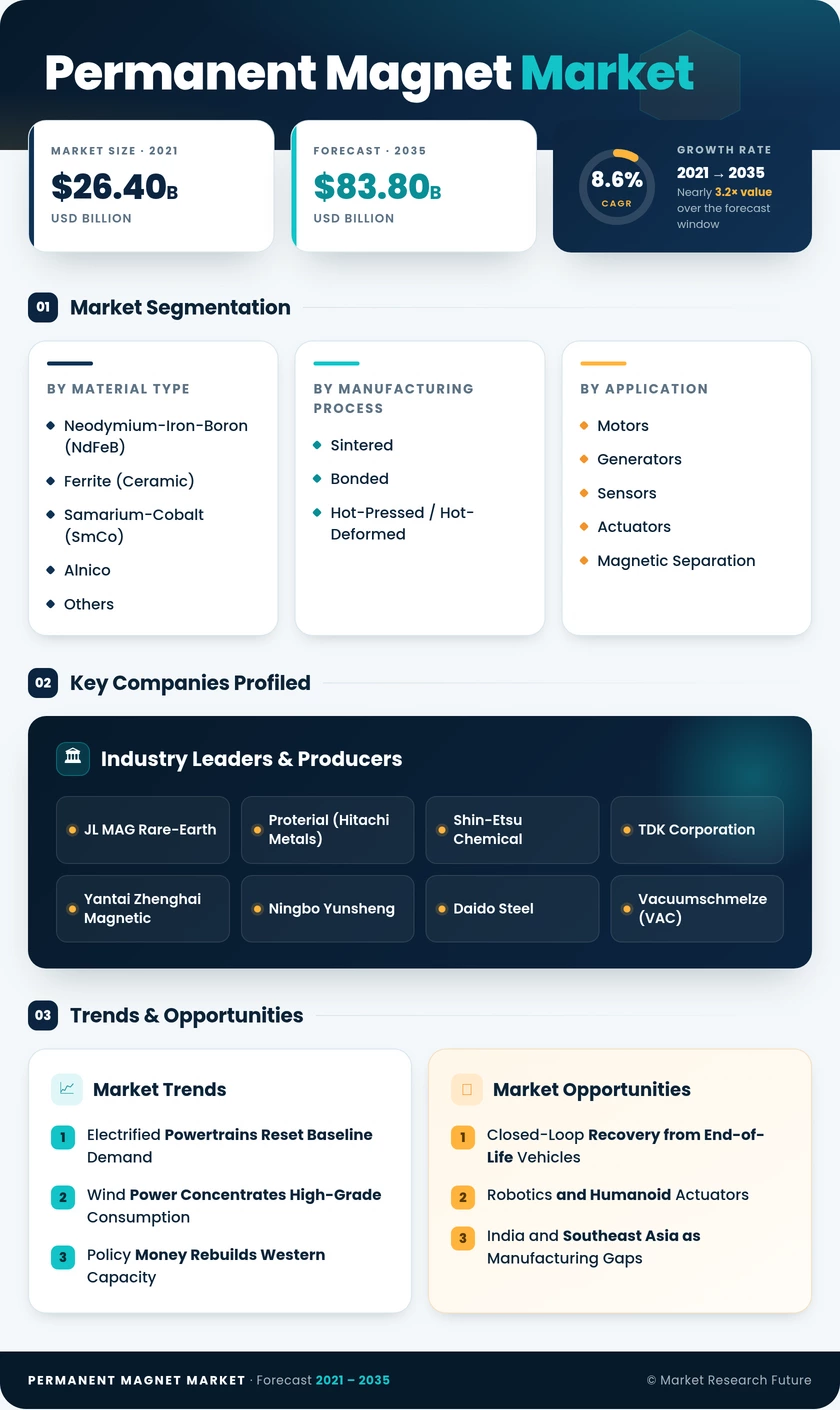
Permanent Magnet Market Research Report By Material Type (Neodymium-Iron-Boron (NdFeB), Ferrite (Ceramic), Samarium-Cobalt (SmCo), Alnico and Others), By Manufacturing Process (Sintered, Bonded, Hot-Pressed / Hot-Deformed), By Application (Motors and Generators, Sensors and Actuators, Magnetic Separation and Holding, Acoustics and Speakers, Medical Imaging and Instruments), By End-Use Industry (Automotive and E-Mobility, Consumer Electronics, Industrial Machinery and Robotics, Energy and Power Generation, Healthcare, Aerospace and Defence) - Forecast to 2035
Permanent Magnet Market
Market Size
Forecast Period2026-2035
CAGR (2026-2035)8.6%
2025 Market SizeUSD 36.8 Billion
2035 Market SizeUSD 83.8 Billion
Key Players
JL MAG Rare-Earth
Proterial
Shin-Etsu Chemical
TDK Corporation
Yantai Zhenghai Magnetic
Ningbo Yunsheng
Opportunities
  • Closed-Loop Recovery from End-of-Life Vehicles
  • Robotics and Humanoid Actuators
  • India and Southeast Asia as Manufacturing Gaps
  1. 1 Market Overview | |
    1. 1.1 Study Assumptions & Market Definition | |
    2. 1.2 Scope of the Study | |
    3. 1.3 Research Methodology | |
  2. 2 Market Summary & Key Report Takeaways | |
    1. 2.1 Key Takeaways by Technology | |
    2. 2.2 Key Takeaways by Sector | |
    3. 2.3 Key Takeaways by Geography | |
  3. 3 Global Market Size & Forecast (2021–2035) | |
    1. 3.1 Historical Market Size (2021–2025) | |
    2. 3.2 Current & Forecast Market Size (2026–2035) | |
    3. 3.3 Market Size by Revenue (USD Billion) | |
    4. 3.4 Year-over-Year Growth Analysis | |
  4. 4 Market Dynamics — Driver Impact Analysis | |
    1. 4.1 Electrified Powertrains Reset Baseline Demand | |
    2. 4.2 Wind Power Concentrates High-Grade Consumption | |
    3. 4.3 Policy Money Rebuilds Western Capacity | |
    4. 4.4 Efficiency Regulation Pulls Industrial Demand | |
  5. 5 Market Dynamics — Restraints Impact Analysis | |
    1. 5.1 Feedstock Volatility Undermines Contract Discipline | |
    2. 5.2 Heavy Rare Earths Remain the Real Bottleneck | |
    3. 5.3 Building Western Capacity Costs More Than Expected | |
  6. 6 Market Opportunity Analysis | |
    1. 6.1 Closed-Loop Recovery from End-of-Life Vehicles | |
    2. 6.2 Robotics and Humanoid Actuators | |
    3. 6.3 India and Southeast Asia as Manufacturing Gaps | |
    4. 6.4 Traceability Platforms and Materials Data Services | |
    5. 6.5 High-Temperature Niches Beyond Automotive | |
    6. 6.6 Industry Value Chain Analysis | |
    7. 6.7 Porter's Five Forces Analysis | |
  7. 7 Regional Market Share & Country-Level Analysis | |
    1. 7.1 North America | | |
      1. 7.1.1 United States | | |
      2. 7.1.2 Canada | | |
      3. 7.1.3 Mexico | |
    2. 7.2 Europe | | |
      1. 7.2.1 Germany | | |
      2. 7.2.2 France | | |
      3. 7.2.3 United Kingdom | | |
      4. 7.2.4 Italy | | |
      5. 7.2.5 Rest of Europe | |
    3. 7.3 Asia-Pacific | | |
      1. 7.3.1 China | | |
      2. 7.3.2 Japan | | |
      3. 7.3.3 India | | |
      4. 7.3.4 South Korea | | |
      5. 7.3.5 Rest of Asia-Pacific | |
    4. 7.4 South America | | |
      1. 7.4.1 Brazil | | |
      2. 7.4.2 Argentina | | |
      3. 7.4.3 Rest of South America | |
    5. 7.5 Middle East & Africa | | |
      1. 7.5.1 Saudi Arabia | | |
      2. 7.5.2 United Arab Emirates | | |
      3. 7.5.3 South Africa | | |
      4. 7.5.4 Rest of Middle East & Africa | |
  8. 8 Future Outlook (2026–2035) | |
    1. 8.1 The Electrification Supercycle Holds | |
    2. 8.2 Supply Chains Fragment Along Political Lines | |
    3. 8.3 Materials Science Reduces Heavy Rare Earth Dependence | |
    4. 8.4 Circularity Becomes a Procurement Requirement | |
  9. 9 Segmentation Analysis | |
    1. 9.1 By Material Type | | |
      1. 9.1.1 Neodymium-Iron-Boron (NdFeB) | | |
      2. 9.1.2 Ferrite (Ceramic) | | |
      3. 9.1.3 Samarium-Cobalt (SmCo) | | |
      4. 9.1.4 Alnico and Others | |
    2. 9.2 By Manufacturing Process | | |
      1. 9.2.1 Sintered | | |
      2. 9.2.2 Bonded | | |
      3. 9.2.3 Hot-Pressed / Hot-Deformed | |
    3. 9.3 By Application | | |
      1. 9.3.1 Motors and Generators | | |
      2. 9.3.2 Sensors and Actuators | | |
      3. 9.3.3 Magnetic Separation and Holding | | |
      4. 9.3.4 Acoustics and Speakers | | |
      5. 9.3.5 Medical Imaging and Instruments | |
    4. 9.4 By End-Use Industry | | |
      1. 9.4.1 Automotive and E-Mobility | | |
      2. 9.4.2 Consumer Electronics | | |
      3. 9.4.3 Industrial Machinery and Robotics | | |
      4. 9.4.4 Energy and Power Generation | | |
      5. 9.4.5 Healthcare | | |
      6. 9.4.6 Aerospace and Defence | |
  10. 10 Competitive Landscape | |
    1. 10.1 Market Concentration Analysis (2026) | |
    2. 10.2 Competitive Benchmarking Matrix | |
    3. 10.3 Company Profiles | | |
      1. 10.3.1 JL MAG Rare-Earth | | |
      2. 10.3.2 Proterial (Hitachi Metals) | | |
      3. 10.3.3 Shin-Etsu Chemical | | |
      4. 10.3.4 TDK Corporation | | |
      5. 10.3.5 Yantai Zhenghai Magnetic Material | | |
      6. 10.3.6 Ningbo Yunsheng | | |
      7. 10.3.7 Daido Steel | | |
      8. 10.3.8 Vacuumschmelze (VAC) | | |
      9. 10.3.9 Arnold Magnetic Technologies | | |
      10. 10.3.10 Neo Performance Materials | |
  11. 11 Recent Developments & News | |
  12. 12 Report Scope & Methodology | |
    1. 12.1 Study Period & Base Year | |
    2. 12.2 Data Sources & Citations | |
    3. 12.3 Abbreviations | |
  13. 13 Detailed Sources and Citations | |
  14. 14 Frequently Asked Questions (FAQs) | | LIST OF TABLES | | LIST OF FIGURES

Segmentation Quick Reference

DimensionSub-SegmentsDominant SegmentFastest Growing Segment
By Material TypeNeodymium-Iron-Boron (NdFeB); Ferrite (Ceramic); Samarium-Cobalt (SmCo); Alnico and OthersNeodymium-Iron-Boron (NdFeB)Samarium-Cobalt (SmCo)
By Manufacturing ProcessSintered; Bonded; Hot-Pressed / Hot-DeformedSinteredHot-Pressed / Hot-Deformed
By ApplicationMotors and Generators; Sensors and Actuators; Magnetic Separation and Holding; Acoustics and Speakers; Medical Imaging and InstrumentsMotors and GeneratorsSensors and Actuators
By End-Use IndustryAutomotive and E-Mobility; Consumer Electronics; Industrial Machinery and Robotics; Energy and Power Generation; Healthcare; Aerospace and DefenceAutomotive and E-MobilityIndustrial Machinery and Robotics
By RegionNorth America; Europe; Asia-Pacific; South America; Middle East & AfricaAsia-PacificNorth America


Market Segmentation Overview

By Material Type

Sub-SegmentKey Trend
Neodymium-Iron-Boron (NdFeB)Grain boundary diffusion cuts heavy rare earth loading 30–50% while holding thermal rating
Ferrite (Ceramic)Volume growth persists in appliances and audio as buyers hedge rare earth exposure
Samarium-Cobalt (SmCo)Aerospace, downhole and defence specification expands on 300°C-plus tolerance
Alnico and OthersSteady replacement demand in instrumentation, sensing and holding devices


Material selection increasingly reflects supply risk as much as physics. Buyers who once specified a single chemistry across a product family now maintain dual designs, allowing a shift toward ferrite in cost-sensitive lines if rare earth pricing spikes. That optionality carries engineering overhead but has become standard practice among tier-one appliance and pump manufacturers.

By Manufacturing Process

Sub-SegmentKey Trend
SinteredRemains the default for traction and generator duty; scrap recovery economics improving
BondedComplex geometries and thin-wall precision parts drive adoption in sensors and micromotors
Hot-Pressed / Hot-DeformedNear-net-shape anisotropic rings scale rapidly in small brushless motor applications


Process economics diverge sharply on yield. Sintering wastes a quarter or more of input alloy to machining, which matters enormously when feedstock prices move; bonded and hot-deformed routes lose far less material and are gaining share wherever their lower energy product is tolerable. Recovery of sintering swarf has become a genuine profit centre rather than a disposal cost.

By Application

Sub-SegmentKey Trend
Motors and GeneratorsElectrification across transport, industry and wind sustains majority consumption
Sensors and ActuatorsUnit counts multiply across ADAS, factory automation and appliance controls
Magnetic Separation and HoldingRecycling and materials handling investment lifts industrial demand
Acoustics and SpeakersAutomotive infotainment and premium audio sustain mature but stable volumes
Medical Imaging and InstrumentsOpen MRI architectures and surgical robotics expand specialty requirements


Application mix shapes grade requirements more than any other variable. Motor duty demands thermal stability and coating durability; sensor duty prioritises dimensional precision and field uniformity over raw energy product. Suppliers serving both must maintain separate qualification and metrology infrastructure, which partly explains why specialisation persists despite consolidation pressure.

By End-Use Industry

Sub-SegmentKey Trend
Automotive and E-MobilityLong-dated offtake agreements replace spot purchasing as supply security dominates
Consumer ElectronicsHaptics, camera actuation and audio sustain high unit volumes at low mass per device
Industrial Machinery and RoboticsServo drive replacement and humanoid actuator programmes drive fastest growth
Energy and Power GenerationDirect-drive offshore wind concentrates high-coercivity consumption
HealthcareImaging, infusion pumps and prosthetic actuation expand steadily with device penetration
Aerospace and DefenceOrigin restrictions reshape qualification pipelines well beyond military volumes


End-use concentration in automotive creates correlated risk that few buyers have properly modelled. A meaningful slowdown in electric vehicle adoption would free capacity and soften pricing across every other segment simultaneously — a scenario worth stress-testing in any capital allocation decision touching this supply chain.




Download PDF ×

We do not share your information with anyone. However, we may send you emails based on your report interest from time to time. You may contact us at any time to opt-out.