Request Free Sample ×

Kindly complete the form below to receive a free sample of this Report

* Please use a valid business email

Leading companies partner with us for data-driven Insights

clients tt-cursor
Hero Background
English
Chinese
French
Japanese
Korean
German
Spanish

Pasta Sauces Market Analysis

ID: MRFR/FnB/5944-HCR
90 Pages
Snehal Singh
March 2026

Pasta Sauces Market Size, Share, Industry Trend & Analysis Research Report Information By Product Type (Tomato-Based Sauces, Pesto-Based Sauces), Category (Conventional, Organic), Packaging Type, Distribution Channel (Store-based, Non-store based), And By Region (North America, Europe, Asia-Pacific, And Rest Of The World) – Forecast Till 2035

Share:
Download PDF ×

We do not share your information with anyone. However, we may send you emails based on your report interest from time to time. You may contact us at any time to opt-out.

Pasta Sauces Market Infographic
Purchase Options

Market Analysis

In-depth Analysis of Pasta Sauces Market Industry Landscape

The pasta sauce market is dynamic and ever-changing. Many variables affect this market, and they all work together to shape its growth. Pasta sauce sales are driven by the growing desire for fast, cheap meals. People are busy nowadays, therefore they want quick and easy cooking techniques. This group loves pasta sauces.

Another factor affecting the market is how people buy and what they do. More people worldwide are liking pasta recipes that taste like different things. Due to demand, producers have created several different tastes. Pesto, arrabbiata, and roasted garlic are unusual sauces, yet marinara and Alfredo are staples.

Another important aspect in pasta sauce sales is the economy. The amount of money individuals spend on expensive and unique pasta sauces depends on their income, price inflation, and the economy. People choose simpler, cheaper recipes during economic downturns. When things are well, people may desire to eat more expensive and complex dishes. Because they cost more.

Healthy living is another major aspect affecting pasta dish sales. People are more concerned about their health and want pasta sauces made with natural and organic components. Companies are making healthier goods to satisfy health-conscious customers. These sauces include reduced salt, no sugar, and organic ingredients.

The pasta sauce market is productive because of marketing. More pasta sauce variations are accessible due to internet buying. They may now try several brands and tastes at home. Due to increased competition, manufacturers have improved their websites and marketing strategies.

This is because the top pasta sauce players set the market's competitive standard. In order to stay ahead of the competition, makers create new items, run marketing campaigns, and cooperate on massive projects. Mergers and acquisitions let bigger companies sell more items. This reduces the market.

New food safety and labeling laws may also affect the pasta sauce sector. They must follow strict quality and safety standards. Follow these tips to acquire and keep customer trust.

Author
Author Profile
Snehal Singh
Manager - Research

High acumen in analyzing complex macro & micro markets with more than 6 years of work experience in the field of market research. By implementing her analytical skills in forecasting and estimation into market research reports, she has expertise in Packaging, Construction, and Equipment domains. She handles a team size of 20-25 resources and ensures smooth running of the projects, associated marketing activities, and client servicing.

Leave a Comment

FAQs

What is the current valuation of the Pasta Sauces Market as of 2024?

<p>The Pasta Sauces Market was valued at 3.55 USD Billion in 2024.</p>

What is the projected market valuation for the Pasta Sauces Market in 2035?

<p>The market is projected to reach 6.811 USD Billion by 2035.</p>

What is the expected CAGR for the Pasta Sauces Market during the forecast period 2025 - 2035?

<p>The expected CAGR for the Pasta Sauces Market during 2025 - 2035 is 6.1%.</p>

Which types of pasta sauces are leading in market valuation?

<p>Tomato-based sauces and pesto-based sauces are key segments, with valuations of 4.5 USD Billion and 2.31 USD Billion respectively by 2035.</p>

How do organic pasta sauces compare to conventional ones in terms of market size?

<p>By 2035, organic pasta sauces are projected to reach 2.31 USD Billion, while conventional sauces are expected to reach 4.5 USD Billion.</p>

What distribution channels are most effective for pasta sauces?

<p>Store-based distribution channels are projected to grow to 4.12 USD Billion, compared to 2.69 USD Billion for non-store based channels by 2035.</p>

Who are the key players in the Pasta Sauces Market?

Key players include Barilla, Campbell Soup Company, Unilever, Kraft Heinz Company, Pasta Lensi, Bertolli, Ragú, Prego, and Hunt's.

What growth trends are observed in the Pasta Sauces Market?

The market shows a robust growth trend, with a projected increase from 3.55 USD Billion in 2024 to 6.811 USD Billion by 2035.

What factors are driving the growth of the Pasta Sauces Market?

The growth appears driven by increasing consumer demand for both conventional and organic pasta sauces.

How does the market for pesto-based sauces compare to tomato-based sauces?

Pesto-based sauces are expected to grow to 2.31 USD Billion by 2035, while tomato-based sauces are projected to reach 4.5 USD Billion.

Market Summary

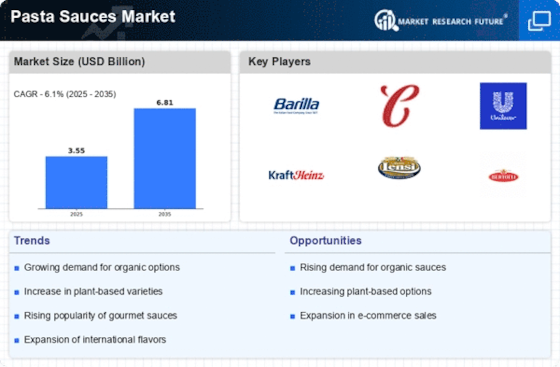
As per Market Research Future analysis, the Pasta Sauces Market Size was estimated at 3.55 USD Billion in 2024. The Pasta Sauces industry is projected to grow from 3.767 USD Billion in 2025 to 6.811 USD Billion by 2035, exhibiting a compound annual growth rate (CAGR) of 6.1% during the forecast period 2025 - 2035

Key Market Trends & Highlights

The Pasta Sauces Market is experiencing a dynamic shift towards health-conscious and convenient options.

  • Health-conscious choices are increasingly influencing consumer preferences in the Pasta Sauces Market.
  • North America remains the largest market, while the Asia-Pacific region is recognized as the fastest-growing area for pasta sauces.
  • Tomato-based sauces dominate the market, yet pesto-based sauces are emerging as the fastest-growing segment.
  • Key market drivers include the rising popularity of plant-based diets and the demand for convenient, ready-to-use options.

Market Size & Forecast

2024 Market Size 3.55 (USD Billion)
2035 Market Size 6.811 (USD Billion)
CAGR (2025 - 2035) 6.1%
Largest Regional Market Share in 2024 Europe

Major Players

Barilla (IT), Campbell Soup Company (US), Unilever (GB), Kraft Heinz Company (US), Pasta Lensi (IT), Bertolli (IT), Ragú (US), Prego (US), Hunt's (US)

Market Trends

The Pasta Sauces Market is currently experiencing a dynamic evolution, driven by shifting consumer preferences and an increasing inclination towards convenience foods. As lifestyles become busier, individuals are seeking quick meal solutions that do not compromise on flavor or quality. This trend is reflected in the rising popularity of ready-to-use sauces, which offer a blend of traditional recipes and modern convenience. Additionally, the growing awareness of health and wellness is influencing purchasing decisions, with consumers gravitating towards sauces that incorporate organic ingredients and lower sodium content. This shift suggests a potential transformation in product formulations, as manufacturers adapt to meet the demands of health-conscious buyers. Moreover, the Pasta Sauces Market is witnessing a surge in innovative flavors and ethnic varieties, appealing to adventurous palates. The introduction of unique ingredients and bold flavor profiles indicates a desire for culinary exploration among consumers. This trend may lead to an expansion of product lines, as brands strive to differentiate themselves in a competitive landscape. Furthermore, sustainability is becoming a focal point, with an increasing number of consumers favoring brands that prioritize eco-friendly packaging and sourcing practices. Overall, the Pasta Sauces Market appears poised for continued growth, driven by evolving consumer expectations and a commitment to quality and sustainability.

Health-Conscious Choices

Consumers are increasingly prioritizing health and wellness, leading to a demand for pasta sauces that feature organic ingredients and reduced sodium levels. This trend reflects a broader shift towards healthier eating habits.

Convenience and Ready-to-Use Options

The fast-paced lifestyle of modern consumers drives the popularity of ready-to-use pasta sauces. These products offer quick meal solutions without sacrificing taste, appealing to those seeking convenience.

Flavor Innovation and Ethnic Varieties

There is a noticeable trend towards unique flavors and ethnic-inspired sauces. This reflects consumers' desire for culinary exploration and the willingness to try new taste experiences.

Pasta Sauces Market Market Drivers

Health-Conscious Choices

The Pasta Sauces Market is witnessing a notable shift towards health-conscious choices among consumers. As individuals increasingly prioritize nutrition, there is a growing demand for sauces that are organic, low in sugar, and free from artificial additives. This trend is reflected in the rising sales of products labeled as 'natural' or 'clean label.' According to recent data, the market for organic pasta sauces has expanded significantly, with a projected growth rate of approximately 8% annually. This indicates that consumers are willing to pay a premium for healthier options, thereby influencing manufacturers to innovate and reformulate their products. The emphasis on health not only caters to dietary preferences but also aligns with broader lifestyle changes, making it a pivotal driver in the Pasta Sauces Market.

Convenience and Ready-to-Use Options

In the Pasta Sauces Market, the demand for convenience and ready-to-use options is surging. Busy lifestyles and the increasing number of dual-income households have led consumers to seek quick meal solutions. Ready-to-use pasta sauces, which require minimal preparation, are becoming increasingly popular. Market data suggests that sales of jarred and canned sauces have seen a significant uptick, with a growth rate of around 6% over the past year. This trend is further fueled by the rise of e-commerce platforms, which provide easy access to a variety of pasta sauces. As consumers continue to prioritize convenience, manufacturers are likely to expand their offerings, introducing new flavors and packaging formats that cater to this need, thereby shaping the future of the Pasta Sauces Market.

Flavor Innovation and Ethnic Varieties

Flavor innovation and the introduction of ethnic varieties are emerging as key drivers in the Pasta Sauces Market. As consumers become more adventurous in their culinary choices, there is a growing appetite for diverse flavors that reflect global cuisines. This trend is evidenced by the increasing popularity of sauces inspired by Mediterranean, Asian, and Latin American flavors. Market analysis indicates that products featuring unique ingredients and bold flavors are gaining traction, with a notable increase in sales of specialty sauces. This diversification not only enhances consumer experience but also encourages brand loyalty, as customers seek to explore new taste profiles. Consequently, manufacturers are investing in research and development to create innovative products that resonate with evolving consumer preferences, thereby influencing the trajectory of the Pasta Sauces Market.

Rising Popularity of Plant-Based Diets

The rising popularity of plant-based diets is significantly influencing the Pasta Sauces Market. As more consumers adopt vegetarian and vegan lifestyles, there is an increasing demand for pasta sauces that cater to these dietary preferences. This shift is reflected in the growing availability of plant-based sauces, which often feature ingredients such as vegetables, legumes, and nuts. Market data suggests that the plant-based segment is experiencing rapid growth, with sales projected to increase by approximately 10% annually. This trend not only reflects changing consumer attitudes towards health and sustainability but also encourages manufacturers to innovate and expand their product lines. As the demand for plant-based options continues to rise, it is likely to reshape the offerings within the Pasta Sauces Market.

Sustainability and Eco-Friendly Packaging

Sustainability is becoming a crucial consideration in the Pasta Sauces Market, as consumers increasingly demand eco-friendly products. The push for sustainable practices is prompting manufacturers to adopt environmentally friendly packaging solutions, such as recyclable materials and reduced plastic usage. Recent surveys indicate that a significant portion of consumers is willing to pay more for products that are packaged sustainably. This trend is not only beneficial for the environment but also enhances brand image and consumer trust. As awareness of environmental issues continues to grow, companies that prioritize sustainability are likely to gain a competitive edge in the Pasta Sauces Market. This shift towards eco-consciousness may also drive innovation in product formulation, as brands seek to align their offerings with consumer values.

Market Segment Insights

By Type: Tomato-Based Sauces (Largest) vs. Pesto-Based Sauces (Fastest-Growing)

<p>The Pasta Sauces Market is primarily dominated by tomato-based sauces, which hold the largest share of the market. These sauces have established themselves as a staple in households and restaurants alike, driving consistent demand. Tomato-based sauces are well-regarded for their versatility, making them a go-to choice for various pasta dishes, pizza, and more. In contrast, pesto-based sauces are gaining traction, appealing to health-conscious consumers and those seeking gourmet flavors. This growth illustrates a notable shift in consumer preferences towards unique and fresh ingredients in cooking.</p>

<p>Tomato-Based Sauces: Dominant vs. Pesto-Based Sauces: Emerging</p>

<p>Tomato-based sauces are characterized by their rich flavor profiles and versatility, making them a dominant force in the Pasta Sauces Market. They cater to a wide array of culinary needs, from simple weeknight dinners to elaborate meals. Their established popularity and cultural associations contribute to their strong market position. On the other hand, pesto-based sauces signify an emerging trend, characterized by their use of fresh herbs, cheese, and nuts, appealing to gourmet enthusiasts and health-focused consumers. As the demand for natural and organic products rises, these sauces are positioned for growth, attracting a new demographic looking for distinctive taste experiences.</p>

By Category: Conventional (Largest) vs. Organic (Fastest-Growing)

<p>In the Pasta Sauces Market, the Conventional category holds a dominant market share, appealing to traditional consumer preferences with its wide variety of options and established brands. Conventional pasta sauces are favored for their taste profile and pricing, making them a staple in many households. In contrast, the Organic category, while smaller in market share, is rapidly gaining traction among health-conscious consumers who seek natural ingredients and environmentally friendly products. This shift reflects a growing trend towards sustainable living and awareness of food sourcing.</p>

<p>Pasta Sauces: Conventional (Dominant) vs. Organic (Emerging)</p>

<p>The Conventional pasta sauces segment is characterized by its extensive range of products, catering to diverse tastes and cooking styles. With established brands leading the market, this segment benefits from strong distribution networks and consumer loyalty. On the other hand, the Organic category represents a crucial emerging segment, driven by increasing consumer demand for health-oriented and sustainably sourced products. Organic pasta sauces typically feature natural ingredients devoid of artificial additives, appealing to a demographic that prioritizes wellness and ethical consumption. Both segments are likely to coexist, with Conventional maintaining dominance while Organic experiences accelerated growth.</p>

By Distribution Channel: Store-based (Largest) vs. Non-store based (Fastest-Growing)

<p>In the Pasta Sauces Market, store-based distribution channels hold a significant market share, dominating the landscape due to their widespread accessibility and established consumer trust. Supermarkets, hypermarkets, and convenience stores facilitate a consistent purchasing experience, hence positioning store-based channels as a primary choice for consumers. Non-store based channels are witnessing an upward trend, catering to a growing demographic of online shoppers seeking convenience and variety. This shift in consumer behavior indicates an evolving market where traditional retail methods are supplemented by innovative online solutions. The growth trends within these segments indicate that the store-based channel, while dominant, is facing increasing competition from the non-store based segment. Factors driving this growth include the proliferation of e-commerce platforms and a shift in purchasing preferences towards online shopping. Non-store based channels are particularly appealing to younger audiences who value the convenience of ordering from home and the diverse options offered through digital platforms. As online shopping continues to grow, suppliers will need to adopt agile strategies to effectively cater to both distribution channels.</p>

<p>Pasta Sauces: Store-based (Dominant) vs. Non-store based (Emerging)</p>

<p>Store-based distribution of pasta sauces remains dominant, relying on traditional retail setups to reach a broad customer base. Supermarkets and grocery stores serve as primary locations, providing consumers with immediate access and the ability to evaluate products firsthand. These stores benefit from established relationships with consumers, creating brand loyalty and encouraging repeat purchases. On the other hand, non-store based distribution is emerging rapidly, driven by the increasing demand for convenience and online shopping capabilities. E-commerce websites, subscription services, and delivery apps are gaining traction, appealing particularly to tech-savvy consumers seeking a hassle-free shopping experience. This segment’s emergence is characterized by innovations in packaging and enhanced product visibility, tailored to attract a new generation of pasta sauce consumers.</p>

Get more detailed insights about Pasta Sauces Market Research Report -Global Forecast till 2035

Regional Insights

North America : Market Leader in Consumption

North America is the largest market for pasta sauces, holding approximately 40% of the global share. The region's growth is driven by increasing consumer demand for convenience foods, coupled with a rising trend towards healthier eating. Regulatory support for food safety and quality standards further catalyzes market expansion. The U.S. is the primary contributor, followed by Canada, which is experiencing a growing interest in diverse pasta sauce options. The competitive landscape in North America is robust, featuring key players such as Campbell Soup Company, Kraft Heinz Company, and Unilever. These companies are focusing on product innovation and marketing strategies to capture consumer interest. The presence of established brands and a well-developed distribution network enhances market accessibility, making it easier for consumers to find a variety of pasta sauces in retail outlets.

Europe : Culinary Innovation Hub

Europe is the second-largest market for pasta sauces, accounting for approximately 30% of the global market share. The region's growth is fueled by a strong culinary tradition and increasing consumer interest in gourmet and organic products. Regulatory frameworks promoting food quality and sustainability are also significant drivers. Italy and Germany are the leading markets, with Italy being particularly influential due to its rich culinary heritage and diverse sauce offerings. The competitive landscape in Europe is characterized by a mix of local and international brands, including Barilla and Bertolli. The presence of these key players fosters innovation in flavors and packaging, catering to evolving consumer preferences. Additionally, the rise of e-commerce platforms is enhancing market reach, allowing consumers to access a wider variety of pasta sauces conveniently.

Asia-Pacific : Emerging Market Potential

Asia-Pacific is witnessing rapid growth in the pasta sauces market, holding about 20% of the global share. The increasing urbanization and changing lifestyles are driving demand for convenient meal solutions. Countries like China and Japan are leading this growth, with a rising interest in Western cuisine and pasta dishes. Regulatory initiatives aimed at improving food safety standards are also contributing to market expansion in the region. The competitive landscape in Asia-Pacific is evolving, with both local and international brands vying for market share. Key players such as Unilever and Kraft Heinz are expanding their product lines to cater to local tastes. The growing influence of social media and food trends is further shaping consumer preferences, leading to an increase in the availability of diverse pasta sauces across retail channels.

Middle East and Africa : Untapped Market Opportunities

The Middle East and Africa region is emerging as a potential market for pasta sauces, currently holding about 10% of the global share. Urbanization and a growing middle class are driving demand for convenient food options. Countries like South Africa and the UAE are at the forefront of this growth, with increasing exposure to international cuisines. Regulatory efforts to enhance food safety and quality are also paving the way for market development. The competitive landscape in this region is still developing, with a mix of local and international brands. Key players are beginning to establish a presence, focusing on adapting products to local tastes and preferences. The rise of modern retail formats and e-commerce is facilitating greater access to pasta sauces, making it easier for consumers to explore new flavors and options.

Key Players and Competitive Insights

Major market players are investing a lot of money in R&D to expand their product portfolios, which will spur further market growth for the Pasta Sauces Market. With significant industry changes including new product releases, contractual agreements, mergers and acquisitions, increased investments, and collaboration with other organizations, market participants are also undertaking a variety of strategic activities to expand their presence. To grow and remain in a market that is becoming more and more competitive, Pasta Sauces industry competitors must provide affordable products.Manufacturing locally to cut operational costs is one of the main business tactics the Pasta Sauces industry uses to serve customers and increase the market sector. The Pasta Sauces industry has recently given medicine some of the most important advantages. The Pasta Sauces Market major player such as Mizkan Co.(Japan),  Barilla S.p.A.(Italy), Mars Incorporated (US), ConAgra Foods Inc.(US), The Kraft Heinz Company (US), Amy's Kitchen (US), Newman Own Co.(US),  B&G Foods Holdings Corp.(US), Premier Foods PLC (UK), Campbell Soup Company (US) and others are working on expanding the market demand by investing in research and development activities.Birch Benders, a food and beverage company, sells pancake and waffle mixes that are natural and organic and require adding water. Just-add-water pancake and waffle mixes, frozen toaster waffles, and microwaveable cups are among the brand's tasty, healthier items. Birch Benders, the nation's top-selling pancake and waffle mix on the natural channel, has announced the addition of a new line of no-sugar-added, ready-to-eat, keto-friendly Cookies to its portfolio of well-liked, better-for-you goods.Birch Benders, well-known for its premium organic, paleo baking, keto, and breakfast mix products, created this new cookie line with the same focus on rethinking the foods people enjoy in a way they can feel good about.One PPG Place in Pittsburgh, Pennsylvania serves as the corporate headquarters for the American food processing firm The H. J. Heinz Company. Henry J. Heinz established the business in 1869. Heinz produces hundreds of food items in factories across six continents and sells them in more than 200 nations and territories. According to Heinz, various ready-to-use pasta sauces in seven different flavors have been released. A digital campaign with the slogan "Ridiculously Late, Ridiculously Good" supports the newest items.Tomato, Mascarpone & Grana Padano cheese, Tomato & Chilli, Sundried Cherry Tomato & Basil, and Tomato Sauce for Bolognese are just a few tomato-based tastes available. The first of their kind from Heinz, the sauces are made in Italy without added sugar. Georgiana de Noronha, president of Kraft Heinz for northern Europe, claimed that although the firm is well-known for its tomato ketchup, some people know it also manufactures tomato seeds.

Key Companies in the Pasta Sauces Market include

Industry Developments

Two new pasta sauces have been introduced by Casa Visco, a family-run producer of pizza and pasta sauces in Schenectady, with proceeds going to Planned Parenthood. Both My Body, My Choice Homestyle Pasta Sauce and Feminist Fra Diavolo are available for purchase at the Niskayuna Co-Op and online at Casa Visco.

Heinz's strategy, which includes apologising for being "ridiculously late" with the debut of their pasta sauce line, is based on the idea that promoting innovation is the key to growth. Two kitchen essentials that are synonymous with Heinz are beans and ketchup. The 150-year-old company, although having the largest share in these two categories, is unwilling to rest on its laurels and regards innovation as a crucial component of its operations. One of the most important elements of the plan is the release of new items to satisfy consumer demand.

A limited-edition tomato vodka pasta sauce has been introduced by Heinz in collaboration with Absolut. Starting in mid-April, Waitrose will carry the "rich and creamy" vodka-infused tomato, basil, and cheese sauce. Additionally, a constrained quantity of jars can be ordered on Heinz's DTC website.

According to research, fresh pasta can have its shelf life increased by 30 days by changing the packaging, adding bioprotective, and utilising probiotics, an antibacterial bacteria. Although it is an essential component of Italian cuisine, pasta is loved worldwide. In 2022, sales of pasta in Europe brought in $19.14 billion, but it is anticipated that demand will increase by 9.28 percent yearly.

Pasta Sauces Market Key Market Players & Competitive Insights

Major market players are investing a lot of money in R&D to expand their product portfolios, which will spur further market growth for the Pasta Sauces Market. With significant industry changes including new product releases, contractual agreements, mergers and acquisitions, increased investments, and collaboration with other organizations, market participants are also undertaking a variety of strategic activities to expand their presence. To grow and remain in a market that is becoming more and more competitive, Pasta Sauces industry competitors must provide affordable products.

Manufacturing locally to cut operational costs is one of the main business tactics the Pasta Sauces industry uses to serve customers and increase the market sector. The Pasta Sauces industry has recently given medicine some of the most important advantages. The Pasta Sauces Market major player such as Mizkan Co.(Japan),  Barilla S.p.A.(Italy), Mars Incorporated (US), ConAgra Foods Inc.(US), The Kraft Heinz Company (US), Amy's Kitchen (US), Newman Own Co.(US),  B&G Foods Holdings Corp.(US), Premier Foods PLC (UK), Campbell Soup Company (US) and others are working on expanding the market demand by investing in research and development activities.

Birch Benders, a food and beverage company, sells pancake and waffle mixes that are natural and organic and require adding water. Just-add-water pancake and waffle mixes, frozen toaster waffles, and microwaveable cups are among the brand's tasty, healthier items. Birch Benders, the nation's top-selling pancake and waffle mix on the natural channel, has announced the addition of a new line of no-sugar-added, ready-to-eat, keto-friendly Cookies to its portfolio of well-liked, better-for-you goods.

Birch Benders, well-known for its premium organic, paleo baking, keto, and breakfast mix products, created this new cookie line with the same focus on rethinking the foods people enjoy in a way they can feel good about.

One PPG Place in Pittsburgh, Pennsylvania serves as the corporate headquarters for the American food processing firm The H. J. Heinz Company. Henry J. Heinz established the business in 1869. Heinz produces hundreds of food items in factories across six continents and sells them in more than 200 nations and territories. According to Heinz, various ready-to-use pasta sauces in seven different flavors have been released. A digital campaign with the slogan "Ridiculously Late, Ridiculously Good" supports the newest items.

Tomato, Mascarpone & Grana Padano cheese, Tomato & Chilli, Sundried Cherry Tomato & Basil, and Tomato Sauce for Bolognese are just a few tomato-based tastes available. The first of their kind from Heinz, the sauces are made in Italy without added sugar. Georgiana de Noronha, president of Kraft Heinz for northern Europe, claimed that although the firm is well-known for its tomato ketchup, some people know it also manufactures tomato seeds.

Key Companies in the Pasta Sauces Market include

  • Mizkan Co. (Japan)
  • Barilla S.p.A. (Italy)
  • Mars Incorporated (US)
  • ConAgra Foods Inc. (US)
  • The Kraft Heinz Company (US)
  • Amy's Kitchen (US)
  • Newman Own Co. (US)
  • B&G Foods Holdings Corp. (US)
  • Premier Foods PLC (UK)
  • Campbell Soup Company (US)

Pasta Sauces Industry Developments

  • November 2021: A new set of science-based goals (SBT) for decreasing greenhouse gas emissions was unveiled by Campbells. Targets have been adopted by the Science Based Targets project (SBTi), which identifies and promotes best practices in carbon reduction.
  • November 2021: To explain the principles that underlie the goods produced by the Parma-based firm, where sustainable agriculture coexists with nature, Barilla created the Barilla agriBosco. It is a celebration of Barilla’s position with an emphasis on premium, eco-friendly goods and raw materials.
  • April 2022: A contract between Kraft Heinz and the Brazilian food business Hemmer was inked. The acquisition expedites Kraft Heinz's Taste Elevation plan in a crucial development sector, and CADE, Brazil's antitrust watchdog, approved the deal without caveats.
  • February 2020: A 40% easier-to-open spaghetti sauce jar lid has been introduced by the US grocery chain Boyer's Food Markets. Customers may easily open the glass jar of pasta sauce from Darci by pushing a button on the Easy Lid. These packaging advancements will probably impact market expansion in the upcoming years.


Future Outlook

Pasta Sauces Market Future Outlook

The Pasta Sauces Market is projected to grow at a 6.1% CAGR from 2025 to 2035, driven by increasing consumer demand for convenience, health-conscious options, and innovative flavors.

New opportunities lie in:

  • Expansion into plant-based sauce alternatives
  • Development of premium, artisanal pasta sauces
  • Implementation of subscription-based delivery services for sauces

By 2035, the market is expected to achieve robust growth, reflecting evolving consumer preferences and innovative product offerings.

Market Segmentation

Pasta Sauces Market Type Outlook

  • Tomato-Based Sauces
  • Pesto-Based Sauces

Pasta Sauces Market Category Outlook

  • Conventional
  • Organic

Pasta Sauces Market Distribution Channel Outlook

  • Store-based
  • Non-store based

Report Scope

MARKET SIZE 2024 3.55(USD Billion)
MARKET SIZE 2025 3.767(USD Billion)
MARKET SIZE 2035 6.811(USD Billion)
COMPOUND ANNUAL GROWTH RATE (CAGR) 6.1% (2025 - 2035)
REPORT COVERAGE Revenue Forecast, Competitive Landscape, Growth Factors, and Trends
BASE YEAR 2024
Market Forecast Period 2025 - 2035
Historical Data 2019 - 2024
Market Forecast Units USD Billion
Key Companies Profiled Barilla (IT), Campbell Soup Company (US), Unilever (GB), Kraft Heinz Company (US), Pasta Lensi (IT), Bertolli (IT), Ragú (US), Prego (US), Hunt's (US)
Segments Covered Product Type, Region
Key Market Opportunities Growing demand for organic and plant-based options in the Pasta Sauces Market presents significant growth opportunities.
Key Market Dynamics Rising consumer preference for organic and clean-label pasta sauces drives innovation and competition among manufacturers.
Countries Covered North America, Europe, APAC, South America, MEA

FAQs

What is the current valuation of the Pasta Sauces Market as of 2024?

<p>The Pasta Sauces Market was valued at 3.55 USD Billion in 2024.</p>

What is the projected market valuation for the Pasta Sauces Market in 2035?

<p>The market is projected to reach 6.811 USD Billion by 2035.</p>

What is the expected CAGR for the Pasta Sauces Market during the forecast period 2025 - 2035?

<p>The expected CAGR for the Pasta Sauces Market during 2025 - 2035 is 6.1%.</p>

Which types of pasta sauces are leading in market valuation?

<p>Tomato-based sauces and pesto-based sauces are key segments, with valuations of 4.5 USD Billion and 2.31 USD Billion respectively by 2035.</p>

How do organic pasta sauces compare to conventional ones in terms of market size?

<p>By 2035, organic pasta sauces are projected to reach 2.31 USD Billion, while conventional sauces are expected to reach 4.5 USD Billion.</p>

What distribution channels are most effective for pasta sauces?

<p>Store-based distribution channels are projected to grow to 4.12 USD Billion, compared to 2.69 USD Billion for non-store based channels by 2035.</p>

Who are the key players in the Pasta Sauces Market?

Key players include Barilla, Campbell Soup Company, Unilever, Kraft Heinz Company, Pasta Lensi, Bertolli, Ragú, Prego, and Hunt's.

What growth trends are observed in the Pasta Sauces Market?

The market shows a robust growth trend, with a projected increase from 3.55 USD Billion in 2024 to 6.811 USD Billion by 2035.

What factors are driving the growth of the Pasta Sauces Market?

The growth appears driven by increasing consumer demand for both conventional and organic pasta sauces.

How does the market for pesto-based sauces compare to tomato-based sauces?

Pesto-based sauces are expected to grow to 2.31 USD Billion by 2035, while tomato-based sauces are projected to reach 4.5 USD Billion.

  1. SECTION I: EXECUTIVE SUMMARY AND KEY HIGHLIGHTS
    1. | 1.1 EXECUTIVE SUMMARY
    2. | | 1.1.1 Market Overview
    3. | | 1.1.2 Key Findings
    4. | | 1.1.3 Market Segmentation
    5. | | 1.1.4 Competitive Landscape
    6. | | 1.1.5 Challenges and Opportunities
    7. | | 1.1.6 Future Outlook
  2. SECTION II: SCOPING, METHODOLOGY AND MARKET STRUCTURE
    1. | 2.1 MARKET INTRODUCTION
    2. | | 2.1.1 Definition
    3. | | 2.1.2 Scope of the study
    4. | | | 2.1.2.1 Research Objective
    5. | | | 2.1.2.2 Assumption
    6. | | | 2.1.2.3 Limitations
    7. | 2.2 RESEARCH METHODOLOGY
    8. | | 2.2.1 Overview
    9. | | 2.2.2 Data Mining
    10. | | 2.2.3 Secondary Research
    11. | | 2.2.4 Primary Research
    12. | | | 2.2.4.1 Primary Interviews and Information Gathering Process
    13. | | | 2.2.4.2 Breakdown of Primary Respondents
    14. | | 2.2.5 Forecasting Model
    15. | | 2.2.6 Market Size Estimation
    16. | | | 2.2.6.1 Bottom-Up Approach
    17. | | | 2.2.6.2 Top-Down Approach
    18. | | 2.2.7 Data Triangulation
    19. | | 2.2.8 Validation
  3. SECTION III: QUALITATIVE ANALYSIS
    1. | 3.1 MARKET DYNAMICS
    2. | | 3.1.1 Overview
    3. | | 3.1.2 Drivers
    4. | | 3.1.3 Restraints
    5. | | 3.1.4 Opportunities
    6. | 3.2 MARKET FACTOR ANALYSIS
    7. | | 3.2.1 Value chain Analysis
    8. | | 3.2.2 Porter's Five Forces Analysis
    9. | | | 3.2.2.1 Bargaining Power of Suppliers
    10. | | | 3.2.2.2 Bargaining Power of Buyers
    11. | | | 3.2.2.3 Threat of New Entrants
    12. | | | 3.2.2.4 Threat of Substitutes
    13. | | | 3.2.2.5 Intensity of Rivalry
    14. | | 3.2.3 COVID-19 Impact Analysis
    15. | | | 3.2.3.1 Market Impact Analysis
    16. | | | 3.2.3.2 Regional Impact
    17. | | | 3.2.3.3 Opportunity and Threat Analysis
  4. SECTION IV: QUANTITATIVE ANALYSIS
    1. | 4.1 Food, Beverages & Nutrition, BY Type (USD Billion)
    2. | | 4.1.1 Tomato-Based Sauces
    3. | | 4.1.2 Pesto-Based Sauces
    4. | 4.2 Food, Beverages & Nutrition, BY Category (USD Billion)
    5. | | 4.2.1 Conventional
    6. | | 4.2.2 Organic
    7. | 4.3 Food, Beverages & Nutrition, BY Distribution Channel (USD Billion)
    8. | | 4.3.1 Store-based
    9. | | 4.3.2 Non-store based
    10. | 4.4 Food, Beverages & Nutrition, BY Region (USD Billion)
    11. | | 4.4.1 North America
    12. | | | 4.4.1.1 US
    13. | | | 4.4.1.2 Canada
    14. | | 4.4.2 Europe
    15. | | | 4.4.2.1 Germany
    16. | | | 4.4.2.2 UK
    17. | | | 4.4.2.3 France
    18. | | | 4.4.2.4 Russia
    19. | | | 4.4.2.5 Italy
    20. | | | 4.4.2.6 Spain
    21. | | | 4.4.2.7 Rest of Europe
    22. | | 4.4.3 APAC
    23. | | | 4.4.3.1 China
    24. | | | 4.4.3.2 India
    25. | | | 4.4.3.3 Japan
    26. | | | 4.4.3.4 South Korea
    27. | | | 4.4.3.5 Malaysia
    28. | | | 4.4.3.6 Thailand
    29. | | | 4.4.3.7 Indonesia
    30. | | | 4.4.3.8 Rest of APAC
    31. | | 4.4.4 South America
    32. | | | 4.4.4.1 Brazil
    33. | | | 4.4.4.2 Mexico
    34. | | | 4.4.4.3 Argentina
    35. | | | 4.4.4.4 Rest of South America
    36. | | 4.4.5 MEA
    37. | | | 4.4.5.1 GCC Countries
    38. | | | 4.4.5.2 South Africa
    39. | | | 4.4.5.3 Rest of MEA
  5. SECTION V: COMPETITIVE ANALYSIS
    1. | 5.1 Competitive Landscape
    2. | | 5.1.1 Overview
    3. | | 5.1.2 Competitive Analysis
    4. | | 5.1.3 Market share Analysis
    5. | | 5.1.4 Major Growth Strategy in the Food, Beverages & Nutrition
    6. | | 5.1.5 Competitive Benchmarking
    7. | | 5.1.6 Leading Players in Terms of Number of Developments in the Food, Beverages & Nutrition
    8. | | 5.1.7 Key developments and growth strategies
    9. | | | 5.1.7.1 New Product Launch/Service Deployment
    10. | | | 5.1.7.2 Merger & Acquisitions
    11. | | | 5.1.7.3 Joint Ventures
    12. | | 5.1.8 Major Players Financial Matrix
    13. | | | 5.1.8.1 Sales and Operating Income
    14. | | | 5.1.8.2 Major Players R&D Expenditure. 2023
    15. | 5.2 Company Profiles
    16. | | 5.2.1 Barilla (IT)
    17. | | | 5.2.1.1 Financial Overview
    18. | | | 5.2.1.2 Products Offered
    19. | | | 5.2.1.3 Key Developments
    20. | | | 5.2.1.4 SWOT Analysis
    21. | | | 5.2.1.5 Key Strategies
    22. | | 5.2.2 Campbell Soup Company (US)
    23. | | | 5.2.2.1 Financial Overview
    24. | | | 5.2.2.2 Products Offered
    25. | | | 5.2.2.3 Key Developments
    26. | | | 5.2.2.4 SWOT Analysis
    27. | | | 5.2.2.5 Key Strategies
    28. | | 5.2.3 Unilever (GB)
    29. | | | 5.2.3.1 Financial Overview
    30. | | | 5.2.3.2 Products Offered
    31. | | | 5.2.3.3 Key Developments
    32. | | | 5.2.3.4 SWOT Analysis
    33. | | | 5.2.3.5 Key Strategies
    34. | | 5.2.4 Kraft Heinz Company (US)
    35. | | | 5.2.4.1 Financial Overview
    36. | | | 5.2.4.2 Products Offered
    37. | | | 5.2.4.3 Key Developments
    38. | | | 5.2.4.4 SWOT Analysis
    39. | | | 5.2.4.5 Key Strategies
    40. | | 5.2.5 Pasta Lensi (IT)
    41. | | | 5.2.5.1 Financial Overview
    42. | | | 5.2.5.2 Products Offered
    43. | | | 5.2.5.3 Key Developments
    44. | | | 5.2.5.4 SWOT Analysis
    45. | | | 5.2.5.5 Key Strategies
    46. | | 5.2.6 Bertolli (IT)
    47. | | | 5.2.6.1 Financial Overview
    48. | | | 5.2.6.2 Products Offered
    49. | | | 5.2.6.3 Key Developments
    50. | | | 5.2.6.4 SWOT Analysis
    51. | | | 5.2.6.5 Key Strategies
    52. | | 5.2.7 Ragú (US)
    53. | | | 5.2.7.1 Financial Overview
    54. | | | 5.2.7.2 Products Offered
    55. | | | 5.2.7.3 Key Developments
    56. | | | 5.2.7.4 SWOT Analysis
    57. | | | 5.2.7.5 Key Strategies
    58. | | 5.2.8 Prego (US)
    59. | | | 5.2.8.1 Financial Overview
    60. | | | 5.2.8.2 Products Offered
    61. | | | 5.2.8.3 Key Developments
    62. | | | 5.2.8.4 SWOT Analysis
    63. | | | 5.2.8.5 Key Strategies
    64. | | 5.2.9 Hunt's (US)
    65. | | | 5.2.9.1 Financial Overview
    66. | | | 5.2.9.2 Products Offered
    67. | | | 5.2.9.3 Key Developments
    68. | | | 5.2.9.4 SWOT Analysis
    69. | | | 5.2.9.5 Key Strategies
    70. | 5.3 Appendix
    71. | | 5.3.1 References
    72. | | 5.3.2 Related Reports
  6. LIST OF FIGURES
    1. | 6.1 MARKET SYNOPSIS
    2. | 6.2 NORTH AMERICA MARKET ANALYSIS
    3. | 6.3 US MARKET ANALYSIS BY TYPE
    4. | 6.4 US MARKET ANALYSIS BY CATEGORY
    5. | 6.5 US MARKET ANALYSIS BY DISTRIBUTION CHANNEL
    6. | 6.6 CANADA MARKET ANALYSIS BY TYPE
    7. | 6.7 CANADA MARKET ANALYSIS BY CATEGORY
    8. | 6.8 CANADA MARKET ANALYSIS BY DISTRIBUTION CHANNEL
    9. | 6.9 EUROPE MARKET ANALYSIS
    10. | 6.10 GERMANY MARKET ANALYSIS BY TYPE
    11. | 6.11 GERMANY MARKET ANALYSIS BY CATEGORY
    12. | 6.12 GERMANY MARKET ANALYSIS BY DISTRIBUTION CHANNEL
    13. | 6.13 UK MARKET ANALYSIS BY TYPE
    14. | 6.14 UK MARKET ANALYSIS BY CATEGORY
    15. | 6.15 UK MARKET ANALYSIS BY DISTRIBUTION CHANNEL
    16. | 6.16 FRANCE MARKET ANALYSIS BY TYPE
    17. | 6.17 FRANCE MARKET ANALYSIS BY CATEGORY
    18. | 6.18 FRANCE MARKET ANALYSIS BY DISTRIBUTION CHANNEL
    19. | 6.19 RUSSIA MARKET ANALYSIS BY TYPE
    20. | 6.20 RUSSIA MARKET ANALYSIS BY CATEGORY
    21. | 6.21 RUSSIA MARKET ANALYSIS BY DISTRIBUTION CHANNEL
    22. | 6.22 ITALY MARKET ANALYSIS BY TYPE
    23. | 6.23 ITALY MARKET ANALYSIS BY CATEGORY
    24. | 6.24 ITALY MARKET ANALYSIS BY DISTRIBUTION CHANNEL
    25. | 6.25 SPAIN MARKET ANALYSIS BY TYPE
    26. | 6.26 SPAIN MARKET ANALYSIS BY CATEGORY
    27. | 6.27 SPAIN MARKET ANALYSIS BY DISTRIBUTION CHANNEL
    28. | 6.28 REST OF EUROPE MARKET ANALYSIS BY TYPE
    29. | 6.29 REST OF EUROPE MARKET ANALYSIS BY CATEGORY
    30. | 6.30 REST OF EUROPE MARKET ANALYSIS BY DISTRIBUTION CHANNEL
    31. | 6.31 APAC MARKET ANALYSIS
    32. | 6.32 CHINA MARKET ANALYSIS BY TYPE
    33. | 6.33 CHINA MARKET ANALYSIS BY CATEGORY
    34. | 6.34 CHINA MARKET ANALYSIS BY DISTRIBUTION CHANNEL
    35. | 6.35 INDIA MARKET ANALYSIS BY TYPE
    36. | 6.36 INDIA MARKET ANALYSIS BY CATEGORY
    37. | 6.37 INDIA MARKET ANALYSIS BY DISTRIBUTION CHANNEL
    38. | 6.38 JAPAN MARKET ANALYSIS BY TYPE
    39. | 6.39 JAPAN MARKET ANALYSIS BY CATEGORY
    40. | 6.40 JAPAN MARKET ANALYSIS BY DISTRIBUTION CHANNEL
    41. | 6.41 SOUTH KOREA MARKET ANALYSIS BY TYPE
    42. | 6.42 SOUTH KOREA MARKET ANALYSIS BY CATEGORY
    43. | 6.43 SOUTH KOREA MARKET ANALYSIS BY DISTRIBUTION CHANNEL
    44. | 6.44 MALAYSIA MARKET ANALYSIS BY TYPE
    45. | 6.45 MALAYSIA MARKET ANALYSIS BY CATEGORY
    46. | 6.46 MALAYSIA MARKET ANALYSIS BY DISTRIBUTION CHANNEL
    47. | 6.47 THAILAND MARKET ANALYSIS BY TYPE
    48. | 6.48 THAILAND MARKET ANALYSIS BY CATEGORY
    49. | 6.49 THAILAND MARKET ANALYSIS BY DISTRIBUTION CHANNEL
    50. | 6.50 INDONESIA MARKET ANALYSIS BY TYPE
    51. | 6.51 INDONESIA MARKET ANALYSIS BY CATEGORY
    52. | 6.52 INDONESIA MARKET ANALYSIS BY DISTRIBUTION CHANNEL
    53. | 6.53 REST OF APAC MARKET ANALYSIS BY TYPE
    54. | 6.54 REST OF APAC MARKET ANALYSIS BY CATEGORY
    55. | 6.55 REST OF APAC MARKET ANALYSIS BY DISTRIBUTION CHANNEL
    56. | 6.56 SOUTH AMERICA MARKET ANALYSIS
    57. | 6.57 BRAZIL MARKET ANALYSIS BY TYPE
    58. | 6.58 BRAZIL MARKET ANALYSIS BY CATEGORY
    59. | 6.59 BRAZIL MARKET ANALYSIS BY DISTRIBUTION CHANNEL
    60. | 6.60 MEXICO MARKET ANALYSIS BY TYPE
    61. | 6.61 MEXICO MARKET ANALYSIS BY CATEGORY
    62. | 6.62 MEXICO MARKET ANALYSIS BY DISTRIBUTION CHANNEL
    63. | 6.63 ARGENTINA MARKET ANALYSIS BY TYPE
    64. | 6.64 ARGENTINA MARKET ANALYSIS BY CATEGORY
    65. | 6.65 ARGENTINA MARKET ANALYSIS BY DISTRIBUTION CHANNEL
    66. | 6.66 REST OF SOUTH AMERICA MARKET ANALYSIS BY TYPE
    67. | 6.67 REST OF SOUTH AMERICA MARKET ANALYSIS BY CATEGORY
    68. | 6.68 REST OF SOUTH AMERICA MARKET ANALYSIS BY DISTRIBUTION CHANNEL
    69. | 6.69 MEA MARKET ANALYSIS
    70. | 6.70 GCC COUNTRIES MARKET ANALYSIS BY TYPE
    71. | 6.71 GCC COUNTRIES MARKET ANALYSIS BY CATEGORY
    72. | 6.72 GCC COUNTRIES MARKET ANALYSIS BY DISTRIBUTION CHANNEL
    73. | 6.73 SOUTH AFRICA MARKET ANALYSIS BY TYPE
    74. | 6.74 SOUTH AFRICA MARKET ANALYSIS BY CATEGORY
    75. | 6.75 SOUTH AFRICA MARKET ANALYSIS BY DISTRIBUTION CHANNEL
    76. | 6.76 REST OF MEA MARKET ANALYSIS BY TYPE
    77. | 6.77 REST OF MEA MARKET ANALYSIS BY CATEGORY
    78. | 6.78 REST OF MEA MARKET ANALYSIS BY DISTRIBUTION CHANNEL
    79. | 6.79 KEY BUYING CRITERIA OF FOOD, BEVERAGES & NUTRITION
    80. | 6.80 RESEARCH PROCESS OF MRFR
    81. | 6.81 DRO ANALYSIS OF FOOD, BEVERAGES & NUTRITION
    82. | 6.82 DRIVERS IMPACT ANALYSIS: FOOD, BEVERAGES & NUTRITION
    83. | 6.83 RESTRAINTS IMPACT ANALYSIS: FOOD, BEVERAGES & NUTRITION
    84. | 6.84 SUPPLY / VALUE CHAIN: FOOD, BEVERAGES & NUTRITION
    85. | 6.85 FOOD, BEVERAGES & NUTRITION, BY TYPE, 2024 (% SHARE)
    86. | 6.86 FOOD, BEVERAGES & NUTRITION, BY TYPE, 2024 TO 2035 (USD Billion)
    87. | 6.87 FOOD, BEVERAGES & NUTRITION, BY CATEGORY, 2024 (% SHARE)
    88. | 6.88 FOOD, BEVERAGES & NUTRITION, BY CATEGORY, 2024 TO 2035 (USD Billion)
    89. | 6.89 FOOD, BEVERAGES & NUTRITION, BY DISTRIBUTION CHANNEL, 2024 (% SHARE)
    90. | 6.90 FOOD, BEVERAGES & NUTRITION, BY DISTRIBUTION CHANNEL, 2024 TO 2035 (USD Billion)
    91. | 6.91 BENCHMARKING OF MAJOR COMPETITORS
  7. LIST OF TABLES
    1. | 7.1 LIST OF ASSUMPTIONS
    2. | | 7.1.1
    3. | 7.2 North America MARKET SIZE ESTIMATES; FORECAST
    4. | | 7.2.1 BY TYPE, 2025-2035 (USD Billion)
    5. | | 7.2.2 BY CATEGORY, 2025-2035 (USD Billion)
    6. | | 7.2.3 BY DISTRIBUTION CHANNEL, 2025-2035 (USD Billion)
    7. | 7.3 US MARKET SIZE ESTIMATES; FORECAST
    8. | | 7.3.1 BY TYPE, 2025-2035 (USD Billion)
    9. | | 7.3.2 BY CATEGORY, 2025-2035 (USD Billion)
    10. | | 7.3.3 BY DISTRIBUTION CHANNEL, 2025-2035 (USD Billion)
    11. | 7.4 Canada MARKET SIZE ESTIMATES; FORECAST
    12. | | 7.4.1 BY TYPE, 2025-2035 (USD Billion)
    13. | | 7.4.2 BY CATEGORY, 2025-2035 (USD Billion)
    14. | | 7.4.3 BY DISTRIBUTION CHANNEL, 2025-2035 (USD Billion)
    15. | 7.5 Europe MARKET SIZE ESTIMATES; FORECAST
    16. | | 7.5.1 BY TYPE, 2025-2035 (USD Billion)
    17. | | 7.5.2 BY CATEGORY, 2025-2035 (USD Billion)
    18. | | 7.5.3 BY DISTRIBUTION CHANNEL, 2025-2035 (USD Billion)
    19. | 7.6 Germany MARKET SIZE ESTIMATES; FORECAST
    20. | | 7.6.1 BY TYPE, 2025-2035 (USD Billion)
    21. | | 7.6.2 BY CATEGORY, 2025-2035 (USD Billion)
    22. | | 7.6.3 BY DISTRIBUTION CHANNEL, 2025-2035 (USD Billion)
    23. | 7.7 UK MARKET SIZE ESTIMATES; FORECAST
    24. | | 7.7.1 BY TYPE, 2025-2035 (USD Billion)
    25. | | 7.7.2 BY CATEGORY, 2025-2035 (USD Billion)
    26. | | 7.7.3 BY DISTRIBUTION CHANNEL, 2025-2035 (USD Billion)
    27. | 7.8 France MARKET SIZE ESTIMATES; FORECAST
    28. | | 7.8.1 BY TYPE, 2025-2035 (USD Billion)
    29. | | 7.8.2 BY CATEGORY, 2025-2035 (USD Billion)
    30. | | 7.8.3 BY DISTRIBUTION CHANNEL, 2025-2035 (USD Billion)
    31. | 7.9 Russia MARKET SIZE ESTIMATES; FORECAST
    32. | | 7.9.1 BY TYPE, 2025-2035 (USD Billion)
    33. | | 7.9.2 BY CATEGORY, 2025-2035 (USD Billion)
    34. | | 7.9.3 BY DISTRIBUTION CHANNEL, 2025-2035 (USD Billion)
    35. | 7.10 Italy MARKET SIZE ESTIMATES; FORECAST
    36. | | 7.10.1 BY TYPE, 2025-2035 (USD Billion)
    37. | | 7.10.2 BY CATEGORY, 2025-2035 (USD Billion)
    38. | | 7.10.3 BY DISTRIBUTION CHANNEL, 2025-2035 (USD Billion)
    39. | 7.11 Spain MARKET SIZE ESTIMATES; FORECAST
    40. | | 7.11.1 BY TYPE, 2025-2035 (USD Billion)
    41. | | 7.11.2 BY CATEGORY, 2025-2035 (USD Billion)
    42. | | 7.11.3 BY DISTRIBUTION CHANNEL, 2025-2035 (USD Billion)
    43. | 7.12 Rest of Europe MARKET SIZE ESTIMATES; FORECAST
    44. | | 7.12.1 BY TYPE, 2025-2035 (USD Billion)
    45. | | 7.12.2 BY CATEGORY, 2025-2035 (USD Billion)
    46. | | 7.12.3 BY DISTRIBUTION CHANNEL, 2025-2035 (USD Billion)
    47. | 7.13 APAC MARKET SIZE ESTIMATES; FORECAST
    48. | | 7.13.1 BY TYPE, 2025-2035 (USD Billion)
    49. | | 7.13.2 BY CATEGORY, 2025-2035 (USD Billion)
    50. | | 7.13.3 BY DISTRIBUTION CHANNEL, 2025-2035 (USD Billion)
    51. | 7.14 China MARKET SIZE ESTIMATES; FORECAST
    52. | | 7.14.1 BY TYPE, 2025-2035 (USD Billion)
    53. | | 7.14.2 BY CATEGORY, 2025-2035 (USD Billion)
    54. | | 7.14.3 BY DISTRIBUTION CHANNEL, 2025-2035 (USD Billion)
    55. | 7.15 India MARKET SIZE ESTIMATES; FORECAST
    56. | | 7.15.1 BY TYPE, 2025-2035 (USD Billion)
    57. | | 7.15.2 BY CATEGORY, 2025-2035 (USD Billion)
    58. | | 7.15.3 BY DISTRIBUTION CHANNEL, 2025-2035 (USD Billion)
    59. | 7.16 Japan MARKET SIZE ESTIMATES; FORECAST
    60. | | 7.16.1 BY TYPE, 2025-2035 (USD Billion)
    61. | | 7.16.2 BY CATEGORY, 2025-2035 (USD Billion)
    62. | | 7.16.3 BY DISTRIBUTION CHANNEL, 2025-2035 (USD Billion)
    63. | 7.17 South Korea MARKET SIZE ESTIMATES; FORECAST
    64. | | 7.17.1 BY TYPE, 2025-2035 (USD Billion)
    65. | | 7.17.2 BY CATEGORY, 2025-2035 (USD Billion)
    66. | | 7.17.3 BY DISTRIBUTION CHANNEL, 2025-2035 (USD Billion)
    67. | 7.18 Malaysia MARKET SIZE ESTIMATES; FORECAST
    68. | | 7.18.1 BY TYPE, 2025-2035 (USD Billion)
    69. | | 7.18.2 BY CATEGORY, 2025-2035 (USD Billion)
    70. | | 7.18.3 BY DISTRIBUTION CHANNEL, 2025-2035 (USD Billion)
    71. | 7.19 Thailand MARKET SIZE ESTIMATES; FORECAST
    72. | | 7.19.1 BY TYPE, 2025-2035 (USD Billion)
    73. | | 7.19.2 BY CATEGORY, 2025-2035 (USD Billion)
    74. | | 7.19.3 BY DISTRIBUTION CHANNEL, 2025-2035 (USD Billion)
    75. | 7.20 Indonesia MARKET SIZE ESTIMATES; FORECAST
    76. | | 7.20.1 BY TYPE, 2025-2035 (USD Billion)
    77. | | 7.20.2 BY CATEGORY, 2025-2035 (USD Billion)
    78. | | 7.20.3 BY DISTRIBUTION CHANNEL, 2025-2035 (USD Billion)
    79. | 7.21 Rest of APAC MARKET SIZE ESTIMATES; FORECAST
    80. | | 7.21.1 BY TYPE, 2025-2035 (USD Billion)
    81. | | 7.21.2 BY CATEGORY, 2025-2035 (USD Billion)
    82. | | 7.21.3 BY DISTRIBUTION CHANNEL, 2025-2035 (USD Billion)
    83. | 7.22 South America MARKET SIZE ESTIMATES; FORECAST
    84. | | 7.22.1 BY TYPE, 2025-2035 (USD Billion)
    85. | | 7.22.2 BY CATEGORY, 2025-2035 (USD Billion)
    86. | | 7.22.3 BY DISTRIBUTION CHANNEL, 2025-2035 (USD Billion)
    87. | 7.23 Brazil MARKET SIZE ESTIMATES; FORECAST
    88. | | 7.23.1 BY TYPE, 2025-2035 (USD Billion)
    89. | | 7.23.2 BY CATEGORY, 2025-2035 (USD Billion)
    90. | | 7.23.3 BY DISTRIBUTION CHANNEL, 2025-2035 (USD Billion)
    91. | 7.24 Mexico MARKET SIZE ESTIMATES; FORECAST
    92. | | 7.24.1 BY TYPE, 2025-2035 (USD Billion)
    93. | | 7.24.2 BY CATEGORY, 2025-2035 (USD Billion)
    94. | | 7.24.3 BY DISTRIBUTION CHANNEL, 2025-2035 (USD Billion)
    95. | 7.25 Argentina MARKET SIZE ESTIMATES; FORECAST
    96. | | 7.25.1 BY TYPE, 2025-2035 (USD Billion)
    97. | | 7.25.2 BY CATEGORY, 2025-2035 (USD Billion)
    98. | | 7.25.3 BY DISTRIBUTION CHANNEL, 2025-2035 (USD Billion)
    99. | 7.26 Rest of South America MARKET SIZE ESTIMATES; FORECAST
    100. | | 7.26.1 BY TYPE, 2025-2035 (USD Billion)
    101. | | 7.26.2 BY CATEGORY, 2025-2035 (USD Billion)
    102. | | 7.26.3 BY DISTRIBUTION CHANNEL, 2025-2035 (USD Billion)
    103. | 7.27 MEA MARKET SIZE ESTIMATES; FORECAST
    104. | | 7.27.1 BY TYPE, 2025-2035 (USD Billion)
    105. | | 7.27.2 BY CATEGORY, 2025-2035 (USD Billion)
    106. | | 7.27.3 BY DISTRIBUTION CHANNEL, 2025-2035 (USD Billion)
    107. | 7.28 GCC Countries MARKET SIZE ESTIMATES; FORECAST
    108. | | 7.28.1 BY TYPE, 2025-2035 (USD Billion)
    109. | | 7.28.2 BY CATEGORY, 2025-2035 (USD Billion)
    110. | | 7.28.3 BY DISTRIBUTION CHANNEL, 2025-2035 (USD Billion)
    111. | 7.29 South Africa MARKET SIZE ESTIMATES; FORECAST
    112. | | 7.29.1 BY TYPE, 2025-2035 (USD Billion)
    113. | | 7.29.2 BY CATEGORY, 2025-2035 (USD Billion)
    114. | | 7.29.3 BY DISTRIBUTION CHANNEL, 2025-2035 (USD Billion)
    115. | 7.30 Rest of MEA MARKET SIZE ESTIMATES; FORECAST
    116. | | 7.30.1 BY TYPE, 2025-2035 (USD Billion)
    117. | | 7.30.2 BY CATEGORY, 2025-2035 (USD Billion)
    118. | | 7.30.3 BY DISTRIBUTION CHANNEL, 2025-2035 (USD Billion)
    119. | 7.31 PRODUCT LAUNCH/PRODUCT DEVELOPMENT/APPROVAL
    120. | | 7.31.1
    121. | 7.32 ACQUISITION/PARTNERSHIP
    122. | | 7.32.1

Food, Beverages & Nutrition Market Segmentation

Food, Beverages & Nutrition By Type (USD Billion, 2025-2035)

  • Tomato-Based Sauces
  • Pesto-Based Sauces

Food, Beverages & Nutrition By Category (USD Billion, 2025-2035)

  • Conventional
  • Organic

Food, Beverages & Nutrition By Distribution Channel (USD Billion, 2025-2035)

  • Store-based
  • Non-store based
Infographic

Free Sample Request

Kindly complete the form below to receive a free sample of this Report

Get Free Sample

Customer Strories

Compare Licence

×
Features License Type
Single User Multiuser License Enterprise User
Price $4,950 $5,950 $7,250
Maximum User Access Limit 1 User Upto 10 Users Unrestricted Access Throughout the Organization
Free Customization
Direct Access to Analyst
Deliverable Format
Platform Access
Discount on Next Purchase 10% 15% 15%
Printable Versions