Request Free Sample ×

Kindly complete the form below to receive a free sample of this Report

* Please use a valid business email

Leading companies partner with us for data-driven Insights

clients tt-cursor
Hero Background
English
Chinese
French
Japanese
Korean
German
Spanish

Palm Oil Market Share

ID: MRFR/FnB/3797-HCR
200 Pages
Snehal Singh
April 2026

Palm Oil Market Size, Share, Industry Trend & Analysis Research Report By Application (Food Industry, Personal Care Products, Biofuels, Animal Feed, Industrial Lubricants), By Form (Crude Palm Oil, Refined Palm Oil, Palm Kernel Oil, Fractionated Palm Oil), By Distribution Channel (Direct Sales, Retail, E-commerce, Wholesale), By End Use (Food Processing, Cosmetics Manufacturing, Energy Production, Chemical Manufacturing) and By Regional (North America, Europe, South America, Asia Pacific, Middle East and Africa) - Forecast to 2035

Share:
Download PDF ×

We do not share your information with anyone. However, we may send you emails based on your report interest from time to time. You may contact us at any time to opt-out.

Palm Oil Market Infographic
Purchase Options

Market Share

Palm Oil Market Share Analysis

The Palm Oil Market is a crucial sector within the global vegetable oil industry, with companies employing various strategies to secure market share and gain a competitive advantage. One of the primary strategies in this market is cost leadership. Many companies focus on large-scale production and efficient supply chain management to lower production costs and offer competitive prices. By achieving economies of scale, companies can produce palm oil at lower costs than their competitors, making their products more attractive to buyers and enabling them to capture a significant share of the market.

Another key strategy in the Palm Oil Market is product diversification. Companies often produce a wide range of palm oil derivatives, including palm kernel oil, palm olein, and palm stearin, among others. By diversifying their product portfolios, companies can cater to diverse customer needs and preferences, thereby expanding their customer base and increasing market share. For example, some companies may focus on producing high-quality palm oil for food and beverage applications, while others may target the growing demand for palm oil-based biofuels and oleochemicals in industries such as cosmetics and detergents. The palm oil business is predicted to develop in the next years due to the demand for fairly cost edible oils and fats.

Geographical expansion is also a common strategy in the Palm Oil Market. Companies seek to penetrate new markets and regions by expanding their distribution networks and establishing partnerships with local distributors and retailers. For instance, companies may enter emerging markets in Asia-Pacific or Africa, where palm oil consumption is increasing rapidly due to population growth and rising incomes. By expanding geographically, companies can tap into new sources of demand, reduce dependence on mature markets, and strengthen their overall market position.

Furthermore, branding and marketing play a crucial role in positioning companies in the Palm Oil Market. Strong branding helps companies differentiate their products, build consumer trust, and establish emotional connections with their target audience. Companies invest in building recognizable brands that convey attributes such as quality, sustainability, and social responsibility. Marketing efforts such as advertising campaigns, social media engagement, and consumer education initiatives help companies raise awareness about their products and communicate their brand values effectively. By building strong brand equity, companies can command higher prices, generate customer loyalty, and maintain a competitive edge in the market.

Additionally, companies may adopt sustainability-focused positioning strategies to appeal to environmentally conscious consumers and address concerns about the environmental and social impacts of palm oil production. Sustainable practices may include sourcing palm oil from certified sustainable plantations, implementing responsible land use and conservation practices, and supporting local communities. By promoting their commitment to sustainability, companies can differentiate themselves from competitors, mitigate reputational risks, and attract consumers who prioritize ethical and environmentally friendly products.

Author
Author Profile
Snehal Singh
Manager - Research

High acumen in analyzing complex macro & micro markets with more than 6 years of work experience in the field of market research. By implementing her analytical skills in forecasting and estimation into market research reports, she has expertise in Packaging, Construction, and Equipment domains. She handles a team size of 20-25 resources and ensures smooth running of the projects, associated marketing activities, and client servicing.

Leave a Comment

FAQs

What is the current valuation of the palm oil market as of 2025?

<p>The palm oil market valuation stands at 60.0 USD Billion in 2024.</p>

What is the projected market size for the palm oil industry by 2035?

<p>The palm oil market is expected to reach a valuation of 75.0 USD Billion by 2035.</p>

What is the expected CAGR for the palm oil market during the forecast period 2025 - 2035?

<p>The expected CAGR for the palm oil market during the forecast period 2025 - 2035 is 2.05%.</p>

Which companies are considered key players in the palm oil market?

<p>Key players in the palm oil market include Wilmar International Limited, Sime Darby Plantation Berhad, and Cargill, Incorporated.</p>

What are the primary applications of palm oil in the market?

<p>The primary applications of palm oil include the food industry, cosmetics, biofuels, pharmaceuticals, and animal feed.</p>

How does the palm oil market segment by end use?

<p>The palm oil market segments by end use include cooking oil, margarine, shortening, biodiesel, and industrial lubricants.</p>

What types of palm oil are currently available in the market?

<p>The types of palm oil available in the market include crude palm oil, refined palm oil, palm kernel oil, and fractionated palm oil.</p>

What is the market outlook for sustainable palm oil by 2035?

<p>The market for sustainable palm oil is projected to grow, with a valuation expected between 12.0 and 15.0 USD Billion by 2035.</p>

What processing methods are utilized in the palm oil industry?

<p>The palm oil industry utilizes processing methods such as cold pressing, refining, hydrogenation, and fractionation.</p>

How does the market for conventional palm oil compare to organic palm oil?

<p>The market for conventional palm oil is projected to be valued between 36.0 and 45.0 USD Billion, while organic palm oil is expected to reach between 12.0 and 15.0 USD Billion by 2035.</p>

Market Summary

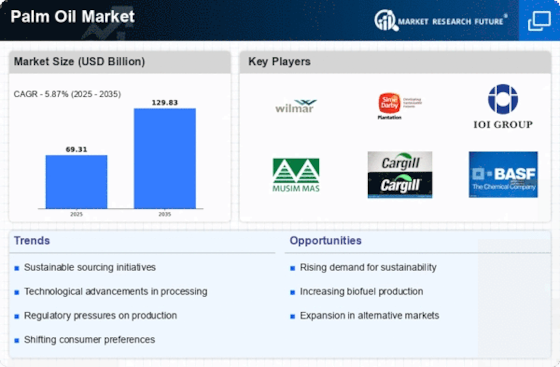
As per Market Research Future analysis, the Palm Oil Market Size was estimated at 69.31 USD Billion in 2024. The Palm Oil industry is projected to grow from 73.38 USD Billion in 2025 to 129.83 USD Billion by 2035, exhibiting a compound annual growth rate (CAGR) of 5.87% during the forecast period 2025 - 2035

Key Market Trends & Highlights

The Palm Oil Market is currently experiencing a dynamic shift towards sustainability and diversification.

  • North America remains the largest market for palm oil, driven by its extensive food processing sector. The Asia-Pacific region is the fastest-growing market, reflecting a surge in demand for both edible oils and biofuels. The food industry continues to dominate palm oil consumption, while the biofuels segment is rapidly expanding due to increasing energy needs. Rising demand for edible oils and growing interest in sustainable practices are key drivers influencing market growth.

Market Size & Forecast

2024 Market Size 69.31 (USD Billion)
2035 Market Size 129.83 (USD Billion)
CAGR (2025 - 2035) 5.87%
Largest Regional Market Share in 2024 Asia Pacific

Major Players

Wilmar International Limited (SG), <a href="https://www.sime.com/">Sime Darby Plantation Berhad (MY)</a>, Golden Agri-Resources Ltd (SG), IOI Corporation Berhad (MY), Musim Mas Holdings (SG), Cargill, Incorporated (US), BASF SE (DE), Kuala Lumpur Kepong Berhad (MY)

Market Trends

The Palm Oil Market is currently experiencing a dynamic phase characterized by evolving consumer preferences and regulatory frameworks. As sustainability becomes a focal point for many industries, the demand for sustainably sourced palm oil is on the rise. This shift is prompting producers to adopt more environmentally friendly practices, which may enhance their market positioning. Additionally, the increasing awareness of health implications associated with palm oil consumption is influencing purchasing decisions, leading to a potential decline in demand for traditional palm oil products. Moreover, the Palm Oil Market is witnessing a surge in innovation, with companies exploring alternative uses for palm oil beyond food products. This diversification could open new avenues for growth, particularly in sectors such as cosmetics and biofuels. As the market adapts to these changes, stakeholders must remain vigilant and responsive to emerging trends, ensuring they align with consumer expectations and regulatory requirements. The interplay between sustainability, health consciousness, and innovation appears to be shaping the future landscape of the Palm Oil Market.

Sustainability Initiatives

The palm oil market analysis indicates a structurally important commodity sector driven by its wide application across food processing, personal care, bio-based products, and industrial uses. Ongoing global palm oil industry trends highlight increasing emphasis on supply chain efficiency, sustainability initiatives, and evolving end-user demand, particularly in emerging economies where palm oil remains a key edible oil. From a demand perspective, changing dietary patterns, population growth, and expanding processed food consumption continue to influence long-term market dynamics. The palm oil market growth forecast suggests steady expansion supported by its cost competitiveness, high yield efficiency, and versatility compared to alternative vegetable oils. Meanwhile, the broader palm oil industry outlook is shaped by regulatory developments, traceability requirements, and innovation in sustainable cultivation practices, which are redefining production and trade strategies. In terms of competitive positioning, palm oil market share distribution reflects the dominance of major producing regions while downstream industries increasingly focus on value-added derivatives and certified sourcing to strengthen market presence and resilience.

The emphasis on sustainable practices is becoming increasingly pronounced within the Palm Oil Market. Producers are adopting certifications and standards that promote environmentally friendly cultivation methods, which may appeal to eco-conscious consumers.

Health Trends

Growing awareness regarding health and nutrition is influencing consumer choices in the Palm Oil Market. As individuals seek healthier alternatives, there is a potential shift towards products that are perceived as more beneficial or less harmful.

Diversification of Applications

The Palm Oil Market is expanding its horizons as companies explore innovative applications for palm oil. Beyond traditional food uses, there is a notable interest in utilizing palm oil in cosmetics and biofuels, which could drive future growth.

Palm Oil Market Market Drivers

Biofuel Production

The shift towards renewable energy sources is propelling the Palm Oil Market, particularly in the biofuel sector. Governments and industries are increasingly investing in biofuels as a sustainable alternative to fossil fuels. In 2025, it is estimated that biofuels derived from palm oil could account for nearly 10% of the total energy consumption in several regions. This transition is supported by policies promoting the use of renewable energy, which enhances the attractiveness of palm oil as a feedstock for biodiesel production. Consequently, the Palm Oil Market is poised for growth as it aligns with global energy sustainability goals.

Rising Demand for Edible Oils

The increasing global population and changing dietary preferences are driving the demand for edible oils, particularly in developing regions. The Palm Oil Market is experiencing a surge as palm oil is favored for its versatility and cost-effectiveness. In 2025, the demand for palm oil is projected to reach approximately 75 million metric tons, reflecting a compound annual growth rate of around 4.5%. This trend is further fueled by the growing awareness of health benefits associated with palm oil, such as its high vitamin E content. As consumers seek affordable and nutritious cooking oils, the Palm Oil Market is likely to expand, catering to both local and international markets.

Expansion of Food Processing Sector

The food processing industry is a major driver of the Palm Oil Market, as palm oil is widely used in various food products. The sector is projected to grow at a rate of 5% annually, with palm oil being a preferred ingredient due to its stability and long shelf life. In 2025, the demand for palm oil in food applications is expected to reach approximately 40 million metric tons. This growth is fueled by the rising consumption of processed foods and snacks, particularly in emerging markets. As the food processing sector expands, the Palm Oil Market is likely to see increased demand, reinforcing its position in The Palm Oil Market.

Growing Interest in Sustainable Practices

The Palm Oil Market is witnessing a significant shift towards sustainability, driven by consumer demand for ethically sourced products. Certification schemes such as the Roundtable on Sustainable Palm Oil Market (RSPO) are gaining traction, encouraging producers to adopt environmentally friendly practices. In 2025, it is anticipated that over 30% of palm oil produced will be certified sustainable, reflecting a growing commitment to responsible sourcing. This trend not only enhances the reputation of the Palm Oil Market but also opens new market opportunities, as retailers and consumers increasingly prioritize sustainability in their purchasing decisions.

Technological Advancements in Cultivation

Innovations in agricultural practices and technology are transforming the Palm Oil Market. Precision agriculture, biotechnology, and improved cultivation techniques are enhancing yield and efficiency. For instance, the adoption of high-yielding palm varieties and advanced pest management strategies has the potential to increase productivity by up to 30%. These advancements not only contribute to higher output but also address environmental concerns by promoting sustainable farming practices. As a result, the Palm Oil Market is likely to benefit from increased production capacity while minimizing ecological impact, appealing to environmentally conscious consumers.

Market Segment Insights

By Application: Food Industry (Largest) vs. Biofuels (Fastest-Growing)

<p>The application of palm oil spans various industries, with the food sector leading due to its versatility and widespread use in cooking oils, margarine, and processed foods. Notably, it holds a major share of the overall palm oil applications, which is influenced by consumer demand for palm oil derivatives in various food products. Other applications, such as cosmetics, pharmaceuticals, and animal feed, also contribute appreciably to the market share, highlighting the oil's multifunctional nature. In recent years, biofuels have emerged as the fastest-growing application for palm oil, driven by rising global energy demands and a shift towards renewable energy sources. The increasing focus on sustainability in fuel production has spurred investments in biofuel technologies, further enhancing the demand for palm oil as a feedstock. Furthermore, the cosmetics and pharmaceuticals segments continue to expand, presentation opportunities for growth driven primarily by product innovation and health trends that embrace natural and plant-based ingredients.</p>

<p>Food Industry (Dominant) vs. Biofuels (Emerging)</p>

<p>The food industry remains the dominant application of palm oil, capitalizing on its favorable properties such as high oxidative stability and extended shelf life, making it a preferred choice for food manufacturers. In contrast, biofuels represent an emerging segment, driven by the need for sustainable energy solutions. Palm oil's high yield and energy content position it well in the biofuels sphere, particularly with increasing regulations on fossil fuel use and environmental concerns. As consumer awareness regarding the impact of energy sources on climate change rises, the biofuels market is anticipated to gain traction, potentially altering the competitive landscape as it complements the established food industry.</p>

By End Use: Cooking Oil (Largest) vs. Biodiesel (Fastest-Growing)

<p>The palm oil market is significantly influenced by various end-use segments, with cooking oil holding the largest share due to its extensive usage in households and food service industries. Following cooking oil, margarine and shortening are also notable players, catering to the food processing sector. Biodiesel is emerging as a strong contender, driven by the increasing emphasis on renewable energy sources and sustainable practices. Industrial lubricants, while smaller in comparison, still play a crucial role in various industrial applications as palm oil-derived products gain traction.</p>

<p>Cooking Oil: Dominant vs. Biodiesel: Emerging</p>

<p>Cooking oil remains the dominant segment in the palm oil market, primarily attributed to its versatile use in domestic cooking and commercial food production. Its widespread consumer acceptance and health considerations have solidified its position. On the other hand, biodiesel is categorized as an emerging segment, fueled by the global shift towards sustainable and renewable energy solutions. This segment is witnessing rapid growth due to increasing government initiatives supporting biofuel usage and a heightened environmental consciousness among consumers and businesses alike. Biodiesel's potential to reduce carbon emissions makes it an attractive option in the transition towards greener energy sources.</p>

By Type: Crude Palm Oil (Largest) vs. Refined Palm Oil (Fastest-Growing)

<p>In the palm oil market, the largest segment is Crude Palm Oil (CPO), which holds a significant portion of the overall market share due to its extensive application in food, cosmetics, and biofuels. Refined Palm Oil (RPO), on the other hand, caters to specific consumer demands for premium quality and pureness, leading to its rapid adoption across various industries. This segmentation indicates a diversified market, responsive to both mass and niche demands. As consumer preferences evolve, the growth trajectory of Refined Palm Oil is driven by health-conscious trends and regulatory frameworks that emphasize food quality. Additionally, the expanding food processing sector and rising demand for sustainable products further enhance RPO's position. Meanwhile, Crude Palm Oil remains essential for standard applications but faces challenges from competitors in the health and sustainability realms.</p>

<p>Crude Palm Oil (Dominant) vs. Palm Kernel Oil (Emerging)</p>

<p>Crude Palm Oil (CPO) is the dominant segment in the palm oil market due to its versatility and wide range of applications, including cooking, baking, and as an ingredient in various food products. It is valued for its efficiency and cost-effectiveness. Conversely, Palm Kernel Oil (PKO) is emerging as a significant player, primarily utilized in the production of personal care products, confectionery, and specialty fats. PKO's rising popularity can be attributed to its unique fatty acid composition and burgeoning demand in the cosmetic industry. While CPO remains the mainstream choice, PKO is carving out a niche market, reflecting a trend towards diversified sourcing and consumer preference for sustainable and high-quality alternatives.</p>

By Source: Sustainable Palm Oil (Largest) vs. Conventional Palm Oil (Fastest-Growing)

<p>In the palm oil market, the source segment is primarily dominated by sustainable palm oil, which caters to the growing consumer demand for ethically produced goods. Sustainable palm oil accounts for a significant portion of the market share, driven by regulations and certifications that promote responsible sourcing. On the other hand, conventional palm oil still retains a substantial share, but it is encountering rising scrutiny due to environmental concerns, which may impact its long-term viability in the market. The growth trends in the source segment are notable, particularly for conventional palm oil, which is experiencing a resurgence as producers adopt more sustainable practices to improve their brand image. However, sustainable palm oil remains the preferred choice as consumers increasingly prioritize environmental consciousness. Factors such as increased awareness regarding deforestation, climate change, and ethical consumption are fuelling the rapid expansion of sustainable palm oil, making it a vital area of focus for producers in the palm oil market.</p>

<p>Sustainable Palm Oil (Dominant) vs. Organic Palm Oil (Emerging)</p>

<p>Sustainable palm oil has emerged as the dominant category within the palm oil source segment, characterized by its adherence to ecological and ethical standards throughout cultivation and production processes. This segment has seen a strong push from both consumers and regulatory bodies advocating for environmentally friendly practices. In contrast, organic palm oil is an emerging player, distinguished by its production without synthetic fertilizers or pesticides, appealing to niche markets that prioritize organic goods. While organic palm oil holds a smaller market share, its growth is supported by the increasing consumer demand for healthy and natural products. Both segments share an inherent commitment to sustainability, but their market approaches differ in terms of certifications, consumer bases, and growth potential.</p>

By Processing Method: Refining (Largest) vs. Cold Pressing (Fastest-Growing)

<p>In the palm oil market, the processing methods segment is characterized by a diverse range of techniques, with refining comprising a significant portion of market share. This method is widely adopted due to its ability to remove impurities and improve oil stability, making it the preferred choice for many manufacturers. Cold pressing, on the other hand, is gaining traction. It appeals to consumers seeking natural and less processed products, resulting in its rapid growth in the market.<br><br>Growth trends within this segment show a clear consumer shift towards healthier and more sustainable options. Cold pressing is increasingly favored due to its preservation of nutrients and flavor, reflecting the growing health consciousness among consumers. Meanwhile, refining continues to dominate, propelled by food industry requirements for consistent quality and shelf life.</p>

<p>Refining (Dominant) vs. Cold Pressing (Emerging)</p>

<p>Refining is the dominant processing method in the palm oil market, essential for producing an oil that meets industrial and consumer standards. This method involves a series of steps including degumming, bleaching, and deodorization to eliminate unwanted substances, resulting in a higher-quality oil that is versatile for various applications. Its well-established processes make it a benchmark in the industry. Conversely, cold pressing is an emerging method that appeals to health-conscious consumers. This technique retains more natural nutrients and flavors, aligning with the rising trend towards organic and minimally processed food products. While cold pressing currently holds a smaller share of the market, its growth trajectory indicates a shift in consumer preferences towards healthier alternatives.</p>

Get more detailed insights about Palm Oil Market Research Report - Forecast till 2035

Regional Insights

North America : Sustainable Growth Focus

The North American palm oil market is driven by increasing consumer awareness regarding sustainability and health benefits. The region is witnessing a shift towards certified sustainable palm oil, with the U.S. and Canada being the largest markets, holding approximately 30% and 15% of the market share, respectively. Regulatory initiatives aimed at promoting sustainable sourcing are further catalyzing this growth. Leading players in this region include Cargill, Incorporated and BASF SE, which are actively involved in sustainable practices and certifications. The competitive landscape is characterized by partnerships and collaborations aimed at enhancing supply chain transparency. As consumer preferences evolve, companies are adapting their strategies to meet the demand for ethically sourced palm oil, ensuring compliance with local regulations and standards.

Europe : Regulatory Landscape Impact

Europe is a significant player in the palm oil market, driven by stringent regulations and a strong consumer preference for sustainable products. The European Union is the largest market, accounting for approximately 40% of global palm oil imports, followed by the UK with around 10%. Regulatory frameworks, such as the EU's Renewable Energy Directive, are pushing for sustainable sourcing and traceability in palm oil supply chains. Key countries in this region include Germany, France, and the Netherlands, where demand for certified sustainable palm oil is on the rise. Major players like BASF SE and Wilmar International Limited are focusing on compliance with EU regulations and enhancing their sustainability initiatives. The competitive landscape is marked by collaborations between producers and retailers to ensure responsible sourcing practices, aligning with consumer expectations and regulatory requirements.

Asia-Pacific : Emerging Market Dynamics

The Asia-Pacific region dominates global production and consumption, with the Indonesia palm oil market and India palm oil market playing critical roles in global supply and demand dynamics. Indonesia remains the largest producer, while the Indian palm oil market continues to expand due to rising food consumption and import dependency. The region's market is characterized by a growing demand for palm oil in food, cosmetics, and biofuels, with Indonesia holding approximately 55% and Malaysia around 30% of the market share. Regulatory support for sustainable practices is also gaining traction, further boosting growth. Leading players in this region include Sime Darby Plantation Berhad and Golden Agri-Resources Ltd, which are at the forefront of sustainable palm oil production. The competitive landscape is evolving, with increasing investments in technology and innovation to enhance yield and sustainability. As the region continues to expand its market presence, the focus on responsible sourcing and environmental impact is becoming paramount for industry players.

Middle East and Africa : Emerging Market Opportunities

The Middle East and Africa region is witnessing a gradual increase in palm oil consumption, driven by rising population and urbanization. Countries like South Africa and Egypt are leading the market, with South Africa holding approximately 10% of the market share. The region's growth is supported by increasing demand for palm oil in food processing and personal care products, alongside favorable trade agreements that facilitate imports. Key players in this region include local distributors and international companies like Musim Mas Holdings. The competitive landscape is characterized by a mix of established players and emerging local businesses, focusing on meeting the growing demand for palm oil products. As awareness of health benefits and sustainability increases, the market is expected to expand, with a focus on responsible sourcing practices.

Key Players and Competitive Insights

The Palm Oil is characterized by a complex interplay of competitive dynamics, driven by increasing demand for sustainable practices and innovative solutions. Major players such as Wilmar International Limited (Singapore), Sime Darby Plantation Berhad (Malaysia), and Cargill, Incorporated (United States) are at the forefront of this evolving landscape. Wilmar International Limited (Singapore) has strategically positioned itself through a focus on sustainability, aiming to enhance its supply chain transparency and reduce its carbon footprint. Meanwhile, Sime Darby Plantation Berhad (Malaysia) emphasizes technological advancements in its operations, particularly in precision agriculture, to optimize yield and minimize environmental impact. Cargill, Incorporated (United States) is leveraging partnerships and collaborations to enhance its market presence, particularly in the realm of sustainable palm oil production, thereby shaping a competitive environment that increasingly prioritizes ethical sourcing and environmental stewardship. Key business tactics within the Palm Oil Market include localizing manufacturing and optimizing supply chains to enhance efficiency and responsiveness to market demands. The market structure appears moderately fragmented, with a mix of large multinational corporations and smaller regional players. The collective influence of key players, particularly those focusing on sustainability and innovation, is likely to reshape market dynamics, pushing competitors to adopt similar strategies to maintain relevance. In August 2025, Wilmar International Limited (Singapore) announced a partnership with a leading technology firm to develop a blockchain-based traceability system for its palm oil supply chain. This initiative is poised to enhance transparency and accountability, addressing growing consumer demand for ethically sourced products. The strategic importance of this move lies in its potential to not only improve operational efficiency but also to bolster the company's reputation in sustainability, thereby attracting environmentally conscious consumers. In September 2025, Sime Darby Plantation Berhad (Malaysia) launched a new initiative aimed at integrating AI-driven analytics into its plantation management processes. This strategic action is expected to optimize resource allocation and improve crop yields, reflecting a broader trend towards digital transformation in agriculture. The significance of this development is underscored by the increasing need for efficiency in production, particularly in a market where sustainability and productivity are paramount. In July 2025, Cargill, Incorporated (United States) expanded its sustainable palm oil sourcing program by collaborating with local farmers in Indonesia to promote best practices in cultivation. This strategic move not only enhances Cargill's supply chain reliability but also supports local economies, aligning with global sustainability goals. The importance of this initiative lies in its dual focus on ethical sourcing and community engagement, which could serve as a competitive differentiator in the market. As of October 2025, current competitive trends in the Palm Oil Market are increasingly defined by digitalization, sustainability, and the integration of advanced technologies such as AI. Strategic alliances among key players are shaping the landscape, fostering innovation and collaboration. Looking ahead, it appears that competitive differentiation will evolve from traditional price-based competition to a focus on innovation, technological advancements, and supply chain reliability, as companies strive to meet the demands of a more environmentally conscious consumer base.

Key Companies in the Palm Oil Market include

Industry Developments

Recent developments in the Palm Oil Market share have contributed to volatility in palm oil market price, influenced by climate conditions, geopolitical tensions, and regulatory changes. These factors continue to shape the short-term dynamics of the palm oil market today, while long-term investments support a stable palm oil market outlook.

For instance, in September 2023, the Malaysian Palm Oil Market Board announced a reduction in palm oil production forecasts due to adverse weather impacts.

This has led to price increases, with concerns over supply chains being further exacerbated by geopolitical tensions.

Companies like Wilmar International and Genting Plantations are actively navigating these challenges while exploring sustainability practices to meet rising consumer demands for responsibly sourced palm oil.

In terms of mergers and acquisitions, August 2023 saw Cargill expanding its palm oil processing capabilities in Southeast Asia through a strategic partnership with Olam International, enhancing their market position.

The financial performance of major players has shown resilience, with Golden Agri-Resources and Kuala Lumpur Kepong Berhad reporting significant revenue growth attributed to increased global consumption and rising biodiesel production.

Furthermore, the industry has faced scrutiny regarding sustainability claims, which has prompted companies like IOI Corporation and Musim Mas to intensify their environmental certifications and ethical sourcing efforts, reflecting a broader trend towards responsible sourcing in the Palm Oil Market.


Future Outlook

Palm Oil Market Future Outlook

The Palm Oil Market is projected to grow at a 5.87% CAGR from 2025 to 2035, driven by rising demand for sustainable products and biofuels.

New opportunities lie in:

  • <p>Expansion into high-value <a href="https://www.marketresearchfuture.com/reports/specialty-oils-market-1837">specialty oils</a> Investment in sustainable palm oil certification programs Development of innovative palm oil-based bioplastics</p>

By 2035, the Palm Oil Market is expected to achieve robust growth, driven by sustainability and innovation.

Market Segmentation

Palm Oil Market Form Outlook

  • Crude Palm Oil
  • Refined Palm Oil
  • Palm Kernel Oil
  • Fractionated Palm Oil

Palm Oil Market End Use Outlook

  • Food Processing
  • Cosmetics Manufacturing
  • Energy Production
  • Chemical Manufacturing

Palm Oil Market Application Outlook

  • Food Industry
  • Personal Care Products
  • Biofuels
  • Animal Feed
  • Industrial Lubricants

Palm Oil Market Distribution Channel Outlook

  • Direct Sales
  • Retail
  • E-commerce
  • Wholesale

Report Scope

MARKET SIZE 2024 69.31(USD Billion)
MARKET SIZE 2025 73.38(USD Billion)
MARKET SIZE 2035 129.83(USD Billion)
COMPOUND ANNUAL GROWTH RATE (CAGR) 5.87% (2025 - 2035)
REPORT COVERAGE Revenue Forecast, Competitive Landscape, Growth Factors, and Trends
BASE YEAR 2024
Market Forecast Period 2025 - 2035
Historical Data 2019 - 2024
Market Forecast Units USD Billion
Key Companies Profiled Wilmar International Limited (SG), Sime Darby Plantation Berhad (MY), Golden Agri-Resources Ltd (SG), IOI Corporation Berhad (MY), Musim Mas Holdings (SG), Cargill, Incorporated (US), BASF SE (DE), Kuala Lumpur Kepong Berhad (MY)
Segments Covered Application, Form, Distribution Channel, End Use, Regional
Key Market Opportunities Growing demand for sustainable palm oil drives innovation in eco-friendly production methods.
Key Market Dynamics Rising consumer demand for sustainable palm oil drives regulatory changes and competitive shifts in the market.
Countries Covered North America, Europe, APAC, South America, MEA

FAQs

What is the current valuation of the palm oil market as of 2025?

<p>The palm oil market valuation stands at 60.0 USD Billion in 2024.</p>

What is the projected market size for the palm oil industry by 2035?

<p>The palm oil market is expected to reach a valuation of 75.0 USD Billion by 2035.</p>

What is the expected CAGR for the palm oil market during the forecast period 2025 - 2035?

<p>The expected CAGR for the palm oil market during the forecast period 2025 - 2035 is 2.05%.</p>

Which companies are considered key players in the palm oil market?

<p>Key players in the palm oil market include Wilmar International Limited, Sime Darby Plantation Berhad, and Cargill, Incorporated.</p>

What are the primary applications of palm oil in the market?

<p>The primary applications of palm oil include the food industry, cosmetics, biofuels, pharmaceuticals, and animal feed.</p>

How does the palm oil market segment by end use?

<p>The palm oil market segments by end use include cooking oil, margarine, shortening, biodiesel, and industrial lubricants.</p>

What types of palm oil are currently available in the market?

<p>The types of palm oil available in the market include crude palm oil, refined palm oil, palm kernel oil, and fractionated palm oil.</p>

What is the market outlook for sustainable palm oil by 2035?

<p>The market for sustainable palm oil is projected to grow, with a valuation expected between 12.0 and 15.0 USD Billion by 2035.</p>

What processing methods are utilized in the palm oil industry?

<p>The palm oil industry utilizes processing methods such as cold pressing, refining, hydrogenation, and fractionation.</p>

How does the market for conventional palm oil compare to organic palm oil?

<p>The market for conventional palm oil is projected to be valued between 36.0 and 45.0 USD Billion, while organic palm oil is expected to reach between 12.0 and 15.0 USD Billion by 2035.</p>

  1. SECTION I: EXECUTIVE SUMMARY AND KEY HIGHLIGHTS
    1. | 1.1 EXECUTIVE SUMMARY
    2. | | 1.1.1 Market Overview
    3. | | 1.1.2 Key Findings
    4. | | 1.1.3 Market Segmentation
    5. | | 1.1.4 Competitive Landscape
    6. | | 1.1.5 Challenges and Opportunities
    7. | | 1.1.6 Future Outlook
  2. SECTION II: SCOPING, METHODOLOGY AND MARKET STRUCTURE
    1. | 2.1 MARKET INTRODUCTION
    2. | | 2.1.1 Definition
    3. | | 2.1.2 Scope of the study
    4. | | | 2.1.2.1 Research Objective
    5. | | | 2.1.2.2 Assumption
    6. | | | 2.1.2.3 Limitations
    7. | 2.2 RESEARCH METHODOLOGY
    8. | | 2.2.1 Overview
    9. | | 2.2.2 Data Mining
    10. | | 2.2.3 Secondary Research
    11. | | 2.2.4 Primary Research
    12. | | | 2.2.4.1 Primary Interviews and Information Gathering Process
    13. | | | 2.2.4.2 Breakdown of Primary Respondents
    14. | | 2.2.5 Forecasting Model
    15. | | 2.2.6 Market Size Estimation
    16. | | | 2.2.6.1 Bottom-Up Approach
    17. | | | 2.2.6.2 Top-Down Approach
    18. | | 2.2.7 Data Triangulation
    19. | | 2.2.8 Validation
  3. SECTION III: QUALITATIVE ANALYSIS
    1. | 3.1 MARKET DYNAMICS
    2. | | 3.1.1 Overview
    3. | | 3.1.2 Drivers
    4. | | 3.1.3 Restraints
    5. | | 3.1.4 Opportunities
    6. | 3.2 MARKET FACTOR ANALYSIS
    7. | | 3.2.1 Value chain Analysis
    8. | | 3.2.2 Porter's Five Forces Analysis
    9. | | | 3.2.2.1 Bargaining Power of Suppliers
    10. | | | 3.2.2.2 Bargaining Power of Buyers
    11. | | | 3.2.2.3 Threat of New Entrants
    12. | | | 3.2.2.4 Threat of Substitutes
    13. | | | 3.2.2.5 Intensity of Rivalry
    14. | | 3.2.3 COVID-19 Impact Analysis
    15. | | | 3.2.3.1 Market Impact Analysis
    16. | | | 3.2.3.2 Regional Impact
    17. | | | 3.2.3.3 Opportunity and Threat Analysis
  4. SECTION IV: QUANTITATIVE ANALYSIS
    1. | 4.1 Food, Beverages & Nutrition, BY Application (USD Billion)
    2. | | 4.1.1 Food Industry
    3. | | 4.1.2 Cosmetics
    4. | | 4.1.3 Biofuels
    5. | | 4.1.4 Pharmaceuticals
    6. | | 4.1.5 Animal Feed
    7. | 4.2 Food, Beverages & Nutrition, BY End Use (USD Billion)
    8. | | 4.2.1 Cooking Oil
    9. | | 4.2.2 Margarine
    10. | | 4.2.3 Shortening
    11. | | 4.2.4 Biodiesel
    12. | | 4.2.5 Industrial Lubricants
    13. | 4.3 Food, Beverages & Nutrition, BY Type (USD Billion)
    14. | | 4.3.1 Crude Palm Oil
    15. | | 4.3.2 Refined Palm Oil
    16. | | 4.3.3 Palm Kernel Oil
    17. | | 4.3.4 Fractionated Palm Oil
    18. | 4.4 Food, Beverages & Nutrition, BY Source (USD Billion)
    19. | | 4.4.1 Sustainable Palm Oil
    20. | | 4.4.2 Conventional Palm Oil
    21. | | 4.4.3 Organic Palm Oil
    22. | 4.5 Food, Beverages & Nutrition, BY Processing Method (USD Billion)
    23. | | 4.5.1 Cold Pressing
    24. | | 4.5.2 Refining
    25. | | 4.5.3 Hydrogenation
    26. | | 4.5.4 Fractionation
    27. | 4.6 Food, Beverages & Nutrition, BY Region (USD Billion)
    28. | | 4.6.1 North America
    29. | | | 4.6.1.1 US
    30. | | | 4.6.1.2 Canada
    31. | | 4.6.2 Europe
    32. | | | 4.6.2.1 Germany
    33. | | | 4.6.2.2 UK
    34. | | | 4.6.2.3 France
    35. | | | 4.6.2.4 Russia
    36. | | | 4.6.2.5 Italy
    37. | | | 4.6.2.6 Spain
    38. | | | 4.6.2.7 Rest of Europe
    39. | | 4.6.3 APAC
    40. | | | 4.6.3.1 China
    41. | | | 4.6.3.2 India
    42. | | | 4.6.3.3 Japan
    43. | | | 4.6.3.4 South Korea
    44. | | | 4.6.3.5 Malaysia
    45. | | | 4.6.3.6 Thailand
    46. | | | 4.6.3.7 Indonesia
    47. | | | 4.6.3.8 Rest of APAC
    48. | | 4.6.4 South America
    49. | | | 4.6.4.1 Brazil
    50. | | | 4.6.4.2 Mexico
    51. | | | 4.6.4.3 Argentina
    52. | | | 4.6.4.4 Rest of South America
    53. | | 4.6.5 MEA
    54. | | | 4.6.5.1 GCC Countries
    55. | | | 4.6.5.2 South Africa
    56. | | | 4.6.5.3 Rest of MEA
  5. SECTION V: COMPETITIVE ANALYSIS
    1. | 5.1 Competitive Landscape
    2. | | 5.1.1 Overview
    3. | | 5.1.2 Competitive Analysis
    4. | | 5.1.3 Market share Analysis
    5. | | 5.1.4 Major Growth Strategy in the Food, Beverages & Nutrition
    6. | | 5.1.5 Competitive Benchmarking
    7. | | 5.1.6 Leading Players in Terms of Number of Developments in the Food, Beverages & Nutrition
    8. | | 5.1.7 Key developments and growth strategies
    9. | | | 5.1.7.1 New Product Launch/Service Deployment
    10. | | | 5.1.7.2 Merger & Acquisitions
    11. | | | 5.1.7.3 Joint Ventures
    12. | | 5.1.8 Major Players Financial Matrix
    13. | | | 5.1.8.1 Sales and Operating Income
    14. | | | 5.1.8.2 Major Players R&D Expenditure. 2023
    15. | 5.2 Company Profiles
    16. | | 5.2.1 Wilmar International Limited (SG)
    17. | | | 5.2.1.1 Financial Overview
    18. | | | 5.2.1.2 Products Offered
    19. | | | 5.2.1.3 Key Developments
    20. | | | 5.2.1.4 SWOT Analysis
    21. | | | 5.2.1.5 Key Strategies
    22. | | 5.2.2 Sime Darby Plantation Berhad (MY)
    23. | | | 5.2.2.1 Financial Overview
    24. | | | 5.2.2.2 Products Offered
    25. | | | 5.2.2.3 Key Developments
    26. | | | 5.2.2.4 SWOT Analysis
    27. | | | 5.2.2.5 Key Strategies
    28. | | 5.2.3 Golden Agri-Resources Ltd (SG)
    29. | | | 5.2.3.1 Financial Overview
    30. | | | 5.2.3.2 Products Offered
    31. | | | 5.2.3.3 Key Developments
    32. | | | 5.2.3.4 SWOT Analysis
    33. | | | 5.2.3.5 Key Strategies
    34. | | 5.2.4 IOI Corporation Berhad (MY)
    35. | | | 5.2.4.1 Financial Overview
    36. | | | 5.2.4.2 Products Offered
    37. | | | 5.2.4.3 Key Developments
    38. | | | 5.2.4.4 SWOT Analysis
    39. | | | 5.2.4.5 Key Strategies
    40. | | 5.2.5 Musim Mas Holdings (SG)
    41. | | | 5.2.5.1 Financial Overview
    42. | | | 5.2.5.2 Products Offered
    43. | | | 5.2.5.3 Key Developments
    44. | | | 5.2.5.4 SWOT Analysis
    45. | | | 5.2.5.5 Key Strategies
    46. | | 5.2.6 Cargill, Incorporated (US)
    47. | | | 5.2.6.1 Financial Overview
    48. | | | 5.2.6.2 Products Offered
    49. | | | 5.2.6.3 Key Developments
    50. | | | 5.2.6.4 SWOT Analysis
    51. | | | 5.2.6.5 Key Strategies
    52. | | 5.2.7 BASF SE (DE)
    53. | | | 5.2.7.1 Financial Overview
    54. | | | 5.2.7.2 Products Offered
    55. | | | 5.2.7.3 Key Developments
    56. | | | 5.2.7.4 SWOT Analysis
    57. | | | 5.2.7.5 Key Strategies
    58. | | 5.2.8 Kuala Lumpur Kepong Berhad (MY)
    59. | | | 5.2.8.1 Financial Overview
    60. | | | 5.2.8.2 Products Offered
    61. | | | 5.2.8.3 Key Developments
    62. | | | 5.2.8.4 SWOT Analysis
    63. | | | 5.2.8.5 Key Strategies
    64. | 5.3 Appendix
    65. | | 5.3.1 References
    66. | | 5.3.2 Related Reports
  6. LIST OF FIGURES
    1. | 6.1 MARKET SYNOPSIS
    2. | 6.2 NORTH AMERICA MARKET ANALYSIS
    3. | 6.3 US MARKET ANALYSIS BY APPLICATION
    4. | 6.4 US MARKET ANALYSIS BY END USE
    5. | 6.5 US MARKET ANALYSIS BY TYPE
    6. | 6.6 US MARKET ANALYSIS BY SOURCE
    7. | 6.7 US MARKET ANALYSIS BY PROCESSING METHOD
    8. | 6.8 CANADA MARKET ANALYSIS BY APPLICATION
    9. | 6.9 CANADA MARKET ANALYSIS BY END USE
    10. | 6.10 CANADA MARKET ANALYSIS BY TYPE
    11. | 6.11 CANADA MARKET ANALYSIS BY SOURCE
    12. | 6.12 CANADA MARKET ANALYSIS BY PROCESSING METHOD
    13. | 6.13 EUROPE MARKET ANALYSIS
    14. | 6.14 GERMANY MARKET ANALYSIS BY APPLICATION
    15. | 6.15 GERMANY MARKET ANALYSIS BY END USE
    16. | 6.16 GERMANY MARKET ANALYSIS BY TYPE
    17. | 6.17 GERMANY MARKET ANALYSIS BY SOURCE
    18. | 6.18 GERMANY MARKET ANALYSIS BY PROCESSING METHOD
    19. | 6.19 UK MARKET ANALYSIS BY APPLICATION
    20. | 6.20 UK MARKET ANALYSIS BY END USE
    21. | 6.21 UK MARKET ANALYSIS BY TYPE
    22. | 6.22 UK MARKET ANALYSIS BY SOURCE
    23. | 6.23 UK MARKET ANALYSIS BY PROCESSING METHOD
    24. | 6.24 FRANCE MARKET ANALYSIS BY APPLICATION
    25. | 6.25 FRANCE MARKET ANALYSIS BY END USE
    26. | 6.26 FRANCE MARKET ANALYSIS BY TYPE
    27. | 6.27 FRANCE MARKET ANALYSIS BY SOURCE
    28. | 6.28 FRANCE MARKET ANALYSIS BY PROCESSING METHOD
    29. | 6.29 RUSSIA MARKET ANALYSIS BY APPLICATION
    30. | 6.30 RUSSIA MARKET ANALYSIS BY END USE
    31. | 6.31 RUSSIA MARKET ANALYSIS BY TYPE
    32. | 6.32 RUSSIA MARKET ANALYSIS BY SOURCE
    33. | 6.33 RUSSIA MARKET ANALYSIS BY PROCESSING METHOD
    34. | 6.34 ITALY MARKET ANALYSIS BY APPLICATION
    35. | 6.35 ITALY MARKET ANALYSIS BY END USE
    36. | 6.36 ITALY MARKET ANALYSIS BY TYPE
    37. | 6.37 ITALY MARKET ANALYSIS BY SOURCE
    38. | 6.38 ITALY MARKET ANALYSIS BY PROCESSING METHOD
    39. | 6.39 SPAIN MARKET ANALYSIS BY APPLICATION
    40. | 6.40 SPAIN MARKET ANALYSIS BY END USE
    41. | 6.41 SPAIN MARKET ANALYSIS BY TYPE
    42. | 6.42 SPAIN MARKET ANALYSIS BY SOURCE
    43. | 6.43 SPAIN MARKET ANALYSIS BY PROCESSING METHOD
    44. | 6.44 REST OF EUROPE MARKET ANALYSIS BY APPLICATION
    45. | 6.45 REST OF EUROPE MARKET ANALYSIS BY END USE
    46. | 6.46 REST OF EUROPE MARKET ANALYSIS BY TYPE
    47. | 6.47 REST OF EUROPE MARKET ANALYSIS BY SOURCE
    48. | 6.48 REST OF EUROPE MARKET ANALYSIS BY PROCESSING METHOD
    49. | 6.49 APAC MARKET ANALYSIS
    50. | 6.50 CHINA MARKET ANALYSIS BY APPLICATION
    51. | 6.51 CHINA MARKET ANALYSIS BY END USE
    52. | 6.52 CHINA MARKET ANALYSIS BY TYPE
    53. | 6.53 CHINA MARKET ANALYSIS BY SOURCE
    54. | 6.54 CHINA MARKET ANALYSIS BY PROCESSING METHOD
    55. | 6.55 INDIA MARKET ANALYSIS BY APPLICATION
    56. | 6.56 INDIA MARKET ANALYSIS BY END USE
    57. | 6.57 INDIA MARKET ANALYSIS BY TYPE
    58. | 6.58 INDIA MARKET ANALYSIS BY SOURCE
    59. | 6.59 INDIA MARKET ANALYSIS BY PROCESSING METHOD
    60. | 6.60 JAPAN MARKET ANALYSIS BY APPLICATION
    61. | 6.61 JAPAN MARKET ANALYSIS BY END USE
    62. | 6.62 JAPAN MARKET ANALYSIS BY TYPE
    63. | 6.63 JAPAN MARKET ANALYSIS BY SOURCE
    64. | 6.64 JAPAN MARKET ANALYSIS BY PROCESSING METHOD
    65. | 6.65 SOUTH KOREA MARKET ANALYSIS BY APPLICATION
    66. | 6.66 SOUTH KOREA MARKET ANALYSIS BY END USE
    67. | 6.67 SOUTH KOREA MARKET ANALYSIS BY TYPE
    68. | 6.68 SOUTH KOREA MARKET ANALYSIS BY SOURCE
    69. | 6.69 SOUTH KOREA MARKET ANALYSIS BY PROCESSING METHOD
    70. | 6.70 MALAYSIA MARKET ANALYSIS BY APPLICATION
    71. | 6.71 MALAYSIA MARKET ANALYSIS BY END USE
    72. | 6.72 MALAYSIA MARKET ANALYSIS BY TYPE
    73. | 6.73 MALAYSIA MARKET ANALYSIS BY SOURCE
    74. | 6.74 MALAYSIA MARKET ANALYSIS BY PROCESSING METHOD
    75. | 6.75 THAILAND MARKET ANALYSIS BY APPLICATION
    76. | 6.76 THAILAND MARKET ANALYSIS BY END USE
    77. | 6.77 THAILAND MARKET ANALYSIS BY TYPE
    78. | 6.78 THAILAND MARKET ANALYSIS BY SOURCE
    79. | 6.79 THAILAND MARKET ANALYSIS BY PROCESSING METHOD
    80. | 6.80 INDONESIA MARKET ANALYSIS BY APPLICATION
    81. | 6.81 INDONESIA MARKET ANALYSIS BY END USE
    82. | 6.82 INDONESIA MARKET ANALYSIS BY TYPE
    83. | 6.83 INDONESIA MARKET ANALYSIS BY SOURCE
    84. | 6.84 INDONESIA MARKET ANALYSIS BY PROCESSING METHOD
    85. | 6.85 REST OF APAC MARKET ANALYSIS BY APPLICATION
    86. | 6.86 REST OF APAC MARKET ANALYSIS BY END USE
    87. | 6.87 REST OF APAC MARKET ANALYSIS BY TYPE
    88. | 6.88 REST OF APAC MARKET ANALYSIS BY SOURCE
    89. | 6.89 REST OF APAC MARKET ANALYSIS BY PROCESSING METHOD
    90. | 6.90 SOUTH AMERICA MARKET ANALYSIS
    91. | 6.91 BRAZIL MARKET ANALYSIS BY APPLICATION
    92. | 6.92 BRAZIL MARKET ANALYSIS BY END USE
    93. | 6.93 BRAZIL MARKET ANALYSIS BY TYPE
    94. | 6.94 BRAZIL MARKET ANALYSIS BY SOURCE
    95. | 6.95 BRAZIL MARKET ANALYSIS BY PROCESSING METHOD
    96. | 6.96 MEXICO MARKET ANALYSIS BY APPLICATION
    97. | 6.97 MEXICO MARKET ANALYSIS BY END USE
    98. | 6.98 MEXICO MARKET ANALYSIS BY TYPE
    99. | 6.99 MEXICO MARKET ANALYSIS BY SOURCE
    100. | 6.100 MEXICO MARKET ANALYSIS BY PROCESSING METHOD
    101. | 6.101 ARGENTINA MARKET ANALYSIS BY APPLICATION
    102. | 6.102 ARGENTINA MARKET ANALYSIS BY END USE
    103. | 6.103 ARGENTINA MARKET ANALYSIS BY TYPE
    104. | 6.104 ARGENTINA MARKET ANALYSIS BY SOURCE
    105. | 6.105 ARGENTINA MARKET ANALYSIS BY PROCESSING METHOD
    106. | 6.106 REST OF SOUTH AMERICA MARKET ANALYSIS BY APPLICATION
    107. | 6.107 REST OF SOUTH AMERICA MARKET ANALYSIS BY END USE
    108. | 6.108 REST OF SOUTH AMERICA MARKET ANALYSIS BY TYPE
    109. | 6.109 REST OF SOUTH AMERICA MARKET ANALYSIS BY SOURCE
    110. | 6.110 REST OF SOUTH AMERICA MARKET ANALYSIS BY PROCESSING METHOD
    111. | 6.111 MEA MARKET ANALYSIS
    112. | 6.112 GCC COUNTRIES MARKET ANALYSIS BY APPLICATION
    113. | 6.113 GCC COUNTRIES MARKET ANALYSIS BY END USE
    114. | 6.114 GCC COUNTRIES MARKET ANALYSIS BY TYPE
    115. | 6.115 GCC COUNTRIES MARKET ANALYSIS BY SOURCE
    116. | 6.116 GCC COUNTRIES MARKET ANALYSIS BY PROCESSING METHOD
    117. | 6.117 SOUTH AFRICA MARKET ANALYSIS BY APPLICATION
    118. | 6.118 SOUTH AFRICA MARKET ANALYSIS BY END USE
    119. | 6.119 SOUTH AFRICA MARKET ANALYSIS BY TYPE
    120. | 6.120 SOUTH AFRICA MARKET ANALYSIS BY SOURCE
    121. | 6.121 SOUTH AFRICA MARKET ANALYSIS BY PROCESSING METHOD
    122. | 6.122 REST OF MEA MARKET ANALYSIS BY APPLICATION
    123. | 6.123 REST OF MEA MARKET ANALYSIS BY END USE
    124. | 6.124 REST OF MEA MARKET ANALYSIS BY TYPE
    125. | 6.125 REST OF MEA MARKET ANALYSIS BY SOURCE
    126. | 6.126 REST OF MEA MARKET ANALYSIS BY PROCESSING METHOD
    127. | 6.127 KEY BUYING CRITERIA OF FOOD, BEVERAGES & NUTRITION
    128. | 6.128 RESEARCH PROCESS OF MRFR
    129. | 6.129 DRO ANALYSIS OF FOOD, BEVERAGES & NUTRITION
    130. | 6.130 DRIVERS IMPACT ANALYSIS: FOOD, BEVERAGES & NUTRITION
    131. | 6.131 RESTRAINTS IMPACT ANALYSIS: FOOD, BEVERAGES & NUTRITION
    132. | 6.132 SUPPLY / VALUE CHAIN: FOOD, BEVERAGES & NUTRITION
    133. | 6.133 FOOD, BEVERAGES & NUTRITION, BY APPLICATION, 2024 (% SHARE)
    134. | 6.134 FOOD, BEVERAGES & NUTRITION, BY APPLICATION, 2024 TO 2035 (USD Billion)
    135. | 6.135 FOOD, BEVERAGES & NUTRITION, BY END USE, 2024 (% SHARE)
    136. | 6.136 FOOD, BEVERAGES & NUTRITION, BY END USE, 2024 TO 2035 (USD Billion)
    137. | 6.137 FOOD, BEVERAGES & NUTRITION, BY TYPE, 2024 (% SHARE)
    138. | 6.138 FOOD, BEVERAGES & NUTRITION, BY TYPE, 2024 TO 2035 (USD Billion)
    139. | 6.139 FOOD, BEVERAGES & NUTRITION, BY SOURCE, 2024 (% SHARE)
    140. | 6.140 FOOD, BEVERAGES & NUTRITION, BY SOURCE, 2024 TO 2035 (USD Billion)
    141. | 6.141 FOOD, BEVERAGES & NUTRITION, BY PROCESSING METHOD, 2024 (% SHARE)
    142. | 6.142 FOOD, BEVERAGES & NUTRITION, BY PROCESSING METHOD, 2024 TO 2035 (USD Billion)
    143. | 6.143 BENCHMARKING OF MAJOR COMPETITORS
  7. LIST OF TABLES
    1. | 7.1 LIST OF ASSUMPTIONS
    2. | | 7.1.1
    3. | 7.2 North America MARKET SIZE ESTIMATES; FORECAST
    4. | | 7.2.1 BY APPLICATION, 2025-2035 (USD Billion)
    5. | | 7.2.2 BY END USE, 2025-2035 (USD Billion)
    6. | | 7.2.3 BY TYPE, 2025-2035 (USD Billion)
    7. | | 7.2.4 BY SOURCE, 2025-2035 (USD Billion)
    8. | | 7.2.5 BY PROCESSING METHOD, 2025-2035 (USD Billion)
    9. | 7.3 US MARKET SIZE ESTIMATES; FORECAST
    10. | | 7.3.1 BY APPLICATION, 2025-2035 (USD Billion)
    11. | | 7.3.2 BY END USE, 2025-2035 (USD Billion)
    12. | | 7.3.3 BY TYPE, 2025-2035 (USD Billion)
    13. | | 7.3.4 BY SOURCE, 2025-2035 (USD Billion)
    14. | | 7.3.5 BY PROCESSING METHOD, 2025-2035 (USD Billion)
    15. | 7.4 Canada MARKET SIZE ESTIMATES; FORECAST
    16. | | 7.4.1 BY APPLICATION, 2025-2035 (USD Billion)
    17. | | 7.4.2 BY END USE, 2025-2035 (USD Billion)
    18. | | 7.4.3 BY TYPE, 2025-2035 (USD Billion)
    19. | | 7.4.4 BY SOURCE, 2025-2035 (USD Billion)
    20. | | 7.4.5 BY PROCESSING METHOD, 2025-2035 (USD Billion)
    21. | 7.5 Europe MARKET SIZE ESTIMATES; FORECAST
    22. | | 7.5.1 BY APPLICATION, 2025-2035 (USD Billion)
    23. | | 7.5.2 BY END USE, 2025-2035 (USD Billion)
    24. | | 7.5.3 BY TYPE, 2025-2035 (USD Billion)
    25. | | 7.5.4 BY SOURCE, 2025-2035 (USD Billion)
    26. | | 7.5.5 BY PROCESSING METHOD, 2025-2035 (USD Billion)
    27. | 7.6 Germany MARKET SIZE ESTIMATES; FORECAST
    28. | | 7.6.1 BY APPLICATION, 2025-2035 (USD Billion)
    29. | | 7.6.2 BY END USE, 2025-2035 (USD Billion)
    30. | | 7.6.3 BY TYPE, 2025-2035 (USD Billion)
    31. | | 7.6.4 BY SOURCE, 2025-2035 (USD Billion)
    32. | | 7.6.5 BY PROCESSING METHOD, 2025-2035 (USD Billion)
    33. | 7.7 UK MARKET SIZE ESTIMATES; FORECAST
    34. | | 7.7.1 BY APPLICATION, 2025-2035 (USD Billion)
    35. | | 7.7.2 BY END USE, 2025-2035 (USD Billion)
    36. | | 7.7.3 BY TYPE, 2025-2035 (USD Billion)
    37. | | 7.7.4 BY SOURCE, 2025-2035 (USD Billion)
    38. | | 7.7.5 BY PROCESSING METHOD, 2025-2035 (USD Billion)
    39. | 7.8 France MARKET SIZE ESTIMATES; FORECAST
    40. | | 7.8.1 BY APPLICATION, 2025-2035 (USD Billion)
    41. | | 7.8.2 BY END USE, 2025-2035 (USD Billion)
    42. | | 7.8.3 BY TYPE, 2025-2035 (USD Billion)
    43. | | 7.8.4 BY SOURCE, 2025-2035 (USD Billion)
    44. | | 7.8.5 BY PROCESSING METHOD, 2025-2035 (USD Billion)
    45. | 7.9 Russia MARKET SIZE ESTIMATES; FORECAST
    46. | | 7.9.1 BY APPLICATION, 2025-2035 (USD Billion)
    47. | | 7.9.2 BY END USE, 2025-2035 (USD Billion)
    48. | | 7.9.3 BY TYPE, 2025-2035 (USD Billion)
    49. | | 7.9.4 BY SOURCE, 2025-2035 (USD Billion)
    50. | | 7.9.5 BY PROCESSING METHOD, 2025-2035 (USD Billion)
    51. | 7.10 Italy MARKET SIZE ESTIMATES; FORECAST
    52. | | 7.10.1 BY APPLICATION, 2025-2035 (USD Billion)
    53. | | 7.10.2 BY END USE, 2025-2035 (USD Billion)
    54. | | 7.10.3 BY TYPE, 2025-2035 (USD Billion)
    55. | | 7.10.4 BY SOURCE, 2025-2035 (USD Billion)
    56. | | 7.10.5 BY PROCESSING METHOD, 2025-2035 (USD Billion)
    57. | 7.11 Spain MARKET SIZE ESTIMATES; FORECAST
    58. | | 7.11.1 BY APPLICATION, 2025-2035 (USD Billion)
    59. | | 7.11.2 BY END USE, 2025-2035 (USD Billion)
    60. | | 7.11.3 BY TYPE, 2025-2035 (USD Billion)
    61. | | 7.11.4 BY SOURCE, 2025-2035 (USD Billion)
    62. | | 7.11.5 BY PROCESSING METHOD, 2025-2035 (USD Billion)
    63. | 7.12 Rest of Europe MARKET SIZE ESTIMATES; FORECAST
    64. | | 7.12.1 BY APPLICATION, 2025-2035 (USD Billion)
    65. | | 7.12.2 BY END USE, 2025-2035 (USD Billion)
    66. | | 7.12.3 BY TYPE, 2025-2035 (USD Billion)
    67. | | 7.12.4 BY SOURCE, 2025-2035 (USD Billion)
    68. | | 7.12.5 BY PROCESSING METHOD, 2025-2035 (USD Billion)
    69. | 7.13 APAC MARKET SIZE ESTIMATES; FORECAST
    70. | | 7.13.1 BY APPLICATION, 2025-2035 (USD Billion)
    71. | | 7.13.2 BY END USE, 2025-2035 (USD Billion)
    72. | | 7.13.3 BY TYPE, 2025-2035 (USD Billion)
    73. | | 7.13.4 BY SOURCE, 2025-2035 (USD Billion)
    74. | | 7.13.5 BY PROCESSING METHOD, 2025-2035 (USD Billion)
    75. | 7.14 China MARKET SIZE ESTIMATES; FORECAST
    76. | | 7.14.1 BY APPLICATION, 2025-2035 (USD Billion)
    77. | | 7.14.2 BY END USE, 2025-2035 (USD Billion)
    78. | | 7.14.3 BY TYPE, 2025-2035 (USD Billion)
    79. | | 7.14.4 BY SOURCE, 2025-2035 (USD Billion)
    80. | | 7.14.5 BY PROCESSING METHOD, 2025-2035 (USD Billion)
    81. | 7.15 India MARKET SIZE ESTIMATES; FORECAST
    82. | | 7.15.1 BY APPLICATION, 2025-2035 (USD Billion)
    83. | | 7.15.2 BY END USE, 2025-2035 (USD Billion)
    84. | | 7.15.3 BY TYPE, 2025-2035 (USD Billion)
    85. | | 7.15.4 BY SOURCE, 2025-2035 (USD Billion)
    86. | | 7.15.5 BY PROCESSING METHOD, 2025-2035 (USD Billion)
    87. | 7.16 Japan MARKET SIZE ESTIMATES; FORECAST
    88. | | 7.16.1 BY APPLICATION, 2025-2035 (USD Billion)
    89. | | 7.16.2 BY END USE, 2025-2035 (USD Billion)
    90. | | 7.16.3 BY TYPE, 2025-2035 (USD Billion)
    91. | | 7.16.4 BY SOURCE, 2025-2035 (USD Billion)
    92. | | 7.16.5 BY PROCESSING METHOD, 2025-2035 (USD Billion)
    93. | 7.17 South Korea MARKET SIZE ESTIMATES; FORECAST
    94. | | 7.17.1 BY APPLICATION, 2025-2035 (USD Billion)
    95. | | 7.17.2 BY END USE, 2025-2035 (USD Billion)
    96. | | 7.17.3 BY TYPE, 2025-2035 (USD Billion)
    97. | | 7.17.4 BY SOURCE, 2025-2035 (USD Billion)
    98. | | 7.17.5 BY PROCESSING METHOD, 2025-2035 (USD Billion)
    99. | 7.18 Malaysia MARKET SIZE ESTIMATES; FORECAST
    100. | | 7.18.1 BY APPLICATION, 2025-2035 (USD Billion)
    101. | | 7.18.2 BY END USE, 2025-2035 (USD Billion)
    102. | | 7.18.3 BY TYPE, 2025-2035 (USD Billion)
    103. | | 7.18.4 BY SOURCE, 2025-2035 (USD Billion)
    104. | | 7.18.5 BY PROCESSING METHOD, 2025-2035 (USD Billion)
    105. | 7.19 Thailand MARKET SIZE ESTIMATES; FORECAST
    106. | | 7.19.1 BY APPLICATION, 2025-2035 (USD Billion)
    107. | | 7.19.2 BY END USE, 2025-2035 (USD Billion)
    108. | | 7.19.3 BY TYPE, 2025-2035 (USD Billion)
    109. | | 7.19.4 BY SOURCE, 2025-2035 (USD Billion)
    110. | | 7.19.5 BY PROCESSING METHOD, 2025-2035 (USD Billion)
    111. | 7.20 Indonesia MARKET SIZE ESTIMATES; FORECAST
    112. | | 7.20.1 BY APPLICATION, 2025-2035 (USD Billion)
    113. | | 7.20.2 BY END USE, 2025-2035 (USD Billion)
    114. | | 7.20.3 BY TYPE, 2025-2035 (USD Billion)
    115. | | 7.20.4 BY SOURCE, 2025-2035 (USD Billion)
    116. | | 7.20.5 BY PROCESSING METHOD, 2025-2035 (USD Billion)
    117. | 7.21 Rest of APAC MARKET SIZE ESTIMATES; FORECAST
    118. | | 7.21.1 BY APPLICATION, 2025-2035 (USD Billion)
    119. | | 7.21.2 BY END USE, 2025-2035 (USD Billion)
    120. | | 7.21.3 BY TYPE, 2025-2035 (USD Billion)
    121. | | 7.21.4 BY SOURCE, 2025-2035 (USD Billion)
    122. | | 7.21.5 BY PROCESSING METHOD, 2025-2035 (USD Billion)
    123. | 7.22 South America MARKET SIZE ESTIMATES; FORECAST
    124. | | 7.22.1 BY APPLICATION, 2025-2035 (USD Billion)
    125. | | 7.22.2 BY END USE, 2025-2035 (USD Billion)
    126. | | 7.22.3 BY TYPE, 2025-2035 (USD Billion)
    127. | | 7.22.4 BY SOURCE, 2025-2035 (USD Billion)
    128. | | 7.22.5 BY PROCESSING METHOD, 2025-2035 (USD Billion)
    129. | 7.23 Brazil MARKET SIZE ESTIMATES; FORECAST
    130. | | 7.23.1 BY APPLICATION, 2025-2035 (USD Billion)
    131. | | 7.23.2 BY END USE, 2025-2035 (USD Billion)
    132. | | 7.23.3 BY TYPE, 2025-2035 (USD Billion)
    133. | | 7.23.4 BY SOURCE, 2025-2035 (USD Billion)
    134. | | 7.23.5 BY PROCESSING METHOD, 2025-2035 (USD Billion)
    135. | 7.24 Mexico MARKET SIZE ESTIMATES; FORECAST
    136. | | 7.24.1 BY APPLICATION, 2025-2035 (USD Billion)
    137. | | 7.24.2 BY END USE, 2025-2035 (USD Billion)
    138. | | 7.24.3 BY TYPE, 2025-2035 (USD Billion)
    139. | | 7.24.4 BY SOURCE, 2025-2035 (USD Billion)
    140. | | 7.24.5 BY PROCESSING METHOD, 2025-2035 (USD Billion)
    141. | 7.25 Argentina MARKET SIZE ESTIMATES; FORECAST
    142. | | 7.25.1 BY APPLICATION, 2025-2035 (USD Billion)
    143. | | 7.25.2 BY END USE, 2025-2035 (USD Billion)
    144. | | 7.25.3 BY TYPE, 2025-2035 (USD Billion)
    145. | | 7.25.4 BY SOURCE, 2025-2035 (USD Billion)
    146. | | 7.25.5 BY PROCESSING METHOD, 2025-2035 (USD Billion)
    147. | 7.26 Rest of South America MARKET SIZE ESTIMATES; FORECAST
    148. | | 7.26.1 BY APPLICATION, 2025-2035 (USD Billion)
    149. | | 7.26.2 BY END USE, 2025-2035 (USD Billion)
    150. | | 7.26.3 BY TYPE, 2025-2035 (USD Billion)
    151. | | 7.26.4 BY SOURCE, 2025-2035 (USD Billion)
    152. | | 7.26.5 BY PROCESSING METHOD, 2025-2035 (USD Billion)
    153. | 7.27 MEA MARKET SIZE ESTIMATES; FORECAST
    154. | | 7.27.1 BY APPLICATION, 2025-2035 (USD Billion)
    155. | | 7.27.2 BY END USE, 2025-2035 (USD Billion)
    156. | | 7.27.3 BY TYPE, 2025-2035 (USD Billion)
    157. | | 7.27.4 BY SOURCE, 2025-2035 (USD Billion)
    158. | | 7.27.5 BY PROCESSING METHOD, 2025-2035 (USD Billion)
    159. | 7.28 GCC Countries MARKET SIZE ESTIMATES; FORECAST
    160. | | 7.28.1 BY APPLICATION, 2025-2035 (USD Billion)
    161. | | 7.28.2 BY END USE, 2025-2035 (USD Billion)
    162. | | 7.28.3 BY TYPE, 2025-2035 (USD Billion)
    163. | | 7.28.4 BY SOURCE, 2025-2035 (USD Billion)
    164. | | 7.28.5 BY PROCESSING METHOD, 2025-2035 (USD Billion)
    165. | 7.29 South Africa MARKET SIZE ESTIMATES; FORECAST
    166. | | 7.29.1 BY APPLICATION, 2025-2035 (USD Billion)
    167. | | 7.29.2 BY END USE, 2025-2035 (USD Billion)
    168. | | 7.29.3 BY TYPE, 2025-2035 (USD Billion)
    169. | | 7.29.4 BY SOURCE, 2025-2035 (USD Billion)
    170. | | 7.29.5 BY PROCESSING METHOD, 2025-2035 (USD Billion)
    171. | 7.30 Rest of MEA MARKET SIZE ESTIMATES; FORECAST
    172. | | 7.30.1 BY APPLICATION, 2025-2035 (USD Billion)
    173. | | 7.30.2 BY END USE, 2025-2035 (USD Billion)
    174. | | 7.30.3 BY TYPE, 2025-2035 (USD Billion)
    175. | | 7.30.4 BY SOURCE, 2025-2035 (USD Billion)
    176. | | 7.30.5 BY PROCESSING METHOD, 2025-2035 (USD Billion)
    177. | 7.31 PRODUCT LAUNCH/PRODUCT DEVELOPMENT/APPROVAL
    178. | | 7.31.1
    179. | 7.32 ACQUISITION/PARTNERSHIP
    180. | | 7.32.1

Food, Beverages & Nutrition Market Segmentation

Food, Beverages & Nutrition By Application (USD Billion, 2025-2035)

  • Food Industry
  • Cosmetics
  • Biofuels
  • Pharmaceuticals
  • Animal Feed

Food, Beverages & Nutrition By End Use (USD Billion, 2025-2035)

  • Cooking Oil
  • Margarine
  • Shortening
  • Biodiesel
  • Industrial Lubricants

Food, Beverages & Nutrition By Type (USD Billion, 2025-2035)

  • Crude Palm Oil
  • Refined Palm Oil
  • Palm Kernel Oil
  • Fractionated Palm Oil

Food, Beverages & Nutrition By Source (USD Billion, 2025-2035)

  • Sustainable Palm Oil
  • Conventional Palm Oil
  • Organic Palm Oil

Food, Beverages & Nutrition By Processing Method (USD Billion, 2025-2035)

  • Cold Pressing
  • Refining
  • Hydrogenation
  • Fractionation
Infographic

Free Sample Request

Kindly complete the form below to receive a free sample of this Report

Get Free Sample

Customer Strories

Compare Licence

×
Features License Type
Single User Multiuser License Enterprise User
Price $4,950 $5,950 $7,250
Maximum User Access Limit 1 User Upto 10 Users Unrestricted Access Throughout the Organization
Free Customization
Direct Access to Analyst
Deliverable Format
Platform Access
Discount on Next Purchase 10% 15% 15%
Printable Versions
%>